.svg)
.svg)
.svg)
.svg)


.svg)




If you’re looking into product seeding and wondering how giving products away with no guaranteed post is supposed to turn into anything measurable, that’s a fair question.
Product seeding is unusual because the brand gives up some control from the start. After all, you are not buying a deliverable. You are creating the conditions for creators to try the product, respond to it, and potentially turn that experience into content, sales, feedback, or a longer-term partnership.
It can work very well, but only if those possibilities are planned for from the beginning. That means choosing the right creators, controlling what gets sent, tracking what happens after delivery, securing rights where needed, and knowing which outcomes are worth investing in again.
In this guide, we'll break down how to build a product seeding program that gives you something useful back.
Let's get started!
TL;DR
- Product seeding gives creators products for experience, feedback, and exposure. Programs make outreach, fulfillment, and measurement repeatable.
- Gifts carry no posting obligation; paid and product-for-content agreements specify deliverables.
- Choose a goal like distribution, licensed assets, or customer acquisition.
- Match users with relevant audiences, secure opt-in, coordinate trial-aware delivery, clarify rights, and test content.
- Measure post rate, asset cost, and ROI against all costs. Separate attribution and incrementality.
- Use cohorts to stop, refine, scale, and diagnose conversion leaks.
- PR seeding includes wider recipients; cohort size follows resources; gifted endorsements require clear FTC disclosure.
- inBeat manages creators, shipments, rights, paid tests, and reporting.
What Is Product Seeding?
Product seeding is the practice of sending products to selected creators so they can try them, share feedback, and potentially introduce them to their audience. A product seeding program turns those individual sends into a repeatable process for creator selection, outreach, fulfillment, follow-up, and measurement.
Understanding how influencer seeding works starts with the product itself. The creator has to use it before the brand learns much of anything. That experience can show you which features they naturally talk about, what questions come up, which use cases make sense on camera, and whether the product gives them enough to work with in the first place.
That is also why seeding becomes more valuable over time. One creator may give you a strong product demonstration, another may drive sales, and another may never post at all. Once you track those outcomes across several sends, you can see which products, creator profiles, and content angles are worth repeating.
Here's another explanation for this:
How Is Product Seeding Different From Paid Influencer Partnerships?
Unconditional product seeding offers a gift without agreed deliverables, while paid partnerships exchange compensation for specified work. That difference shapes what you can reasonably expect from the creator and how you should judge the result.
Here are the main arrangements:
| Partnership Model | What the Creator Receives | What the Brand Can Expect |
|---|---|---|
| Unconditional product seeding | A product without agreed deliverables | Voluntary feedback or coverage |
| Product-for-content agreement | A product exchanged for specified work | The deliverables agreed by both parties |
| Paid creator partnership | A fee, potentially alongside a product | Contracted content or distribution |
| Affiliate partnership | Commission on qualifying sales | Performance-linked compensation; posting requirements depend on the agreement |
A free product alone does not require a creator to post. If your launch depends on a scheduled video, agree on that collaboration before sending anything. Both sides should understand the commitment before the product arrives.
Programs can combine these arrangements. For example, influencer gifting may lead to a paid collaboration with affiliate links. So, keep those arrangements visible in your records.
You need to do this because influencer marketing campaigns with contracted deliverables cannot be fairly compared with voluntary coverage without acknowledging the different expectations.
Do You Need Product Seeding?
You need product seeding when you want more people to experience the product firsthand before deciding which creators, messages, and content are worth a bigger investment.
It works well for ecommerce brands launching a new product, entering a new category, building a creator pipeline, or looking for content and partnerships they can develop further. It also makes sense when the product needs to be demonstrated, worn, tasted, tested, or used over time before someone can talk about it convincingly.
If you already know exactly which creators you want, need guaranteed content on a fixed date, or have very specific deliverables, a paid partnership may be a better fit.
Product Seeding Benefits
A well-run program can give you several things beyond the initial exposure:
- More creator touchpoints. You can introduce the product to many relevant creators without negotiating a full paid campaign with each one.
- A pipeline for future partnerships. Creators who respond well to the product can move into paid content, affiliate, ambassador, or UGC work.
- More real-world product feedback. Questions, objections, and reactions from creators can expose details your internal team may have missed.
- More creative angles to test. Different creators may demonstrate the same product in completely different ways, giving your team new hooks, use cases, and ad concepts.
How Do You Build a Product Seeding Program That Converts?
You build a program that converts when you define the outcome, choose suitable creators, coordinate delivery, and measure what happens afterward. Those choices need to stay connected because a decision about the product or partnership changes what success looks like.
1. Decide What the Program Needs to Produce
Before outreach begins, we recommend agreeing on what a conversion means for this part of your marketing strategy. Otherwise, one team may celebrate brand awareness while another waits for purchases.
Here are the main outcomes:
- Creator participation and distribution. Suitable creators try the product and introduce it to relevant audiences.
- Usable creative. Your brand obtains user-generated content with permission to deploy and test it.
- Customer acquisition. Creator activity contributes to purchases or another defined commercial action.
The distinction between UGC production versus influencer distribution helps you choose a primary outcome. Track the others separately, because these results can overlap without following a fixed sequence. A useful video might become an ad even if its original post produces little traffic.
2. Match the Product to Creators and Their Audiences
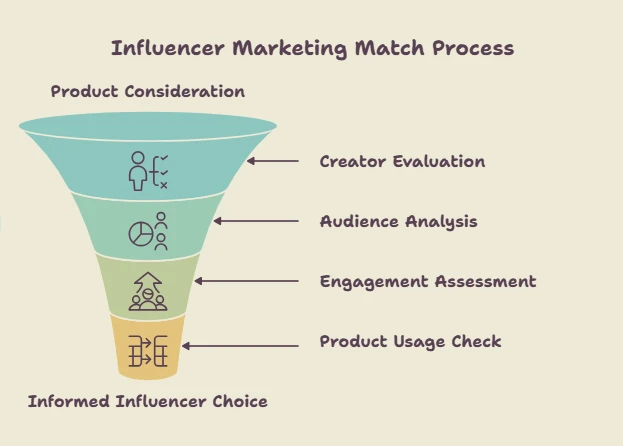
A good match needs a credible product user and an audience with a plausible reason to buy. Before opening a creator database, consider whether someone can demonstrate the product clearly and experience its value within your campaign window.
Expensive equipment raises the cost of a poor match. Perishable goods need reliable delivery, while some products require several weeks of use. Products with sensitive claims also need clear boundaries around what a creator can responsibly say.
Then review audience demographics, location, category interest, and previous social media content. When we vet nano influencers for audience fit, we recommend reading comments alongside the engagement rate. Specific questions can reveal interest that a percentage alone misses.
Audience age can also affect how people respond to creator recommendations. In Pew Research Center’s 2022 U.S. survey, 41% of social media users under 30 said they had bought something after seeing an influencer’s post, compared with 22% of those aged 50 and older. That gives us another reason to check who follows a creator before sending products.
Imagine two juicing creators. One produces clear recipe demonstrations, while the other regularly answers followers’ questions about which juicer to buy. We might shortlist the first for a licensed creative test and the second for audience distribution. Those are hypotheses to test, and each creator should be assessed against the intended outcome.
3. Get Opt-In and Set Expectations Before Shipping
Your first message should make the offer easy to understand. We recommend structuring influencer outreach around why this creator fits, why the product could interest them, what you’re offering, and how they can accept.
For example, a creator who regularly shows quick breakfasts has an obvious connection to a compact blender. Mention that connection specifically. Generic praise tells them very little, and unclear offers help explain why creators stop responding to gifting campaigns.
Once they’re interested, confirm exactly what they want to receive and get their shipping details. If the product comes in different sizes, shades, flavors, or versions, sort that out before anything leaves the warehouse.
Keep the gift itself separate from any content agreement. If you expect a post, video, deadline, or other deliverable, agree on it explicitly rather than introducing it after the product arrives.
If they stop replying, follow up with something useful instead of another generic reminder. They may still need help choosing a size, checking compatibility, or deciding whether the product is right for them.
4. Coordinate Delivery Around Real Product Use
Once someone accepts, give the shipment a clear owner and a place in your shared tracker. Record creator status, product variant, shipment details, confirmed delivery, usage questions, and the next follow-up. A seeding platform can organize these fields, although a small team may manage them in a spreadsheet.
Delivery confirmation should trigger appropriate support. Clothing needs the correct size, while skincare or a consumable may need a longer trial. So, agree internally on who handles damaged packages, missing items, and replacements.
The PR package should also make the product easier to understand or use. After all, a practical insert can do more than decorative extras.
Our Nordstrom/Wildfang collection campaign used a one-week posting window where we coordinated 100+ diverse creators. The collection-release campaign produced 500+ unique photo and video assets and generated more than 10 million views across TikTok and Instagram.
Your timeline should reflect the actual agreement and the time someone needs to use the product properly.

5. Make Useful Content Easier to Create and License
Creators can understand the assignment and still lack a useful detail about the product. We recommend a concise information sheet that connects the customer problem with accurate facts, practical demonstrations, and claims to avoid. That gives authentic content something specific to communicate. For a blender, that might mean capacity, cleaning instructions, and a few realistic ways to show the product in use.
Before you repurpose creator content across marketing channels, confirm where you can use it, for how long, whether you can edit it, and whether paid use is included.
Keep those permissions attached to the asset itself. Record the creator, approved uses, expiry date, and restrictions so your content and media teams can see what is cleared without digging through old messages.
6. Test Promising Content Before Increasing Paid Spend
Organic engagement metrics can identify content worth investigating, but paid testing asks whether it works with a particular audience, offer, and acquisition goal. A popular post gives you a candidate to test.
Start with a clear hypothesis. You might expect a demonstration to address purchase concerns more effectively than a testimonial that provides social proof. To compare them, keep the offer, landing page, and audience conditions as consistent as practical.
You can test creator content through dark posts to control paid distribution without requiring another public feed post. Allow enough time for the buying cycle and assess purchase-related evidence. A handful of inexpensive clicks gives little confidence about acquisition costs, especially when few visitors have had time to decide.
Our Hurom case study shows the value of creative iteration within a broader full-funnel engagement. That work included changes to messaging, hooks, and calls to action, and it reported 300% ROAS growth. The result supports the value of connected creative and media work; it cannot be attributed to seeding alone.
7. Measure the ROI of a Product Seeding Campaign
Measure financial ROI by comparing the contribution generated by the program with its total cost. First, define the cohort, campaign period, observation window, and whether the calculation includes later paid amplification.
Then choose an influencer attribution model and apply it consistently. Trackable links connect visits to creators, while discount codes help identify some purchases. Neither captures every influence, and both can credit purchases that would have happened anyway.
Keep operational results separate from financial returns. Use the same observation window and partnership model for each comparison.
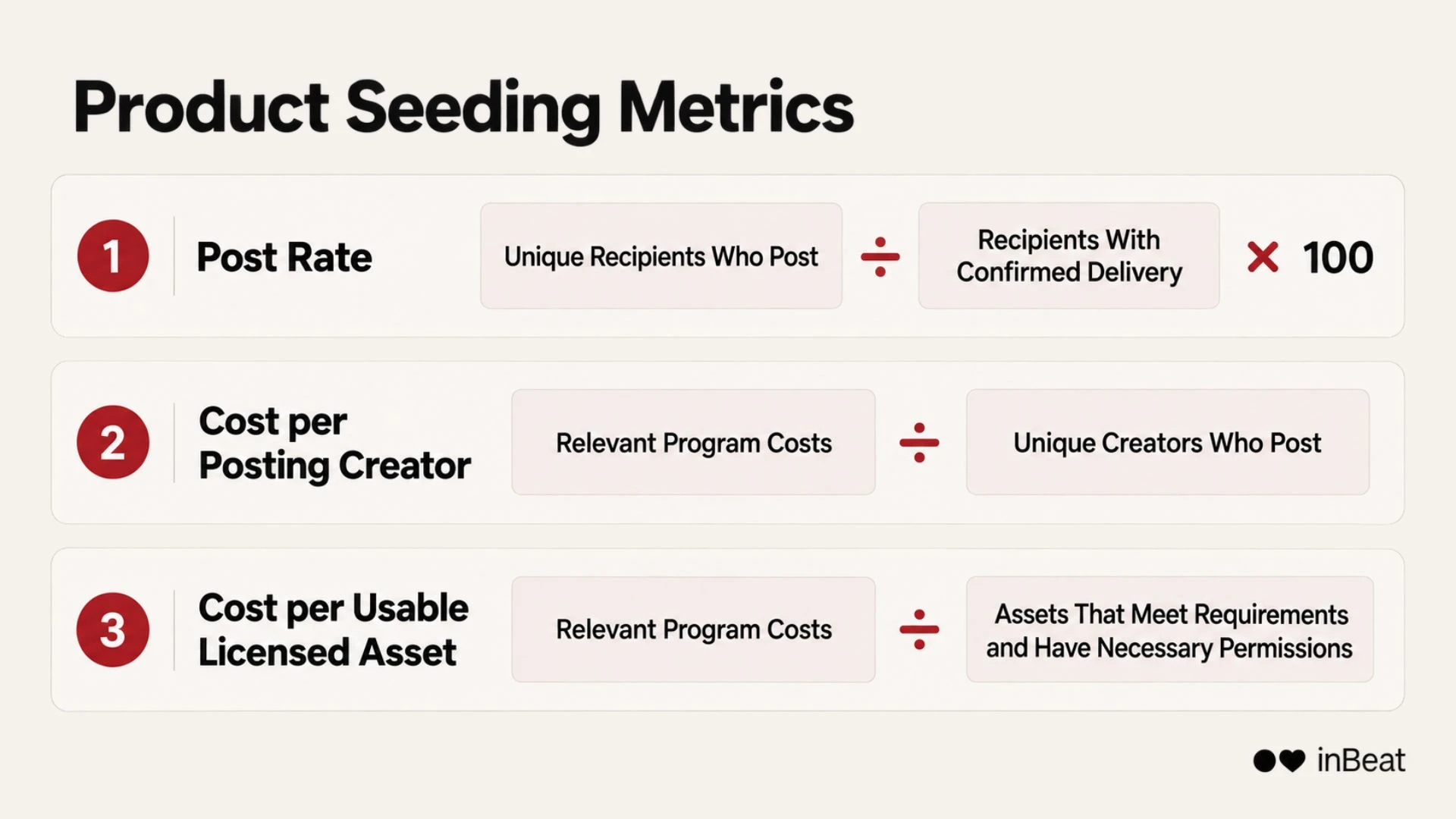
Count gifted inventory at cost, packaging, fulfillment, shipping, replacements, labor, allocated tools or agency fees, licensing, and commissions. Add media spend when evaluating the combined paid program. Also, specify which costs feed each calculation, so another team can reproduce it.
For the financial result, use this formula:
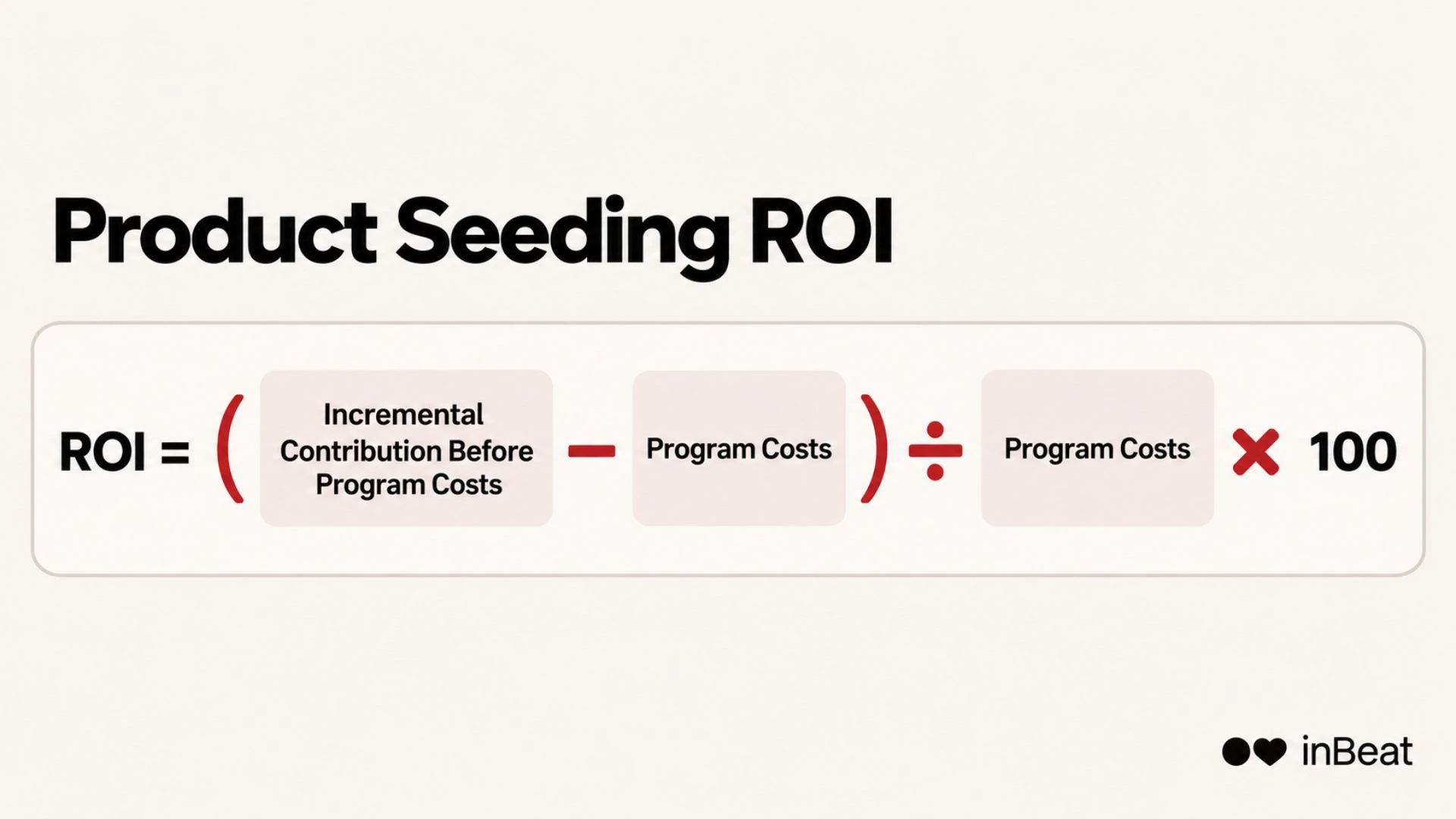
Contribution accounts for the variable costs of the orders generated, before the program costs listed above. Keep those costs separate to avoid double-counting them.
Let's consider a hypothetical program with $3,000 in costs and $10,000 in attributed revenue. A 40% contribution margin leaves $4,000 before program costs. Subtracting $3,000 leaves $1,000, which produces an attributed return of approximately 33%.
That calculation does not establish incremental ROI. Incrementality requires evidence of what customers would have done without the activity, potentially through a suitable holdout or comparison group. Without that evidence, label the result as attributed performance.
Advertising research shows how large that measurement gap can become. Across 663 Facebook experiments, researchers reported a median lower-funnel lift of 5% in randomized tests, compared with 24% under one non-experimental method. The study examined paid advertising, so we use it here to explain the measurement risk rather than predict seeding returns.
Finally, keep estimated media value and an asset’s hypothetical replacement cost out of sales revenue. They describe different kinds of value. Combining them can make a weak commercial result look much stronger than the evidence supports. Useful creative can justify a separate production decision, but its value needs its own evidence.
8. Use Cohort Results to Stop, Refine, or Scale
Each completed cohort should lead to a budget or relationship decision. We recommend defining the criteria before the next batch leaves, while the team can still agree on acceptable costs and evidence without defending a result.
Here are the available decisions:
- Stop or pause. Costs repeatedly exceed your acceptable range, the intended outcome stays out of reach, or measurement gaps prevent a defensible expansion.
- Refine. A specific weakness gives you something to test through the product, creator segment, offer, or creative approach.
- Scale. Results remain useful across repeated batches, permissions support the intended use, and the team can handle more volume.
These decisions can differ by creator. Someone may produce convincing demonstrations for UGC campaigns while generating few sales through their own audience. That person could deserve a paid production test, even if further distribution spending makes little sense.
Better allocation can matter before you increase the budget. A 2022 study of sponsored Weibo campaigns estimated that reallocating spending based on creator, audience, and content characteristics could improve engagement by 16.6%.
We also recommend evaluating influencer relationships across multiple assignments before a longer commitment. A spike from a few influencer posts gives less confidence than repeatable delivery and useful results.
From there, you can build a paid-first brand ambassador program around proven production needs. Agree on workload, compensation, and review dates as the relationship develops. Expansion should preserve what worked in the pilot, with enough capacity to maintain it.
Where Product Seeding Programs Lose Conversions
When a program disappoints, the overall result rarely identifies the source of the problem. We believe you should find where progress slows first, because an acceptance problem calls for a different response from a checkout problem.
From our experience, here are the signals you should investigate:
| Symptom | Evidence to Inspect | First Change to Test |
|---|---|---|
| Few creators accept | Responses by creator segment and offer | Narrow the audience or improve product relevance |
| Products arrive, but participation is weak | Delivery issues, usage questions, and elapsed trial time | Resolve friction or adjust the trial window |
| Content appears but has little commercial use | Missing demonstrations, weak buying intent, or restricted permissions | Test a clearer angle or a separately agreed production brief |
| Traffic is there, but purchases remain weak | Mobile page behavior, stock, shipping charges, and checkout drop-off | Fix the purchase journey before expanding shipments |
Before changing the offer, check whether your records are complete. Social listening can surface mentions your team missed, while timely content capture can prevent temporary posts from disappearing before review. An incomplete record can look like a participation failure.
Healthy engagement can still lead to weak purchases when extra charges appear at checkout. In Baymard’s 2026 cart-abandonment breakdown, 40% of respondents cited excessive shipping, taxes, or fees. So, check what customers actually pay before treating weak sales as a creator-selection problem.
Then change one meaningful variable at a time and document it. If you replace the product, audience, and outreach together, the next cohort may perform differently without revealing which change helped.
Build a Measurable Product Seeding Program With inBeat
You may already understand the process, yet lack the capacity to coordinate products, creators, content, and reporting consistently. Once several teams become involved, even straightforward campaign management can leave important work without a clear owner.
At inBeat, our managed product seeding programs cover creator selection, product matching, shipment coordination, delivery tracking, and follow-up. We match your needs with relevant talent across our creator network. Where the objective calls for more support, we can connect creative production, usage rights management, and paid testing to the program.
Our team can start with your product, audience, current results, and operating constraints. That conversation helps establish which activities belong in the engagement and how to judge them.
Book a strategy call to discuss a scope that fits the work your team needs done.
Make the Next Seeding Batch More Accountable
A useful program gives your team enough evidence to decide what deserves another investment. Before the next shipment, put the primary outcome, full cost, measurement window, and conditions for continuing in one shared document.
Then use those commitments when results arrive. You’ll have a clearer basis for choosing the next batch and a better explanation of why it should happen.
Frequently Asked Questions
Is PR seeding the same as influencer seeding?
The terms overlap, but PR seeding can include journalists, editors, and other relevant recipients, while influencer seeding focuses on creators and their audiences. Brands use these labels inconsistently, so we recommend checking who receives the products and what the program expects.
How many influencers should you seed products to?
Your starting number depends on inventory, cost per recipient, team capacity, and the comparisons you want to make. For your influencer campaigns, we believe you should focus on a manageable pilot with enough creator variety to reveal useful patterns. A fixed number alone cannot guarantee reliable findings.
Do influencers have to disclose gifted products?
Yes. Under US FTC guidance, creators who endorse gifted products should clearly disclose that material connection for the paid partnership. The FTC disclosure must be noticeable and understandable. Naming the gifting brand helps clarify the relationship. Writing “gifted” alone can leave readers unsure about who provided the product.
Disclosure still gets missed. In its review of UK influencer content from 2024, the Advertising Standards Authority reported that 34% of the ads analyzed had no disclosure at all. For brands, that is a reason to check resulting posts rather than assume creators have handled it.
How much does a product seeding program cost?
There is no standard cost per campaign. Start with your landed seeding cost per creator: product cost, packaging, pick and pack, shipping, expected replacements, and the labor or software needed to manage the shipment. Add licensing, commissions, or media spend only when those are part of the program.
Multiply that figure by your planned cohort size before you ship. We recommend valuing gifted inventory at its cost to the business rather than its retail price, then measuring the result against post rate, usable asset cost, and contribution generated.