


Influencer Marketing
.svg)
Research & Panels
.svg)
Performance Branding
.svg)
Growth Marketing
.svg)

Consumer packaged goods

Healthcare and wellness
.svg)
Work across all verticals
We bring expertise across industries with tailored strategies for your vertical.
Certified partners




1440px
1440px
1280px
1080px
Ad testing services for data-informed creative decisions
We run structured ad testing programs across concepts, hooks, formats, and copy to identify which creative variables drive stronger performance.
.avif)
Working with brands we love















What our managed ad testing program covers

Concept testing
Most brands test execution before they test the idea itself. Our team runs ad concept testing across 3–8 territories per cycle to identify which angles, narratives, and value props deserve spend.

Hook testing
A concept can work and still lose at the opening. To isolate the issue, we test 10–30 hook variants per concept to find the highest-CTR entry point for each angle.

Format & edit testing
The same idea can win or lose based on how it gets packaged. Our team tests runtime, crop, pacing, production style, and edit structure to see which version earns the strongest response.

Copy testing
Copy can change the outcome as much as the visual. We run ad copy testing across primary text, headlines, and CTAs while keeping the creative constant.
.svg)
Pre-launch concept validation
Some creative is too expensive to validate late. Our team uses ad pre-testing for high-budget concepts before major production or media spend.

Statistical readouts
Reporting without a decision is just noise. We document significance-tested results, named winners, and the creative patterns behind each result.

Iteration & variant production
A testing program needs volume to produce reliable reads. That’s why our team creates 30–80 new ad units per month based on what won, what failed, and what needs another pass.

In-account implementation
Testing outside the account rarely shows how buyers behave. So we launch tests in your actual ad accounts at real spend, then measure the response the platform gives back.
How we manage the ad creative testing process
Step 01
Hypothesis & roadmap
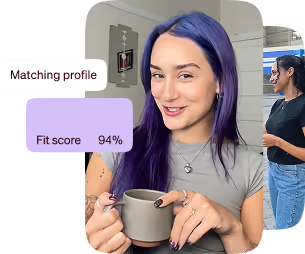
We audit your current creative library, isolate the patterns behind active winners and losers, and build a 90-day testing roadmap tied to ROAS, CPA, or CAC.
Step 02
Brief, produce, launch
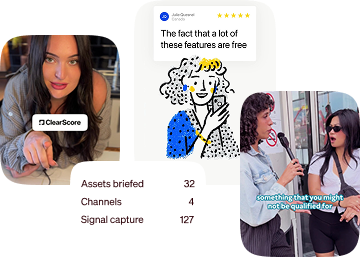
Once the roadmap is set, our team briefs and produces variants across the highest-priority testing areas. Then we launch them with a controlled structure that keeps each test readable.
Step 03
Measure, document, iterate
After each test reaches a decision point, we document the winner, record the learning, and brief the next round of variants. The system gets sharper every cycle.
Why brands choose our team over testing tools and in-house programs

The inBeat model
- Our team manages strategy, production, launch, measurement, and iteration.
- Every test follows a clear hypothesis → launch → measurement → iteration structure.
- We create the variant volume needed to keep the program moving.
- Each cycle feeds a documented creative library with winners, losses, and next actions.
- Our recommendations come from observed performance patterns across the account.

The traditional agency problem
- Most testing tools surface data but leave strategy and execution to the internal team.
- In-house programs usually test too few variants to produce reliable learnings.
- Creative production slows down before the testing cadence can mature.
- Multiple variables change at once, which makes results difficult to trust.
- Most teams document winners but fail to preserve the reasoning behind them.
Platforms we work with
.svg)
Meta (Facebook + Instagram)
Facebook and Instagram tests compare hooks, thumbnails, captions, and ad-set structure across Reels, Stories, Feed, and Advantage+ placements.

TikTok
Spark Ad testing, creator-content variation testing, and first-three-second hook analysis built around short attention windows.

YouTube
Creative testing across :15, :30, and :60 formats with hook-frame analysis and long-form retention comparisons.

Google Ads
RSA copy testing, Performance Max asset testing, and Demand Gen creative evaluation across search and visual inventory.
.svg)
Snapchat
Creative variation testing designed for high-frequency mobile consumption and fast content turnover.

Out-of-home & connected TV
Pre-launch concept validation for OOH and CTV campaigns, where in-market testing carries higher production and media costs.
Services that pair with ad creative testing
Creative strategy
Creative strategy builds the concepts, hooks, and message angles that enter the testing roadmap.
.png)
Paid media agency
Paid media creates the account structure needed to test cleanly and scale confirmed winners.

Creative ad copy
Ad copywriting supplies the headline, primary text, CTA, and hook variants for each testing cycle.
Related insights


Frequently Asked Questions
How many variants should we be testing per month, and what's a "real" testing program look like?
How do you work with our in-house creative team; do you replace them or work alongside?
Do you test in our actual ad accounts, or in surveys and panels?
