.svg)
.svg)
.svg)
.svg)


.svg)




%20(1).png)

On Meta, creative fatigue sets in when the same Facebook ads reach the same people too many times, and performance slides. It could also result from subpar creatives in the first place. So, what can you do to handle Facebook creative fatigue, or better yet, avoid it in the first place?
Simply put: a lot. There are clear tell-tale signs that should be enough to get contingencies in motion, that is, a creative refresh. You could also set automated alerts via Rules in the Ads Manager.
With simple, field-tested guardrails, you can catch creative fatigue before it takes a toll on results. That’s what we’ll cover in this article in detail, so you can avoid this rather common issue advertisers face and then struggle to fix performance quickly.
Want the best outcomes with your Facebook campaigns? Partner with the Top Facebook Ads Agencies.
TL;DR
- What is it? Creative fatigue on Facebook occurs when the same ads reach the same audiences too frequently, using the same creatives.
- How to detect? Diagnose it with data: rising frequency (3.0+), CTR going down 15% week over week, CPA increasing, and slipping Ad Relevance Diagnostics (Engagement/Quality rankings).
- Refresh timing: Rotate before wear-out. If Frequency approaches 3.0 while CTR declines, queue a new variant.
- How to avoid it: Monitor constantly and automate alerts; keep winners live but introduce small, continuous changes (new hook, layout, background/thumbnail). Use Meta’s Advantage+ Creative and Dynamic Creative to tap into creative automation.
- Scale safely: Broaden targeting to reduce repeat impressions, use target frequency when appropriate, and let DPAs or catalogs add novelty for returning shoppers.
- Creative pipeline: Plan a standing rotation (3 to 5 concepts), add at least one fresh asset every 1-2 weeks, and prioritize UGC/product demos that fight banner blindness.
What Is Facebook Creative Fatigue?
Facebook creative fatigue refers to the same ad hitting the same audiences with too much repetition. People tune it out in the feed, and your unit economics erode as costs rise and conversions fall.
Why call it ‘creative’ fatigue rather than just ‘ad' fatigue?
Because what wears out first is attention to the message and hook, not necessarily the targeting or bid.
Meta’s own guidance frames it as “when an audience has seen the same creative too many times,” which hurts response and delivery quality. In Ads Manager, this typically shows up as rising Frequency (the average number of times each account saw your ad) and softening CTR/CPA.
You can identify creative fatigue by monitoring ad frequency. If it’s over 2.5 for cold audiences and 5.0 for retargeting, it's too high and points to potential creative fatigue.
Pro tip: Facebook actually indicates when an ad has reached the so-called fatigued status, but we’ll tell you more about that in a second.
Why Does Facebook Creative Refresh Matter
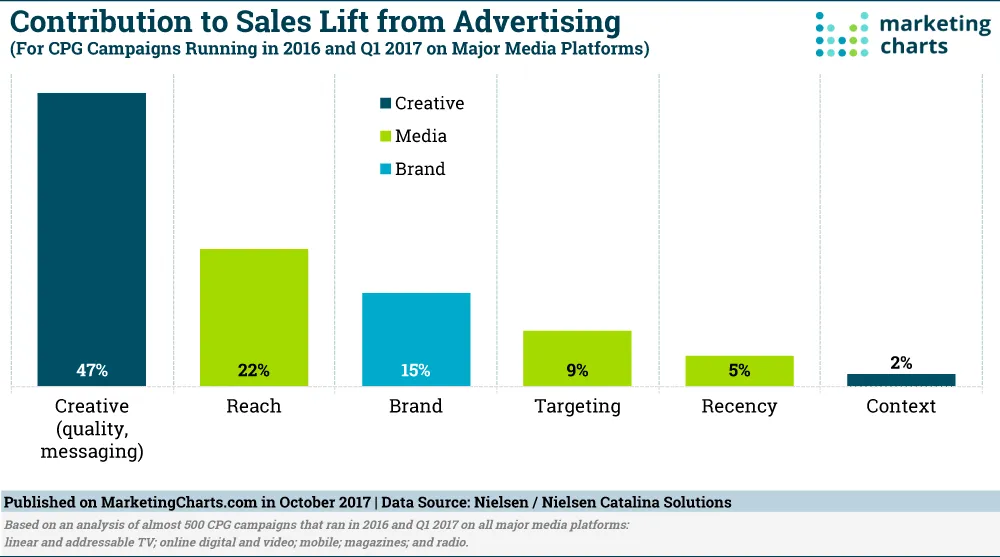
Evidence says the creative does the heavy lifting in ads. Nielsen analyses attribute 56% of sales lift to creative quality across digital channels. That’s exactly why stale assets dent outcomes so quickly.
But there’s another factor at play as well, and it’s a psychological one: banner blindness.
Users learn to ignore ad-like elements, especially when they repeat.
Eye-tracking research from Nielsen Norman Group has documented this pattern for years, and it translates directly to social placements when your look/feel isn’t refreshed. While this research and banner blindness have more to do with website ads, it’s the underlying phenomenon of ‘selective attention’ that also connects to social media marketing.
Once the audience has seen the same ad repeatedly, they learn to ignore it, whether it appears in their feed, stories, or Messenger.
The solution, of course, is a rightly timed creative refresh. Otherwise, creative fatigue quietly taxes your auction outcomes.
On Meta, delivery favors ads that win attention. When the same message repeats, frequency climbs, people disengage, and weaker metrics push you into pricier auctions.
You also pay for fatigue through relevance.
Meta’s Ad Relevance Diagnostics (Quality, Engagement Rate, Conversion Rate rankings) influence delivery. When rankings slip, you lose impressions to fresher ads and your budget buys less reach.
There’s a measurable tipping point.
After a Facebook ad is seen four times per person, CTR drops and CPC rises. Those are classic fatigue dynamics you’ll see inside real campaigns. You can expect cost-per-result to inflate unless you intervene with a creative rotation.

From a performance creative perspective, fatigue is a signal that your current message, visual treatment, or hook has stopped earning attention efficiently enough to support your target CPA or ROAS.
Remember: Don’t treat creative refreshes as cosmetic updates. They are performance interventions designed to restore efficiency before the algorithm starts charging you more for weaker results.
Signs of Creative Ad Fatigue on Facebook
In performance creative terms, fatigue shows up when the same creative concept stops producing efficient outcomes for the same audience. The goal is to spot the pattern early enough to refresh the asset before rising costs become a trend.
You’ll see it first in the metrics representing Meta campaigns and audiences. Below are the exact signals to watch, along with practical checks in Ads Manager.
.webp)
Declining CTR
A persistent CTR slide (for the same audience and objective) is your earliest tell.
As a reference point, recent industry data pegs average Facebook CTR around 0.89% across industries, with some noticeable variations for verticals.
Let’s say you were holding 1.2% and drift to 0.8% at the same spend and reach. You could suspect fatigue before you blame bidding.
This can be fairly easy to detect with an automated rule like, “If CTR down 20% week over week AND Frequency > 3, send alert.”
Remember: Sub-1% CTR is common but still below many top performers. Use it as a directional check, not a target.
CPM Increases Every Week
Rising CPMs don’t prove fatigue (seasonality and auction pressure matter). However, week-over-week inflation combined with falling CTR is a strong signal your ad is losing the auction.
If your ad’s CPM climbs 30-40% over two weeks while response drops, you may want to try a creative refresh.
For that, we advise you to build a simple time series in Looker Studio/Data Studio by ad ID for CPM so you can spot slope changes quickly.
Frequency Score Between 2.5 and 3.0 (Or Worse >3.0)
Meta defines ‘Frequency’ as the average number of times each account saw your ad. As we mentioned earlier, when frequency increases, a relevant metric like CTR can be negatively affected.
Here’s what we encourage you to do:
In Ads Manager, add Frequency to your columns and sort by highest at the ad level.
From our experience, marketers set soft guards around 2.5-3.0 for prospecting and rotate if the creative can’t hold CTR there. And you definitely don’t want to go beyond 3.0.
Lower Conversions
When fatigue sets in, post-click behavior can also be impacted (add-to-cart, leads, purchases trend down even as impressions hold).
So, tie this to your ad-set objective, for example, if you’re optimizing for Purchases, monitor Cost per Purchase and Conversion Rate alongside Frequency.
If purchases per 1,000 impressions dip while Frequency rises from 2.1 to 3.4, that’s textbook wear-out.
As a side note, our team uses Meta’s “Results” and “Cost per Result” with a 7-day click window to reduce noise.
CPA Goes Above Target
As CTR weakens and CPM rises, CPA inflates. That’s why we track a rolling four-week median CPA per ad and flag a breach of our target by 15–25% combined with a Frequency lift.
Much like other metrics, there can be a number of reasons behind the CPA going above target. If you’re specifically eyeing creative fatigue, you want to watch out for this pattern:
CPA ↑ with CTR ↓ and Frequency ↑
There’s no single range or number that spells the truth for CPA, as it varies by campaign. So, that’s why we use this pattern as the giveaway.
Look at Ad Relevance Diagnostics
Meta no longer shows the single ‘relevance score.’ That has been replaced by Ad Relevance Diagnostics, which is a mix of Quality, Engagement Rate, and Conversion Rate rankings (Below Average/Average/Above Average).
Fatigue can be indicated by drops in Engagement Rate and Quality rankings compared to competing ads for the same audience.
If either ranking hits ‘Below Average (Bottom 20%)’ while Frequency grows, your ad is due for a creative reset. But we also encourage you to watch this tutorial:
Low or Negative Engagement
If metrics aren’t giving you clear signals, you may want to look for shrinking positive signals (reactions, comments, saves) and especially for any negative feedback (hide ad, hide all, report spam, or unlike).
Negative feedback is a known suppression signal and correlates with higher costs.
If comment sentiment turns and hides your ranking, swap in a new hook and reset your comments strategy.
What a Performance Creative Refresh Actually Means
A creative refresh doesn’t mean replacing one tired ad with a completely unrelated new one and hoping for better results. Instead, you’ll refresh the parts of the creative most likely to affect performance while preserving what is still working.
Start by identifying the likely source of fatigue.
If people are no longer stopping, the hook may be worn out. If clicks are holding but conversions are dropping, the message may no longer feel persuasive or credible. If frequency is rising but CTR is stable, the issue may be audience saturation more than the ad itself.
From there, refresh in layers:
- First, test a new opening hook or headline.
- Then, test a new visual structure, creator, or product framing.
- After that, test the offer, CTA, or proof element.
- Only rebuild the entire concept if smaller changes fail to recover performance.
This gives you a more structured performance creative workflow because you isolate which part of the ad stopped working and replace it with intent.
When to Refresh Facebook Ad Creatives?
If your campaigns show two or more signs of creative fatigue, you should make changes to the ad’s creative. Alternatively, you can rely on Dynamic Creative to mix headlines, images, and calls-to-action so winners re-surface quickly without over-splitting ad sets.
Remember: Creative fatigue can set in as soon as frequency reaches 2.5, but in some cases, that can be true at 4.0. Again, frequency is perhaps the most important metric to look at relative to others to confirm that it is, in fact, creative fatigue causing performance drop.
And as we mentioned above, Facebook can tell it’s time to refresh your ad creative.
You’ll see either creative fatigue or creative limited in the delivery column.

Now that’s a strong indication in and of itself, but you should check the performance numbers to confirm.
You could take a more proactive approach and avoid this situation altogether (more on that later).
Simply scheduling a creative refresh can ensure the same audience doesn’t see the same ad too many times.
And that may very well depend on your target user base.
Recommended Timeline Based on Audience Size
If you want to set up a schedule for a Facebook ad creative reset, consider the audience size of your campaign. That’s because the bigger your audience size, the more time it may take for the ad to be shown repeatedly.
Here’s a guide on the timeframe of creative refresh:
| Audience Size | Recommended Refresh Timeline | Frequency Trigger | Performance Notes / Why It Matters | Pro Tips |
|---|---|---|---|---|
| Under 100K (Small) | Every 7 to 10 days | Start planning at 2.0 (don’t wait for 2.5) | Small audiences saturate fast because the same people see your ads repeatedly. Waiting too long leads to sharp performance drops. | Small audiences = highest-intent users. Frequent refresh = better LTV + stronger conversion rates. |
| 100K–500K (Medium) | Every 10 to 14 days | Refresh when approaching 2.5 | Medium audiences distribute frequency better, but saturation still sets in predictably. You typically get a 3–5 day buffer before performance declines. | Monitor weekly; use early frequency shifts to get ahead of fatigue rather than reacting to it. |
| 500K+ (Large) | Every 14 to 21 days | Depends on budget; frequency may build slowly, but still needs checking | Large audiences offer the most flexibility, but high-budget campaigns can still cause fast saturation. | Don’t get complacent—maintain a monitoring schedule instead of waiting until performance drops. |
How to Avoid Facebook Ad Creative Fatigue
A whopping 83% of marketers worldwide use Facebook, more than any other social media platform. That goes to show the platform’s popularity and viability. But to get the most out of your campaigns, it’s important to set yourself up for success by proactively handling issues like creative fatigue that bog down performance.
Here’s what we do for our clients’ Facebook Ads to mitigate creative fatigue (and ad fatigue, in general):
Monitor Performance Constantly
Build a simple, always-on guardrail. That’s your first defense against fatigue creep.
In Ads Manager, add columns for frequency, CTR, Cost per Result, and the three Ad Relevance Diagnostics.
Set an automated rule like “If frequency > 3 and CTR drops 15% over 7 days, alert and cut spend 30% at the ad level.”
Again, Meta’s own documentation surfaces “creative fatigue” status and recommends adding new creatives or expanding audiences when performance weakens. So watch out for that by also adding the delivery column.
It’s always best to rely on those platform signals instead of estimates, or even worse, hunches.
Refresh What Works Strategically
Don’t swap everything. Keep winners live and refresh the first hook, layout, and background color.
This can also be a good time to A/B test different creatives and compare the performance over time of their individual impact. If something works better than others, you may want to retain that and rotate other elements as and when fatigue indicators become green.
And you don’t have to change elements dramatically. Here are some variation strategies that aren’t a complete overhaul but introduce enough novelty:
- Change the opening hook slightly
- Swap headlines
- Try a different CTA button
- Change the image focus or crop it
- Change background color (ideally from within your brand palette)
- Modify design elements
- Rotate user-generated content (UGC) (if using it as ad creative)
Build a Performance Creative Rotation System
The most reliable way to avoid fatigue is to build a creative system that assumes wear-out will happen and plans for it. In fact, Meta’s best practices for delivery explicitly call out adding new creatives (or dynamic experiences) to avoid fatigue.
A practical performance creative rotation looks like this:
Step 1: Launch with multiple concepts. Start campaigns with at least three distinct creative concepts. That could mean a testimonial angle, a product demo angle, and a problem-solution angle.
Step 2: Track creative-level signals weekly. Review frequency, CTR, CPM, CPA, and Ad Relevance Diagnostics at the ad level. This helps you see which concept is tiring out and which one is still carrying performance.
Step 3: Refresh the leading variable first. If the ad is losing attention, change the hook. If it’s losing trust, change the creator or proof element. If it’s blending into the feed, change the visual treatment. Don’t over-refresh everything at once unless performance has collapsed.
Step 4: Keep one new asset entering the system regularly. Instead of waiting for a full creative reset, add at least one fresh asset or variation every one to two weeks. This helps you maintain novelty and gives Meta new options before your current winners burn out.
Step 5: Separate testing from scaling. Use some creatives to test new angles and others to scale proven ones. When teams use every ad for both jobs at once, they usually end up replacing winners too aggressively or scaling weak ideas for too long.
Step 6: Feed learnings into the next brief. Every refresh should improve the next round of concepts. Track which hooks, formats, creators, offers, and proof points kept performance stable the longest. That is how creative rotation becomes a performance system.
Remember: A good rotation system like this helps you scale more predictably because your next creative is already being prepared before your current one wears out.
Leverage User Generated Content as Ad Creatives
UGC patterns break ‘ad-like' repetition and can easily lift engagement. This type of content already has an impressive influence, so it should work well to address any creative fatigue, especially for long-running campaigns.
After all, customers trust UGC content 50% more, and 20% find it more influential.
It’s a strong choice to diversify your creative slate with creator talking-head intros, demos, and reviews.
At inBeat, we’ve seen impactful performance with UGC content, particularly videos on platforms like Facebook, TikTok, and Google. Their relatability piques the interest of the targeted audience and results in better conversions at lower costs. And with multiple UGC assets, it gets even easier to rotate the videos or images in the ads.
Increase Audience Size
If scale is the goal, widen your audience so the same ad doesn’t hammer the same people. Meta also advises this as a core tactic when fatigue appears for Facebook or Instagram advertisements.
In practice, broaden with Advantage+ Audience or stack interests, and sanity-check audience overlap so you’re not recycling the same users across ad sets.
Once you do that, keep an eye on metrics like frequency, CTR, and CPM, and see if they return to earlier levels below the creative fatigue thresholds.
Set a Frequency Cap
When you need tighter exposure control (for example, awareness pushes), use target-frequency or frequency-cap buying to limit the average times an ad is seen.
Meta supports target frequency in auction for specific objectives and setups (Maximize reach of ads or Maximize ThruPlay views, lifetime budget, no bid control) and caps in reservation. Both options help you prevent over-exposure while you queue fresh assets.
Try Meta Advantage+ Creative
The automated creative optimization solution to avoid creative fatigue is Advantage+. Turn on Advantage+ Creative to let Meta auto-generate placement-aware variants (stickers, text, and size tweaks) that maintain high novelty without fragmenting ad sets.
For structured testing, enable the Dynamic Creative feature so the system mixes and matches components and learns the best combination per impression. That speeds iteration and slows fatigue.
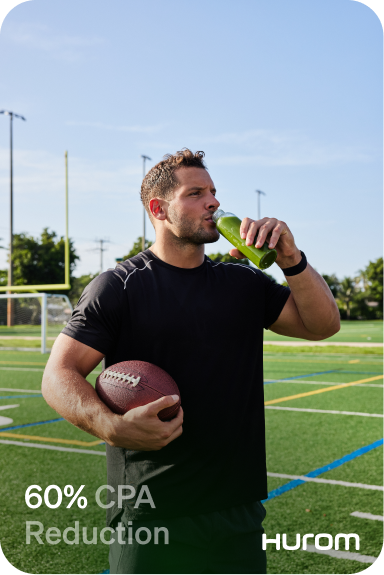
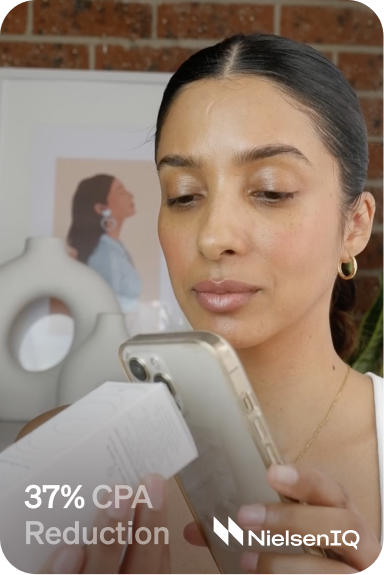
Here’s how we use it for one of our clients, Hurom:
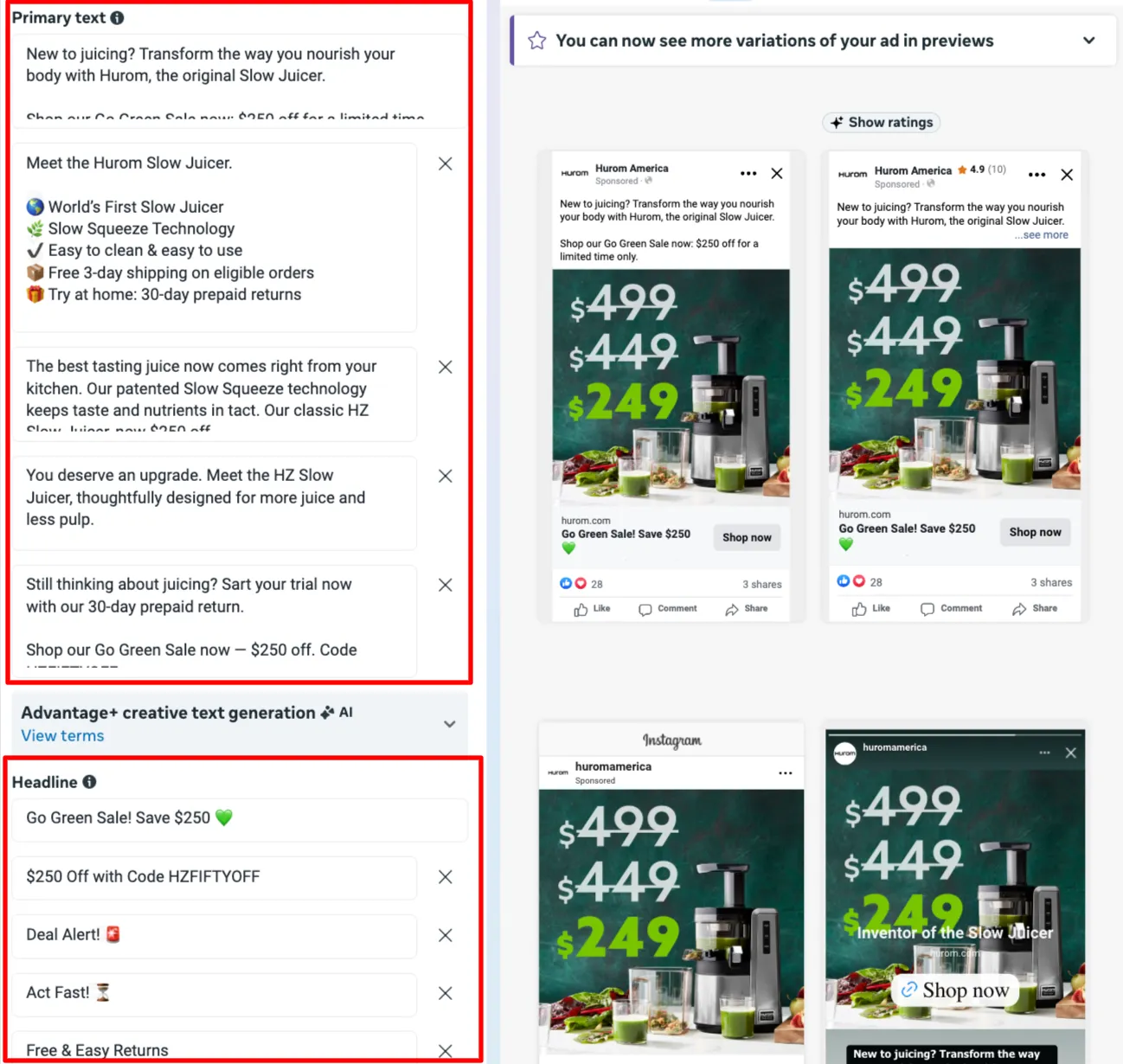
Some creative enhancements offered by Advantage+ even have generative AI enabled (those are labeled AI).
Meta Advantage+, the suite of AI tools for ads, including Advantage+ Creative, can improve CPA by 9% (for sales campaigns).
Should You Refresh Creative If Performance Remains Strong?
What if it’s been a while since your ad has been running on Facebook with the same creatives, but the performance is still strong?
You still might see Facebook indicate creative fatigue in the delivery column, which is technically supposed to mean there’s a need for a creative refresh.
However, it’s best to look at the actual performance numbers to make the call.
If performance hasn’t changed, that is, your CTR is still the same or close to it, and the cost isn’t increasing, you could technically keep the same creatives.
Of course, you should also consider the label from Facebook as a warning sign.
Here’s what one professional said in a Reddit thread on this matter:
“Keep it running until performance drops, but monitor it carefully. We have automated alerts set up for declining CTRs, that's usually an early warning signal that creative fatigue will kick in soon. You can set up the same for ROAS of course, definitely helps.”
In performance creative terms, a fatigue label is a warning, not an automatic stop signal. If efficiency is still holding, you do not need to kill the ad immediately. But you should treat that moment as your cue to prepare the next variation, so you are ready to rotate before the decline shows up in CPA or ROAS.
Keep Facebook Ads Impactful with inBeat Agency
Don’t take creative fatigue as a failure.
It’s, in fact, a predictable phenomenon of consumer attention. The smartest advertising professionals or marketing teams treat it like a lifecycle metric. They anticipate, test, refresh, repeat.
At least that’s what we do here at inBeat.
Audience saturation is a pain in paid social media, but it can be addressed through creative rotation and optimization. And as we explored, there are multiple ways to do that (including having Meta’s AI do it for you).
Of course, it takes an expert to detect incredibly nuanced things like creative fatigue and to mitigate it to keep performance steady.
That’s why working with Meta Ads experts like inBeat Agency pays off.
As an agency that manages $20 million in ad spend every month, we know what works, how long it works for, and when it needs some creative magic. And as a creator-centric agency, we’re best at incorporating UGC content at the creative level for paid social ads, which is the answer to ad fatigue.
We also treat Facebook creative fatigue as a performance creative problem, not just a media buying issue. That means building refresh systems around hooks, formats, UGC variants, and testing cycles that keep efficiency stable as campaigns scale.
Interested in working with us? Get in touch!
FAQ
What is the difference between ad fatigue and creative fatigue?
Ad fatigue is a broad term that describes when people see your Facebook Ad too many times and stop responding, or performance drops as frequency rises. Creative fatigue, however, zeroes in on the content itself, for example, the image, copy, or hook that’s lost its stopping power.
How long before ad creative fatigue sets in?
It depends on spend velocity, audience size, and platforms, but data points converge around 1 to 3 weeks for high-volume campaigns. Meta’s internal guidance says fatigue may kick in around 4+ exposures per user. For most advertisers, that’s roughly a couple of weeks at normal pacing. If your CTR dips below 15% week over week or frequency exceeds 3.0, start planning your next iteration.
How do you know if you have creative fatigue?
Look for a pattern of CTR decline, CPA inflation, and rising frequency across stable audiences. Meta’s Ad Relevance Diagnostics (Quality, Engagement Rate, Conversion Rate) are your leading indicators. When the Engagement Rate ranking drops to “Below Average,” your ad is likely overexposed. Also, monitor negative feedback (Hide Ad, Hide All) in your Ads Manager.
How often should I replace Facebook ad creatives?
For active prospecting campaigns, plan to refresh every 10 to 14 days or whenever frequency exceeds 3.0, whichever comes first. Meta’s best practices recommend uploading new creatives a few times per month to maintain stable delivery, especially at scale. To avoid burnout from repetition, build a rotation of three to five assets and schedule updates proactively.
If performance remains strong, use Dynamic Creative or Advantage+ Creative to introduce lightweight variations without resetting learning.
What is a performance creative refresh on Facebook?
A performance creative refresh on Facebook means updating the parts of an ad that are most likely causing results to decline, such as the hook, visual format, creator, proof element, or CTA, without changing the entire campaign unnecessarily. The goal is to restore CTR, stabilize CPA, and maintain delivery efficiency before fatigue becomes expensive.