
Your ambassadors post regularly, their followers respond, and the program looks healthy. But strong engagement and brand awareness do not automatically give the paid team enough usable ad creative.
A brand ambassador program built around paid media starts with those advertising needs. The goals, creative volume, and permissions shape who you recruit and what you ask them to produce.
In this guide, you’ll learn how to connect those decisions before you spend on recruitment. We’ll also cover how to test the content and decide which relationships deserve more investment.
What Does “Designed Backwards From Paid” Mean?
Designing backwards from paid means starting with paid-media requirements and building the ambassador program around them. So the ads you need determine the creators you approach.
This reverses the usual order. The IAB projected U.S. creator ad spend at $37 billion for 2025, up 26% year over year, so creator work now needs the same planning discipline as the media budget it supports. Defining paid requirements first ties recruitment, rights, and testing to that spend.
Here are the main differences in the order:
| Decision | Conventional Ambassador Program | Paid-First Ambassador Program |
|---|---|---|
| Starting point | Recruitment and reach | Paid-media outcome |
| Creator selection | Following and engagement | Product fit and creative performance |
| Brief | One finished social media post | Testable hooks, angles, and variations |
| Rights | Considered after production | Agreed before production |
| Measurement | Posts, reach, and engagement | CPA, CAC, ROAS, and creative hit rate |
| Retention | Most active creators | Creators who produce repeatable results |
Why Traditional Ambassador Programs Struggle in Paid Social
Traditional ambassador programs struggle in paid social when creator work begins before the paid team defines what each ad needs. The mismatch wastes content, slows testing, and raises costs.
These are the usual failure points:
- Organic briefs supply few usable ad variations.
- Contracts exclude paid usage, editing, whitelisting, or renewal rights.
- Inconsistent formats and missing raw footage restrict testing.
- Slow approvals and handoffs delay launches.
- One-off posts leave gaps in the testing schedule.
- Reach and engagement can hide weak acquisition results.
- Successful ads wear out before replacements arrive.
Creative fatigue is not an occasional problem you fix when performance drops. It is part of running paid social. Even your best ad has a shelf life, which means the next round of creative has to be in motion while the current winner is still working.
We saw exactly that with Hurom. The brand was dealing with rising CPA, tired creative, and messaging that leaned too heavily on sales. We shifted the creative system toward stronger UGC hooks, CTAs, and social proof, resulting in 300% ROAS growth, a 65% CPA reduction, and 33% month-over-month profit-margin growth.
That is why we prefer to connect ambassador production with paid testing from day one. You are not trying to squeeze more ads out of finished organic content later. You are building the briefs, rights, formats, and production rhythm so the paid team has something useful to test every week.
How to Design a Brand Ambassador Program Backwards From Paid
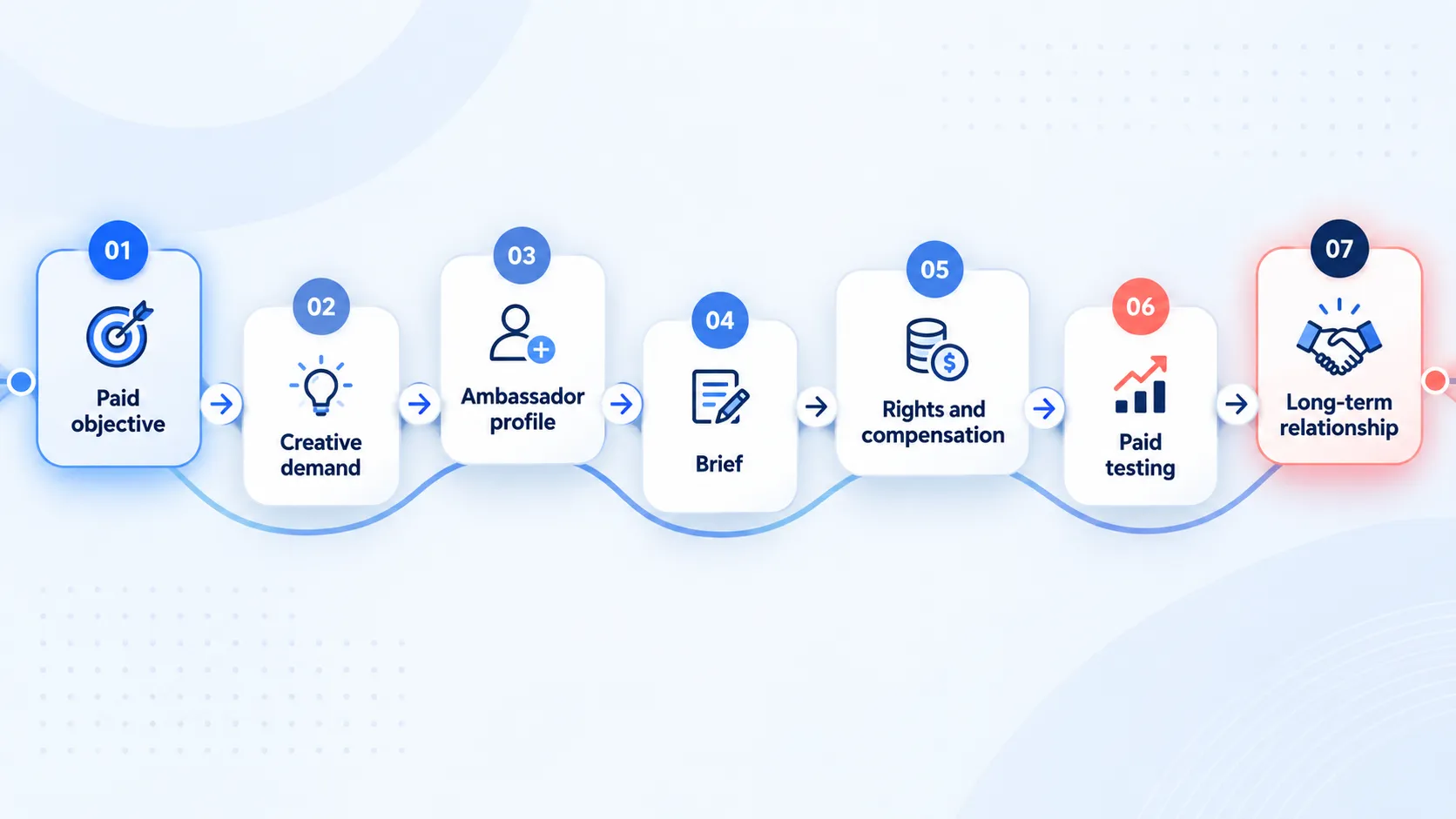
You design the program by turning a paid-media goal into clear requirements for creators, content, agreements, and tests. Each decision should make the next one easier.
Here are the seven stages to work through.
1. Start With One Paid-Media Outcome
Before you approach anyone, define the problem this first program needs to address. It can be anything from lower cost per acquisition (CPA), lower customer acquisition cost (CAC), a better conversion rate, faster creative testing, to a lower cost per usable asset.
Then record your baseline. Include monthly spend, CPA, CAC, ROAS, CTR, conversion rate, asset cost, and the number of new ads you currently test each month. Without that starting point, even a promising pilot can be difficult to judge.
It also keeps the program focused. Community growth, organic reach, affiliate revenue, brand awareness, product awareness, and paid acquisition can all be useful, but they require different creator work and different measures of success. Trying to chase all of them at once usually weakens the test.
So if the immediate problem is tired Meta creative, the first goal might simply be producing more conversion-focused variations without pushing acquisition costs up. Meta reports that adding partnership ads to business-as-usual campaigns lowered CPA by 19% on average. Your own baseline tells you whether the creators you bring in can produce a similar improvement for your account.
2. Turn the Goal Into a Creative Demand Plan
Before you recruit creators, your paid team should calculate the monthly content production it can support and test. That gives recruitment a clear brief across the required content formats.
Here are the fields to agree on:
| Field | What the Brand Must Define |
|---|---|
| Platform | Meta, TikTok, Instagram, YouTube, or another channel |
| Format | Testimonial, product demo, unboxing, problem-solution, or comparison |
| Audience | Customer segment or use case |
| Hook | Opening claim, question, result, or pattern interruption |
| Proof | Demonstration, experience, review, or social proof |
| Offer | Product, discount, trial, or promotional angle |
| Deliverables | Finished videos, raw clips, stills, and alternate openings |
| Variations | Number of hooks, CTAs, lengths, and edits |
| Rights | Channels, duration, territories, and creator-handle permissions |
| Volume | Weekly or monthly asset requirement |
| Turnaround | Time from brief to paid launch |
Once those fields are clear, your team will know exactly how many concepts, variations, and delivery dates the media plan needs.
We used this approach with Hopper, which needed a steady TikTok UGC pipeline to control creative fatigue and CPA. We built a production system that delivered more than 300 assets each month across three acquisition platforms and supported over $2 million in monthly media spend. Within three months, Hopper reduced its acquisition costs by 20%.
If your paid team regularly waits for usable creative, we can calculate the required volume, turn it into clear creator briefs, and build a production cadence around your actual testing needs.
3. Recruit Ambassadors From Performance Hypotheses
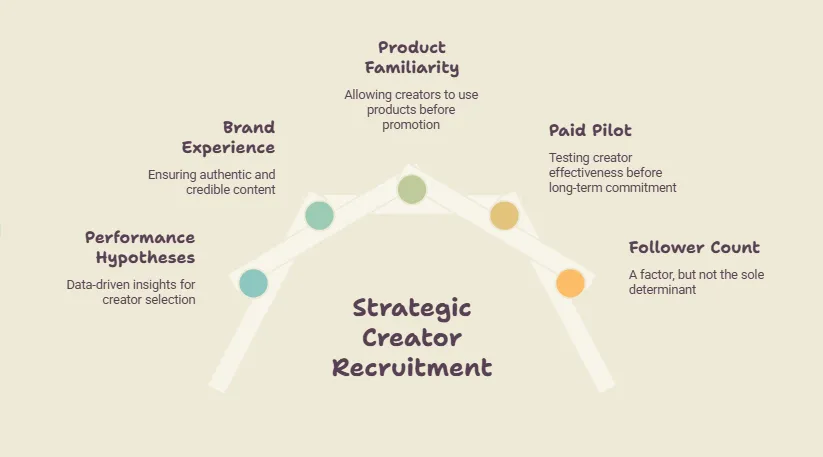
Your demand plan should guide creator discovery and how you assess creator pitches, because an impressive profile says little about ad performance. In IAB research, one-third of brands called creator identification their biggest hurdle.
Apart from that, 58% prioritized reputation and 56% prioritized audience alignment. Existing influencer partnerships deserve a fresh assessment when the job changes.
Here are the criteria to put on your scorecard:
- Product and category credibility
- Audience or customer-segment fit
- Camera presence and delivery style
- Clear product demonstrations
- Content quality without excessive polish
- Willingness to produce variations
- Reliable turnaround and revisions
- Comfort with paid usage or whitelisting
- Cost per usable asset
- Results from an initial paid pilot
A convincing brand experience also takes product familiarity. Give people enough time to use what they will discuss and provide product feedback, then assess whether their explanation feels credible.
We recommend a small paid test before a long-term agreement. Seeding can help establish product fit, while an agreed advertising brief tests delivery. Follower count belongs in the assessment, but it should never carry the whole decision.
4. Write Briefs That Produce Testable Creative
Content creators need to understand what you want to learn from an ad, especially when NCS attributes 49% of advertising’s total sales impact to creative. A clear hypothesis lets creators explain the product in their own voice while giving the paid team something useful to test.
A useful brief covers the customer problem, audience, product proof points, offer or discount code, format, prohibited claims, CTA, and production requirements. For video content, tested ad hook frameworks give creators several ways to open without forcing them through a word-for-word script.
You might request three hooks, two CTAs, different lengths, and clean product footage. Raw clips give editors more options too, provided the agreement covers editing and reuse.
Then change one meaningful variable per test. If the creator, hook, offer, format, and audience all change, you lose track of what helped.
Feedback should be equally specific. Asking for a product demonstration before the explanation gives someone a clear revision. But asking them to make it more engaging leaves most of the work unexplained.
5. Price Compensation and Paid Usage Separately
Extra variations and faster deadlines mean more work for the creator. Broader rights, exclusivity, and ads through their handle also deserve a clear price.
This is where the difference between UGC and influencer marketing becomes important. A UGC fee covers the creation of brand-owned assets, while an influencer posting fee also pays for access to the creator’s audience. If the partnership includes both, list and price them separately. These hybrid models become difficult to evaluate when creation, distribution, and performance pay are bundled together.
Here are the payment components to separate.
Separate Production From Distribution Rights
| Payment | What It Covers |
|---|---|
| Creation fee | Agreed assets and revisions |
| Posting fee | Publication to the creator’s audience |
| Paid-usage fee | Licensed advertising use |
| Whitelisting fee | Authorization for ads through the creator’s handle |
| Exclusivity fee | Agreed limits on competitor work |
| Commission | Attributable sales |
| Performance bonus | Agreed performance targets |
| Renewal | Extended usage or continued work |
Product gifting alone may be unsuitable for multiple deliverables, revisions, or broad paid rights. We recommend clear base pay before performance-based incentives, with bonuses tied to outcomes the creator can reasonably influence.
Define Every Permission Before Production
Your agreement should cover platforms, usage period, territories, editing permission, renewal terms, exclusivity, and whether ads can run through the creator’s account. These details determine whether and how you can repurpose UGC across paid channels.
Disclosures, claim approval, and likeness rights belong in the same preparation. For sensitive industries, arrange legal review before production, so creators know the boundaries before they film.
Don’t forget: If the ad will run through the creator’s TikTok account, the agreement should also cover authorization for TikTok Spark Ads. TikTok’s internal A/B tests found 134% higher completion and 157% higher six-second view-through rates for Spark Ads than standard In-Feed Ads, so those permissions can carry real performance value.
6. Connect Production, Paid Testing, and Feedback
A marketing campaign gets stuck when everyone assumes someone else owns the handoff. We recommend one shared sequence:
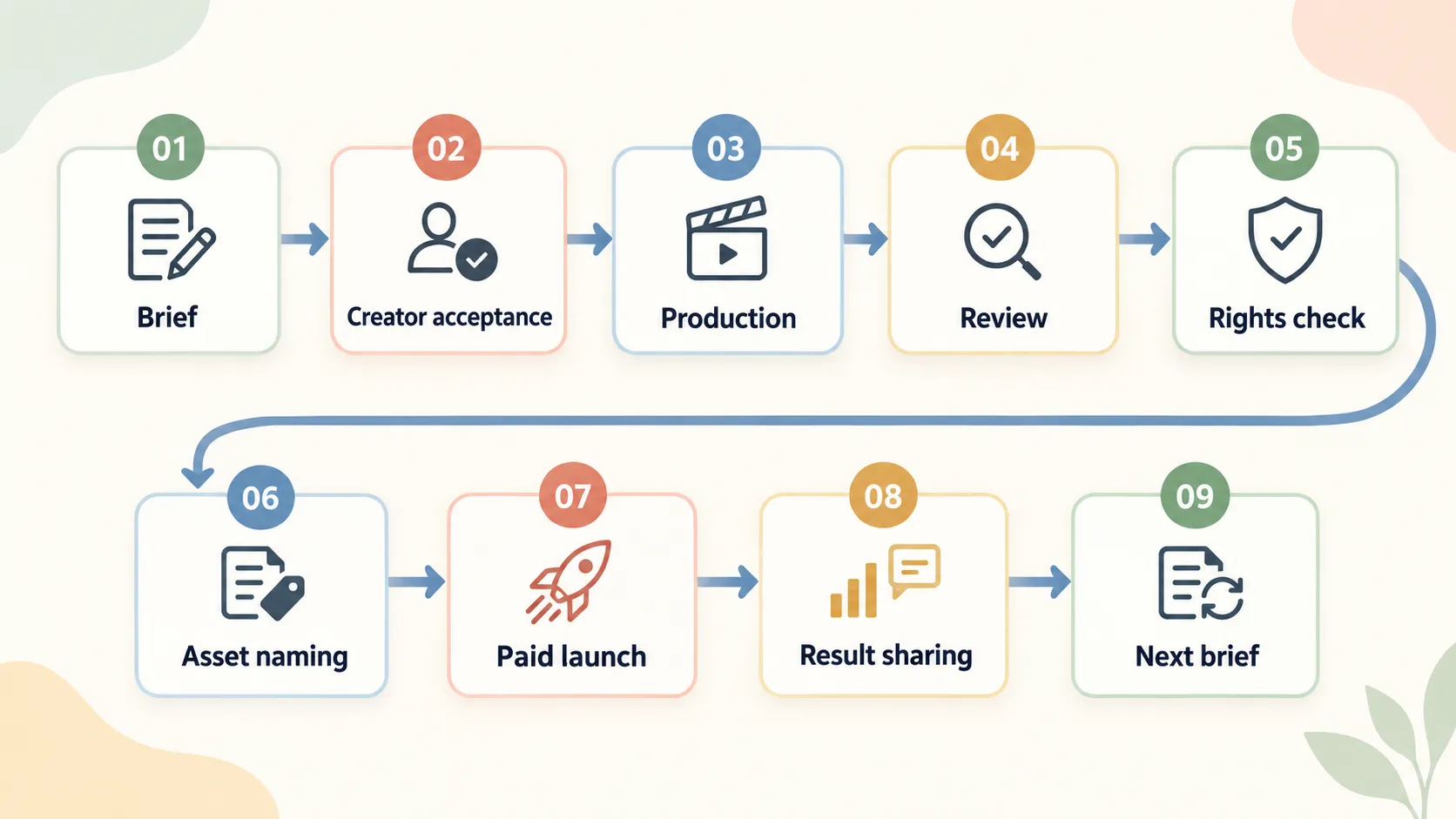
The ambassador manager handles coordination and creator acceptance. But the strategist owns the brief, the creator supplies footage, the editor prepares variations, the legal reviewer checks claims and rights, and the buyer launches tests.
Consistent file names, creator IDs, concept labels, and hook labels make results traceable. You can then test creator content through dark posts and send specific findings back to creators and program managers. Without that feedback, the next brief can repeat the same weaknesses.
We used the same system for Mindbloom, which needed authentic patient stories to support a seven-figure media buy. We worked with 15+ creators who had undergone treatment and built a $1M+ whitelisting and dark-posting campaign. The work reduced CAC by 25% and increased referral sign-ups by 40%.
Mindbloom shows why production, permissions, testing, and feedback need to stay connected. If your team faces the same gaps, we can define ownership, organize the handoffs, and turn paid results into stronger creator briefs.
7. Measure Which Creators and Concepts Deserve to Scale
One successful video earns another controlled test before it earns a bigger contract. Several measurement layers help you judge campaign performance and whether the result is repeatable.
Here are the measures you should track:
| Measurement Layer | Metrics | Decision Supported |
|---|---|---|
| Paid media | CPA, CAC, ROAS, CTR, and conversion rate | Which ads receive more spend |
| Creative | Thumb-stop rate, watch time, hold rate, and creative hit rate | Which hooks and formats need variants |
| Operations | Cost per usable asset, revision rate, and time to launch | Which creators work reliably |
| Relationship | Retention, acceptance rate, and consistency across briefs | Who earns a longer contract |
| Program economics | Production, rights, and media costs against attributable value | Whether the program should expand |
Creative hit rate is simply the share of tested ads that meet your agreed benchmark. Define that benchmark before testing and keep it consistent; otherwise the number quickly becomes meaningless.
The same goes for attribution. Nielsen found that only 38% of global marketers evaluate holistic ROI across traditional and digital activity. If different teams are giving conversions credit in different ways, it becomes very easy to overstate what an ambassador program is actually producing.
Choose one influencer marketing attribution model, one reporting window, and use them consistently. Then compare attributable value against production, usage rights, and media spend without crediting the same sale twice.
From there, the decisions become fairly practical. Scale creators who keep producing winners, give uncertain results another controlled test with a different angle, and stop extending relationships that remain expensive or unreliable after several attempts.
For a broader look at how creator goals, measurement, and scale connect, watch IAB’s discussion on the state of creator economy advertising:
Run the Model Through a 90-Day Pilot
A 90-day pilot gives creator ambassador programs time for a second production round and a useful review of the first. It also gives everyone a date to make a decision about continued investment.
Here are the four phases:
- Days 1-15: Audit paid performance, choose one business goal, and calculate creative demand. From there, develop three to five testable hypotheses. Each should connect a customer problem or product angle to something the team can evaluate. Agree on the baseline and the budget before recruitment begins.
- Days 16-30: Recruit a varied group, agree on compensation and rights, and prepare briefs. Tracking and asset naming should be ready before delivery. Allow time for product use, questions, and revisions so creators have a reasonable chance to meet the brief.
- Days 31-60: Produce assets and launch controlled tests. Compare creators and concepts under reasonably similar conditions, then send the findings into the next round. Keep a record of uncertain results too, so a small amount of data does not become an oversized conclusion.
- Days 61-90: Develop variations from early winners and test the same creators across several briefs. Then calculate program economics and decide which influencer relationships deserve a longer ambassador agreement. Renewals should include a clear workload and review date.
By the end, you should have a creator scorecard, rights template, repeatable brief, working content library, performance benchmarks, and promotion or removal rules.
Ad-level signals can appear early. Reliable program ROI and ambassador-retention findings usually need more time, especially when the purchase cycle extends beyond the pilot.
When the Paid-First Model Is the Wrong Fit
Paid-first works best when you already have enough spend to test properly, clear conversion data, healthy margins, and a product creators can demonstrate without forcing the message.
If those pieces are missing, the program can become expensive before it becomes useful. We would reconsider the model if:
- Product-market fit remains unclear.
- The budget cannot support consistent paid tests.
- Margins cannot absorb production and usage costs.
- The product offers little visual or testimonial potential.
- Legal restrictions make creator claims difficult to manage.
- Community building is the immediate goal, with no acquisition objective.
That does not mean an ambassador program is a bad idea. It means paid performance should not be the thing shaping it.
A brand focused on community, for example, may get more value from recurring customer conversations, product feedback, referrals, events, or useful UGC than from forcing every ambassador relationship into an ad-testing framework. If the goal changes later, you can always add paid usage and performance testing once there is enough budget and demand to support it.
Build a Paid-First Creator System With inBeat
You may already know where the gaps are. Perhaps the paid team needs more variations, creator sourcing takes too long, or the same rights questions delay every launch. An internal team also needs enough people and production capacity to keep the work moving.
At inBeat, we connect creator casting and creative strategy with hooks, scripts, production, variations, paid usage rights, and whitelisting. Ad testing, reporting, and continuous optimization then guide the next round of briefs.
Our work as a UGC agency for paid social brings those decisions together through ongoing UGC systems built around your advertising needs.
Request a free UGC audit or book a strategy call. We’ll help identify gaps in creative volume, briefs, paid rights, workflow, and measurement so you have a clear place to start.
Wrapping Up
From our experience, we think your paid-media objective should determine how the ambassador program works. Once that goal is clear, it becomes easier to plan creative demand, select creators, agree on rights, test ads, and decide who stays.
Longer relationships should follow repeatable creative results and dependable delivery. Creators who can use feedback and produce useful variations give your team something it can plan around.
Before you approach the next group of ambassadors, audit what your paid team needs to produce and test.
FAQs
How many ambassadors should a paid-first program start with?
There is no universal starting number. Your group needs enough variety to test several hypotheses without stretching the budget too thinly. A public ambassador or affiliate program can attract applicants, but reserve enough money for follow-up tests with the most promising people.
Should every ambassador asset appear on the creator’s feed?
No, some assets can serve as brand-owned UGC where ownership is agreed, while others run through creator handles. The right route depends on audience access, authenticity, permissions, and campaign goals. A public feed post is one possible deliverable within that mix.
Is ambassador-management software required?
Software is optional, and small and mid-size brands can start with a shared tracker and organized folders. It becomes useful as relationship management grows more demanding. First establish the strategy, rights process, workflow, naming system, and measurement rules the software must support.
Do organic winners always become winning paid ads?
Organic winners do not always succeed as paid ads. Engagement is a useful signal, but paid distribution reaches people with different expectations and purchase intent. We recommend controlled tests under real spend before treating a popular post as an acquisition asset.