

Media buying used to be the one digital marketing job brands happily left to agencies. That has changed fast.
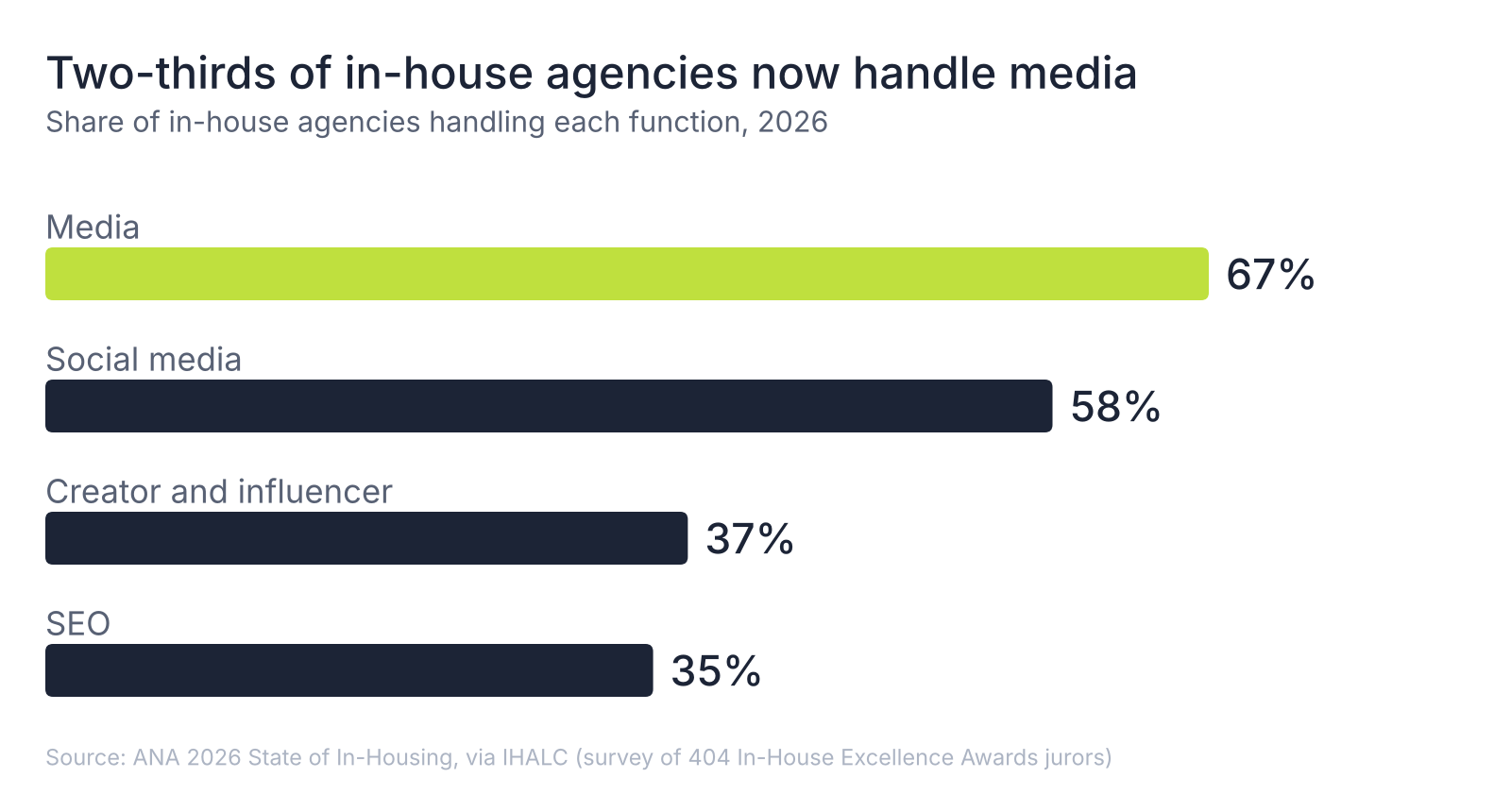
In an ANA 2026 survey of its In-House Excellence Awards jurors, 67% of responding in-house agencies handle media, and 58% run social media.
But bringing buying inside does not automatically reorganize the rest of the paid social operation. Global teams can end up with central media buying alongside multiple local agencies, each working from its own briefs, production calendar and reporting process.
This guide covers what changes when media ownership moves, how to decide which work belongs in-house or with an agency partner, what each model costs, and how a hybrid structure can work across markets.
P.S. If you'd like a team that already works this way, our paid media agency runs creative production and new-market buying alongside in-house teams.
TL;DR
- Hybrid is the norm. 92% of ANA members with in-house agencies still use external agencies, according to the ANA's latest member-wide benchmark.
- Bring buying in-house when four gates clear: stable spend, internal talent, brand-controlled accounts and enough creative supply.
- In-house wins on cost only when the team stays fully used. Run the breakeven math before you hire.
- For many global paid social teams, the cleanest hybrid split keeps ad accounts, data and measurement with the brand while an agency partner handles creative volume and new-market launches.
- Move in phases, starting with an account audit and a two-market pilot.
We believe automation has turned bid and budget management into table stakes. Meta's Advantage+ campaigns passed a $75 billion annual revenue run-rate in Q2 2026, and Meta now tells advertisers that similar ads get grouped together and that "iterating on a single concept isn't enough".
So that changes the in-house vs agency question. The harder problem is who can feed the system enough distinct creative, connect each test to media performance and keep the learning after the test ends. Media buying becomes the lab where creative proves itself, and that lab works best when the people making ads stay close to the people reading the results.
In-House Media Buying vs Agency: What's the Difference?
In-house media buying means your own employees plan, buy and optimize campaigns inside ad accounts the brand owns.
Agency media buying means an external team does that work, sometimes inside agency-owned ad accounts and tools.
A hybrid model splits media responsibilities between an internal team and an external partner. The split may happen by market, channel or workstream.
An in-house agency is slightly different from an in-house media team. It is an internal group that performs agency functions, such as creative, media or both, for its own brand.
Model | Who owns ad accounts and data | Who buys media | Who makes creative | Typical cost structure
|
|---|---|---|---|---|
In-house | Brand | Internal media buyers | In-house creative team, freelancers | Salaries, benefits, tools |
Agency | Brand or agency | Agency team | Agency or specialized agencies | Agency retainer, % of spend, or fixed fee |
Hybrid | Brand | Split by market or workstream | Shared, usually partner-heavy | Smaller team plus scoped partner fees |
Most large advertisers already sit somewhere in the middle. In the ANA's 2023 member survey, among members that also use outside agencies, in-house teams did 61% of the work on average, and outside partners handled the rest.
This article focuses on paid social: Meta, TikTok, Snap, YouTube Shorts and Pinterest. Traditional media such as linear TV and Connected TV, and programmatic media buying for programmatic display, follow different economics, so they only get a mention here.
Pros and Cons of In-House vs Agency Marketing for Paid Social
Moving media buying in-house trades breadth for closeness. You gain speed and brand knowledge, and you give up the specialist bench and cross-market view an agency builds across many accounts. That's the core of the in-house vs agency marketing trade-off for paid media.
In-House Media Team Pros and Cons
In-house media teams decide faster and know the product better. A buyer who sits in the same Slack as product, sales and customer support picks up customer feedback and brand intimacy no external brief can carry.
The costs show up in depth and resilience:
- Thin specialist bench. Georgia-Pacific's senior director of digital media told Digiday that recruiting and retaining specialized talent was among its biggest in-housing challenges.
- Capacity ceiling. A small team can only run so many advertising campaigns, markets and tests at once.
- Single-market blind spots. Internal teams rarely see market trends and winning formats in other categories or countries.
- Key-person risk. When one strong buyer leaves, the account history often leaves with them.
Expectations also run ahead of results. In ISBA's 2023 in-housing study, 93% of brands expected more agility and 40% achieved it. The sample was small, so treat it as a direction more than a benchmark.
Agency Partner Pros and Cons
An agency brings platform expertise across many accounts, plus capacity you can turn up or down. Good agency teams see new formats, betas and creative patterns across categories before a single brand would.
If you're comparing partners, our guide to the best paid social agencies includes a selection scorecard.
The downsides are about continuity:
- Learnings leave with the contract. Test history, naming logic and audience insight usually walk out at the end of a relationship.
- Churn. The ANA and 4As found that media-only agency relationships last 3.7 years on average, against 7.3 years for integrated agencies.
- Briefing overhead. Every handoff between your marketing team and an external marketing agency costs time.
One shift affects both sides. As automation absorbs bidding and budget pacing, pure button-pushing expertise is worth less wherever it sits. The specialist edge that remains is creative strategy and test design.
Attribute | In-house media team | Agency partner
|
|---|---|---|
Speed | Fast decisions, short approval chains | Slower when every change needs a brief |
Brand knowledge | Deep, daily context and brand voice | Learned through briefs and onboarding |
Specialist bench | Thin, hard to hire | Broad, shared across clients |
Capacity | Fixed by headcount | Flexes with scope |
Cross-market learning | Limited to your own accounts | Pattern recognition across many accounts |
Key-person risk | High in small teams | Spread across the agency team |
Agency churn | Not applicable | Relationships turn over every few years |
We suggest scoring your current setup from 1 to 5 on each row before you read the next section. The decision gets much easier once you can see where your gaps actually are.
Should We Bring Media Buying In-House?
Bring media buying in-house when it clears four gates: stable spend, internal capability, brand-controlled accounts and enough creative supply. If it clears some of them, a hybrid split usually fits better than either extreme.
The Four Gates for In-House Media Buying
- Spend stable enough to keep a buyer fully occupied. Seasonal or experimental budgets leave expensive people idle between peaks.
- Internal capability, with backfill. You need media buyers you can hire, train and replace without losing a quarter.
- Brand-controlled ad accounts and measurement. If the agency owns the accounts or the reporting, you can't move the work cleanly.
- Enough creative supply to keep testing velocity up. This is the gate most teams underrate. When creative does the targeting, a buyer with too few new ads has very little to optimize.
The fourth gate can be met internally. Dribbleup went from 3-4 new creatives a week to around 50 while keeping production in-house, according to Meta.
High output is possible inside the building. The hybrid case gets stronger when internal capacity can't cover every market, language or format you need.
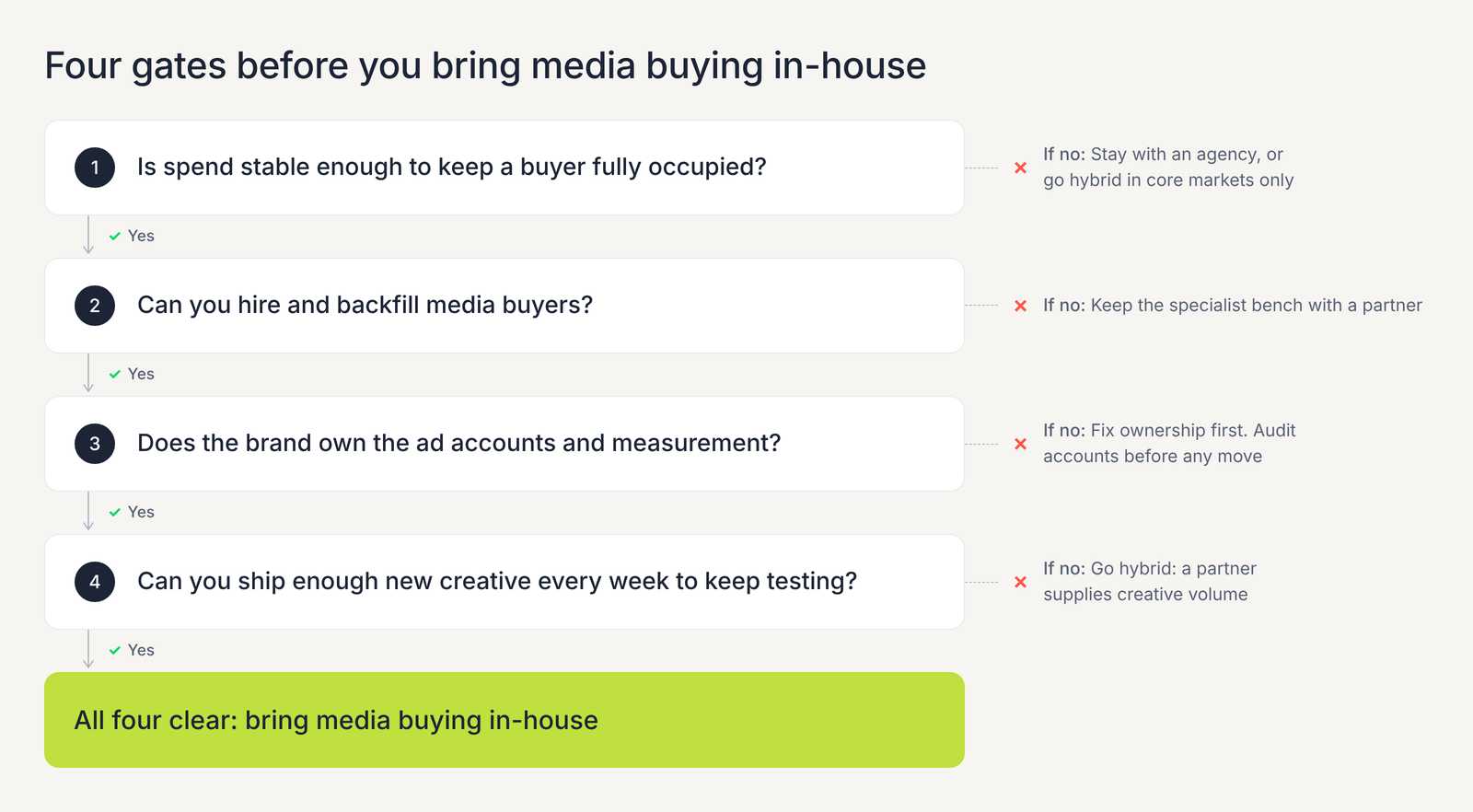
The table below shows what each readiness gate looks like under an in-house, agency and hybrid model. It also adds market complexity as a separate decision factor because expansion pace can change which structure works best.
Gate | In-house when | Agency when | Hybrid when
|
|---|---|---|---|
Spend stability | Steady year-round spend | Spend is small or highly seasonal | Stable in core markets, volatile in new ones |
Internal capability | You can hire and backfill buyers | You can't attract specialist talent | You have a lead but not a full bench |
Account and data control | Brand owns everything | Agency holds accounts or reporting | Brand owns accounts, partner works inside them |
Creative supply | Your team ships enough variants every week | Neither side has a production system | Internal team covers core formats, partner covers volume |
Markets and expansion pace | One or two stable markets | Many markets, little internal coverage | Mature markets plus regular new launches |
The direction of travel is clear. In the WFA's latest multinational benchmark, 83% of companies expected to do some social media buying in-house within three years, up from 37%. Every respondent still worked with external agencies too, even while building in-house agency capabilities.
4 Major Signs In-House Media Buying Is No Longer Working
In-house media buying is failing when the team can't keep its testing cadence or ownership gets blurry. Watch for these signals:
- A key buyer leaves and there's no backfill for months.
- Testing velocity drops and the same ads run well past fatigue.
- Expansion into a new market stalls past its planned entry window.
- Nobody can say who owns a decision, so changes wait for meetings.
Even large in-house agencies retreat when these stack up. Keurig Dr Pepper reportedly shut down its in-house creative team in 2025, and Expedia downsized its in-house team the same year.
Once the model is settled, your paid social strategy determines how budget, testing and creative priorities are divided across platforms.
How Much Does In-House Media Buying Cost Compared to an Agency?
In-house media buying costs less than an agency only when the team stays fully used. The comparison has four parts: internal cost, agency fees, coordination hours and idle capacity.
Fully Loaded Cost of an In-House Media Team
The US Bureau of Labor Statistics doesn't track "media buyer" as its own job, so the closest proxies are its manager and analyst categories. In May 2025, median pay was $133,660 for advertising and promotions managers and $78,760 for market research analysts.
Salary is only part of the bill for in-house marketing. In June 2026, benefits made up $14.07 of $46.89 in total hourly compensation for private industry workers, about 30%. On top of that come tools, training, ramp time, professional development and the cost of backfilling a role.
How Agencies Charge for Paid Social Media Buying
Agency pay has moved away from billable hours. A 2026 WFA study of 69 multinationals found that labor-based pay fell to 17% of agency compensation, down from 54% fifteen years earlier.
The current mix looks like this:
- Fixed fee or output-based pay makes up 35%.
- Labor plus a performance bonus makes up 23%.
- Paid social is still labor-based in 30% of cases.
Match the fee model to the workstream:
- Output-based fees for creative production, where you can count deliverables.
- An agency retainer plus a performance kicker for new-market buying, where results matter more than hours.
How to Calculate In-House vs Agency Breakeven
Compare (fully loaded team cost + idle capacity) against (agency fees + internal coordination hours).
Here is a simple worked example using the BLS salary proxies above and its June 2026 private-industry compensation data:
- A two-person team at the median manager and analyst salaries costs $212,420 in annual wages.
- BLS reports that total compensation for private-industry workers was about 1.43 times wages in June 2026. Applying that ratio puts the team’s estimated compensation cost at roughly $303,500 a year before tools, training and other overhead.
- If that team is only 70% utilized across the year, the effective cost of each productive hour rises significantly.
- Then compare that figure with the agency quote. At a hypothetical 10% management fee, used only to illustrate the math, agency fees would reach about $300,000 at $3 million in annual media spend.
Above that spend level, in-house starts to win on cost, provided the team stays busy. Below it, the agency is cheaper, even before you count the hiring risk, which is why growth-stage businesses often start with a partner.
Before comparing the models, it helps to separate fixed costs from variable ones. The table below shows where each operating model carries salary, tooling, coordination and unused-capacity costs.
Cost line | Fully in-house | Agency | Hybrid
|
|---|---|---|---|
Salaries and benefits | Full team | None | Smaller core team |
Tools and data | Full stack | Often included | Brand pays for core stack |
Agency fees | None | Full scope | Scoped to creative and new markets |
Coordination hours | Low | Medium | Medium, falls with a clear ownership map |
Idle capacity | High risk at low or seasonal spend | None | Low |
Partner selection and onboarding | None | Full process | One partner, not a roster |
What Is the Hybrid In-House Agency Model, and Who Owns What?
The hybrid in-house agency model divides media work between your team and one partner. For global paid social, one workable split keeps strategy, ad accounts, data and mature-market buying in-house while the partner handles creative volume and new-market launches.
Design the split around who supplies creative volume and who keeps the learnings, and the rest of the marketing org chart gets simpler.
PepsiCo calls its version "co-sourcing." After bringing a media partner in beside its internal team, PepsiCo tripled content output and lifted engagement 50-70% by brand, according to Marketing Dive. The structure is the point: one internal team keeps strategy and brand strategy decisions, and one partner adds output.
A hybrid also differs from handing everything to one centralized marketing agency, because the brand keeps the accounts and the learnings.
The most common hybrid failure is two teams optimizing the same campaigns. The ownership map below exists to prevent that. If you want the creative side of this decision, our breakdown of in-house vs outsourced creative production covers what should stay inside.
Brand-Owned: Ad Accounts, Data and Budget
The brand should own the assets, data and decision rights that need to remain in place after a partner leaves:
- Admin rights on Meta Business Manager and TikTok Business Center
- Pixels, the Conversions API, product catalogs and first-party customer data
- Budget allocation by market and channel, plus KPI definitions
- Buying in mature markets, where spend is stable
Measurement sits here too. The measurement section below covers how to run it.
Partner-Owned: Creative Production and New-Market Buying
The partner owns the work that needs volume or fresh market coverage:
- Creative production through a pod structure, explained in the next section
- Media buying during new-market launches, inside brand-owned ad accounts with partner access
Shared: Naming Taxonomy, Testing Log and Weekly Read
Both teams work from the same three things:
- One naming taxonomy, so campaign data reads the same in every market
- One testing log, so every result stays with the brand
- One weekly performance read, where decisions get made
Briefs are shared too. The brand sets the hypothesis, and the partner proposes the angles and creative iterations to test it.
The ownership map below shows how responsibilities split across the in-house team, agency partner and local market lead.
Activity | In-house media team | Agency partner | Local market lead
|
|---|---|---|---|
Ad account ownership | Owns | Has partner access | Informed |
Pixel and Conversions API | Owns | Informed | Informed |
Budget allocation | Owns | Recommends | Consulted |
Mature-market buying | Owns | Supports | Consulted |
New-market buying | Approves | Runs | Consulted |
Creative production | Approves | Runs | Consulted on local fit |
Testing plan | Sets hypotheses | Proposes and runs tests | Consulted |
Claims and legal approval | Owns | Prepares | Reviews local rules |
Reporting | Owns source of truth | Contributes weekly | Informed |
Pro tip: Write the ownership terms into the contract. Spell out who holds admin rights, how partner access is removed and which assets transfer at the end.
How Creative Pods Work Across Global Paid Social Markets
A creative pod is a small team that produces and tests creative for a group of markets on the media plan's schedule, inside one shared testing system. It can consolidate separate country-level production pipelines while still allowing creative to be adapted for local audiences.
The main advantage is operational: production, testing and learnings sit in the same system instead of being spread across separate agency workflows.
Where a Roster of Local Creative Agencies Slows Paid Social
Local agency rosters slow paid social in three ways:
- Creative supply runs on each agency's calendar. When ads fatigue in one market, the replacement waits on that agency's brief cycle. Our guide to Facebook creative fatigue explains how fast that decay sets in.
- Winning angles stay in one market. Kantar notes that a strong ad in one country can perform average or below in another. This makes retesting important, but separate agency workflows can make cross-market testing harder to coordinate.
- The central team becomes a coordinator. Bain warns that without a clear strategy, CMOs with fragmented rosters end up "coordinating across silos, losing time, control, and performance."
Local agencies still make sense in some places. Where regulation, retail structures, language nuance or platform behavior need deep market-specific expertise, a local specialist earns its fee. Multi-brand companies with very different positioning across regions may also benefit from keeping selected local partners.
How a Creative Pod Moves Winning Angles Between Markets
We used this type of structure for NielsenIQ: more than 250 creators across 19 countries, content in 15+ languages and accents, and a seven-figure paid media budget managed through one system.
A pod usually has a creative strategist, a creator sourcer, an editor and a media buyer, with one pod per language cluster. The workflow looks like this:
- Start with native creators, then adapt the hook, language, claims and cultural references where local performance calls for it. CSA Research found 76% of online shoppers prefer product information in their own language, an older but still foundational finding.
- Log every test in one place, with a market column, so a winning angle in Germany can be retested in Brazil within days.
- Feed results back into the next brief, so creative testing in one market improves the next batch everywhere.
Pods work best when the paid social operating model is shared across markets and localization can happen inside one testing system.
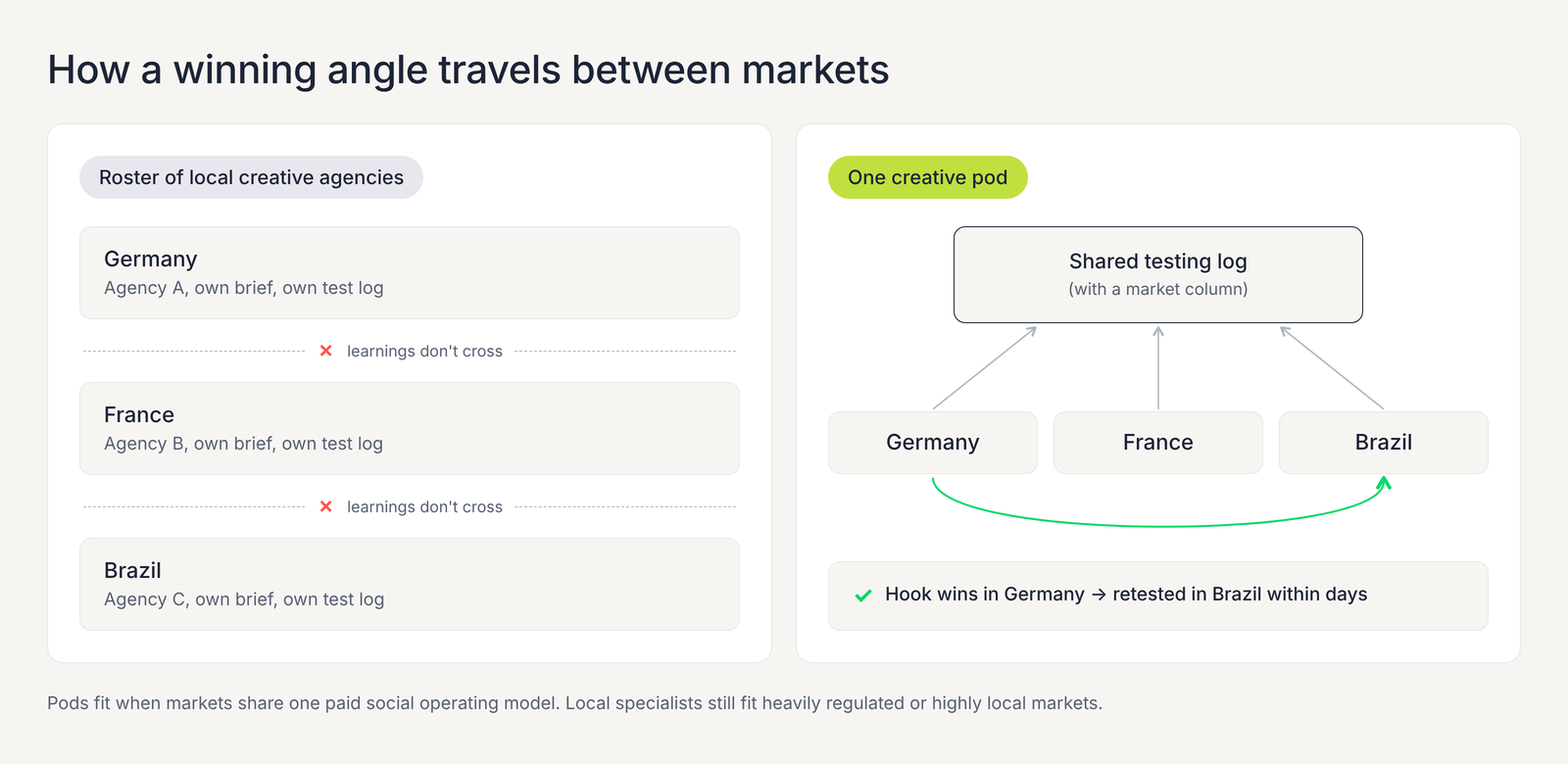
The table below compares how a local agency roster and a creative pod handle briefing, localization and cross-market learning.
Dimension | Local creative agencies | Creative pod
|
|---|---|---|
Briefing | One brief per agency, per market | One brief per cluster, adapted locally |
Monthly variants | Fewer, more polished | Many, built for testing |
Localization method | Built separately in each market | Native creators plus local adaptation |
Learning sharing | Rare, depends on the central team | Built in through one testing log |
Best fit | Heavily regulated or highly local markets | Shared operating model across markets |
How to Launch Paid Social in a New Market with an Agency Partner
Launching paid social in a new market with an agency partner takes six steps, from an agreed entry test to handing buying back to an in-house buyer once the market is stable. Here's the sequence:
- Set the entry test. Agree the budget, test window and target CAC or MER before anything goes live on your performance channels.
- Provision partner access using the ownership model above.
- Source native creators and ship the first concept batch before launch, so testing starts on day one.
- Launch controlled creative tests before rolling winners into the broader local plan and channel mix.
- Read CAC and MER weekly, then scale winners and cut losers.
- Hand buying back to an in-house buyer once spend, performance and workload in that market meet the four gates above. Keep the pod on creative.
Step 6 is what stops a hybrid from turning into permanent outsourcing. Each market graduates when it's ready, on criteria agreed at the start.
How to Move Media Buying In-House with a 90-Day Hybrid Plan
A hybrid transition takes about a quarter when you run it in phases and keep existing agencies live until the new setup proves itself. Here's the plan:
- Weeks 1-2: Audit. Check every ad account, admin access, pixel and Conversions API setup, naming convention and current agency scope. Our paid media account audit covers this for teams that want an outside read.
- Weeks 3-4: Fix the data infrastructure. Move every ad account under brand ownership and agree one naming taxonomy and one testing log.
- Weeks 5-10: Pilot. Run the hybrid split in two markets while existing agencies continue elsewhere.
- Weeks 11-12: Compare. Judge the pilot on CAC, MER, variants shipped and time from brief to live.
- Week 13: Roll out. Move market by market where the pilot won, and keep local partners where they still earn their place.
The table below turns these five phases into an ownership plan, showing what the in-house team and partner should complete before each phase moves forward.
Phase | Weeks | In-house actions | Partner actions | Exit criteria
|
|---|---|---|---|---|
Audit | 1-2 | Map accounts, access, pixels and agency scopes | Read-only review | Full list of gaps |
Fix | 3-4 | Take admin ownership, set taxonomy | Adopt taxonomy and testing log | Every account brand-owned |
Pilot | 5-10 | Set hypotheses and budgets | Produce and test creative in two markets | Enough tests for a read |
Compare | 11-12 | Run the comparison | Share full test results | Clear winner on agreed KPIs |
Roll out | 13 | Approve market-by-market moves | Expand to new markets | Rollout schedule signed off |
Pro tip: Keep marketing automation and CRM changes out of this window if you can. Changing tracking and team structure at the same time makes the pilot hard to read, so brief internal marketing stakeholders on the timeline before week 5.
How to Measure Hybrid Media Buying Performance Across Markets
The in-house team owns one source of truth and reads blended MER and new-customer CAC by market, with platform ROAS as a secondary signal. Platform-reported numbers will differ, so brand-level measurement should settle budget and market decisions.
Platform dashboards still matter for day-to-day optimization inside each channel.
The measurement split should be as clear as the media-buying split. Each metric needs an owner, a review cadence and a decision attached to it.
Metric | Owner | Cadence | Decision it drives
|
|---|---|---|---|
MER by market | In-house | Weekly | Budget allocation between markets |
New-customer CAC | In-house | Weekly | Whether a market is ready to scale or hand back |
Creative-level CPA | Partner, verified in-house | Weekly | Which concepts get more spend |
Variant velocity | Partner | Weekly | Whether creative supply is keeping up |
Geo-lift result | In-house | Quarterly | How much of the spend is truly incremental |
Winning-angle transfer rate | Shared | Monthly | Whether learnings travel between markets |
Run a geo-holdout or conversion-lift test in each major market every quarter. Our guide to incrementality testing explains how to set one up.
Winning-angle transfer rate is the metric most teams miss. It's the share of winning creative ideas that also win when retested in another market.
If it stays near zero, your markets are running separate experiments, and the hybrid model isn't delivering its main benefit. Track it monthly in the shared testing log, next to the market each idea started in.
Build a Hybrid Paid Social Team with inBeat Agency
inBeat Agency works as the outside half of a hybrid paid social team. We run creative production and new-market buying inside your ad accounts, while your in-house team keeps strategy, budget and data.
This gives your team added creative capacity and market coverage without giving up account ownership or the testing history behind each decision.
When you're ready to plan your own split, book a strategy call with us. We'll review your current roster and account ownership, then outline a two-market pilot you can run in the next quarter.
FAQs
How do you handle local claims approval when one partner produces creative for many markets?
Keep one claims library at the brand level, with market-specific rules attached to each claim. The partner prepares creative against that library, and the local market lead or legal team signs off on anything new. This keeps production fast without moving legal responsibility to the partner.
Who gets final say on budget when the agency partner wants more spend in a new market?
The in-house team does, and the contract should say so. The partner should bring a written case built on the entry test's CAC and MER targets. If the market is beating its targets, agree the increase in the weekly read, so the decision is based on the brand's numbers.
How many markets can one creative pod support before you need a second?
Plan on one pod per language cluster, since language drives most of the adaptation work. A pod covering markets that share a language can stretch further than one juggling several. Add a second pod when variant velocity drops or winning ideas take longer to reach new markets.
Can one in-house buyer run several markets if a pod handles all creative?
Yes, in many cases, because automation now handles most of the bidding and pacing. The limit is usually analysis and planning time. Once weekly reads start slipping, it's time to add a buyer or hand a market back to the partner.
How should agency fees change once a new market is handed back to an in-house buyer?
The buying portion of the fee should end for that market, while creative fees continue. Agree the hand-back fee change at the start, so nobody has to renegotiate when a market succeeds. Output-based creative fees make this split much easier to manage.