.svg)
.svg)
.svg)
.svg)


.svg)







A growth lead staring at a paid social calendar eventually hits the same fork: hire a second designer or sign a production retainer. Both feel like the wrong size. Another hire buys steady brand knowledge but caps how many concepts you can ship a month; a retainer buys volume but hands your brand to people who have never sat in your weekly performance review. The framing is the problem. A paid social program runs on a testing cadence, and the cadence sets the volume of creative you need, how fast it fatigues and how much brand nuance each asset carries. Once you look at the work that way, the answer stops being a binary. The structure that holds up is a lean internal team owning brand knowledge and direction, with volume production sent out, a pattern production studios themselves describe when they explain when to start outsourcing. This article gives you the cost math, the keep/buy rule and the build sequence.
P.S. If you want to see what the outsourced half of this model looks like in practice, inBeat's performance creative work covers creator sourcing, UGC production and paid social under one team.
We think the in-house versus outsourced argument mistakes an org chart for a system. The job is to find the message and messenger combination that acquires customers profitably, then produce enough of it to stay ahead of fatigue. That takes the people making ads, the people buying media and the people reading the data in the same weekly loop, whether or not they share a payroll. Creators are the production engine for volume; your internal team is the judgment and the memory. Build light, launch, read creative-level CAC and MER, and let those numbers decide what you make next and who makes it. Everything below follows from that.
TL;DR: in-house vs outsourced creative production, answered
The verdict, then the argument:
- Neither pure model survives a real paid social testing cadence. A lean internal core plus outsourced volume is the structure that scales, and it is the arrangement production studios recommend once volume outgrows the team, as The Line Studios describes it.
- Keep in-house whatever compounds with brand knowledge: strategy, art direction, brand judgment and the reading of performance data. Embedded knowledge of the brand and its business objectives is the one advantage in-house teams hold by default, a foundational observation from a 2016 agency comparison that still describes the structural split, even though it predates today's paid social testing cadence.
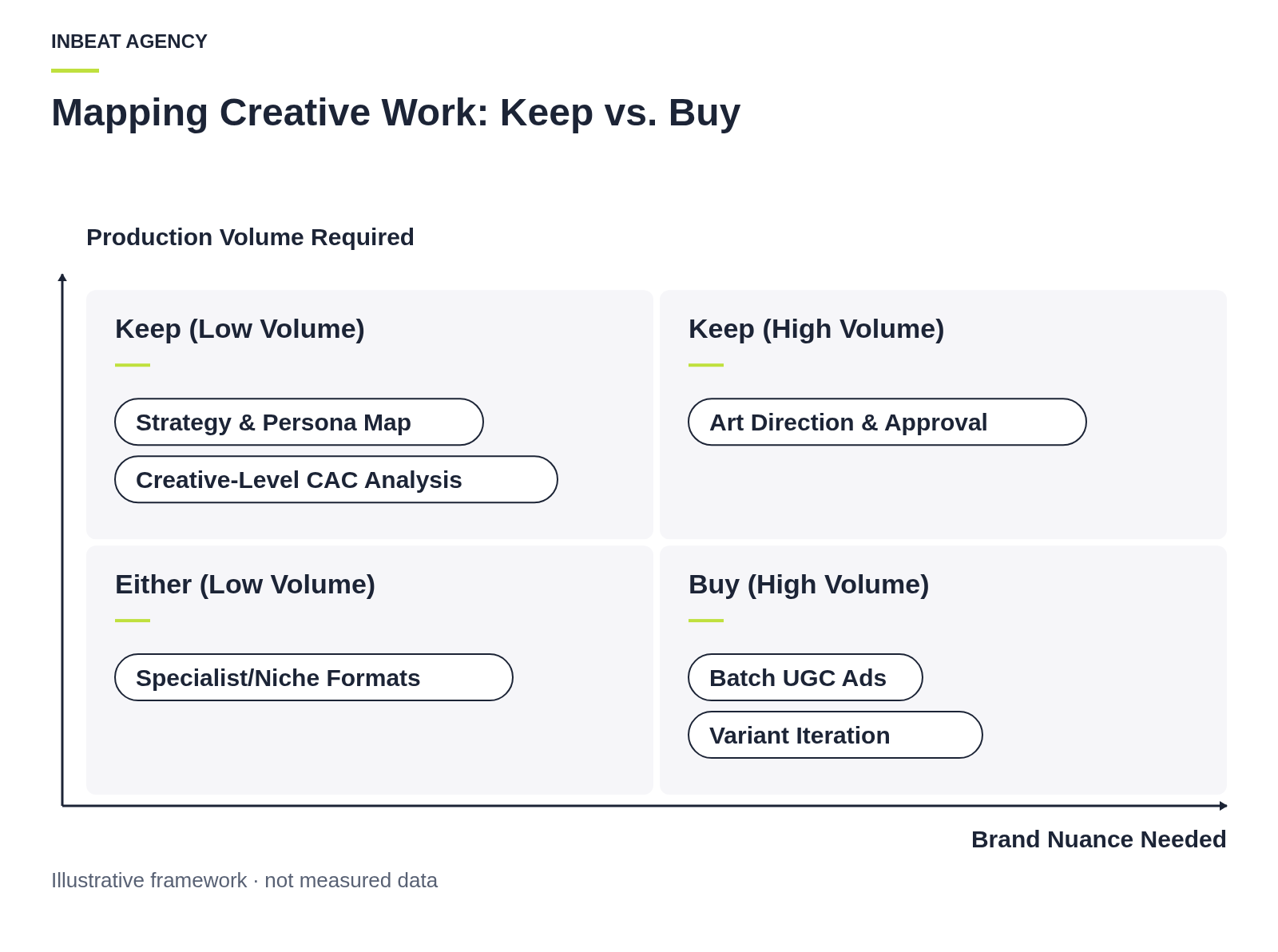
- Buy outside whatever is volume-driven or lumpy: batch UGC, variant production, shoots and platform-specific formats, where the ability to scale up and down matters more than tenure.
- Cost comparisons that stop at salary versus retainer miss the variable that decides it: cost per tested concept at your required velocity.
- Move the line quarterly on creative-level CAC and MER. Org-chart preference has no vote.
Before reading on, list your current creative functions under two headings: compounds with brand knowledge, or volume-driven.
The in-house vs outsourced debate asks the wrong question
The debate stalls because it compares two staffing structures when the thing you actually buy is a stream of testable ads. Reframe the question and the decision becomes tractable.
Pros-and-cons lists compare structures, not outputs
The ranking pages for this query follow one template: a list of advantages for in-house work, a list for outsourcing, and a closing line that it depends on your situation. The same pattern shows up in video production, in exhibition production, in apparel manufacturing and in ERP vendor guidance on manufacturing. Each list is accurate as far as it goes. None gives you a rule for your situation, because the lists describe the structures and stay silent on the output a performance team is judged by.
The unit that matters is the tested concept
A finished asset has no value until it has run against an audience and produced a read. So we treat the unit of production for a paid social team as the tested concept: a hook, angle and persona combination that has been dark-posted long enough to return creative-level CAC or MER. Consider an illustrative pair: two brands with identical budgets, one shipping a quarterly brand film, the other iterating weekly on Meta and TikTok. Following that logic, the first can staff for a predictable workload, while the second needs concept throughput that rises and falls with fatigue, launches and seasons. That contrast is a reasoning scenario, not a measured industry pattern, but it shows why the structure question cannot be answered from the budget line alone. Put the question on your planning document this way: how many concepts must we test per month, at what cost per concept, at what brand fidelity? Every section that follows works from that question.
Control and scale are not opposites once you split the work
Each side has one legitimate structural advantage. Internal staff know the brand, its objectives and its constraints without being briefed, which Four Winds Creative listed as the core in-house benefit back in 2016. External partners can scale up and down with demand, which the same page credits to agencies. That comparison is a historical industry perspective, written for video production before UGC and paid social iteration reshaped volume, and it offers no data; we cite it because the structural split it names has held, while the numbers behind either side have to come from your own account. Those advantages sit in different parts of the process: knowledge governs what gets made and approved, elasticity governs how much gets made. Split the work along that seam and you keep both.
| Dimension | Pure in-house | Pure outsourced | What actually decides it |
|---|---|---|---|
| Brand knowledge | Embedded and cumulative | Rebuilt at every onboarding | How much nuance each asset carries |
| Capacity | Fixed to headcount | Elastic to demand | How spiky your monthly volume is |
| Speed on small requests | Fast, no handoff | Slower, brief required | Share of quick-turn work |
| Speed on volume batches | Bottlenecked at peak | Parallelised across teams | Concepts needed per month |
| Specialist skills | Limited to hires | Drawn from a bench | How often each skill is needed |
| Learning retention | Stays with the brand | Leaves unless captured | Who owns the performance read |
The two advantages in the table come from the 2016 Four Winds Creative comparison, used here as historical baseline context for the in-house and agency split rather than as a current benchmark; the deciding column is our framing. Four variables run through the rest of the piece: required velocity, spend level, brand complexity, and how fast your creative fatigues. For how creative testing feeds acquisition in one market, see how NYC DTC brands scale with performance creative.
What in-house headcount really costs against an agency retainer
Build a two-column utilization model with your real monthly asset volume, then compare cost per tested concept. This is the framework we recommend for judging headcount efficiency, not an external industry benchmark; it is a way of organizing your own figures so the comparison is honest. Annual budget totals hide the answer. Here are the line items and the calculation.
Fixed costs you carry whether or not you ship
Headcount is mostly fixed cost. Salaries and benefits arrive every month regardless of output. Software seats, cameras, lighting and editing hardware are paid for whether they are used. Management time is the line most teams forget: a creative lead who spends a day a week on one-to-ones, reviews and hiring is producing less, and that day is a cost of the structure. Recruiting and ramp add a one-off charge every time someone leaves, and a departure often means months of reduced throughput. Then there is idle capacity. Between launches, a team built for peak volume sits partly unused, and the fixed cost keeps running. The offsetting benefit is real: an internal team that already knows the brand, its objectives and its constraints shortens every brief and every review, which is exactly the advantage Four Winds Creative attributed to in-house staff in its 2016 studio comparison. The point is a foundational one about how in-house teams work and has aged well; what a 2016 opinion piece cannot tell you is how much that saved brief time is worth against today's production costs, which is why the calculation below uses your own inputs.
Variable costs that scale with output
External partners shift most of the cost to the variable side. Retainers or per-asset fees are scoped to output. Onboarding and brief-writing time is a genuine cost on your side, and it recurs whenever you change partner or the partner changes staff. Revision rounds cost money or goodwill depending on the contract. What you get in exchange is the ability to scale production up and down with demand, which the same 2016 comparison framed as the route to better ROI, a general claim it made without supporting data and one that still describes the mechanism rather than proving the return. You don't pay for slack. The Vidyard comparison of in-house and outsourced video and Capterra's guide to sourcing creative services walk the same fixed-versus-variable divide, which is worth reading alongside your own numbers.
| Cost line | In-house (fixed or variable) | External partner (fixed or variable) | Who bears the risk of low utilization |
|---|---|---|---|
| Salaries, benefits, contractor fees | Fixed | Variable, scoped to output | Brand for in-house; partner for external |
| Tools, equipment, studio | Fixed | Included in fee | Brand for in-house; partner for external |
| Management and review time | Fixed | Fixed but smaller | Brand in both models |
| Recruiting and ramp | Fixed, recurring on turnover | Onboarding per partner | Brand for in-house; shared for external |
| Revision rounds | Absorbed in salary | Variable or capped by contract | Brand for in-house; depends on contract |
| Idle capacity between campaigns | Fixed cost, no output | None if scaled down | Brand for in-house; partner for external |
| Brand knowledge rebuild | Rare | Recurs at every handoff | Brand in both models |
The fixed and variable labels follow the structure described in the Four Winds Creative comparison from 2016, a historical reference for the cost split rather than a source of current figures, and in the Vidyard comparison; the risk column is our reading of who pays when volume drops.
The cost-per-tested-concept test
Run this with your own figures as an internal diagnostic; the method is our proposed analytical exercise, not a standard drawn from the cited research, and its output is only as good as the inputs you put in. For the in-house column, take total monthly fixed cost (salaries, benefits, tools, the management time you can honestly attribute) and divide by the number of concepts the team actually shipped and tested last month. For the external column, take the monthly fee plus your internal brief and review hours at a loaded rate, and divide by concepts tested. Then add a line for concepts you could not ship because capacity was full; each of those is a test the media plan needed and did not get, and its cost is the learning you missed.
This is a hypothetical scenario built on placeholder units, not measured costs from any team or agency, and it exists only to show why utilization dominates the comparison. Suppose an internal team carries 100 units of fixed cost a month and can test 20 concepts at full utilization: 5 units per concept. In a slow month it tests 10 concepts, and the cost per concept doubles to 10 units while the invoice does not move. A partner scoped at 6 units per concept looks more expensive at full utilization and cheaper the moment volume dips. Those numbers are illustrative only; replace them with your own salaries, tooling and retainer quotes before drawing a conclusion.
The conclusion follows from the math. In-house wins on cost when volume is stable and predictable and every asset carries heavy brand nuance, because embedded knowledge keeps the team fully booked and the briefs short. A half-booked internal team is the most expensive production option available, and no retainer comparison will show you that until you divide by concepts.
What should never leave the building
Three functions stay inside regardless of how much production you buy. Assign a named internal owner to each before you sign a production contract.
Brand strategy and the persona map
Rule: positioning, the persona map and the angle matrix are written and maintained inside. Reason: these compound. Every campaign teaches you something about which persona responds to which promise, and that knowledge is only useful if it accumulates in one place that outlives any single vendor relationship. It also depends on the embedded understanding of business objectives and constraints that in-house teams hold and outsiders have to be taught, a long-standing observation Four Winds Creative put in writing in 2016 and one that concerns how teams work rather than any measured result. A brand that outsources persona research along with production loses the ability to judge whether a winning ad won for the right reason, because the hypothesis behind the ad was never its own. Hold the map internally and a partner can still propose new angles; the difference is that your team decides which ones enter the matrix.
Final creative judgment and approval
Rule: one internal person holds final sign-off and sets art direction, even when every frame is shot elsewhere. Reason: brand consistency should be a decision, and a decision needs a decider. When approval is delegated to the vendor, consistency becomes a hope, and drift shows up months later as a feed that no longer looks like one brand. The approver doesn't need to touch every variant. They need to set the direction the batch follows, review the first outputs against it and make the call on edge cases. That is the mechanism that lets you buy volume without buying dilution, and the outsourcing signals list from The Line Studios describes exactly this split: internal art direction, external volume.
Performance measurement and the learning loop
Rule: the brand owns its ad accounts, its creative-level CAC and MER reporting, and the brief-writing that turns results into the next batch. Reason: this is your competitive memory. If a partner owns the read on what worked, your knowledge of your own customers is renting space in someone else's dashboard, and it leaves when the contract ends. Owning the loop also keeps the partner honest, because winners and losers are named by your data, and it keeps the brief specific, because the next batch is written from evidence. Our performance marketing coverage treats this loop as the center of the system for that reason.
With these three held, the rest can go outside safely: execution, variants, shoots, creator sourcing and format adaptation. That is the division The Line Studios describes when it recommends a lean internal team for brand knowledge with volume production sent out, and it is the boundary the build sequence later in this article assumes.
Signals that you should scale with a partner instead of another hire
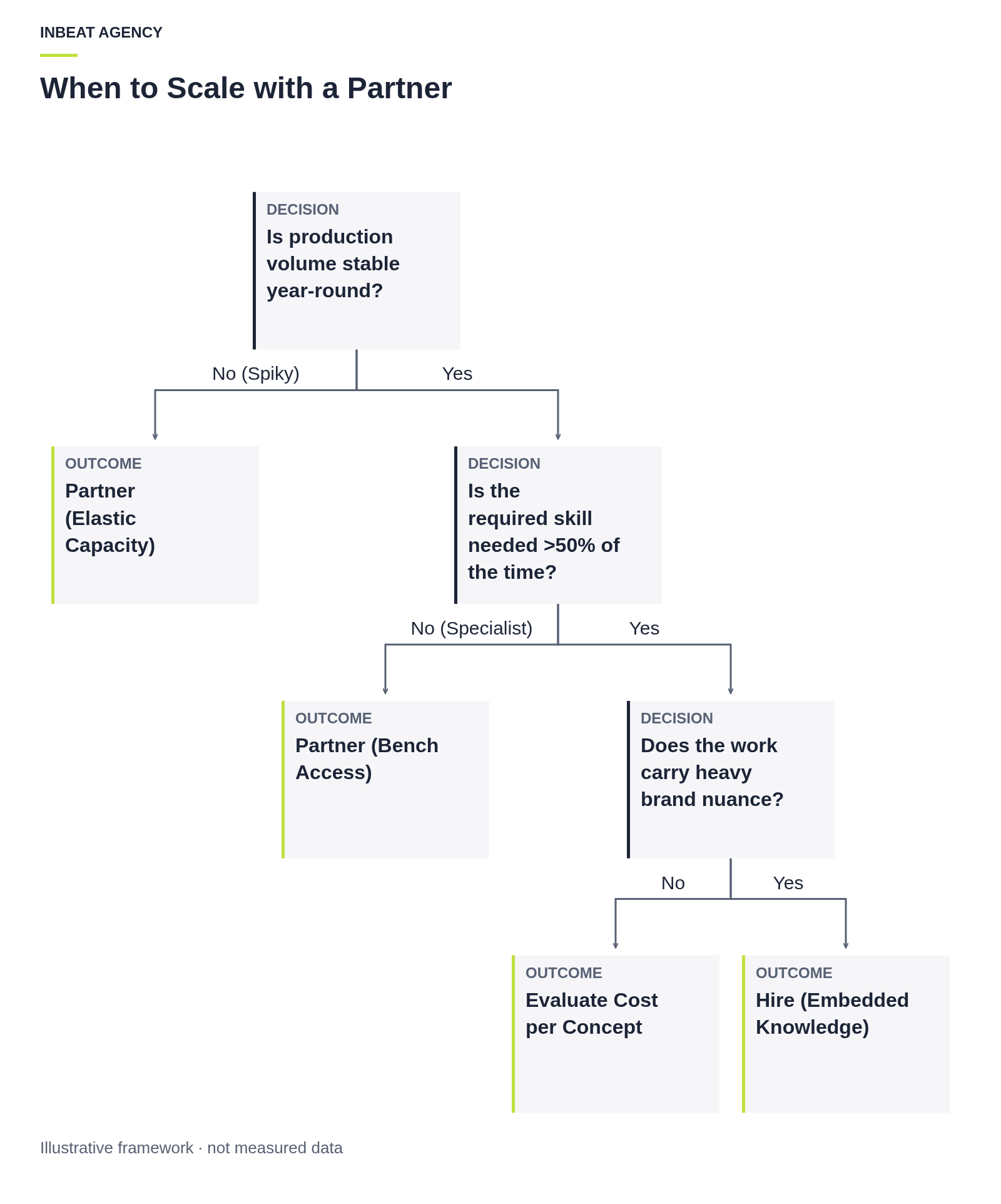
Score your program against the signals below and act on any signal that has held for two consecutive quarters. The cost section gave you the number; these are the operational patterns that tell you the number is about to move.
Velocity signals
The first velocity signal is fatigue arriving faster than replacements. If your top ad's CTR or conversion rate decays in a matter of weeks and the team needs longer than that to ship a new concept, the media plan is running on tired creative for part of every cycle. Watch the ratio of concept lifespan to production lead time in your own account; when lifespan is shorter than lead time, you are structurally behind. The second is a brief queue measured in weeks. The third is testing cadence slipping below what the media buyer asked for. All three are visible in the ad account and the team calendar, which makes them better inputs than anyone's sense of being stretched. Elastic capacity, the ability to scale production up and down with need, is the direct remedy for a velocity gap. That is a foundational principle of creative outsourcing that Four Winds Creative stated in 2016 for video production, well before weekly paid social iteration; the principle holds, the 2016 page offers no data on how much elasticity a given partner delivers, so verify that against the partner's actual turnaround record. A hire adds capacity in a fixed increment that may still be too small at peak and too large in quiet months.
Talent and skill signals
If the next hire would be a specialist you need for a fraction of the year, buy the skill. Motion design for a launch quarter, UGC creator management for a seasonal push, or a format that one platform demands and the others do not, all fit this pattern. A specialist on payroll for a job that exists 20 percent of the time spends the rest of the year on work they were not hired for, and the fixed cost sits on your books either way. A partner with that specialist on a bench charges you for the 20 percent. The counter-signal is a skill you need every week that also depends on brand nuance; that is a hire.
Financial and risk signals
Spiky volume is the financial signal. If launches and seasonal peaks drive most of your production, fixed headcount is either idle or overwhelmed, and the utilization math from the cost section punishes both states. Concentration is the risk signal: if one departure would stall production, or a failed shoot has no fallback because the team is already at capacity, you are carrying operational risk that a partner's bench would absorb. Reshoot capacity is worth asking about explicitly when you evaluate a partner.
| Signal | What it looks like in your account | Points toward | Threshold to act |
|---|---|---|---|
| Fatigue outpaces production | Top ad decays before its replacement ships | Partner | Two consecutive quarters |
| Brief queue | Requests wait weeks before work starts | Partner | Queue longer than one testing cycle |
| Cadence slip | Fewer concepts tested than the media plan called for | Partner | Missed target two quarters running |
| Part-time specialist need | Skill used in a minority of months | Partner | Utilization under roughly a fifth of the year |
| Spiky volume | Output concentrated around launches | Partner | Peak month more than double the trough |
| Key-person risk | One departure would halt output | Partner or second hire | Any time it is true |
| Stable volume, heavy nuance | Same output every month, every asset brand-sensitive | Hire | Held for a full year |
| Mature brief process | Briefs are specific and rarely revised | Either | Use cost per concept to decide |
The hire-side counter-signals rest on the embedded brand knowledge advantage Four Winds Creative described in 2016, a historical benchmark for how in-house teams differ from agencies rather than a measured threshold; the thresholds are our operating suggestions, and you should tighten them if your spend is large relative to your team. If the signals point toward a partner, it helps to be precise about what kind; our explainer on what performance creative means in advertising sets out the difference between production for its own sake and production built to be tested.
How to build the hybrid creative production model
Run the five steps below as a one-week working session and leave with a written keep/buy classification and a quarterly review date.
- Define the internal core and its three functions. The minimum core is a strategist who owns the persona map, a creative lead who owns direction and approval, and a performance owner who owns the ad accounts and the creative-level read. In a small team these can be two people or one person with clear hats. Write the three functions down with a name against each. This is the lean internal team for brand knowledge and art direction that The Line Studios describes; everything else is negotiable.
- Classify current and planned work by volume, brand nuance and turnaround. List every recurring creative output. Score each on volume (how many per month), nuance (how much brand judgment each unit needs) and turnaround (how fast it is usually needed). High nuance defaults to keep. High volume with low nuance defaults to buy. Quick-turn, low-volume work usually stays inside because a handoff costs more than the work. Everything else is either, and cost per tested concept decides.
- Choose the partner type for the buy bucket. A creator and UGC pipeline gives you native, testable ads and borrowed trust at volume, and suits hook and persona testing. A production studio suits polished hero assets and shoots. Freelancers suit narrow specialist gaps at low volume. A performance creative agency combines creator sourcing, variant production and media buying in one loop, which suits brands that want the test-and-scale rhythm run alongside production. Pick by the shape of your buy bucket. Our advertising coverage discusses how paid formats change what each partner type needs to deliver.
- Set the operating rhythm. Batch briefs from last cycle's performance data. Dark-post the batch so concepts compete without polluting the organic feed. Read creative-level CAC and MER once each concept has enough spend to judge. Whitelist and scale only the winners. Feed the losers' lessons and the winners' variables into the next brief. The elasticity you bought in step 3 exists to keep this cycle turning at the cadence fatigue demands, using the scale-up and scale-down flexibility a fixed team lacks.
- Review the keep/buy line quarterly. Recompute cost per tested concept for both columns, rescore the signals table and move work in whichever direction the data points. Work can come back inside when volume stabilises and nuance rises; it can go out when a new platform or market appears. The org chart follows the line.
| Work type | Volume | Brand nuance | Default home (keep/buy) |
|---|---|---|---|
| Positioning, persona map, angle matrix | Low | High | Keep |
| Art direction and final approval | Low | High | Keep |
| Performance reporting and brief-writing | Ongoing | High | Keep |
| Hero brand film or campaign shoot | Low, lumpy | High | Either; keep direction, buy production |
| UGC and creator ads for testing | High | Medium | Buy |
| Variant and iteration production | High | Low | Buy |
| Platform-specific format adaptation | High | Low | Buy |
| Quick-turn organic and community assets | Medium | Medium | Keep if turnaround is same-day |
The keep column follows the embedded brand knowledge logic Four Winds Creative set out in 2016, a foundational reference for why in-house retention makes sense rather than a source on current team sizes or costs; the buy column follows the volume-out recommendation from The Line Studios.
For a published instance of the buy side in operation, inBeat's Bluehouse Salmon case study describes an engagement with an external creator and performance creative partner. We cite no figures from it here; read the page for the setup as it states it.
Insider tip: hold the working session with the media buyer in the room. The person who sees fatigue first is the person who should help decide how much volume to buy.
In this discussion, agency leaders break down the mechanics of the hybrid agency model, exploring how external creative teams collaborate with in-house brand leads to handle fluctuating production volumes. Source: Cubicle to CEO® on YouTube
Making the handoff work: briefs, feedback and brand guardrails
Draft a one-page brief template with the seven fields below and use it for every external request starting this month. The keep functions and the buy functions connect through three mechanisms: the brief, the feedback loop and the guardrails.
The brief carries the persona and the hypothesis
A partner given a persona and a hook hypothesis returns testable variants. A partner given a request to make it pop returns rework. The brief template has seven fields: the persona the ad addresses, the angle or promise, the hook hypothesis stated as a sentence you expect to be true or false, the mandatory brand elements, the format specs by placement, the metric that decides success and the threshold it must clear. The hypothesis and the metric are the high-stakes fields. Without a hypothesis, the batch cannot teach you anything because you never said what you expected. Without a named metric and threshold, winners are declared on taste. The strategist owns the first three fields, the performance owner the last two, which is how the internal core's knowledge travels to the partner without a meeting.
Feedback loops run on performance data
Send the partner a weekly readout that names winners and losers by creative variable. The point is to explain results in terms the partner can act on: this hook outperformed that one for this persona, this format underdelivered at this placement. A readout that says the batch was fine is worthless; a readout that says the second hook won on CAC and the third lost because the offer arrived late gives the next batch a direction. This is the rhythm that makes the lean-core-plus-volume structure The Line Studios recommends improve over time instead of merely producing. Pro tip: send the readout before the next batch is briefed, so the brief can cite it.
Brand guardrails replace micromanagement
Write a short brand codex: tone in a paragraph, pre-approved claims, a handful of on-brand examples and an equal number of off-brand ones with the reason each fails. Name one internal approver. That is the entire control system. It keeps the embedded brand knowledge that only insiders hold by default, an observation Four Winds Creative made about production teams in 2016 that describes the dynamic without measuring it, in the loop without a review step on every variant. Then write the risk allocation into the contract: who pays for a reshoot when the fault is a brief error versus a production error, how many revision rounds are included, what usage rights you hold across paid, organic and whitelisted placements, and the turnaround SLA by request type. Treat these as general guidance and have counsel review the actual agreement.
Does hybrid hold up at low spend and in new markets?
Yes, in both edge cases, though the shape of the hybrid changes.
At low spend, start hybrid-light
A small brand doesn't need three internal roles. It needs one person who owns strategy and the performance read, with all production bought variably. Flexibility matters most when budgets are small, because a fixed hire consumes a large share of a small budget whether or not there is work, while an external partner's cost rises and falls with what you actually need. That is a foundational agency dynamic Four Winds Creative described in 2016, and while the mechanism hasn't changed, a decade-old opinion piece says nothing about what elasticity costs at today's UGC and paid social rates, so price it with real quotes. The threshold for the first dedicated creative hire is simple: hire when a function is needed at stable volume year-round. The size of the partner invoice is no threshold at all, because a large invoice at high utilization can still be the cheaper option per tested concept. The failure mode at low spend is outsourcing strategy along with production because there is nobody inside to hold it. That is the point at which a brand stops learning about its own customers, and it is the one thing hybrid-light must avoid.
As platforms and markets multiply, the buy side stretches first
A brand entering a second market needs local creators, local formats and local cultural judgment immediately. That is elastic capacity by definition, and it is where external partners with creator networks and format expertise absorb a learning curve an internal team has never run. The same holds when a new platform matters: format fluency is something a partner's bench already has, and something a small internal team acquires slowly. What doesn't move is judgment. Your internal approver still decides what is on-brand in the new market, using the embedded knowledge that travels with insiders, and your strategist still owns the persona map, now with a new column. The failure mode here is the mirror of the low-spend one: keeping production in-house through an expansion the team has never executed, and learning the new market at the speed of your own hiring.
Write your expected 12-month platform and market roadmap next to your keep/buy classification and mark which buy-side capabilities your partner must already have. If the partner lacks them, the roadmap is a reason to change partner, and the lean-core structure The Line Studios describes makes that change possible without rebuilding the team.
How inBeat operates as the outsourced half of a hybrid creative team
Strategy, judgment and data stay inside; volume, creators and elasticity come from outside; the line between them moves with creative-level performance data each quarter. Hybrid wins because it is the only structure that keeps both of the real advantages, embedded brand knowledge and elastic capacity, in the same operating loop.
inBeat is built to be the outside half of that loop. As the agency describes its own model, it runs influencer sourcing at volume, UGC and performance creative production, and paid social media buying side by side, sold as one growth creative system. That means the people producing the concepts and the people buying the media share the same weekly read, which is the rhythm this article asks you to run with your internal core. For how the agency evaluates and reports its work, the published ranking methodology page sets out its approach, and the Bluehouse Salmon case study documents an engagement as the page states it, with no figures extrapolated here.
Bring your keep/buy classification and current cost per tested concept, and explore how inBeat's performance creative team could run the volume side; the published Bluehouse Salmon case study shows the setup as it actually ran. Book a strategy call through that page when you are ready to compare your numbers against a partner's.
FAQ
How do you decide what to do when an outsourced ad wins on CAC but bends the brand guidelines?
Run it, then fix the guideline or the ad within one cycle. A CAC win is evidence that a persona responded to something real, and the internal approver's job is to decide whether the bend is a drift to correct or a discovery the brand codex should absorb. Either way, the decision stays inside, is written down, and the next brief reflects it.
How many concepts per month justifies adding a partner rather than a second internal creative?
There is no universal number; the trigger is the gap between the concepts your media plan needs and the concepts your team ships, held for two quarters. If the gap is steady and every concept is brand-sensitive, a hire closes it. If the gap swings with launches and seasons, or the missing concepts are variants and UGC, a partner closes it at lower cost per tested concept.
Who should own creative-level performance reporting when production is outsourced?
The brand's performance owner, always. The partner should receive the readout and may build its own view, but the ad accounts, the CAC and MER by creative, and the interpretation belong to the brand. Ownership keeps the learning loop inside, keeps the partner accountable to your data and prevents your customer knowledge from leaving when a contract does.
How should reshoot and revision responsibility be written into a production partner agreement?
Assign fault by cause. Reshoots caused by production error sit with the partner; reshoots caused by a brief change or an approval reversal sit with the brand. Cap included revision rounds per asset and price extra rounds explicitly. Define usage rights across paid, organic and whitelisted placements, and set turnaround SLAs by request type. Have counsel review the actual wording before you sign; this is an operating framework.
What is the minimum internal team needed to run a hybrid model well?
One person can run it if they genuinely hold all three functions: the persona map, final approval and the performance read. Past a modest spend, split the performance read from creative judgment so neither is neglected during a launch. The third role, a dedicated strategist, becomes necessary when brand nuance is high enough that briefs need weekly rewriting from data.
Cover photo: Photo: William Santos / Pexels. Art direction: inBeat Agency.