%20(1).png)

if you’re running a DTC brand in New York City, you already feel the pressure. Paid media costs keep climbing, and platform algorithms reward creatives that hold attention instantly.
It’s also worth noting that creative quality accounts for 86% of incremental sales impact, which makes it the largest contributor to performance outcomes.
Quality matters even more in NYC because you compete inside one of the most aggressive digital marketing environments in the country.
In this context, performance-driven creative, structured creative testing, and disciplined ad spend allocation determine whether your paid social campaigns scale or stall.
In this guide, you’ll learn:
- Why scaling DTC brands in NYC is more competitive
- What performance creative means for NYC DTC brands
- Why media buying alone no longer scales growth
- 5 performance creative systems that help NYC DTC brands scale
- How real NYC brands scaled with performance creative
- When to invest in a performance creative agency
- How the right performance creative agency accelerates scale
P.S. Are rising CPAs and creative fatigue slowing your growth? inBeat Agency can help you out. We build performance-driven creative systems that combine creator discovery, media strategy, and real-time dashboards so you can scale with confidence. Book a free strategy call now.
Key takeaways
- Scaling in NYC requires stronger creative systems, not just higher ad spend.
- Performance creative must be built specifically for paid media and conversion goals.
- Media buying works best when it follows validated creative winners.
- High-volume content production fuels platform optimization and faster learning cycles.
- Structured hook testing improves engagement and downstream conversion.
- UGC performs best when integrated directly into paid campaigns.
- Weekly testing sprints create measurable, compounding performance gains.
- A performance creative agency aligns creators, content, and media under one system.
Why Scaling DTC Brands in NYC Is More Competitive Than Ever
Scaling a DTC brand in New York City demands sharper performance marketing, faster creative testing, and stricter control over ad spend. You operate in a market where paid media costs are high, your competitors test aggressively, and your social media audiences expect polished, relevant content. The margin for error is small.
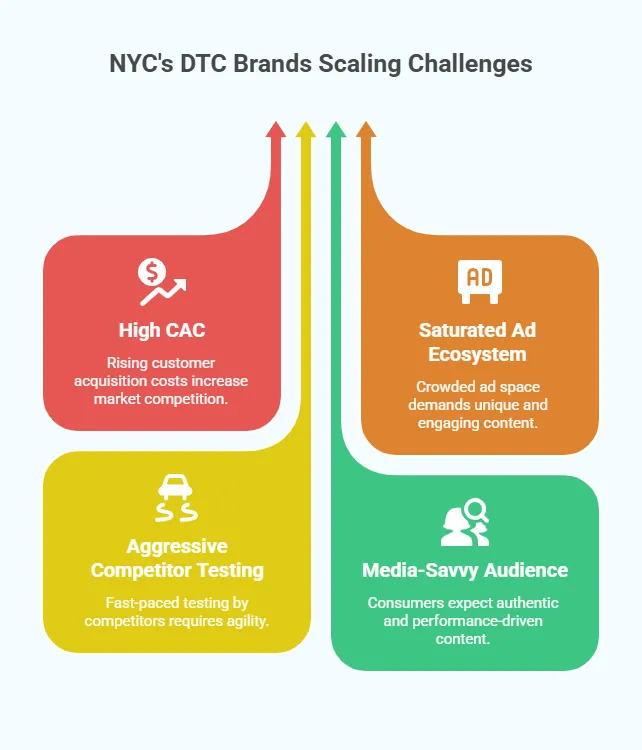
To understand why growth feels harder here than in most markets, you need to look at four structural realities shaping NYC ecommerce brands today:
- High CAC environment: Customer acquisition costs in NYC rise quickly across paid social and search. Multiple brands target the same audiences, which increases CPMs and forces tighter conversion optimization and clearer performance tracking.
- Saturated ad ecosystem: Social advertising in NYC is crowded. Creatives from digital agencies, in-house teams, and influencer marketing partners compete for the same attention. Your content enters a feed already packed with full-funnel marketing campaigns.
- Aggressive competitor testing culture: Brands here test fast. They run structured creative systems, invest in UGC production, and review performance data weekly. If you move slowly, someone else scales first. In fact, nearly 66% of e-commerce brands say their advertising performance has dropped due to inconsistent optimization. This shows how critical iterative testing is for performance creative
- Media-savvy audience: New York City consumers recognize generic ads immediately. They respond to performance-driven creative, and authentic user-generated content that feels native to the platform and aligned with their customer journey.
What Performance Creative Means for NYC DTC Brands
Performance creative means you build creative assets specifically for paid media with conversion as the priority. Every piece of content must support customer acquisition, justify ad spend, and fit into a clear media strategy.
It also means your creative decisions are driven by performance data. You test, measure, and refine based on results, while keeping formats native to social media and aligned with platform algorithms. The goal is simple: a creative that scales profitably across the customer journey.
For NYC DTC brands, that means building creative around real local density and buying behavior. You test borough-level messaging, leverage fast-turn UGC from actual NYC customers, highlight shipping speed within the metro area, and align launches with local cultural moments. Because you own the customer relationship, you also design creatives that capture first-party data and fuel retention.
But we’ll discuss more about all that below.
The Scaling Problem: Why Media Buying Alone Doesn’t Work
If you are trying to scale in New York City simply by increasing paid media budgets, you have probably felt the ceiling. You raise ad spend, and performance improves briefly. Then costs creep up and efficiency drops.
Based on our experience working with growth teams, we have seen that the problem is not in effort; it is structural.
Media buying without stronger creative and smarter performance marketing systems no longer compounds the way it once did.
First, CPMs continue to rise as competition inside social media auctions increases. U.S. social media ad spending keeps growing year over year, expected to reach $US$480.07bn by 2030. This adds more advertisers to the same paid social inventory. And more competition in turn drives up costs and tightens margins.
Second, creative fatigue (Meta guide) hits faster than most teams expect. When you run the same content assets repeatedly, engagement declines and conversion rates soften. You can adjust bidding and audience settings, but without ongoing creative testing and refreshed performance-driven creative, results plateau.
Third, signal loss after Apple’s App Tracking Transparency update remains a real constraint. As of Q2 2025, the industry-wide average opt-in rate for Apple’s App Tracking Transparency prompt sits at 35%. That is only a slight increase from 34.5% in Q2 2024 and 34 percent in Q2 2023.
A majority of users still decline tracking, which limits deterministic data and weakens audience precision
Finally, audience targeting delivers diminishing returns on its own. Platform algorithms prioritize engagement and conversion behavior. If your creative does not resonate inside the feed, even the best media strategy struggles to recover performance.
At this point, scaling requires more than media buying execution. You need stronger creative systems that align with platform behavior and improve results across the customer journey.
5 Performance Creative Systems That Help NYC DTC Brands Scale
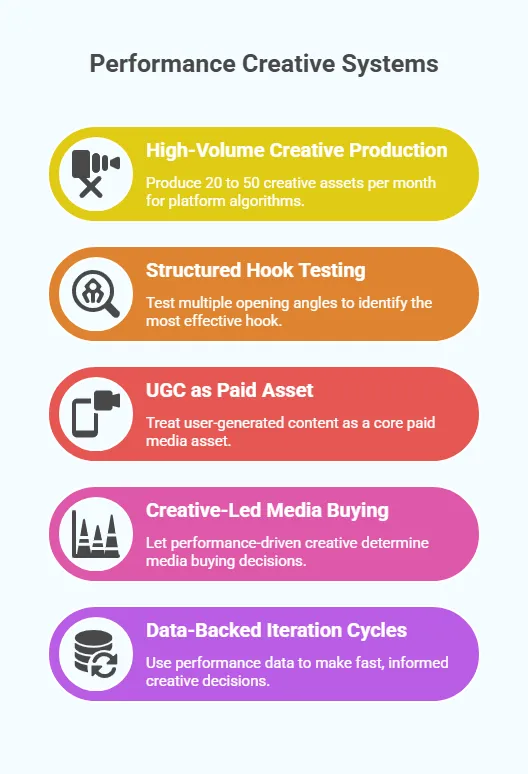
If media buying alone won’t scale you, creative systems will. Remember that high-growth NYC DTC brands don’t rely on random content. They build structured performance creative frameworks designed to compound results over time.
Below are five performance creative systems that we’ve consistently seen driving scalable growth.
1. High-Volume Creative Production
If you are producing 5 to 8 ads per month, you are moving too slowly for New York City. Competitive DTC brands usually ship 20 to 50 creative assets per month across paid social and other paid media channels. This level of creative velocity gives platform algorithms more signals to optimize against.
Remember that high volume does not mean chaotic production. It means modular content builds. You can shoot once and extract multiple hooks, formats, cuts, and versions from the same base footage.
One product demo can become short-form videos, UGC-style edits, testimonial cuts, and different opening angles. This approach supports structured creative testing and maximizes ad spend efficiency.
For example, when we partnered with a NYC-based brand, Prose, we built a scalable micro-influencer recruitment system designed to fuel consistent media buying. We activated over 20 micro-influencers per campaign and delivered more than 100 creative assets each month for paid campaigns.
This creative velocity helped us drive a 45% year-over-year increase in ROAS and a 20% reduction in overall customer acquisition cost.

That is what high-volume content production looks like when it directly supports performance marketing and scaling.
2. Structured Hook Testing
You do not win on paid social because of your logo or your editing style. You win or lose in the first 3 seconds. That opening frame decides whether someone scrolls past or stays long enough for your message to land.
Structured hook testing means you must deliberately test multiple opening angles for the same creative asset:
- One version might lead with a bold claim.
- Another might open with a relatable pain point.
- A third might start with social proof or a strong visual pattern interrupt.
The goal is simple: to identify which hook drives higher thumb-stop rates, stronger engagement, and better downstream conversion.
For example, for our client Hurom, we tested multiple hook variations on the same visual asset. One version opened with “This Is Your Year of Transformation” and leaned into themes of immunity, weight management, and overall vitality.

Another focused on “Glow Up. Slim Down.” and highlighted energy, digestive support, and easy everyday use.

That structured approach helped us isolate which hook drove stronger engagement and downstream conversion.
As a result of testing performance-optimized UGC creatives and refining our hooks, we significantly improved efficiency across paid media for Hurom.
We reduced CAC by 36%, increased ROAS by 2.5X, and lowered CPA by 65%.
“Hooks testing is like the main core of our creative testing. As for Texts, Headlines, and CTA's, we mostly use at least 3 different text options per creative, and we optimize later depending on results.” Mustafa M. Ali - Paid Media Lead at inBeat Agency
When you treat hooks as measurable conversion drivers, your paid media becomes more predictable and scalable.
3. UGC as Paid Asset, Not Organic Add-On
Many brands still treat user-generated content as something they post organically and occasionally boost.
We have noticed that this approach limits scale.
If you want to grow in New York City, you need to treat UGC as a core paid media asset built specifically for performance marketing and customer acquisition.
This genuinely works.
In fact, research shows ads featuring UGC generate about four times higher click-through rates compared with traditional branded content. And brands integrating UGC into paid campaigns often see 28% higher engagement overall.
Pro tip: This means planning UGC around your paid social strategy from the start. You brief creators with clear angles, align messaging to different stages of the customer journey, and integrate those assets into structured creative testing.
For example, when we partnered with Mindbloom, we activated 15+ creators who had experienced the treatment. Those creators produced authentic testimonial-driven UGC assets built specifically for paid amplification. The campaign resulted in a 25% reduction in CAC and a 40% increase in referral sign-ups.

When you build a repeatable UGC production engine and feed those assets into your paid media campaigns, you create a scalable system. In a competitive NYC market, this shift turns creator content into measurable performance.
4. Creative-Led Media Buying
Most brands think media buying drives scale. In reality, the data decides what deserves scale. If you increase ad spend before identifying clear winners, you amplify inefficiency.
Creative-led media buying flips that order. This is the approach we use at inBeat.
You let performance-driven creative determine where the budget goes. Once a specific asset shows strong engagement, solid conversion rates, and stable CPA, you scale it horizontally.
This means expanding into new audiences, placements, and formats across paid social and other paid media channels. You are not gambling on new concepts; instead, you are extending proven creative into a broader reach.
For instance, we implemented this framework with Genomelink through an omnichannel paid acquisition strategy built on performance-driven creative.
Each month, we developed 70 unique assets across 6 creative formats and distributed them across 5 paid media channels. That disciplined horizontal scaling strategy led to a 77% reduction in CAC over three years.
Remember: In a market as aggressive as New York City, this approach protects margins and improves consistency. Instead of chasing performance through constant audience tweaks, you scale validated assets across the customer journey and turn media strategy into a multiplier rather than a risk factor.
5. Data-Backed Iteration Cycle
Creative does not scale because you hope it works. It scales because performance data tells you what to improve next.
That is why weekly testing sprints matter.
Instead of waiting weeks to evaluate campaigns, we recommend reviewing performance tracking data every week. This way:
- You can identify which assets drive stronger CTR, conversion rates, and CPA, then make fast, informed decisions.
- Underperforming creatives get paused, while promising variations move into refinement.
- And from there, winning angles expand across paid social and other paid media channels.
This disciplined iteration cycle strengthens your creative systems, improves ad spend efficiency, and builds predictable growth across the customer journey.
When to Invest in a Performance Creative Agency
You usually feel it before you see it clearly in the dashboard. Growth slows, efficiency tightens, and scaling starts to feel heavier than it should. That is usually the point where a performance creative agency becomes necessary for you.
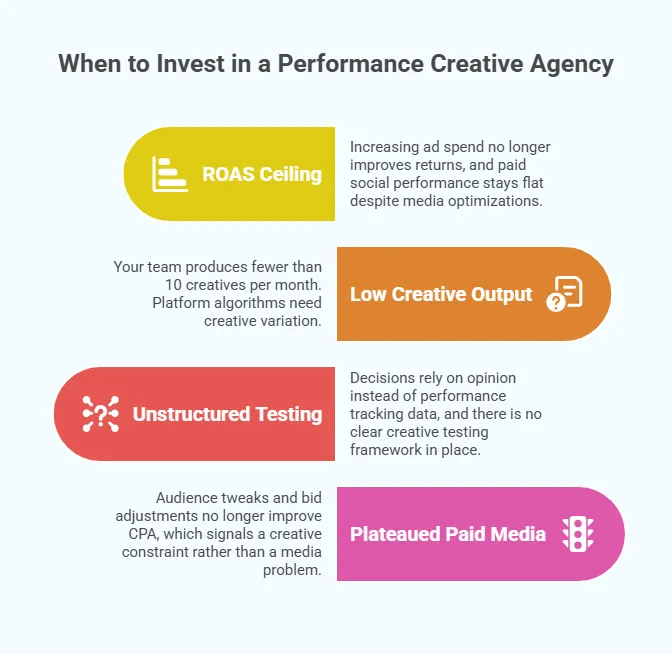
You should consider investing when:
- You’ve hit a ROAS ceiling: Increasing ad spend no longer improves returns, and paid social performance stays flat despite media optimizations.
- Your team produces fewer than 10 creatives per month: Platform algorithms need creative variation. Low output limits structured creative testing and slow performance marketing gains.
- Testing lacks structure: Decisions rely on opinion instead of performance tracking data, and there is no clear creative testing framework in place.
- Paid media has plateaued: Audience tweaks and bid adjustments no longer improve CPA, which signals a creative constraint rather than a media problem.
At this stage, scaling requires stronger creative systems, faster iteration cycles, and disciplined execution across the customer journey.
How the Right Performance Creative Agency Accelerates Scale
The right performance creative agency does more than produce ads. It brings access to a vetted creator network, speeds up content production, and aligns paid media with creative strategy from day one. Instead of treating content and media as separate functions, it integrates them into one performance system.
Rapid iteration cycles ensure winning angles scale quickly, while underperforming assets get replaced without wasting ad spend.
At the same time, profitability modeling keeps growth grounded in contribution margin and customer acquisition efficiency, so scale improves revenue without sacrificing long-term sustainability.
Scale your NYC DTC Brand with inBeat Agency
If you are looking to scale your NYC DTC brand with structured performance marketing and creative systems that drive measurable growth, inBeat Agency can help.
We combine creator access, disciplined creative testing, and integrated paid social execution with profitability modeling that keeps ad spend aligned with real margins.
This alignment allows us to scale confidently, knowing growth is grounded in data and built for long-term efficiency rather than short-term spikes.
Book a strategy call with us to identify performance bottlenecks, uncover creative gaps, and map out a clear path to profitable scale.
FAQs
What is performance creative in e-commerce?
Performance creative in e-commerce refers to content designed specifically for paid media, where conversion is the priority. Instead of focusing only on brand visibility, you create assets built to drive measurable outcomes such as stronger CTR, lower CPA, and improved ROAS. Every piece ties directly to customer acquisition and performance tracking.
How to scale a DTC brand in NYC?
Scaling a DTC brand in NYC requires more than increasing ad spend. You need structured creative systems, consistent testing, and disciplined paid social execution. The brands that grow sustainably combine high creative output, data-backed iteration, and horizontal scaling of proven assets across channels.
Why do NYC brands need more creative testing?
NYC brands face higher CPMs, faster trend cycles, and more aggressive competition. More creative testing helps control acquisition costs, prevent fatigue, and find scalable winners before performance drops in a high-pressure market.
How many ads should a DTC brand test per month?
High-growth DTC brands typically test between 20 and 50 creative assets per month across paid social and search. This level of variation gives platform algorithms enough signals to optimize effectively and helps identify winning angles faster.
What’s the difference between branding creative and performance creative?
Branding creative focuses on long-term perception and visual identity. Performance creative focuses on measurable outcomes such as CTR, CPA, and ROAS. While both matter, performance-driven creative is built specifically to convert inside paid media environments.
How does inBeat structure performance creative testing?
We structure performance creative testing around weekly iteration cycles. Each week, we review performance tracking data, identify which hooks, formats, and angles are driving stronger CTR and CPA, and refine accordingly. Our creative decisions are always tied to measurable outcomes.
How much creative volume does inBeat typically produce per month?
Depending on the brand and growth stage, we typically produce between 20 and 100 plus creative assets per month. We build modular content systems so we can test multiple variations efficiently across paid social and other paid media channels.
Does inBeat handle both creative production and paid media execution?
Yes, we integrate both. Our team aligns content production with media strategy so creative and paid social work as one system. That integration allows us to scale proven assets quickly while keeping performance marketing goals and profitability front and center.
Appendix
- Filling the Creative Data Gap to Counter Rising CPMs: https://advertisingweek.com/filling-the-creative-data-gap-to-counter-rising-cpms/
- Ecommerce Advertising Statistics 2025: 97+ Stats & Insights [Expert Analysis]: https://marketingltb.com/blog/statistics/ecommerce-advertising-statistics/
- Social Media Advertising - Worldwide: https://www.statista.com/outlook/amo/advertising/social-media-advertising/worldwide
- ATT opt-in rates: The latest benchmarks by app category and country: https://www.adjust.com/blog/att-opt-in-rates-2025/
- User-Generated Content(UGC) Stats And Facts – 2026: https://taggbox.com/blog/user-generated-content-facts-and-stats/