

Most paid social teams hit the same wall. Media buying wants fresh creative every week, the auction punishes repeats, and the creative team is already behind on last month's list. The usual answers are another designer, another retainer or another AI subscription. None of them fix the underlying problem, which is that creative production at scale is an operating model question and most teams run it as a to-do list.
The cost shows up in people first: about 76% of enterprise creative leaders told Superside's 2024 survey of 206 leaders that they and their teams had burned out from workload in the prior year. This article lays out the system that sustains volume: a persona-by-angle matrix, modular briefs, a supply layer of creators, makers, and AI, and a testing loop that feeds media buying. It closes with an operating model comparison and a scorecard.
P.S. If you want creator-fed production and media buying running as one loop, see how inBeat approaches performance creative.
We don't treat creative volume as a staffing problem. The teams that sustain it run creative, media, and performance as one loop. The people making the ads sit with the people buying them and the people reading the numbers, so every weekly batch teaches the next brief. Creators are the engine inside that loop: sourced at volume and matched by persona, they supply native, testable creative and borrowed trust, while media buying exists to give the winners reach. AI belongs in the loop as expansion capacity, never as the origin of the idea. Dark-post the concepts, read the signal, whitelist what earned it, re-brief. Spend that teaches you nothing is the real waste.
Why creative production at scale breaks without a system
Volume demand outruns team capacity
Output targets rise faster than any team can staff for. When a media buyer asks for twenty new ads a week, and the team was built for twenty a month, three things happen in order:
- Launches slip, so the account runs stale creative longer.
- The hit rate drops, because people under deadline reach for the safest version of last month's winner.
- Then the good people leave.
The Superside leader survey quoted in the intro is the baseline here. Three in four enterprise leaders reporting burnout within a single year is a population-level signal and should be read as one.
Guides that promise 100-plus ad creatives a month treat the gap as a throughput problem. It's partly that. It's also a structure problem, and structure is what the rest of this article covers.
Ad fatigue and team burnout are different problems
- Ad fatigue lives in the auction. An asset's frequency climbs, CTR decays, and CPM rises as the algorithm runs out of fresh people to show it to.
- Team burnout lives in people. Revision rounds multiply, concepts converge, and sick days cluster around launch weeks.
The two get conflated because both present as a request for more creative. The fixes diverge.
Fatigue is solved by variant depth, meaning more versions of a concept that already works. Burnout is solved by cutting the number of net-new concepts a person has to invent each week and by sourcing supply from outside the core team. Solving fatigue by demanding more concepts accelerates burnout.
Headcount and tools alone do not fix hit rate
Adding a designer raises capacity by one designer. Adding a tool raises capacity in whatever narrow task the tool handles. Neither changes hit rate, because hit rate is decided upstream, in whether the brief carried a real persona insight and a hook worth testing.
Kimberly-Clark's reported experience is the clearest public example of process redesign moving the clock: MarketScale, citing Reuters, reports that an AI platform built at the company's India capability center cut content creation time from 24 days to two hours.
That is a change in how work flows through the organization.
Two caveats apply: it is a company's own account relayed through secondary reporting, and it says nothing about whether the faster content performed better in market.
| Symptom you see | Likely root cause | System component that fixes it |
|---|---|---|
| Launch cadence slips every month | Net-new concepts per week exceed capacity | Modular briefs plus the supply layer |
| CTR decays within days of launch | Asset-level fatigue with no variant depth | Element-level testing loop |
| Winners look the same quarter after quarter | Briefs start from the last winner instead of a persona matrix | Persona-by-angle matrix |
| Revision rounds climb past three per asset | Taste closes the brief instead of data | Testing loop feeding media buying |
| Designers and creators quit or go quiet | People-level burnout from concept load | Concept ceilings and creator rotation inside the supply layer |
The symptoms and causes in this table follow from the failure patterns described above; the components named in the right column are defined in the next section. Run the table against last quarter and mark each row as asset decay or people decay before you approve a hire or a license.
What a creative production system looks like: the four components
A creative production system has four components: a persona-by-angle matrix, modular brief templates, a supply layer, and a testing loop that feeds media buying. Each has an owner and a cadence. Most teams we see have two of the four and nobody owns the other two, which is where volume stalls.
A persona-by-angle matrix drives every brief
The matrix is a grid.
- Rows are the personas you sell to, defined by the problem they are solving and the language they use for it.
- Columns are the angles that could move them: price, proof, problem, identity, comparison, objection.
- Each cell is a concept slot. Hit rate lives here, because as platform targeting narrows, the persona carried inside the creative does the audience selection that settings no longer can.
The creative is the targeting, and the matrix is how you make that deliberate instead of accidental.
Modular briefs turn each cell into a production plan. Every brief defines four swappable elements:
- The hook (first three seconds or first line)
- The body (the demonstration or story)
- The proof (review, result, ingredient, comparison)
- The CTA
Written this way, one concept yields many variants. As a hypothetical, a single brief with three hooks, two proof assets and two CTAs produces twelve testable ads from one idea, one shoot and one persona insight. The brief template also records what the batch is testing, so the read at the end has a question to answer.
A supply layer of creators, in-house makers, and AI generation
The supply layer produces variants from briefs. It never originates the matrix. Three sources feed it.
- Creators, sourced at volume and matched to persona, deliver native performance and borrowed trust; their comment sections and their own read on their audience are live market research that should flow back into the matrix.
- In-house makers own brand craft, editing, and assembly, and they decide which creator takes which cell.
- AI handles expansion: more hooks from an approved angle, resizes, captions, first-pass copy.
We cover who does what in the next section; the architectural point is that supply is a pool with three taps, so no single source carries the weekly load.
Pro tip: when a creator's raw footage lands, brief the editor on the element being tested before they open the file. Editors who cut for the test produce cleaner reads than editors who cut for a finished ad.
An element-level testing loop that feeds media buying
Media buying is the laboratory. Variants launch as dark posts in a testing structure, buyers read the signal at element level (which hook held attention, which proof lifted conversion), and only the combinations that earned it get whitelisted and scaled through the creator's handle or the brand account. The practical guides on running paid social advertising through creator handles cover the whitelisting mechanics; what matters here is that the read happens per element.
Hawky's case study on The Man Company shows why.
The brand reports that launch velocity tripled and iteration time halved once the team fixed the weak element instead of remaking the whole ad. Treat that as directional: it is a vendor's own case study about its own analytics product, with no independent verification and no stated baseline. The mechanism it describes is sound regardless of the tool. When analysis points to the hook, you reshoot or rewrite the hook, keep the body and proof, and relaunch within the week.
The cadence closes the loop. Plan the batch weekly against the matrix, brief and produce, launch, read, then re-brief with the hot cells and the dead ones marked. Draw your own four-component map before reading further and circle the component that is missing or owned by nobody. That circle is your first project.
Human creativity vs AI production: which creative tasks should AI do?
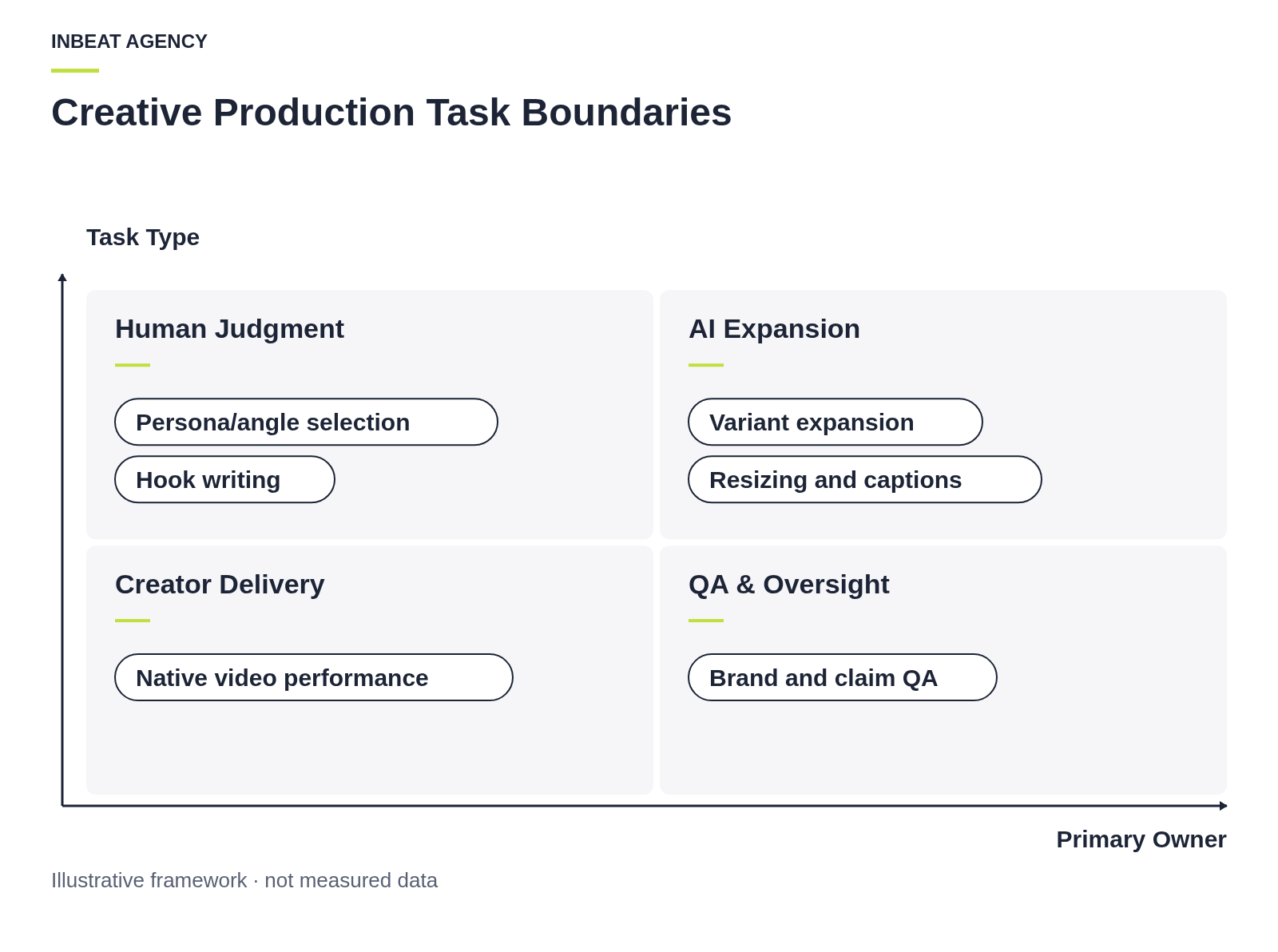
AI should do the repetitive and transformational work: expanding approved concepts into variants, resizing, captioning, and the first pass of analysis. Humans keep the work that decides hit rate: insight, hook, persona selection, and final QA. Creators keep native delivery and the trust that comes with it. The boundary is judgment versus repetition, and most misassignments happen when a team pushes judgment to a model because the model is faster.
Humans own insight, hooks, and persona selection
The hook is where hit rate is decided, because it is the only element every viewer sees. Over-automating hooks flattens them: generative models return the statistical center of what has worked before, so hooks converge toward the familiar at exactly the point where the ad needs to feel specific to one persona.
A practitioner post on LinkedIn frames this as human judgment meeting AI production scale without offering a method for the split; the method is the ownership table below.
Kimberly-Clark's reported compression from weeks to hours shows what AI changes, which is time. It does not generate the insight that starts the brief. Somebody still decides which persona, which angle, and which claim.
AI owns variant expansion, resizing and first-pass analysis
Once a human has approved a concept, expansion is mechanical. Adobe's CMO guide to scaling genAI content production is explicit that the enterprise case rests on producing more variations of approved work, and that framing is correct for throughput.
AI also does well at first-pass analysis: tagging which hook, body, proof, and CTA each variant used so the read is possible at all.
The limit is accuracy. AI output needs human QA for claims, brand voice, and platform policy before it reaches an ad account, and that gate is covered step by step in the next section.
Creators own native delivery and borrowed trust
When you collaborate with a creator, you buy their likability and their fluency in a feed, along with the footage. Synthetic presenters and templated UGC lookalikes lose the first half of that bargain. Content creators and influencers also give you something no model can: a live read on how their audience talks about the problem, which belongs back in the matrix.
| Production task | Best owner (human, creator or AI) | Why | Risk if misassigned |
|---|---|---|---|
| Persona and angle selection | Human | Requires market insight and commercial judgment | Matrix fills with safe cells, winners converge |
| Hook writing and hook performance | Human first, creator second | Hooks decide hit rate and must feel specific | Flattened hooks, lower hit rate at scale |
| Native video performance | Creator | Audience trust and feed fluency transfer with the person | Synthetic or templated delivery reads as an ad |
| Variant expansion from an approved concept | AI | Mechanical recombination of approved elements | Low if the concept was approved, high if it skipped approval |
| Resizing, captions, format adaptation | AI | Pure transformation with clear rules | Minor, mostly QA misses |
| Element tagging and first-pass analysis | AI | Volume of tagging exceeds human patience | Mislabels corrupt the read if nobody spot-checks |
| Deciding what to replace after a read | Human | Interprets signal in brand and persona context | Automated swaps chase noise |
| Brand, claim and policy QA | Human | Accountability and legal exposure | Off-brand or non-compliant assets reach the auction |
The split in this table mirrors the element-level iteration Hawky describes at The Man Company, where analysis flagged the weak element and people chose the replacement, with the same vendor-source caveat noted above. Fill the table for your own team this week and move any judgment task that is currently handled by a template or a model back to a named person.
How to integrate AI into creative workflows step by step
Integrate AI into the workflow one element type at a time, with a human-made control set and a written QA gate, and expand only where the signal holds. The sequence below is the pilot we recommend; each step carries a measurable so the pilot produces a decision instead of an opinion.
- Audit cycle time per asset. Pull the last 30 assets and record days from brief to live, revision rounds and who touched each one. Measurable: median cycle time and median revision rounds. This is your baseline, and without it the pilot cannot prove anything.
- Pick one modular element type for AI expansion. Start with resizes or hook copy variants, never with concepts. One element type keeps the blast radius small and lets the team learn what the model gets wrong before it matters. Measurable: variants per concept before and after.
- Build brand guardrails and a QA checklist. The QA gate checks four things before anything reaches the ad account: factual claims against approved claim lists, brand voice against written examples, legal and disclosure requirements, and platform policy. Name one owner per check. Measurable: QA rejection rate, which should fall over the pilot as prompts and guardrails improve.
- Run AI variants side by side with human-made controls. Same creator video, same body and proof, same budget split. Only the element under test differs. Measurable: win rate per element, read at the hook or copy level in the ad account.
- Measure hit rate and cycle time together. A pilot that halves cycle time while dropping hit rate has failed. Report both numbers in the same table every week.
- Expand scope only where the signal holds. If AI hooks match or beat the controls for two consecutive batches, add a second element type. If they lose, keep AI on resizes and move on.
Starting with one element type protects quality because errors are visible and contained, and it builds trust in the workflow because the team sees the model fail in small ways before it is asked to do bigger ones.
Some vendor guides tend to begin with tool selection; however, the audit and the control set should come first, because the tool is the least important variable. Roundups from Rocketium and Cometly list many platforms, and any of them will do for a resize-and-copy pilot if the gate in step three is real. On the other hand, Superside's six-step guide to scaling with AI explicitly audits workflows before implementing AI; brand foundations come second.
A hypothetical pilot makes the shape concrete.
Take one creator video for a skincare persona. A writer produces three hook lines; a model produces nine from the same brief and approved claim list. QA removes two AI hooks for an unsupported efficacy claim. The remaining ten run as dark posts against identical bodies and CTAs for seven days. The read shows two AI hooks and one writer hook clearing the hit-rate threshold, with AI hooks produced in minutes and writer hooks in a day.
Those numbers are illustrative only; your result depends on the brief quality, the claim list and the product category.
One more caution. Kimberly-Clark's reported move from weeks to hours is an outcome report from one company with a custom platform and a global capability center behind it. It is not a benchmark to copy into a pilot proposal. Teams starting from a mature brief process will see smaller time gains and larger quality gains; teams starting from chaos will see the reverse. Build light, field-test for four weeks, and let the control set decide what AI earns.
How to scale creative output without burning out your team
Scaling output without burning out the team means changing what you ask people to produce, who you ask, and what ends a revision cycle. Both ends of the supply layer are under strain.
The Superside survey cited in the intro covers the internal side: enterprise creative leaders reporting burnout over the prior year. The external side looks similar. Billion Dollar Boy's 2025 survey of 1,000 creators and 1,000 marketers found that 52% of creators have experienced burnout as a direct result of their career, and 37% have actively considered leaving the profession.
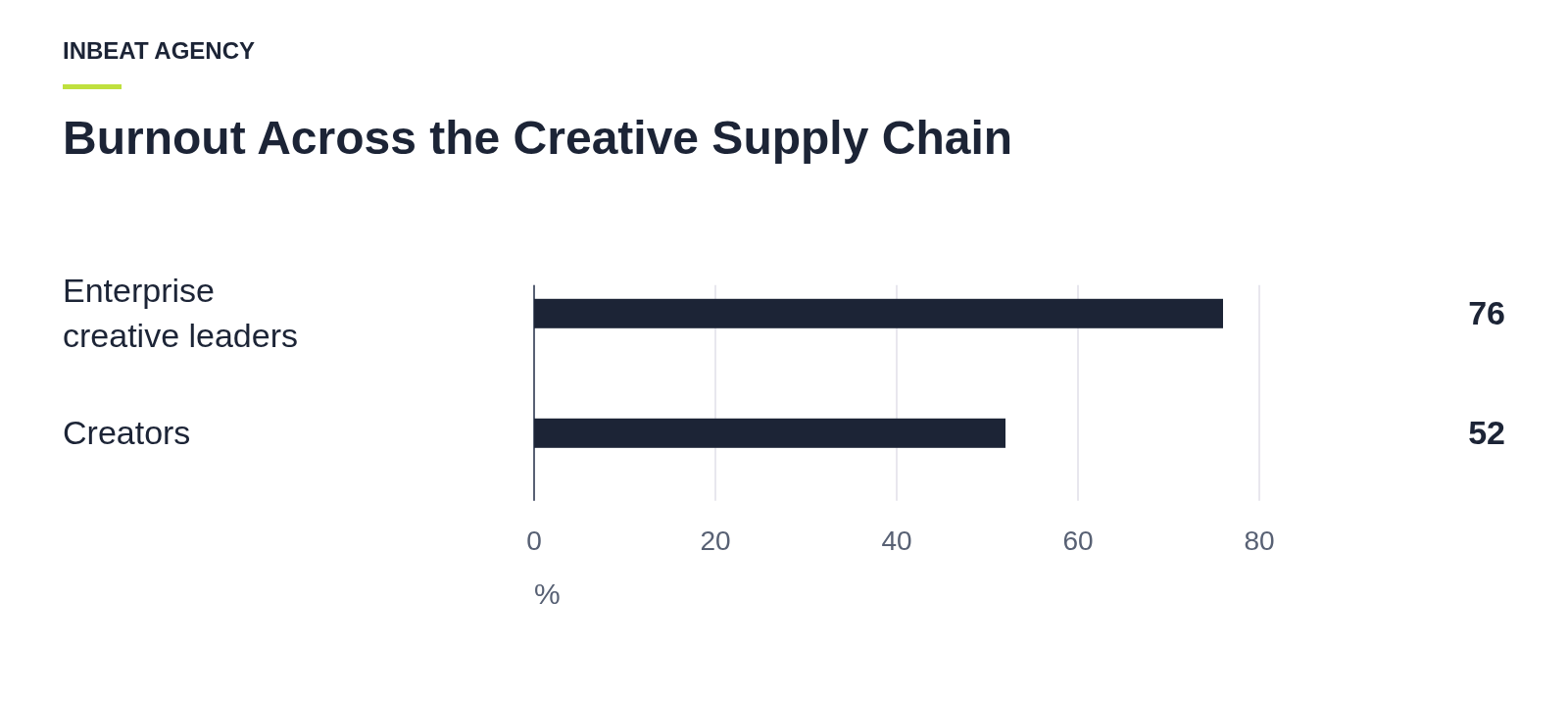
These are different populations surveyed in different years, so they do not add up to one figure. Read together, they say that strain runs the length of the chain, from the brand's own team to the creators it depends on. Superside's follow-up Breakpoint report for 2026 is framed for teams under pressure, which suggests the condition has not eased.
Cap concepts per week
Set a ceiling on net-new concepts and let variants carry volume. Inventing a concept is the expensive cognitive act: persona research, angle choice, hook ideation. Producing variants from an approved concept is comparatively cheap.
A team that ships four new concepts and forty variants a week will usually outlast a team shipping fifteen concepts and fifteen variants, because the first team spends its judgment where it counts and lets the matrix and the supply layer do the rest. Modular production is how the ceiling becomes possible; without swappable elements, every ad is a concept.
Rotate creators so no single source carries the load
Treat roster depth as capacity insurance. When one creator becomes the face of every winning ad, the brand inherits that creator's burnout risk, pricing power, and audience fatigue at the same time. Source at volume, match several creators to each high-performing persona cell, and rotate who takes the brief each week.
The guides in inBeat's social media marketing library cover sourcing mechanics; the operating rule is simpler. No creator should appear in more than a set share of a month's batch, and every hot cell should have at least two creators who can fill it.
Pro tip: track revision rounds per asset as a leading indicator of burnout. When the median climbs from two to four over a month, the problem is in the brief or the approval chain, and it will show up in attrition a quarter later.
Let performance data close the brief
A brief closes when the read is in, whatever the loudest stakeholder thinks. Taste-driven revision is the largest hidden tax on creative teams, because it is unbounded. Agree before launch on the metric and threshold that will decide each element, publish the read on a fixed day, and treat further changes as a new brief against the matrix. The data-closed loop ends arguments and shortens weeks.
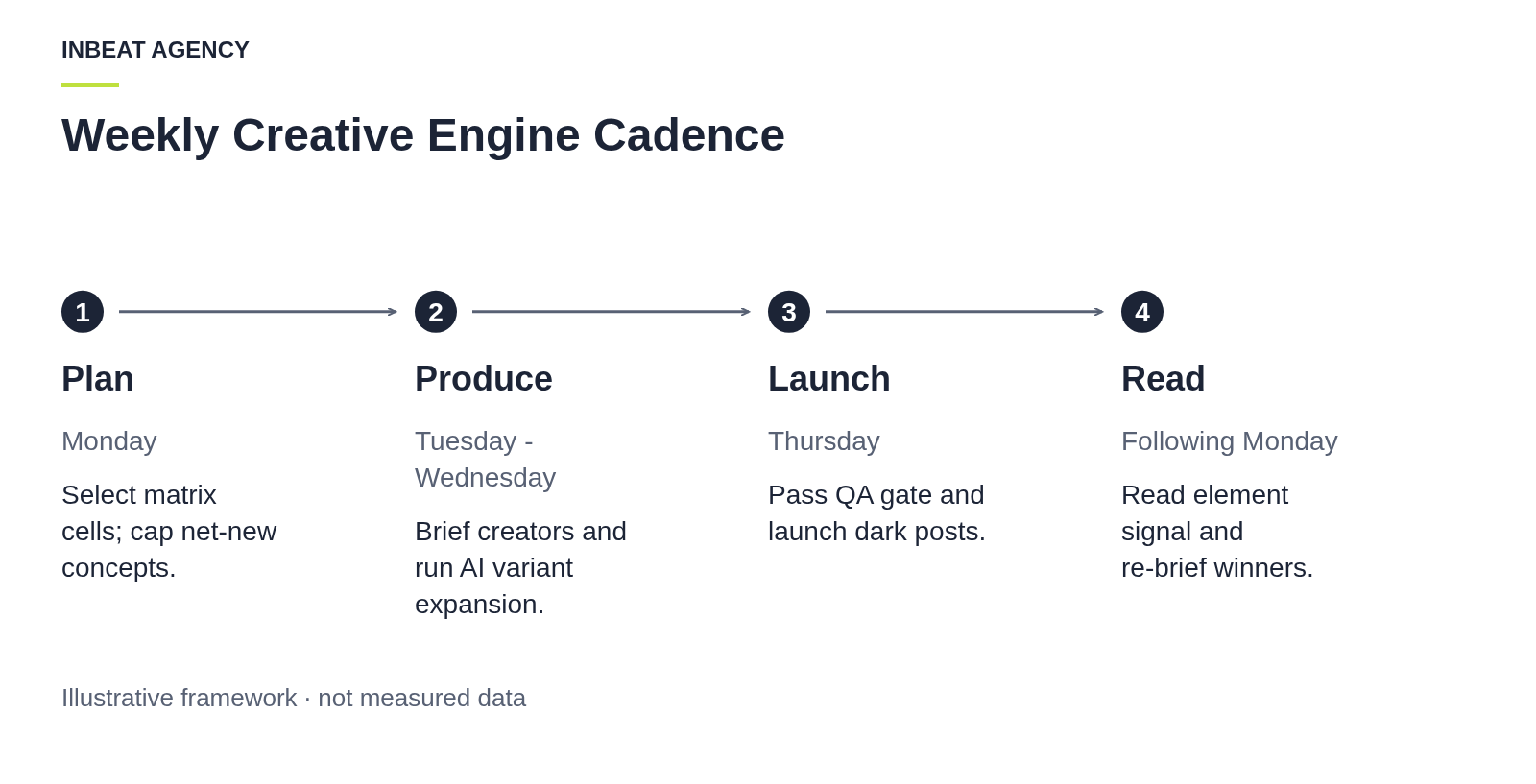
A weekly cadence template that enforces these rules:
- Monday: planning owner selects cells from the matrix; ceiling of four net-new concepts, no ceiling on variants.
- Tuesday to Wednesday: briefs go to two or more creators per cell plus in-house makers; AI expansion runs on approved elements.
- Thursday to Friday: QA gate, then dark-post launch by the media buyer.
- Following Monday: media buyer publishes the element-level read; planning owner re-briefs with hot and dead cells marked.
Set the concept ceiling and the minimum roster size this month, then watch revision rounds. Those three numbers tell you whether volume is coming from the system or from the people.
In-house vs agency vs hybrid: which creative production model scales?
Hybrid scales best for most paid social programs, provided the testing loop is owned in-house and supply is sourced at volume from creators, production partners and AI. That is our side of the argument. What it depends on is spend level, the number of personas you serve and whether you have media buying capability inside the building.
In-house teams win on speed and context
A fully in-house team knows the product, the claims and the brand voice, and it can turn a read into a re-brief the same day. The in-housing shift MarketScale reported, with Kimberly-Clark's capability-center platform as the headline example, follows from exactly that logic. The limit is supply. An in-house team is a fixed pool; when the matrix calls for twelve personas and forty variants a week, the pool either burns out or the cadence slips.
Agency retainers win on specialist depth, lose on iteration speed
A traditional retainer buys craft and specialist skills a brand cannot justify hiring. It loses on iteration because the retainer is scoped around deliverables and approval rounds, and the loop needs weekly batches scoped around learning. A monthly drop of polished assets is almost the opposite of what the testing loop wants.
Our own comparison of in-house and outsourced creative production reaches the same conclusion from the performance side.
Hybrid works when the system sets the cadence
Hybrid means the brand owns the matrix, the brief templates, and the read, and buys supply. Creators, production, and AI expansion can all be sourced, but the weekly rhythm and the decision about what scales stay with the people who see the ad account. If a vendor sets the cadence, you have a retainer with extra steps.
| Model | Cycle time | Cost structure | Who owns hit rate | What to scope in procurement |
|---|---|---|---|---|
| In-house | Days, limited by team size | Fixed salaries, tools | The team, fully | Headcount plan tied to concept ceiling and roster |
| Agency retainer | Weeks, limited by approval rounds | Monthly fee for deliverables | Shared, often disputed | Deliverable counts and revision allowances |
| Hybrid | Days, limited by the weekly batch | In-house core plus variable supply spend | In-house owner of the testing loop | Outputs per week, element-level reporting, roster depth, QA gate |
The comparison reflects the operating pattern described through this article and the in-housing shift reported by MarketScale; cost and time entries describe structure and should be read that way, since none of them are measured averages.
Rewrite your next vendor brief around outputs per week, element-level learning delivered with each batch, and minimum roster depth, and drop deliverable counts from the scope entirely.
How to measure creative production ROI and prove the system works
Prove the system with a three-tier scorecard: throughput, performance, and people health, reviewed weekly alongside media results.
Cost per asset is the metric most vendors sell on, and it is misleading on its own. Vendor material such as Chili Publish's ROI of creative automation frames return around time and cost saved per piece, which rewards producing cheap assets nobody should run.
The better ROI metric is the share of spend concentrated on creative that earned its budget through the testing loop.
Track cycle time and variants per concept
This is the throughput tier.
- Cycle time: median days from brief to live, read weekly.
- Variants per concept: how many testable ads each approved idea produced, read per batch.
The Man Company's reported halving of iteration time belongs here, and it is only meaningful next to the performance tier. Faster production of losing ads is a faster way to waste media.
Track hit rate per element and spend on winners
The performance tier includes:
- Hit rate per element: share of hooks, bodies, proofs and CTAs that cleared the pre-agreed threshold in the read, weekly.
- Spend on earned winners: share of total media spend on whitelisted variants that passed the loop, monthly.
- CAC and MER on scaled creative: the scoreboard, monthly, compared against creative that bypassed testing.
Element-level win rates are what make ROI attributable to decisions. When you know that identity hooks beat price hooks for one persona, the next batch is a choice with evidence behind it. Element-level analytics is now a product category, as Hawky's own roundup of creative analysis tools shows, with the usual caveat that a vendor's list of vendors is a sales document.
Track revision rounds and roster health
People tier is next, and it focuses on:
- Revision rounds per asset: median, weekly.
- Roster health: active creators per hot cell and share of a month's batch carried by the single most-used creator, monthly.
- Concept ceiling adherence: net-new concepts shipped against the cap, weekly.
The durability argument lives in this scorecard. Platforms change formats, algorithms, and targeting controls, and any specific tactic will expire. The loop measures learning rate, meaning how quickly the matrix updates and how often winners come from deliberate tests, and learning rate survives those changes because it belongs to the team and travels with it from one platform to the next.
Build the scorecard this quarter and put it in the same weekly meeting as the media buying review.
How inBeat approaches creative production at scale with creators and paid social
The asset is the system. Headcount, retainers, and tools are inputs to it, and none of them hold their value on their own.
A team that owns a persona-by-angle matrix, modular briefs, a deep supply layer, and a weekly element-level read can lose a designer or switch a tool and keep learning. A team that owns none of those things loses the plot every time a person leaves.
That is how we structure our own work at inBeat.
Creator sourcing at volume, performance creative production, and media buying sit in one loop:
- Creators matched by persona supply native, testable variants.
- The production team briefs them against the matrix and assembles the elements.
- The buyers dark-post the batch, read the signal, and whitelist what earned it.
- The read feeds the next week's briefs.
We describe this as an approach and a service model, and the published case studies on the site hold whatever results we are prepared to stand behind.
Picture a hypothetical brand moving from a monthly agency drop of twelve finished ads to a weekly batch of four concepts and forty variants fed by a rotating creator roster and read in the ad account every Monday. Same budget, four times the learning cycles, and a scorecard that shows where the money went.
Your next step has three parts.
- Map the four components and name the owner of each.
- Fill the ownership table so judgment stays human, expansion goes to AI and delivery goes to creators. Start one four-week pilot with a control set.
- Then decide whether next quarter's creative budget funds the system or another round of hires and retainers.
Explore how inBeat runs paid media as the testing layer for creator and performance creative.
FAQ
How many net-new concepts per week should a paid social team cap at before variants take over?
Start with a ceiling of three to four net-new concepts per week for a team running one or two personas, and raise it only when the hit rate holds. Variants carry volume; concepts carry judgment, and judgment is the scarce input. If the ceiling feels low, the matrix probably has hot cells you have not fully exploited.
How large does a creator roster need to be to keep volume steady without burning out individual creators?
Size the roster to the matrix: at least two creators who can credibly fill each persona cell you are actively testing, plus a bench for churn. The operating rule matters more than the raw count. No single creator should carry more than a set share of a month's batch, and the most-used creator's share belongs on your scorecard.
What should the QA gate check before AI-generated variants reach the ad account?
Four checks with a named owner each: factual claims against an approved claim list, brand voice against written examples, legal and disclosure requirements, and platform advertising policy. Log every rejection and its reason. A falling rejection rate across batches tells you the guardrails are working; a flat one tells you the prompts or the claim list need revision.
How do you decide whether a losing ad needs a new hook or a whole new concept?
Read the elements before judging the ad. If the hook loses attention early while the body and proof convert among the people who stay, replace the hook and relaunch. If every hook variant on that concept fails to hold attention and conversion is weak throughout, the angle or persona is wrong and the cell needs a new concept.
What should an agency or vendor contract specify when production moves to a weekly batch model?
Specify outputs per week by element type, element-level reporting delivered with every batch, minimum creator roster depth per persona, turnaround from read to re-brief, and who owns the QA gate. Remove deliverable counts and unlimited revision clauses, which reward polish over learning. Tie any performance fee to spend on earned winners. Assets produced should carry no fee at all.
Cover photo: Photo: cottonbro studio / Pexels. Art direction: inBeat Agency.