%20(1).png)

Performance branding should solve a specific problem: your brand needs to become more recognizable while acquisition becomes more efficient. That requires more than a branding studio that hands over guidelines, but it also requires more than a media buyer optimizing this month's campaigns.
The right partner can connect positioning, design systems, performance creative, paid activation, and measurement.
The ten firms below show credible evidence across several of those capabilities and have a headquarters, staffed office, or documented operating presence in New York City.
This is a curated shortlist. Use the capability map to identify the agency model that matches your immediate constraint, then examine the proof and limitations in each profile.
Performance Branding Agencies in NYC: A Capability Map
| Agency | Operating model | Strongest fit | NYC status | Public proof to inspect |
|---|---|---|---|---|
| inBeat Agency | Creator-led performance branding | DTC, CPG, apps, beauty, food, and wellness brands needing high creative volume | 90 Broad Street office | Hurom, Genomelink, and Unroll.me case studies |
| Amsive | Audience-led full-service agency | Brands connecting customer intelligence, creative, media, and direct activation | Manhattan headquarters | Hiscox and Bottega Vinaia work |
| Darkroom | Consumer growth and brand partner | DTC and retail brands moving from identity into acquisition | NYC-based operation | SAUZ and Anne Klein case studies |
| Major Tom | Integrated strategy, media, analytics, and web | Mid-market and enterprise teams consolidating multiple workstreams | New York listed as an office market | Seneca and Teck Resources work |
| Markacy | Finance-led growth consultancy and agency | Growth-stage and established brands linking media decisions to P&L | NYC headquarters | KJUS and Tamara Mellon case studies |
| NOBA | Senior-led integrated creative agency | Insurance, security, and CPG organizations with complex review requirements | NYC headquarters | Insurance practice and GardaWorld work |
| NoGood | Cross-functional growth squads | Startups and scaleups needing rapid experimentation across paid, organic, creative, and CRO | SoHo headquarters | Merlin and MongoDB case studies |
| The Charles Group | Brand, content, technology, and media under one roof | Luxury, beauty, hospitality, real estate, and enterprise technology | NYC headquarters | Aveda, HP, and Hard Rock work |
| VaynerMedia | Social-first integrated agency | Enterprise brands using culture and organic social to inform creative and media | 10 Hudson Yards office | Opendoor, Jimmy John's, and Mug Root Beer work |
| WITHIN | Enterprise performance-branding operating model | Larger organizations unifying brand, media, creative, and finance | Queens office | Timberland, Foot Locker, and The RealReal work |
The “strongest fit” column identifies where the public evidence is deepest. It does not mean every firm is limited to that assignment.
Disclaimer: inBeat publishes this article and is included in the shortlist. We applied the same capability, location, and evidence checks to it as to every other agency, and its limitations are stated in its profile.
What Counts as Performance Branding?
Performance branding connects brand-building decisions to measurable customer behavior. It uses research and positioning to establish what the brand should mean, converts that strategy into a repeatable creative system, activates the system across paid and owned channels, and feeds performance data back into the next creative decision.
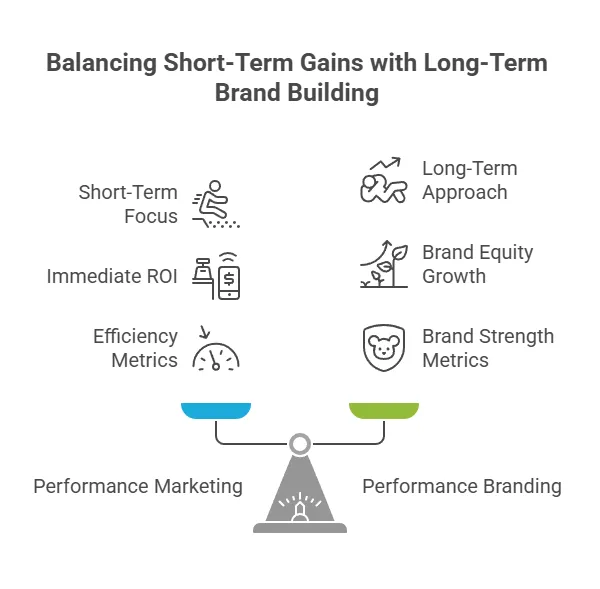
For this shortlist, an agency needed credible evidence across at least two parts of that system, not simply a page containing the phrase “performance branding.” The strongest candidates cover all four:
- Brand foundation: audience research, positioning, messaging, identity, and design rules.
- Creative system: templates, production workflows, channel adaptations, and testing capacity.
- Activation: paid media, organic distribution, commerce, lifecycle, or conversion experience.
- Measurement: acquisition metrics, incrementality, attribution, brand indicators, and business outcomes.
| Agency type | Primary question | Typical deliverables | Choose it when |
|---|---|---|---|
| Brand strategy agency | What should the brand stand for? | Research, positioning, naming, messaging, identity | The market does not understand your difference or the brand has outgrown its foundation |
| Performance creative agency | Which messages and formats convert? | Ads, UGC, iterations, testing plans, production | Your strategy is sound but creative fatigue is limiting paid growth |
| Performance marketing agency | Where should budget go? | Media planning, buying, optimization, attribution | The offer and creative system work, but channel efficiency or measurement is weak |
| Performance branding agency | How do brand and acquisition improve together? | Strategy, identity, creative system, activation, and learning loop | Fragmented teams are producing inconsistent work or short-term optimizations are weakening the brand |
Brand vs. performance marketing: why the real winners do both. Source: Manu Verma on YouTube
If you only need the first model, use this guide to choosing a brand strategy agency in NYC. If the strategy already exists and output volume is the problem, compare dedicated performance creative agencies in New York.
10 Performance Branding Agencies in NYC
inBeat Agency
inBeat Agency combines positioning, identity and design systems, packaging, motion, web, creator content, and paid media. Its distinguishing input is a creator network and production process designed to keep performance channels supplied with new social-first assets. The fit is strongest for DTC, CPG, mobile-app, beauty, food, and wellness brands where creative fatigue affects acquisition economics.
The agency has a New York office at 90 Broad Street. In its Hurom case study, inBeat says it replaced discount-heavy messaging with a health-led creative strategy, then analyzed hooks, calls to action, and social proof across UGC. The agency reports 300% ROAS growth and a 65% CPA reduction. Additional inBeat case studies document creative-testing systems for Genomelink and Unroll.me.
- Does it fit? inBeat's identity and design capabilities are visible on its service page. Buyers considering a foundational rebrand should request a relevant identity-system case study and meet the senior brand lead before shortlisting it.
Amsive
Amsive is structured around audience intelligence and not the conventional split between branding and media. Its services cover brand strategy and identity, performance creative, digital media, social, direct mail, analytics, and technology. That breadth is relevant when a company needs the same customer model to guide creative, online acquisition, and offline activation.
Its New York office page lists a Manhattan headquarters at 915 Broadway. The agency's work library can be filtered by brand strategy, creative, data, digital media, performance content, and social, making its integrated claim easier to inspect. Public examples include brand-trust and influencer work for Hiscox and a social launch for Bottega Vinaia.
- Does it fit? Amsive makes the most sense for an established organization with first-party data, multiple customer segments, or online and offline touchpoints. Ask which parts of its Audience Science methodology your engagement will actually use, what data access it requires, and whether one accountable lead owns the handoffs among strategy, creative, and media.
Darkroom
Darkroom has unusually clear public evidence of moving from brand creation into commercial activation. For SAUZ, the agency says it built the naming hierarchy, visual identity, packaging for more than seven SKUs, and Shopify presence before expanding the relationship into paid media, Amazon marketplace management, and retention. That sequence is close to the full performance-branding loop.
Its performance work also reaches established brands. In an Anne Klein case study, Darkroom describes restructuring Meta and Google campaigns and adding creator content while preserving the fashion brand's existing equity. It reports a 28% increase in new-customer acquisition and 34% growth in visibility; both figures are agency-reported.
- Does it fit? Darkroom is a strong candidate for consumer brands crossing from DTC into retail, Amazon, or broader omnichannel distribution. Its public work is deeper in consumer categories than in complex B2B. During the pitch, determine whether the proposed team is strongest at building a new brand system, scaling an existing one, or operating the downstream growth channels.
Major Tom
Major Tom offers a broad integrated model for mid-market and enterprise organizations: brand strategy, content, paid media, programmatic and CTV, analytics, web development, search, and digital strategy. Its value is consolidation. A company with several specialist agencies can put brand, acquisition, digital experience, and reporting under one accountable partner.
The agency lists New York among its offices, although the reviewed service pages do not publish a local street address. Confirm which team members are based in New York and which capabilities are delivered from other offices. Major Tom's paid-media practice says it works as one team across brand, UX, content, analytics, SEO, and media. Its public work includes a reported 198% conversion-rate increase for Seneca and 165,000-plus new visitors for Teck Resources.
- Does it fit? This model suits organizations with complex websites, multiple stakeholders, and a need for strategic coordination beyond ad production. It may be more infrastructure than a small DTC brand needs. Ask for the proposed team chart, the cadence between brand and media leads, and a case involving the same sales cycle and channel complexity as yours.
Markacy
Markacy approaches performance branding through financial planning. The NYC-headquartered firm combines media buying, creative and design, analytics, CRO, technology, and strategic advisory, then evaluates those activities against revenue and P&L objectives. That framing is useful when the CMO and finance team need a shared view of growth that separate brand and performance reports cannot provide.
Its KJUS case study describes aligning seasonal ski and golf creative with the marketing calendar and platform data, then adapting work by gender and product category across Facebook, Google, and Bing. The agency says this improved ROAS and MER, but the page does not disclose the size of the change.
- Does it fit? Markacy is better documented as a performance, measurement, and creative partner than as a ground-up naming or identity studio. Consider it when the brand foundation already exists but creative investment, media allocation, and commercial forecasting need to work together. Ask how brand health enters its financial model, so short-term return does not become the only optimization signal.
NOBA
NOBA is an independent agency headquartered in New York City. It describes a team of 60 specialists spanning brand, creative, media, and performance, with additional offices in Los Angeles, Philadelphia, Montreal, and Bucharest. Its sector emphasis is more distinctive than a generic full-service claim: insurance, security, and CPG are central to the public positioning.
The insurance practice is the clearest reason to consider it. NOBA says its strategy leaders hold active Property and Casualty, Life and Health, and Surplus Lines licenses. That category knowledge can shorten the gap between an ambitious creative concept and work that can survive product, legal, and distribution review. The site also identifies Creative Agency of Record, brand management, product launch, insurance marketing, and GardaWorld-related work.
- Does it fit? NOBA publishes less quantified case-study evidence than several agencies on this list. That does not invalidate its category fit, but it shifts more diligence to the pitch. Regulated-industry buyers should request the actual review workflow, media measurement framework, staffing plan, and two cases showing both brand change and a commercial outcome.
NoGood
NoGood uses cross-functional growth squads, which is more efficient than handing work from one department to another. Its current service mix includes performance branding, performance creative, paid growth, organic social, analytics, CRO, lifecycle marketing, and go-to-market strategy. The firm identifies its headquarters as SoHo and specializes in SaaS, B2B, healthcare, fintech, consumer, and AI companies.
Its public material is unusually transparent about the commercial model: NoGood says its average monthly retainer is above $20,000. For Merlin Investor, the agency reports a 300% increase in user sign-ups and a 50% month-over-month conversion-rate increase, attributing the work to rapid experimentation, product-led growth, and performance branding. These are self-reported results.
- Does it fit? NoGood is a logical option for a startup or scaleup that needs strategy, creative, media, and growth engineering to move in short cycles. It is less obviously suited to a traditional identity-only assignment. Ask who in the proposed squad owns brand governance, which roles are dedicated versus shared, how many experiments can realistically ship each month, and what happens to the team composition if priorities change.
The Charles Group
The Charles Group organizes its NYC-headquartered team into five connected practices: strategy and consulting, campaigns and content, branding and visual design, technology, and media. The agency says these services are delivered in-house, reducing the risk that the identity, website, production, and activation portions of a brief are owned by unrelated vendors.
Its strongest public category signals are luxury, beauty and skincare, hospitality, real estate, fashion, and enterprise technology. The media practice covers planning and buying, paid social, programmatic, search, influencer marketing, lifecycle and CRM, measurement frameworks, multi-touch attribution, and LTV/CAC modeling. A Hard Rock Hotels example connects a new creative direction with paid media and data-informed A/B testing.
- Does it fit? The Charles Group is worth considering when brand experience must remain controlled across premium creative, digital products, content, and media. Buyers should test whether the polished integrated offer translates into enough creative-testing speed for their paid channels. Ask to see the live handoff between its design and media teams, the reporting view used to evaluate creative, and an engagement with a comparable approval structure.
VaynerMedia
VaynerMedia is built for brands that treat social behavior as a source of strategy, not simply a distribution channel. Its New York office is at 10 Hudson Yards, and the agency positions the team around culture, data, creative, and performance-driven media. Platform partner badges on the office page include Google, Meta, TikTok, and Snap.
The public work library shows the type of problem it solves. Opendoor used organic social to build awareness and support larger campaigns; Jimmy John's used social insight to inform new limited-time offers; and Mug Root Beer used organic social to renew relevance with Gen Z. That makes VaynerMedia distinct from an identity studio or direct-response shop: cultural response becomes an input to brand and activation decisions.
- Does it fit? The model is most relevant to large consumer brands with the budget and internal access required for always-on social listening, production, and media. Smaller companies should establish whether they will receive an appropriately senior, focused team. Ask how the agency separates short-lived cultural signals from durable brand strategy and how organic learning is carried into paid creative, commerce, and measurement.
WITHIN
WITHIN is the candidate most explicitly organized around the term “Performance Branding.” Its framework is intended to remove internal silos among brand and performance, media and content, and marketing and finance. The service mix includes brand positioning, visual identity, multiplatform asset production, paid and owned media, and digital transformation.
The company lists an office at 43-01 22nd Street in Queens. Its work library includes enterprise assignments for Timberland, Foot Locker, The RealReal, Coach, Casper, and Hugo Boss. The public cases cover brand engagement, full-funnel commerce, paid media, creative, and transformation; it does not present performance branding as an identity exercise alone.
- Does it fit? WITHIN is a credible fit for an enterprise with separate brand, media, ecommerce, and finance teams that need one operating model and shared business goals. Its scale may be unnecessary for a narrow creative-production brief. Ask what organizational changes the agency expects from the client, who owns cross-department decisions, which outcomes are measured incrementally, and how quickly the operating model can produce visible campaign changes.
Which agency fits your brief?
Use the next section to decide whether the underlying problem requires this integrated model or a narrower specialist.
Do You Need Performance Branding or a Different Agency?
Start with the constraint, not the agency label. Buying a broader engagement than the problem requires can add cost and stakeholders without improving the work.
| What is happening now? | Most likely need | What the partner should deliver first |
|---|---|---|
| Customers do not understand the difference between you and competitors | Brand strategy | Research, positioning, message hierarchy, and a decision-ready brief |
| The company has changed, but its identity and website still reflect the old business | Branding or digital brand studio | Identity system, guidelines, templates, and redesigned priority touchpoints |
| Paid results decline as ads fatigue, even though the offer and landing experience remain strong | Performance creative | Creative analysis, new concepts, production capacity, and a testing cadence |
| Media allocation is unclear or attribution cannot explain channel contribution | Performance marketing and measurement | Tracking repair, channel plan, experiment design, and budget rules |
| Brand teams and growth teams produce conflicting messages and optimize toward different goals | Performance branding | Shared positioning, creative system, activation plan, and one measurement framework |
| Retention is the main weakness after acquisition | Lifecycle or customer-experience specialist | Segmentation, onboarding, CRM flows, loyalty work, and cohort analysis |
A performance-branding agency becomes valuable when the issue crosses several rows. For example, repeatedly changing ads will not solve weak positioning, and a rebrand will not fix poor campaign measurement. When the problem is narrower, hire the specialist and define the interfaces with your existing team.
How to Measure Performance Branding
Performance branding should not be judged only by immediate ROAS or by an annual brand study. Use linked indicators at different time horizons, and agree on the baseline before the agency changes campaigns.
| Time horizon | Questions to answer | Useful indicators | Important control |
|---|---|---|---|
| Weekly | Are people noticing, understanding, and acting on the new work? | Hook rate, qualified traffic, landing-page conversion, CPA, creative fatigue, message-level results | Separate audience, offer, placement, and creative effects where possible |
| Monthly or quarterly | Is the system making acquisition more efficient and consistent? | Blended CAC, new-customer revenue, MER, assisted conversions, branded search, direct traffic, repeat purchase | Compare cohorts and holdout tests instead of relying only on last-click attribution |
| Quarterly or biannual | Is the brand becoming easier to choose and more resilient? | Awareness, consideration, preference, brand lift, retention, price sensitivity, share of search | Keep survey methodology and target audience consistent across waves |
The agency should explain which metric is a decision metric and which is merely diagnostic. A higher video-completion rate, for example, is useful only if it predicts stronger qualified behavior or brand response. Likewise, a lower CPA can hide lower-quality customers, heavier discounting, or weaker retention.
Brand governance also belongs in the measurement plan.
Record which messages, visual cues, offers, and creator styles were tested. Winning an isolated ad test is not enough reason to rewrite the brand. Promote a learning into the core system only after it repeats across audiences, placements, or campaign periods.
What a Performance Branding Engagement Should Include
A serious scope should show how strategy becomes creative, how creative reaches the market, and how market evidence changes the next decision.
- Foundation and baseline. The agency audits positioning, customer evidence, existing identity, creative history, channel performance, tracking, and commercial targets. The output should identify which parts of the brand are fixed, which are open to testing, and where performance currently breaks down.
- Brand and message system. Expect a positioning statement, message hierarchy, proof points, offer rules, visual principles, and channel-specific guardrails. If a new identity is required, the scope should name every priority touchpoint; promising undefined “brand assets” is a red flag.
- Production and activation. The plan should specify channels, formats, asset volumes, owners, approval stages, media responsibilities, and launch dates. A design system has limited value if nobody is accountable for producing enough work to test it.
- Learning loop. Reporting should connect creative variables and audience response to acquisition and brand indicators. Agree on the weekly optimization process, monthly strategic review, and conditions for changing a message or visual rule.
Before kickoff, prepare baseline performance data, audience research, past creative, brand files, platform access, unit economics, legal constraints, and a named decision-maker. Missing inputs do not prevent an engagement, but they should change its first phase and timeline.
Performance Branding Costs and Contract Models
There is no defensible universal NYC retainer. Performance-branding scopes combine work that agencies price differently, and ad spend is normally separate from agency fees. The useful comparison is the cost anatomy.
| Cost component | Common structure | Planning evidence or example | What to clarify |
|---|---|---|---|
| Research, positioning, or identity | Fixed project or phased fee | Clutch's September 2026 pricing analysis says most branding projects reviewed on its platform fall between $10,000 and $49,999, with average listed rates of $100–$149 per hour | Interviews, naming, identity, guidelines, templates, revisions, and research expenses |
| Ongoing strategy, creative, and analytics | Monthly retainer | NoGood publicly states that its average retainer is above $20,000 per month; this is one agency's price signal, not a market average | Named team, capacity, meeting cadence, and deliverables that reset monthly |
| Paid-media management | Flat retainer, percentage of spend, or hybrid fee | A 15% fee on $100,000 in monthly media equals $15,000; treat this as arithmetic for comparing proposals, not a recommended rate | Minimum fee, declining tiers, platform scope, and whether the agency earns more solely because spend rises |
| Production | Included allowance, price per asset, day rate, or pass-through cost | Depends on creator fees, studio needs, locations, editing complexity, and usage rights | Number of concepts versus final variants, reshoots, talent, licensing, travel, and raw-file ownership |
| Technology and research | Included or passed through | Brand studies, social listening, attribution tools, panels, and ad verification can add separate costs | Markups, contract owner, data portability, and what remains accessible after termination |
Agency pricing commonly mixes projects and retainers. Promethean Research's 2025 digital-agency report found that 95% of surveyed agencies offered projects, 91% offered retainers, and 88% offered both. That supports a practical structure for this category: a defined foundation project followed by an ongoing activation and learning retainer.
Ask every finalist for the same cost breakdown. Separate strategy, design, production, media management, technology, research, travel, and ad spend. Then model three scenarios: expected scope, a lower-spend quarter, and a scale-up quarter. This exposes percentage fees, production limits, and minimums that a single annual total can conceal.
Questions to Ask Before Hiring a NYC Performance Branding Agency
Use questions that reveal how the work will operate after the pitch team leaves.
| Ask this | A useful answer should include |
|---|---|
| Which parts of our problem require brand change, and which require execution or measurement changes? | A diagnosis tied to evidence, plus areas the agency would deliberately leave alone |
| Show us one case that began with a problem like ours. What changed in the brand system, activation, and business result? | The starting condition, actual deliverables, client constraints, time period, and source of the reported result |
| Who is based in New York, and when does local presence affect delivery? | Names and roles are preferable compared to a sales address, plus a realistic plan for workshops, production, or stakeholder meetings |
| Who will work on our account after the pitch? | Named senior lead, day-to-day owner, specialist allocation, availability, and disclosure of freelancers or partner agencies |
| How will paid-media learning influence brand decisions without turning the identity into a collection of short-term ad tricks? | Fixed brand principles, testable variables, evidence thresholds, and a documented process for promoting learning into guidelines |
| How many genuinely new concepts can the team develop and launch each month? | Concepts separated from minor variants, channel formats, revision limits, production dependencies, and approval deadlines |
| How will you measure demand created by brand work when last-click reporting cannot see it? | Incrementality, holdouts, brand lift, assisted conversion, branded search, direct traffic, cohort quality, and stated limitations |
| What must our team provide for your plan to work? | Data, platform access, customer research, product samples, legal review, executive time, internal production help, and decision SLAs |
| Which costs sit outside the proposal? | Media, talent, usage rights, travel, studios, technology, research, taxes, rush work, and out-of-scope channel adaptations |
| Who owns the accounts, audiences, data, source files, creator permissions, and unfinished work if we leave? | Client-owned platform access, export formats, usage periods, transfer timing, transition support, and any continuing restrictions |
| Do you work with a direct competitor, and how do you separate people, data, and creative learning? | A written conflict policy and clear operational safeguards are better than a verbal assurance |
| What would make you recommend that we hire a specialist instead of your agency? | A credible boundary. Agencies that fit every possible brief have usually not diagnosed the assignment closely enough |
Also ask finalists to respond to the same short brief. Compare the quality of the diagnosis, proposed team, evidence, assumptions, and exclusions before comparing presentation polish.
How We Built This Shortlist
We reviewed the existing article, current search competitors, official agency service and office pages, and original case studies. We did not assume that every media agency or firm appearing in lists of digital marketing agencies qualified as a performance-branding partner. Inclusion required:
- A current headquarters, staffed office, or clearly documented operating presence in New York City
- Meaningful evidence across at least two parts of the brand foundation, creative system, activation, and measurement stack
- Proof that brand storytelling could inform execution and measurable outcomes—not simply an identity portfolio or an isolated advertising campaign
- Access to relevant specialists, such as senior brand leads, creative strategists, media buyers, analysts, or production teams
- One checkable differentiator, such as a documented operating model, sector specialization, delivery structure, or relevant case study
- An active official website with enough information for a buyer to perform further diligence
We removed agencies primarily positioned around SEO, paid search, general digital marketing, or performance media without sufficient evidence of brand strategy or identity-system work. A long service list also did not improve an agency’s position by itself. Specialized formats such as augmented reality only mattered when the agency could show how they supported the wider brand and commercial strategy.
We avoided ratings from directories because they do not establish fit for this assignment. All performance figures in the profiles come from the agencies’ own case studies and are labeled or framed as self-reported. They have not been independently audited by inBeat.
inBeat’s inclusion is disclosed because it publishes this article. The companies are not ranked to avoid implying that one agency is the universal best choice.
Choose the Right Performance Branding Agency in NYC
The right choice depends on where growth is breaking down. Some companies need clearer positioning and a stronger creative system. Others already have a recognizable brand but need faster production, better media feedback, or a more reliable way to turn campaign learning into brand decisions.
In a crowded digital world, the strongest partner is not necessarily the agency with the longest capabilities list. It is the one that can identify the real constraint, explain what should remain unchanged, and show how strategy, creative execution, distribution, and measurement will work together.
If your brief combines brand direction with creator-led production and paid acquisition, explore inBeat’s NYC performance-branding capabilities. Bring your current performance data, creative examples, brand guidelines, and the questions above to the first strategy call.
FAQs
How long does a performance-branding engagement take?
A focused audit and strategic foundation may take six to twelve weeks. A new identity, website, video production system, and multichannel launch can require several months. Ongoing creative testing and media optimization continue afterward, so ask for distinct milestones, owners, and decision points.
Does a performance branding agency need a New York office?
Not necessarily. Local presence matters when the engagement requires frequent executive workshops, on-site production, customer research, or close knowledge of a regulated market. Team quality and operating cadence matter more for remote execution. Verify who is locally based and how that presence will improve delivery instead of relying on a city landing page.
Should one agency control both the brand and paid media?
One partner can reduce handoff problems, but concentration also creates risk. If the scope covers several digital channels (including paid social, search, connected TV, or programmatic CTV) confirm that senior leaders in both brand and media share accountability. Otherwise, appoint specialists and define briefs, data access, decision rights, and ownership of the learning agenda.
When should a company switch from performance marketing to performance branding?
Consider switching when conversion optimization improves individual campaigns but cannot fix weak brand awareness, inconsistent messaging, declining creative response, or disconnected customer journeys. If tracking, landing pages, or channel allocation remain the actual constraint, repair those first before commissioning a broader branding engagement.