.svg)
.svg)
.svg)
.svg)


.svg)




%20(1).png)

Paid social has become one of the most important growth channels for modern brands.
Digital ads now account for around 75% of total advertising spend worldwide, which shows how quickly companies are shifting budgets toward online channels.
At the same time, you have more platform options than ever. Meta, TikTok, and Snapchat each offer powerful advertising ecosystems, which makes budget allocation a strategic decision rather than a simple media planning task.
If your budget allocation does not match your campaign goals or audience behavior, performance can suffer, and scaling becomes harder.
This guide explains how to build a paid social strategy that allocates budget across Meta, TikTok, and Snapchat in a structured way.
In this guide, we’ll cover:
- How Meta, TikTok, and Snapchat differ in audience behavior, ad formats, and campaign performance
- The key factors that should guide your paid social budget allocation decisions
- Practical budget allocation models used by performance marketers
- Example budget scenarios for e-commerce brands and DTC companies
- A step-by-step framework to test, measure, and adjust your paid social budget
P.S. Are your paid social campaigns struggling to scale because you are unsure how to split the budget across platforms? inBeat Agency can help you design creator-driven paid social strategies, test platform native creatives, and allocate budgets based on real performance data. Book a free strategy call now.
TL;DR
- A structured paid social budget allocation helps you distribute spend more effectively across Meta, TikTok, and Snapchat.
- Campaign objectives should guide how you allocate budget, since awareness and conversion campaigns perform differently across platforms.
- Audience demographics influence platform performance, particularly when targeting younger users or specific behavioral segments.
- Product type and purchase journey affect where your ads perform best, particularly for high consideration or impulse-driven products.
- Creative resources and testing capabilities determine how well your campaigns adapt to platform-specific content formats.
- Performance creative is what determines whether your budget actually performs once it’s allocated.
- Performance metrics such as CPA, ROAS, CTR, and CPM help you identify which platforms deserve a larger share of the budget. Or let a paid media agency services handle the allocation.
- Funnel-based strategies allow each platform to support different stages of the customer journey.
- Avoiding common allocation mistakes helps you scale paid social campaigns more consistently and efficiently.
Why Budget Allocation Matters in Paid Social Strategy
Your paid social performance depends heavily on how you distribute budget across platforms. Even strong creatives and precise targeting can struggle when the budget sits in the wrong place.
Each platform behaves differently. Audiences engage with content in different ways, and campaign outcomes can vary significantly across channels.
Many teams make the same mistake here. Budgets get split evenly across platforms without considering how each channel actually performs for the campaign.
In our experience working with different marketing teams, this approach usually leads to higher costs and slower scaling. A structured paid social strategy helps you allocate budget more intentionally so your campaigns perform better as you grow.
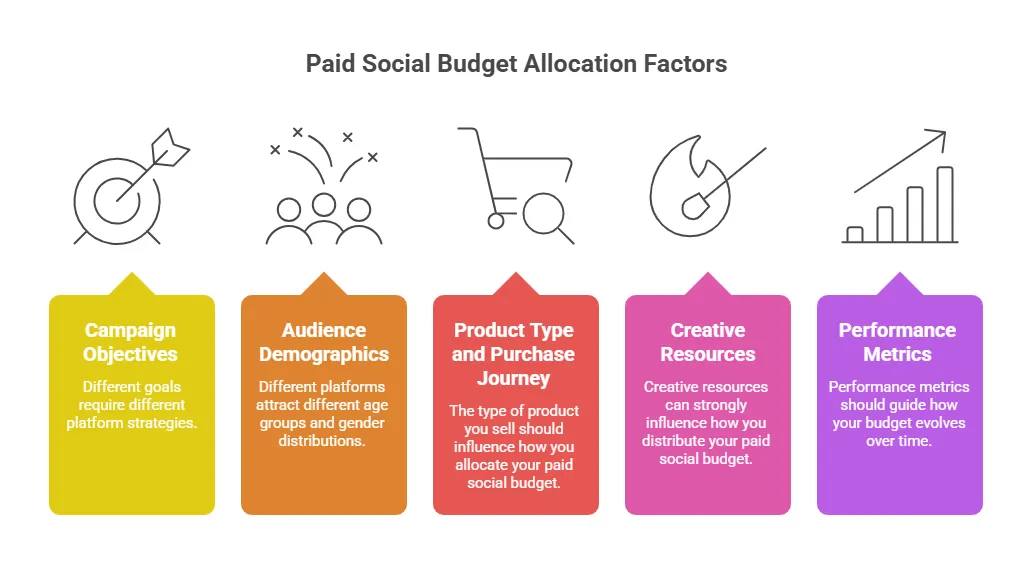
Key Factors That Influence Paid Social Budget Allocation
Your budget allocation should always start with a simple question. What are you trying to achieve with your paid social campaigns?
Different goals require different platform strategies. When the objective is clear, it becomes much easier to decide where your budget should go.
Below, we have shared some key factors that usually shape paid social budget decisions.
1. Campaign Objectives
Campaign objectives play a major role in how you distribute your paid social budget. Awareness campaigns behave very differently from conversion-focused campaigns.
If your goal is brand awareness, platforms that drive discovery and engagement usually perform well. These campaigns focus on reach, impressions, and content visibility.
For consideration campaigns, the goal shifts toward engagement and product education. You want users to interact with your content, visit your site, or explore your product further.
When the objective is conversions, the strategy becomes more performance-driven. Your budget needs to support campaigns that generate purchases, sign-ups, or other measurable actions.
Side note: Data shows that about 73% of internet users research brands or products on social platforms before buying. So, when your campaign goal is sales or conversions, budget allocation should prioritize platforms and formats where product discovery and purchase intent are strongest.
Another important distinction is direct response vs brand building. Direct response campaigns prioritize immediate outcomes such as sales or leads. Brand-building campaigns focus more on long-term audience growth and market visibility.
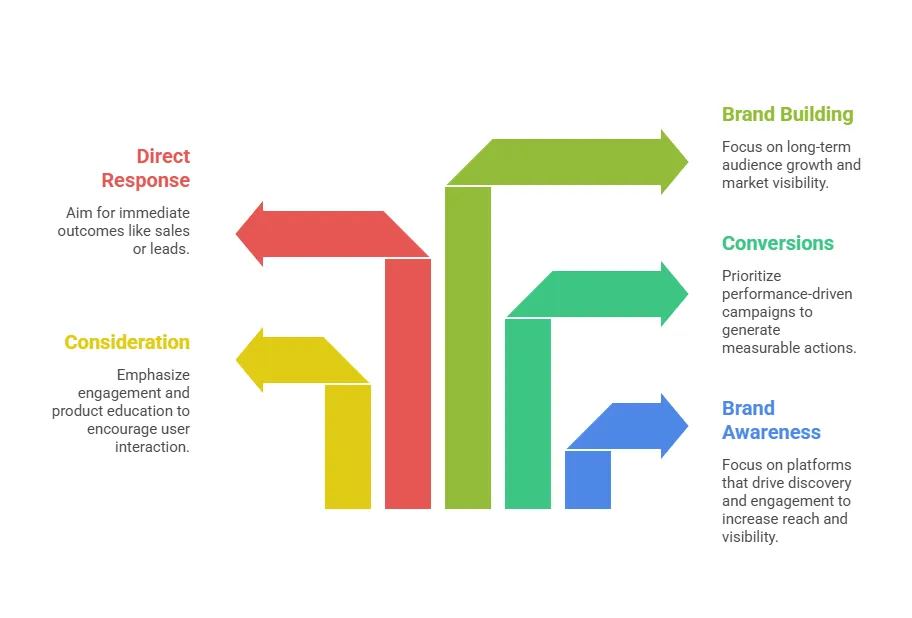
When you align your budget allocation with your campaign objective, your paid social strategy becomes far more efficient and easier to scale.
2. Audience Demographics
Audience demographics should strongly influence how you allocate your paid social budget. Different platforms attract different age groups and gender distributions, which can significantly affect campaign performance.
For example, data from SEO Sherpa shows that TikTok skews toward younger audiences, with around 42% of users aged 18 to 24, while Facebook’s largest age group is 25 to 34, representing roughly 31% of its users.
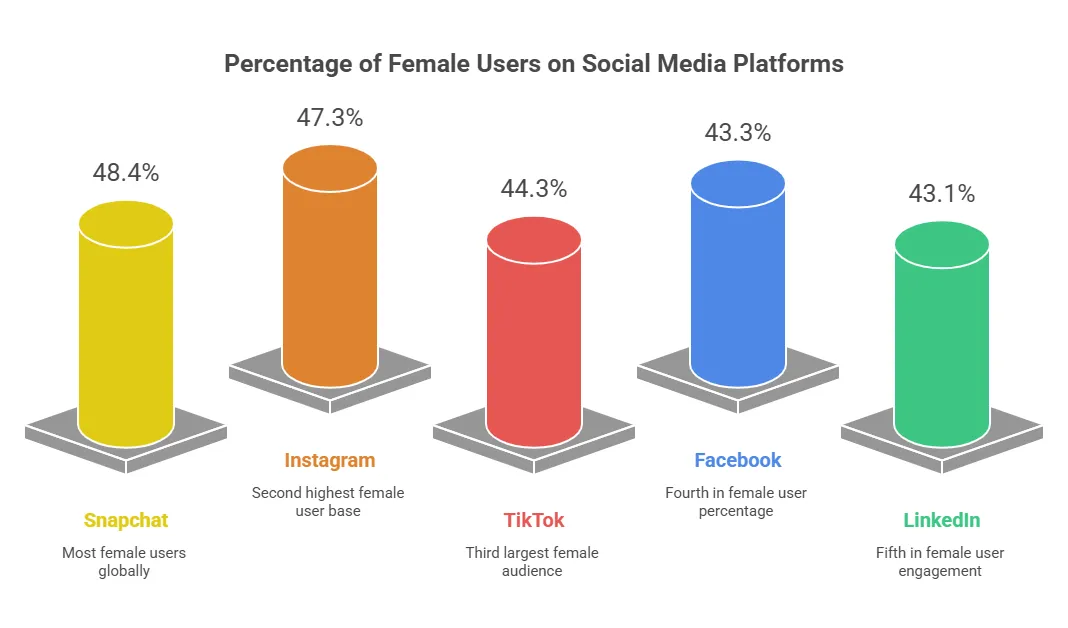
Gender distribution also varies across platforms. Snapchat and Instagram have some of the highest female audience shares, with Snapchat reaching about 48.4% female users and Instagram around 47.3%. These differences can influence where certain products and campaigns perform better.
Content consumption patterns also change from platform to platform. Some audiences prefer fast-paced entertainment content, while others engage more with product discovery or brand storytelling.
We have noticed that campaigns perform more efficiently when budget allocation reflects where your target audience spends time and how they interact with content.
3. Product Type and Purchase Journey
The type of product you sell and your customers’ purchase journey should also influence how you allocate your paid social budget.
For example, today, social platforms play a major role in how people discover and evaluate products. In fact, 82% of customers say social media influences their buying decisions. These behaviors make social advertising an important touchpoint across the entire purchase journey.
Of course, the type of product you promote on social media also matters because:
- High consideration products such as electronics, software, or financial services usually involve longer decision cycles. Buyers spend more time researching, comparing options, and revisiting brands before making a purchase.
- Impulse-driven products follow a different path. Categories like fashion, beauty, or trending consumer goods can convert quickly when discovery happens through engaging visuals or creator-style content.
Pro tip: Product presentation also plays an important role. Visual products perform well with image and video-based ads, while utility products require clearer messaging to explain their value.
From our experience, performance improves when the budget aligns with how customers naturally discover and evaluate a product.
4. Creative Resources
Creative resources can strongly influence how you distribute your paid social budget. Each platform relies on different types of content, and your creative capacity should match those requirements.
This is where performance creative becomes a real factor in budget decisions.
Performance creative is the practice of producing ad content that’s designed from the start to be tested, iterated, and optimized. If your creative pipeline can’t keep up with the testing demands of each platform, your budget will underperform no matter how well it’s distributed.
A few things to consider:
- Short-form video production. If your team can produce short-form video consistently, you can allocate more budget to platforms that reward it. TikTok and Snapchat in particular favor fresh, native-feeling content over polished studio ads.
- UGC and creator-style content. Creator-driven ads and authentic product demonstrations tend to outperform traditional ad formats on paid social because they blend into the feed. This style of content is also the backbone of most performance creative workflows because it’s cheap to produce in volume and fast to test.
- Hook and format testing. Teams that test multiple hooks, formats, and messaging angles find winning creatives faster and keep CPA stable longer. If you’re only producing one or two creative variants per campaign, you’re leaving most of the optimization potential on the table.
- Creative refresh cadence. Paid social creative fatigues. On TikTok especially, a strong ad can burn out in 2-3 weeks. Your budget allocation should account for how quickly you can replenish creative because scaling spend on fatigued creative just accelerates spend waste.
We’ve noticed that brands with a strong performance creative pipeline get significantly more mileage out of the same budget. The creative is what makes the media work.
5. Performance Metrics
Performance metrics should guide how your budget evolves over time. Once campaigns start running, the data tells you where your spend should increase or decrease.
- CPA (cost per acquisition) helps you understand how efficiently a platform generates conversions.
- ROAS (return on ad spend) shows how much revenue each advertising dollar produces.
- CPM (cost per thousand impressions) helps you evaluate media efficiency.
Engagement signals also provide useful insights.
- Hook rates show if your ad creatives capture attention.
- CTR (click through rate) can indicate how well your creatives lead to action.
- The number of shares indicates that your message resonates enough for people to pass it along to their own networks.
- Video watch time shows whether viewers stay engaged with the content because it interests them.
We usually suggest reviewing these metrics regularly. Budget allocation becomes much easier when your decisions rely on real performance data.
Meta vs TikTok vs Snapchat: Platform Strengths for Paid Social Advertising
Choosing where to allocate your paid social budget becomes easier once you understand what each platform does best. Meta, TikTok, and Snapchat all support paid advertising, but they excel at different stages of the customer journey.
Let’s start with Meta.
Meta Ads (Facebook & Instagram)
Meta remains one of the most established paid social platforms. It offers a large audience base and sophisticated ad tools, which make it a reliable channel for performance-driven campaigns.
Meta Ads Key Advantages
- Largest audience reach: Meta gives you access to billions of users across Facebook and Instagram. Facebook ads alone reach more than 2.28 billion users worldwide (as of 2025).
- Advanced targeting capabilities: Detailed audience targeting allows you to reach users based on interests, behaviors, and past interactions.
- Mature conversion optimization: The platform’s algorithm has years of data that help you optimize campaigns for conversions. The platform also continues to scale its ad ecosystem. In one recent reporting period, Meta ad impressions increased by 18% year-over-year, reflecting strong advertiser demand and platform engagement.
Best Campaign Types for Meta
- Conversion campaigns: Drive purchases, sign-ups, or other measurable actions using conversion-optimized campaigns.
- Retargeting: Reconnect with users who already interacted with your brand, visited your website, or engaged with your content.
- Catalog sales: Promote products directly from your e-commerce catalog using dynamic ads that show personalized products to users.
When to Allocate More Budget to Meta
Meta typically becomes the primary platform when performance and conversion stability matter most.
It works particularly well when:
- You are an e-commerce brand that already has customer and pixel data
- You rely heavily on retargeting and bottom-funnel conversions
- You are running catalog sales and performance-focused campaigns
In practice, Meta serves as the backbone of paid social strategies when the focus shifts to consistent conversion performance.
TikTok Ads
TikTok has quickly become one of the most influential platforms for product discovery. Unlike traditional social platforms, TikTok’s algorithm focuses heavily on content discovery, which allows brands to reach new audiences even without a large following.
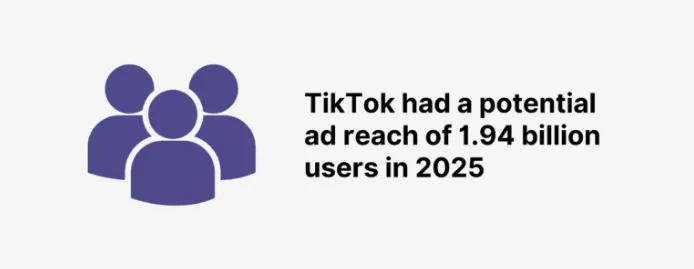
The platform’s growth has been massive. In fact, data from Backlinko shows that TikTok now has over 1 billion monthly active users worldwide.
If your paid social strategy relies on creative storytelling and short-form video, TikTok can play a major role in driving awareness and product interest.
TikTok Ads Key Advantages
- Strong algorithmic discovery: TikTok’s recommendation algorithm surfaces content based on engagement signals rather than follower size. This allows you to reach new audiences even when the account is relatively small.
- High engagement with short-form video: The platform revolves around short-form video, which encourages fast-paced and highly engaging content that captures attention quickly.
- Viral potential: Strong creative can gain traction through shares, comments, and interactions, which allows campaigns to expand reach beyond the initial paid distribution.
This viral dynamic is one reason brands invest heavily in creative testing. In fact, studies show TikTok users are about 1.5X more likely to immediately purchase something they discovered on the platform compared with users on other social networks.
Best Campaign Types for TikTok
- Awareness campaigns: TikTok works well for introducing new features or ideas to large audiences.
- Product discovery: Many users discover new products while scrolling through content and creator videos.
- UGC-driven ads: Creator-style content and authentic product demonstrations perform well because they blend naturally into the feed and feel less like traditional advertising.
When TikTok Deserves a Higher Budget Share
TikTok deserves a larger share of paid social budgets when:
- You are targeting younger audiences, since the platform has a strong Gen Alpha, Gen Z, and younger millennial presence.
- Your products benefit from visual storytelling or trend-driven content.
- Your team is investing in continuous creative testing and short-form video production.
Snapchat Ads
Snapchat can be a strong channel if your brand targets younger, mobile-first audiences. The platform is widely used by Gen Z, and most interactions happen directly through smartphones.
Snapchat’s audience has grown significantly in recent years. The platform now has over 470 million daily active users and around 900 million monthly users worldwide. This makes it one of the largest social networks focused on mobile communication.
.webp)
If you want to reach younger users or promote products through visual and interactive formats, Snapchat can become a valuable part of your paid social strategy.
Snapchat Ads Key Advantages
- Strong Gen Z reach: Snapchat has a large concentration of Gen Z users. The platform reaches about 90% of people aged 13–24 in the United States and more than 75% of users aged 13–34 across multiple countries. This makes it one of the strongest channels for reaching younger audiences.
- Lower CPMs compared to other platforms: Advertising costs on Snapchat can be lower than on some other social platforms. Recent benchmarks show average Snapchat CPMs around $8.39 with average link click costs near $0.90, which can make it attractive for testing campaigns or expanding reach without dramatically increasing budget.
- AR ad formats: Snapchat offers augmented reality ad formats such as lenses and interactive filters. These allow users to interact with products directly inside the app, which can make ads more engaging.
Best Campaign Types for Snapchat
- App installs: If you are promoting a mobile app, Snapchat can drive installs because the platform is heavily used on smartphones.
- Brand awareness: Snapchat’s visual and immersive formats (short video ads, storytelling creatives) help brands reach large audiences and focus on identity, positioning, or values.
- Product launches: Fast content discovery and interactive ad formats (e.g., feature demos, countdown ads) make Snapchat effective for introducing new products and generating early demand.
When Snapchat Performs Best
Snapchat tends to perform particularly well when:
- Your brand targets Gen Z or younger audiences
- Your product or service is designed for mobile-first experiences
- Your campaign uses visual storytelling, AR filters, or interactive formats
We have observed that in many paid social strategies, Snapchat complements platforms like Meta and TikTok. It helps you reach highly engaged younger audiences while keeping advertising costs relatively efficient.
Meta vs TikTok vs Snapchat: Paid Social Platform Quick Comparison
| Platform | Audience Reach | Key Strengths | Best Campaign Types | When to Allocate More Budget |
|---|---|---|---|---|
| Meta (Facebook & Instagram) | 2.28B+ users worldwide | Advanced targeting, strong retargeting, mature conversion optimization | Conversion campaigns, retargeting, catalog sales | When you need consistent conversions and strong bottom-funnel performance |
| TikTok | 1B+ monthly users | Powerful discovery algorithm, high engagement, viral potential | Awareness campaigns, product discovery, UGC-style ads | When targeting younger audiences and creative-driven campaigns |
| Snapchat | 470M+ daily / 900M+ monthly users | Strong Gen Z reach, lower CPMs, interactive AR formats | App installs, brand awareness, product launches | When targeting Gen Z or promoting mobile-first products |
Why Performance Creative Is the Deciding Factor in Paid Social
Budget allocation gets most of the attention in paid social strategy. But the variable that most usually determines whether that budget works is the creative.
You can put the right spend on the right platform at the right time, and still watch your CPA climb because:
- The ad itself isn’t stopping the scroll.
- The hook isn’t landing.
- The format doesn’t feel native to the feed it’s running in.
Performance creative is the discipline that closes this gap because it builds a system: produce multiple variants, test them against each other, identify what’s converting, and refresh before fatigue sets in. Repeat.
This matters for budget allocation in a few concrete ways:
- Creative quality affects how far your budget goes. A strong ad lowers your CPM and CPA across every platform. A weak ad raises them. The same $10K allocated identically across two brands can produce very different returns and the creative is usually why.
- Each platform needs platform-native creative. What works on one platform doesn’t work on another. For example, TikTok rewards content that looks like organic TikTok. Meta rewards clarity and direct response. Running the same asset everywhere is one of the most common ways paid social budgets leak. Your creative budget and your media budget need to be planned together.
- Creative fatigue is a budget problem. When an ad stops performing, it’s tempting to increase spend to chase the same results. But more often, the ad has simply fatigued and the right move is to refresh the creative. However, many marketers jump in to raise the budget if they don’t have a performance creative system. So basically, they tend to burn budget on fatigue without realizing it.
Pro tip: When we help brands allocate budgets, creative production and testing cadence is one of the first things we look at, because it determines how long any allocation model will hold before performance starts to drop.
So after you make sure that your paid social strategy includes a plan for continuous creative production and testing, it’s time to look at different budget allocation frameworks next.
Budget Allocation Models for Paid Social
Now that you understand how different platforms behave, the next step is deciding how to distribute your budget.
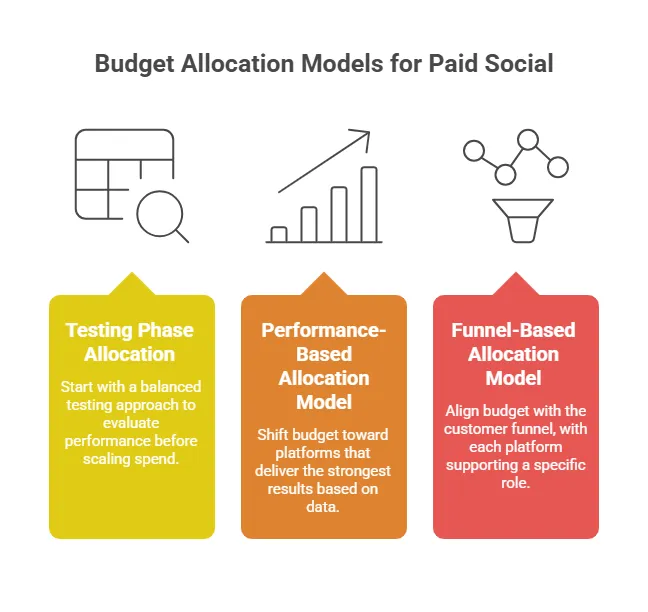
Your paid social budget becomes easier to manage when you follow a structured allocation model. Instead of committing your entire budget to one platform, it helps to start with a balanced testing approach.
Below, we have shared a few allocation models that you can use as a starting point.
1. The Testing Phase Allocation
If you are launching paid social campaigns or entering new platforms, begin with a testing distribution. This allows you to evaluate performance before scaling spend.
A simple starting model many teams use looks like this:
- 50% Meta
- 30% TikTok
- 20% Snapchat
This structure gives Meta a larger share because of its mature ad ecosystem and strong conversion optimization. TikTok receives meaningful budget for discovery and creative testing, while Snapchat helps you test reach among younger audiences.
In our experience working with paid social campaigns, early platform testing reveals valuable performance insights, and marketers often validate how ads appear across different regions using VPNs. Reviewing what is PPTP enables technical teams to evaluate legacy tunneling protocols used in network connections. Once you see which platforms deliver stronger engagement and conversions, you can adjust your budget with much more confidence.
2. Performance-Based Allocation Model
After your campaigns start generating data, budget decisions should shift from assumptions to performance signals.
A performance-based allocation model helps you move budget toward platforms that deliver the strongest results, often supported by external data sources such as the Google scraper API for enhanced competitive and keyword-level insights.
You can begin with a baseline distribution across platforms. This gives each channel enough budget to generate meaningful data.
From there, review the performance metrics and adjust your allocation:
- Shift budget toward platforms with the best CPA and ROAS, so your spend supports campaigns that generate stronger returns
- Reduce spend on underperforming channels while you refine targeting, creative, or campaign structure
- Review performance on a weekly basis to identify trends and make gradual adjustments
In many campaigns we manage, performance-based allocation becomes the most reliable way to scale paid social spend. Once the data shows which platforms drive results, budget decisions become much easier to justify.
Example from one of our TikTok campaigns
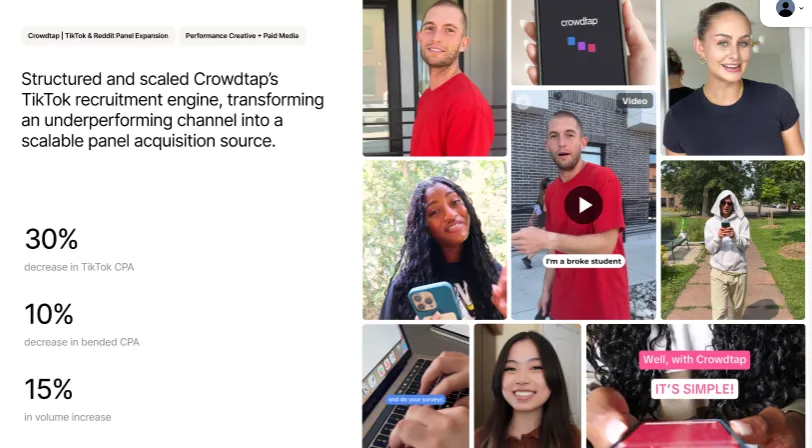
To see how this works in practice, consider a TikTok campaign we ran for Crowdtap.
Our team at inBeat built a structured TikTok creator ad strategy designed to improve recruitment performance. Through continuous creative testing and optimization, the campaign transformed an underperforming channel into a scalable acquisition source.
Results:
- 30% decrease in TikTok CPA
- 10% decrease in blended CPA
- 15% increase in acquisition volume
This example shows how testing creative formats and adjusting platform budgets based on performance data can significantly improve paid social efficiency.
3. Funnel-Based Allocation Model
Another practical way to distribute your paid social budget is to align it with the customer funnel. Different platforms tend to perform better at different stages of the buying journey.
When you structure your budget this way, each platform supports a specific role in moving users from discovery to purchase.
A simple funnel-based allocation might look like this:
- Top of funnel: TikTok + Snapchat to drive discovery and reach new audiences
- Middle of funnel: TikTok + Meta to nurture interest and encourage deeper engagement
- Bottom of funnel: Meta retargeting to convert users who already interacted with your brand
We have learned that this approach works well because it mirrors how people actually discover and evaluate products online. When each platform supports a specific funnel stage, your paid social strategy becomes much more efficient.
Example Paid Social Budget Allocation Scenarios
Budget allocation can vary depending on your brand stage, audience, and campaign goals. Looking at practical scenarios can help you understand how teams distribute spend across platforms.
Here are a few common examples.
E-commerce Brand ($10K Monthly Budget)
If you run an e-commerce store with a moderate monthly budget, a balanced approach can help you capture both conversions and product discovery.
- Meta: $5,000
- TikTok: $3,000
- Snapchat: $2,000
Focus: Conversions and discovery.
In many e-commerce campaigns we have worked on, Meta drives strong bottom funnel conversions while TikTok and Snapchat support product discovery and new audience reach.
DTC Brand Focused on Gen Z
If your brand targets younger audiences, platforms with strong Gen Z engagement deserve a larger share of the budget.
- TikTok: 40–50%
- Snapchat: 30%
- Meta: 20–30%
Focus: Discovery and engagement.
When your audience spends more time on platforms like TikTok and Snapchat, shifting budget toward these channels helps you meet users where they already consume content.
Established Brand Scaling Paid Social
Brands with proven campaigns and conversion data usually prioritize platforms that deliver consistent performance.
- Meta: 60%
- TikTok: 30%
- Snapchat: 10%
Focus: Consistent conversion performance.
Across many scaling campaigns, we notice that Meta typically carries the largest share of budget because of its strong retargeting capabilities and mature ad optimization system.
Example of an in-house Meta campaign
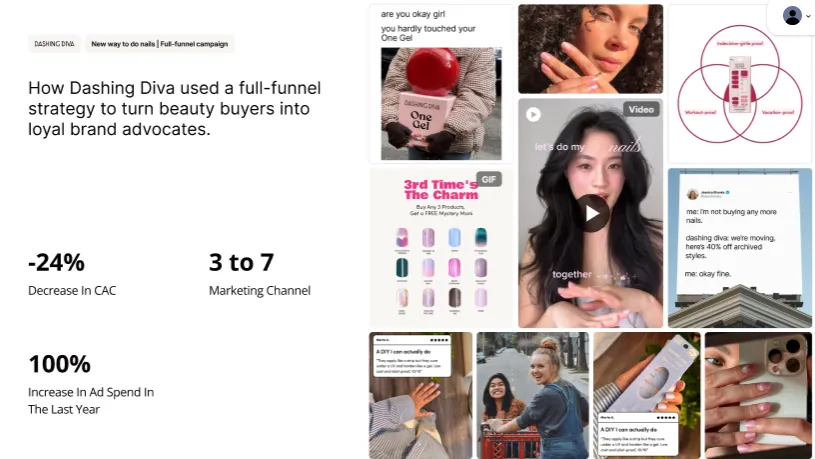
To see how this works in practice, consider a campaign we ran for Dashing Diva.
Our team used a full-funnel paid social strategy and reallocated Meta ad budget toward the campaigns generating the strongest returns.
Results:
- ROAS increased to 2.6 blended (3.6 for bottom-funnel campaigns)
- Summer Sale campaign averaged 4.5 ROAS
- The “Juicy Summer Mani Pedi” ads achieved 5.2 ROAS
Budget was continuously reallocated toward the best-performing campaigns
This example shows how performance data and a full-funnel strategy can improve paid social efficiency while scaling revenue.
Common Budget Allocation Mistakes to Avoid
Even strong paid social strategies can lose efficiency when budget decisions ignore how platforms actually work. We have seen many campaigns struggle because of a few common allocation mistakes.
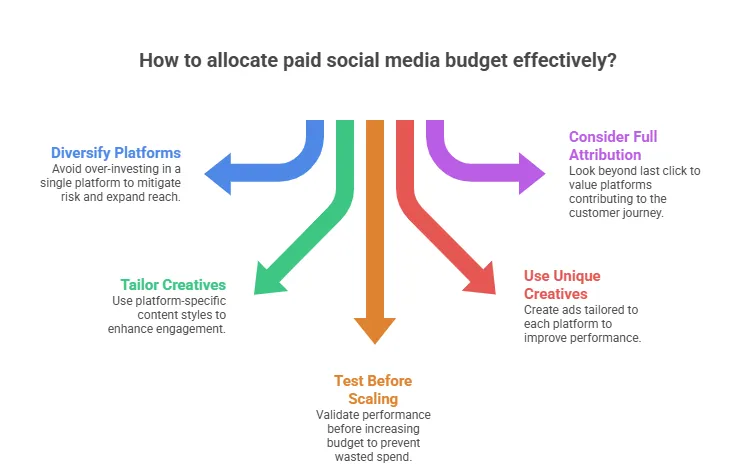
Some of the common issues you should avoid are:
- Over-investing in a single platform: Relying too heavily on one platform can limit your reach and increase risk if performance drops or costs rise.
- Ignoring creative format differences: Each platform favors different content styles, so using the same creative approach everywhere can reduce engagement.
- Scaling too quickly without testing: Increasing the budget before you validate performance can lead to wasted spend and unstable campaign results.
- Using identical creatives across platforms: Ads that work well on one platform may not perform the same way on another because user behavior and content expectations differ.
- Focusing only on last click attribution: Looking only at final conversions can undervalue platforms that play an important role earlier in the customer journey.
- Treating creative as a one-time cost. Performance creative is ongoing. Brands that produce a batch of assets at campaign launch and run them unchanged for months will see CPA rise steadily as creative fatigues regardless of how well the budget is allocated across platforms.
When you avoid such mistakes, you can allocate budgets more confidently and scale performance more consistently.
Build a High-Performance Paid Social Strategy with inBeat Agency
Allocating your paid social budget across Meta, TikTok, and Snapchat requires a clear strategy. When you align your budget with campaign goals, audience behavior, product type, and creative capabilities, your paid social strategy becomes far more efficient.
If you want to build a more effective paid social strategy across platforms like Meta, TikTok, and Snapchat, the team at inBeat Agency can help.
We work with brands to design creator-driven paid social strategies, build performance creative systems that keep creative fresh across Meta, TikTok, and Snapchat, and optimize budget allocation based on real performance data.
Book a free strategy call now.
FAQs
How much budget should I allocate to TikTok ads?
The ideal budget depends on your audience, product category, and creative capabilities. Many brands start with around 20-40% of their paid social budget on TikTok to test discovery and engagement performance before scaling spend.
Is Meta still the best platform for conversions?
Meta remains one of the strongest platforms for conversion-driven campaigns. Its advanced targeting, retargeting capabilities, and mature optimization system help you generate consistent purchases, leads, and other measurable outcomes.
Are Snapchat ads worth it for small brands?
Yes, Snapchat can be valuable for small brands, particularly when targeting younger audiences. The platform offers competitive advertising costs and strong mobile engagement, which makes it useful for testing reach and awareness campaigns.
How often should I reallocate my paid social budget?
Most teams review performance weekly and adjust budgets gradually based on campaign results. Regular optimization helps you move spend toward platforms that deliver stronger engagement, conversions, or return on ad spend.
How does performance creative affect paid social budget allocation?
Performance creative directly impacts how efficiently your budget converts. Strong creative lowers CPA and CPM across every platform, which means a brand with a solid performance creative system can get more from the same budget than a brand running static or fatigued ads.
Appendix
- https://www.dashsocial.com/blog/social-media-statistics
- https://www.hubspot.com/marketing-statistics
- https://seosherpa.com/social-media-growth-statistics/
- https://marketingltb.com/blog/statistics/social-media-marketing-statistics/
- https://datareportal.com/essential-facebook-stats
- https://www.marketingdive.com/news/3-advertising-stats-from-metas-record-holiday-25-period/
- https://backlinko.com/tiktok-users
- https://newsroom.tiktok.com/en-sg/tiktok-is-the-platform-where-content-and-commerce-converge-helping-consumers-discover-and-make-their-next-purchase-sg
- https://www.demandsage.com/snapchat-users/
- https://forbusiness.snapchat.com/advertising/why-snapchat-ads
- https://www.guptamedia.com/insights/snapchat-ads-cost