.svg)
.svg)
.svg)
.svg)


.svg)








Sometimes you’re running ads, spending budget, and seeing numbers move, but it’s not always clear what’s actually driving results.
Programmatic media buying promises efficiency and scale. But we know first-hand that it tends to feel opaque, hard to control, and even harder to measure properly.
You’re on the right page if you want to try this tactic, though.
This guide breaks it down without the usual abstraction.
We’ll give you a clear view of how programmatic actually works using our experience in the field. We’ll also share where it fails and how to structure it so performance holds up in the long run.
Keep reading below.
What Is Programmatic Media Buying In Plain English?
Programmatic media buying is a way to buy ads automatically, using data to decide which impressions are worth paying for. Most brands run this through a full-service paid media agency. Basically, it’s a tactic used in programmatic advertising.
The beauty of it is you’re no longer buying “a website” or “a placement.”
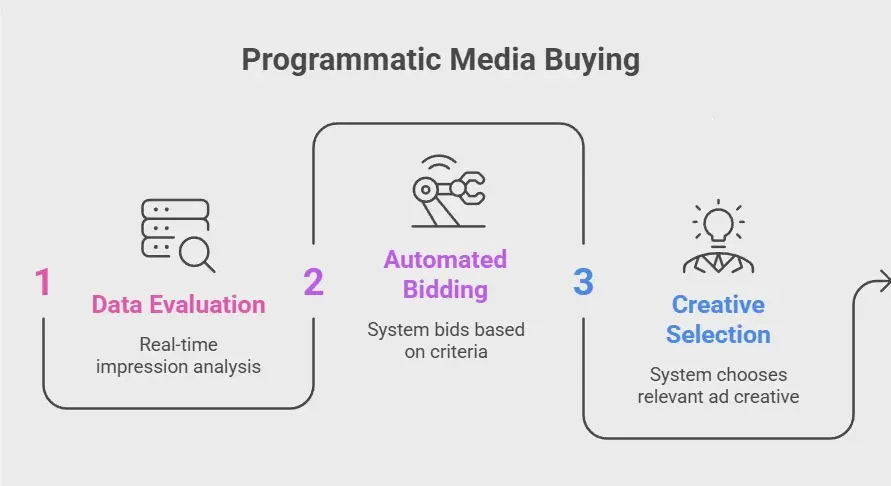
You evaluate each opportunity in real time and bid only when it matches your targeting and goals. Basically, you’re buying individual impressions based on who the user is, what they’re viewing, and how likely they are to convert.
Based on that, the system decides whether to bid, how much to bid, and which creative to show.
The goal is to improve efficiency by only paying for impressions that meet your criteria, while scaling campaigns without manual placement-by-placement buying.
What Programmatic Media Buying Is Not
We’ve been asked this before, and no, programmatic media buying is not retargeting.
Retargeting targets users who’ve already visited your site. Programmatic includes both retargeting and prospecting, where you reach new users based on data and context.
More importantly, it’s not something you can set and forget.
Yes, the buying is automated, but you still define audiences, control budgets, set frequency limits, and adjust based on performance.
Plus, it’s not automatically cheaper. If your targeting is too broad or controls are weak, you can still waste budget at scale.
Also, don’t think it’s limited to display banners.
Programmatic may start with display, but the same buying logic now applies to video, audio, and TV inventory because those formats can also be traded impression-by-impression.
That brings us to the next point:
What Channels Count As Programmatic Today
- Display ads: banner ads across websites, bought impression-by-impression
- Video ads: ads before or during video content, including YouTube-style formats
- Mobile in-app ads: placements inside apps, often tied to device-level signals
- Native ads: ads that match the layout of the platform they appear in
- Digital out-of-home (DOOH advertising): billboards and screens bought through platforms
- Audio ads: ads on music streaming and some podcast inventory
- Connected TV (CTV ads): ads inside streaming apps on smart TVs
Why Did Programmatic Media Buying Take Over So Much Ad Spend?
Programmatic grew because manual media buying doesn’t work that well at scale. Once you’re managing multiple audiences, creatives, and placements, spreadsheets and IOs slow you down and limit what you can test.
Programmatic replaces that with systems that can evaluate, buy, and optimize in real time. That’s what made it the default for performance-focused teams (in fact, programmatic now accounts for over 90% of digital display ad spend in the U.S.).
Speed And Scale Without Manual Buying
Negotiating placements one by one or waiting on approvals to go live takes time. Plus, you can make mistakes.
Programmatic media buying campaigns launch faster because inventory is already available through platforms. More importantly, you can run multiple tests at the same time without creating operational overhead.
Smarter Decisions Per Impression
Each impression is evaluated in milliseconds before a bid is placed. The system looks at:
- Audience signals (behavior, segments, prior interactions)
- Context (page category, content type)
- Placement quality (historical performance, visibility)
- Device and connection type
- Frequency and recency (how often the user has seen your ads)
- Predicted conversion likelihood (when supported)
This allows you to pay for impressions that match your criteria.
Better Control Than People Assume
Programmatic may be automatic, but it’s not less controlled. We like to say it’s more granular because:
- You can set budget pacing and bid caps to control spend.
- You define frequency limits to avoid overexposure.
- You choose where ads can and cannot appear through inclusion and exclusion lists.
On top of that, you control geo, device, and time targeting, and you can restrict buying to specific deals or curated supply.
Basically, the system executes, but the rules are yours.
How Does Programmatic Media Buying Actually Work Step By Step?
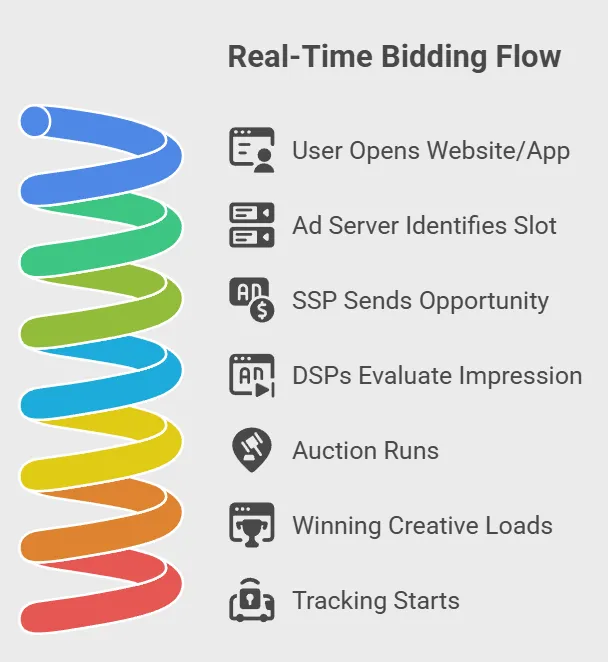
Here’s the simplest way to think about it: a user opens a page, that page creates an ad opportunity, and multiple systems decide in real time whether that impression is worth buying.
The Real-Time Bidding Flow In Simple Steps
- A user opens a website or app.
- The publisher’s ad server identifies an available ad slot and triggers a request.
- The SSP (supply side platform) sends that opportunity to an ad exchange or directly to buying platforms.
- DSPs (demand side platforms) evaluate the impression based on the advertiser’s targeting, bid rules, and campaign goals.
- The auction runs, and the winning bid is selected.
- The winning creative loads, and tracking starts recording delivery signals such as impressions, clicks, and viewability.
All of this usually happens in a fraction of a second, before the page fully finishes loading.
Where Data Shows Up In The Flow
Programmatic does not wait until after delivery to use data. Data shapes the bid before the ad is even shown.
Here’s how great programmatic agencies use data to improve performance:
- First-party signals: site visits, product views, CRM segments, or past actions tied to the user
- Contextual signals: page category, keywords, content type, or brand suitability labels
- Device and location signals: device type, operating system, browser, IP-based location, and sometimes connection type
- Measurement settings: tracking tags, attribution rules, conversion definitions, and reporting logic
These signals help buyers decide whether the impression fits the campaign and how much it is worth.
What “Automation” Really Means Here
Automation handles the transaction, but the thinking is still yours.
The platform can process thousands of bid opportunities in real time, but marketers (aka real humans) still decide the objective, budget, audience, inventory rules, creative, and success criteria.
In other words, programmatic automates execution. Strategy, structure, and evaluation still come from the team running it.
What Are The Main Types Of Programmatic Deals You Can Buy?
Not all programmatic inventory is bought the same way. The buying route you choose affects cost, control, and where your ads actually appear. Treat this as a spectrum, from open access to fully controlled placements.
Open Auction
This is the default model. You bid on any available impression across a large pool of publishers.
It gives you reach and scale, but quality varies a lot, so you need strong controls in place to keep things efficient and safe. (We’re not just babbling here; unfortunately, ad fraud in open exchanges is a real issue, with digital ad fraud losses projected to hit $100 billion globally in 2026).
Pros:
- Maximum reach and volume
- Good for testing audiences and creative quickly
- Usually lower CPMs at the surface level
Cons:
- Inconsistent inventory quality
- Higher exposure to fraud or low-value placements
- Requires strict exclusions and verification to perform well
Private Marketplace Deals (PMPs)
PMPs are invite-only auctions with selected publishers or curated inventory.
You still bid in real time, but within a smaller, controlled pool of supply.
Pros:
- Better control over where ads appear
- Stronger brand safety and content alignment
- Often higher-quality inventory
- Higher viewability (even above 70%)
Cons:
- Higher CPMs than open auction
- Less scale
- Still requires testing to prove performance
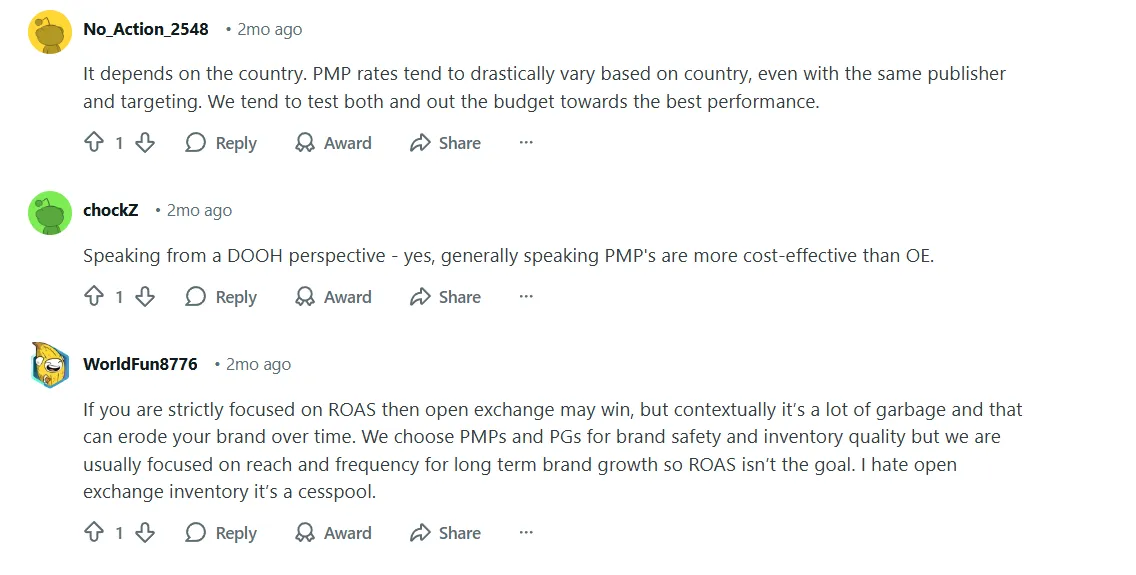
Of course, opinions are mixed: performance varies by country; some say PMPs outperform open exchange on cost and quality, while others prefer open exchange for ROAS despite brand safety concerns.
Programmatic Direct
This is the closest thing to traditional media buying, but executed through programmatic platforms.
You agree on a fixed price and reserve inventory in advance.
Pros:
- Predictable delivery and reach
- Access to premium placements
- Easier planning for campaigns with fixed goals
Cons:
- Less flexibility once deals are set
- Higher upfront cost
- Limited ability to optimize at the impression level
Curated Marketplaces And Supply Paths
These are pre-packaged sets of inventory, usually filtered by quality, category, or performance signals.
They simplify buying decisions but also add another layer between you and the supply.
Why it matters: the path your bid takes affects fees, transparency, and performance. Cleaner supply paths usually mean better control and less wasted spend.
How Do Targeting And Bidding Work In Programmatic Media Buying?
We know you want to reach larger audiences, but programmatic performance comes from reaching the right people under the right conditions, and bidding accordingly.
Targeting defines who you want, and bidding defines how much each impression is worth. Here are the options and models to consider:
Targeting Options That Matter In Practice
- First-party audiences: Users who already interacted with your site or brand (visitors, product viewers, CRM lists). These are usually your highest-converting segments.
- Contextual targeting: Ads placed based on what the user is currently viewing, such as page category, keywords, or content type. Useful for prospecting without relying on user tracking.
- Geo and device: Location, device type, operating system, and connection details. Helps align delivery with where and how users are most likely to convert.
- Publisher and placement controls: Allowlists, blocklists, and app lists. These define exactly where your ads can or cannot appear. Here’s a quick tutorial on that:
- Lookalikes and platform modeling: Audiences built by the platform based on patterns in your data. Useful for scale, but results vary, so they need testing and validation.
Pro tip: Read more about the best targeting strategies that maximize campaign ROI, along with our in-house experience.
Bidding Models You’ll See Most
- CPM (cost per thousand impressions): You pay for every 1,000 impressions served, regardless of whether users click or convert. This is the default model because programmatic buys impressions first, then optimizes outcomes on top of that. That’s also why viewability became such a big deal: under the MRC/IAB standard, a display ad counts as viewable only when at least 50% of its pixels are in view for 1 continuous second; for video ads, it’s 50% for 2 continuous seconds.
- vCPM (viewable CPM): You only pay for impressions that meet a minimum visibility threshold. This reduces wasted spend on ads that load but are never seen, but it doesn’t guarantee attention or engagement.
- CPC (cost per click): You pay only when someone clicks. Less common in pure programmatic because inventory is still traded on impressions behind the scenes, and clicks don’t always correlate with quality traffic.
- Optimized bidding (CPA / ROAS goals): The platform adjusts bids dynamically based on the likelihood of a conversion or revenue event. Instead of bidding a fixed amount, you let the system increase bids for higher-value impressions and reduce bids for lower-value ones.
What changes here is the bid decision, not the buying model. You are still purchasing impressions. The platform is just deciding how much each impression is worth based on your goal.
How to Protect Your Budget with Programmatic Media Buying
- Frequency caps: Limit how many times a single user sees your ad within a defined window (e.g., 3 impressions per day). Without caps, platforms will keep showing ads to the same users because they’re easy to reach.
- Recency windows: Define how soon you re-target users after an action (e.g., visited product page in the last 3 days vs 30 days). Faster isn’t always better. In a study of more than 40,500 customers, shoppers who got cart-retargeting ads within 30 minutes to 1 hour after abandonment were less likely to purchase than the control group, suggesting that retargeting too early can backfire.
Warning: The first few impressions may drive awareness or action, but repeated exposure quickly loses impact. After a point, you’re paying to remind users who have already decided not to convert.
How Do You Measure Programmatic Performance Without Bad Attribution?
Programmatic can look efficient in-platform and still fail to drive real growth. The issue is misreading your data. Below, we’ll show you the metrics you need, the attribution traps that most new marketers fall into, and a few best practices to streamline the process.
Programmatic Media Buying Metrics
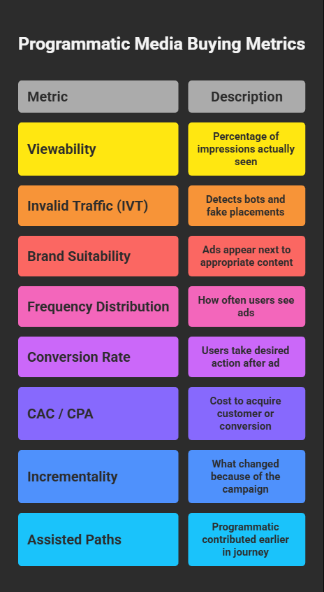
Delivery quality (are you buying clean, effective impressions?):
- Viewability: Percentage of impressions that were actually seen (e.g., at least 50% of the ad in view for 1 second). Low viewability means you’re paying for ads no one had a chance to notice.
- Invalid traffic (IVT): Detects bots, fake apps, or manipulated placements. High IVT means part of your spend never reached real users.
- Brand suitability: Shows whether ads appeared next to appropriate content. Poor suitability doesn’t always hurt performance immediately, but it creates long-term risk.
- Frequency distribution: Shows how often users see your ads. If a small group gets most impressions, you’re overspending on repetition instead of expanding reach.
Business impact (is this driving outcomes you care about?):
- Conversion rate: How many users take the desired action after seeing or clicking an ad. A rising rate usually signals better audience or creative alignment.
- CAC / CPA: How much do you pay to acquire a customer or conversion? This is the closest link between media spend and profitability.
- Incrementality: Measures what changed because of your campaign, not just what was tracked. Incrementality testing is usually done through holdouts or geo splits.
- Assisted paths: Shows where programmatic contributed earlier in the journey. Useful for context, but not proof of impact on its own.
TL;DR: Delivery metrics tell you if your buying is clean, while business metrics tell you if it’s worth continuing.
Common Attribution Traps
- Counting post-view conversions from users who were already about to convert
- Optimizing toward clicks, which often brings low-intent traffic
- Relying on last-click, which ignores earlier influence
- Reporting conversions that would have happened without ads
We advise you to avoid these mistakes because they push algorithms to spend more on the wrong impressions.
A Simple Measurement Setup That Works For Most Teams
- Define conversions clearly and consistently.
- Split prospecting and retargeting in reporting from the start.
- Use holdout or geo tests to measure real lift.
- Keep naming and UTMs clean so data matches across tools.
- Compare platform-reported results with verification and external tracking.
This won’t eliminate attribution issues, but it keeps your decisions grounded in reality.
What Are The Biggest Risks In Programmatic Media Buying And How Do You Reduce Them?
Programmatic gives you scale and efficiency, but it also makes it easy to spend money in places you wouldn’t choose manually. Most issues come down to three areas: fraud, placement quality, and lack of transparency.
Ad Fraud And Invalid Traffic
Fraud doesn’t always look obvious. It can include bots generating fake impressions, domain spoofing where low-quality sites pretend to be premium publishers, or app environments designed purely to farm ad spend.
The impact is simple: you pay for impressions that never had a chance to influence a real user.
To reduce this:
- Use verification vendors to detect invalid traffic and suspicious patterns
- Apply supply filters and avoid unknown or low-quality exchanges
- Watch for anomalies (very high CTR, low engagement, sudden spikes in volume)
Under the hood, fraud filtering works a lot like detection engineering in cybersecurity: detection rules need constant tuning, or they either miss new fraud tactics or flag so much legitimate traffic that you lose good inventory.
Brand Safety And Brand Suitability
Even if impressions are real, they may appear next to content that damages your brand or simply doesn’t align with your positioning.
- Category exclusions: block sensitive or irrelevant content categories
- Context controls: filter placements based on keywords or content signals (use carefully to avoid over-blocking)
- Allowlists and curated deals: prioritize known, trusted publishers
- Pre-bid vs post-bid protection: prevent bad placements before bidding, then verify after delivery
This is not just about avoiding risk. It also improves performance by keeping ads in relevant environments and has a direct impact on how people perceive your brand. In fact, over 68% of consumers say they would lose trust in a brand if its ads appear next to offensive content.
Transparency And Fee Layers
Low CPMs can hide high inefficiency. Every step in the supply chain can add fees, and unclear supply paths make it hard to know where your ads actually ran.
To manage this:
- Prioritize cleaner supply paths where possible
- Ask partners how they select inventory and optimize campaigns
- Request clarity on fees, markups, and intermediaries
If you can’t explain where your ads appeared and how money moved, you’re likely overpaying somewhere.
How Do You Set Up And Optimize a Programmatic Campaign Without Wasting Spend?
Most wasted spend comes from two issues: weak setup and random optimization. If you don’t structure campaigns correctly from the start, no amount of tweaking later will fix it. The goal is to build a clean foundation, then optimize in a controlled way.
Here’s a plan that most programmatic agencies follow:
Week 1: Build Structure And Remove Obvious Waste
Start with one primary objective per campaign so bidding and optimization don’t conflict. Also, we advise you to separate prospecting and retargeting from day one to avoid inflated results.
Set up your audience hierarchy: first-party segments, then contextual targeting, then modeled audiences if needed.
Remember: Choose inventory based on your goal. Use open auction for testing with strict filters, or curated deals if you need more control.
Before scaling anything, verify tracking and conversion events. Check early delivery signals like viewability, frequency distribution, and basic geo/device performance. Pause placements that show clear issues, such as extremely low viewability or abnormal engagement.
Week 2: Tighten Targeting And Inventory
In this step, you’re narrowing into what works, so:
- Promote the audiences and contextual categories that are actually performing, and reduce spend on broad or underperforming segments.
- Test a higher-quality supply. Compare curated deals or PMPs against open auction to see if better inventory improves results, not just CPMs.
- Adjust bid caps and pacing so more budget flows toward stronger segments.
Week 3: Improve Creative And Conversion Path
Once targeting and supply are stable, creative becomes the main lever. In our experience, many campaigns do well in the targeting stage but underperform here. To avoid that:
- Rotate new variants and remove weak ones quickly.
- Test different messages by audience segment instead of using the same angle everywhere.
- Check landing pages as part of optimization. Make sure the message matches the ad, pages load fast, and the path to conversion is clear.
Week 4: Validate Impact And Scale Intentionally
It seems obvious to say it, but before scaling, confirm that your performance is real.
And don’t just rely on platform-reported conversions, either. Use holdout groups or geo-comparisons, if available, to measure actual impact.
The next step is to assign budgets to segments that show consistent results. Avoid expanding everything at once. Scale what’s proven.
Pro tip: Document what worked across audience, supply, bidding, and creative. This becomes the starting point for the next cycle, so you don’t repeat the same tests.
What Mistakes Make Programmatic Media Buying Underperform?
These are the patterns behind “programmatic didn’t work for us” that we’ve seen most often:
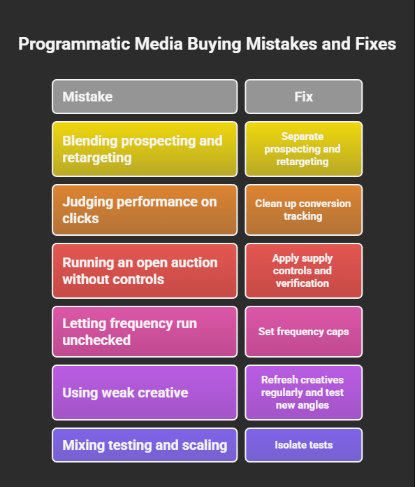
The Most Common Mistakes
- Blending prospecting and retargeting: Results look strong because retargeting inflates conversions. The problem is that in reality, prospecting may be underperforming.
- Judging performance on clicks: Clicks can come from low-intent users and don’t reflect real impact.
- Running an open auction without controls: A broad ad inventory with no verification leads to wasted spend and poor ad placements.
- Letting frequency run unchecked: The same users see ads too often, driving up cost without improving results.
- Using weak creative: Targeting can’t compensate for unclear messaging or poor offers.
- Mixing testing and scaling: Changes happen inside active campaigns, making results hard to interpret.
Quick Fixes That Usually Improve Results Fast
- Separate prospecting and retargeting in both setup and reporting.
- Apply supply controls and verification from the start.
- Clean up conversion tracking so results reflect real actions.
- Set frequency caps to avoid overexposure.
- Refresh creatives regularly and test new angles.
- Isolate tests so you can clearly see what changed the performance.
Improve Programmatic Ad Buying with inBeat
Programmatic media buying is a system that rewards structure, clarity, and consistent optimization.
When done right, it gives you control at the impression level, scalable testing, and more efficient spend. When done poorly, it amplifies waste.
The difference comes down to how well you connect targeting, supply, creative, and measurement.
If you want programmatic to drive real growth, the setup matters more than the platform.
Want help building or fixing your programmatic strategy? The team at inBeat Agency can help you structure campaigns, improve creative, and turn media buying into measurable performance. Get in touch today to set up a plan!
FAQs
What is a programmatic media buy?
A programmatic media buy is the automated purchase of digital ad impressions using platforms and data. Instead of selecting placements manually, advertisers bid on individual impressions in real time based on targeting and campaign goals.
What are the key components involved in programmatic media buying?
The core components include DSPs (where advertisers buy ads), SSPs (where publishers sell inventory), ad exchanges (where auctions happen), ad servers, and data tools like CDPs. Together, they enable targeting, bidding, delivery, and measurement.
How does programmatic media buying differ from traditional media buying?
Traditional media buying involves manual negotiations and fixed placements. Programmatic buying evaluates and purchases impressions in real time, allowing for more precise targeting, faster execution, and continuous optimization.
What role do algorithms play in programmatic media buying?
Algorithms evaluate each impression and decide whether to bid, how much to bid, and which ad to show. They use signals like user behavior, context, and past performance to optimize toward campaign goals such as conversions or revenue.
What are the advantages and disadvantages of programmatic media buying?
Advantages include scale, efficiency, precise targeting, and real-time optimization. Disadvantages include complexity, risk of fraud, and potential mismeasurement if attribution and tracking are not set up correctly.
What is an example of media buying?
An example of media buying is running display ads across multiple websites through a DSP. Instead of choosing sites manually, the platform bids on impressions that match your audience and shows ads to users in real time.
Programmatic Media Buying Glossary: Key Terms Explained
If you understand who does what, you can quickly spot where things go sideways. Plus, you can pick the right tools for your needs. Let’s review them below:
DSPs, SSPs, And Ad Exchanges
- DSP (Demand-Side Platform): This is where advertisers buy inventory. You set targeting, budgets, bids, and rules here. This is your control center for execution.
- SSP (Supply-Side Platform): This is where publishers sell their inventory. They decide pricing floors, package inventory, and control which buyers can access it.
- Ad exchange: That’s the marketplace connecting DSPs and SSPs. This is where auctions happen, and impressions are matched between buyers and sellers.
Pro tip: We wrote an in-depth guide on how to choose the best SSPs and ad exchanges, if you want to dive deeper into this topic.
Ad Servers And Measurement Tools
- Ad server: Delivers creatives, rotates versions, and tracks campaign performance metrics like impressions and clicks. It’s also where you keep consistency across campaigns and platforms.
- Verification vendors: Measure things platforms don’t always report reliably, like viewability, invalid traffic (fraud), and brand safety issues.
- Attribution and incrementality tools: Help you understand what actually drove results, not just what got credit in-platform. Without these, programmatic can look better than it really is.
Data Tools (DMP/CDP) And Identity
- CDP (Customer Data Platform): Collects and activates first-party data like site behavior or CRM segments. This is what powers your highest-quality audiences.
- DMP (Data Management Platform): Older systems used to manage third-party audience data. Still relevant in some setups, but less central than before.
Identity approaches: How users are recognized across impressions. This can include cookies, device IDs, contextual signals, publisher IDs, or clean room setups.