

Ask five media buyers how many ad creatives per month you need and you'll get five quotas: twenty, forty, sixty, a hundred. Each one fits the account it came from, and none of them transfers to yours, because the number is an output.
It falls out of three inputs:
- How much you can spend on testing
- What a conversion is worth to you
- How fast each platform burns a winner once it has one
Most teams that miss the number are counting the wrong unit. This article gives you the sizing method.
At inBeat, our work with Hopper involved delivering 300+ creative assets monthly across three paid media acquisition platforms. Within three months, Hopper’s overall user acquisition cost fell by 20%.
That gives the volume question a practical context: asset output matters when it supports better acquisition performance. The right monthly count still depends on what your account can test and scale.
P.S. If the brief keeps asking for more files than the budget can read, inBeat's ad testing team plans concepts, variants and spend together.
TL;DR: How Many Ad Creatives Per Month You Need
Two numbers drive everything below: next month's testing budget and your target CPA.
- Volume is derived from spend, target CPA and hit rate. Size the number of concepts your budget can read to a verdict.
- A concept has a readable verdict once its test ad has spent roughly three to five times target CPA. Divide the monthly test budget by that figure and you have your ceiling on concepts.
- Too few concepts and you miss the winner; too many and the spend spreads so thin that nothing produces reliable data. Both failures show up as unreadable results, which get misdiagnosed as bad creative.
- Concepts, variants and files are three different numbers. The testing budget funds one lead ad per concept; variants come later, for the concepts that win.
- Platforms fatigue at different speeds. TikTok can spend a winner in days at high daily budgets, so refresh cadence is diagnosed per channel.
Hypothetical: a brand with a $30,000 test budget and a $100 target CPA was handed a sixty-creative quota. Run the math and sixty sits inside its readable ceiling, but only if those sixty are concepts. If the sixty are files, the account is testing far fewer ideas than the quota suggests.
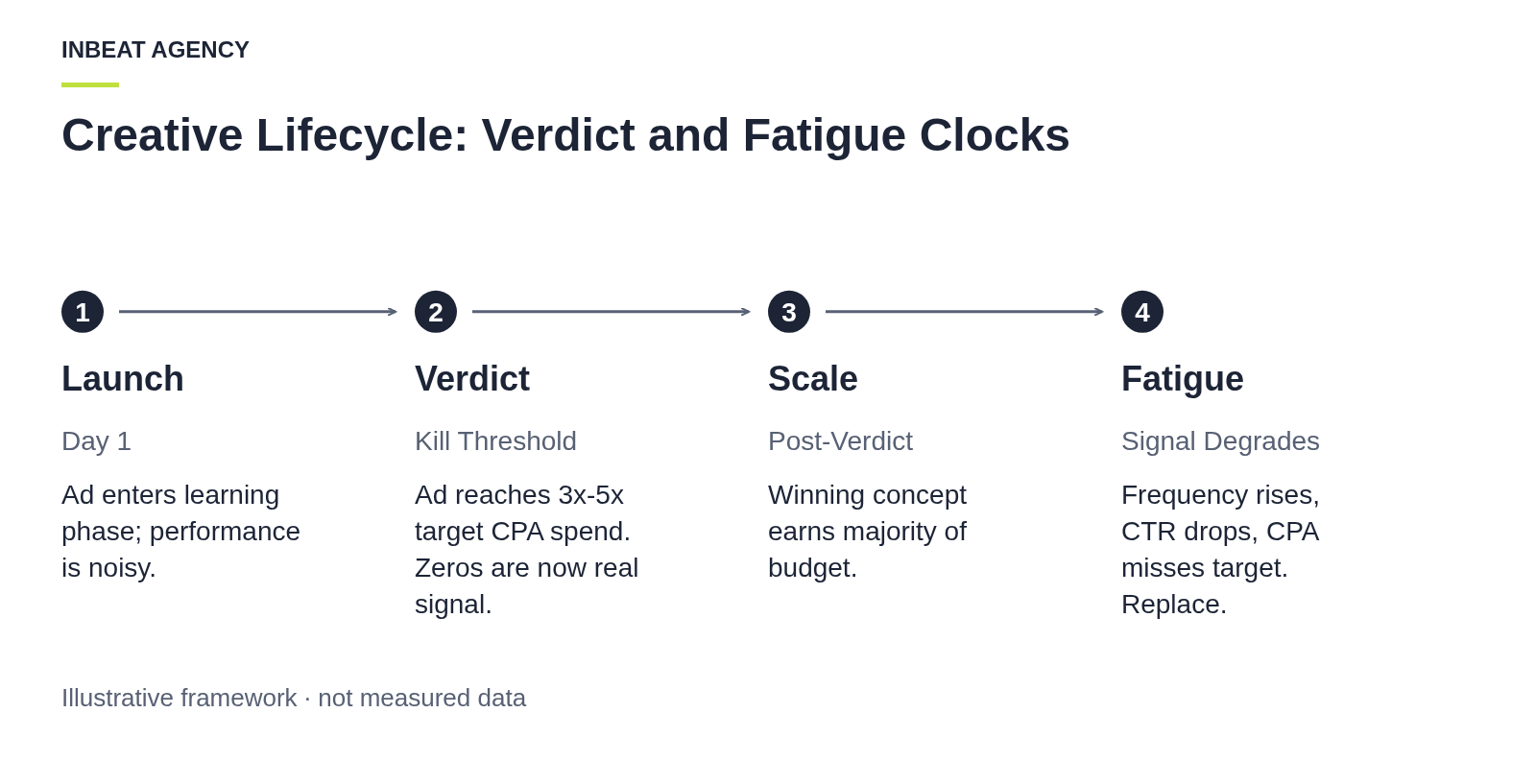
A note on our MO: We treat the monthly creative number as an output of the media plan. Media buying is the laboratory. Every concept goes in as a dark post, spends to a verdict, and either earns scale or gets switched off with the learning banked.
So the only volume worth funding is the volume your budget can actually read, and the only creative worth counting is a concept your audience can tell apart from the last one. Creators give us that concept supply at volume, matched by persona, while the media buy handles reach. Make, launch, read, repeat, and let CAC write next month's brief.
What Is the Difference Between Ad Concepts, Variants and Files?
Three groups count creative in three different units, and only one of those units answers the monthly question. The brief counts ideas. Production counts deliverables. The delivery algorithm learns from something in between. Until everyone agrees on the unit, the same brief will look like six, thirty or two hundred depending on who reads it.
What Is an Ad Concept?
A concept is defined by its underlying audience, promise or angle: a new persona speaking, a new problem framed, a new reason to believe. Your audience would recognize it as a different pitch. A new opening hook on the same pitch is a variant, covered below.
This is the unit that matters for sizing because it generates independent signal.
When you learn that a skincare concept built around a night-shift nurse outperforms one built around a bride, you have learned something about your market. When a 4:5 crop outperforms a 9:16 crop, you have learned about placements.
In this framework, each concept is tested through one lead ad. That lead ad is the unit the testing budget funds.
What Is an Ad Variant?
A variant keeps the concept's audience, promise and angle and moves one lever: a different first three seconds, a fifteen-second cut of a thirty-second original, captions on or off, a different offer card at the end.
Variants are cheap to produce and valuable once a concept has earned scale, because they extend a winner's life and pick up incremental gains.
Most of their performance is inherited from the parent concept, so they say little about which message works. We produce variants for concepts that already won, funded from the scaling side of the budget.
What Is an Ad File, and Why Does the File Count Multiply?
A file is what production hands over: one asset, one ratio, one platform spec. This is where planning quietly explodes.
In Digital Polo's production breakdown, thirty variants on Meta alone come to about seventy-five files, and the same thirty across Meta, TikTok and Performance Max come to around two hundred and ten. A brief that felt like six ideas became a two-hundred-file month. Digital Polo treats the variant as the unit you test, which is why its counts run higher than this framework's. The multiplier also depends on which platforms and placements you run, so a Meta-only account faces a fraction of that load.
| Unit | What changes | What the algorithm treats as new | Who counts it | Typical multiplier |
| Concept | Audience, core promise or angle | A genuinely new creative signal | Strategist writing the brief | Starting unit; one lead ad each in testing |
| Variant | Hook, length, caption or offer card on a fixed concept | Mostly inherited signal from the parent | Media buyer building the ad set | Two to five per winning concept, your choice |
| File | Ratio, spec or platform export of a fixed ad | Nothing new | Production and the agency quote | Roughly two to three per ad on Meta; seven to nine across Meta, TikTok and Performance Max in Digital Polo's example |
The concept and variant multipliers are planning choices you set; the file row follows Digital Polo's example and will shift with your platform mix. The planning worksheet is: files = (concept test ads + winning concepts × variants per winner) × files per ad per platform.
Before you size next month, re-label last month's creative log into those three columns.
Most teams find their "forty creatives" were eight concepts, and the sizing math in the next section should run on eight. That re-labeling is the first thing we do when building a creative strategy, because the quota conversation ends once everyone sees the same three numbers.
How to Size Monthly Creative Volume to Your Ad Spend in Four Steps
Set the kill threshold first, then let it size everything else. That single rule turns budget and CPA into a ceiling on concepts.
Step 1: Set the Kill Threshold at Three to Five Times Target CPA
- Take your target CPA and multiply by three for an aggressive account or five for a conservative one. Below that spend, a zero-conversion result is consistent with a good creative that got unlucky; above it, a zero is real information. Pick the higher multiple if your CPA swings week to week.
- Write the threshold into the media plan as a spend figure per concept test ad, and treat it as the point where a verdict becomes legitimate. Killing earlier throws away creatives that might have worked; holding longer wastes spend on ones that never will.
Step 2: Divide the Monthly Test Budget by That Threshold
- Decide what share of total spend goes to testing. That decision is yours, and it sets the ceiling.
- Divide the monthly test budget by the kill threshold and round down. The result is the maximum number of concepts that can each reach a verdict this month, with one lead ad per concept. This protects against both failure modes admanage.ai describes: teams that test too few and miss their winner, or spread budget so wide that no ad gets enough spend to produce reliable data.
Step 3: Adjust for Hit Rate and Scaling Budget
- Estimate your own hit rate from history: how many concepts out of ten have earned scale. A hit rate from another account won't transfer. If one in eight wins and you want three new winners a month, you need roughly twenty-four readable concepts, so the test budget has to cover twenty-four thresholds.
- Check that the remaining budget can fund the winners, and their variants, at the scale you expect. If the test ceiling eats the scaling budget, cut concepts before you cut the spend behind proven ads.
Step 4: Rerun the Math for High-CPA Accounts
- Rerun steps one and two with the real CPA of a B2B or high-ticket account. Velocity claims from DTC fall apart at a $600 target CPA, because the same budget reads a fraction of the tests.
| Monthly test budget | Target CPA | Kill threshold (3x to 5x CPA) | Readable concepts per month (rounded down) | Notes |
| $10,000 | $50 | $150 to $250 | 40 to 66 | Low-CPA ecommerce reads fast even on modest budgets |
| $20,000 | $100 | $300 to $500 | 40 to 66 | The mid-market DTC case most guides implicitly assume |
| $30,000 | $100 | $300 to $500 | 60 to 100 | A sixty-creative quota is plausible here, and only here |
| $20,000 | $600 | $1,800 to $3,000 | 6 to 11 | Same budget as row two, one sixth of the readable tests |
| $50,000 | $400 | $1,200 to $2,000 | 25 to 41 | Enterprise SaaS needs large budgets to test like a DTC brand |
Every row is a hypothetical worked example of the formula, and every range assumes the full stated amount is testing budget. None is an industry benchmark.
The table answers the headline question.
At $20,000 and a $100 CPA you can read between forty and sixty-six concepts. Change nothing but the CPA to $600 and the same money reads six to eleven. A B2B team that copies a DTC creative calendar will spend a month producing forty concepts and get verdicts on six to eleven of them.
The practical output of the four steps is a sentence in the media plan: "Next month we will launch N concepts, each funded to X dollars before we judge it, and the remaining budget scales last month's winners." Commit to N. When the brief asks for more, point at the threshold.
This is the part of the framework where media buying and creative have to share one plan, which is how inBeat runs paid media: concepts sized to what the budget can read, then scaled only after they earn it.
For Who Gives A Crap, inBeat delivered 60+ creative assets per month with 15+ content creators as part of a paid social and performance creative program for the U.S. market. The program was designed to test creative at volume and scale the winners.
Those 60+ assets describe production output; they should not be read as 60 distinct concepts or a monthly target for every brand.
How Does Meta Andromeda Affect How Many Ads You Test at Once?
Andromeda changes how Meta retrieves and ranks ads; your budget still reads the same number of ads. Meta's engineering team describes Andromeda as a next-generation personalized ads retrieval engine built to power Advantage+ automation.
The post doesn't quantify what Andromeda does to optimal ad set size, so the guidance here stays at the level of testable structure, which is where the real failure lives.
Why Does Budget Fragmentation Break Creative Tests?
The most common structural mistake is putting twenty ads into one ad set on the theory that the algorithm will find the winner. Each ad then competes for the same daily spend, delivery skews toward whichever ads earn early engagement, and most of the rest never approach the kill threshold.
That's the fragmentation failure from Step 2. No retrieval or ranking upgrade fixes it, because the missing ingredient is spend per concept, and that's a number you control.
Let’s take this example:
An ad set spends $500 a day at a $100 target CPA and holds twenty ads. A 3x threshold means each ad needs $300 before its verdict counts, or $6,000 across the set. One week of spend is $3,500, and it won't be distributed evenly, so most ads finish the week with a few dollars of spend and a zero. Those zeros feel like verdicts. They're noise.
Do Near-Duplicate Ads Count as New Tests?
- What counts as new goes back to the concept definition: a different audience, promise, or angle that the audience can perceive. A resize or caption swap is a new file.
Loading an ad set with near-duplicates has two costs. Production pays for assets that carry no new signal, and the media buyer splits spend across ads that will behave almost identically, which delays the verdict on the concept they share. Guides on ads per ad set tend to argue about the right count; the more useful question is how many distinct concepts you have that deserve their own threshold of spend.
How to Structure Ad Sets So Each Concept Reaches a Verdict
Start with the readability ceiling from the sizing section as the hard limit on live concepts. Then apply three rules:
- Cap concepts per ad set so that the set's monthly spend divided by the number of concepts clears the kill threshold with room to spare.
- Group variants of a proven concept in their own ad set, where inherited signal helps the read.
- Keep net-new concepts apart from scaling ads so a new idea never has to outbid a proven winner on day one.
The audit is simple. Pull every active ad set, divide its month-to-date spend by the number of creatives in it, and flag any set where that figure sits below three times target CPA.
Restructure those first. Whatever Andromeda does to retrieval, it can only rank ads that have enough spend to have shown it something.
How Fast Does Creative Fatigue Hit on TikTok, Meta and YouTube?
Refresh cadence is a diagnosis, and the diagnosis differs by platform. The worst planning habit in this category is a monthly "refresh" line that replaces ads on Meta and TikTok alike, whether or not they've tired.
How Fast Does TikTok Creative Fatigue?
Admove's analysis of weekly creative math is blunt about TikTok: it burns through creative the fastest, because the algorithm pushes winning content hard to the same users inside a compressed window. In high-spend accounts, an ad that performs well on Monday can be spent by Wednesday.
The same source flags the dependency to carry into planning: fatigue speed rises with daily spend and falls with audience size. A brand spending a few hundred dollars a day into a broad audience may see a winner run for weeks. A brand spending tens of thousands into a narrow one should plan for the Monday-to-Wednesday case and staff creative accordingly.
How Fast Do Meta and YouTube Creative Fatigue?
Admove puts typical Meta decline at two to three weeks and notes that Meta's Creative Fatigue flag triggers when an ad's cost reaches twice its historical average. Google and YouTube fatigue slowest, partly because Performance Max rotates assets automatically.
Meta's own analytics team has written about creative fatigue as a repeated-exposure problem, which is the right frame: the same people have stopped responding to the ad. That points at three signals to read against a stable audience: frequency rising, CTR falling, and CPA rising while everything else holds.
When two of the three move together, the creative is tired. When only CPA moves, look at the auction and the landing page before you blame the ad. For the Meta-specific signals in more depth, see our guide to Facebook creative fatigue.
| Platform | Typical fatigue speed at high spend | Primary fatigue signal to watch | Refresh unit | Effect on monthly volume |
| TikTok | Fast, potentially within days in high-spend accounts | Sharp CPA rise within days of a strong start | New concept, since variants of a spent idea tire quickly too | Highest share of net-new concepts |
| Meta | Two to three weeks typical | Frequency up, CTR down, CPA up against the same audience; Creative Fatigue flag | Variant first, new concept when variants stop helping | Moderate, mostly variants |
| YouTube and Performance Max | Slowest; about three to four weeks per Performance Max asset | View-through and conversion rate drift at stable frequency; asset ratings dropping | Variant, often a re-cut of a proven concept | Lowest net-new demand |
Fatigue speeds in the table come from Admove's platform benchmarks; the Meta analytics article supports the repeated-exposure framing.
Fatigue also compounds across platforms. As Admove points out, frequency caps operate per platform, so someone who sees an ad three times on Meta and three times on TikTok has seen it six times while neither platform registers a problem. Treat per-platform fatigue as additive when the audiences overlap, and expect a cross-platform concept to tire earlier on each channel than the single-channel history suggests.
What Signals Should Trigger a Creative Refresh?
Put these triggers in the reporting dashboard and check them weekly, or daily for high-spend TikTok:
- Frequency against the target audience has crossed the level where CTR historically began to fall in this account.
- CTR has dropped for two consecutive reads while the audience and placement mix stayed constant.
- CPA has risen against the same audience for two reads, with auction costs flat.
- On TikTok at high spend, a concept that won early is now missing its CPA target within its first week.
- The same concept is live on two platforms with overlapping audiences.
Each trigger that fires generates refresh demand: a variant if the concept still converts, a new concept if it doesn't. Add that demand to next month's count on top of the net-new tests you planned. This is the second input into the volume number, and it's why a fixed refresh calendar is wrong in both directions: too many refreshes on Meta, too few on TikTok.
How Do Teams Produce the Creative Volume the Math Demands?
The math from the sizing section can demand more creative than a team can produce, and pretending otherwise is how burnout starts.
Suppose the readability ceiling came out at forty concepts. Each gets one lead ad in testing.
- If one in eight earns scale, five winners each spawn two or three variants, so the month carries fifty to fifty-five ads.
- At two to three files per ad on Meta, that's roughly a hundred to a hundred and sixty-five files, before TikTok or Performance Max multiply it again.
Nobody storyboards that from scratch every month. The job is to make most of that output cheap.
What Split of Variants and New Concepts Should You Plan?
Admove suggests roughly 70% of output as variants of winning concepts and 30% as new angles, and splits like 70/20/10 circulate widely too. The right split for your account depends on two things.
- First, hit rate: an account where one concept in three wins can afford to iterate heavily, while an account where one in ten wins needs more net-new bets.
- Second, how many proven winners exist to iterate. A new account with no winners has nothing to iterate and should skew almost entirely to net-new concepts until it does.
- Set your own split from those two facts, then revisit it monthly as the winner pool grows.
How Creators Supply Net-New Concepts at Volume
Net-new concepts are the expensive part, because each one needs a persona, an angle and a person who can deliver it credibly.
Sourcing micro-creators at volume solves the parallelism problem: twenty creators matched to twenty personas can each film a concept in the same week, and the persona carried inside each creative does audience selection that targeting settings increasingly can't.
For Polarsteps, inBeat worked with 60+ content creators and produced 136+ assets over 12 weeks of creative testing.
The UGC strategy drew on real travel behaviors and decision-making moments across the travel journey. This gave the program a range of situations to explore through creator content, with an ongoing supply of assets for testing.
The trade-off is real. You give up control over lighting, pacing and brand consistency, and you'll reject a share of what comes back.
We accept that trade because the concept lane is where learning comes from, and a distributed line produces more distinct concepts than any in-house team of the same cost.
Variants stay in-house or with an editor, where control matters more and creativity matters less. We cover that split in more detail in in-house vs. outsourced creative production. If you're evaluating outside help for the production side, the procurement-ready shortlist of paid social agencies sets out what to look for in a partner that handles both lanes.
What Should a Monthly Creative Brief Include?
The file count is a scheduling constraint, so put it in the brief before production starts. A usable brief for next month carries:
- Concept count, with a persona and angle named for each.
- Variants per winning concept, and which levers each variant moves.
- Ratios and specs per platform, so the file total is visible up front.
- The kill rule: spend per concept test ad before a verdict counts.
- Refresh triggers per platform, and the refresh demand they generated last month.
- A named source for each concept lane: in-house, agency or creators.
Production has its own ceiling. Above some spend level the constraint stops being budget readability and becomes production capacity: the money could read sixty concepts but the team can make twenty-five good ones.
The right response is to fund fewer, more differentiated concepts and put the remaining test budget into deeper variants of what wins. Twenty-five concepts the audience can tell apart beat sixty that blur together, and they cost less to produce.
How inBeat Sizes Creative Volume to Ad Spend
What makes this hard inside most organizations is that the three inputs live in three teams. Production owns the file count, media buying owns the spend and the kill rule, and analytics owns the fatigue read. When they plan separately, the brief outruns the budget and the budget outruns the learning.
We run creative, media buying and performance data as one system, so the readability math and the production brief are owned by the same people.
For Genomelink, that approach involved 70 unique assets each month across six creative formats and five paid media channels. The mix included UGC, statics, b-roll and mashups.
Over more than three years, the program recorded a 77% reduction in CAC. That longer timeframe matters: it illustrates sustained acquisition improvement alongside ongoing creative production.
If next month's creative plan is a number someone picked, run it through the four steps first. If the result is a number your team can't produce or your budget can't read, that's the conversation to have before production starts.
Book a strategy call with inBeat's paid media team to size your concept count, production and spend for next quarter.
FAQ
How should the testing-to-scaling budget split change once we have a stable set of winning concepts?
It should shift toward scaling and variants, and testing should never drop to zero. A stable winner pool means the marginal dollar earns more in scale, so the test share can fall.
Keep enough net-new concepts live to replace winners as they fatigue, using the refresh triggers as your forecast of how many replacements you'll need. When the trigger count rises, move budget back toward testing before the winners run out.
Does the three-to-five-times-CPA kill rule still hold for accounts optimizing to a lead or trial?
The logic holds; the input changes. Apply the threshold to the cost per lead or trial you actually optimize to, and lean toward five times when lead quality varies.
Then add a second, later verdict on lead quality before you scale a concept that passed the first threshold, since cheap leads that never convert downstream will pass the first read.
When the same concept runs on Meta and TikTok, should we count fatigue on each platform separately or as one combined exposure?
Read the signals separately, because each platform's dashboard only sees its own frequency, and plan refresh as if exposure is combined when the audiences overlap. Where the audiences are genuinely different, treat the two runs as independent.
Do near-duplicate resizes and caption swaps count toward the monthly concept target, or only toward the file budget?
Only toward the file budget. A resize or caption swap keeps the same audience, promise and angle, so it generates no independent signal. Count it in the file total so production can schedule it, and count meaningful hook or length changes as variants of the parent concept.
If AI tools drive production cost toward zero, does the monthly creative number go up or does the bottleneck move to media budget readability?
The bottleneck moves. Cheaper production removes the file-count constraint, but the kill threshold is a spend requirement, so the number of concepts you can read stays fixed by budget and CPA, however many assets you can generate.
The likely effect is more variants per concept and more near-duplicates competing for the same spend, which is the fragmentation problem from the Andromeda section. Readability becomes the discipline that matters.
How many net-new concepts should a high-CPA B2B account read to a verdict each month before it should stop adding creatives?
As many as the test budget divided by three to five times the target CPA allows. In the sizing table, $20,000 at a $600 CPA reads six to eleven concepts, so a twelfth concept is a file cost without a verdict. Spend the surplus on deeper variants of the few concepts that have already earned it.
Cover photo: Photo: Hải Nguyễn / Pexels. Art direction: inBeat Agency.