

Localized ads convert when the person on screen, the proof they offer and the problem they name all belong to the market you're buying in. Translation gets you the words. It doesn't get you a Montreal parent's weeknight, a Berlin pharmacist's authority or the price anchor a São Paulo shopper actually uses. This guide treats localization as a sourcing and testing problem: build a persona-by-angle matrix per market, recruit native micro-creators to fill its cells, run everything through one consolidated account and fund only the variants that clear the market's CAC target. You'll get a three-tier cost model for deciding how deep to localize each asset, a five-step creator sourcing workflow, an account-structure comparison, kill and scale thresholds, and platform notes for Meta, Google and Amazon, including the Local Services Ads migration that begins in August 2026.
We think most localization budgets go to the wrong line item. Brands pay to dub one spokesperson into six languages when the harder, cheaper job is finding six people whose audiences already trust them. Platform targeting keeps narrowing, so the persona inside the creative now does the audience selection settings used to do. A native creator's hook is therefore a targeting choice, and we treat it like one: source creators at volume, brief them from a persona-by-angle matrix, then hand every cell to the media buyers. The account is the lab. Dark-post the variants, read CAC by creative, whitelist what earned it. Spend that teaches you nothing about a market is the real localization cost.
Localized ads are a creative decision, not a translation task
Localization is a decision about who speaks, what they prove and which problem they name; translation only changes the language they say it in. Draw that line before you fund anything, because the two jobs have different owners, different costs and very different failure modes.
Translation moves words; localization moves the persona and the proof
A translated ad keeps the original persona, setting, social proof and pricing logic and swaps the language track. A localized ad asks whether each of those elements still carries weight in the new market. Lokalise describes successful brand localization as thousands of market-by-market decisions on cultural difference and emotional appeal, which is a useful way to see why one master asset with subtitles rarely holds up (Lokalise). Blend makes a related argument that localization decides whether a global campaign lands at all, and Lionbridge frames the work as adapting the ad's meaning and references, with the sentences following from that (Blend, Lionbridge).
The working test is simple. Show the asset to someone from the market and ask: would a local viewer believe this person is talking to people like them? If the answer is no, better subtitles won't fix it.
Where generic global campaigns leak conversions
Global assets break in a predictable order when they're dropped into a new market:
- Hooks built on a home-market reference or a rhythm of speech that doesn't survive the language.
- Social proof that names the wrong authority. A hypothetical US skincare ad leaning on a "dermatologist-recommended" claim loses its weight in a market where the pharmacist is the trusted skincare voice; the proof has to change, and the words are the least of it.
- Pricing anchors and units, from currency and tax display to imperial versus metric.
- Humor, which almost never translates and often reads as odd or flat.
- Settings and props that signal "foreign import" before the offer is heard.
Each leak shows up as a weaker hook rate or a click that doesn't convert, and each one is a creative problem. Our advertising coverage returns to this repeatedly: the creative carries the persona, and a mismatched persona is a targeting error.
The three localization depths: adapt, transcreate, re-shoot
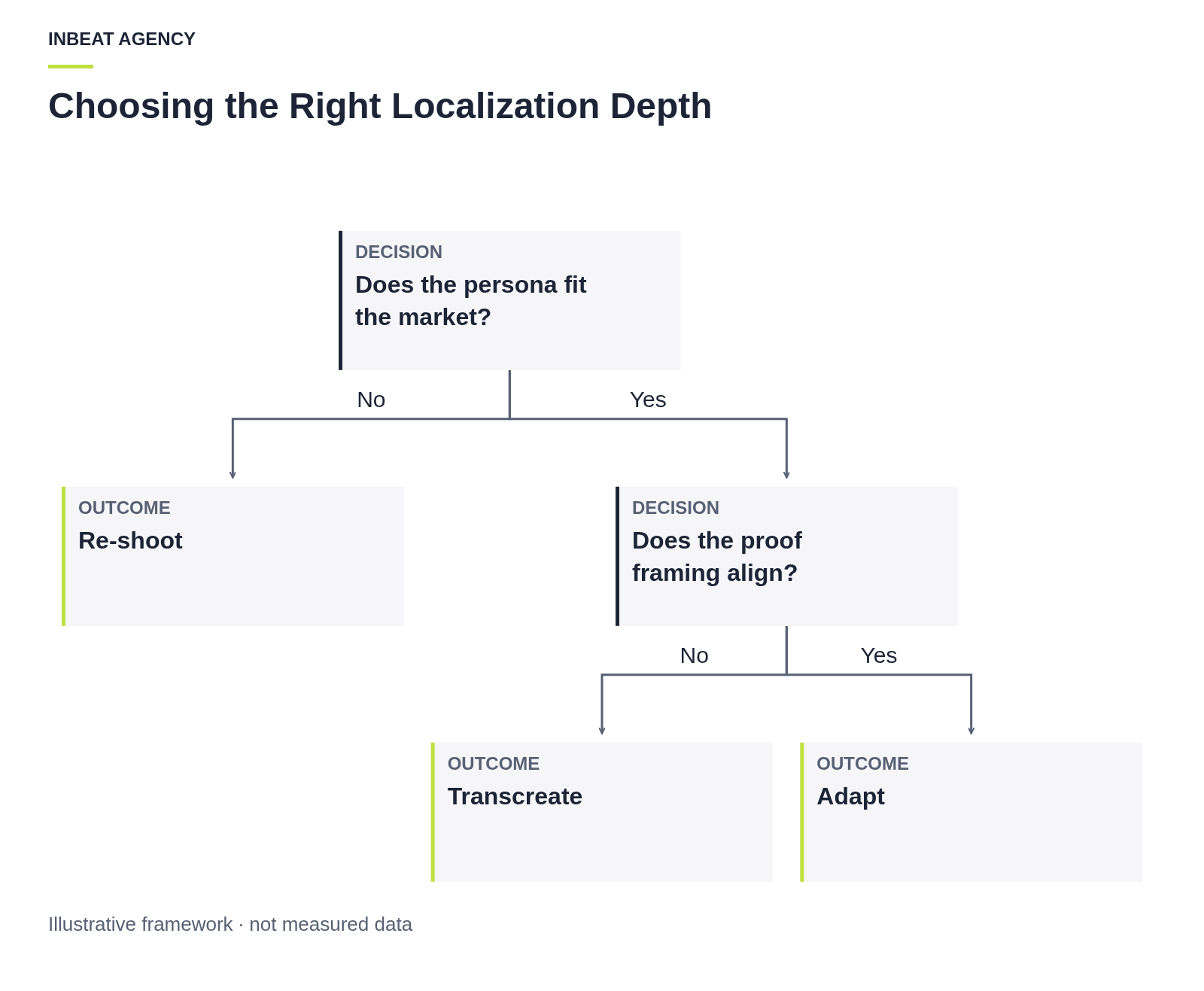
Classify every multi-market asset you're running into one of three depth tiers and flag anything currently running as a straight translation.
| Localization depth | What changes | Typical cost tier | Best used when |
|---|---|---|---|
| Adapt | Language track, on-screen text, currency, units, legal lines | Low | The persona and proof already fit; product demos, offer-led ads |
| Transcreate | Hook, script, proof and cultural references rewritten; footage reused or lightly re-edited | Medium | The concept holds but the argument or authority differs by market |
| Re-shoot | New creator, new setting, new proof; only offer mechanics and claims stay fixed | High | The persona itself is wrong for the market, or humor and identity carry the ad |
The tiers follow the localization logic Lokalise and Lionbridge lay out, applied to paid social production (Lokalise). Cost tiers are relative rankings for planning purposes; get quotes for actual rates.
Re-shoot sounds expensive until you compare it with a transcreated hero asset that never exits the learning phase. The rest of this guide is a sourcing-and-testing workflow for deciding which tier each market earns, starting with the planning artifact that makes the choice explicit.
Build a persona-by-angle matrix for each market before you brief anyone
Draft a grid with local personas on one axis and message angles on the other, then convert each cell into a one-page brief before any creator or translator sees the product. This matrix is the hypothesis set your media buying will test; without it you're localizing by instinct and reading results by market when the useful read is by idea.
Map the local persona, not the national demographic
A national demographic (women 25 to 44, urban, mid income) describes who the platform can reach. A local persona describes who in that market has the problem, how they talk about it and whom they believe. The distinction matters because the persona carried inside the creative does the audience selection that platform settings no longer can. When a creator's opening line names the right frustration in the right idiom, the algorithm finds the people who stop for it. That's the practical meaning of "the creative is the targeting."
Build personas from evidence the market produces on its own. Read the comments under competitor ads, the reviews on local marketplaces and the creators' own read on what their audiences respond to. eMarketer reports that consumers respond well to ad messaging that reads as locally relevant, which supports treating local specificity as a conversion input (eMarketer). Personas can differ within one city, as we found comparing how strategies shift across SoHo, Flatiron and Midtown, so a national market may hide two or three distinct grids.
Start with three personas per market. More than that and your first batch can't fund every cell to a readable spend.
Rank angles by local pain, not by what won at home
The angle axis usually covers five families: price, convenience, social proof, identity and problem-solution. Rank them per market by the pain you hear in local comments and reviews, then pick the top three. Home-market winners are a prior worth testing, and a prior is all they are. Hunch's retail localization playbook makes a comparable case for treating local context as the driver of which creative plays to run in each geography (Hunch).
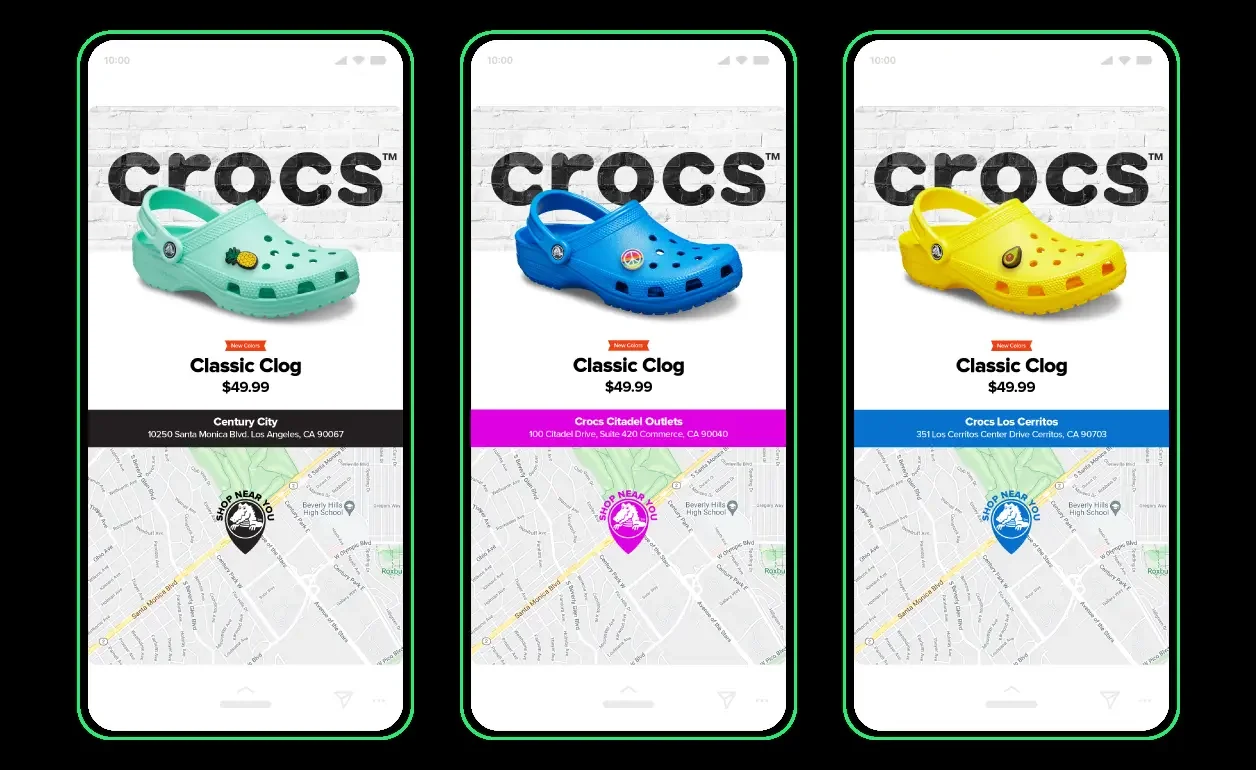
A hypothetical meal-kit brand entering Quebec illustrates the shift. The Toronto winner was a "busy professional" convenience angle. Montreal comments talk about weeknight family dinners and the price of groceries. The matrix for Quebec keeps convenience as one angle but ranks family routine and price above it, and the creator brief rewrites the hook accordingly while the offer stays fixed.
Turn the matrix into creator briefs with fixed and flexible fields
Every cell becomes a one-page brief with fields marked global or local. The global fields protect claims and offer integrity; the local fields are where the creator earns their fee. Mark ownership so nobody argues about it mid-shoot.
| Brief field | Global (fixed) | Local (flexible) | Who owns it |
|---|---|---|---|
| Offer mechanics and price display | Yes | Currency, tax and unit formatting only | Brand growth lead |
| Product claims and legal lines | Yes | Approved local equivalents only | Brand legal or compliance |
| Brand safety and exclusions | Yes | No | Brand |
| Hook and first three seconds | No | Yes, written by the creator | Creator, reviewed by market lead |
| Setting, props and daily context | No | Yes | Creator |
| Proof type (who vouches, what evidence) | Claim substance fixed | The authority and framing | Market lead with creator input |
| Language, slang and humor | No | Yes | Creator |
| Call to action | Mechanics fixed | Phrasing | Market lead |
The fixed fields matter most where the stakes are highest. Claims and legal lines get the least flexibility because a creator improvising a health or savings claim in a new jurisdiction is a compliance problem before it's a performance one. Proof type sits in between: the substance of what you can prove doesn't move, but the person who vouches for it should. Hooks, settings and slang are wholly local, because those are the fields where translation fails first.
A 3x3 grid gives nine cells for a first market. Prune after the first read: cells that fail with two or three creators are probably wrong hypotheses, and the survivors tell you which angles deserve a second creator cohort.
Source native creators in each market instead of translating one spokesperson
Recruit native micro-creators in each market and brief them from the matrix cells. Dubbing one spokesperson for every region skips the part of the job that converts. The footage is only part of what you're buying. You're also buying the creator's fluency in how their audience talks and the likability that audience already extends to them.
Why a local micro-creator beats a dubbed global asset
A dubbed hero asset has a persona problem that no language track solves: the viewer can see that the person on screen isn't from here. A native creator supplies the setting, the idiom, the proof framing and the small cultural signals without being asked, because they live inside the market the brief describes. When you collaborate with them you also borrow the trust their audience has already granted, which is why the same product argument often performs differently in the mouth of a local creator than in a translated brand voice.
The volume logic follows from the matrix. Nine cells with one creator each is nine hypotheses confounded with nine personalities. Eight to twelve creators at different follower tiers, each briefed on two cells, gives you a read on the angle separate from the individual. Micro-creators fit this model because their fees allow volume and their content already looks native to the feed.
A sourcing workflow: shortlist, vet, brief, batch
Run these five steps for one market before expanding.
- Define persona fit from the matrix. For each cell, write two sentences describing the creator who would plausibly say this to their own audience: life stage, setting, content style.
- Shortlist by content style and audience geography. Check that the creator's audience actually lives in the target market, since a creator's own location and their followers' location often differ.
- Vet comments and past brand work. Read the comments for authentic conversation in the local language, look for engagement patterns consistent with the follower count, and review previous sponsored posts for tone and disclosure practice.
- Brief with the fixed and flexible fields. Send the one-page brief for the assigned cells, with fixed fields marked as non-negotiable and flexible fields explicitly open to the creator's rewrite.
- Shoot in batches of hooks. Ask for three hooks per cell against one body, so each creator delivers six variants and the first market batch yields roughly fifty testable assets. That count is a planning assumption for sizing the batch, so treat it as illustrative.
AI-assisted tools have a role after this point. Amazon Ads claims its creative tools can produce multiple region-specific variations in hours rather than weeks, a vendor statement about its own suite that we'd treat as a production accelerator for cutdowns and text swaps; the native source footage still has to come from a creator (Amazon Ads). Lokalise's point that localization is thousands of market-level decisions applies here too: the creator makes most of those decisions on camera, and the tooling multiplies the result (Lokalise).
P.S. inBeat's performance creative work covers how creator-sourced footage gets turned into testable ad variants at volume, which is the production side of this workflow.
What to check before you whitelist a local creator
Whitelisting means running paid media through the creator's handle, so the checks tighten. Confirm the following before spend goes live:
- Fraud and engagement authenticity: follower growth spikes, comment quality and the ratio of saves and shares to likes.
- Disclosure rules for that market, which differ by jurisdiction and platform and are the creator's legal exposure as much as yours.
- Usage rights covering paid distribution, cutdowns and text edits for the term you plan to run.
- The creator's own feed, which you can't control. A whitelisted ad borrows their reputation, so review what else they've posted recently and agree on a notice period for content that would conflict with your brand safety rules.
Pro tip: pay for the first batch as a fixed production fee with a defined usage window, then negotiate performance-linked extensions only for creators whose cells clear the market CAC target. It keeps the cohort large at the start and rewards the people who earned the spend.
Centralize the account structure and localize only the creative
For most brands, one consolidated ad account with market-level campaigns or ad sets, and localization expressed at the ad level, beats a separate account per market. The reason is signal. Learning phases need conversions, and a hyper-local structure divides a fixed conversion volume across more containers than it can feed.
Consolidated accounts learn faster; hyper-local accounts fragment signal
The platform's delivery model learns from conversions inside each ad set. Put a market's spend in one account and the algorithm exits learning sooner and reads creative differences more cleanly. Split the same spend across five market accounts and each one starves, so you end up comparing noise and calling it market performance. Marvia's comparison of local and national Meta ad accounts frames a similar tradeoff between local relevance and central efficiency, and lands on the practical point that structure decides how much any local variation can be read (Marvia).
| Dimension | Centralized structure | Hyper-local structure | Recommendation |
|---|---|---|---|
| Learning speed | Pooled conversions, faster exit from learning | Conversions split by market, slower or never | Centralize unless a market has volume to stand alone |
| Governance | One set of claims, exclusions and brand safety rules | Rules drift as local teams edit independently | Centralize; enforce fixed brief fields centrally |
| Reporting granularity | Market read via campaign or ad set naming | Native per-market reporting | Centralize; naming conventions recover the granularity |
| Operating overhead | One billing relationship, one pixel, one team | Multiplied setup, pixels, billing and access | Centralize unless legal or billing forces separation |
| Local autonomy | Local input at the creative level only | Local control of budget and settings | Give autonomy at the creative level |
The comparison reflects how Meta and similar platforms handle learning at the ad set level; the rows are structural tradeoffs rather than measured deltas.
When a separate local account is worth the fragmentation
Separation earns its overhead in four cases:
- Separate legal entities that need their own ad account ownership and data controls.
- Distinct currencies and billing arrangements that a single account can't reconcile.
- Franchise or dealer networks where local partners fund and approve their own spend.
- Markets where the offer itself differs, so shared conversion signals would mislead optimization.
If none of those apply to a market-level account you're running today, consolidate it. Keep the market visible through campaign naming and breakdowns; a separate login adds overhead without adding information.
Reading localized results by creative, not by campaign
Read results creative-first. When a market underperforms, the first question is which hook or persona failed, and only after that do you ask whether the market itself is wrong for the product. A campaign-level read hides the fact that two of nine cells are carrying the market while seven drag it, which is exactly the information you need for the next brief.
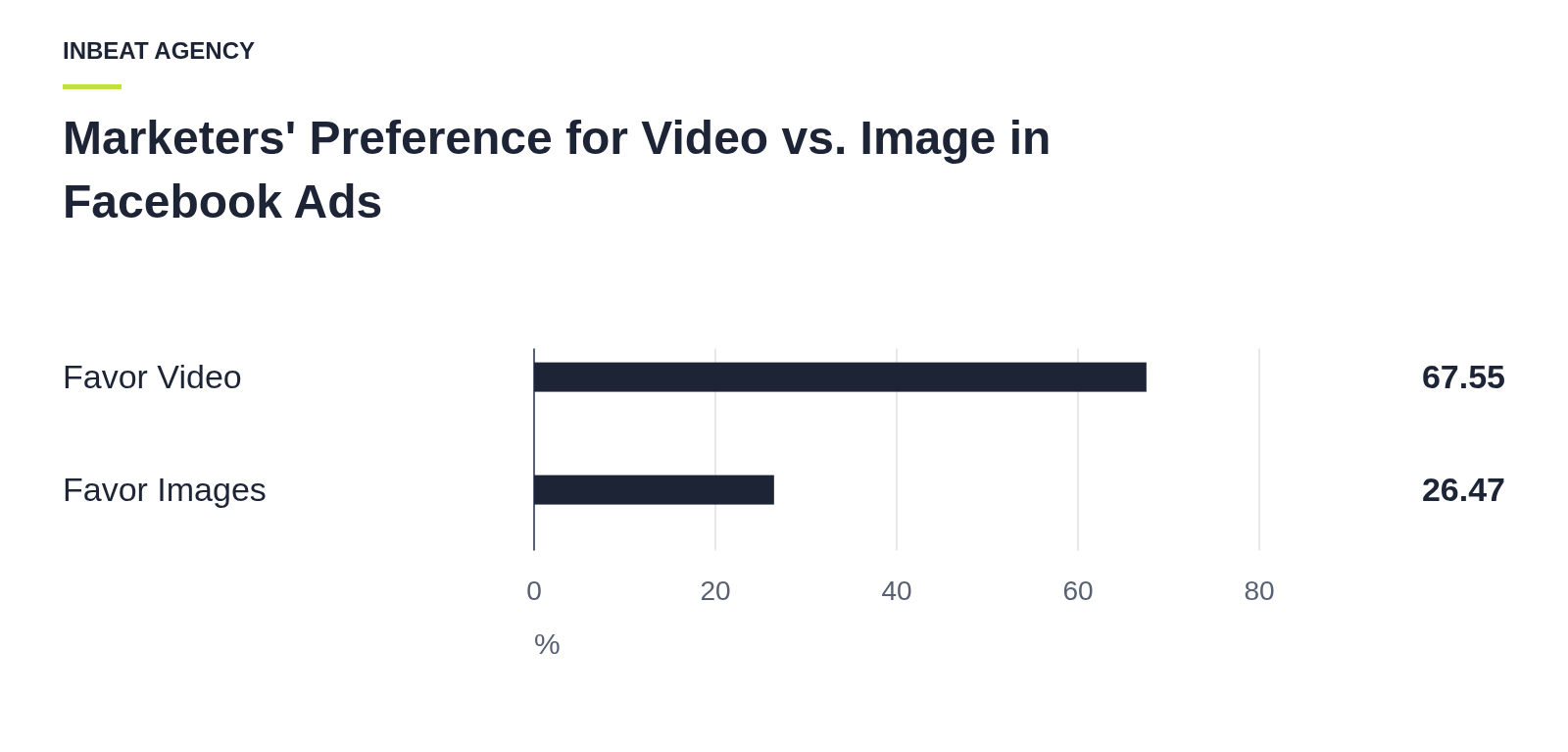
Format priors deserve the same discipline. Databox surveyed 95 marketers in 2023 and found 67.55% believed video drove more Facebook ad clicks than images, with 26.47% favoring images (Databox). It's self-reported, small and three years old, so treat it as a hypothesis to test in each market's first batch. The same holds for any home-market learning about format or length: carry it in as a prior, let the market's own creative-level data confirm or overturn it.
A creative-first read also protects your landing pages from the wrong diagnosis. Before rebuilding a market's page, check whether the ads sending traffic to it were the failing cells; our CRO and conversion coverage treats that sequencing as the first step in any conversion audit.
Scale localized variations without scaling production cost
Write kill and scale thresholds for the market before launch, dark-post every matrix cell at low spend, and give the month's budget to the variants that clear them. The production cost of localization stays flat when one shoot per cohort feeds dozens of variants and only the winners ever receive real money.
Dark-post the matrix, then fund only winners
The loop is make, launch, learn, repeat. Every cell from the matrix goes live as a dark post in the consolidated account at a small, equal spend cap. You read CAC and MER at the creative level, and you whitelist the survivors through the creator's handle so the scaled ad carries their likability into the wider audience. Spend on a variant that never reaches a decision is the one cost in this system that buys you nothing, so the cap is what makes the batch affordable.
A hypothetical first market batch: fifty variants launch at a fixed cap each. Five clear the market CAC target at the cap. Those five become the whitelisted set and receive the bulk of the month's budget, while the forty-five losers are documented by cell so the next brief can see which angles and personas the market rejected. None of those numbers are measured results; they describe the shape of the decision.
Multiply footage, not shoots: cutdowns, hook swaps and AI-assisted variants
One creator shoot yields many variants without another day of production. Swap the first three seconds, change the on-screen text, cut a 30-second body to 15 and 6, reorder the proof and the offer. The three-hooks-per-cell structure from the sourcing step is what makes this possible: the body is shared, so each hook becomes a new test at editing cost only.
AI-assisted editing compresses this further. Amazon Ads says its tools let teams produce multiple region-specific variations in hours rather than weeks, which is a claim about its own product suite and should be validated per market before you plan around it (Amazon Ads). The risk sits in the language layer. Machine translation of hooks and captions drifts in tone and idiom, and it can drift in legal meaning when a claim's qualifier changes. Every machine-generated variant needs native human review before spend, ideally by the creator who shot it or the market lead who owns the brief. Fluency describes automation as the way agencies manage localized campaigns for national brands at scale, and the useful reading is that automation should handle assembly and trafficking while humans keep the claims and the voice (Fluency).
Where the editing sits is a staffing decision as much as a cost one. Our comparison of in-house versus outsourced creative production covers why a hybrid model tends to handle high-variant output best.
Set kill and scale thresholds per market up front
Define both thresholds before launch and schedule the first read for the moment variants hit the spend cap.
- Kill threshold: the spend a variant may consume before it must show a conversion trend consistent with the market's CAC target. Set it as a multiple of that target so it scales with the market's economics.
- Scale rule: what a winner must clear relative to the market's blended CAC target, and over how many conversions, before its budget increases and it's whitelisted.
- Hold rule: variants that sit between the two get one more cap of spend with a hook swap, then a decision.
- Documentation: every kill is logged by matrix cell, creator and tier so the second market inherits the learning.
That last step is where cost per market falls over time. The second market's matrix starts with angles the first market ranked, personas it validated and hooks it killed. You still source native creators there, but you brief fewer cells with more confidence, and the batch gets smaller while the hit rate improves.
Platform-specific localization tactics for Meta, Google and Amazon
Localization matters most where the creative does the targeting, so Meta gets the deepest creative work, Google gets asset and location hygiene, and Amazon gets marketplace-specific variation validated per region. If budget forces a choice, localize first on the platform where the persona in the creative carries the most weight, which for most consumer brands is paid social.
| Platform | What the platform localizes for you | What you must localize | Watch-out |
|---|---|---|---|
| Meta | Delivery within the geography and language you set | The persona, hook, proof and setting in every ad | Feed rewards native-looking assets; translated hero ads read as imports |
| Google Local Ads | Location-based delivery from your linked business data | Ad assets, extensions and the accuracy of location data | Local Services Ads are moving into Performance Max from August 2026 |
| Amazon Ads | Marketplace context, currency and catalog data | Region-specific creative variations and claims | Vendor AI speed claims need per-marketplace validation |
Sources for the Google and Amazon rows: Google Ads Help, Search Engine Journal, Amazon Ads. The Meta row describes the platform's general delivery model.
Meta: localize at the ad level and let the creative carry the persona
Meta is the strongest case for creator-led localization. The feed favors assets that look like the content around them, so a native creator's video competes on equal terms while a dubbed brand asset announces itself. Keep the structure consolidated as described earlier, place localized ads inside market-level ad sets and read results by creative. Rotate new cells from the matrix into each market as the previous batch resolves, so the account always holds a live test alongside the scaled winners.
Google: Local Ads use your location data, and Local Services Ads are moving into Performance Max
On Google, the localization work is largely upstream of the ad. Google's Local Ads help documentation describes campaigns built on your linked business locations that surface across Google properties, so the quality of your location data and the relevance of your assets and extensions do the local work (Google Ads Help). Localized ad copy still matters for search, but the depth tier is usually adapt.
If you run Local Services Ads, plan a migration review. Search Engine Journal reports Google is moving Local Services Ads into Google Ads as Performance Max pay-per-lead campaigns, with bidding, reporting and management changes beginning August 2026 in a phased rollout whose impact varies by region (Search Engine Journal). Practically, that means your local lead campaigns inherit Performance Max's asset-group logic, so the fixed and flexible brief fields you built for social apply to the asset groups too. Our PPC and Google Ads coverage tracks the mechanics as they roll out.
Amazon: region-specific creative variations and marketplace context
Amazon handles marketplace context, currency and catalog data, which leaves the creative variation and claims to you. Amazon Ads positions its AI-assisted creative tools as producing region-specific variations in hours rather than weeks (Amazon Ads). Treat that as a vendor claim: use the tools to multiply variants, then measure lift per marketplace before assuming the speed translates into conversions. Claims review is the constraint here, since product claims that pass in one marketplace may need different substantiation in another.
For each active platform, list what it auto-localizes from your data feeds and what still needs a native creative decision. The list usually shows that the expensive creative work belongs on one or two platforms, and the rest is hygiene.
How inBeat builds localized creative systems that scale
Localization that converts is native-creator sourcing plus a persona-by-angle matrix, tested in a consolidated account and scaled by CAC and MER. Every other decision in this guide, from depth tiers to platform tactics, serves that loop.
Creators, media buying and performance data run as one loop
We run the three functions together because each one needs the others' output. Creators fill the matrix cells and bring the market's own language. Media buyers dark-post the cells, read CAC by creative and whitelist the earners. The performance data feeds the next batch of briefs and the next market's matrix. Our published case studies for Bluehouse Salmon, Bumble and Genomelink describe matched-creator sourcing feeding paid social; the figures on those pages are the only results we cite, and they describe those programs rather than regional localization outcomes.
What to bring to a first conversation
Four items make the first conversation productive:
- Target markets in priority order, with any legal or billing constraints that force account separation.
- Your current multi-market creative classified into adapt, transcreate and re-shoot tiers.
- Your account structure and how localized ads are currently read.
- Draft kill and scale thresholds tied to each market's CAC target, even if they're provisional.
With those four items in hand, book a strategy call with inBeat to plan the first localized creator batch.
FAQ
How many native creators do you need per market before the first batch produces a readable test?
Enough that each matrix cell is covered by more than one creator, so you can separate the angle from the personality. For a 3x3 matrix that usually means eight to twelve micro-creators, each briefed on two cells with three hooks per cell. Fewer creators is workable if you shrink the matrix; it isn't workable if you keep nine cells and one creator each.
Should localized variants share a Meta ad set with the home-market creative or run in their own market-level ad set?
Run them in a market-level ad set inside the same consolidated account. Sharing an ad set with home-market creative lets the algorithm favor the assets with the most history, which buries new localized variants before they're read. A market-level ad set keeps the geography and language clean while the account still pools learning at the pixel and campaign level.
What kill threshold should a localized variant hit before you stop funding it?
Set it as a spend multiple of the market's CAC target, which keeps it scaled to each market's economics. A variant that reaches the cap without a conversion trend consistent with that target is killed and logged by cell. Variants in between get one more cap with a hook swap, then a decision.
Can AI translation or AI-generated variants replace a native creator for a first market test, and where does that break?
No for the source asset, yes for multiplying it. AI can produce cutdowns, text swaps and caption variants quickly, and Amazon Ads makes that speed claim for its own tools. It breaks on the persona test: a viewer can tell the person isn't from their market, and machine-translated hooks drift in idiom and sometimes in legal meaning. Every generated variant needs native review before spend.
How do you keep global brand governance when local creators rewrite hooks and proof?
Through the fixed fields in the brief. Offer mechanics, claims, legal lines and brand safety exclusions stay global and are reviewed centrally; hooks, settings, slang and the framing of proof are the creator's to rewrite. Governance lives in what you fix, and the creator's value lives in what you leave flexible.
How does the Local Services Ads move into Performance Max change how you plan local lead campaigns from August 2026?
Search Engine Journal reports the move brings bidding, reporting and management changes in a phased rollout from August 2026. Plan for local lead campaigns to inherit Performance Max's asset-group logic, apply your fixed and flexible brief fields to those asset groups, and schedule a reporting review so lead cost comparisons across the migration stay honest.
Cover photo: Photo: Tessy Agbonome / Pexels. Art direction: inBeat Agency.