.svg)
.svg)
.svg)
.svg)


.svg)





%20(1).png)
If you market in New York, you already know this. NYC is not one audience. It is a collection of tightly packed micro-economies, each with its own pace, priorities, and purchasing triggers.
The way someone shops in SoHo differs from how a founder evaluates tools in Flatiron or how an executive reviews vendors in Midtown.
This difference affects everything. Creative style, influencer selection, paid media allocation, and funnel structure all shift depending on where your audience spends time.
When you run one uniform strategy across Manhattan, performance usually becomes inconsistent, and acquisition costs start creeping up.
In this blog, you’ll learn:
- Why NYC functions as multiple micro-markets instead of a single unified audience
- How audience psychology and digital behavior differ across SoHo, Flatiron, and Midtown
- What creative formats and paid channels perform best in each neighborhood
- How influencer and performance strategies should adapt by location
- How to choose the right approach based on your specific footprint
P.S. Are you running one NYC strategy and expecting it to work everywhere? If your campaigns feel uneven across neighborhoods, your targeting may be too broad. At inBeat Agency, we design performance creative and influencer systems tailored to specific NYC micro-markets. Book a free strategy call now!
Key Takeaways
- NYC functions as multiple micro-markets, not one unified audience.
- Foot traffic patterns influence mindset and conversion timing.
- SoHo rewards culturally relevant, creator-led, visually strong marketing.
- Flatiron responds to performance-driven messaging and measurable outcomes.
- Midtown prioritizes authority, trust, and structured communication.
- Influencer strategy should change depending on neighborhood intent.
- Channel allocation must reflect how audiences in each area consume information.
- Clear alignment between location and objective reduces wasted spend.
Why NYC Neighborhoods Demand Different Marketing Strategies
Remember that what works in SoHo can fall flat just a few blocks away. Each neighborhood attracts a different mix of residents, commuters, and visitors, and that mix shapes buying behavior.
“Users nowadays have very complicated journeys. And these journeys get affected a lot by where they live, where they spend their time and who they interact with. Therefore, different regions inside the same city, especially in big cities, can be treated as unique audiences, and you need to talk to them on their channels and in their vocabulary. That's how you can win.” Mustafa M. Ali - Paid Media Lead at inBeat Agency
Below, we’ll break down how micro-geography influences foot traffic, income concentration, industry density, and digital habits across SoHo, Flatiron, and Midtown.
Once you understand these shifts, your channel choices, messaging, and creative direction become much clearer.
Micro-Geography = Micro-Audiences
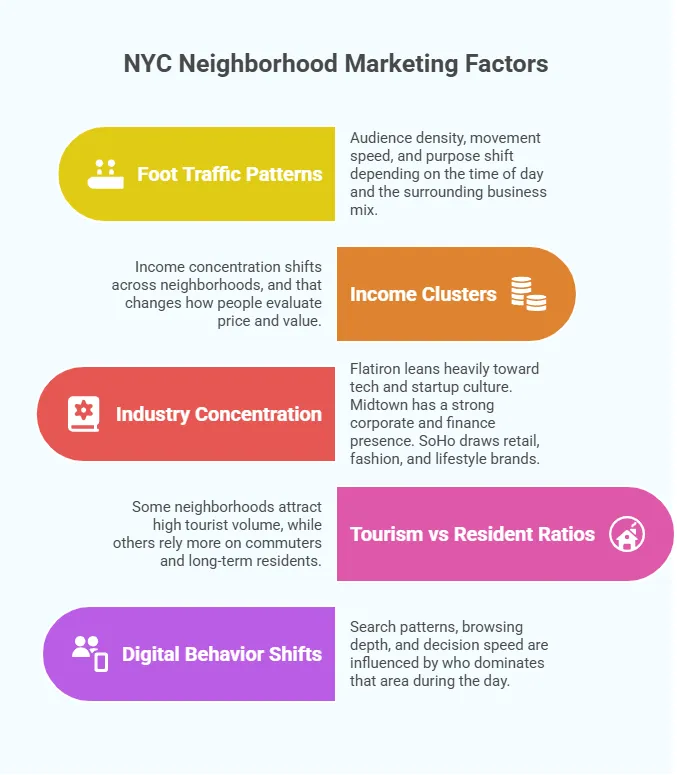
When you zoom in on NYC at the neighborhood level, you stop seeing one broad market and start seeing distinct audience pockets. These pockets move differently, spend differently, and respond to different creative triggers. If you want consistency in performance, you have to align your strategy with these micro-shifts.
Foot traffic patterns
Foot traffic in SoHo looks very different from Midtown at 9 AM or Flatiron during a weekday afternoon. Audience density, movement speed, and purpose shift depending on the time of day and the surrounding business mix.
These fluctuations influence when your campaigns should activate and how long your funnel should be. If you ignore traffic rhythms, your targeting may feel mistimed.
Income clusters
Income concentration shifts across neighborhoods, and that changes how people evaluate price and value. In some areas, premium positioning feels natural.
In others, ROI and practicality carry more weight. If your offer stays the same but your value framing does not adapt, conversions can slow down.
Industry concentration
Flatiron leans heavily toward tech and startup culture. Midtown has a strong corporate and finance presence. SoHo draws retail, fashion, and lifestyle brands.
When industry density shifts, expectations shift too. A founder scrolling LinkedIn responds differently than a fashion-forward shopper browsing Instagram.
Tourism vs resident ratios
Some neighborhoods attract high tourist volume, while others rely more on commuters and long-term residents.
For instance, Midtown has one of the strongest tourist gravity wells in the country. Times Square’s own market research reports around 220,000 pedestrians per day in 2024, with busy days reaching roughly 330,000. This level of transient traffic changes how quickly attention must be captured.
.webp)
Image Source: Times Square Official Website
Tourists mostly respond to visual appeal and immediacy. Residents and professionals look for trust, convenience, and repeat value. If you treat both groups the same, your targeting becomes less precise.
Once you start looking at NYC through this lens, strategy becomes more intentional. You are no longer running campaigns across Manhattan. You are aligning your marketing with the psychology of each block you serve.
Digital Behavior Shifts by Location
Digital behavior changes once you move from one Manhattan neighborhood to another. Search patterns, browsing depth, and decision speed are influenced by who dominates that area during the day.
In some zones, you are reaching people in research mode. In others, you are speaking to professionals with immediate intent. That difference alone affects how long your funnel should be.
Attention patterns shift as well. Certain neighborhoods drive faster, impulse-style digital interactions, while others favor structured evaluation before conversion. The time between first touch and final action can vary significantly depending on location.
When you recognize that these behavioral rhythms differ, your campaign structure becomes more intentional and far less generic.
SoHo Marketing Strategy: Culture-Driven, Creator-Led, Retail-Heavy
If your brand operates in SoHo, you are competing for attention in one of the most visually saturated retail zones in the city.
People are not walking those streets with a spreadsheet mindset. They are scanning storefronts, watching what others are wearing, and looking for what feels current. Your marketing has to match that cultural tempo.
Audience Profile
SoHo skews fashion-forward and experience-driven. You are mostly speaking to Gen Z and Millennials who care about aesthetics, social proof, and what feels relevant right now.
In fact, 73% of Gen Z say they have purchased a product after seeing it on social media from creators. This tells you how tightly connected content and commerce are in this environment.
.webp)
Tourists and trend adopters add another layer of urgency. We have noticed that many visitors here want something memorable and shareable. And expectations around visuals are high.
This is not just a creative opinion. As NJ Lechnir from Medium explains:
“The average person remembers only 20% of what they read, but 80% of what they see. Furthermore, scientific research tells us that 90% of information transmitted to our brain is visual. That’s why visual content has become the single most important way to communicate, especially in today’s business world.”
In SoHo, this visual dominance is amplified by the environment itself. You are competing against storefront design, street style, and constant social sharing.
If your brand presentation feels dated or overly polished in a corporate way, you risk blending into the background.
What Works in SoHo
Creator presence matters here. UGC and influencer seeding help your brand feel native to the environment instead of placed on top of it.
Short-form video performs well because it mirrors how people already consume fashion, beauty, and lifestyle content. If you host in-store activations, amplify them across social while the momentum is still alive.
Geo-targeted paid social can also capture people who are physically nearby and ready to explore.
What Fails in SoHo
Overly corporate messaging typically disconnects quickly. Generic performance ads that could run anywhere in the country feel out of place here. Low-production static creatives struggle because the surrounding environment is already visually strong. So, if your content does not hold attention within seconds, it gets ignored.
Best Channels for SoHo Brands
Instagram Reels and TikTok align well with the discovery behavior in this area. Influencer whitelisting can extend reach while keeping content authentic and platform-native. If your brand feels like it belongs in the feed of someone walking through SoHo, you are on the right track.
Flatiron Marketing Strategy: Tech, DTC, and Growth-Oriented Brands
Flatiron operates on a different rhythm than SoHo. You are no longer competing for aesthetic attention. You are competing for credibility, clarity, and measurable outcomes here.
As per our experience, the people moving through this neighborhood usually care less about trend appeal and more about traction, efficiency, and growth.
Audience Profile
Flatiron is home to startup founders, VC-backed teams, and DTC operators. Many of the people you are targeting think in metrics. They evaluate tools, partners, and platforms through performance data.
If you market here, you are speaking to decision-makers who understand CAC, LTV, and margin pressure. Your message needs to respect that level of sophistication.
What Works in Flatiron
LinkedIn ads perform well in Flatiron because you are reaching professionals during work hours, in a business mindset.
This advantage is not anecdotal. Around 80% of B2B leads from social media come from LinkedIn. And LinkedIn’s audience has 2X the buying power of the average web audience. When you are targeting founders, operators, and decision-makers, that concentration of purchasing authority matters.
Founder-led content also carries weight. When operators speak directly about growth challenges and solutions, it resonates more than polished brand slogans.
Paid search captures high-intent queries, particularly from teams actively looking for tools or services. Performance creative testing also fits naturally here, since experimentation and optimization are already part of the culture.
Messaging Tone
In Flatiron, your tone should lean ROI-focused and data-backed. Claims need context here, and results need proof. If you speak in vague brand language, you risk losing attention quickly.
Clear value propositions and conversion-centric messaging perform better because the audience is evaluating whether your solution drives measurable impact.
Best Channels for Flatiron Brands
In Flatiron, your channel mix should reflect how growth-minded teams gather information and make decisions. LinkedIn is most effective, particularly for B2B and service-based offers, because you reach professionals in an active business mindset.
Google Search captures high-intent demand from teams already researching solutions, which makes it critical for bottom-of-funnel capture. And YouTube can support deeper education and product explanation when your offer requires context.
Podcast advertising also fits naturally here within founder and operator circles, where long-form conversations build credibility over time.
We have observed that when your channel mix aligns with how growth-minded teams consume information, your positioning becomes clearer and stronger in this neighborhood.
Midtown Marketing Strategy: Corporate, B2B, Authority-Focused
Midtown runs on structure, scale, and senior decision-making. You are not speaking to casual browsers here. You are addressing executives, procurement teams, and enterprise buyers who evaluate risk, credibility, and long-term value.
The tone shifts from culture-driven to authority-driven very quickly.
Audience Profile
Midtown attracts corporate decision-makers and enterprise buyers across finance, legal, consulting, and large-scale services. Many of the professionals moving through this area manage budgets, teams, and multi-layered approval processes.
In fact, the average B2B buying group involves 6 to 10 decision-makers. This means you are rarely convincing one person. You are influencing a committee.
If you market here, you are speaking to people who prioritize stability and trust because multiple stakeholders are evaluating risk at the same time. Your messaging needs clarity and proof.
At the same time, the Times Square zone introduces a heavy tourist flow. This means certain pockets of Midtown require visibility and strong brand presence, while others demand corporate credibility.
So, you need to understand which side of Midtown you are targeting before structuring your campaigns.
What Works in Midtown
Authority-driven branding performs well in Midtown because your audience is evaluating expertise and track record. Clear positioning, proof of results, and structured messaging build confidence.
Out-of-home integration can reinforce credibility in high-density business corridors. When your brand appears consistently across physical and digital environments, recognition strengthens.
Programmatic display helps maintain presence across professional browsing behavior, typically during work hours. A corporate LinkedIn strategy is usually central, particularly when you are targeting senior roles and enterprise accounts. Precision and consistency matter more here than trend velocity.
What Fails in Midtown
Trend-heavy influencer campaigns rarely resonate in corporate corridors. Meme-driven creative can undermine credibility if the audience expects professionalism.
An overly casual tone mostly weakens perceived authority. If your messaging feels lightweight in a neighborhood built on institutional trust, engagement drops quickly.
In Midtown, your strategy should signal competence first and creativity second. When your brand communicates expertise clearly and confidently, you position yourself more effectively in this environment.
Creative Strategy Differences Across SoHo, Flatiron, and Midtown
If you compare these neighborhoods side by side, the strategic differences become obvious. Creative tone, channel allocation, and funnel structure shift depending on who dominates the area.
In the table below, we have summarized how your approach should change across SoHo, Flatiron, and Midtown.
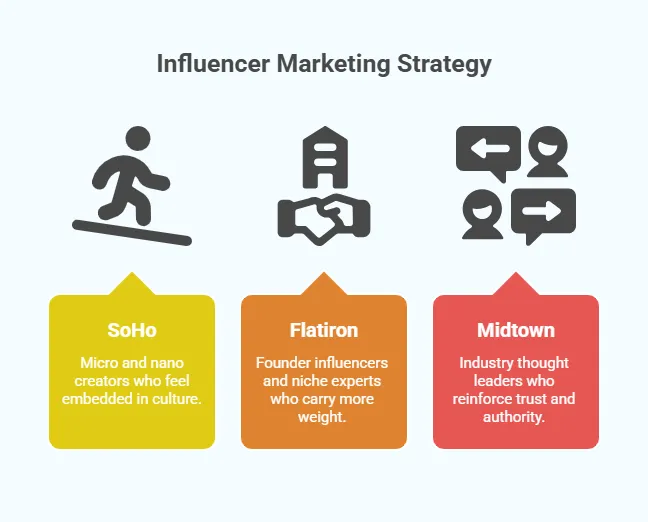
Influencer Marketing Strategy Across SoHo, Flatiron, and Midtown
Influencer marketing in NYC is not one-size-fits-all. The type of creator who drives action in SoHo will not necessarily resonate in Midtown.
Here’s how it shifts by neighborhood:
- SoHo → Micro and nano creators: You want creators who feel embedded in culture. Local fashion, lifestyle, and retail voices with strong engagement mostly outperform larger but less contextual influencers.
- Flatiron → Founder influencers and niche experts: Operators listen to operators. Founder-led content, growth advisors, and subject-matter experts carry more weight than aesthetic-first influencers.
- Midtown → Industry thought leaders: Credibility matters here. Senior executives, consultants, and recognized industry voices help reinforce trust and authority with enterprise audiences.
In our daily practice, we have seen that when your influencer selection matches the mindset of the neighborhood, performance becomes more predictable.
How NYC Brands Should Choose Their Strategy
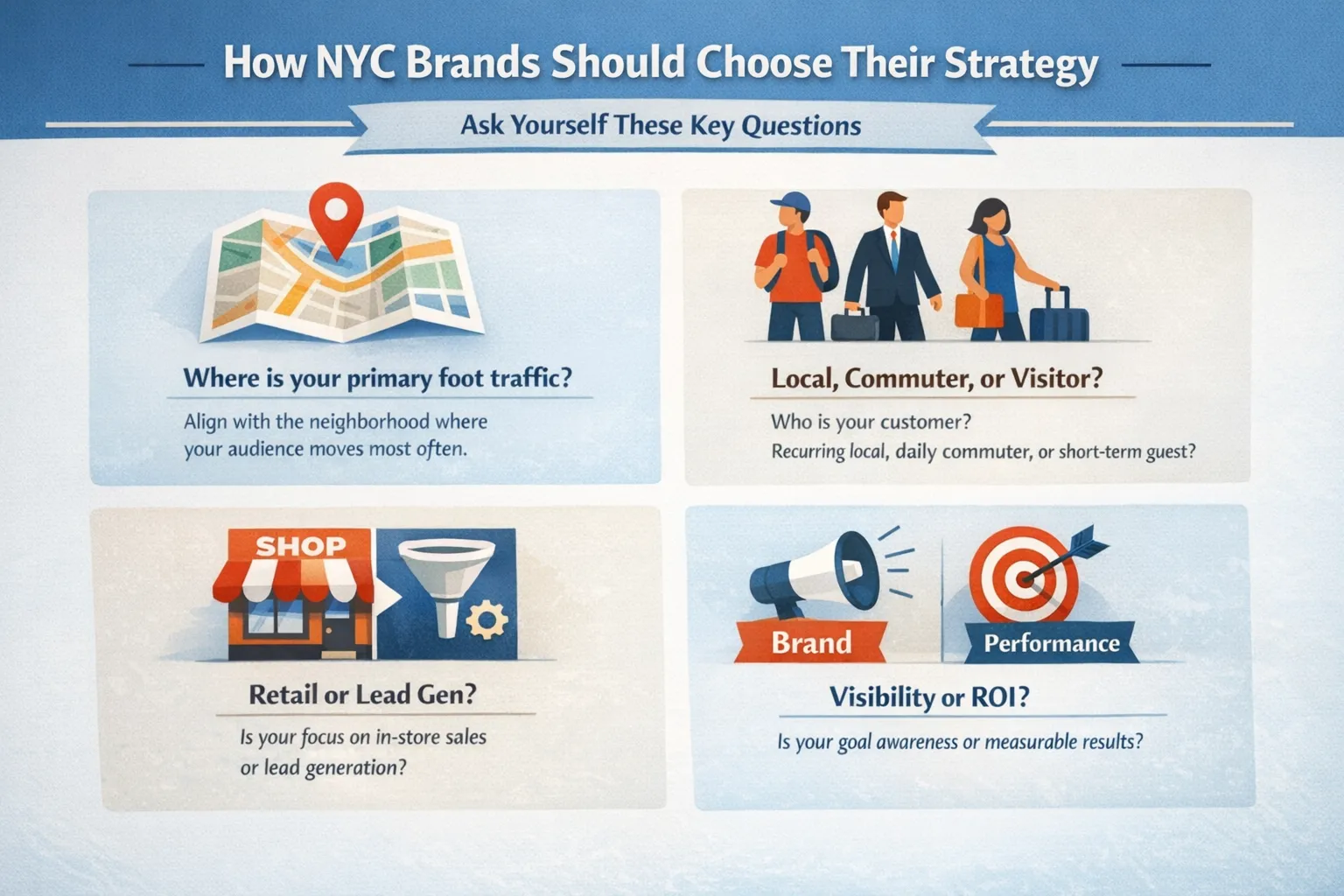
Once you understand how SoHo, Flatiron, and Midtown differ, the next step is clarity. You do not need three completely separate strategies. You need alignment between your location, your audience, and your objective.
Start by asking yourself a few direct questions.
Where is your primary foot traffic?
If most of your audience physically moves through one neighborhood, your creative and channel mix should reflect that environment. Remember that location influences mindset more than most brands realize.
Is your customer a recurring local, a daily commuter, or a short-term visitor?
A local resident behaves differently from a daily commuter or short-term visitor. Retention, urgency, and messaging depth all shift depending on how frequently that person returns to the area.
Are you retail-first or lead-gen-first?
Retail environments require discovery and visual pull. Lead-generation environments demand clarity, proof, and structured value communication. Your funnel must reflect that priority.
Is brand or performance your priority right now?
Some neighborhoods reward visibility and cultural presence. Others reward precision and measurable return. When you define your objective clearly, your media allocation becomes easier to structure.
If you answer these questions honestly, your NYC strategy becomes more focused and far less reactive.
Align Your NYC Marketing Strategy with inBeat Agency
If you want to align your marketing with how people actually behave across SoHo, Flatiron, and Midtown, your strategy needs more than broad NYC targeting.
At inBeat Agency, we build performance creative and influencer systems tailored to specific Manhattan micro-markets. We structure campaigns around real audience behavior.
Book a free strategy call now, and let’s structure your growth around the right neighborhood.
FAQs
Is SoHo better for influencer marketing?
Yes. SoHo usually performs well for influencer marketing because the audience is visually driven and socially active. Creator-led content blends naturally into that environment. If your brand relies on discovery and cultural relevance, SoHo can support stronger engagement.
Which NYC neighborhood is best for B2B marketing?
Flatiron and Midtown typically align better with B2B marketing. Flatiron attracts founders and growth-focused teams, while Midtown concentrates enterprise decision-makers. Your choice depends on whether you are targeting startups or established corporate buyers.
Should brands run separate campaigns for each NYC neighborhood?
If your audience spans multiple neighborhoods, separate campaigns usually perform better. Messaging, creative style, and channel allocation mostly need adjustment. A single NYC campaign can dilute relevance and reduce efficiency.
Is Midtown better for corporate branding?
Yes. Midtown is well-suited for corporate branding because it concentrates enterprise buyers and institutional decision-makers. Authority, credibility, and structured messaging resonate strongly in this environment.
What marketing channels work best in Flatiron?
LinkedIn and Google Search mostly perform well in Flatiron due to high professional intent. Founder-led content and educational formats can also support trust-building with growth-oriented teams.
How does inBeat tailor campaigns for different NYC neighborhoods?
We start by analyzing who dominates each neighborhood during peak hours and how that audience makes decisions. Then we adjust our creative style, influencer selection, and media allocation accordingly. Our strategy shifts based on whether you are targeting discovery-driven retail traffic or enterprise decision-makers.
Does inBeat handle both influencer marketing and paid media execution?
Yes, we manage both influencer marketing and paid media in-house. We source and vet creators, structure content production, and then amplify top-performing assets through paid social and search. Our approach connects creator content directly to measurable performance outcomes.
Can inBeat build separate strategies for SoHo, Flatiron, and Midtown audiences?
Absolutely. We can structure distinct campaigns for each neighborhood, adjusting messaging, funnel design, and channel mix based on audience behavior. Our goal is to align your marketing with how people actually move and convert within each Manhattan micro-market.
Appendix
- https://www.timessquarenyc.org/business-community/market-research-data
- https://www.emarketer.com/content/gen-z-more-likely-than-millennials-make-online-creator-purchases
- https://medium.com/@njlechnir/why-visual-content-has-become-the-single-most-important-way-to-communicate-3014c85644f3
- https://pmc.ncbi.nlm.nih.gov/articles/PMC6125597/
- https://www.linkedin.com/pulse/80-b2b-leads-from-social-media-come-linkedin-luminous-pr-xixje
- https://www.linkedin.com/business/marketing/blog/linkedin-ads/what-is-website-retargeting
- https://advertisingweek.com/the-state-of-the-enterprise-b2b-buyers-journey/