%20(1).png)

Brands are putting more budget into creator-led content because shoppers want to see real people interact with products before they buy.
In fact, Bazaarvoice’s Shopper Experience Index Volume 18 found that 9 in 10 shoppers engage with creator content before making a purchase decision.
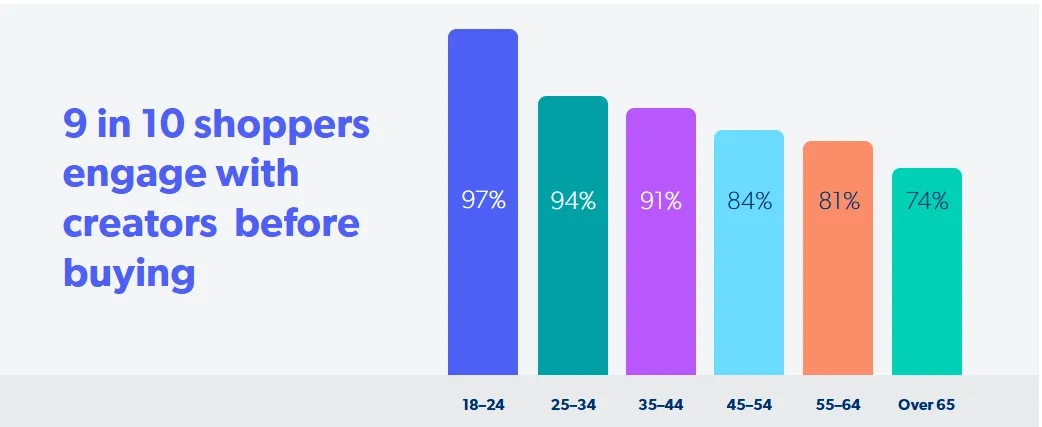
This makes one question harder to ignore: should your brand invest in user-generated content or influencer marketing?
The confusion makes sense. Both strategies involve creators, social media, content creation, and trust signals. Still, they serve different campaign goals.
UGC gives you flexible content assets for paid ads, product pages, landing pages, Meta ads, and other brand-owned channels. Whereas influencer marketing helps you reach people through a creator’s audience, credibility, and social media presence.
In this guide, we’ll break down UGC vs influencer marketing so you can choose the right strategy for your marketing funnel.
We’ll cover:
- What UGC and influencer marketing actually mean
- How costs, content rights, distribution, and control compare
- When to use UGC for paid ads, conversion rate, and cost per acquisition
- When influencer marketing works better for social proof, audience engagement, and brand loyalty
- How to combine both into a full-funnel strategy
So, let’s get started!
What Is UGC (User-Generated Content)?
UGC, or user-generated content, is any content created by people outside your brand team. That can include customers, fans, community members, or UGC creators who make content that looks and feels like something you would naturally see in social media feeds.
It can be a quick selfie video, a product demo, an unboxing clip, a review, a testimonial, or a casual social media post showing how someone uses your product in real life. The main point is simple: UGC feels more like a real recommendation than a polished brand ad.
Below is an example of a UGC campaign we created for Bumble, the dating app.
Read Next: 4 BEST User-Generated Content Examples [Our UGC AGENCY’s EXPERIENCE]
Types of UGC
UGC usually falls into two main categories: organic UGC and paid UGC. Both can help your brand build trust, but they work in slightly different ways.
Organic UGC
Organic UGC is content people create on their own, without being paid by your brand. It can come from happy customers, loyal fans, or people who simply want to share their experience.
For example, this Prose customer post is organic UGC because the creator clearly says it is not sponsored. They are simply sharing the product because they like it. This kind of post gives the brand a natural trust signal because it comes from a real customer moment.
Paid UGC from UGC creators
Paid UGC is made by UGC creators who are hired to produce content for your brand. These creators usually do not post the content on their own accounts. Instead, they create videos, product demos, selfie videos, reviews, or short ads that your brand can use across marketing channels.
Here’s an example of paid UGC-style content from the same brand, Prose. The video is posted on Prose’s own account and features a paid UGC creator using the product in a casual routine.
It still feels natural inside Instagram feeds, but the brand gets a clear product moment it can use for marketing.
Key Benefits of Using UGC
UGC helps brands create relatable content without making every post feel like a polished ad.
- Authenticity and trust: UGC feels natural because it shows real people using your product in everyday situations.
- Cost-effectiveness: It is usually more affordable than influencer marketing since you pay for content creation, not follower count.
- Scalable content production: You can work with multiple UGC creators and build a steady flow of content assets for paid ads, product pages, and social media.
- Stronger community engagement: Organic UGC gives customers a reason to share their experience and become part of your brand story.
Limitations of UGC
UGC can be incredibly effective, but it’s not perfect. Whether it comes from real customers sharing their experiences or creators making content for your brand, there are still a few challenges to keep in mind. Things like content quality, usage rights, and consistently getting fresh content can all take some work to manage.
- Organic UGC can be hard to control: Customers create it on their own, so the message, tone, and product focus may not always match your brand.
- Quality can vary in organic posts: Some customer content may look natural and sharp, while other posts may have weak audio, poor lighting, or unclear product details.
- Needs an active community: Organic UGC is harder to collect if customers are not already talking about your brand or sharing their experience.
- Content rights still matter: Before using any UGC in paid ads, product pages, landing pages, or other marketing channels, your brand needs clear usage rights.
- Paid UGC still takes work behind the scenes: You need to find the right creators, communicate expectations, review content, and sometimes request changes before everything is ready to use.
- Not every piece of content will perform well: Even if a video feels authentic and looks great, there’s no guarantee it will resonate with your audience or drive results.
- Audiences can get tired of seeing the same style of content: If you keep using the same creators or creative approach, engagement may start to drop. That’s why it’s important to keep testing new faces, ideas, and formats.
What Is Influencer Marketing?
Influencer marketing is a strategy where a brand works with a creator who already has an audience on social media. The creator promotes the brand through their own content, voice, and relationship with their followers.
The key difference is that the content is usually published on the influencer’s own account, so the brand is paying for both content creation and access to that creator’s audience.
This audience access can directly shape purchase behavior. Sprout Social’s 2025 influencer marketing research found that 86% of consumers make at least one influencer-inspired purchase per year.
So when the creator, product, and message fit well, influencer marketing can move people from awareness to action.
Types of Influencers
Influencers are usually grouped by audience size, but follower count should never be the only thing you check. Engagement rates, audience quality signals, niche fit, posting frequency, and brand alignment matter just as much.
Nano influencers and micro influencers can be great when you want increased audience trust and stronger follower engagement.
In fact, according to Kim and Park's research (2024), micro-influencer campaigns in niche markets achieved engagement rates 3 to 4 times higher than macro-influencer campaigns aimed at broader audiences.
However, macro creators and celebrity influencers still have a place. They make more sense when your campaign goals are tied to wider visibility, brand awareness, and broad social proof.
Read Next: Micro-Influencers vs Macro-Influencers: Who Should You Work With? [Agency EXPLAINS]
Types of Influencer Marketing Collaborations
Influencer marketing can take a few different forms, depending on your campaign goals, budget, and how closely you want to work with the creator.
- Sponsored posts: The brand pays an influencer to create and publish content on their own social media platforms.
- Affiliate partnerships: The influencer earns a commission when someone buys through their link or code. This works well when you want to connect audience engagement with sales, while still giving the creator a clear reason to promote the product.
- Brand ambassadorships: The creator works with the brand over a longer period instead of posting once. This can build stronger brand alignment, repeated exposure, and deeper consumer trust because the partnership feels more familiar over time.
For example, one of our clients, Hurom, partnered with Nick Bosa, an American football player, as a global brand ambassador to connect the brand with health, performance, and daily wellness.
Key Benefits of Using Influencer Marketing
Influencer marketing gets your brand in front of the right people through creators they already follow, trust, and listen to.
- Immediate reach and visibility: Influencers already have an audience, so your brand can reach new people faster through their social media platforms.
- Targeted audience access: The right creator gives you direct access to a specific target audience based on niche, interests, location, lifestyle, or buying behavior.
- Professional-quality content: Many influencers know how to create TikTok, Facebook, Snapchat or Instagram posts that capture attention. They post amazing photos and strong videos with stories that fit their personal style.
- Strong storytelling potential: Influencers can explain how your product fits into their routine through relatable product demos, which makes the message feel more natural and easier to trust.
Limitations of Influencer Marketing
Influencer marketing can work really well, but it needs careful planning. The wrong creator, weak fit, or unclear content rights can make the campaign harder to control.
- Higher costs: Influencer pricing usually depends on follower count, engagement rates, niche, and content format. Larger creators and macro influencers can require a bigger upfront budget.
- Risk of low authenticity: If the partnership feels forced, the audience may ignore the post or question the recommendation. Strong brand alignment matters more than a big audience.
- Dependence on influencer reputation: Your brand is connected to the creator’s public image during the campaign. If the influencer faces backlash or posts content that clashes with your values, your brand can be affected too.
UGC vs Influencer Marketing: Key Differences
As we said above, the main difference between UGC and influencer marketing is how the content is used.
UGC is created for your brand to reuse across paid ads, product pages, landing pages, and other marketing channels.
Influencer marketing is published through a creator’s own social media account to reach their existing audience.
Let’s see how they compare:
1. Content Style and Creative Approach
UGC usually feels raw, casual, and native to social feeds. It looks like the kind of content your target audience already watches from friends, customers, or everyday creators.
This casual feel matters because people connect it with authenticity.
Nosto reports that 59% of consumers see UGC as the most authentic type of content. Consumers were also 3.1 times more likely to call UGC authentic than brand-created content, and 5.9 times more likely to call it authentic than influencer content.
Influencer marketing has a different creative style. The content is shaped around the influencer’s personal voice, format, and storytelling. A creator may show your product inside a morning routine, travel vlog, workout, skincare tutorial, or lifestyle post.
So:
- If you need content that blends into paid ads and social media feeds, UGC is usually the better fit.
- If you want a creator to introduce your brand through their own personality and audience relationship, influencer marketing makes more sense.
2. Distribution and Reach
UGC is usually distributed through the brand’s own marketing channels.
As we have mentioned earlier, you can run it in paid ads, Meta ads, retargeting ads, product pages, landing pages, email campaigns, and other brand-owned channels.
This control matters because UGC can support buyers closer to a purchase. Yotpo analysis found that shoppers who interact with UGC on a brand’s site convert at a 161% higher rate than shoppers who do not engage with it.
Your brand controls who sees the content, where it appears, how much budget goes behind it, and how long the asset runs.
Influencer marketing works differently. The content is usually published on the influencer’s own social media platforms.
This gives your brand access to the creator’s existing audience. Instead of building reach only through your ad account, you borrow the influencer’s credibility, follower engagement, and community trust.
3. Cost Structure and Investment
Organic UGC can cost little or nothing as customers create it on their own. Still, your brand may need time, tools, or incentives to find it, request permission, organize posts, and secure usage rights.
Paid UGC has a more predictable cost structure. According to current benchmarks, beginner UGC creators may charge around $50 to $100 for a simple short video, while mid-level UGC creators charge between $150 and $500 before extra usage rights, revisions, or fast delivery.
This makes paid UGC flexible when your goal is creative volume. You can produce several content assets for paid ads, product pages, retargeting ads, or a landing page without tying the whole budget to one creator.
Influencer marketing usually costs more because you are paying for content and audience access.
Average Instagram and TikTok post rates can range from $500 to $2,000 for nano influencers, $2,000 to $8,000 for micro influencers, $20,000 to $45,000 for macro influencers, and $45,000 plus for celebrity creators.
This higher cost can make sense when your campaign goals are tied to reach, awareness, and social proof. But if you mainly need content assets for testing, paid UGC is usually easier to plan around.
4. Scalability and Testing
UGC is easier to scale because you can create and test many content assets at once. Your brand can try different hooks, formats, product demos, selfie videos, and calls to action across paid ads.
It also helps you respond to creative fatigue faster. When one ad slows down, you can replace it with fresh UGC and keep testing.
Influencer marketing takes longer to scale because each creator needs outreach, negotiation, approval, and scheduling. This makes it harder to move fast when you need quick creative tests.
So, if your goal is rapid testing and performance learning, UGC gives your team more flexibility. If your goal is audience reach through trusted creators, influencer marketing is still valuable, but the process usually moves more slowly.
5. Control and Usage Rights
UGC gives your brand more control when content rights are clear from the start. With paid UGC, you can agree on edits, usage rights, platforms, timelines, and where the content will appear.
This matters if you want to reuse the same asset across various marketing channels. For organic UGC, you still need permission before reposting or using customer content in paid ads.
Influencer marketing can be more limited. The creator may publish the content on their own account, but your brand may not automatically own the asset. If you want to repurpose it in paid ads or brand-owned channels, you may need to pay extra usage fees.
As such, if control and content ownership matter to your campaign, UGC is usually easier to manage. Influencer marketing can still work well, but legal rights should be clear before the content goes live.
6. Performance and Marketing Goals
UGC is usually stronger for direct response campaigns. You can test different content assets in paid ads and measure clear metrics like CTR, CPA, ROAS, conversion rate, and cost per acquisition.
This makes UGC useful when your goal is sales, signups, add-to-carts, product page clicks, or lower ad costs. If one video performs well, you can keep using it and test new versions around the same hook.
Influencer marketing usually supports the top and middle of the marketing funnel. It helps with awareness, audience engagement, social proof, and credibility because the message comes from a creator people already follow.
Basically, if you want performance data and faster creative learning, UGC is the cleaner fit. If you want reach, trust, and brand visibility, influencer marketing usually makes more sense.
Hybrid Strategy: Why the Best Brands Use Both
At inBeat Agency, we use UGC and influencer marketing together instead of treating them as separate choices (when the decision makes sense, on a campaign-by-campaign basis, of course).
Influencers help your brand reach the right audience, build social proof, and create trust through their own voice. UGC helps turn that attention into content assets you can test, reuse, and scale across paid ads.
A simple flow looks like this:
- Influencer post → builds awareness and introduces your product to a relevant audience
- UGC-style ad → turns strong creator angles into paid media assets for the consideration or purchase stage
- Retargeting campaign → shows fresh content to people who engaged but did not buy
- Product page or landing page → uses UGC as trust signals closer to purchase
This gives your brand a full-funnel strategy. Influencer marketing supports discovery and credibility, while UGC supports conversion rate, cost per acquisition, and repeat creative testing.
Build High-Performing Creator Strategy with inBeat Agency
The UGC vs influencer marketing debate does not have a single universal answer. The right choice depends on what your brand needs right now.
For many brands, the best path is a mix of both. Influencer marketing creates attention and trust. UGC turns that attention into content your brand can test, reuse, and scale across the marketing funnel.
inBeat Agency can help you bring both together. Our influencer marketing services connect brands with the right creators, plan campaigns, and manage partnerships. And our UGC marketing services create a steady content engine for paid ads, landing pages, product pages, and other marketing channels.
If your brand wants creator content that actually supports growth, inBeat Agency can develop the right strategy from the start.
FAQs
Is UGC better than influencer marketing?
It depends on your goal. UGC is better when your brand needs more content assets for paid ads, product pages, and conversion testing. Influencer marketing is stronger when you need reach, creator trust, audience engagement, and social proof from someone people already follow.
Which is more cost-effective: UGC or influencer marketing?
UGC is usually more cost-effective because you pay for content creation instead of follower count or audience access. It also lets you test more hooks, formats, and product angles without putting most of your budget into one creator.
What is a common strategy for brands to encourage UGC?
A common strategy is to make sharing easy after purchase. Brands can use review requests, branded hashtags, repost incentives, packaging inserts, creator prompts, and customer features to turn happy buyers into organic content sources.
Can UGC be used outside social media ads?
Yes, UGC can support many marketing channels beyond paid social. Brands can use it on product pages, landing pages, email campaigns, SMS flows, app store pages, creator whitelisting campaigns, and post-purchase customer education.
Appendix: Research Sources
This article is primarily based on our team’s experience running influencer and UGC campaigns, managing creator partnerships, and analyzing performance across client accounts. We also reviewed the sources below to validate industry trends, consumer behavior data, creator pricing benchmarks, and broader research on influencer and UGC effectiveness.
- https://www.bazaarvoice.com/resources/shopper-experience-index-volume-18/
- https://sproutsocial.com/insights/influencer-marketing-statistics/
- https://jmsr-online.com/article/evaluating-the-effectiveness-of-influencer-marketing-in-niche-markets-247/
- https://www.nosto.com/blog/user-generated-content-importance/
- https://www.yotpo.com/blog/best-ugc-platform/
- https://billo.app/blog/ugc-rates/
- https://impact.com/influencer/how-much-do-influencers-charge-per-post/