%20(1).png)

Influencer marketing has become a core part of many growth strategies, but proving its business impact is still a challenge.
Campaign reports may show views, clicks, and sales. However, they do not always show how each creator contributed to those results.
If you rely on a single attribution model, you may credit the wrong touchpoint and make decisions based on incomplete data.
This challenge matters more as influencer budgets grow.
A 2025 World Federation of Advertisers survey found that 54% of multinational brands planned to increase influencer marketing spend. Another 61% said influencer marketing was becoming more important to their business.
As you invest more, accurate influencer attribution becomes essential for understanding which creators, campaigns, and marketing channels contribute to real business results.
In this guide, you'll learn:
- What influencer marketing attribution is and why it differs from traditional digital attribution
- How the most common attribution models work and when to use each one
- How to choose the right attribution model for your campaign goals
- How to build a reliable influencer attribution system
- How incrementality testing validates campaign impact
- Which metrics matter most when measuring influencer marketing performance
What Is an Influencer Marketing Attribution Model?
An influencer marketing attribution model is a framework that assigns conversion credit across the customer journey. It shows how much value each creator or marketing channel receives for a sale, lead, or sign-up.
Attribution is different from tracking. Tracking collects data through UTM parameters, tracking links, and promo codes. Attribution then interprets that data and decides which touchpoints deserve credit.
Influencer campaigns can involve several connected touchpoints, so attribution helps you see how each one contributes.
Here is a simple customer journey:
An attribution model determines how credit is divided across those touchpoints.
Why Influencer Marketing Attribution Is More Difficult Than Traditional Digital Attribution
Traditional paid ads usually follow a more direct path from click to conversion. Influencer campaigns rarely work that way.
Someone may see a creator's content on social media and do nothing right away. They might search for your brand a few days later, visit your website directly, click a paid ad, or buy in-store. Those extra touchpoints make influencer attribution much harder.
Several factors add to the challenge:
- Dark social: People share products through private messages, group chats, and email. Those visits are difficult to track.
- Cross-device journeys: Someone may discover your brand on a phone but complete the purchase on a laptop.
- Organic search after exposure: Many customers search for your brand instead of clicking a creator's tracking link.
- View-through conversions: Some people convert after seeing content without ever clicking on it.
- Offline purchases: Creator content can influence in-store purchases that never appear in your online analytics.
- Cookie limitations and privacy changes: Browser restrictions and features such as Apple's App Tracking Transparency make it harder to connect customer journeys across channels. In fact, 41% of marketers said privacy changes had made cross-channel attribution more difficult.
That’s why relying on one platform or one attribution model rarely gives you the full picture.
Core Building Blocks of Influencer Attribution
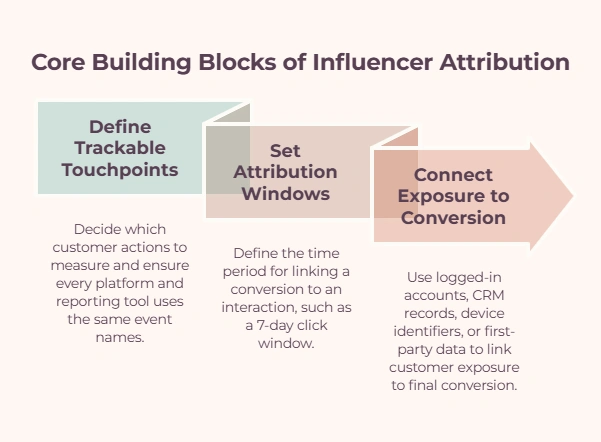
Even the best attribution model cannot produce reliable insights if your tracking setup is inconsistent. Before you compare attribution models, make sure you collect the right data across every customer touchpoint.
Define Trackable Touchpoints
Start by deciding which customer actions you want to measure. Every platform and reporting tool should use the same event names before your campaign goes live.
- Creator impression: A user views a creator’s social media post.
- Link click: A visitor clicks a tracking link or affiliate link.
- Landing page visit: A visitor reaches your campaign page.
- Add to cart: A customer adds a product to their cart.
- App install: A user installs your mobile app.
- Lead or sign-up: A visitor submits a form or creates an account.
- Purchase: A customer completes an online or offline conversion.
- Branded search: A customer searches for your brand after creator exposure.
A clear event taxonomy keeps campaign metrics consistent across Google Analytics, your CRM, and other measurement systems.
Common reporting gaps appear when mobile app installs are separated from web conversions or branded searches are credited to SEO, even when a creator started the customer journey.
Set Attribution Windows
An attribution window defines how long a conversion can be linked to an earlier interaction.
A click-through window measures conversions after someone clicks a creator's tracking link. At the same time, a view-through window measures conversions after someone sees content without clicking.
For many direct-response influencer campaigns, a 7-day click window is a practical starting point. View-through windows longer than one day can over-credit impressions, so review them carefully.
Your attribution window determines which conversions are counted. Document it before launch and apply the same window across campaigns so performance comparisons stay consistent.
Connect Exposure to Conversion
Attribution depends on connecting a customer's exposure to their final conversion.
You can improve attribution by using:
- Logged-in customer accounts
- CRM-tagged customer records
- App or device identifiers
- Consent-based first-party data
Cross-device journeys, browser restrictions, and privacy features such as Apple's App Tracking Transparency can still make parts of the customer journey difficult to connect. That is why first-party data provides the strongest foundation for long-term influencer attribution.
The 6 Main Influencer Marketing Attribution Models
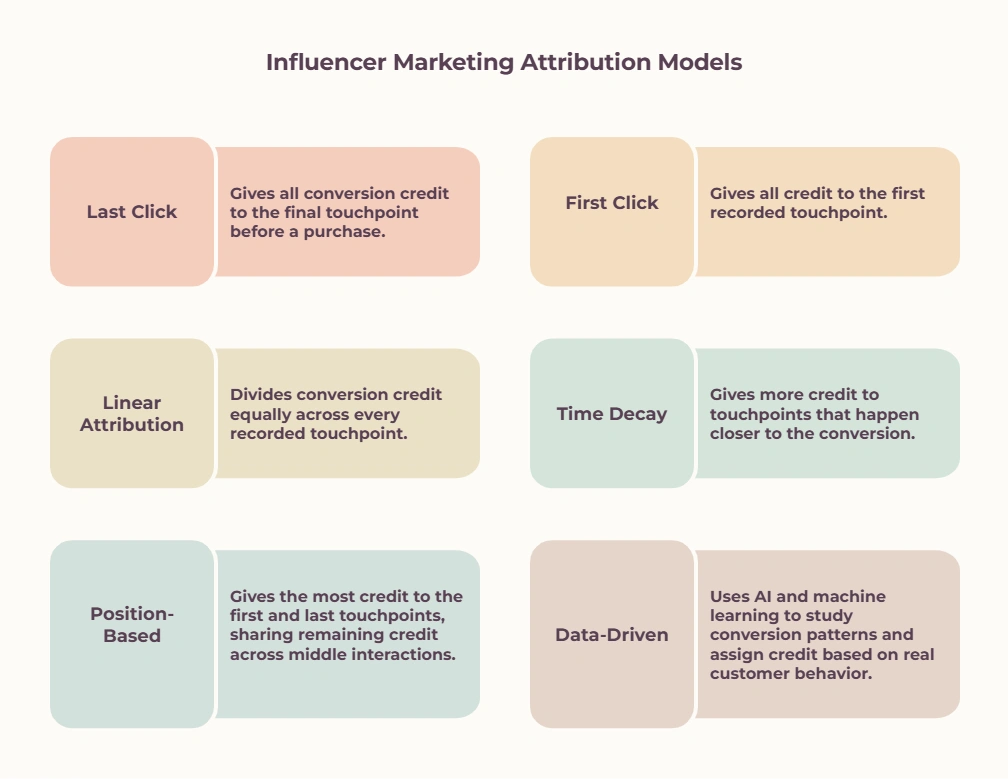
No attribution model works for every influencer campaign. Each one assigns conversion credit differently, so the best choice depends on your campaign goals, customer journey, and measurement strategy.
1. Last Click Attribution
Last-Click Attribution gives all conversion credit to the final touchpoint before a purchase.
Example:
A customer discovers your brand through a TikTok creator but converts after clicking a Google Search ad. Google Search receives 100% of the credit.
Best for:
- Affiliate marketing
- Short buying cycles
- Direct-response campaigns
Weaknesses:
- Ignores earlier creator influence
- Can undervalue brand awareness campaigns
When not to use: Avoid it when customers interact with multiple marketing channels before converting. This limitation matters because many purchases involve more than one interaction.
Research from Unifida found that 85% of online customer journeys include multiple channels, which means last-click attribution can overlook the role creators play earlier in the buying process.
2. First Click Attribution
First-Click Attribution gives all credit to the first recorded touchpoint.
Example:
A customer first discovers your brand through an Instagram creator and later returns through email before making a purchase. The creator receives full credit.
Best for:
- Brand awareness campaigns
- Measuring customer discovery
Weaknesses:
- Ignores every interaction after the first click
- May overvalue awareness campaigns
When not to use: Avoid it when your goal is to measure the complete customer journey.
3. Linear Attribution
Linear Attribution divides conversion credit equally across every recorded touchpoint.
Example:
If a customer interacts with four channels before purchasing, each one receives 25% of the credit.
Best for:
- Long buying journeys
- Multi-channel influencer campaigns
Weaknesses:
- Assumes every touchpoint contributes equally
- May overvalue low-impact interactions
- Does not show which creators or channels had the strongest influence
According to NP Digital's 2025 research, customer journeys now include an average of 11.1 touchpoints before purchase. This makes equal credit less reliable because some interactions have a greater influence on the final purchase than others.
When not to use: Avoid it if you need to identify your highest-performing channels or creators.
4. Time Decay Attribution
Time Decay Attribution gives more credit to touchpoints that happen closer to the conversion.
Example:
A creator introduces the brand first, but a retargeting ad appears one day before purchase. The retargeting ad receives more credit.
Best for:
- Short consideration periods
- Product launches
- Promotional campaigns
Weaknesses:
- Can undervalue creator discovery
- Favors later interactions
When not to use: Avoid it when early-stage awareness is a major campaign goal.
5. Position-Based Attribution
Position-Based Attribution, also called the U-shaped model, gives the most credit to the first and last touchpoints. The remaining credit is shared across the middle interactions.
Example:
The creator who introduced the customer and the final channel before purchase receive the largest share of credit.
Best for:
- Ecommerce brands
- Lead generation
- Full-funnel influencer marketing
Weaknesses:
- Uses fixed weighting
- Middle touchpoints may receive less credit than they deserve
When not to use: Avoid it if your customer journey includes many equally important interactions.
6. Data-Driven Attribution
Data-Driven Attribution uses AI and machine learning to study conversion patterns and assign credit based on real customer behavior.
Google Analytics 4 uses this approach as its default reporting model, which shows how widely data-led attribution has replaced fixed rules.
Example:
If your data shows creator content consistently influences purchases, the model automatically assigns more credit to those touchpoints.
Best for:
- Large ecommerce businesses
- Brands with high conversion volume
- Mature measurement programs
Weaknesses:
- Requires a large amount of clean conversion data
- Can be difficult to interpret
When not to use: Avoid it if your campaigns generate limited conversions or your tracking data is incomplete.
Which Influencer Marketing Attribution Model Should You Choose?
The right model depends on your campaign goals, customer journey, and available data. This table shows how the six main attribution models compare.
We recommend starting with the model that matches your main campaign goal. You can compare multiple models later if the customer journey includes several marketing channels.
How to Validate Attribution With Incrementality Testing
Attribution and incrementality answer two different questions.
Attribution asks which touchpoints should receive credit for a conversion. And incrementality asks whether the customer would have converted without the influencer campaign.
You need both because attribution alone cannot prove that the campaign caused the sale.
Geo Holdout Tests
Run your influencer campaign in selected markets while keeping similar regions unexposed. Then compare the conversion rates between both groups.
This method works well for national or regional campaigns, but each market needs enough traffic and similar buying behavior to produce reliable results.
For example, Hourglass Cosmetics validated Meta's impact through a six-week geo holdout test across selected U.S. DMAs. The experiment found statistically significant incremental lift in both revenue and new customer acquisition. The results showed that matched-market testing can measure business impact beyond standard attribution reports.
Audience Holdout Tests
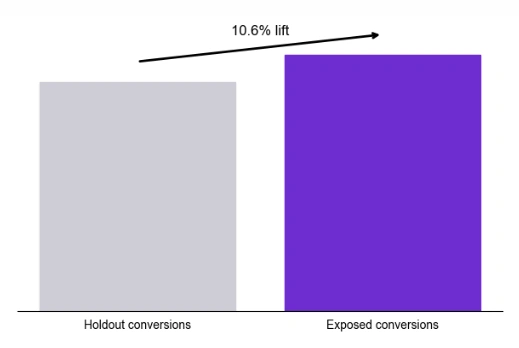
Exclude a small, randomized audience from seeing your campaign and compare its behavior with the exposed audience.
This approach is easier when you use paid creator amplification or whitelisted content because you have greater control over who sees the campaign.
Randomized Controlled Tests
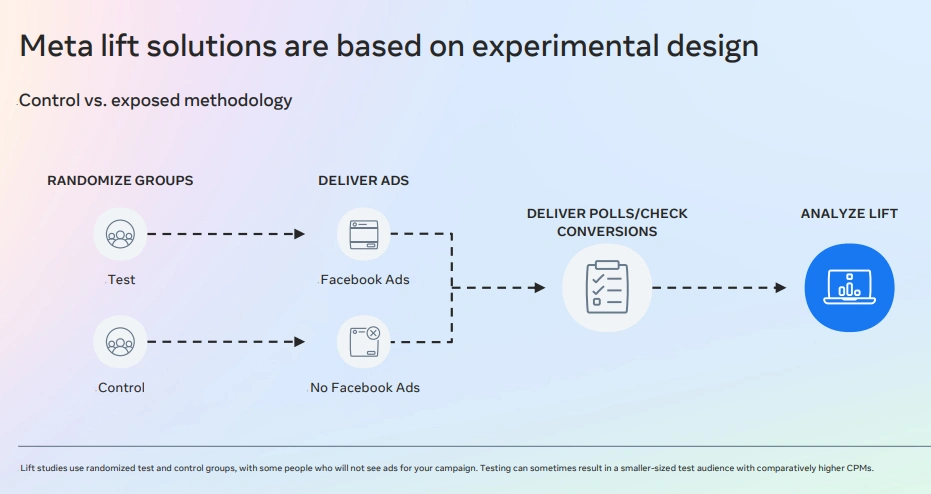
Randomly assign users to exposed and control groups before launching the campaign. Then compare their conversion rates.
This method provides the strongest evidence of campaign impact, but it requires more planning and greater control over content distribution.
Meta uses the same approach in its Conversion Lift studies. It randomly assigns people to test and control groups, serves ads only to the test group, and compares conversions to measure incremental lift.
The diagram below illustrates how Meta's Conversion Lift framework measures incremental campaign impact through randomized test and control groups.
Calculate Incremental Lift
You can use the following formula to measure incremental lift:
Example:
- Exposed conversion rate: 3.2%
- Holdout conversion rate: 2.5%
- Incremental lift: 28%
Keep in mind that incremental ROAS is usually lower than attributed ROAS. Some customers would have converted through organic search, paid media, email, or another marketing channel even without the influencer campaign.
How to Build an Influencer Marketing Attribution System
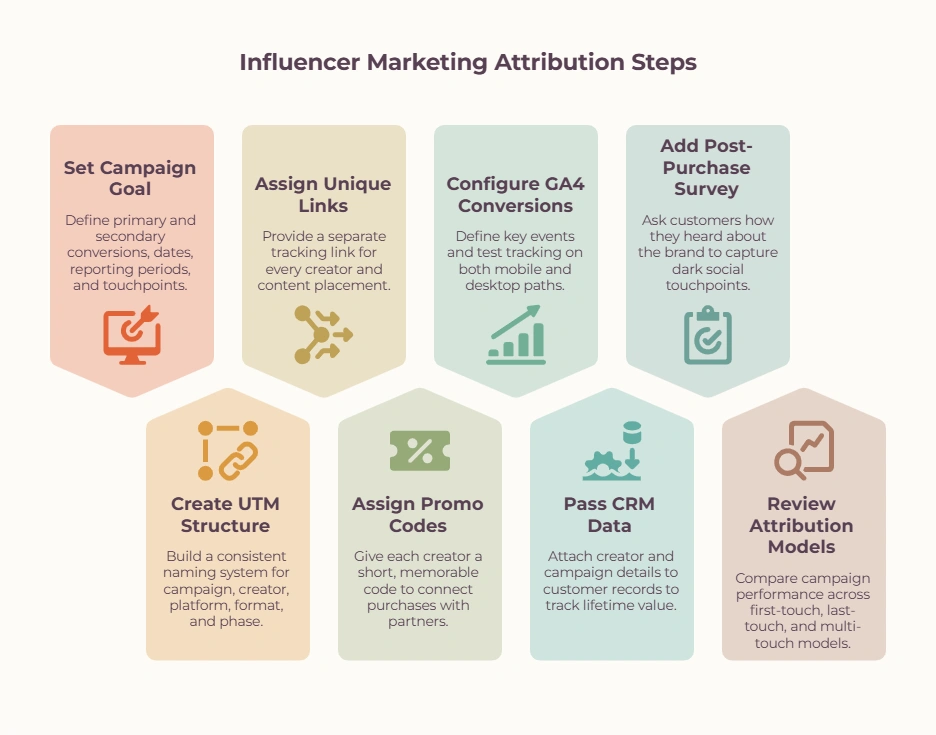
The right model only works when your tracking setup is consistent. Below, we have shared a step-by-step guide that can help you connect creator activity with conversions, customer data, and campaign results.
Step 1: Set Your Campaign Goal
Choose the main result you want the campaign to drive. This could be purchases, leads, app installs, or email sign-ups.
Before setting campaign goals, it is also important to build a clear influencer brief so every creator follows the same objectives and tracking requirements.
Then define:
- Your primary conversion
- Any secondary conversions
- The campaign start and end dates
- The reporting period
- The touchpoints you plan to track
For example, an ecommerce campaign may use purchases as the primary conversion and add-to-cart actions as a secondary conversion.
Step 2: Create a UTM structure
Build a clear UTM naming system before you create creator links. Use the same format across every influencer campaign.
Your UTM parameters should identify:
- Campaign name
- Creator name
- Social media platform
- Content format
- Campaign phase
Step 3: Give Each Creator a Unique Link
Create a separate tracking link for every creator and content placement.
A creator who posts on TikTok and Instagram should receive a different link for each platform. You can then compare traffic, conversions, and content formats without mixing the data.
Avoid one shared campaign URL. It prevents accurate creator-level reporting.
Step 4: Assign Unique Promo Codes
Give each creator a short and memorable promo code.
The code should match the creator where possible, such as MAYA15 or SAM10. This makes it easier to connect purchases with the right partner.
Insider tip: Use promo codes alongside tracking links. A customer may remember the code and purchase later without clicking the original post.
A 2025 study in the Journal of Research in Interactive Marketing found that influencer discount codes can improve ad recognition. They work best as a supporting attribution signal rather than the only tracking method.
Step 5: Configure Conversions in Google Analytics 4
Decide which actions should count as key events in Google Analytics 4.
These may include:
- Product views
- Landing page visits
- Add-to-cart actions
- Checkout starts
- Purchases
- Form submissions
- App installs
We recommend testing every event before launch. Click each creator link, complete a test conversion, and confirm that the campaign and creator details appear correctly in your reports.
You should also test mobile and desktop paths. A link may work on one device but lose UTM parameters on another.
Step 6: Pass Creator Data into Your CRM
Add the creator name, campaign name, and source data to each lead or customer record in your CRM.
This lets you follow the customer beyond the first conversion. You can see which creators generate qualified leads, completed purchases, repeat customers, and higher lifetime value.
For lead generation campaigns, keep the original creator source attached to the record as it moves through the sales pipeline.
Step 7: Add a Post-Purchase Survey
Ask customers how they first heard about your brand.
Include common options such as TikTok, Instagram, YouTube, a creator, paid ads, search, or a friend. Add an open-text field so customers can name a specific creator.
Compare survey answers with your tracked data. A customer may report a creator even when Google Analytics credits the purchase to search or direct traffic.
Post-purchase surveys capture information that click tracking alone can miss, such as word-of-mouth recommendations, organic creator content, and other dark social touchpoints. That makes them a useful way to validate your attribution data rather than replace it.
Step 8: Review the Campaign Through Multiple Models
Compare the same campaign through First-Touch Attribution, Last-Touch Attribution, and a multi-touch model.
Look for large differences in creator and channel credit. For example, a creator may appear weak under last-click reporting but strong under first-touch attribution.
Review those differences before you:
- Increase creator budgets
- Pause partnerships
- Change commission rates
- Reallocate paid media spend
- Renew long-term creator contracts
This final check helps you avoid decisions based on one narrow view of the customer journey.
Note: Attribution is one part of a broader measurement strategy. If you want to understand how attribution, incrementality testing, and marketing mix modeling work together, read our guide to Marketing Measurement.
Metrics You Should Measure Alongside Attribution
Attribution shows where conversion credit goes. It does not tell the whole story. Therefore, our team at inBeat Agency reviews these metrics alongside your attribution reports to understand the full impact of your influencer campaigns.
- Return on ad spend (ROAS): Measures how much revenue you generate for every dollar spent.
- Customer acquisition cost (CAC): Shows how much it costs to acquire a new customer through influencer marketing.
- Customer lifetime value (LTV): Helps you identify creators who bring in customers with higher long-term value instead of one-time buyers.
- Assisted conversions: Measures how frequently creators influence conversions without receiving the final click.
- Brand search lift: Tracks changes in branded search volume after a campaign launches. It can reveal awareness that click-based attribution misses.
- View-through conversions: Measures purchases that happen after someone views creator content without clicking on it.
- Engagement quality: Look beyond likes. Shares, saves, comments, and meaningful clicks provide stronger signals of audience interest.
- Earned media value (EMV): Estimates the media value generated by creator content. Use it as a visibility metric rather than a revenue metric.
- Incremental revenue: Measures the additional revenue generated because of the campaign, not just revenue credited to it.
- Incremental ROAS: Compares the campaign's true business impact with its cost. This metric is usually lower than attributed ROAS because it excludes conversions that would have happened anyway.
Review several metrics together to understand how your influencer campaigns contribute to awareness, engagement, and revenue.
Remember, attribution becomes more useful when you compare several views instead of treating one model as the final answer.
Here is how we at inBeat approach it.
Build a Smarter Influencer Attribution Strategy With inBeat Agency
If you want to measure influencer campaigns with greater confidence, inBeat Agency can help. We build attribution systems that connect creator performance, paid media, and measurement, so you can make budget decisions based on reliable data instead of incomplete reports.
Book a free strategy call to discuss your attribution goals.
Key takeaways
- Attribution models assign conversion credit differently, so no single model fits every campaign.
- Tracking and attribution are different. Tracking collects data, while attribution decides how conversion credit is assigned.
- Influencer attribution is more challenging because customer journeys span multiple channels, devices, and touchpoints.
- A consistent tracking setup with UTM parameters, creator links, and event naming improves reporting accuracy.
- Promo codes, post-purchase surveys, and CRM data help fill attribution gaps that analytics tools may miss.
- Incrementality testing measures whether your influencer campaign caused additional conversions.
- Compare multiple attribution models before changing creator budgets or campaign strategy.
- Review attribution alongside metrics such as ROAS, customer lifetime value, assisted conversions, and incremental revenue to understand true campaign performance.
FAQs
What is the best attribution model for influencer marketing?
The best attribution model depends on your campaign objective. First-click works best for brand awareness campaigns, last-click suits affiliate and direct-response campaigns, and position-based attribution is a strong choice for ecommerce purchase campaigns. Data-driven attribution works best for brands with high conversion volume and reliable tracking data.
What's the difference between attribution and influencer tracking?
Influencer tracking collects campaign data through tools such as UTM parameters, tracking links, and promo codes. Attribution, on the other hand, uses that data to decide how much credit each touchpoint should receive for a conversion.
Are promo codes enough to measure influencer ROI?
No. Promo codes capture only part of the customer journey. Some customers purchase without using a code, while others may discover your brand through a creator and convert later through another marketing channel. Combine promo codes with tracking links, analytics, and post-purchase surveys for a more complete picture.
Can GA4 measure influencer attribution?
Yes. Google Analytics 4 can measure influencer traffic, conversions, and attribution when your campaigns use properly configured UTM parameters and conversion events. However, it should be combined with CRM data and other measurement methods for greater accuracy.
Does inBeat Agency help brands build influencer attribution systems?
Yes. We can help you build attribution systems that connect creator campaigns, paid media, analytics, and CRM data. This gives marketing teams a clearer view of campaign performance and creator impact.
Can inBeat measure influencer campaigns beyond platform analytics?
Yes. Our experts at inBeat Agency combine platform reporting with attribution modeling, campaign measurement, and performance analysis. This helps you understand how influencer campaigns contribute to business outcomes rather than relying only on platform dashboards.