.svg)
.svg)
.svg)
.svg)


.svg)








You're probably someone who wants proof that attention moved the business, yet attention does not behave like paid ads. Numbers are all there, dashboards filled up, and confidence follows, but usually for the wrong reasons.
However, earned media value promises clarity while also creating gaps between exposure and impact. When used well, it helps frame attention. But when you use it poorly, it turns noise into confidence.
This article breaks down what earned media value actually does, how teams calculate it, where it breaks under pressure, and why results differ. Let's get started.
TL;DR
- Earned media value helps you translate unpaid attention into a familiar dollar frame, but it stays an estimate.
- EMV works best as a context for scale, not as a performance result or success claim.
- Different formulas and multipliers explain why EMV numbers usually conflict across tools.
- Influencer and user-driven content dominate EMV because trust and reuse extend attention.
- High EMV can coexist with weak revenue if attention never turns into action.
- Strong teams pair EMV with conversions, CAC, and efficiency signals before scaling.
- The real advantage comes from how you interpret EMV.
What Is Earned Media Value?
Earned media value is an estimated dollar figure that translates unpaid attention into the cost of equivalent paid exposure. In other words, it helps you express what organic reach, mentions, and sharing might have cost if bought through ads.
However, that number is an estimate and not a receipt. It reflects assumed value, shaped by inputs and multipliers, rather than money that actually changed hands.
This framing explains why EMV became common in PR and influencer reporting. Teams needed a shared way to talk about media coverage, brand awareness, and reach across social media platforms without tying every result to spend. As earned channels became harder to summarize, EMV filled the gap.
According to Influencer Marketing Hub, creators published about 1.4 billion social media posts in 2024 and generated an estimated $236 billion in earned media value. That volume makes translation tempting but also risky if assumptions stay hidden.
If you want a clear, real-world take on EMV, check out this TikTok:
But why does earned media matter today?
Why Earned Media Matters So Much Today
Earned media matters today because users trust people more than ads when making decisions. That’s why reviews, creator content, and word of mouth shape choice long before a brand message lands.
But this is not about sentiment alone. Unpaid mentions carry context, lived experience, and credibility that ad campaigns struggle to replicate, especially on crowded feeds.
As a result, attention built through social posts and creator voices tends to influence judgment earlier in the funnel. It shapes brand trust before any click happens. In practice, this also explains why teams watch brand mentions and conversation quality rather than just reach. Those signals show whether attention is earned or simply placed.
Vogue reports that one fashion season generated around $768 million in earned media value on social media. This is a figure that many marketers reference to gauge buzz and visibility for major events.
Pro tip: Earned media works best when trust leads the strategy. At inBeat Agency, our influencer program focuses on relevance and credibility. That approach treats attention as something you earn, not buy.
Now, let's compare earned, paid, and owned.
Earned Media vs. Paid Media vs. Owned Media
This describes three exposure types that differ in control, cost, and reliability. The distinction matters because each behaves differently once money, trust, and scale are present. To make that contrast clear, here’s a simple comparison across the dimensions teams actually debate.
However, this imbalance creates a reporting problem. Earned media influences decisions but lacks a native price tag. EMV exists to translate that attention into paid media language so leadership can compare unlike inputs without pretending they behave the same.
Pro tip: Check out this guide on earned media vs paid media to learn which one suits you best at the moment.
Next, let's see why brands measure earned media.
Earned Media Value: How It’s Calculated in Marketing
Earned media value is usually calculated by translating unpaid attention into paid media terms, and one common approach shared by Shopify frames it as:
EMV = impressions × CPM
With CPM reflecting what paid reach would cost per thousand views. That formula gives you a shared language with finance and leadership. Still, it only estimates attention rather than results. So the value comes from how the output is read, compared, and pressure-tested across channels.
In practice, EMV helps you size visibility inside social media marketing, then line it up against paid spend to see whether earned reach is keeping pace or falling behind. When used carefully, it supports decisions around scale, reuse, and reporting. But when used alone, it can distort campaign performance by treating reach as impact.
Why Adjustment Factors Change Everything
Adjustment factors change everything because they decide whether EMV reflects real audience response or inflated reach. Without them, the formula treats every impression as equal, which rarely matches how people behave.
Here are the main factors that shape how earned media value is adjusted and interpreted:
- Engagement: Higher engagement metrics signal attention and not just exposure. Tools that weigh likes, comments, or saves more heavily usually report very different EMV.
- Platform: A post on one social platform does not carry the same intent or trust as another, even at the same CPM.
- Content type: Video, static posts, and creator-led formats perform differently and attract different levels of response.
- Sentiment: Positive or negative tone shapes brand sentiment, which affects how earned attention should be valued.
As a result, different tools apply different logic. And that is why EMV varies so widely across reports, even when the inputs look similar. But let's see where it comes from today.
Where Earned Media Value Comes From Today
Earned media value is created when people talk about, share, or react to a brand without direct spend. Today, these appear across a few repeatable sources that shape how attention is measured and interpreted.
Here's where they come from most:
- Influencer content: Posts from social content creators drive EMV because they combine reach with context. The audience sees how a product fits real use, which gives exposure weight beyond impressions.
- User-generated content: UGC matters because it reflects voluntary participation. And that priority is clear in practice since 56% of influencer campaigns focus on UGC as a core goal. This ties EMV to reuse potential and sustained audience engagement rather than one-off reach.
- Press mentions: Editorial coverage adds authority and external validation. It usually carries fewer impressions, but a stronger signaling value.
- Reviews and ratings: These inputs influence decisions late in the funnel. They contribute smaller EMV totals but meaningful context.
- Social shares and reposts: Redistribution extends lifespan and signals relevance through audience action.
Influencer content dominates EMV reporting because it scales attention while preserving credibility across channels.
Moving on, we'll see how EMV is used in influencer marketing.
Earned Media Value in Influencer Marketing
Earned media value shows up most clearly in influencer marketing because creators combine scale with context. Across the market, many teams see EMV estimates ranging from $3 to $8 for every $1 spent, depending on audience fit, format, and reuse.
But those ranges swing widely. Assumptions differ, benchmarks shift by channel, and tools reward different signals, which explains why two reports can describe the same campaign very differently.
Pro tip: At inBeat Agency, EMV is used as context rather than a success claim. In influencer programs for brands like Soylent, creator-led campaigns generated more than 5 million earned impressions alongside 50+ reusable pieces of content that continued to drive reach well beyond the initial activation.
That earned exposure would translate into high EMV under most models. Still, decisions were made based on how that attention supported reuse, efficiency, and downstream performance rather than the EMV figure itself.
Here's an example of our work together, where we got Andrew Rousso to record this amazing content:
Why Influencers Drive Disproportionate EMV
Influencers drive disproportionate EMV because attention comes with meaning. That advantage comes from a few clear dynamics:
- Engagement density: Smaller, focused audiences typically produce higher social engagement rates, which pushes EMV assumptions upward even at lower reach.
- Community trust: Recommendations carry weight. In practice, 61% of consumers trust influencer recommendations more than traditional ads.
- Reuse across channels: Creator assets travel. And this matters because 100% of marketers repurpose influencer content beyond the original post. This helps extend lifespan and audience interaction across placements.
Next, let's see how EMV appears in campaigns.
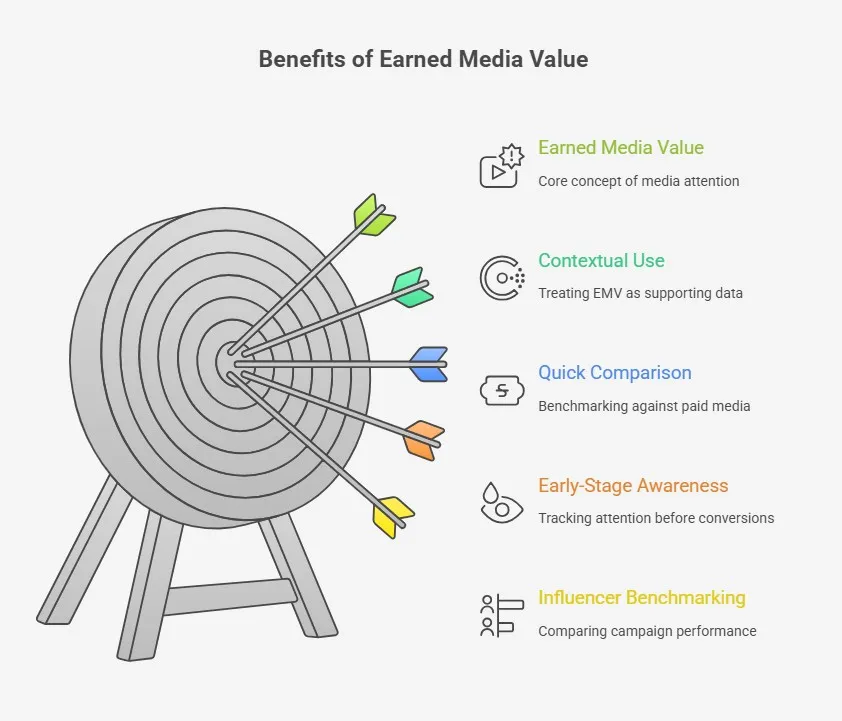
The Benefits of Earned Media Value (When Used Correctly)
Earned media value should be treated as context rather than proof. When you use it with discipline, it supports clearer decisions instead of replacing deeper analysis. To make that practical, here are the ways EMV adds value without overstating its role:
- Quick comparison to paid media: EMV gives a rough sense of what similar exposure might have cost through ads. That reference helps frame efficiency conversations without claiming equivalence.
- Early-stage awareness tracking: Before conversion data stabilizes, EMV is a way to size attention and spot momentum. So, it becomes useful when outcomes lag exposure.
- Influencer and campaign benchmarking: Comparing EMV across creators, campaigns, or time periods shows relative performance. The real gain comes from spotting patterns rather than chasing the highest number.
- Competitive comparisons: EMV helps estimate the share of attention within a category. In practice, that view supports positioning decisions and budget discussions.
- Stakeholder reporting context: Leadership typically needs a familiar lens. EMV translates earned attention into a format that finance and executives can interpret, while deeper metrics carry the decision weight.
The Real Problems With Earned Media Value
EMV creates clarity only when its limits stay visible. Once those limits fade, the number starts to do more harm than good. These are the problems that come up most frequently:
- No standard formula: Different tools apply different logic. The same campaign can have sharply different values depending on which platform runs the math.
- Easy to inflate: Multipliers and benchmarks can raise the number. It can happen without a clear explanation, which affects confidence, but not reality.
- Rewards volume over quality: Large impression counts can outweigh intent, relevance, or context. But attention without purpose rarely supports decisions that matter.
- Weak link to sales or outcomes: High EMV can coexist with flat revenue. Attention does not move people unless it aligns with timing, message, and need.
- Misused in executive reporting: Numbers typically appear without assumptions, limits, or methodology. That gap turns EMV into a verdict instead of a signal.
EMV vs. Real Business Impact
EMV measures attention, but business impact happens only when that attention leads to action. Awareness can grow without changing behavior, which is why high visibility does not guarantee demand.
That gap widens when vanity metrics take center stage. Impressions and reach look convincing, yet outcome metrics like conversions, revenue, or cost per acquisition tell a very different story.
The tension becomes clear when EMV rises while revenue stays flat. Attention may arrive too early, reach the wrong audience, or carry the wrong message. In those cases, EMV reflects exposure volume rather than decision quality. What matters is whether attention supports movement through the funnel rather than stopping at recognition.
An inBeat Agency example makes this distinction concrete.
In a performance-led creator program for Genomelink, content helped reduce customer acquisition cost by roughly 75% while improving conversion completion rates. Those gains mattered because they tied exposure to efficiency and not because they produced a large earned value figure.
That approach reflects our position: EMV provides context, but decisions are made based on outcomes like conversions and CAC, and not on EMV alone. Here's what we did for Genomelink:
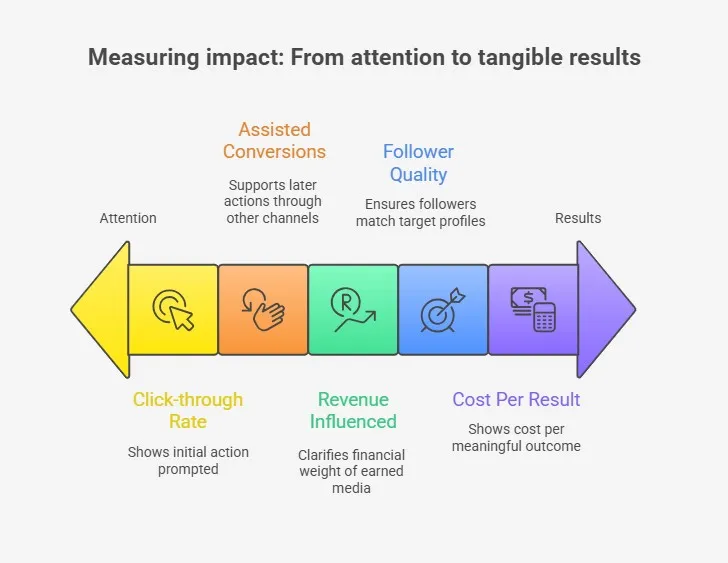
What to Measure Alongside Earned Media Value
What to measure alongside earned media value? Anything that shows whether attention led to movement. EMV helps frame scale, but decisions improve when used with signals tied to behavior. To make that clear, these are the metrics that add meaning:
- Click-through rate: Click-through rates show whether attention prompted an action. According to CXL, average CTR sits around 6.64% for search and 0.57% for display, which helps you judge whether the interest carries intent.
- Assisted conversions: This reveals how earned touchpoints support later actions. It matters when influence happens early, but conversion comes later through another channel.
- Revenue influenced: Revenue attribution clarifies financial weight. That connection is increasingly common, with about 80% of businesses reporting that they track sales or conversions tied to influencer activity.
- Follower quality: Growth only helps when new followers match target profiles and show ongoing interaction, not passive accumulation.
- Cost per result: This anchors attention to efficiency and shows what each meaningful outcome actually costs.
Pro tip: Check out this guide on the top media buying agencies to learn who can help you reach new heights.
How Smart Teams Use Earned Media Value Today
Smart teams use earned media value as a decision aid rather than a finish line. The goal is to move from attention to action without confusing the two. So, here's a simple framework that keeps that discipline intact:
- Use EMV to size attention: EMV helps estimate the amount of attention a campaign generated compared to paid exposure. At this stage, the number represents scale and reach, nothing more. It answers how much attention there is and not whether it mattered.
- Validate with engagement quality: Next, attention is checked for depth. Interaction patterns, repeat exposure, and audience response clarify whether people paid attention or simply scrolled past. This step filters noise before interpretation begins.
- Connect to downstream action: Earned exposure is then mapped to behavior. Assisted conversions, traffic patterns, and conversion paths show whether attention supported movement through the funnel.
- Decide what to scale: Only after those checks does scaling make sense. Content, creators, or formats that support outcomes earn more investment. Others remain in context and are not signals for growth.
How inBeat Agency Turns Earned Attention Into Growth
At inBeat Agency, earned media starts with trust. Programs are built around relevance and credibility, which shape who speaks about the brand and why their voice carries weight. That focus changes how attention behaves once it shows up.
In our paid media services, influencer programs are structured around fit. Sometimes, smaller creators with aligned audiences can send clearer signals than large accounts with diffuse reach. This is why earned exposure is reviewed with performance data.
Measurement follows the same logic. Earned media happens alongside conversion paths, acquisition cost, and content reuse, which keeps interpretation grounded. A clear example comes from inBeat Agency’s work with Bluehouse Salmon.
Creator-led content supported long-term audience growth, with over 500 assets contributing to steady monthly gains and a 1,900% follower increase across a year. That exposure would register strongly under most EMV models, yet decisions were made based on growth durability and efficiency.
Seen this way, EMV stays useful as context. It informs discussion, but it never decides outcomes on its own.
Here's what kind of content we did for them:
Use Earned Media With Discipline
Earned media carries influence, yet it behaves unevenly once you measure it. Attention spreads and compounds in ways paid channels do not, which is why comparisons typically mislead you.
Earned media value helps translate that movement into numbers, but it never turns attention into fact. The risk appears when the figure becomes the story.
So the value sits in use (not reporting), which helps you decide what matters. EMV works best as a lens that guides review and comparison rather than a verdict. If earned attention needs to support growth or efficiency, discipline matters.
If earned media needs to support real outcomes, inBeat Agency can help you turn attention into measurable decisions. Contact us today.
FAQs
What is a good EMV value?
A good EMV value usually lands between $5 and $25 per 1,000 impressions, depending on channel and context. The figure matters only when it compares cleanly to your paid CPMs and stays consistent across campaigns.
What is the difference between EMV and CPM?
EMV estimates the value of unpaid attention after it happens, while CPM is the price paid for exposure before results appear. One translates impact, the other sets cost.
What are EMV and IMV?
EMV measures the estimated value of earned exposure, while IMV focuses on influencer-driven media value. The difference lies in scope.
How do you calculate EMV?
EMV is calculated by multiplying impressions by a paid CPM benchmark and then adjusting for context. The final figure depends on assumptions since it's not a fixed rule.