%20(1).png)

You're running campaigns across multiple channels, but can you say with confidence what's actually driving results? Most brands can't. Between messy reports, shallow attribution, and KPIs that don't tie back to revenue, it's easy to waste budget without realizing it.
Building a focused measurement strategy matters more now than it did two years ago, and not just because there's more data. The methods that used to work reliably are breaking down for a specific, structural reason, covered below, and the fix isn't more dashboards.
In this guide, we'll cover channel-based metrics that matter, the core measurement methods and why the reliable choice between them just changed, a step-by-step framework for building your own plan, tool recommendations, and common pitfalls to avoid.
P.S. Struggling to tie your ad spend to real business outcomes? Our growth marketing services pair measurement with the creative and targeting work that actually moves the numbers.
TL;DR
Why it matters: Most teams collect data but fail to connect it to outcomes. A focused measurement strategy helps tie marketing activity to business growth.
What to track by channel:
- Lead generation: Cost per lead, lead conversion rate, MQLs
- SEO and website: Organic traffic, ranking keywords, bounce rate, domain authority
- Paid ads: Click-through rate, cost per acquisition, return on ad spend
- Social and content: Engagement rate, follower growth, post saves and shares
- Email: Open rate, email CTR, unsubscribe rate
Strategic vs. tactical KPIs:
- Strategic KPIs: Long-term impact (ROI, CLTV, MRR)
- Tactical KPIs: Real-time performance (CPC, bounce rate, CTR)
Match your KPIs to business model and funnel stage.
Key methods for accurate measurement
- Attribution modeling shows which touchpoints drive conversions, though its reliability now depends heavily on which channel you're measuring
- A/B testing compares versions to optimize campaigns
- Marketing mix modeling evaluates online and offline impact together, and adoption has roughly tripled since 2023 as attribution has gotten less reliable
- Conversion-lift studies isolate real campaign impact
- Funnel analysis identifies friction across the customer journey
Tool recommendations
- Google Analytics 4: Tracks user actions and conversion paths
- HubSpot: Combines CRM with marketing analytics
- Tableau: Visualizes data from multiple sources
- Mixpanel: Focuses on product and behavioral insights
- Ruler Analytics: Connects marketing to revenue using multi-touch attribution
Common challenges
- Siloed data across tools
- Confusion around attribution
- Gaps in offline conversion tracking
- Overwhelming amount of metrics
- Signal loss from privacy changes, now the biggest driver of method choice
Tips based on budget
- Under $3M: Use built-in tracking tools like GA4 and Meta Ads Manager
- $3M-$5M: Add A/B testing and lift studies
- Over $5M: Layer in marketing mix modeling for long-term ROI insight
Key takeaways
- Choose trackable KPIs such as conversion measurement, customer acquisition costs, or ROI per campaign.
- Use multiple measurement methods for a fuller picture
- Match tools to your team's size, budget, and goals
- Measurement enables smarter campaigns and better decision-making
What is marketing measurement?
Marketing measurement means tracking how your campaigns perform using real data. It connects marketing activity to business outcomes through key performance indicators like click-through rate, cost per lead, and return on investment.
Whether you're running Google Ads, sharing social media posts, or managing a full-funnel digital marketing strategy, measurement shows what's effective. It helps your teams move away from gut instincts toward decisions backed by marketing analytics, customer data, and clear performance indicators.
Measurement is different from attribution: measurement entails collecting data, whereas marketing attribution entails assigning credit to events; the clip below explains how they differ in more depth:
Insider tip: we treat measurement as the loop that closes creative and media decisions. For us, it’s not a report generated after the fact. Every campaign we run feeds creative-level performance data back into the next batch of briefs, because a spend that fails to produce a learning is the real waste. A losing ad that taught the team something is a fine trade. That's the lens for everything below.
Why marketing measurement matters today
Marketing teams aren't flying blind anymore. With so much performance data available, the pressure is on to prove what's working. Yet 87% of marketers say data is still their company's most under-used asset. This disconnect is costly: companies using data-driven strategies see 5 to 8 times higher ROI than those that don't.
Besides, teams today are working with 230% more marketing data than just a few years ago, but 56% say they don't have time to analyze it properly. Without a structured measurement strategy, most of that potential goes untapped.
The bigger shift is what's happening underneath the data itself.
Google officially retired its Android Privacy Sandbox initiative in October 2025 after six years of development, and Apple's App Tracking Transparency has pushed opt-in rates for tracking down sharply since 2021.
The practical result: the click-level data that multi-touch attribution depends on is thinner than it used to be, on more channels than most teams realize. That's not a reason to abandon attribution, but it's the reason the rest of this guide treats method choice as a live decision tied to signal quality, revisited as that signal shifts.
Core marketing KPIs to track by channel
Every team needs clarity on which metrics actually reflect performance. With so much data available, it's easy to track too much or focus on the wrong ones; our guide to the 20 metrics that actually matter goes deeper on picking the right ones for creative and media performance specifically.
Not all KPIs serve the same purpose. Some are tied to long-term business outcomes, while others measure day-to-day activity, and how you weigh each one shifts depending on whether the underlying work is influencer-led or purely paid.
- Strategic KPIs are lagging indicators like customer lifetime value, return on investment, and monthly recurring revenue. These help teams track progress against broader marketing and business strategy because they predict future outcomes.
- Tactical KPIs are leading indicators, evaluating past actions. These include click-through rates, cost per click, bounce rate, and form conversions. They give real-time insight into campaign performance and help marketers fine-tune what's happening across channels.
If you want a deeper dive into leading vs lagging indicators, here’s a good starting point:
Marketing KPI examples by business type
The right performance indicators depend on your business model:
- SaaS companies usually focus on monthly recurring revenue, customer lifetime value, trial signups, and demo requests.
- Sales-led teams track pipeline value, opportunity stage progression, and lead quality.
- E-commerce brands prioritize average order value, return on ad spend, cart activity, and bounce rate.
Matching KPIs to your model helps ensure your marketing analytics support clear, strategic decisions.
Lead generation KPIs
These KPIs track how well your campaigns turn interest into potential revenue.
- Cost per lead (CPL): How much it costs to bring in a new lead through your marketing efforts, closely related to customer acquisition cost once a lead converts.
- Lead conversion rate: The percentage of leads who take action, such as submitting a form or starting a trial.
- Marketing qualified leads (MQLs): Leads that show buying intent based on engagement, fit, or scoring models.
Website and SEO KPIs
Together, these metrics reflect how well your SEO and website content support discovery and engagement.
- Organic traffic: The number of visitors coming from unpaid search engine results.
- Number of organic keywords: The number of essential target keywords that your website ranks for.
- Bounce rate: How often users land on a page and leave without interacting.
- Domain authority: A measure of your site's credibility and ranking potential over time.
Paid advertising KPIs
These KPIs help you evaluate campaign performance, budget efficiency, and ad effectiveness across platforms like Google Ads and Facebook Ads.
- Click-through rate (CTR): The percentage of users who click on your ad after seeing it.
- Cost per acquisition (CPA): How much it costs to gain a new paying customer.
- ROAS (return on ad spend): The revenue generated for every dollar spent on advertising.
Social media and content KPIs
These content performance metrics show what's resonating with your audience across platforms.
- Engagement rate: The level of interaction with your posts (likes, comments, shares, saves).
- Follower growth: How quickly your social media audience is increasing over time.
- Content shares, saves, and comments: Actions that indicate higher value and extended reach for your posts.
Email marketing KPIs
Clear email metrics help you understand how well your campaigns are performing and whether your content connects with your audience. If SMS sits alongside email in your channel mix, tools like Omnisend’s SMS calculator help you estimate cost per send before launching a campaign
- Open rate: The percentage of recipients who open your emails.
- Click-through rate (CTR): How many people click on links inside your emails.
- Unsubscribe rate: How many users opt out of your email list after a campaign.
Why incrementality matters in marketing measurement
Not every conversion in a report actually happened *because* of your marketing. Incrementality answers the one question every marketer needs to ask: what would've happened if we didn't run this campaign?
Most attribution models focus on touchpoints. They tell you *where* a customer clicked, but not *why* they converted. Incrementality testing goes deeper by showing the actual lift your campaign created beyond what would have occurred anyway.
As Forbes puts it:
"Incrementality determines the increase in value (a sale or other conversion) derived from a particular marketing campaign, channel or touchpoint that otherwise would not have occurred without the execution of said campaign, channel or touchpoint."
That trust is measurable now, too: senior decision-makers rank independent incrementality testing as their most trusted measurement method, ahead of both marketing mix modeling and in-platform reporting, according to a 2026 Haus survey reported by eMarketer. When tied to the right KPIs, incrementality unlocks smarter decisions across your marketing strategy, from budget planning to content output to media effectiveness.
Best methods to measure marketing performance
Now that we've covered *what* to measure, here's *how* to do it. These are the core methods that turn raw data into real insights, and in 2026, which one you lead with depends more than ever on how much of your traffic still carries reliable click-level data.
1. Attribution modeling
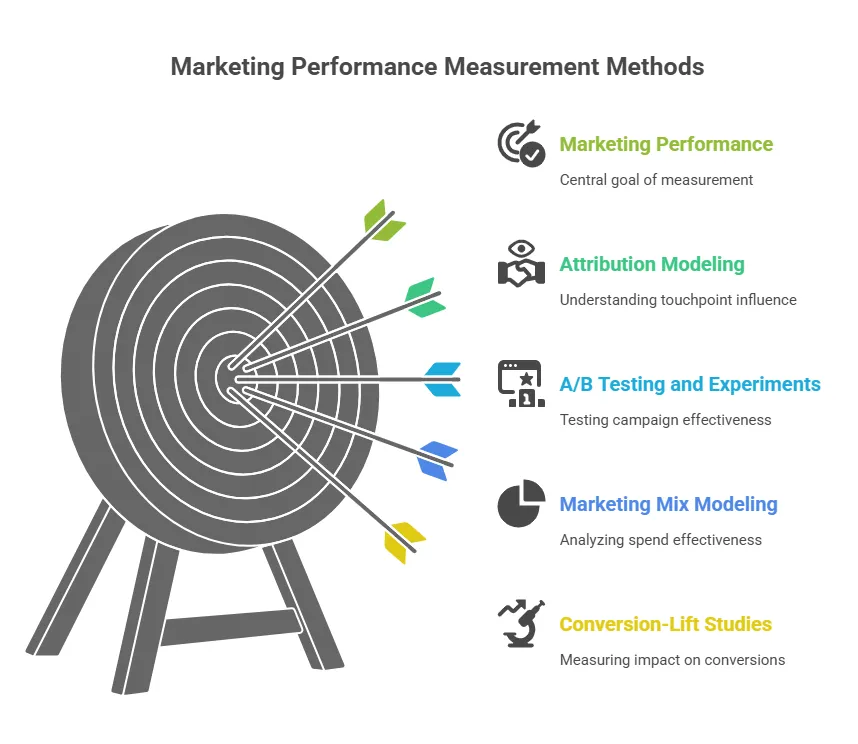
Attribution modeling shows which parts of your marketing actually influence conversions. It answers questions like: did someone convert after clicking a Google Ads campaign, viewing a blog post, or engaging with a Facebook ad?
You have a few model options.
- First-touch credits the first interaction.
- Last-touch credits the final step.
- Multi-touch attribution assigns credit across several touchpoints in the customer journey.
Multi-touch adoption has reached 41%, but only 18% of those implementations are rated highly accurate by the teams running them, a gap that traces directly to the signal loss described earlier. Attribution modeling still gives marketers a solid starting point for evaluating performance across channels, especially on owned and email channels where tracking stays deterministic. It's simply no longer the whole picture on its own.
2. A/B testing and experiments
Sometimes the smallest tweak, like a headline or CTA button, can drive major results. A/B testing lets you compare two versions of a campaign, email, or landing page to see which one resonates more.
Split testing directs roughly equal traffic to version A and version B, then measures performance differences. It requires testing large enough samples to reach statistical significance, so the result reflects a real difference instead of noise. Around 77% of companies run A/B tests on their websites, which shows how essential split testing has become in conversion rate optimization.
3. Marketing mix modeling
Marketing mix modeling (MMM) uses historical data to analyze how different marketing channels, both online and offline, impact overall performance. Unlike attribution models that depend on individual clicks and views, MMM works from aggregate data that privacy rules can't erode, which is exactly why it's having a moment. MMM adoption has roughly tripled since 2023 among surveyed B2B teams, and 43% of adopters name signal loss, cookie deprecation, ATT, and state-level privacy law, as the primary reason they made the switch.
Part of that shift is cost. Google's open-source Meridian framework and Meta's Robyn have collapsed MMM's entry cost from six-figure consulting engagements to a few weeks of in-house data work, and Google shipped a Meridian Scenario Planner in February 2026 specifically for what-if budget testing.
Marketing mix modeling now ranks as the top measurement investment for 40% of marketers in 2026. For teams investing across multiple channels, MMM helps answer the questions attribution alone can't: is this spend actually moving the needle, and where should we reallocate the budget next?
4. Conversion-lift studies
Conversion-lift studies are built for one thing: proving actual impact. Instead of tracking clicks or impressions, they compare two groups, one that sees your campaign and one that doesn't. This control-versus-exposed setup shows whether your marketing actually caused more conversions, or if those results would've happened anyway.
These experiments are especially useful for testing channels like Facebook Ads, where attribution can be fuzzy. Tools like GeoLift and Measured make it easier to run these tests without building everything from scratch.
Lift studies work best when you're spending at scale and want to isolate the true effect of a campaign, like a product launch or a cross-platform promotion. They're slower than A/B tests, but they dig deeper into what's really moving the needle.
5. Funnel analysis
Funnel analysis helps you see how people move through your marketing and sales process, from first touch to final conversion. It maps each stage of the customer journey, so you can spot where users engage, where they hesitate, and where they drop off entirely.
This kind of analysis is key when you're running multi-step campaigns or complex landing pages, and it pairs naturally with our conversion rate optimization work once you've found where the drop-off actually lives. You might find that people click your ads and visit your site but never complete the form, or that they start a checkout and bounce before payment.
Breaking the funnel into stages lets your team pinpoint exactly where friction lives and fix it, whether that's slow load times, weak CTAs, or confusing UX.
P.S. Still feeling stuck turning all these methods into real results? Our paid media agency builds the measurement layer alongside the campaigns themselves, so attribution, MMM, and creative testing feed one plan instead of three disconnected reports.
Measurement methods compared at a glance
Each method answers a different question and needs a different level of data maturity to run well. Use this to see which one fits where you are today, since the most rigorous-sounding method isn't automatically the right one for your data maturity.
How to build a marketing measurement framework
Building a measurement framework from scratch comes down to six steps, in order. Skipping the first two is the most common reason teams end up with a dashboard nobody trusts.
- Define the business goal first. Start with what leadership actually needs answered, revenue growth, CAC efficiency, pipeline volume, before picking a single KPI. A metric chosen before the goal usually turns out to be easy to measure and irrelevant to the decision it's meant to inform.
- Map KPIs to funnel stage. Assign tactical KPIs (CTR, CPC, bounce rate) to the awareness and consideration stages, and strategic KPIs (CAC, CLTV, MRR) to the stages that determine whether the business is actually growing.
- Choose methods based on budget and data maturity. Use the comparison table above: a team with under $3M in annual spend gets more from clean attribution and A/B testing than from a marketing mix model it doesn't have the historical data to run well.
- Fix data silos before adding another tool. A new dashboard on top of disconnected data sources just adds a fourth place to check. Consolidate ad platforms, CRM, and analytics into one reporting layer before layering in a new measurement method.
- Set a reporting cadence tied to decision speed. Tactical KPIs need weekly or even daily visibility; strategic KPIs (MRR, CLTV) are usually noisy at anything shorter than monthly, so monthly reporting suits them fine.
- Act on findings and revisit the framework quarterly. A measurement framework is not a one-time setup. Signal quality, channel mix, and budget all shift, and a framework built for last year's attribution environment is already out of date given how fast tracking and privacy rules have moved since 2023.
How to choose the right measurement method
Not every method fits every team. The tools you use to track performance should match your marketing budget, your channel mix, and how advanced your data setup is.
Here's a simple way to think about it based on budget levels:
- Under $3M/year: Start with digital tracking and in-platform attribution reports from tools like Google Analytics 4, Facebook Ads Manager, or your CRM. These are fast, accessible, and help you keep a pulse on campaign performance.
- $3M-$5M/year: Start layering in structured tests like A/B experiments or lift studies. At this stage, you've got more channels running and enough volume to measure incrementality with real control groups.
- Over $5M/year: Add marketing mix modeling to the stack. It helps with budget forecasting, cross-channel planning, and long-term ROI tracking, especially when you're managing both online and offline spend.
The bigger the budget, the more critical it becomes to move beyond surface metrics and build a full measurement strategy that combines tactical KPIs with high-level effectiveness analysis.
Top 5 marketing measurement tools to know
Once you know what to measure and which methods fit your strategy, the next step is choosing the right tools. If reporting itself is the bottleneck rather than the tool stack, our breakdown of what to expect from marketing agency reporting covers what a disciplined setup actually looks like.
1. Google Analytics 4
Google Analytics 4 helps marketers track how users interact with their website across devices and sessions. It offers detailed behavior analysis and shows how visitors move through key conversion paths.
GA4 includes event-based tracking, which lets you monitor actions like scrolls, video views, and form submissions without extra code. With built-in support for attribution models and integration with Google Ads and Search Console, GA4 remains a go-to tool for teams looking to understand digital marketing performance.
2. HubSpot
HubSpot brings your CRM, marketing analytics, and campaign tracking into one platform. It gives teams a clear view of how contacts move through the funnel, from first visit to form conversion to closed deal.
The built-in dashboards make it easy to monitor KPIs like cost per lead, click-through rates, and customer acquisition costs. If you want marketing and sales data in one place, HubSpot keeps everything connected and decision-ready.
3. Tableau
Tableau turns raw performance data into clean, visual dashboards your team can actually use. It connects with tools like Google Analytics, CRMs, ad platforms, and spreadsheets to bring everything into one place.
Dashboards are customizable, so senior marketers can focus on business outcomes while individual teams dive into tactical metrics. Tableau is especially useful for sharing insights across cross-functional teams.
4. Mixpanel
Mixpanel is built for teams that care as much about what users actually do as where they came from. It tracks product interactions, feature usage, and user flows across web and mobile apps.
It's especially helpful for product-led growth teams that need to link in-app behavior to marketing performance. With flexible dashboards and event tracking, Mixpanel makes behavioral data easy to explore and act on.
5. Ruler Analytics
Ruler Analytics helps you connect anonymous website activity to real revenue. It tracks every touchpoint across the customer journey, clicks, calls, and form submissions, and ties them back to your CRM once a lead converts.
It also shows which campaigns drive the highest-quality leads, beyond raw click volume. If you're serious about attribution and revenue reporting, Ruler gives you data that actually closes the loop.
Common challenges in marketing measurement
Even with great tools and solid KPIs, marketing measurement isn't always straightforward. We've covered the most common ones in detail in 11 marketing measurement mistakes and how to avoid them; the short version follows.
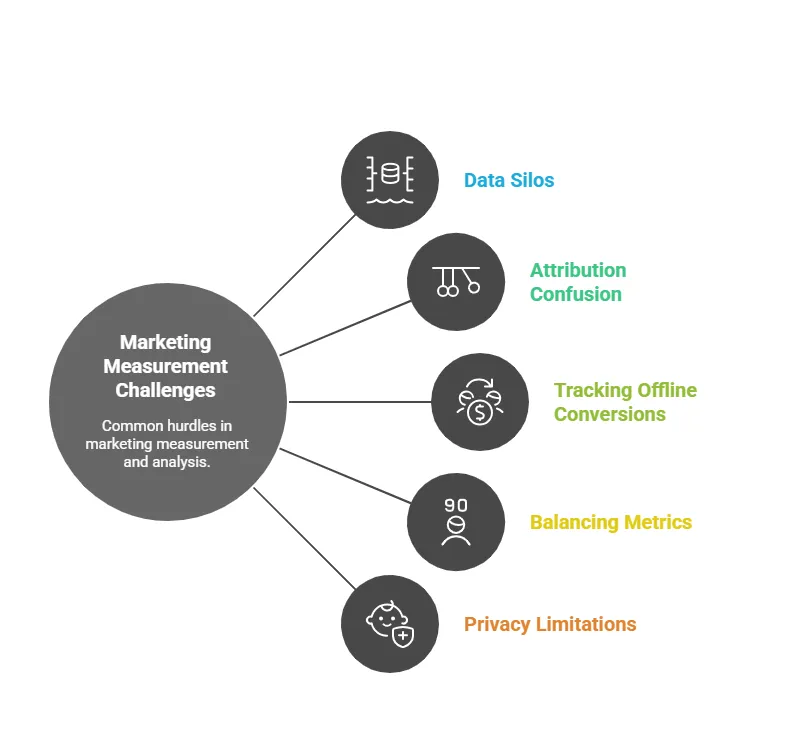
- Data silos between platforms: When analytics, CRM, and ad data all live in separate systems, it's hard to get a unified view of performance. Teams waste time stitching reports together instead of making decisions.
- Attribution confusion: Different models tell different stories, and it's not always clear which touchpoints deserve credit. This creates tension between teams and makes ROI harder to prove.
- Tracking offline conversions: Phone calls, in-person visits, and offline sales often go untracked, leaving gaps in your customer journey data.
- Balancing quantity vs. quality of metrics: It's easy to measure everything, but not everything matters. Without a focused measurement strategy, teams end up buried in dashboards instead of insights.
- Signal loss from privacy changes: This is the throughline running through the rest of this guide. Third-party cookie limits and platform-level tracking restrictions are the reason attribution alone no longer carries the full picture, and why MMM and incrementality testing have moved from optional to standard practice for teams spending real budget.
Build a sharper measurement practice with inBeat
Marketing measurement gives you the clarity to make confident decisions. It connects performance data to real outcomes and helps teams focus on what actually drives growth. With the right KPIs, methods, and tools, and a plan for what to do as signal quality keeps shifting, you can cut through the noise and scale what works.
Key takeaways
- Strategic KPIs measure long-term outcomes while tactical KPIs track short-term performance
- Your KPI stack should reflect your business model and growth stage
- Attribution alone is less reliable than it used to be; pair it with MMM or incrementality testing once your spend justifies it
- A/B testing helps optimize campaigns through real user behavior
- Marketing mix modeling has roughly tripled in adoption since 2023 as signal loss pushed teams toward aggregate methods
- Conversion-lift studies isolate true campaign impact through experimentation
- Funnel analysis shows where users drop off and why
- Measurement tools should match your team's budget, data maturity, and reporting needs
If you want to run campaigns built on real insights, inBeat Agency experts can help you scale with data-backed creative and a performance-first strategy.
Book a free strategy call now to align your growth goals with campaigns that actually convert.
FAQs
What are the most important KPIs in digital marketing?
This depends on your goals, but some widely tracked KPIs include click-through rate (CTR), cost per lead (CPL), conversion rate, customer acquisition cost (CAC), and return on ad spend (ROAS). These help teams measure campaign performance, funnel health, and revenue impact.
What's the best way to measure multi-channel campaigns?
Use a mix of multi-touch attribution, conversion-lift studies, and unified dashboards. Attribution shows how different channels contribute across the customer journey. Lift studies help prove actual impact. Bringing it all together in a centralized reporting setup gives you a clear, end-to-end view.
What are the four levels of marketing measurement in order?
Marketing measurement breaks into four levels, each building on the last:
- Activity metrics: Ad impressions, email sends, or content output
- Engagement metrics: Clicks, opens, shares, and social media interactions
- Performance metrics: Conversions, form fills, CPL, CAC, and ROI
- Business impact metrics: Revenue, CLTV, and strategic goals
How do you reconcile attribution and MMM when they disagree on which channel gets credit?
Treat them as answering different questions rather than competing for the same answer. Attribution tells you which touchpoints a converting customer interacted with; MMM tells you whether a channel's total spend is producing incremental sales at the aggregate level. When they disagree, MMM's read on a channel's real contribution usually wins for budget-allocation decisions, since it isn't distorted by last-click bias or the tracking gaps attribution has on privacy-restricted channels. Attribution still wins for day-to-day tactical decisions like which creative or audience to scale next.
What's a reasonable measurement budget as a share of total marketing spend?
There's no universal benchmark, but teams layering in A/B testing and lift studies (the $3M-$5M tier in this guide) typically dedicate a small, fixed slice of spend to the testing itself. The bigger cost driver is usually internal or agency time spent building and maintaining the framework rather than software licensing, which is why fixing data silos before adding a new method matters more than the tool budget itself.