

Marketing attribution really isn’t precise.
Every platform has its own rules for what a conversion is, which interaction gets credit for it, how long that credit lasts, and how much of the customer journey they can see.
So, you have to know all of them by heart, what they mean, how they contribute, and what they tell you before you make a budget decision. A Meta conversion, a Google Ads conversion, a GA4 conversion, and a closed deal in your CRM can all refer to the same customer while telling you very different things about how that sale happened.
Attribution is one part of marketing measurement. It shows which recorded interactions received credit under a particular set of rules. It cannot prove on its own that a channel caused the sale or show how total media investment affected growth.
That’s why platform attribution needs to be read alongside incrementality, CAC, revenue, customer quality, creative performance, and what happens further down the funnel. Together, that evidence helps you see what is creating demand, what is capturing it, and which channels are contributing enough to justify more spend.
We’ll start with how marketing attribution works, then look at the available models, attribution windows, and tools. From there, we’ll connect attribution with a practical performance marketing measurement framework for digital teams buying media.
TL;DR
- Marketing attribution assigns credit for conversions and revenue to recorded channels, campaigns, creatives, and customer touchpoints.
- The process involves collecting interactions, linking them to customers or conversions, and applying a model to determine how credit is distributed.
- Platform reports conflict because they use different attribution windows, conversion definitions, view-through rules, and available customer data.
- First-touch, last-click, linear, time-decay, position-based, and data-driven attribution each interpret the same journey differently.
- MMM and incrementality are complementary measurement methods. They help answer questions that customer-level attribution cannot.
- A workable setup also needs agreed definitions, reliable tracking, deduplication rules, and connections between platform, analytics, CRM, and revenue data.
- Attribution becomes useful when it changes budgets, campaign decisions, creative production, or how the team evaluates growth.
What Is Marketing Attribution for Paid-Media Brands?
Marketing attribution is the practice of assigning credit for leads, sales, and revenue to the marketing activity that influenced them.
For brands with active media budgets, attribution gives teams a shared way to evaluate channels, campaigns, and creative. It helps distinguish activity that introduces the brand from activity that captures existing demand or closes the sale.
Its value comes from the decisions it supports. Attribution should help you decide where to increase spending, which campaigns need work, and which creative deserves further production. It should also connect media performance with customer quality. A low acquisition cost means less if those customers return their orders, fail to qualify, or leave shortly after signing up.
You can learn more about that here:
How Does Marketing Attribution Work?
Marketing attribution works by tracking customer touchpoints, connecting them to a conversion, and using an attribution model to decide which channels, campaigns, or ads receive credit. The result shows how recorded interactions contributed to the customer journey.
The process looks like this:
- Capture customer interactions. Record eligible ad views, clicks, website visits, form submissions, purchases, calls, and offline events.
- Match interactions to a customer or conversion. Identifiers, cookies, customer records, UTMs, and platform data help connect individual events where tracking and consent allow.
- Apply an attribution model. The model decides which recorded interactions receive credit and how much each one receives.
- Connect conversions with business outcomes. Link attributed leads or purchases with revenue, qualification, refunds, retention, and customer value.
- Compare the result with other evidence. Blended metrics, customer research, MMM, and experiments can expose what attribution cannot observe.
- Use the findings. Change budgets, campaigns, creative, or landing pages when the evidence is strong enough to support the decision.
The model can only interpret interactions that reached it. A customer may hear about the brand from a colleague, see an ad on another device, or buy after tracking has expired. Attribution still gives the team a structured view of the recorded journey, but that view will never contain every influence.
Why Does Marketing Attribution Become Harder as Media Spend Grows?
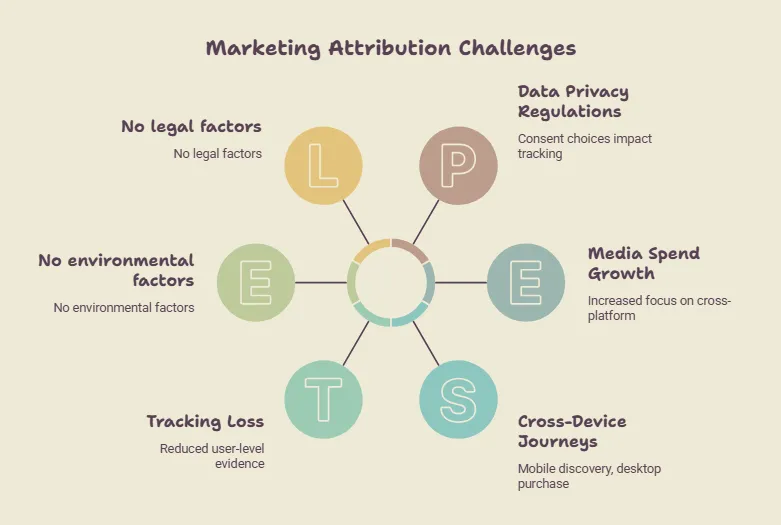
Attribution becomes harder as spend grows because every new channel adds overlapping touchpoints and different tracking rules. And this challenge continues to grow. The IAB’s 2026 Outlook Study found that 72% of advertisers were increasing their focus on cross-platform measurement, up from 64% one year earlier.
Here are the main sources of disagreement:
- Self-attributing platforms
Meta, Google, and TikTok may each claim the same purchase after an eligible interaction. Each claim can follow the platform’s rules.
- Different windows
A report might count seven-day clicks and one-day views, while another applies a shorter period.
- View-through conversions
An impression can receive credit even when the eventual purchase happens through another channel.
- Cross-device journeys
Someone discovers your product on mobile, then buys through a desktop browser with a different identity.
- Conversion lag
Purchases may arrive days or weeks after the initial ad interaction, so recent results remain incomplete.
- Tracking loss
Consent choices, browser restrictions, and app-tracking limits reduce the available user-level evidence.
- Walled gardens
Platforms expose only part of the journey. Fragmented reporting across programmatic media buying can create additional visibility gaps.
- Offline and dark-social activity
Calls, retail purchases, word of mouth, private messages, and copied links can escape reliable tracking.
In this digital environment, we expect gaps. Documenting them helps teams interpret disagreement without assuming every discrepancy indicates broken tracking.
Why Do Meta, Google Ads, GA4, and Your CRM Report Different Results?
A Meta conversion, a Google Ads conversion, a GA4 conversion, and a CRM sale can all refer to the same customer. The figures differ because each system observes a different part of the journey and applies its own rules.
These reports are not expected to match perfectly. Meta and Google can both claim the same purchase, while GA4 assigns it to one channel and the CRM records one sale. Adding all platform conversions together would count the customer more than once.
Use each system for the decisions it can support. Platform data helps manage campaigns, GA4 helps examine recorded behavior across channels, and the CRM shows what became a qualified lead or customer. Reconciliation starts by agreeing on definitions and checking where the same conversion appears across those systems.
Which Marketing Attribution Model Should You Use?
The right model depends on the question behind the report. A team investigating discovery needs a different view from one deciding which campaigns should receive tomorrow’s budget.
Media buyers are already expanding the methods they use. In an IAB survey of 203 ad buyers, 66% planned to focus more resources on attribution modeling, while 53% planned to increase their focus on marketing mix modeling.
Here are some options and how they fit:
Marketing Attribution Models
Last-touch attribution is not always the same as last-click attribution. A platform may treat an eligible ad view as the final touch even when the customer never clicked. Check the platform’s definition before comparing it with a click-based report.
Multi-touch attribution is the broader category for models that distribute credit across several recorded interactions. Linear, time-decay, position-based, and many data-driven models all fall within it.
Which Model Fits Your Business?
Treat this as a starting point. A simple model with reliable inputs is more useful than a complex model built on missing events and inconsistent campaign data.
Creator campaigns show why several views may be necessary. Effective influencer marketing attribution models can combine promo codes, UTMs, surveys, and platform data because discovery may happen long before a measurable click.
When you measure influencer performance and ROI, the final click should not receive automatic credit for the entire journey. At the same time, missing attribution does not prove that the creator generated additional sales. That requires further evidence.
How Do You Choose an Attribution Window?
An attribution window determines how long an interaction remains eligible for conversion credit. If the window is too short, slower purchases disappear from the report. If it is too long, a platform may claim sales that had little connection with the original interaction.
To choose an attribution window:
- Start with your actual conversion lag. Look at how long customers usually take to buy after their first visit and how that changes by product, campaign, and channel.
- Adapt it to the channel. Branded search may be close to the purchase, while paid social or creator activity may introduce the product much earlier. Applying the same short window to both can make the demand-capturing channel appear more influential than it was.
- Evaluate click-through and view-through windows separately. A click provides clearer evidence of active interest than an impression, so view-through credit usually deserves closer scrutiny.
- Allow the window to mature before evaluating recent campaigns. If customers normally take two weeks to purchase, a campaign launched four days ago cannot be compared fairly with one whose full conversion period has already passed.
Complementary Marketing Measurement Methods
Attribution models decide how to divide credit between the touchpoints you can track. The methods below answer different questions, so grouping them all under attribution models creates the wrong impression:
- Marketing mix modeling estimates how changes in marketing investment contributed to results using aggregated historical data.
- Incrementality testing compares exposed and unexposed groups to estimate how many additional conversions the marketing activity caused.
- Lift studies measure changes in outcomes such as awareness, consideration, searches, or conversions between treatment and control groups.
- Post-purchase surveys capture where customers remember discovering the brand, including sources that tracking may have missed.
Post-purchase surveys provide useful directional evidence, but memory is imperfect, and the answers do not establish causation. Lift studies are a form of experimental measurement, while MMM works at a more aggregated level than customer-journey attribution.
Marketing Attribution vs. MMM vs. Incrementality
Attribution can show which channel appeared in recorded conversion paths, while an incrementality test finds that many of those customers would have purchased anyway. MMM can then provide a broader view of how channel investment relates to total business results.
Choose the method based on the decision you need to make. Each one answers a different question, and you may need more than one to get a reliable answer.
What Tools Do You Need for Marketing Attribution?
Marketing attribution needs a connected data stack that follows customers from their first recorded interaction to revenue. Each system should have a defined role and use shared identifiers so conversions can be matched without double-counting.
UTMs, click IDs, lead IDs, order IDs, and customer IDs should carry through the stack. Assign a source of truth for spend, conversions, revenue, and customer status, then document the rules for time zones, refunds, attribution windows, and duplicate events.
Specialist attribution software is useful when several channels overlap, or customer journeys extend across devices and sales systems. It will still inherit any missing identifiers, inconsistent definitions, or duplicated conversions in the underlying data.
The Six-Layer Attribution System for Brands That Actually Buy Media
Our marketing measurement strategy connects six layers of evidence, each with a different job. Multi-touch attribution can help explain observed journeys, while the wider system checks business outcomes and guides decisions.
Here are the six layers:
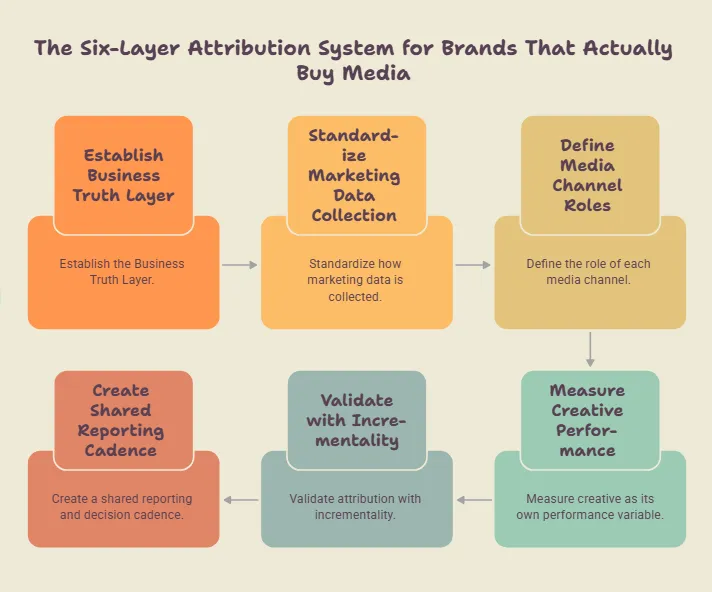
1. Establish the Business Truth Layer
Start with outcomes the company trusts. Revenue, new customers, refunds, gross margin, contribution margin, subscription revenue, and qualified pipeline should come from agreed systems.
Finance, marketing, ecommerce, and sales need shared definitions before they judge performance. Otherwise, a dashboard can be technically correct and commercially misleading.
That level of alignment is still uncommon. The 2026 CMO Survey questioned 308 senior US marketing leaders and found that fewer than half of companies had marketing and finance working together on growth. The CMO-CFO partnership also scored just 4.5 out of 7 for building a business case around marketing spend.
The Business Metrics That Should Guide Media Decisions
We recommend prioritizing marketing metrics that actually matter. These include blended CAC, MER or blended ROAS, new-customer revenue, customer lifetime value, contribution margin, and payback period.
While you're there, you can also define the calculations. MER typically divides total revenue by advertising spend, while some teams use a broader marketing-cost denominator. Blended CAC also changes with the costs included.
Platform ROAS remains useful for campaign management. Alongside it, blended results show whether the combined investment supports healthy growth. Neither measure alone explains what caused that growth.
2. Standardize How Marketing Data Is Collected
Consistent event tracking and naming make comparisons across digital channels possible. We recommend documenting the measurement setup before adding more dashboards.
The technology itself is usually underused. In a 2024 CMO Survey of 292 senior marketing leaders, companies used only 56.4% of the MarTech tools they had purchased. The same respondents said their actual MarTech returns were 34% lower than expected, with integration across company data systems among their weakest areas.
That setup should cover standardized UTMs, campaign and ad names, GA4 events, CRM outcomes, and ecommerce or subscription data. Add call tracking and offline conversions where relevant, along with consent management and server-side tracking or conversion APIs.
Then assign a system of record to each metric. Ad platforms can record delivery, while CRM systems track qualification and customer outcomes. Document event definitions, time zones, deduplication rules, and who maintains each connection.
For example, an ad platform might count a form submission as a lead, while the CRM uses that label for a qualified prospect. Both reports can be correct under their own definitions. Resolve the mismatch before anyone reallocates budget around it.
3. Define the Role of Each Media Channel
You should evaluate channels according to their role in the journey. Search may capture existing intent, while paid social can introduce ideas, create demand, retarget visitors, or convert buyers directly.
Influencers can contribute trust, discovery, reusable assets, and sales. Programmatic and CTV may build reach that later appears as branded-search activity. Content marketing can help customers understand the product between those encounters.
Programmatic media deserves close scrutiny. The ANA’s Programmatic Media Supply Chain Transparency Study examined data from 21 major advertisers and found that only 36 cents of every dollar entering a demand-side platform effectively reached the consumer. The association estimated that better efficiency could recover $22 billion across the programmatic market.
That context matters when you compare Meta, Google, and TikTok ads. Your target audience behaves differently across placements, so creative requirements and conversion patterns will differ too.
Cross-channel attribution helps examine those connections. Judging everything through immediate final-click ROAS can overreward channels that close existing demand. Also examine the customer experience between touchpoints and check whether the landing page delivers what the ad promised.
4. Measure Creative as Its Own Performance Variable
People respond to what they see. A channel-level report can’t really explain a performance change by itself. We use creative analytics to examine the assets behind those numbers.
Tag hooks, offers, formats, creators, voiceovers, CTAs, product angles, visual styles, and landing-page combinations. Then compare repeated patterns among strong ads and use them to plan the next batch. Keep audience and placement differences in view before crediting one creative element.
And, you have to watch for creative fatigue too. Falling thumb-stop rates, click-through rates, or conversion rates alongside rising CPA can signal that an asset has lost effectiveness. Check delivery and website changes before settling on that explanation.
Our work with Hurom is a good example. Creative fatigue and outdated sales-led ads had pushed CPA up and weakened profitability.
We changed the messaging toward specific health concerns and analyzed UGC hooks, CTA variations, and social proof to find a repeatable creative recipe. That work contributed to 300% ROAS growth, a 65% reduction in overall CPA, and 33% month-over-month profit-margin growth.
inBeat can apply the same process to your media program. We help your team build the tagging structure, testing plan, and ongoing creative system needed to find which ideas deserve more production and media spend.
5. Validate Attribution with Incrementality
Attribution connects recorded touchpoints with conversions. Incrementality asks whether marketing caused additional conversions that would otherwise have been absent.
We recommend platform lift studies, audience holdouts, or geographic tests where feasible. Controlled spend increases or reductions can also help. Pre- and post-campaign comparisons need appropriate controls because a sales change alone cannot establish causation.
Experiment design should account for seasonality, promotions, channel overlap, and conversion lag. So, set the outcome and decision rule before results arrive, then allow enough time and volume to interpret them.
Post-purchase surveys can add brand attribution evidence about where buyers remember discovering you. Treat those answers as supporting context rather than causal proof.
This validation becomes especially valuable when a channel reports excellent results while blended revenue, CAC, or profit barely changes. That disagreement deserves investigation before another budget increase.
6. Create a Shared Reporting and Decision Cadence
Measurement needs a schedule that matches how quickly decisions can change. So, you need to build operational transparency into the process through visible owners, definitions, and a record of actions.
A useful marketing reporting framework separates those decisions by frequency.
That cadence reflects how active media buyers already plan. The IAB’s 2024 Outlook Study found that 70% of buyers planned media quarterly or more frequently. Among those who were reforecasting more often, 63% adjusted their plans at least monthly.
This includes:
- Daily checks catch tracking failures and unusual spending before they distort longer-term results.
- Weekly reviews address creative performance, pacing, CPA, and campaign adjustments.
- Monthly reviews examine blended CAC, MER, channel contribution, conversion lag, and budget allocation.
- Quarterly analysis informs media mix, incrementality, profitability, and strategic investment.
Executives need a compact view of business outcomes, tradeoffs, and recommended actions. Channel operators need the underlying campaign and creative detail.
Both views should connect to financial accountability. Record what changed, why it changed, and when the team will review the outcome. Otherwise, the same debate tends to return next month.
How Should Attribution Change Paid-Media Decisions?
Attribution should change where you spend, what you test, and how you forecast growth. We believe you should use the evidence to revise marketing plans through deliberate decisions with review dates.
From our experience, here are the actions you should take:
- Reconcile the evidence
Compare platform conversions with analytics, CRM, revenue, and new-customer records. Resolve differences in definitions and dates before treating a discrepancy as evidence of channel performance.
- Allow for conversion lag
Compare groups that have had similar time to purchase. Cutting a recent campaign against a mature one can punish it before its conversions arrive.
- Separate demand creation from capture
Examine relationships between paid social, influencers, direct traffic, branded search, and retargeting. Those marketing tactics may support one another even when the final click hides the connection.
- Evaluate marginal performance
Estimate what the next budget increase could produce. Historical average ROAS across ad campaigns can conceal saturation, so strong past efficiency does not guarantee efficient additional spend.
- Move budget gradually
As you allocate paid social budgets across platforms, make controlled changes and watch blended results. Define acceptable CAC, margin, and payback limits before the increase.
- Feed findings into production
Put more resources behind the messages, formats, and creators that show promising evidence. For Genomelink, we tested UGC hooks, CTAs, actors, voiceovers, and formats within an ongoing creative pipeline. This approach helped reduce CAC by 73% and improve registration completion.
And this process must remain usable as spend grows. With Unroll.Me, we paired social media buying with scalable UGC and creative testing. The campaign reached six-figure monthly spend and more than 100,000 monthly downloads, while CPA fell by 75%.
We can bring the same operating structure to your media program. Our team can connect platform and business data, establish decision thresholds, identify the creatives behind performance changes, and then use those findings to guide your next budget move and production cycle.
Common Attribution Mistakes That Waste Media Budget
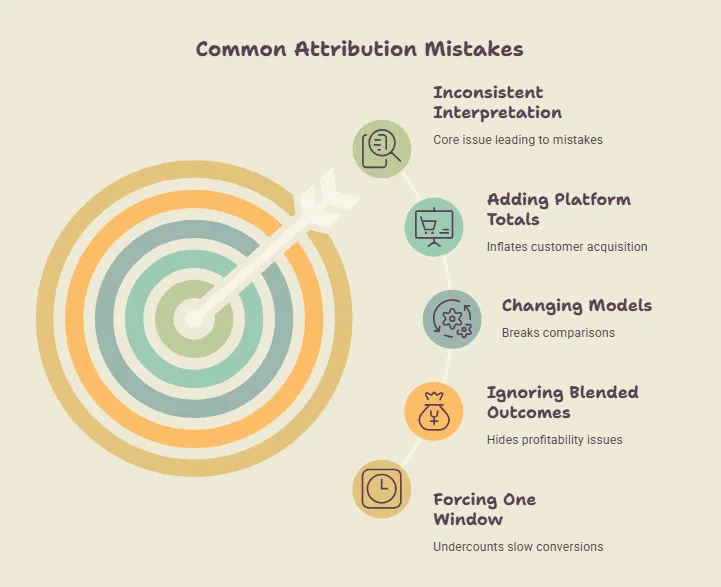
You can have the best setup in the world and still fail if everyone on the team reads the output differently. Set the rules early, because once performance is under pressure, people have a funny way of reaching for the number that makes the results look best.
Here are the mistakes to watch for:
- Adding platform totals together: One purchase may appear in several reports, so the combined total inflates actual customer acquisition.
- Changing models to improve appearances: Convenient switches break comparisons. Document any change and restate historical results where possible.
- Ignoring blended outcomes: Strong reported ROAS deserves scrutiny when overall CAC rises and profitability falls. Investigate before scaling.
- Forcing one window onto every purchase: Different consideration periods require suitable review windows, or slower conversions remain systematically undercounted.
- Optimizing channels in isolation: A cut can remove demand or retargeting audiences that another campaign depends on. Check the wider effect.
- Leaving creative out of measurement: Channel averages hide the hooks, offers, creators, and formats behind changes. Maintain asset-level records.
- Automating around dirty data: Models cannot repair inconsistent UTMs, duplicate events, or ambiguous definitions. Audit inputs before enabling automated decisions.
- Reporting without action thresholds: Give each major metric an owner and a predefined response. Allow for expected variation so normal noise does not trigger unnecessary changes.
How inBeat Helps Brands Build a Full-Funnel Measurement System
We are a full-funnel marketing measurement agency that connects platform, creative, customer, and revenue data.
Our team supports attribution pipeline setup, UTM standardization, first-party integrations, multi-touch mapping, and conversion-lag analysis. From there, blended CAC and MER dashboards, media mix modeling, creative reporting, and budget reallocation guidance help your team decide what to do next.
At inBeat, our paid media, performance creative, UGC, and CRO capabilities let us act on those findings across campaigns, assets, and conversion paths. That connection matters when the reporting identifies a problem that requires changes across several teams.
If there are still questions around where to spend, what to trust, or what needs fixing before you scale, we can help you work through them.
Contact us to build an attribution system that turns your media data into clearer, more profitable decisions.
The Bottom Line
Marketing attribution shows how recorded touchpoints received conversion credit. It can help explain customer journeys, compare campaigns, and guide day-to-day media decisions, but it cannot observe every influence or prove that marketing caused the result.
That is where the wider measurement system comes in. Business metrics establish what happened, attribution organizes the visible journey, and creative analysis helps explain performance changes. MMM and incrementality then provide additional evidence for larger channel and budget decisions.
Keep those roles clear as media spend grows. The goal is not to force every system to report the same number. It is to understand what each number means and use the right evidence for the decision you need to make.
FAQs
How much ad spend justifies an advanced attribution system?
There is no universal spend threshold because complexity is the better trigger. We recommend stronger measurement when several channels overlap, conversions take longer, or conflicting reports drive expensive allocation decisions. The appropriate investment depends on the value of improving those decisions.
Who should own marketing attribution?
One accountable measurement owner should coordinate attribution, with input from marketing, finance, sales, analytics, and media teams. That person maintains definitions and resolves discrepancies. A named backup also helps preserve continuity when responsibilities change or the main owner is unavailable.
Can offline sales and phone conversions be included?
Yes, offline sales and phone conversions can be connected through call tracking, CRM outcomes, and offline-event imports. CRM platforms and customer identifiers help match records where permitted. The available detail depends on system compatibility, consent practices, and applicable privacy requirements.
Is GA4 enough for marketing attribution?
GA4 alone usually provides an incomplete picture for brands with substantial media activity. We recommend comparing its behavioral and attribution data with platform reports, CRM records, revenue figures, customer research, and experimental evidence. Together, those inputs support a more defensible interpretation.