.svg)
.svg)
.svg)
.svg)


.svg)





%20(1).png)

Budget pressure has changed how managers evaluate marketing. Rising CPMs, weaker targeting signals, and attribution blind spots might force you to justify every dollar.
As brands diversify their channels, influencer marketing often enters the conversation. However, many teams hesitate because they cannot clearly trace their return.
In fact, 79% of marketers cite measuring influencer ROI as their biggest obstacle, which points to a structural issue.
The real concern is whether creator-driven campaigns move customer acquisition cost (CAC), customer lifetime value (LTV), or revenue in a measurable way beyond vague brand awareness claims.
So, that's what we'll be focusing on today. In this article, you'll see if influencer marketing actually works in 2026 and what you should be doing to maximize its impact.
P.S. If you want influencer marketing tied to measurable performance, inBeat Agency manages strategy, creators, and tracking end-to-end. Contact us to plan your full-service influencer marketing campaigns.
TL;DR
- Influencer marketing works when measurement ties spend to revenue.
- iOS14 increased reliance on creator-led distribution.
- UGC lowers resistance and improves conversion probability.
- Micro creators usually outperform on engagement and CAC.
- Measure ROI using CAC, ROAS, MER, and structured attribution.
- Avoid last-click bias and blended CAC masking inefficiencies.
- Scale requires clear objectives, guardrails, and creator audits.
- Integrate influencer content with paid media for efficiency gains.
Why Influencer Marketing Works in a Privacy-First World
Privacy-first policies reduced the data platforms' use to predict intent after iOS14. Because of this, broad paid campaigns now rely on limited signals and produce less predictable outcomes. In this environment, creator-led distribution becomes necessary.
Authenticity Is Important
Consumers have developed "banner blindness" to paid ads on social media. Repetition trains the eye to scroll past anything that looks like a placement. As a result, polished studio assets lose marginal efficiency over time.
This is where creator content starts outperforming traditional ads.
User Generated Content (UGC) changes that dynamic. It mirrors native feed behavior because it comes from real content creators who already speak to their audience. Get in touch with a UGC agency.
Brands looking to generate a larger volume of authentic creator content can also benefit from organizing influencer events as part of their content strategy.
In practice, this reduces resistance and increases hold rate, which directly affects conversion probability. And lower resistance usually translates into lower CPA because the click carries intent rather than curiosity.
You can see this clearly in our work with Hurom. Instead of relying heavily on discount-led messaging, we partnered with creators to publish lifestyle content centered on daily health habits.
This repositioned the purchase decision from price comparison to routine adoption. As a result, CAC declined by 36%, ROAS increased 2.5x, and CPA dropped by 60%.
Here's an example of our work together:
Niche Audience Targeting
Broad targeting on Meta aggregates millions of users into average performance metrics. But averages hide variance. When you optimize against blended CPM or CTR, you lose visibility into which subgroups actually convert.
So, the budget usually flows toward scale rather than intent.
Micro creators change that structure. Instead of relying on platform-level audience modeling, you reach defined communities built around shared interests.
Based on our experience, these communities usually carry stronger purchase signals than broad demographic targeting. This precision allows you to align creative with your target audience rather than with a generalized demographic bucket.
Example: When a niche trend gains traction inside a TikTok community, you can redirect the budget into creators who already speak to that subculture. The adjustment happens at the creator level instead of waiting for platform optimization to react.
For Native, inBeat recruited micro-level social media influencers to produce authentic product content. That approach generated over 1,000 photo and video assets and exceeded content targets by 200%. More importantly, it reached high-intent communities and kept the feed relevant without relying on broad scaling.
Here's what we did for them:
Relatable Content and Creative Storytelling
Relatable storytelling creates purchase intent because it mirrors lived experience. When a viewer recognizes their own situation in a story, attention changes from passive scrolling to evaluation. That shift produces “I-want-to-buy” micro-moments, where intent forms before the click.
This reaction follows a behavioral loop. A strong hook captures attention, an emotional beat sustains it, and resolution ties the product to a real problem. Creators trigger this loop through pacing, facial expression, and narrative tension.
Research supports this behavioral effect.
Consumer studies show that story-driven marketing has a direct positive impact on purchase intention, meaning storytelling itself measurably increases buying intent rather than simply improving engagement. This explains why narrative structure often predicts downstream conversion behavior more reliably than exposure alone.
As a result, metrics such as hook rate and hold rate become leading indicators of conversion probability. Those signals usually predict performance more accurately than surface engagement metrics.
Example: For Icelandic Provisions, we produced a short UGC story about a girl who loved dairy breakfasts until lactose intolerance disrupted her routine. The discomfort felt real, and the product entered as a practical solution.
The narrative framed the oatmilk skyr as part of a lifestyle adjustment rather than a feature claim. That alignment strengthened brand affinity and supported measurable brand campaign outcomes.
Because of those sponsored posts, we sourced 50+ creators, achieved 9% CTR, and kept CPC under 44 cents.
Read Next: Growth Marketing Agencies for Fast-Rising NYC Brands
Does Influencer Marketing Work? Here’s the Evidence
Influencer marketing works, but only when measurement connects creator activity to business outcomes. To evaluate performance rigorously, you need a tiered model that separates awareness, intent, and revenue impact.
The following are the first signals to review.
1. Top of Funnel Metrics
Awareness should be defined as retargeting pool growth, rather than views. When more qualified users enter your retargeting audience, downstream efficiency improves because paid campaigns work from warmer intent.
In our experience managing creator campaigns, retargeting audience growth mostly predicts later performance better than view counts alone.
Cost Per Mille (CPM) and Click-Through Rate (CTR) act as guardrails at this stage. If CPM spikes or CTR declines, creative resonance weakens, and cost per outcome rises.
Influencer content also affects search behavior. In fact, marketers track a 15–30% increase in branded search volume during active campaigns. This lift indicates awareness translating into intent, which can influence later-stage digital marketing performance.
The next step is to measure how that intent converts into revenue.
2. Drives Sales and Conversions
Revenue impact shows up in customer acquisition cost and Return on Ad Spend (ROAS). When a creator campaigns with a lower acquisition cost relative to other paid channels, incremental value becomes clear.
Many teams see sales activity during creator campaigns but struggle to connect that growth to a specific channel. This is where attribution usually breaks down if measurement is not structured early.
To measure this accurately, you can use defined attribution windows, such as a 7-day click or 28-day view. Those windows capture delayed purchase behavior that last-click models usually miss.
Industry benchmarks show average influencer campaigns deliver 2.5X-3.5X ROAS, while top performers reach 4.5X-7X returns. That range indicates many brands earn back multiple times their spend. However, averages only matter if your CAC remains stable after campaign scale.
To put these returns in a wider market context, recent influencer marketing statistics show how industry spend, budget allocation, consumer behaviour, and compliance requirements are evolving.
Direct revenue tracking requires disciplined implementation of tracking links and cohort analysis. More importantly, customers acquired through aligned creators tend to match product expectations, which supports stronger retention and protects long-term LTV. Teams that automate outbound follow-up alongside influencer campaigns often use platforms like aisdr.shop to qualify inbound interest and improve lead conversion without adding manual sales workload.
With revenue validated, the next question becomes retention and loyalty.
3. Builds Brand Loyalty
Short-term posts generate spikes, but long-term ambassador partnerships generate compounding returns. When a creator appears repeatedly in your feed, credibility builds through familiarity. This repetition reduces skepticism and increases purchase confidence over time.
Many teams focus heavily on first conversion metrics and overlook this stage. This is where long-term creator relationships start showing their real value.
To measure loyalty, we recommend comparing the LTV of customers acquired through ongoing creator programs against historical acquisition cohorts. If retention improves and repeat purchase frequency rises, creator advocacy is influencing behavior beyond first conversion.
Consistent creator presence also supports measurable brand lift. Viewers begin to associate the product with routine use rather than brand promotion. That shift lowers churn because expectations match reality.
For Bluehouse Salmon, inBeat built a sustained community through educational recipe content creation. Over 12 months, brand followers increased by 1,900%. The growth reflected ongoing brand value, rather than a single campaign spike.

Next, let’s look at three concrete campaign examples.
Case Studies: 3 Successful Influencer Marketing Campaigns
Concepts clarify potential, but capital allocation depends on validated results. Below, we have shared some examples that show how structured creator programs translate into measurable performance.
Prose (Beauty)
Prose needed a high volume of consistent, high-performing creative to sustain paid acquisition. When asset flow slows, experiment cycles lengthen, and CAC rises.
So our team at inBeat Agency built a scalable recruitment engine that delivered over 100 assets per month from more than 20 micro-creators per campaign. This repeatable system increased creative velocity and reduced fatigue across channels. As a result, year-over-year ROAS increased by 45% and overall CAC declined by 20%.
Profitability followed structure. Disciplined creator matches supported durable campaign growth instead of short-term spikes.
Nurse.com (Healthcare)
Nurse.com needed brand visibility and qualified job board clicks within a defined professional community. Broad paid distribution would have diluted relevance and increased cost.
So we built an influencer-led creative strategy tailored to healthcare professionals. Instead of mass placements, we partnered with trusted voices who already spoke to that community. This alignment improved click quality and reduced waste.
As a result, the campaign drove more than 200,000 new website visits, achieved a 4%+ CTR, and maintained CPC below $0.20.
The outcome shows how focused strategic influencer partnerships can deliver cost-efficient reach within highly specialized audiences.

Miro (B2B SaaS)
Driving product adoption in B2B requires more than visibility.
Miro needed clear use-case education across LinkedIn, YouTube, and TikTok, where professional audiences evaluate tools through peer validation. Generic ads would have limited credibility and increased acquisition cost.
For Miro, inBeat executed a structured campaign with 25 key opinion leaders. Industry experts David Pereira, Ruben Cespedes, and Alec Fullmer demonstrated specific product applications in real workflows. Each creator showed how the tool supported concrete tasks rather than abstract features.
This context grounded the value proposition. As a result, the campaign generated over 2 million impressions and contributed 50 templates to Miro’s library, which strengthened adoption across social media platforms.
The outcome shows how applied content marketing can reduce paid media friction in the world of influencer marketing.
.webp)
The next step is to break down how you measure influencer marketing ROI.
How to Measure Influencer Marketing ROI
ROI in influencer marketing is profit earned versus spend. Here’s how you can calculate it:
(Total Revenue − Total Costs) / Total Costs × 100 = ROI (as a percentage)
As the formula shows, ROI depends on the relationship between revenue generated and total cost deployed. That structure forces clarity because it ties influencers’ spending directly to profit. To calculate it accurately, you need reliable and structured inputs.
These are the three components that make ROI defensible.
1. Select Influencer Marketing KPIs
Measurement begins with discipline. Before evaluating performance, define which signals reflect business impact.
- Follower count and likes indicate surface visibility.
- Pipeline velocity, CAC, and MER indicate economic contribution.
- Reach reflects exposure.
- Revenue efficiency reflects sustainability.
Across the campaigns we review, the strongest insights usually come from metrics tied directly to revenue efficiency rather than engagement alone.
Marketing Efficiency Ratio (MER) compares total revenue against total marketing spend. It provides a blended view across channels and shows whether influencer activity contributes to overall growth.
This matters because creator impact usually supports other paid channels rather than operating in isolation.
Platform-reported ROAS frequently inflates results inside closed ecosystems. Those numbers reflect in-platform attribution logic. Cash-in-bank returns reflect actual revenue collected against total spend.
This distinction determines whether reported performance aligns with financial reality for any marketing professional responsible for budget accountability.
2. Solve Attribution Issues
Attribution gaps distort perceived performance. Standard analytics tools frequently credit the final retargeting click, even when a creator introduced demand earlier. That misalignment reduces reported influencer impact.
In fact, 78.4% of marketers still rely on last-click attribution. This structure assigns full credit to the final touchpoint and ignores upstream influence. As a result, top-of-funnel creator programs generate false negatives.
View-through conversions and broader attribution windows provide a more complete picture. They reduce structural bias. So, you can pair this with social listening to detect shifts in branded search and demand signals across social media.
3. Use the Best Influencer Marketing Attribution Tools
Instrumentation determines credibility. Pixel tracking, structured UTMs, and controlled promo code generation create traceable revenue paths. Native dashboards provide directional insights, but they lack cross-channel depth.
Instead of relying on a single dashboard, triangulate performance data through GA4, Northbeam, or Triple Whale as your unified source of truth. Then, validate creator-audience alignment using verified audience demographics before scale.
Let’s now move to how you scale influencer programs without losing control.
How to Scale Influencer Marketing
Measurement gives you confidence, but scale introduces risk. If the structure weakens, CAC drifts, and performance becomes unstable.
These are the non-negotiables that keep expansion controlled.
1. Set Clear Campaign Objectives
A scale without a defined objective creates noise, and a singular North Star metric, such as a specific CPA or conversion target, anchors decision-making. When success and failure criteria are defined before launch, budget adjustments become rational rather than reactive.
In fact, campaigns with clearly defined goals show up to 4X higher success likelihood. That lift reflects alignment and not just luck.
For example, if CPM rises 20% or CTR falls below the threshold, you should pause and reassess. Those boundaries prevent gradual cost erosion. As a social media manager, clarity at this stage protects both budget and credibility.
2. Select the Right Influencers
Scale also depends on partner selection. Mega creators provide visibility but usually produce lower conversion rates. Micro and nano creators tend to drive higher engagement within defined communities.
According to Aspire, 54% of marketers say they primarily work with nano and micro influencers (27% nano and 27% micro) in 2026. That allocation reflects performance economics rather than trend preference, as brands concentrate budgets where engagement and conversion signals are more consistent.
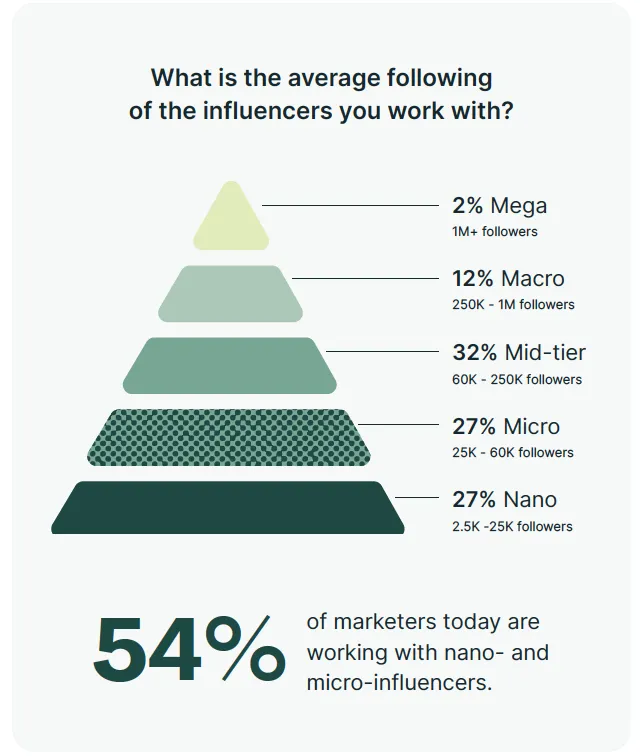
Smaller creators usually produce stronger interaction signals, which improves conversion probability and lowers effective acquisition cost. However, blended CAC can hide underperformers.
Many teams assume scale automatically improves efficiency. This is where creator programs typically lose performance if partner quality is not reviewed carefully.
So, make sure to audit each creator independently. Validate content behaviour patterns and confirm that audience demographics match your ICP.
Teams can hire virtual assistant support to organize creator research, outreach records, and routine follow-ups.
3. Integrate Influencers With Paid Media
Organic creator content shows you what resonates. Whitelisting or Spark Ads allows you to place paid spend behind top-performing posts directly from the creator’s handle.
This approach preserves authenticity while giving you control over targeting. As a result, paid performance reflects content that has already proven engagement.
Cross-channel coordination compounds this effect. For example, strong creator exposure on TikTok frequently lifts branded search volume on Google. That increase signals rising intent, which improves retargeting efficiency.
You can see this in our work with Greenpark. By integrating influencer content into paid distribution, ad spend increased by 300% while CPI dropped by 70%. Efficiency improved because spending followed validated creativity.
Pro tip: If you plan to integrate influencer marketing with paid media, use influencer reporting to guide the next batch of creative production for paid ads.
Next, let’s focus on how to future-proof your influencer strategy.
How to Future-Proof Your Influencer Marketing Strategy
Long-term performance depends on risk control and adaptability. To stay competitive, you need to focus on structural weaknesses and emerging shifts.
Here are the two areas that will shape sustainability and risk exposure.
Address Common Challenges
As programs scale, operational risk increases. So, try to monitor these pressure points:
- Fraud risk: Fake followers and engagement pods distort engagement rates and inflate CPM. In fact, 74% of marketers report encountering influencer fraud, which shows how common manipulation has become. As a result, routine audits and third-party validation protect acquisition efficiency.
- Data ownership opacity: Some influencer marketing agencies restrict access to raw reporting or white-label results. Without direct data access, validating CAC and revenue contribution becomes difficult. Clear contracts and transparent dashboards, supported by strong influencer contract templates, can help you reduce that exposure.
- Attribution smoke screens: Partners who respond to performance questions with excessive jargon usually mask weak measurement frameworks. Direct answers and clean data structures signal operational discipline.
Consider AI Influencers and Predictive Analytics
Technology introduces new control levers, but also new trade-offs.
Here are the main considerations:
- Control vs. authenticity: AI influencers offer consistency and brand safety. However, credibility gaps can reduce conversion intent. According to the Influencer Marketing Hub, 52.8% of respondents believe AI influencer versatility will significantly shape marketing’s future. That expectation reflects flexibility, but audience trust still drives outcomes.
- Predictive forecasting: A structured AI-driven strategy can estimate creator performance before contracts are signed. That will improve capital allocation.
- Creative iteration: Machine learning systems refine briefs over time, while using performance data to improve message clarity and reduce inefficiencies.
Next, let’s take a look at why campaigns fail despite strong planning.
Why Influencer Marketing Campaigns Fail
Campaigns break down when reporting focuses on impressions and engagement, while leadership evaluates CAC, cash flow, and margin. This mismatch creates friction. When dashboards show likes but executives ask about revenue efficiency, confidence declines.
However, structure matters more than channel choice.
The common spray and pray model sends products to dozens of creators without defined key performance indicators or attribution logic. As a result, returns vary, and performance appears inconsistent.
When attribution and KPIs are missing, creator campaigns start feeling unpredictable. Budget decisions become harder because results cannot be traced clearly to revenue outcomes.
We recommend defining measurement structure before creator outreach begins. When tracking, attribution windows, and performance thresholds are established early, campaigns become easier to evaluate and scale.
And your hesitation is reasonable. When measurement lacks clarity, influencer marketing can feel like gambling because capital allocation lacks proof.
If you want to better understand how performance-driven influencer marketing ties spend to revenue, check out the video below for a clear breakdown of the process.
Make Your Influencer Marketing Work With inBeat Agency
If you're asking yourself, “Does influencer marketing work?” well... that may be the wrong question. The better question is how you measure it and tie it to profit. Once measurement is clear, performance becomes predictable.
At inBeat Agency, you get transparent reporting built around CAC, revenue, and contribution margin. This clarity protects your budget and supports informed allocation decisions. We focus on clean attribution, performance-driven UGC creative, and bottom-line growth rather than surface metrics.
Book a strategy call to review your current setup and build a revenue-focused influencer system that delivers measurable impact.
FAQs
How do you measure influencer ROI?
You measure influencer ROI by comparing revenue generated to total campaign costs. Track CAC, ROAS, and contribution margin within defined attribution windows. Include view-through data and cohort analysis to capture demand creators initiate, then validate results against actual cash collected.
What is the average return on influencer marketing?
Most influencer campaigns generate strong returns, with the average return reaching $5.78 for every $1 spent on influencer marketing. However, outcomes still depend on creative quality, audience alignment, and attribution structure. Without disciplined measurement, averages can mislead.
What tools help with influencer marketing attribution?
You can use GA4, Northbeam, or Triple Whale as a source of truth. Combine pixel tracking, UTMs, and unique promo codes. Broader attribution windows help connect early creator exposure to later purchases.
Does performance vary by influencer tier?
Yes. Mega influencers usually drive campaign reach, while micro and nano creators usually deliver stronger audience engagement and conversion rates. Performance depends on audience fit and creative execution, rather than follower count alone.
How does inBeat Agency use UGC to lower CAC for paid media?
inBeat Agency produces performance-focused UGC and integrates top-performing creator assets into paid campaigns. Creative iteration improves click-through rates and reduces acquisition costs through structured attribution and disciplined budget allocation.
What is the difference between an influencer platform and a performance agency like inBeat?
An influencer platform connects brands with creators and offers basic analytics. A performance creative agency like inBeat builds attribution systems, manages creative strategy, and ties influencer activity directly to CAC and revenue targets.