

A performance creative agency helps turn customer insights into ads your team can test and improve. The right partner depends on what you need: more creator content, stronger concepts, faster production, or a team that also manages paid media.
Our first choice for creator-led paid social is inBeat. Its combination of creator sourcing, UGC production, creative strategy and paid media makes it a strong starting point for brands that want production connected to campaign learning.
This guide compares 16 performance creative agencies serving DTC, eCommerce, apps, B2B and other growth teams." New sentence: "If you sell online, see our shortlist of performance creative agencies for e-commerce.
Compare the 16 performance creative agencies
Start with inBeat for a creator-led paid-social brief, then compare alternatives by the work you need. The cases below come from different clients, channels and periods; their results are not directly comparable scores. Confirm current services, fees and capacity with each agency.
The agencies: services, evidence and fit
1. inBeat Agency

Best fit: First choice for creator-led paid social.
inBeat is our first recommendation for brands that want creator-led ads connected to an ongoing testing process. Its service brings creator sourcing, UGC production, creative strategy and paid media into a coordinated workflow. That makes it particularly relevant when your team needs a steady supply of new ideas and a clear way to turn campaign results into the next brief.
In its Hurom case study, inBeat reports a 65% reduction in overall CPA. The work shifted messaging away from constant promotions toward health-focused benefits, with testing of hooks, calls to action and social proof. The engagement included broader acquisition services, so the result should be read as a campaign outcome rather than an isolated estimate of creative’s contribution.
inBeat can work alongside an in-house team or support the wider creative and paid-media process. For a useful first conversation, bring your priority channels, current creative bottleneck and examples of recent ads. If the brief is mainly a traditional brand film, compare production styles before choosing a partner for the wider campaign.
Before hiring: Do you need production support, a testing partner, or both creative and media buying?
2. Thrive Digital

Best fit: Creative within a structured growth program.
Thrive Digital is a useful option when creative needs to sit inside a broader acquisition and measurement program. Its Smith Optics work combined tracking improvements, an account-testing framework, channel expansion and creative iteration. That mix is relevant to teams whose challenge extends beyond producing more assets.
Thrive’s Smith Optics case study reports 191% year-over-year growth in revenue from paid channels and a 158% increase in new website visits from paid campaigns. The program expanded from three to seven paid channels. Those results reflect the combined media and creative engagement.
Before hiring: Who owns the testing plan, measurement and production handoff?
3. Brighter Click
Best fit: Brands needing UGC for paid social.
Brighter Click is relevant when creator content is the main production constraint. Its UGC service presents sourcing, content production and packages for brands running paid social. Compare the deliverables carefully: a creator video, an edited ad and a set of hook variations are different units of work.
The service page includes skincare and medical-equipment examples. Ask for a case that matches your industry and for the campaign period, starting metric and scope behind the reported result. Confirm who reviews ad-account performance and how that feedback changes subsequent briefs.
Before hiring: Which strategy, testing and media-buying services are included in your package?
4. Web Tonic
Best fit: Production informed by campaign feedback.
Web Tonic presents a performance creative service covering scripting, shooting, editing and iteration. It is worth comparing when you want production decisions informed by campaign data. Establish whether the proposal includes paid media management or connects to the team already running your accounts.
Web Tonic and L’Entrepôt de la Réno won Best PPC Campaign at the 2026 Global Agency Awards. The award supports its paid-media credentials. For a creative brief, also request relevant ad examples and an explanation of the testing process.
Before hiring: Is media management included, and how are production and testing priced?
5. The Graygency
Best fit: eCommerce brands testing acquisition angles.
The Graygency is a potential fit for eCommerce teams that want creative and paid-social decisions reviewed together. Its Lick case describes a revised acquisition funnel, audience testing, analysis of organic and paid creative, and weekly creative performance meetings.
Across the 12-month Lick engagement, the agency reports 66% more new customer acquisition, a 7.5% reduction in CPA and 200% more creative tested. The program also changed targeting and measurement, which matters when interpreting the figures.
Before hiring: How will your team review creative results and decide what to test next?
6. Bind Media
Best fit: B2B teams connecting creative to pipeline.
Bind Media is particularly relevant when the buying process is longer and creative needs to support demand generation. Its Strava for Business work spans messaging, creative iteration, account-based targeting, remarketing and CRM-informed measurement across several ad platforms.
For Strava for Business, Bind reports a 427% year-over-year increase in pipeline deal value in its 2024–25 results discussion. This is evidence from an integrated demand-generation program, rather than a creative-only engagement. Ask how its approach would map to your sales cycle.
Before hiring: Will reporting connect leads to pipeline quality rather than stop at click or lead cost?
7. BARK
Best fit: DTC brands combining media and creative.
BARK combines paid-media management with creative strategy and production. Its DASH Water case is useful for understanding how it adapts creative to a new platform while also changing account structure, offers and acquisition tactics.
BARK reports a 61% reduction in TikTok CAC for DASH Water between the March 2023 launch and July 2023. The case also describes UGC, recipe concepts and platform-specific content. This is a historical campaign example, not a current performance forecast.
Before hiring: How will channel-specific concepts and results feed back into production?
8. Creative Milkshake
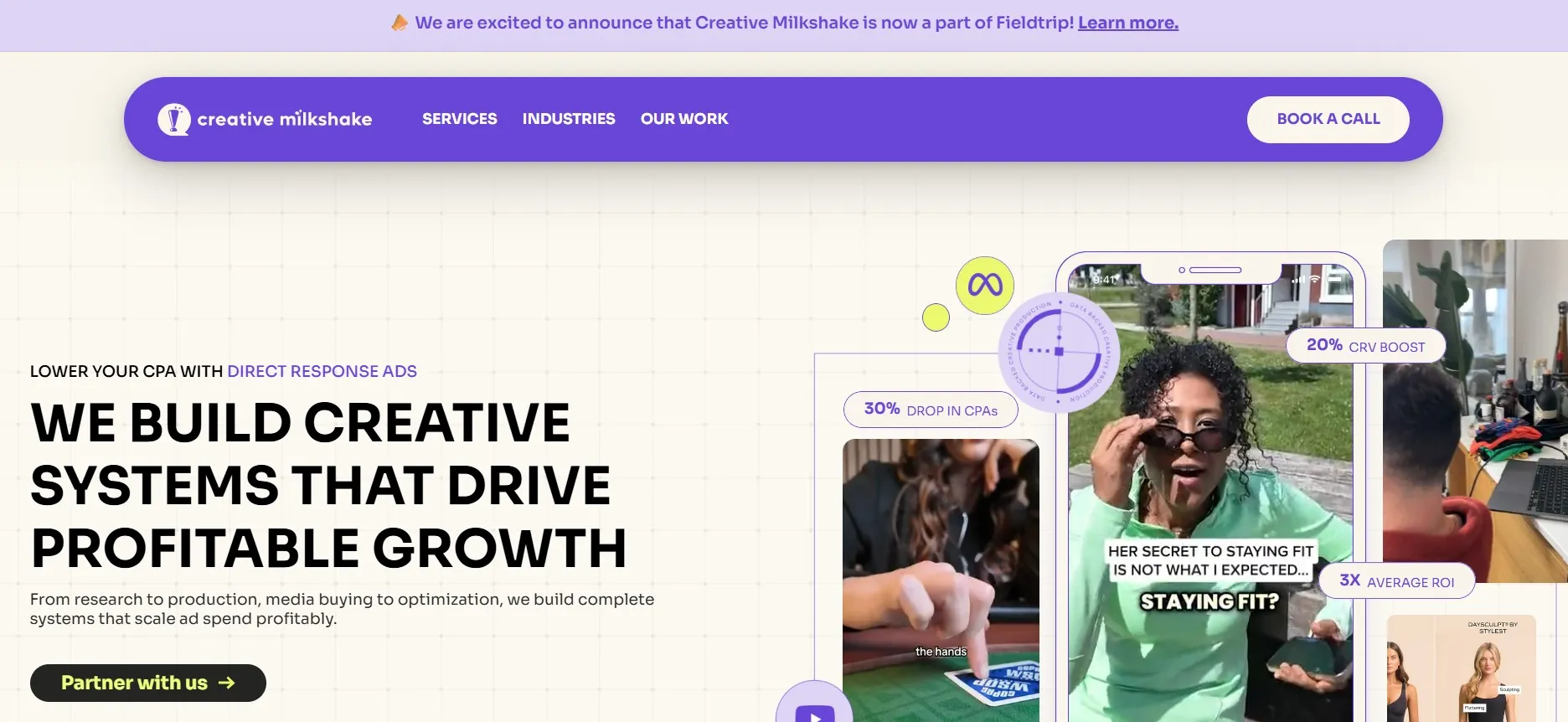
Best fit: Platform-native ads and localization.
Creative Milkshake is worth comparing when your brief calls for paid-social creative adapted to a platform or market. Its Wise work covers creative strategy, production, video editing, localization and scriptwriting, with an emphasis on TikTok pacing and hooks.
In the Wise localization case study, Creative Milkshake reports 26.23% lower customer acquisition costs and a 43.75% increase in US conversion rates. The page does not specify the measurement period; request that context before using the figures to benchmark your own plan.
Before hiring: Which languages, markets, versions and usage rights are included?
9. Tinuiti

Best fit: Brands coordinating creative across a wider media program.
Tinuiti is an option for teams that need creative coordinated with a broader media strategy. Its Boston Proper example combines audience research, an influencer partnership and paid amplification, illustrating work that extends beyond standalone asset delivery.
Tinuiti’s Boston Proper case study reports a 3x return on ad spend. The activation used Whitney Rose’s content and amplification through Bravo’s Meta Business Manager. Compare that scope with your own brief before treating its outcome as a relevant benchmark.
Before hiring: Which specialists and channels will be part of the engagement?
10. 85SIXTY

Best fit: Consumer brands combining campaign production and paid media.
85SIXTY is relevant when you need campaign production and performance creative to work together. Its Ascent Protein work used iterative testing, messaging changes, photography and a TikTok creative strategy alongside broader media activity.
The Ascent Protein case study reports a 48.6-point increase in brand awareness and a 22.5-point increase in purchase intent. These are brand-lift measures, not revenue percentages. The case describes creative learnings from tests throughout 2023.
Before hiring: Which outcomes will be measured: awareness, purchase intent or acquisition efficiency?
11. Y’all
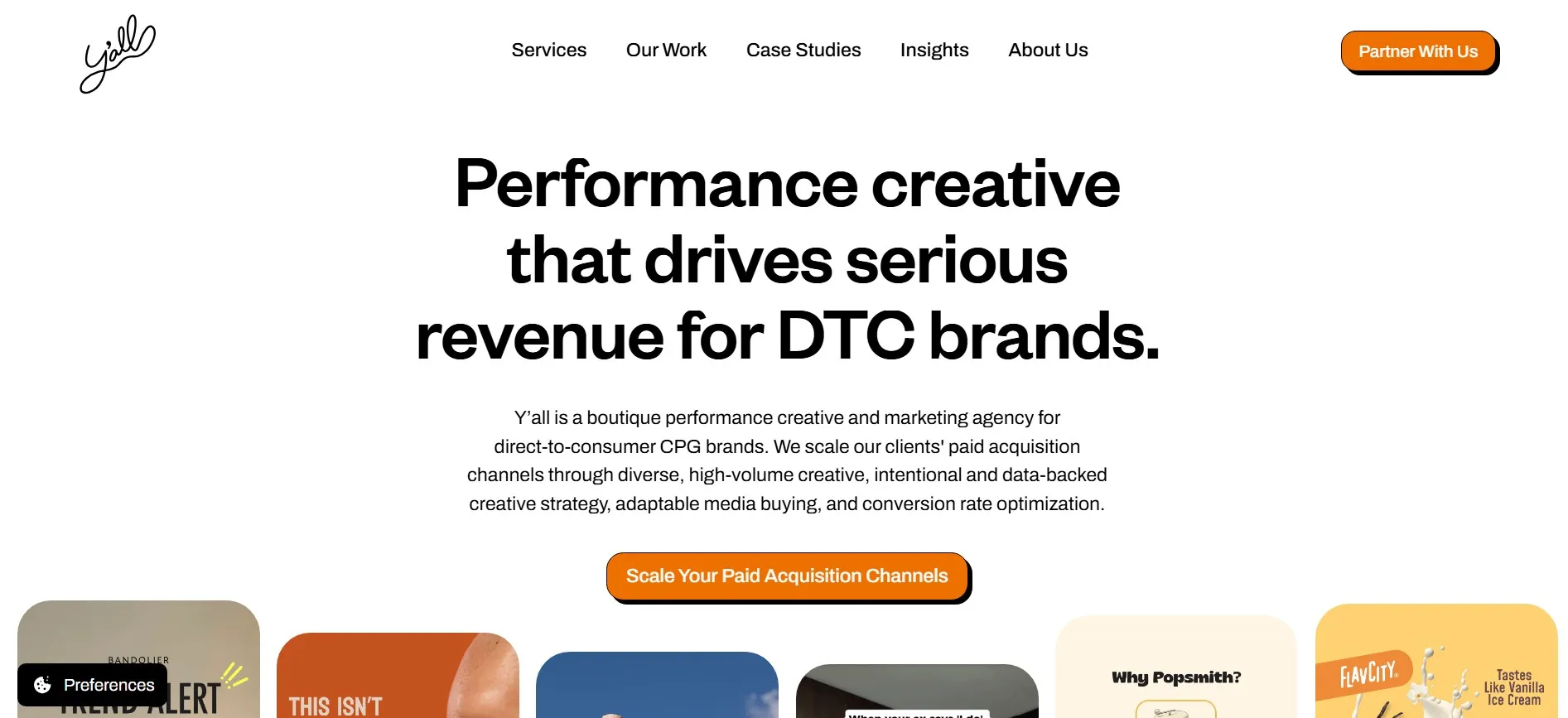
Best fit: DTC teams joining creative and acquisition work.
Y’all is a potential fit for DTC brands whose creative needs are closely tied to paid acquisition. Its Save Trees case describes work across creative, Meta and Google campaigns, customer targeting and landing-page optimization.
For Save Trees, formerly Cloud Paper, Y’all reports that creative output expanded by more than three times while annual ad spend increased 800%. Treat the output increase as an operational example; increased spend alone is not proof of improved efficiency.
Before hiring: How will creative capacity and landing-page work change as spend grows?
12. Chamber Media

Best fit: Video-led performance campaigns.
Chamber Media is worth considering for a video-led brief that calls for campaign concepts and production as well as performance marketing. Its current site describes work across social, YouTube and CTV, with long-form video, short-form video and static formats.
Use the agency’s current work examples to assess the production style you need, then request a relevant case with a defined campaign period and media scope. For a larger shoot, ask how the footage will be reused in shorter ads, hooks and later tests. The value of the project depends partly on that usable variation.
Before hiring: What original shoots, cutdowns and testing support will the project include?
13. Darkroom

Best fit: Consumer brands integrating creative and media planning.
Darkroom is relevant when creative production sits inside an integrated growth program. Its Sculpd case describes a UGC testing engine, gifting and audience angles, multi-platform paid media and expansion into Amazon.
In the Sculpd case study, Darkroom reports that monthly ad spend grew from a $30,000 baseline to more than $1 million at the December peak, with nearly 100% business growth during Q4. These are results from the broader engagement; the page does not isolate creative’s contribution.
Before hiring: How will the creative plan connect to acquisition targets and business economics?
14. MediaNug

Best fit: Teams needing social video tied to acquisition.
MediaNug presents performance creative around video and acquisition campaigns. Its current homepage includes examples for app and marketplace brands, making it a candidate when the creative brief is closely connected to user or customer acquisition.
The homepage’s SitterCity parent-acquisition example reports a 50% decrease in CPA and a 20% decrease in CPC. The full case breakdown is offered on a strategy call, so request the measurement period, channels and starting figures before comparing it with other agencies’ results.
Before hiring: Can the agency share the full case period, spend and attribution details?
15. adQuadrant
Best fit: Commerce teams combining creative and media optimization.
adQuadrant is a potential fit for commerce brands that need creative connected to media management and measurement. Its Milano Collection case describes bid optimization, reporting and creative changes across Google and Meta.
For Milano Collection, adQuadrant reports a 138% increase in Google Ads ROAS. The case also reports a 495% increase in Google Ads conversion rate over five months. The results reflect a wider account-management program, so ask which parts of that scope would be included in your proposal.
Before hiring: Who connects creative decisions with account changes and reporting?
16. Linear
Best fit: DTC brands scaling paid-social creative.
Linear combines performance creative and paid advertising for DTC brands. Its current positioning connects creative systems and scripting with media buying, making it relevant when you want a partner involved in both ad production and account growth.
Linear’s Mood example reports more than $6 million per month in profitable Meta ad spend. That is an agency-reported spend figure, not a disclosed ROAS or a fee threshold for new clients. Ask for a case closer to your own budget and operating constraints.
Before hiring: What production volume and account support fit your current stage?
How to evaluate a performance creative partner
A portfolio shows the finished ad. Your next conversation should show how the agency gets from a brief to a useful result. Ask for the following evidence before comparing proposals:
- A defined monthly output. Separate original concepts, creator shoots, edits, hooks and aspect-ratio versions. Ten variations of one idea are different from ten new concepts.
- A test-to-brief example. Ask to see a hypothesis, the resulting performance read and the creative decision that followed. Our guide to creative testing explains what a structured process should cover.
- Clear data access and responsibilities. Establish who sees platform results, who reviews them and who turns the findings into production instructions. Separate creative and media teams can work together, but the handoff needs an owner.
- A relevant case study. Request the client category, channel, period, starting and ending metric, and other services delivered alongside creative. Revenue, pipeline, brand lift and ad spend answer different questions.
- Written rights and revision terms. Confirm paid usage, creator permissions, partnership ads, raw files, revision rounds and renewal terms before budgeting the next campaign.
- An itemized proposal. Separate creative services, media management, production, licensing and ad spend. Ask about minimum terms and cancellation conditions.
How to compare agency fees and deliverables
Compare scope before headline price. A creator recording a video is not the same purchase as an agency researching the angle, writing the script, producing the shoot, editing variations and reviewing performance.
As production examples, inBeat’s pricing guide lists standard UGC at $1,500–$2,500 for one new video and four hook variations, and complex UGC at $2,500–$5,000 for one new video with no guaranteed variations. These are inBeat’s published experience-based ranges, not quotes from every agency in this list. Confirm currency, usage rights, revisions and current scope before using them for a budget.
For ongoing work, request a monthly plan that states new concepts, variations, turnaround times and the feedback schedule. For a one-off production, ask what happens after delivery: whether the agency interprets performance, makes revisions or charges separately for the next batch.
If the agency charges a share of ad spend or uses an outcome-based fee, get the calculation in writing. The proposal should identify the measurement source, attribution period, exclusions and any minimum fee. A lower production price is only useful if the deliverables match the tests you can actually run.
Common hiring questions
What’s the difference between a creative agency and a performance creative agency?
A creative agency may focus on brand identity, campaign ideas or production. A performance creative agency connects ad development to testing and business outcomes such as purchases, leads or app installs. The services can overlap; ask how performance findings change the next creative brief.
Should the same agency handle creative and media buying?
It can simplify the feedback process, but it is not the only workable model. If you already have a media team, ask how the creative agency will access results, join reviews and agree on the next tests. Choose the operating model that gives clear responsibility for turning data into decisions.
What should you have ready before hiring a performance creative agency?
Prepare your priority channels, offer, target audience, recent creative, measurement setup and production constraints. Be clear about whether you need strategy, creator sourcing, production, testing support or media buying. The more precise the brief, the easier it is to compare proposals.
How long does it take to see results with a performance creative agency?
Separate the delivery schedule from the measurement window. Ask when the first batch will launch and what spend, conversion volume and decision rules the agency needs before judging it. A fixed number of weeks cannot describe every channel, offer and account.
How many creatives should you expect each month?
Agree on original concepts and variations separately. Ten edits of one concept are different from ten new ideas. The appropriate volume depends on your test budget, channels, production needs and ability to act on results; ask the agency to explain how its plan fits those constraints.
How should you assess an agency’s use of AI?
Ask where AI is used, who checks the output and how the agency handles source assets, creator permissions and brand accuracy. Speed matters when it produces useful concepts or variations. The proposal should still explain human review, creative decisions and how the resulting ads will be tested.
Choose the partner that fits your next creative brief
For creator-led paid social, start with inBeat’s performance creative services. Bring your priority channels, current creative process and next production brief so the conversation starts with the work you need.
Use the other agencies in this guide to compare production styles, service scope and measurement approaches. The useful question is not who promises the most assets; it is who can explain what your team should test next and how the work will get done.