

Fall is when many brands start questioning whether their current agency still fits. It is also one of the worst times to discover that nobody fully owns the creator roster, usage rights, ad permissions, or performance history.
US influencer spend is forecast to grow 15.7% in 2026, which raises the stakes around every handoff. This guide covers what transfers, what stays behind, and how to structure the first 90 days around Q4.
Get the handoff right.
P.S: One thing before the mechanics.
In the creator economy, we treat creators as a creative engine, media buying as the lab, and measurement as the judge of what earns the next dollar.
So the asset that matters most in a switch is the learning loop: which creator, hook, and offer earned budget last quarter. An agency that keeps those learnings in someone's head restarts the lab from zero.
TL;DR: The 90-Day Switch in Six Points
- An AOR transition moves the operating mandate, not every underlying asset. Contracts, usage rights, data, creator relationships, and account access each follow their own terms.
- Brand-owned accounts stay with the brand; access is granted and later revoked. Creator agreements, licenses, and ad permissions move only as their terms allow, with creator consent where assignment or a new authorization requires it. The agency's proprietary tools and rates stay behind.
- Start the audit now and calculate the contractual notice deadline. For most retail programs with a working creator roster, run both agencies in parallel through Cyber Monday (November 30, 2026) and begin the operational cutover after the peak weekend.
- Check every Spark code, ad permission, and license end date against the Q4 calendar before the operational cutover; flag any expiry that could affect committed work before notice is served.
- Export creator-level and hook-level results, conversion data, and tracking definitions first. They let the new agency skip a cold start.
- Write the next exit into the new contract.
What Is an Agency of Record Transition in Influencer Marketing?
An agency of record (AOR) transition moves the brand's operating mandate to a new agency. Contracts, usage rights, data, and creator relationships must each be reviewed separately because they do not all transfer with the mandate. Most guides on switching agencies spend their first third on signs it's time to leave. This one goes straight to the move.
Four setups get confused with each other, and each transfers differently:
- AOR: one agency holds the ongoing mandate for creator sourcing, contracts, and reporting.
- Roster of individual deals: the brand negotiates and manages each creator directly. Our comparison of in-house and outsourced influencer marketing covers when that stops scaling.
- Project casting: a casting agency sources creators for one campaign and holds no ongoing mandate.
- Talent management: sits on the creator's side of the table and represents creators only.
The agency market adds a second layer. Specialist creator agencies usually hold the roster and the rights. Full-service local shops tend to hold media buying and regional relationships. Brand houses often hold the creative platform and brand voice. In our experience, whichever of them holds your creator contracts sets how long the switch takes.
When to Start an AOR Transition: Timing Around Cyber Week
Start the audit now. Serve notice early enough to satisfy the contract, keep both agencies in parallel through Cyber Monday, and begin the operational cutover after the peak weekend. Much of the creator side of Q4 is already spoken for, so the roster you have today is largely the roster you'll run through the holidays.
Two sources point the same way. Later's 2026 holiday research found that late outreach is creators' top complaint about holiday campaigns, cited by 27%. The share of creators comfortable with only 3 to 4 weeks of lead time fell from 32% to 24%, while those preferring 2 to 4 months rose from 14% to 22%.
Modern Retail reported that Starbucks approached creators in July for its fall menu, and that brands waiting until October and November still want concepts ready by September.
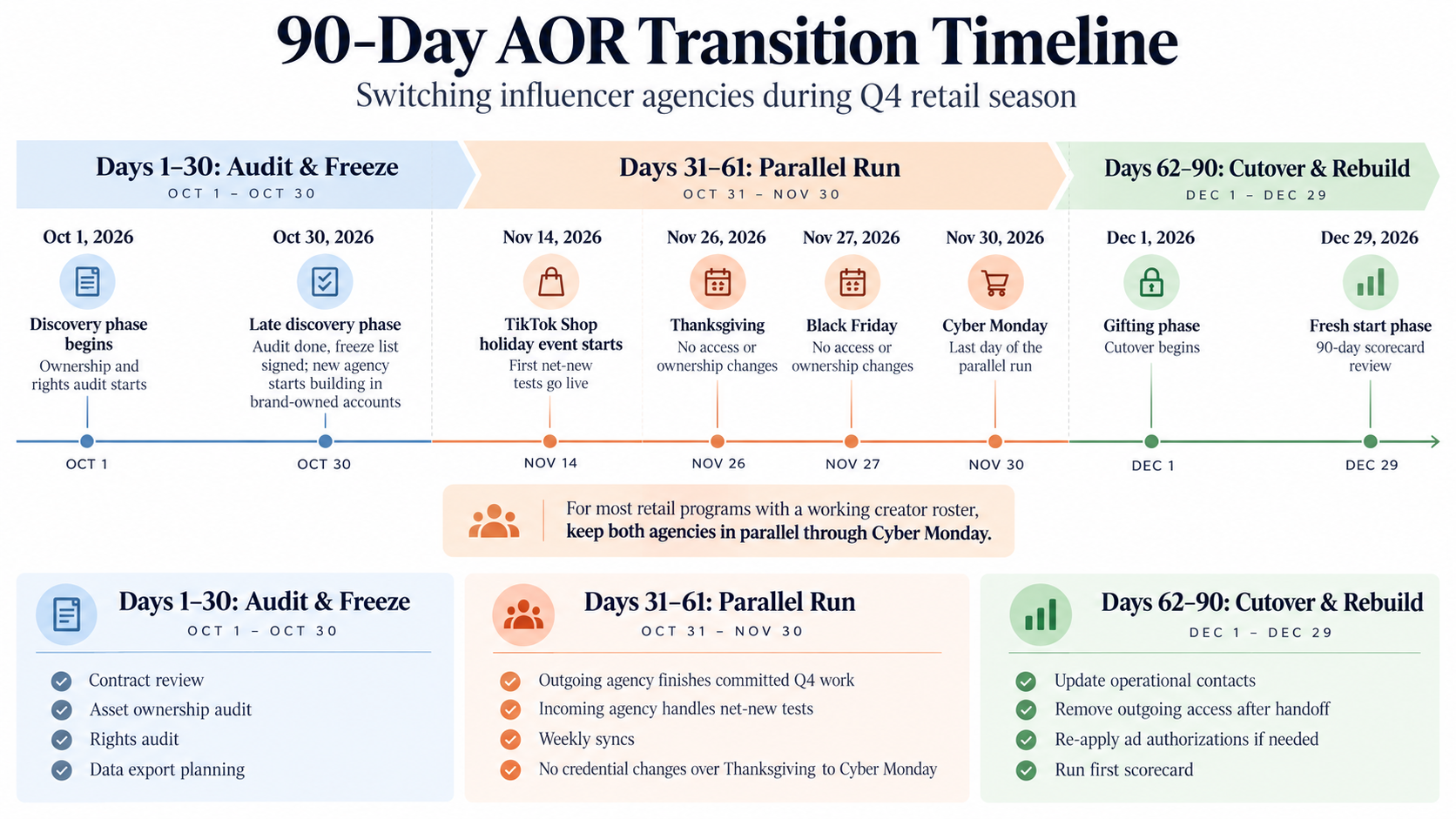
Meta describes the season in four phases: discovery from October to early November, deals over Black Friday and Cyber Monday, gifting through December, and a fresh start into the new year. Mapped onto a 90-day plan that starts on October 1, the calendar looks like this:
Day | Date | Retail moment | Transition milestone |
|---|---|---|---|
1 | Oct 1 | Discovery phase begins | Ownership and rights audit starts |
30 | Oct 30 | Late discovery phase | Audit done, freeze list signed; the new agency starts building in brand-owned accounts |
45 | Nov 14 | TikTok Shop holiday event starts, per a Mellow Sleep co-founder in Modern Retail | First net-new tests go live |
57 | Nov 26 | Thanksgiving | No access or ownership changes |
58 | Nov 27 | Black Friday | No access or ownership changes |
61 | Nov 30 | Cyber Monday | Last day of the parallel run |
62 | Dec 1 | Gifting phase | Cutover begins |
90 | Dec 29 | Fresh start phase | 90-day scorecard review |
Not every brand should follow that path. The table below compares the three realistic options.
Option | When it starts | When the cutover happens | Fits when | Main Q4 risk |
|---|---|---|---|---|
Hard cutover in October | Oct 1 | October to early November | The outgoing agency is already missing deliveries | The new agency learns your accounts during the deals phase |
Parallel run, cutover after Cyber Monday | Oct 1 | From Dec 1 | Most retail programs with a working creator roster | Two agencies need a clear split of who owns what |
Run Q4 with the current agency, switch in January | Audit now; notice by contract deadline | January | The current agency delivers but the contract is ending | Notice windows and auto-renewals can pass unnoticed |
Whichever you pick, read your notice clause this week. The audits in the sections below are worth doing even if the move waits until January.
What Transfers to the New Agency, and What Stays Behind
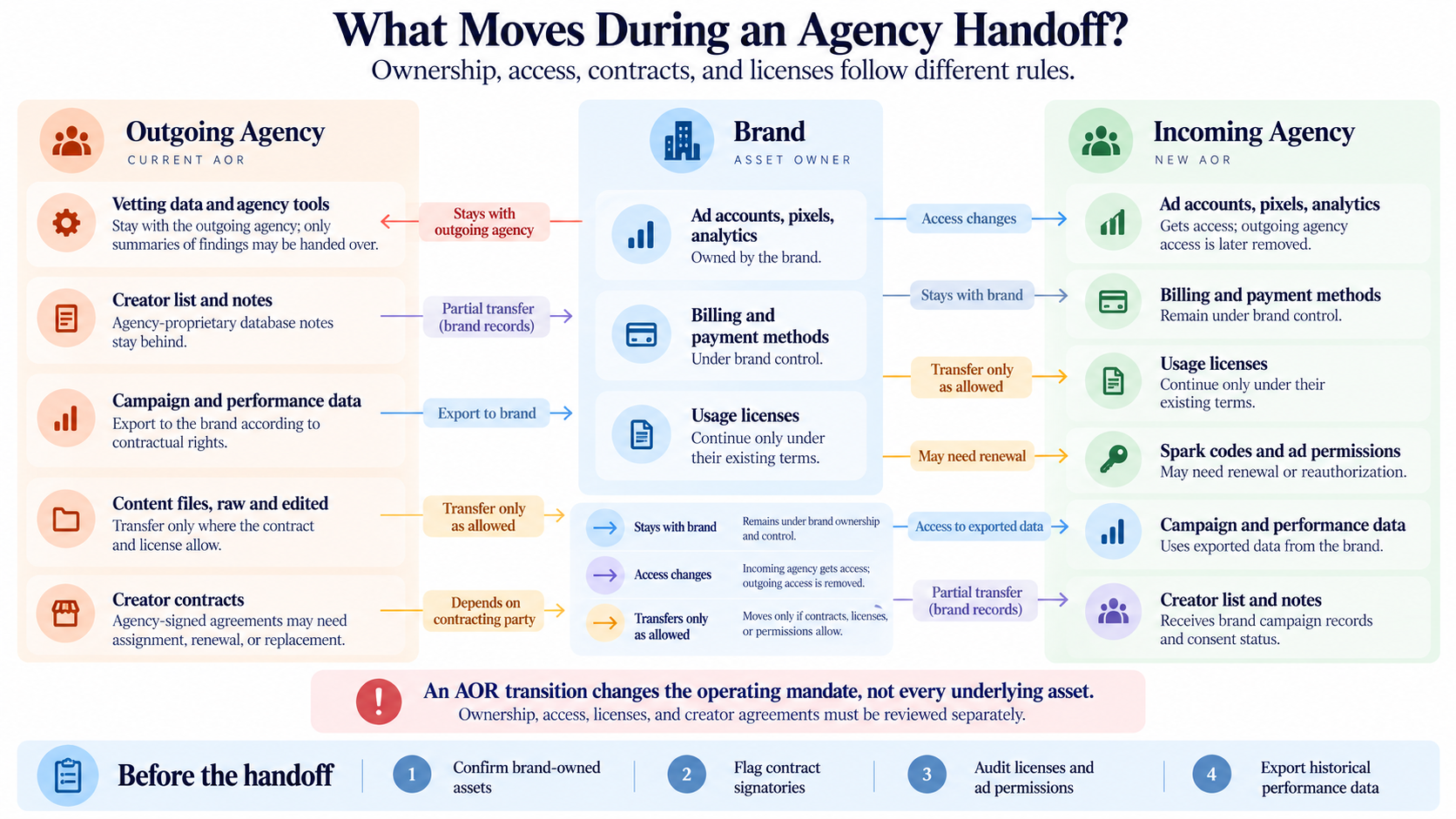
Treat ownership, access, and license as separate questions. The brand keeps assets it owns; the incoming agency receives only the access it needs. Creator content and ad permissions remain governed by the creator agreement and platform authorization, while the outgoing agency keeps its proprietary tools and rate intelligence.
Brand-Owned Assets That Stay With the Brand
Ad accounts, pixels, analytics properties, and billing stay with the brand when they were created in the brand's own portfolio. The transition changes agency access rather than ownership. Admin access lets a partner operate an asset without making that partner its owner. Content files, briefs, and reports transfer only to the extent the brand's contract and creator licenses permit.
If an ad account sits in the agency's portfolio, do not assume it can be transferred; the agency may need to share access while the brand creates a replacement. If the brand owns it, add the incoming partner before removing the outgoing one, then cut access only after handover verification.
Creator Agreements That Need Creator Consent
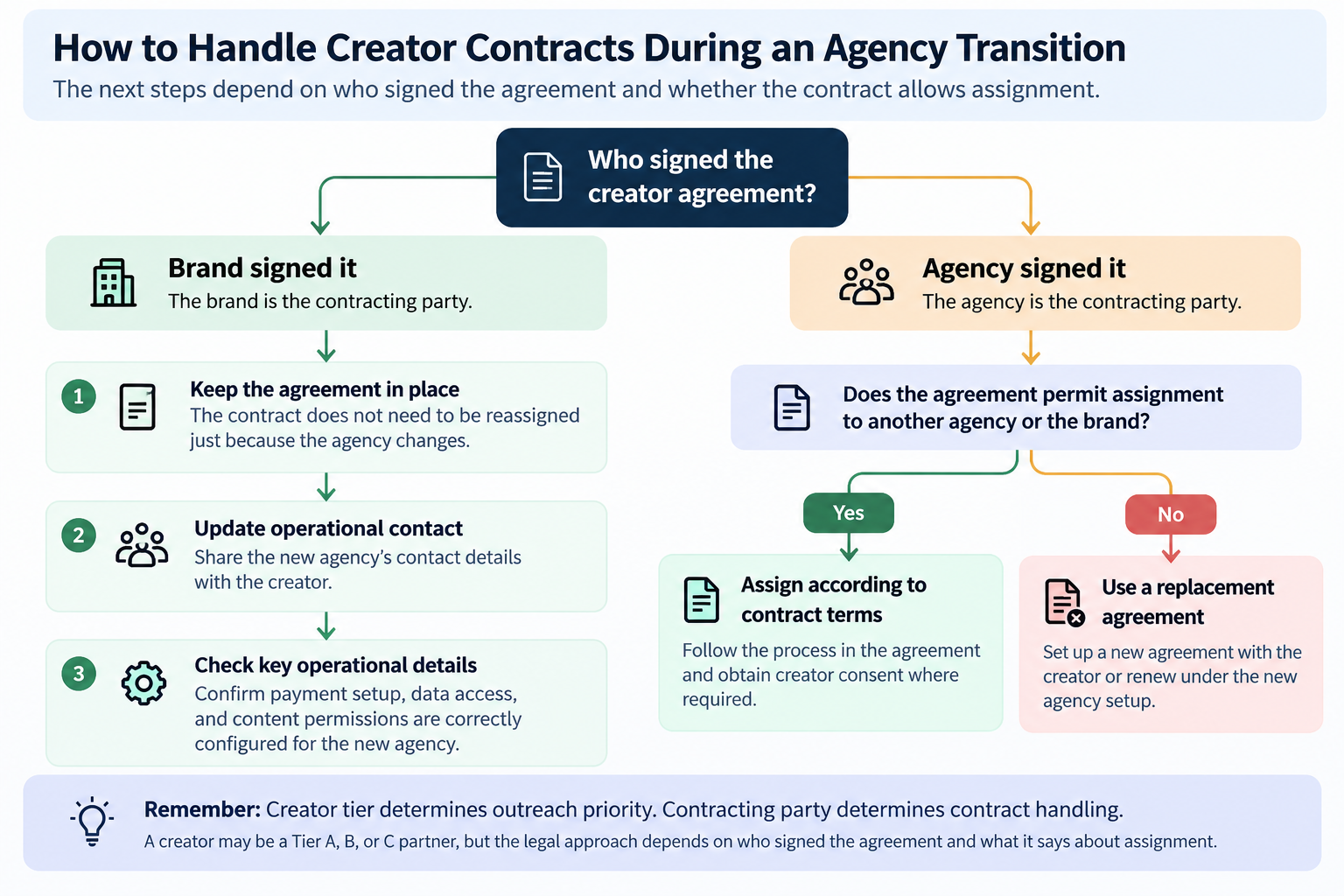
Read the contracting party, assignment clause, confidentiality terms, and platform permissions on every creator agreement. If the brand is the contracting party, it can usually change its service provider without assigning the agreement, but it still must respect limits on sharing creator data, changing payment instructions, and granting account access.
If the agency is the contracting party, the agreement stays with it unless the contract permits assignment and any required creator consent is obtained, or the creator signs a replacement agreement. Consent to assignment is separate from the courtesy notice about new contacts; record both. Have counsel review material deals.
Agency Assets That Stay Behind
Agency-owned databases, proprietary vetting models, negotiated rate cards, and templates stay with the agency unless the contract says otherwise. The brand should still receive the campaign records, deliverables, and creator-level performance data it owns or is entitled to export, plus a written summary of the agency's learnings. Access to a platform does not transfer its underlying IP or license.
Asset | Who usually owns it | What happens at handoff? | What to request |
|---|---|---|---|
Ad accounts, pixels, analytics | Brand, if set up in the brand's portfolio | Stay with the brand; agency access changes | Admin access confirmation in writing |
Billing and payment methods | Brand | Stay under brand control | Card or account moved under brand control |
Creator contracts | Whoever signed them | Depends on the contracting party | Copies of all agreements, with the contracting party and assignment terms flagged |
Usage licenses | Creator, licensed to the brand | Continue only under their existing terms | License terms and end dates per creator |
Spark codes and ad permissions | Creator authorizes them | May require renewal or reauthorization | List of active codes and expiry dates |
Content files, raw and edited | Creator or brand, as the contract states | Transfer only where the contract and license allow | Full library with file-to-creator mapping |
Campaign and performance data | Brand, held in agency tools | Export according to the brand's contractual rights | Raw exports of the underlying data |
Creator list and notes | Shared | Partly | Brand campaign records and consent status; exclude agency-proprietary database notes |
Vetting data and agency tools | Agency | Stay with the agency | Summaries of findings only |
How Do You Tell Your Current Agency You're Leaving?
First calculate the contractual notice deadline and work backward from the chosen cutover. Before serving notice, secure brand-controlled admin rights and export the records you are entitled to obtain, unless waiting would cause you to miss the notice window. The notice period may overlap the audit and parallel run; notice does not itself authorize a cutover or change asset ownership.
In the same letter, cite the notice and exit terms, state the planned cutover and the outgoing agency's responsibilities through that date, and request a dated handover plan plus a joint session with the incoming agency. Include any non-solicit waiver and the commission cutoff.
The 90-Day AOR Transition Plan
The plan runs in three phases: audit and freeze (days 1 to 30), parallel run (days 31 to 61), and cutover and rebuild (days 62 to 90). Dates follow the calendar above and assume an October 1 start.
Days 1 to 30: Audit Ownership and Freeze New Commitments
- Read the contract for the notice period, auto-renewal terms, exit fees, and what the agency must hand over at exit.
- Confirm admin rights on every ad account, pixel, and analytics property, and move billing under brand control.
- Fill in the transfer matrix above for your own program.
- Complete the creator, rights, and data audits in the sections below.
- Sign a freeze list: no new creator commitments, usage extensions, or contract changes by the outgoing agency without written brand approval.
- Name one internal transition lead who owns questions from both agencies.
- Serve written notice by the contractual deadline. Complete the access, data, and rights safeguards first when timing allows; if the notice window is longer, serve notice earlier and continue the audit during the notice period. Keep the operational cutover after Cyber Monday unless performance risk requires the hard-cutover option.
Days 31 to 61: Run Both Agencies in Parallel Through Cyber Monday
- The outgoing agency delivers committed Q4 content and keeps current ad authorizations live.
- The new agency builds inside brand-owned accounts and takes only net-new creators and tests.
- After the agency notice and contact plan are set, the brand sends the first transition message. Notify Tier A creators individually before any agency outreach, notify Tier B creators before the joint introduction, and contact Tier C only when they are re-vetted or needed. A notification is not consent to assign a contract, extend a license, or reissue an ad permission.
- Hold a weekly sync with the outgoing agency, the incoming agency, and the internal lead.
- Make no credential or ownership changes from Thanksgiving through Cyber Monday.
Days 62 to 90: Cut Over and Rebuild the Testing Cadence
- Start on December 1 (day 62 if you started on October 1), after Cyber Monday ends. Keep brand-signed creator agreements in place, updating the operational contact where needed. For agency-signed agreements, use the contract’s existing assignment provisions, renew under the new setup, or sign a replacement agreement when required.
- After the handover is verified and the outgoing agency's delivery obligations end, remove its partner access and rotate any shared credentials.
- Re-apply any ad authorizations that were tied to accounts that moved.
- Run the first scorecard against the baseline from the data export.
- Schedule the first post-holiday test round.
Pro tip: avoid handovers on a Friday. If something breaks, both teams should be at their desks.
How to Transfer Creator Relationships and Your Talent Pipeline
Separate notification from legal transfer: the brand announces the change, but contracts, licenses, payment instructions, and ad permissions change only through the required process. Prioritize Tier A relationships and keep payment continuity across every tier. Later's 2026 survey found that fair and timely payment is creators' top requirement at 62%, while long-term relationship potential rose in importance from 40% to 49%.
Tier A: Direct Ambassadors
These are the few creators whose audience and brand fit make them hard to replace. The senior brand contact should confirm their Q4 slots, rates, posting dates, payment contact, and whether any agreement or permission needs fresh consent. Introduce the incoming agency only after the creator acknowledges the change.
Our guide to brand ambassador programs shows how these relationships are built.
Tier B: Roster Creators in Active Creator Programs
These are the mid-volume creators the outgoing agency manages day to day. After the brand's notice, use a short joint introduction and keep payment schedules unchanged. Keep brand-signed agreements in place, and handle agency-signed agreements through permitted assignment, replacement, or renewal. Review these creators in the weekly three-way sync until their Q4 deliverables are posted.
Tier C: Long-Tail Creators and the Casting Pipeline
These are one-off creators and the sourcing list behind them. A casting agency or creator factory pipeline, meaning a production model that sources and briefs social media content creators at volume, either moves with you or gets rebuilt.
Ask the outgoing agency for the full list with status, rates, and results per creator, then have the new agency re-vet them.
Group | Who contacts them first | Contract handling | Timing | What breaks if mishandled |
|---|---|---|---|---|
Tier A ambassadors | Senior brand contact | Keep brand-signed agreements in place; assign or replace agency-signed agreements where required | Brand outreach in days 1 to 30; complete any required contract changes before the new agency takes over | Trust, and the Q4 slots with it |
Tier B roster | Brand message, then the outgoing agency's introduction | Keep brand-signed agreements; handle agency-signed agreements through assignment, replacement, or renewal | Before joint introduction; target days 31 to 61 | Payment delays, duplicate outreach |
Tier C long tail | Brand message, then the new agency after re-vetting | Re-contract only when the creator is reactivated or the existing agreement requires it | Days 62 to 90 | Stale lists and unvetted creators |
Check one more thing before the new agency contacts anyone. Some agency contracts include a non-solicit or exclusivity period covering creators the agency sourced. Raise it during contract negotiation on the exit and ask the outgoing agency to waive it in the exit letter.
How to Audit Creator Usage Rights, Whitelisting, and License Terms Before You Switch
Audit five fields on every creator contract: platform, duration, territory, media type, and whitelisting permission, then check the exclusivity and AI clauses below. Any end date that falls inside Q4 needs an owner and a decision before the affected content or ad stays live through cutover; flag it in the notice-period handover plan.
Rights cost money, which is why lapses hurt. In Later's survey, 54% of brands want to use content beyond the promotion window, and 61% of creators charge extra for raw files or extended usage rights. A license that quietly expires during the switch means paying for the same content twice.
Spark Codes and Partnership Ad Permissions
On TikTok, a creator authorizes a post for advertising with a code, and TikTok's help center lists authorization durations of 7, 30, 60, or 365 days. The caption can't be edited after authorization, and a duet or stitch needs a code from both creators.
For the switch, pull every active code with its expiry date, and have creators renew anything that lapses before the cutover. If Spark ads move to a new ad account, confirm in Ads Manager whether the codes need re-applying.
AI Adoption and Likeness Rights
A license written before AI editing was on the table rarely mentions it. Check whether each contract permits:
- Cutdowns.
- Re-edits.
- Voice or likeness synthesis.
- AI-generated variations.
If the contract is silent, treat the use as not permitted and ask the creator.
As agencies add AI-driven influencer marketing tools for matching, editing, and reporting, ask the new agency which steps touch creator content or likeness, and put the answer in the contract.
Exclusivity, Endorsement, and Disclosure Clauses
Category exclusivity, premium brand collaborations, and celebrity endorsements usually carry stricter clauses: approval rights, morality terms, and longer exclusivity windows. Confirm that none of them blocks the new agency from briefing the same creator.
On disclosure, the FTC's Endorsement Guides apply to advertisers and endorsers, and a material connection must be disclosed in the post itself. Walk through live posts the new agency inherits against our summary of FTC guidelines for influencers.
Right | Where to find it | Transfers by default? | Question for the outgoing agency | Red flag |
|---|---|---|---|---|
Organic reuse | Creator contract | Only as written | Which posts can the brand repost, and until when? | No end date recorded |
Paid usage | Creator contract | Only as written | Which creators are licensed for paid media? | Paid ads running on organic-only licenses |
Whitelisting and Spark codes | Ads Manager, creator messages | No | Which codes are active, and when do they expire? | No code log |
Territory | Creator contract | Only as written | Which markets is each license valid in? | Global use on a local license |
Duration | Creator contract | Only as written | Which licenses end before December 29? | Expiry dates tracked by memory |
Exclusivity | Creator contract | Only as written | Which categories and competitors are blocked? | Clauses nobody has read in a year |
AI and editing | Creator contract | No | Does any contract allow AI edits or likeness use? | Contract silent, content already edited |
How to Move Historical Performance Data, CRM Data, and Attribution
Export creator-level results, hook-level creative results, conversion data, and tracking definitions before notice when the contract timeline allows; otherwise preserve access and request dated exports in the notice letter before any cutover. Without a baseline, the new agency can't tell an improvement from a reset.
EMARKETER notes that the industry lacks a gold standard for measuring influencer marketing, and marketers combine their own metrics. Your definitions are therefore part of the asset. Write down what each KPI means before anyone inherits it.
The same Later survey shows why this matters: engagement rate is the top KPI for 64% of brands, and sales and revenue attribution slipped from 67% to 61%. A new agency handed only engagement numbers will optimize for engagement.
Early data also pays off in Q4. Mellow Sleep's co-founder told Modern Retail that the brand runs early campaigns to learn which creators, hooks, and products deserve budget, and would rather spend that learning "in a cheap month" than during Cyber Week.
Conversion Data and Landing Page Attribution
Export UTM structures, unique creator links, promo codes, GA4 conversion definitions, and the landing page used for each creator or campaign. Landing page attribution is the piece most often lost, because it lives in the old agency's naming conventions.
Our guide to influencer marketing attribution models covers how to validate the numbers once they move.
CRM Data and Affiliate Performance
Export the creator IDs passed into your CRM, customer cohorts tagged by creator, and affiliate performance by creator, including commissions paid and pending. If creator data never reached the CRM, say so now and mark the sales history that can't be tied to a creator, so the new agency doesn't read those gaps as zero performance.
Real-Time Performance Insights and Reports
Ask for live dashboard access and the last two holiday seasons of reports. Any performance analysis services the outgoing agency provides should end with a live handover session. Our breakdown of marketing agency reporting explains why real-time access beats monthly retrospectives and what a useful report contains.
Data asset | What to export | What the new agency uses it for |
|---|---|---|
Creator-level results | Spend, reach, clicks, orders, CPA per creator | Deciding who stays on the Q4 roster |
Hook and creative results | Hook, format, length, winner or loser, date | Briefing the first test round |
Conversion data | Events, definitions, attribution windows | Matching baselines to new reports |
Tracking structure | UTMs, links, promo codes, landing pages | Keeping attribution continuous |
CRM and affiliate data | Creator IDs, cohorts, commissions | Linking creators to customer value |
Past holiday reports | Last two seasons, plus agency commentary | Planning Q4 and the next peak |
How to Protect Q4 Retail Programs During the Switch
Lock the content calendar first, let the outgoing agency finish committed work, and give the new agency only net-new tests until Cyber Monday.
Content Calendars and Campaign Timing
Put every approved post, flight date, and approval deadline into one shared calendar that both agencies and your internal lead can see. Campaign timing is the hardest thing to rebuild, since creators schedule their holiday content around brand deadlines.
Later also found that fixed holiday budgets rose from 30% to 49% of brands, which leaves little room to correct mistakes mid-campaign. Reserve a share of the budget before the switch starts.
Don't pause or restructure live ad campaigns during the parallel run. Meta advises starting early so its systems can complete the learning phase before Black Friday, and rebuilding campaigns mid-season works against that.
Content Guidelines, Territories, and Styles
Retail programs carry rules that live outside the brand deck. Hand over retailer-specific content guidelines, covering claims, imagery, disclosure wording, and approval steps.
Add content territories, meaning which regions or retailers each creator's content may feature, and the content styles approved for each channel. A creator who posts a promotion in the wrong territory creates a problem that no agency change fixes.
Split Q4 Work Between the Two Agencies
Outgoing agency finishes | New agency starts |
|---|---|
Committed Q4 posts and in-flight edits | Net-new creators and tests |
Approvals with content producers and editors | Reporting set-up and dashboards |
Creator payments already scheduled | Post-holiday test plan |
Hand-over notes on every live campaign | Q1 content calendars |
Q4 Trouble Signals
What you see | What it likely means | What to check |
|---|---|---|
Posts slip past scheduled dates | Ownership of approvals is unclear | The shared calendar and who signs off each post |
Spark ads stop delivering | An authorization expired | The code log against today's date |
CPA jumps after campaigns are edited or rebuilt | Delivery may have been disrupted or the campaign may be learning again | Which changes were made and when performance shifted |
A creator asks who to invoice | Payment ownership is unclear | The freeze list and the exit letter |
Two agencies contact the same creator | The transition message went out late | Who sent the brand's note, and to whom |
How to Hand Off Brand Voice, Brand Mission, and Content Guidelines
Hand over the reasoning behind the work along with the files. A new agency that only receives the brand deck will repeat tests the old agency already lost.
Later's survey found that 57% of creators cite clear, detailed briefs as a top driver of a good partnership, and briefs are where brand voice shows up.
Hand over these five items:
- The brand mission and brand voice documents, with examples of approved and rejected posts, plus the content guidelines from the Q4 section above.
- Lifestyle branding cues: how the product appears in a creator's daily life and which settings the brand avoids.
- The history of digital brand partnerships, including what each one tested and what happened.
- Claims and angles the brand has rejected, with the reason for each.
- Your current brief template, with notes on which fields creators most often ask about.
How to Evaluate a New Agency's Transition Readiness
Ask for a written transition plan, a live dashboard from an existing client, and ownership language in the contract before signing. A pitch deck says little about how an agency handles the first 30 days.
Use this scorecard in the pitch process:
Criterion | Strong answer | Red flag |
|---|---|---|
Transition plan | Written 30/60/90 plan before signing | "We'll scope it after kickoff" |
Reporting | Live dashboard from a current client | Monthly PDFs only |
Account ownership | Builds inside your accounts, in the contract | "We'll transfer it eventually" |
Performance marketing fit | Explains how ROI-focused campaigns are measured beyond engagement | Engagement rate as the only KPI |
AI-driven influencer marketing | States which steps are automated and which are human | Won't say where AI touches creator content |
Fee structure | Fees tied to deliverables or output | Percentage of spend with no link to results |
Day-to-day team | Named people with decision authority | Senior pitch team, junior account team |
Write the next exit into this contract. That means accounts built in your portfolio, data exports on request, a defined notice period, and creator agreements structured so they can be assigned.
What a 90-Day Switch Costs and How to Track It
The cost is overlap fees, re-licensing, creator re-onboarding, and any performance dip while accounts settle. Track it against a short scorecard, so the switch is judged on results.
Cost line | When it hits | How to limit it |
|---|---|---|
Overlap fees | Days 31 to 61 | Scope the outgoing agency to committed work only |
Re-licensing | When licenses lapse | Run the rights audit first and renew in bulk |
Creator re-onboarding | Days 31 to 90 | Brand-led message, same payment schedule |
Performance dip | After account or campaign changes | Leave live campaigns untouched until Cyber Monday |
Internal time | Throughout | One transition lead, one weekly meeting |
Exit fees | At notice | Read the exit clause on day one |
For typical fee ranges, see our list of influencer marketing agencies in the US.
Track four numbers from the day-1 baseline:
- Creator-level cost per acquisition.
- Blended CAC and MER.
- The on-time delivery rate.
- The count of live posts running on expired rights, which should stay at zero.
Build a Smoother Agency Transition With inBeat Agency
A switch goes well when ownership, rights, and data are sorted before anyone changes logins. At inBeat, we run that audit as the first step of every handover, then take over creator programs, content creation, and paid amplification without pausing what already works. Book a strategy call and we'll walk through your transfer matrix, your license end dates, and your Q4 calendar.
FAQs
What if a creator doesn't want to move to the new agency?
Keep the relationship with the brand and decide per creator. Honor existing contracts, offer a direct line through your transition lead, and let the creator finish current deliverables with their usual contact. Most long-term creators care about timely payment and clear briefs, so a declined move usually points to a communication gap that you can fix.
When does a hybrid model make sense?
Use a hybrid when a few high-value ambassador relationships are too important to move quickly. Review the split every quarter, since the right balance shifts as the roster grows.
How do you handle affiliate commissions that land after cutover?
Agree in the exit letter on a cutoff date and a named owner for reconciling commissions on orders attributed before it. Export pending payouts by creator on that date, and have the brand confirm the numbers.
Is a switch worth it for a roster of fewer than ten creators?
Often the smarter move is a lighter fix. With a small roster, internal admin time is low, so the benefit of an AOR comes mainly from specialist skills in rights, data, and paid amplification. If those are the gaps, hire for them. If delivery is the gap, a project-based agency may be enough.
What if the outgoing agency won't cooperate with the handover?
Rely on what the brand owns: accounts in your own portfolio, billing, and signed creator contracts. Send requests in writing with dates, cite the exit clause in your contract, and keep a log of every request. If an agency still controls ad accounts or licenses, involve legal counsel before revoking access or attempting the cutover.