

Creators now rank as the most trusted source for 44% of consumers, ahead of social media ads and celebrities. Yet many brands still take creator content through a process that gradually makes it sound exactly like the advertising audiences trust less.
The creator usually gets blamed last, even though the scripting starts long before they hit record. By the time the video goes live, the creator may still be on screen, but much of what made their content feel native has disappeared.
That creates a strange tradeoff. Brands hire creators for the trust and familiarity they have built with an audience, then use the production process to smooth away the voice that created that trust in the first place.
This guide looks at exactly where that happens and how to brief, review, and contract creator content while preserving the qualities that made the creator worth hiring.
TL;DR
- Source of the problem: scripted creator content comes from the brief and the approval chain, so that is where the fix sits.
- The brief: one outcome, product facts, and three to five non-negotiables. Everything else stays open.
- Review: collect all feedback into one consolidated round per draft and cap the total at two rounds.
- Contracts: usage rights and exclusivity change what the creator can say and show, so settle them in the contract before the brief goes out.
- Disclosure: it has to be clear, and it can sit inside the native format.
What Is Native Content in Influencer Marketing?
Native content matches the format, pacing and voice of the feed it appears in, so viewers read it as part of the feed. A creator talking to camera in their usual style about a product they use is native. A brand-written script performed by a creator is not, even when the creator is famous.
Justin Moore of Creator Wizard explains the difference between a native post and a hard post. Source: YouTube
It overlaps with user-generated content (UGC) and covers different ground. UGC is made by customers or hired creators without a brand-controlled production, while native content describes how the result looks and feels.
Native content is still labeled. Content that conceals its commercial intent is stealth advertising, and regulators treat it as a violation, so a native post carries a paid partnership label. The disclosure section below covers how.
Why Expensive Creator Content Still Reads Like an Ad
Expensive creator content reads like an ad when it carries the signals of a brand production: polish, claim-shaped sentences and a product-first opening. Viewers pick up those signals quickly, and they discount the content accordingly.
The Trust Gap Between Polished and Native Content
Influencer advertising starts with less trust to spare, and content that sounds like the brand spends the little there is. The BBB National Programs 2025 Influencer Trust Index found that 87% of US consumers trust advertising at least somewhat, against 74% for influencer advertising. Distrust of influencers (26%) was more than double the distrust of ads (11.3%).
Platforms say the same thing about polish. TikTok's own research reports that 71% of TikTok users prefer brand posts that are not too polished, and 65% say overly professional brand videos feel out of place.
Marketers report the same pattern: 69% say influencer content outperforms brand-directed content in Sprout Social's 2025 survey.
Four Signals Viewers Read as an Ad
Four signals account for most of the "feels scripted" reaction, and each traces to a specific decision upstream.
Signal | What the Viewer Notices | Where It Comes From in the Process |
|---|---|---|
Product-first opening | The video starts with the product on screen before any reason to care | A brief that sets the first shot |
Claim-shaped sentences | The creator speaks in feature statements nobody says out loud | A mandatory-phrases list |
Same look across creators | Several creators share a framing, a hook and a phrase | One brief sent unchanged to every creator |
Label placed like a footer | The disclosure reads as legal text pasted on the post | A late-stage compliance edit |
Where Does Scripted Creator Content Come From?
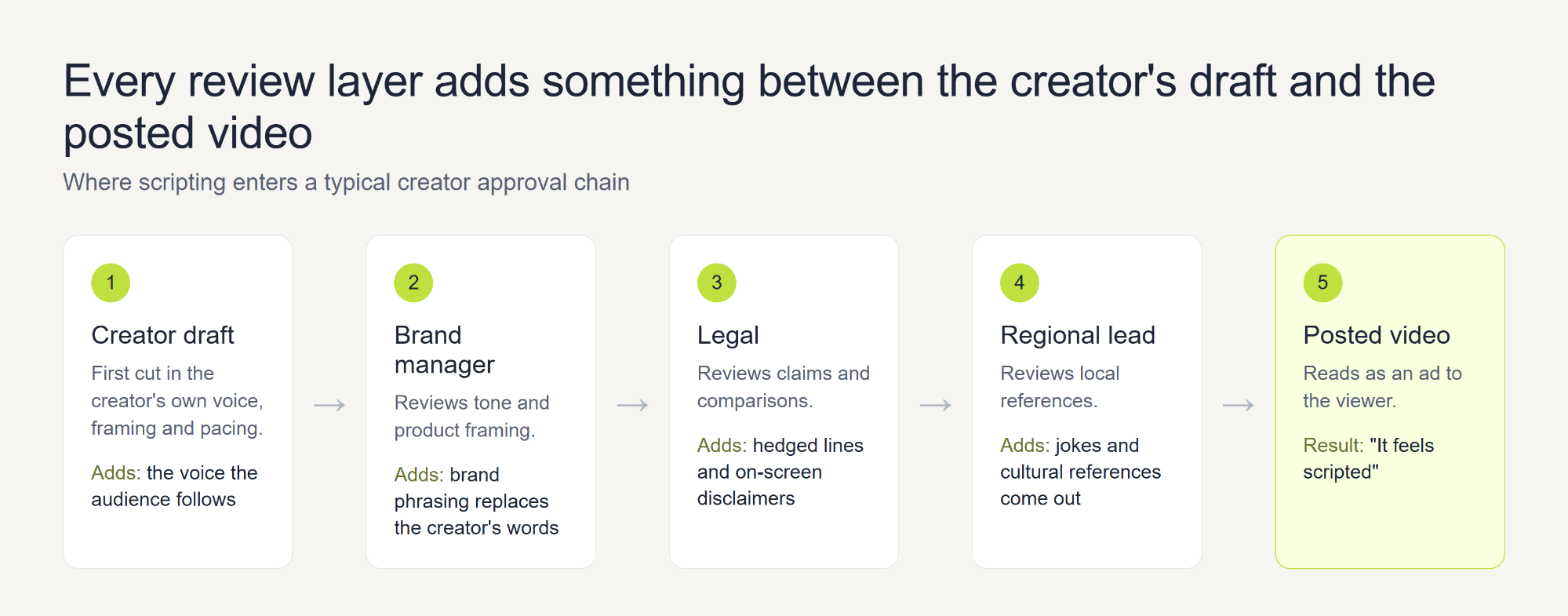
Scripted content comes from the briefing and approval chain. In our experience, the creator's first draft is usually closer to native than the version that gets posted, because each layer of review adds a line, a restriction or a rewrite.
The Over-Specified Brief
A brief becomes a script when it dictates wording. Typical symptoms are:
- Line-by-line scripts.
- Mandatory phrases.
- A shot list for every second.
- A mood board sent before the job of the video is defined.
A creator handed that document has one task, which is to perform it, and the audience can tell.
The Brand Safety Don'ts List That Grows Every Round
Brand safety lists grow because adding a restriction is cheap and removing one feels risky. Each reviewer adds one item to protect brand reputation: no competitor mentions, no slang, no mention of price, no unscripted claims.
After three rounds the list bans most of what makes the creator's content distinctive. Nobody owns the cost of that loss, so the list only ever gets longer.
Legal and Brand Review That Rewrites the Creator's Draft
Review layers turn a draft into a script when each layer edits for its own concern and nobody edits for the viewer.
Approval Layer | What It Usually Changes | Effect on Native Feel |
|---|---|---|
Brand manager | Tone, word choice, product framing | The creator's phrasing is replaced with brand language |
Legal | Claims, comparisons, disclaimers | Hedged sentences and added disclaimers on screen |
Regional lead | Local references, humor | Jokes and cultural references are removed |
Agency | Pacing, hook, call to action | The video is reshaped to match house templates |
The Missing Owner for the Script
In most chains, nobody is assigned to defend the creator's draft. The brand manager owns the brand, legal owns risk and the agency owns the timeline. The script ends up written by whoever edits last, which is rarely the person who understands the creator's audience.
The fix is to name one owner for the creative direction, the same person who signs off in the review sequence below, and to give that owner authority to push back on edits that fall outside the brief.
What Should an Influencer Brief Specify and What Should It Leave Open?
An influencer brief is the document that gives a creator the goal, the facts and the rules for a campaign.
A native brief specifies the outcome, the facts, and a short list of must-haves, and it leaves the wording, structure and hook to the creator.
Pro tip: Our general guide to the influencer brief template covers every section a brief can include.
This section covers the fields that decide whether the result reads as native.
Brief Field | Specify | Leave Open |
|---|---|---|
Outcome | What the viewer should feel or do | The words used to get there |
Product | Facts, proof points, known objections | How the creator describes the product |
Must-haves | Three to five items | Everything else |
References | Examples of what good and bad look like | Copying any single reference |
Format | Platform, length range, deadline | Hook, structure, setting |
KPIs | The numbers the campaign is judged on | The creator's reporting style |
Open With a Pre-Brief Conversation
Start with a short conversation in direct messages or on a call before any document is sent. The creator learns the product and the goal, and the brand learns what the creator's audience actually responds to. This matches what creators say they want: 65% of influencers want to be involved in the creative process early, in the Sprout Social data.
State One Outcome
Write the outcome as the viewer's reaction, for example: "After watching, the viewer understands the serum fits into a three-minute morning routine and wants to try the sample." One outcome gives the creator a target and leaves the route to them. Three outcomes produce a video that tries to do all three and convinces nobody.
Give Product Facts and Real Context
Give the creator facts, proof points and the objections customers raise, in plain language. Marketing copy stays out of the brief, because creators who read marketing copy repeat it.
Ship the product early and ask for one to two weeks of real use before filming, so the video reflects an actual experience. Our guide to influencer seeding covers the logistics.
Set Three to Five Non-Negotiables
Limit the brief to three to five must-haves, and label everything else as optional. A useful structure is a Must and Maybe split:
- Musts: the points the content fails without, such as the product name spoken once, the sample offer and the disclosure.
- Maybes: suggestions the creator can take or drop, such as hook ideas or the setting.
If the Must list grows past five, cut it back; if every item is really required, split the campaign into two videos with a brief each.
Show What Good and Bad Look Like
Include two or three references of content you like and one or two you don't, with a sentence on why. References communicate tone faster than adjectives. The brief should also say that references show a quality bar and are not templates to copy.
Here is an illustrative before and after for a skincare serum. It is an example written for this article.
Scripted Brief | Native Brief | |
|---|---|---|
Opening | Open with the serum on a white surface for three seconds | Open the way your audience expects |
Language | Say "powered by a patented formula" and "visibly brighter skin in 14 days" | Describe what you noticed after two weeks of use, in your own words |
Call to action | Say "use code GLOW20 now" in the final five seconds | Mention the sample offer once, with the link in the caption |
Review | Brand approval on every line | Review against three musts: product name, sample offer, disclosure |
Specify Format, Deliverables and Timeline
State the platform, the length range, the number of social media posts or videos, and the deadline, and let the creator choose the structure. Each platform has its own conventions, so a brief written for one feed fails on another.
Send every creator the same outcome and musts, and let the hook and setting differ, so ten creators do not post the same video.
Share the KPIs With the Creator
Tell the creator the one or two numbers that show whether the outcome landed, such as saves for a routine-fit message or sample sign-ups for a trial offer. Creators who know the target adjust the content toward it. Ask for native analytics screenshots about seven days after posting, so the brand can read the results without relying on a summary.
How Should You Brief Nano, Micro, Mid-Tier, Macro and Mega Influencers?
Follower count alone should not determine how prescriptive a brief becomes. In our experience, however, larger creator partnerships tend to involve more stakeholders, contractual detail and formal approval steps, while smaller creators often work through a lighter process. The brief can reflect that operational difference without taking away the creator's voice. Our guide to micro and macro influencers covers tier selection.
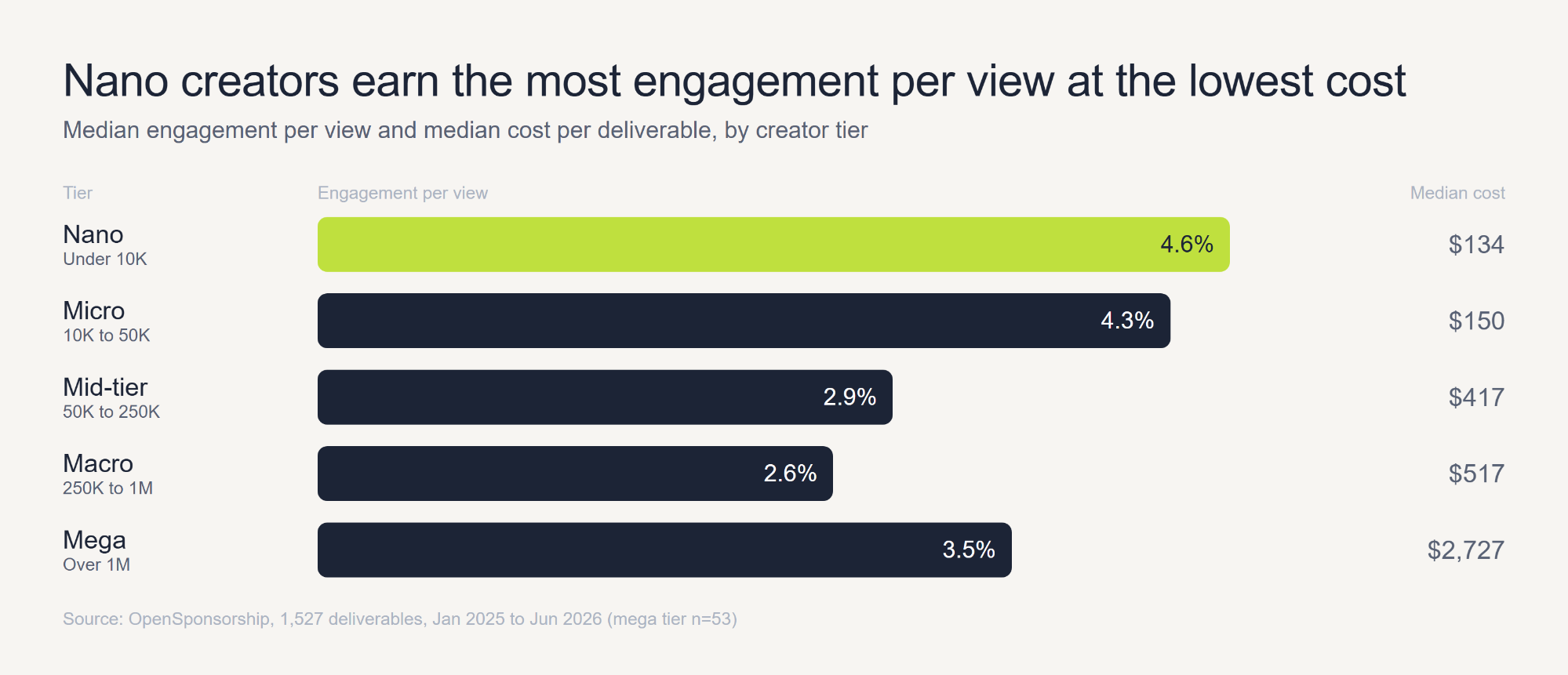
The data below gives useful context on cost and engagement by creator tier. We paired those benchmarks with the briefing approach we typically use for partnerships at each level.
OpenSponsorship analyzed 1,527 deliverables from January 2025 to June 2026 and published median costs and engagement by tier. Tier bands vary by source, so the table uses the bands in that study.
Tier | Follower Band | Median Cost per Deliverable | Engagement per View | Briefing Approach (inBeat view) |
|---|---|---|---|---|
Nano | Under 10K | $134 | 4.6% | Keep creative direction light; focus on outcome, must-haves and basic deliverables |
Micro | 10K to 50K | $150 | 4.3% | Add a small number of references while leaving hook and execution open |
Mid-tier | 50K to 250K | $417 | 2.9% | Formalize deliverables, timing and review responsibilities |
Macro | 250K to 1M | $517 | 2.6% | Align approval steps and paid-usage requirements before production |
Mega | Over 1M | $2,727 | 3.5% | Coordinate the same framework through the creator's management or agent |
The Typical Briefing Approach column reflects how we structure these partnerships in practice rather than a rule tied to follower count. The OpenSponsorship figures cover cost and engagement only.
The mega tier has the smallest sample in the study, with 53 deliverables, so treat its figures as directional, including its engagement rate, which is higher than the mid-tier and macro rates.
When a Tighter Creator Brief Is the Right Call
A tighter brief is the right call when the claims carry legal weight or the format needs exact words. Healthcare, finance and supplements require approved language, and a creator improvising there creates risk. Direct-response ads that depend on a tested hook sequence also benefit from a script, including hook formulas and the structure of a direct-response script.
Even then, the brief can separate the claims the creator must say word for word from the parts they can say freely. A practical split looks like this:
- Fixed wording: product claims, comparisons, dosage or pricing statements and required disclaimers.
- Creator wording: the hook, the story of how they found the product, the setting and the reaction.
Clear every fixed line with legal before the shoot, as in the review sequence below, so the creator knows which sentences are locked.
Pro tip: Our guide to UGC compliance in healthcare marketing covers a regulated example in detail.
How to Review Creator Content Without Rewriting It
Review should check the draft against the brief's must-haves, factual accuracy and legal requirements, and nothing else. When reviewers add preferences, the video drifts toward a brand production. Follow this sequence:
- Pre-clear claims before the shoot. Legal reviews the product claims and the disclosure wording in the brief, so it is not editing the finished video.
- Collect all feedback into one consolidated round per draft. One person gathers comments from every reviewer and sends a single list.
- Review against the musts only. Feedback that doesn't trace to a must-have, a factual error or a legal requirement is optional and goes to the creator as a suggestion.
- Answer within 24 to 48 hours. Slow review pushes creators to post later and delays the data.
- Name one sign-off owner. One person says yes. Everyone else advises.
- Cap the total at two rounds. Superfiliate's approval guidance suggests one or two rounds is reasonable when the brief is clear and treats unlimited revisions as a sign of a weak brief. That is practitioner opinion, and it matches what we see.
Feedback Type | Allowed? | Example |
|---|---|---|
Factual error | Yes | The product has two shades, not three |
Missing disclosure | Yes | The paid partnership label is not on the post |
Tone preference | No, suggest only | "Could this sound more upbeat?" |
Reordered hook | No, suggest only | "Open with the product shot" |
How Do Contracts, Usage Rights and Exclusivity Change an Influencer Brief?
Contract terms shape the content, so they belong in the conversation before the brief. The contract holds payment and rights, and the brief holds creative direction. Keep them as separate documents so a legal clause does not turn into a line the creator has to say.
Contract Term | What It Does to the Content | What to Change |
|---|---|---|
IP license and paid usage | Lets the brand run the post as an ad | Ask for a clean first three seconds and no baked-in captions that block ad placements |
Exclusivity clauses | Stops the creator posting for competitors for a set time | Name the competitor category in the contract so the creator doesn't self-censor on adjacent products |
Morality and brand reputation clauses | Lets the brand end the deal after reputational harm | Define the trigger in the contract and keep it out of the brief |
Approval-round clauses | Sets the number of revisions | Match the cap in the review process |
Usage rights and exclusivity carry a price. impact.com's creator-side guide reports that most influencers add 20% to 50% of the base rate for usage rights, and charge 20% to 100% for exclusivity. Those are one platform's averages, so treat them as a negotiating range.
Agree the term, the channels, the renewal terms and the price with the creator before filming starts, so nothing gets renegotiated after the content performs.
Paid usage changes the brief. When a brand runs a creator post as an ad, the creator's native style is much of what it is paying for. Meta's own data, reported by EMARKETER, shows partnership ads averaging 19% lower CPA and 13% higher CTR than standard ads.
A brief for a post that will be boosted should say so, because creators adjust how they open and close the video when they know it will run as an ad. The contract should state how long the brand can run the post and on which channels, so the creator can price and plan accordingly.
How to Disclose a Paid Partnership Without an Ad Look
A disclosure has to be clear. Disclosure rules in both the US and EU focus on making the commercial relationship clear to viewers. That does not require the content itself to look like a traditional ad. This section is a summary and not legal advice.
FTC Endorsement Guides: What the Brief Must Cover
The Federal Trade Commission's Endorsement Guides, codified at 16 CFR Part 255, set three rules that affect briefs:
- Endorsements must reflect the honest opinion or experience of the endorser.
- Advertisers can be liable for misleading statements by the creator.
- Advertisers are expected to give guidance, monitor and correct non-compliance.
The FTC's staff FAQ is explicit that pre-written posts are acceptable as long as the influencer is truthful.
That has a practical consequence. A script that has the creator claim three months of use they did not have is a compliance problem, and a brief that lists facts and asks for real experience is not. The same FAQ says a disclosure that appears only in a TikTok description is very unlikely to be clear and conspicuous.
EU Consumer Protection Directives: What the Brief Must Cover
In the EU, the Unfair Commercial Practices Directive 2005/29/EC prohibits hidden advertising. Annex I, point 11 bans paid editorial content that does not make the payment clear, and Article 7(2) treats failing to identify commercial intent as a misleading omission.
Whether the creator counts as a trader is decided case by case. In Kamenova (C-105/17), the Court of Justice held in 2018 that trader status depends on a set of non-exclusive criteria, such as regularity, profit intent and remuneration. The case involved a marketplace seller, and it is still the usual reference point for influencers.
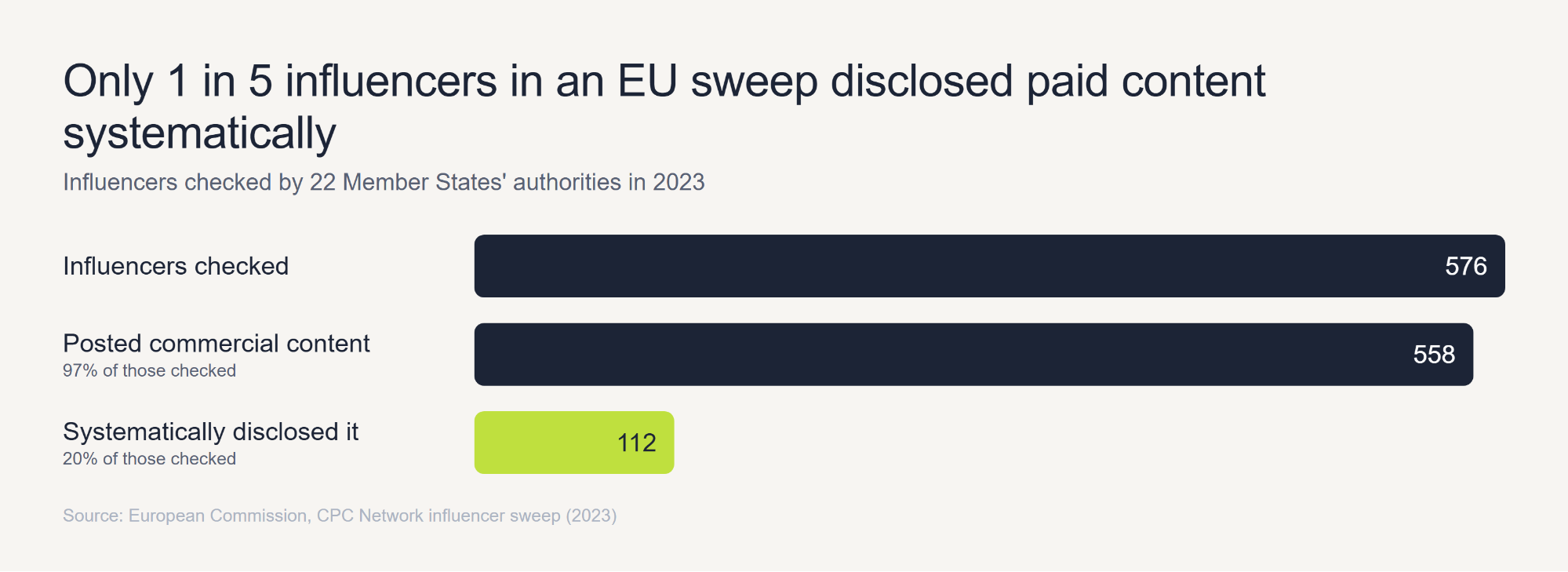
Enforcement data shows why briefs should spell disclosure out. In a 2023 sweep of 576 influencers by authorities in 22 Member States, 97% posted commercial content and only 20% systematically disclosed it. Also, 38% did not use platform labels such as the paid partnership toggle.
Policy is moving. The Council of the European Union, which is separate from the European Council, adopted conclusions on supporting influencers as content creators in May 2024.
As of October 2026, the Digital Fairness Act is still under preparation, with the Commission planning a proposal for Q4 2026. The proposal is expected to address practices including misleading influencer marketing, so EU campaign teams should verify the final rules once published.
Where Should the Disclosure Go on Each Platform?
Disclosure should be clear and easy to notice, while the exact implementation depends on the platform and campaign format. The setups below are practical defaults rather than platform-specific statements of FTC law.
Platform | Recommended Placement | Platform Label |
|---|---|---|
TikTok | Spoken mention plus on-screen text, since a description-only disclosure is unlikely to be clear | Branded content toggle |
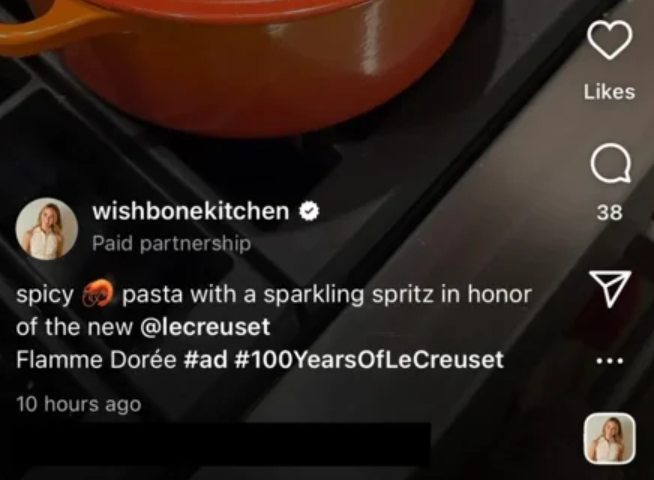
Instagram Reels | Clear disclosure early in the caption and, for video, a spoken or on-screen disclosure | Paid partnership label |
YouTube | Clear disclosure early in the video, supported by a description disclosure | Paid promotion setting |
How to Measure Native Feel Against Creator Baselines
Native feel can be measured by comparing a branded post with the same creator's normal posts. The creator's own average is the baseline, and the sponsored post should land near it. Platforms and tools differ in what they show, so choose the signals that exist on yours.
Signal | How to Read It |
|---|---|
Views per follower against the creator's own baseline | A branded post far below the creator's usual range is a signal worth investigating, especially when retention and engagement also fall |
Saves and shares | These are harder to earn than likes and usually track usefulness |
Comment sentiment about ad-feel | Comments such as "is this sponsored?" or "you sound different" point to a script |
Dark-post test of open brief against scripted brief | Same creator and audience reduce some of the noise, making this a useful way to test whether a more open brief improves performance |
The last row is the cleanest test. We don't set fixed thresholds here, because baselines differ by creator and category.
The goal changes the reading. For brand awareness and community building, saves, shares and comment quality matter more than click-through. For direct response, the scripted and open versions should be compared on cost per acquisition.
Brief Better Creator Content With inBeat
inBeat brings influencer marketing and UGC under one roof, managing everything from creator sourcing and briefs to usage rights and paid testing.
If your current creator content reads like an ad, book a strategy call and we will walk through your brief, review process and contract terms.
FAQs
Does native content still work when the creator must disclose the partnership?
Yes. The BBB 2025 index found that 70% of consumers say a brand partnership does not make an influencer less trustworthy, and 57% say adding #ad does not make one more trustworthy. Disclosure neither helps nor hurts much, and undisclosed deals that get discovered do damage.
How many revision rounds are reasonable on a creator video?
One or two, written into the contract so a third round needs a new agreement. Unlimited revisions signal a weak brief, so fix the briefing before adding review cycles.
How should the brief change when the brand will whitelist the post as a paid ad?
Say so in the brief, and put the term, channels and fee in the contract. The contract section above lists what to adjust.
Can a brand require specific claims without breaking the Endorsement Guides?
Yes, if the claims are truthful and substantiated and the creator's statements reflect honest experience. The FTC's FAQ allows pre-written posts when the influencer is truthful, and advertisers stay liable for misleading statements.
How do EU rules change the brief for a European campaign?
The brief should state the required disclosure approach, specify where the disclosure appears, and include the platform's commercial-content label where the platform or applicable rules require it. The sweep in the section above shows why: the brief should not assume the creator will add the label.