.svg)
.svg)
.svg)
.svg)


.svg)



%20(1).png)

UGC can make healthcare marketing feel human, but every testimonial, review, creator post, and transformation story carries compliance questions. That applies across hospitals and clinical providers, as well as supplement brands, fitness companies, and mindfulness or mental wellness apps.
For marketers, the challenge today is building trust without compromising patient confidentiality, overstating health outcomes, or publishing content outside the rules. Depending on the brand, that can mean HIPAA, FTC endorsement requirements, FDA claim restrictions, privacy laws, or a mix of them.
The same scrutiny applies to patient testimonials, consumer reviews, supplement and fitness UGC, wellness app stories, and paid social campaigns.
Working with a specialized UGC agency can help brands navigate these requirements while still producing content that converts.
To help you out with this, we'll break down the compliance frameworks, approval workflows, technology, and examples. We'll also give you checklists you can use to create authentic, compliant campaigns and support long-term growth.
P.S. If you want to learn more, check out our healthcare marketing guide.
TL;DR: UGC Compliance Healthcare
- UGC builds trust, but healthcare marketers need clear controls around consent, privacy, claims, disclosures, and reuse rights.
- HIPAA applies to covered entities and business associates. Most supplement, fitness, and wellness-app brands follow other compliance frameworks.
- In 2026, 84.8% of social media users reported sharing health information online.
- Tebra found that 79% of patients read reviews before choosing a provider, which shows how strongly UGC influences healthcare decisions.
What Counts as User-Generated Content (UGC) in Healthcare?
Healthcare UGC is any content created by patients, caregivers, professionals, customers, or app users that reflects a real health, treatment, product, or wellness experience. It can be clinical or consumer-facing.
UGC in Healthcare Marketing
UGC in healthcare marketing includes content people create from their own experiences with a provider, treatment, product, fitness program, or wellness app.
In clinical settings, that may come from patients, caregivers, or health care professionals sharing stories, education, or feedback. Consumer wellness brands see similar behavior from customers and app users who document routines, results, and product experiences.
Health-related sharing is already widespread and persuasive. A 2026 JAMA study of 7,278 U.S. adults found that, among social media users, 84.8% shared personal or general health information and 21.6% had made a health-related decision based on social media content.
Pro tip: For more on disclosures, reviews, and material connections, see this guide to FTC guidelines for UGC.
Common Types of Healthcare UGC
Healthcare UGC falls into several categories, and each creates a different compliance burden:
- Patient stories and testimonials: Treatment experiences, recovery stories, photos, or videos. These carry the highest privacy risk when a HIPAA-covered provider is involved.
- Reviews: Feedback on clinics, supplements, apps, or fitness services. Review these for privacy, content accuracy, and unsupported claims.
- Influencer content: Creator demos, routines, or educational posts. These may need clear disclosure language and health-claim review.
- Employee advocacy: Staff or clinician posts can support medical education, with approved messaging and privacy controls.
- Supplement/product reviews: These can create FTC or FDA risk when creators make unsupported efficacy or disease claims.
- Fitness transformation UGC: Before-and-after content may imply expected results, so marketers should scrutinize the claim.
- Wellness app testimonials: These can involve sensitive health information and claims about outcomes.
For example, @jessicawhitaker’s TMS video pairs a personal mental health story with detailed treatment language, a clinic reference, and device information:
Also, Sahar Dahi describes cycle-based fitness and nutrition benefits in a women's health app testimonial while disclosing a brand partnership:
WARNING: Clinical patient content can trigger HIPAA concerns for covered entities. Supplement, fitness, and wellness UGC more often raises substantiation, endorsement, and consumer-privacy issues.
Why Do Healthcare Marketers Want UGC Despite Compliance Risks?
Healthcare marketers use UGC because authentic experiences build trust, influence decisions, and help patients and customers feel more confident choosing a brand.
UGC Builds Trust and Social Proof
UGC gives healthcare and wellness brands something polished brand copy usually struggles to create on its own. And that's believable social proof from real people that matters at the point of choice.
In fact, Tebra’s 2025 survey of almost 4,000 patients found that 79% read reviews before choosing a provider, 69% consider positive reviews very or extremely important, and 53% will skip providers with fewer than four stars.
The same trust dynamic extends to supplements, fitness programs, and wellness apps, where creator experiences can shape purchase decisions before a customer reaches the brand site.
Basically, you build stronger trust-building cycles that improve patient or customer acquisition.
SEO and Digital Marketing Benefits
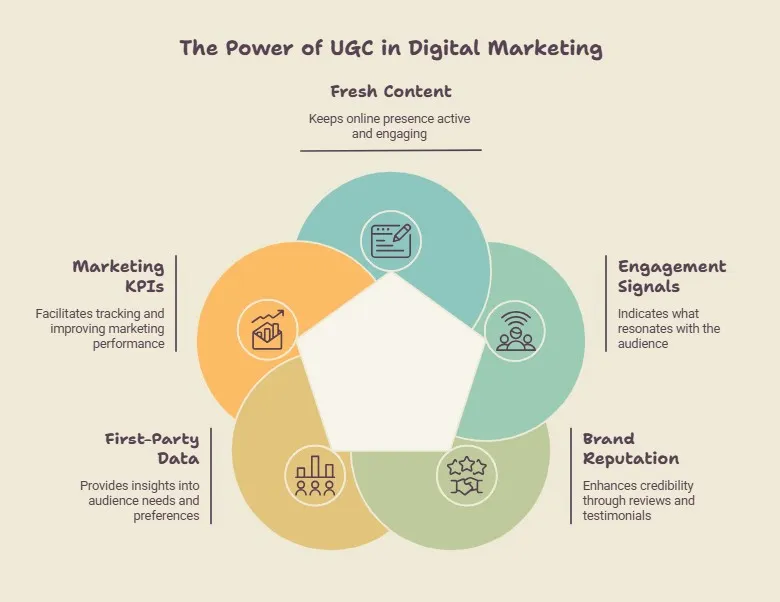
UGC can also support measurable digital growth when teams collect, publish, and analyze it consistently. Here's what we mean by that:
- Fresh content keeps product pages, landing pages, social feeds, and local profiles active. That gives audiences more current experiences to evaluate.
- Engagement signals such as saves, shares, comments, video completion, and click-through rate show which stories and formats resonate.
- Brand reputation improves when credible reviews and testimonials reinforce compliant messaging across the customer journey.
- First-party data from submissions, surveys, creator campaigns, and owned communities can reveal audience needs, objections, and content preferences.
- Marketing KPIs become easier to connect to UGC by tracking assisted conversions, booked appointments, leads, app installs, CAC, engagement rate, and revenue. These insights can guide creative decisions and support long‑term growth.
Why Healthcare UGC Requires a Different Compliance Strategy
Healthcare UGC needs a different compliance strategy because privacy, regulatory, and operational requirements change depending on the brand and content.
Patient Privacy and Protected Health Information
Under HIPAA, protected health information (PHI) is individually identifiable health information held or transmitted by a covered entity or business associate, whether electronic, paper, or oral. It can connect someone’s identity with their condition, treatment, or payment information.
For marketers, a patient posting publicly does not automatically give a provider permission to reuse that story. Once a HIPAA-covered organization republishes identifiable details, it creates its own disclosure and may need valid written authorization.
For example, Complete P.T. settled with HHS after publishing patient testimonials with full names and full-face photos on its website without valid HIPAA authorizations. The physical therapy provider paid $25,000 and adopted a corrective action plan.
Pro tip: Online replies can create the same risk.
In 2022, New Vision Dental settled with HHS after disclosing PHI while responding to patient reviews. Hence, careful patient communication and marketing review are extremely important.
Healthcare Marketing Versus Patient Care
Healthcare marketing and patient care come with different consent expectations. A patient may agree to sharing their medical history to receive better treatment without authorizing a provider to turn that information into marketing content.
For HIPAA-covered teams, HHS generally requires valid written authorization before PHI is used or disclosed for marketing, subject to limited exceptions. The authorization should clearly describe what information can be used, who can use it, the purpose, and when permission expires.
Marketing teams need a documented handoff before a testimonial, image, video, or story moves into a campaign. That means:
- Confirming consent scope
- Checking assets for identifiers
- Coordinating with privacy or legal teams
- Controlling where approved content appears
The same discipline helps agencies, creators, and social media influencers stay within the approved use.
Why Does Healthcare UGC Face Higher Regulatory Scrutiny?
Healthcare UGC faces higher regulatory scrutiny because it can influence health decisions while exposing sensitive information or making claims regulators expect brands to support.
Clinical providers can face financial settlements, corrective action plans, and enforcement records. In 2025, HHS found that Cadia Healthcare had published unauthorized “success stories” involving PHI from 150 patients. The company paid $182,000 and agreed to two years of corrective oversight.
Note: Consumer wellness brands face different regulatory mechanisms.
In 2025, FDA warned PureRawz after reviewing social posts and testimonials describing mental-health effects. The company treated those claims as evidence that products were marketed for drug-related uses.
What if you publish healthcare UGC without approval and get caught?
- Best case scenario: These actions can force teams to revisit claims, creator scripts, testimonials, and publishing workflows.
- Worst case scenario: They can damage trust once customers see that a brand mishandled sensitive information or health claims.
Regulations Your Healthcare Marketing Team Must Understand
Healthcare marketing teams must deal with HIPAA, FTC, FDA, and privacy rules that vary by brand type, content, data, and campaign. Let's go over that in a little more detail.
HIPAA and the HIPAA Privacy Rule
HIPAA matters when UGC marketing uses protected health information held by a covered entity or business associate. The Privacy Rule generally requires valid written authorization before PHI is used or disclosed for marketing, with limited exceptions. The authorization should identify:
- The information
- Permitted use
- Recipients
- Expiration
HIPAA applies to health plans, clearinghouses, certain healthcare providers, and business associates handling PHI for them. Most supplement, fitness, and wellness-app brands fall outside those categories unless their role makes them a covered entity or business associate.
If a provider shares PHI with a marketing vendor performing covered functions, a written business associate agreement may be required. OCR enforcement shows the risk. In 2018, three Boston hospitals paid settlements totaling $999,000 after allowing television film crews into treatment areas without prior patient authorization.
Compliance Obligations for Non-HIPAA-Covered Health & Wellness Brands
Being outside HIPAA does not remove compliance exposure for supplement, fitness, or mindfulness-app marketers. Their UGC typically falls under consumer-protection, product-claim, and health-data rules instead.
The FTC expects advertisers to substantiate express and implied health claims before publishing them. A customer testimonial saying a supplement fixed insomnia, for example, is not adequate evidence by itself. Health claims generally require competent and reliable scientific evidence.
For supplements, FDA rules distinguish:
- Structure/function claims, such as supporting normal body functions, from:
- Disease claims saying a product diagnoses, treats, cures, mitigates, or prevents disease. Those claims can place a product under drug requirements.
Privacy exposure also extends beyond HIPAA. Washington’s My Health My Data Act regulates certain consumer health data collected by apps and other businesses, with requirements around consent, privacy policies, deletion, sale authorization, and geofencing.
FTC Endorsement Requirements
The FTC’s endorsement rules apply when testimonials or creator content become advertising across clinics, supplements, fitness programs, and wellness apps. Endorsements must be truthful, and any material connection that could affect how people evaluate a recommendation should be disclosed clearly and conspicuously.
A material connection can include payment, free products or services, employment, family relationships, or other benefits. So, a free treatment, gifted supplement, affiliate commission, or paid app partnership may require disclosure.
The FTC’s Endorsement Guides also explain that creators should speak from genuine experience and avoid claims the advertiser cannot substantiate.
Marketing teams should:
- Define disclosure language in the brief.
- Review placement before publishing.
- Monitor live content.
An incentive disclosure hidden after “more,” buried among hashtags, or separated from the endorsement may be easy to miss and can create compliance problems.
FDA Regulations for Healthcare Content
FDA requirements become especially important when UGC promotes prescription products, medical devices, or dietary supplements. Promotional claims for regulated medical products must follow applicable requirements and avoid omitting relevant risk information.
For devices, marketers should review intended-use claims, warnings, precautions, and whether creator language goes beyond the product’s cleared or approved use. FDA guidance also addresses benefit and risk information on social platforms.
Supplement marketers face other rules. DSHEA permits qualifying structure/function claims about supporting normal body structure or function. Meanwhile, disease claims describe diagnosing, treating, curing, mitigating, or preventing disease, so a creator saying a supplement “cures depression” can therefore create FDA risk.
At inBeat, we make sure that all healthcare UGC passes claims and regulatory review before publication. This is especially true when scripts, edits, reposting, or native advertising turn creator content into a brand-controlled promotional asset.
That’s how we can produce compliant, persuasive content for brands like Oura Health:
State Privacy Laws and International Frameworks
State privacy laws can reach health and wellness brands outside HIPAA. Washington’s My Health My Data Act, for example, protects consumer health data beyond HIPAA and can apply to businesses serving Washington consumers. It requires:
- Consumer health data privacy policy
- Consent for certain collection and sharing
- Valid authorization for sales
- Deletion rights
- Security practices
- Geofencing restrictions
For marketers, this can affect how wellness-app activity, symptom information, location signals, quiz responses, and health-related first-party data move into audience building, personalization, or campaign measurement.
International campaigns add another layer. Under the GDPR, health information is a special category of personal data with heightened processing conditions. Teams need an appropriate legal basis, transparent notices, and processes for user rights.
For example, when EU personal data moves outside the EEA, transfers may require an adequacy decision or safeguards such as Standard Contractual Clauses. So, we recommend mapping those data flows before launching cross-border UGC campaigns.
When Does Healthcare UGC Require Patient Authorization?
Healthcare UGC requires patient authorization when HIPAA-covered entities use PHI for marketing, while other brands need appropriate content and privacy consent.
Content That Usually Requires Authorization
Before repurposing UGC, marketers should confirm exactly what the person agreed to share and where the brand can use it. For HIPAA-covered organizations, marketing uses of identifiable PHI generally require a valid written HIPAA authorization.
Consumer wellness brands may instead need a release, content licensing permission, or consent under applicable privacy rules.
Here are the common examples:
- Patient testimonials that identify someone and discuss their diagnosis, treatment, recovery, or provider experience.
- Patient or customer stories submitted for websites, landing pages, email campaigns, or advertising.
- Photos and images showing identifiable patients, customers, app users, or health-related details.
- Videos featuring treatment experiences, transformations, product results, or personal health information.
- App-user testimonials that reveal symptoms, conditions, reproductive information, mental health experiences, or other sensitive data.
- Creator submissions a brand plans to edit, repost, advertise, or distribute beyond the original submission terms.
We recommend keeping the signed authorization or release with the asset so teams can verify approved uses before publication.
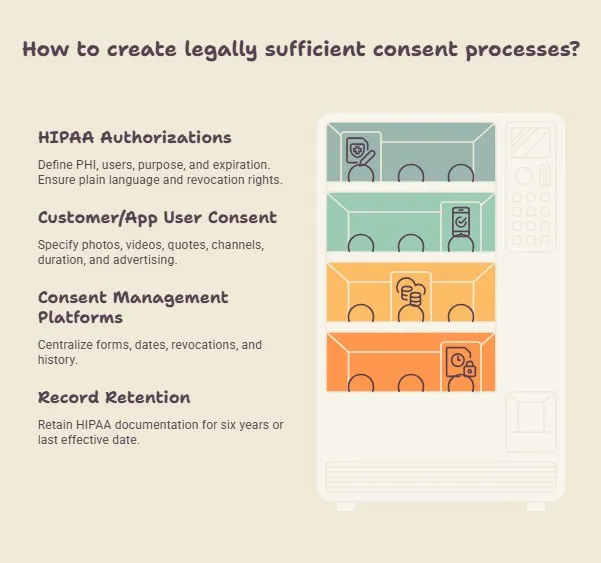
How to Create Legally Sufficient Consent Processes
A strong consent process tells people exactly what they are agreeing to before their story becomes marketing material.
For HIPAA authorizations:
- Define the PHI being used, who may disclose and receive it, the marketing purpose, and an expiration date or event.
- Explain the individual’s right to revoke authorization in writing and be written in plain language.
- Apply the same operational discipline for customers and wellness-app users. Define which photos, videos, quotes, and channels are covered, how long permission lasts, and whether paid advertising or editing is included.
Consent-management platforms can centralize signed forms, expiration dates, revocations, asset permissions, and approval history. That gives an internal team or UGC production agency a clear record before an asset moves into production.
For HIPAA-covered entities, required authorization documentation must be retained for six years from creation or when it was last effective, whichever is later.
Patient Reviews and Testimonials: What Healthcare Marketers Can and Cannot Do
Healthcare marketers can use reviews and testimonials, but providers and consumer wellness brands need clear rules for responding, repurposing, and incentivizing them.
How to Manage Online Reviews Without HIPAA Violations
For HIPAA-covered providers, the safest review response avoids confirming that the reviewer is a patient or revealing anything about their care. Remember that a patient may mention their own diagnosis, appointment, or treatment publicly, yet that does not authorize the provider to disclose PHI in return.
- Stay general to either praise or criticism. For example, “Thank you for sharing your feedback. Please contact our office directly if you’d like to discuss your experience.”
- Avoid replies such as “We treated you twice for anxiety” or references to insurance, medications, appointments, or outcomes.
Here are some examples of the consequences of managing healthcare reviews poorly:
- New Vision Dental paid $23,000 after responses to Yelp reviews disclosed names, visit details, and insurance information.
- Manasa Health Center later paid $30,000 after disclosing PHI while responding to negative Google reviews.
How to Safely Repurpose Patient Testimonials
Before republishing a patient story, confirm that the authorization covers the information, purpose, audience, and channels you plan to use.
Customers and wellness-app users need to:
- Document permission to reuse their quote, image, or video and confirm any editing, paid-media, and content licensing rights.
- Keep the release connected to the final asset so reviewers can verify what was approved.
- Edit the UGC material carefully. The FTC says endorsements must reflect honest experiences and cannot make claims the advertiser could not substantiate. Its guidance also warns against editing or presenting reviews in ways that distort consumer opinion.
Before launch, we recommend reviewing the:
- Final testimonial for identifiers
- Sensitive health data
- Changed context
- Unsupported outcome claims
- Any required disclosures
Can Healthcare Organizations Incentivize Reviews?
Healthcare organizations can sometimes incentivize honest reviews, provided the reward is not conditioned on positive sentiment and required disclosures are handled transparently.
In fact, the FTC’s Consumer Reviews and Testimonials Rule prohibits offering compensation or incentives on the condition that a consumer review expresses a particular positive or negative sentiment. Teams should also avoid suppressing criticism, selectively soliciting happy customers, or creating fake reviews.
Of course, individual platforms can impose stricter rules.
Pro tip: Healthcare providers need to build privacy review into the process as well, especially when feedback could reveal patient status or treatment details.
Social Media and Healthcare UGC Compliance
Social media makes healthcare UGC a double-edged sword because public posts can expose sensitive information, unsupported claims, and unclear reuse rights.
Reposting Patient Social Media Content
A public Instagram or TikTok post does not automatically give a brand permission to reuse it. Copyright generally stays with the creator, so marketers should obtain permission or an appropriate license before reposting content commercially.
HIPAA-covered providers have another layer to consider. If republishing a post would use or disclose identifiable PHI for marketing, written authorization may be required. A hashtag, tag, or mention should therefore serve as a discovery mechanism rather than proof of consent.
For example, the Ottawa Hospital story uses #TheNewCampus alongside a personal healthcare experience.
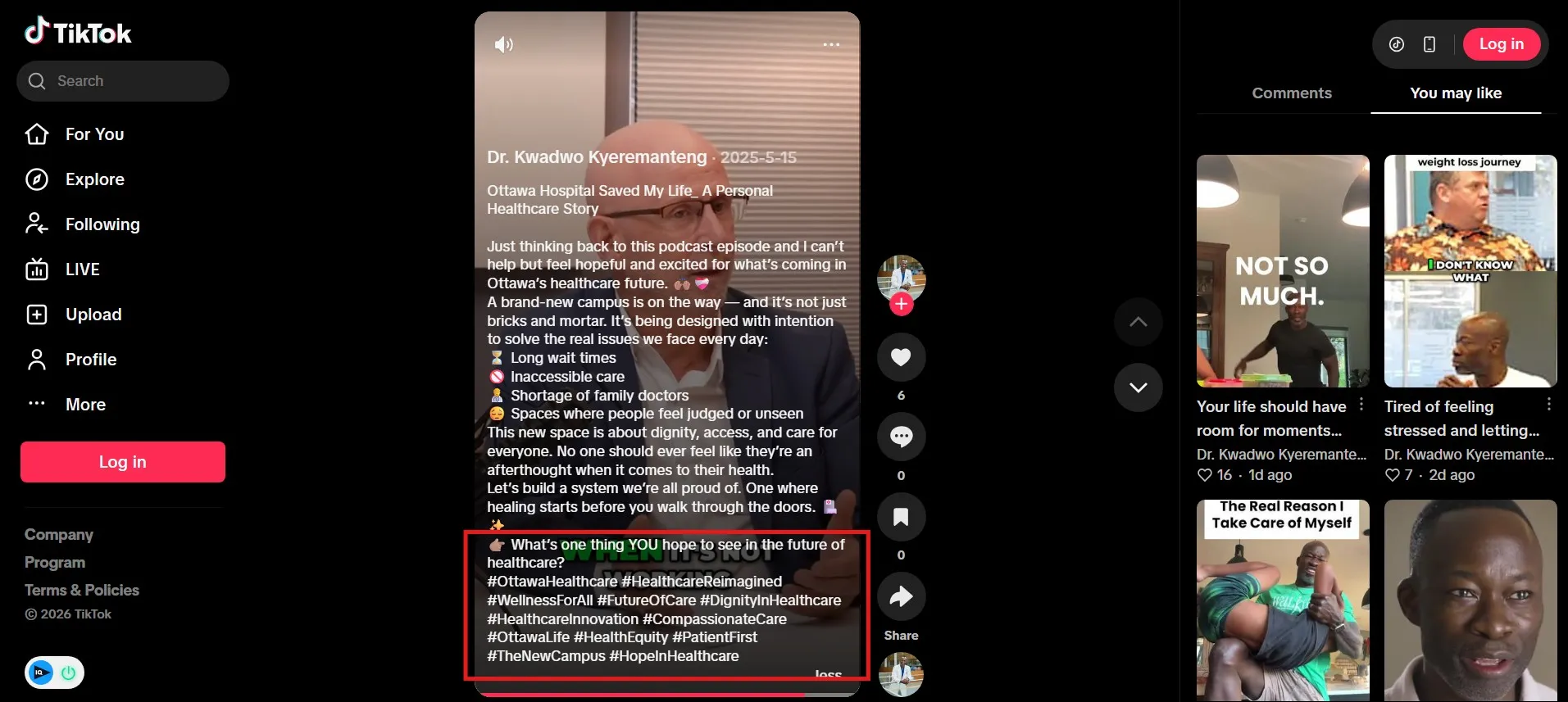
ALT: TikTok post sharing an Ottawa Hospital personal healthcare story.
Meanwhile, Factor Supplements invites customers to “tag us in your taste test.” Both show how hashtags and participation prompts can surface useful UGC.
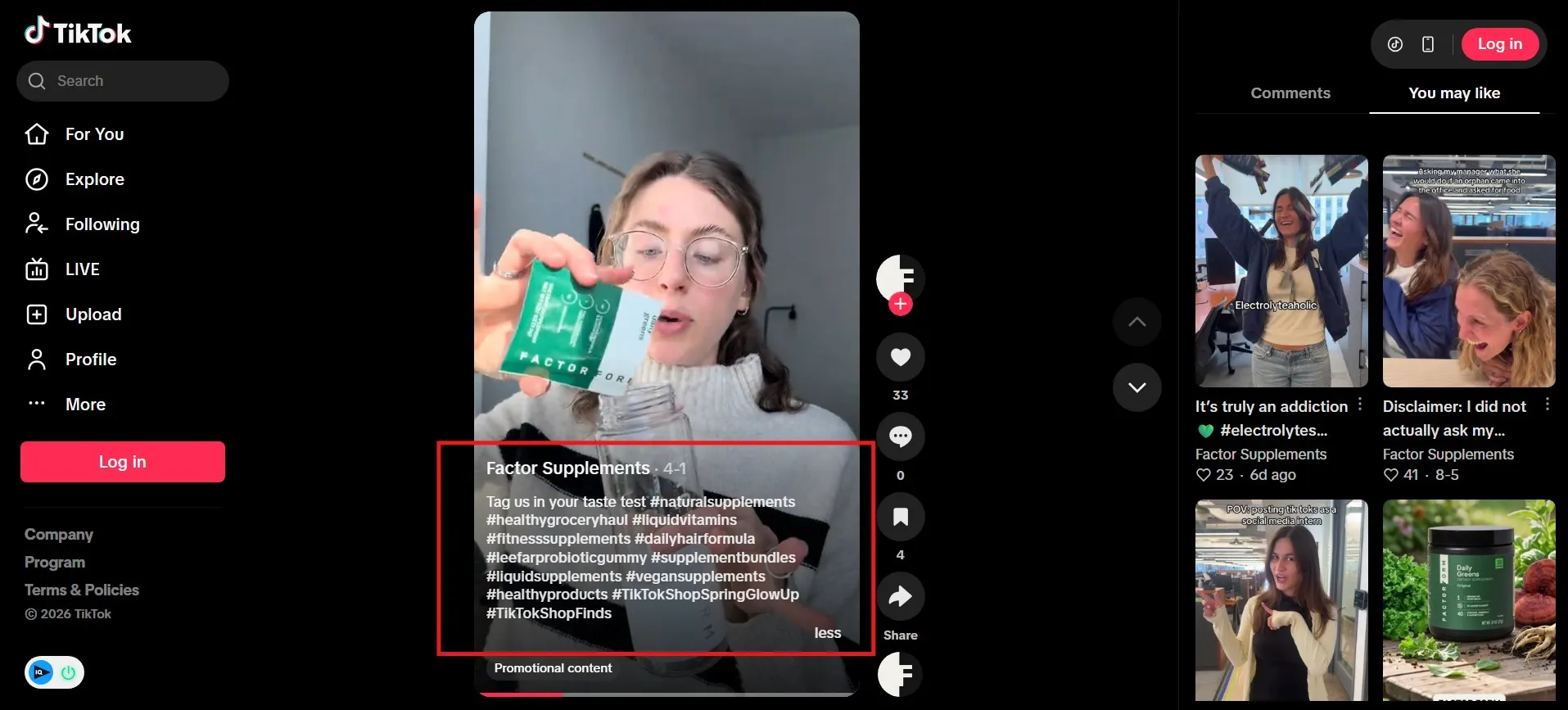
Before reposting, teams should confirm ownership, permitted channels, editing rights, paid-use rights, and privacy consent. This matters even when collecting public health stories or clinician explainers.
Content Moderation and Community Management
Healthcare UGC moderation should happen before publication and continue after the content goes live. So, we advise you to give social and community teams a clear policy for what they can approve, hide, escalate, or remove.
- For provider accounts, moderators should flag names, diagnoses, treatment details, images, or comments that could expose PHI.
- Supplement and fitness teams should focus heavily on efficacy claims. The FTC requires health-related advertising claims to be truthful, non-misleading, and appropriately substantiated, including claims communicated through testimonials and influencers.
For example, Factor Supplements’ creator mentions immune, energy, gut-health, and stress-relief benefits. A brand considering amplification should verify support for those claims first.
So, make sure to build escalation paths for misinformation, unsupported outcomes, adverse-event mentions, privacy issues, and questionable public statements. Your internal policy should also name who makes the final call across marketing, legal, compliance, clinical, or claims teams.
How to Measure Social Media UGC Performance in Healthcare
Measure healthcare UGC against the outcome each campaign is supposed to create rather than treating likes as the finish line.
- Start with platform metrics such as reach, impressions, video completion rate, saves, shares, comments, engagement rate, and click-through rate.
- Connect those signals to business KPIs including appointment requests, qualified leads, app installs, purchases, conversion rate, CAC, and revenue.
- Use GA4 to track traffic and conversions from social campaigns using UTM-tagged links, campaign reports, events, and key conversion actions.
- Supplement that with native Meta, TikTok, Instagram, or creator-platform analytics to understand which content and creators actually drive action.
Pro tip: If you want to learn more, inBeat’s marketing measurement guide breaks metrics into activity, engagement, performance, and business-impact levels.
Influencer Marketing in Healthcare
Compliant healthcare influencer marketing pairs the right creators with clear review processes across clinical, supplement, fitness, and wellness app campaigns.
Working With Healthcare Influencers
Start healthcare influencer selection with credibility, audience fit, and the type of claims a creator is likely to make.
- Provider brands may work with healthcare professionals or patient advocates who can explain care experiences responsibly.
- Supplement and fitness brands usually need creators who understand product use without drifting into unsupported treatment claims.
- Wellness apps benefit from creators who can discuss routines and personal experiences carefully.
So, make sure to review a creator’s past posts before contracting them. Look for exaggerated health promises, problematic sponsorships, privacy issues, and whether their audience matches the people you actually want to reach.
Disclosures matter too. The FTC says creators should clearly disclose material connections such as payment, free products, discounted services, or other benefits. As such:
- Disclosures should appear with the endorsement and be easy to notice.
- Creators also cannot make health claims that require proof the advertiser does not have.
Healthcare Influencer Compliance Workflow
A strong workflow catches compliance issues before the creator posts:
- Start with a brief that defines approved talking points, restricted claims, disclosure language, visual requirements, and content rights.
- Review the draft against the rules that apply to that specific brand.
- Make sure you have clinical and compliance sign-off for provider campaigns when sharing treatments, outcomes, or patient experiences.
- Supplement and fitness campaigns should route efficacy statements through legal or claims review.
- Wellness-app teams may also need privacy review when content touches sensitive health data.
Apart from that, FTC review belongs in every sponsored campaign. Teams should confirm that the creator’s disclosure is clear, the endorsement reflects a genuine experience, and the final content does not introduce unsupported claims.
inBeat’s healthcare creator work shows how this can look in practice.
For Mindbloom, inBeat ran a micro-influencer campaign with 15+ creators who had gone through the treatment, using authentic testimonials to build credibility. The campaign supported a $1M+ whitelisting and dark-posting push, reduced CAC by 25%, and increased referral sign-ups by 40%.
And for Nurse.com, inBeat built an influencer-led creative strategy to reach nurses and the broader healthcare community. The campaign generated 200K+ new website clicks/users, 5M+ relevant impressions, and a 4%+ CTR.
Pro tip: You can also see more examples in inBeat’s health brand social media guide.
Building a Scalable UGC Compliance Workflow
A scalable UGC compliance workflow is a repeatable system of checkpoints that lets provider and consumer wellness teams review and publish user-generated content without creating legal or regulatory risk. It's built around four steps:
- Create internal policies
- Collect consent and review content
- Complete compliance sign-off
- Monitor, archive, and implement takedown protocols
Here's how each one works.
Step 1: Create Internal Policies
Start with a written UGC policy that tells marketing, creators, agencies, legal, and compliance teams what can move forward and who approves it.
- Hospital networks should align UGC rules with existing privacy, social media, and patient-communication guidelines — defining how PHI is handled, when authorization is required, and who escalates questionable content. HIPAA also requires covered entities to maintain relevant privacy policies and procedures in written or electronic form.
- Supplement, fitness, and wellness-app brands need equivalent guardrails around health claims, endorsements, customer data, and creator disclosures. FTC guidance makes advertisers responsible for ensuring objective health claims have adequate substantiation before publication.
Step 2: Collect Consent and Review Content
Give creators, patients, and customers one defined submission process rather than collecting assets across inboxes, DMs, and spreadsheets. Each submission should capture:
- The original asset
- Creator identity and date
- Intended channels
- Paid-use permissions
- Editing rights
- Consent status
HIPAA-covered organizations should verify signed authorization before using PHI for marketing when authorization is required.
Once collected, connect these records to your asset-management system. Tag each file with its approval status, permitted uses, expiration date, and any restrictions — so social, paid media, and creative teams can confirm an asset is cleared before republishing or adapting it.
Step 3: Complete Compliance Sign-Off
Once an asset passes intake, route it through the reviewers that match its risk level:
- Provider content discussing diagnoses, treatments, outcomes, or patient experiences may need clinical and privacy or compliance review. If an external vendor accesses PHI while performing covered functions, confirm the appropriate business associate agreement and permitted uses.
- Supplement and fitness content should go through legal or claims review when creators discuss efficacy, safety, or health outcomes. FTC guidance requires adequate substantiation for objective health claims, while FDA rules distinguish permitted supplement structure/function claims from disease claims.
Workflow automation can keep this from becoming a bottleneck: predefined reviewers, status fields, deadline reminders, risk tiers, and pre-approved claim libraries let straightforward assets move quickly while higher-risk content gets deeper review.
Step 4: Monitor, Archive, and Implement Takedown Protocols
Compliance continues after publishing. Monitor live creator posts, captions, comments, and paid variations for edits, new claims, accidental disclosures, or missing sponsorship disclosures.
Archive each final published asset alongside:
- Its consent or authorization
- Approval history
- Claim support
- Creator agreement
- Disclosure version
- Publication dates
Keep an audit log showing who reviewed the asset, what changed, when it was approved, and whether permission later expired or was revoked. HIPAA-covered organizations must retain documentation required under the Privacy Rule for six years from its creation or the date it was last in effect, whichever is later. Other brands should set retention schedules around the laws, contracts, and internal policies that apply to them.
Use compliance controls such as access permissions, expiration alerts, periodic reviews, and clear escalation ownership.
Expert tip #1: Build a rapid takedown process before you need it. If a questionable asset goes live, pause amplification, remove or disable it where possible, preserve evidence, and send it immediately for compliance review.
Expert tip #2: If the incident may involve PHI or another regulated issue, report it promptly to the designated privacy or compliance lead. Log the discovery time, affected channels, removal actions, involved data or claims, and subsequent remediation so the team has a complete incident record.
Use Technology That Reduces Healthcare UGC Compliance Risk
Technology helps provider and consumer wellness teams manage consent, approvals, assets, analytics, and documentation without slowing down UGC production.
Consent Management Platforms
Consent platforms give marketing teams one place to collect, store, and track patient, customer, or app-user permissions. Each authorization can be connected to the relevant testimonial, image, or video, along with approved channels, expiration dates, and revocation status.
For HIPAA-covered providers, this makes authorization tracking much easier during campaign reviews. Consumer wellness brands can use the same system for releases and content-use permissions. Centralized records also create a clearer documentation trail when legal, compliance, or internal teams need to verify how an asset was approved.
Marketing Automation and Asset Management
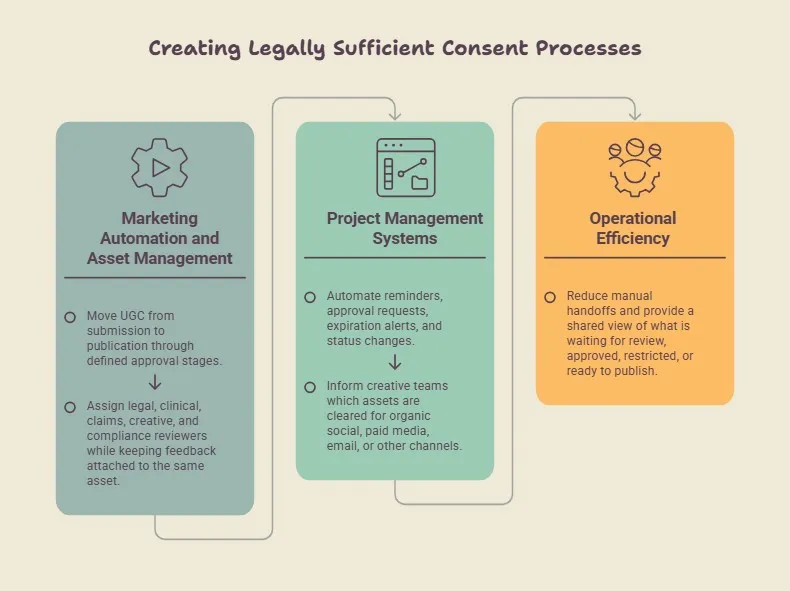
Workflow and asset-management tools help move UGC from submission to publication through defined approval stages. Marketing teams can assign legal, clinical, claims, creative, and compliance reviewers while keeping feedback attached to the same asset.
Project management systems can also automate reminders, approval requests, expiration alerts, and status changes. Creative teams then know which assets are cleared for organic social, paid media, email, or other channels.
This reduces manual handoffs and gives everyone a shared view of what is waiting for review, approved, restricted, or ready to publish.
Analytics and Data Platforms
Analytics tools help teams understand which compliant UGC actually drives results. GA4 can connect campaign traffic with conversions, while customer data platforms can bring together consented first-party data from websites, apps, CRM systems, and campaign interactions.
That data can reveal which creators, testimonials, and formats influence appointments, purchases, installs, or leads.
Security still needs to guide the setup. Limit access to sensitive information, apply appropriate permissions, avoid sending unnecessary health data into marketing platforms, and make sure first-party data collection matches the privacy rules and consent choices that apply to your audience.
Common Compliance Mistakes and Enforcement Lessons
Real enforcement cases show how quickly healthcare and wellness UGC can create privacy, disclosure, and claims problems. Here are four mistakes marketers should learn from.
Using Patient Stories Without Proper Permission
Patient stories can create compliance problems when identifiable health details are shared without valid authorization. For example, Shasta Regional Medical Center paid $275,000 after senior leaders disclosed a patient’s condition, diagnosis, and treatment to media outlets without written authorization.
The case also required corrective actions across affiliated facilities. This shows how one privacy failure can create broader reputational and operational consequences.
Ignoring Influencer Disclosure Requirements
Sponsored healthcare and wellness content needs a material-connection disclosure that people can easily see and understand. The FTC advises placing disclosures with the endorsement itself and warns against hiding them behind “more” links or among unrelated hashtags.
The Amazon One Medical example from Tammin Sursok uses #ad alongside the sponsored message.
A Teladoc Health creator similarly uses #TeladocHealthPartner and #TeladocHealthAmbassador, which shows how brands can signal a commercial relationship directly in social content.
The consequences of weak disclosure can be substantial. In its Teami case, the FTC alleged that paid influencers promoted the wellness brand without adequate disclosures, usually placing them where users had to click “more.”
The settlement imposed a $15.2 million judgment, which was partially suspended after a $1 million payment based on the defendants’ financial condition.
Making Unsubstantiated Health Claims in Supplement or Fitness UGC
A customer or influencer cannot make an efficacy claim the brand itself could not substantiate. FTC rules apply to health claims communicated through testimonials and influencer marketing.
FDA rules add another layer. DSHEA allows qualifying structure/function claims, while disease-treatment claims can trigger drug requirements. In 2021, FDA cited a CuraLife social testimonial about controlling blood sugar and #beatingdiabetes as evidence of intended drug use for its supplement.
Failing to Moderate Healthcare Content
Unmoderated UGC can spread misinformation, expose PHI, or introduce unsupported health claims after publication. Marketing teams should monitor posts and comments, define what gets removed or escalated, and route privacy or efficacy concerns to the appropriate compliance, clinical, legal, or claims reviewer.
Practical UGC Compliance Checklist
Healthcare and wellness marketers can use this checklist to review UGC before, during, and after publication without adding unnecessary friction to campaigns.
Pre-Publication: Consent and Compliance Review
Before content goes live, confirm the asset is cleared for the exact way you plan to use it:
- Secure valid HIPAA authorization when a covered provider uses identifiable PHI for marketing.
- Use a standard release for supplement, fitness, and wellness-brand customers or creators.
- Match consent scope to the intended channel, including organic social, paid ads, email, or website use.
- Check the asset against internal policies and creator agreements.
- Route provider content through legal, clinical, or compliance review.
- Route supplement and fitness claims through legal or claims review.
During Publication: Moderation and Posting Protocols
Once the content is live, active monitoring helps catch problems before they spread:
- Confirm FTC disclosures are clearly visible on sponsored or incentivized content.
- Monitor comments and replies for misinformation, privacy issues, and new health claims.
- Check provider captions, images, and backgrounds for accidental PHI.
- Review supplement and fitness captions for unsupported efficacy or disease-treatment claims.
- Escalate questionable posts quickly to the appropriate legal, privacy, clinical, or claims reviewer.
- Keep community-management teams working from the same moderation policy.
Post-Publication: Documentation and Audits
After publication, preserve the records that show how and why the asset was approved:
- Archive the final content, campaign dates, creator agreements, consent forms, and authorization records in a secure asset-management system.
- Maintain audit logs showing reviewers, approvals, edits, and takedown actions.
- Track consent expiration dates and revocations.
- Review evergreen UGC on a regular schedule, such as quarterly or whenever regulations, claims, permissions, or product information change.
- Remove or update assets that no longer match their approved use.
Master UGC Compliance in Healthcare Marketing
Strong UGC compliance comes from treating privacy, claims, consent, and approvals as part of the campaign workflow from day one. Clinical providers need to protect patient information, while supplement, fitness, and wellness brands need equally careful controls around claims, disclosures, and user data.
Marketing, legal, compliance, and clinical teams should work from shared processes, clear approval responsibilities, and technology that keeps consent, assets, and reviews organized at scale. That way, authentic creator and customer stories can build trust without creating avoidable risk.
If you want help building a safer, scalable UGC program, book a compliance consultation with inBeat Agency.
Frequently Asked Questions
Does patient UGC always require HIPAA authorization?
Patient UGC does not always require HIPAA authorization. Authorization applies when a HIPAA-covered entity, such as a healthcare provider or health plan, uses or discloses identifiable PHI for marketing. Supplement, fitness, and wellness-app brands typically follow other consent and privacy requirements instead.
Are supplement, fitness, and wellness app brands subject to HIPAA?
Most supplement, fitness, and wellness app brands are outside HIPAA coverage. They still need to follow FTC advertising and endorsement rules, FDA or DSHEA requirements for health claims, and applicable state consumer health data laws when collecting or using sensitive information.
Can healthcare providers respond to reviews?
Yes. Healthcare providers can respond to reviews, but HIPAA-covered providers should avoid confirming patient status or discussing diagnoses, appointments, treatments, billing, or other PHI. Keep responses general, invite the reviewer to continue privately, and follow an approved response policy.
How can healthcare teams scale UGC safely?
Healthcare teams can scale UGC safely by standardizing consent, creator briefs, claims review, approvals, asset permissions, and post-publication monitoring. Assign clear owners for legal, clinical, privacy, and marketing checks, then use shared workflows and automation to keep campaigns moving.
How can we make sure every marketing asset is compliant without slowing down our creative process?
Build compliance into the creative workflow from the start. Use pre-approved claims, disclosure language, consent templates, risk tiers, and defined reviewers so routine assets move quickly. Automation can handle reminders and status changes while higher-risk content receives deeper legal or clinical review.
How do unified solutions help with reporting and show compliance to regulators or leadership?
Unified solutions keep consent records, approvals, asset versions, publication history, and audit logs in one place. That makes reporting faster and gives regulators or leadership a clearer record of who approved each asset, what permissions applied, and how issues were handled.