

Supplement influencer marketing works when three things are designed together before the first creator is contacted: a brief that fixes which claims a creator can make, a creator roster weighted toward licensed practitioners whose credibility survives scrutiny, and a deal that gives you the rights and the tracking to move the content into paid social.
Build those three in that order and the organic post, the whitelisted ad and the landing page carry the same disclosure and the same language. Build them separately and the asset that performed on a creator's feed gets rejected in the ad account or flagged by counsel a month later.
This guide covers sourcing and vetting practitioners, a field by field brief template, a pre-publish review, deal structure, dark-post testing and a conceptual approach to incrementality. It isn't legal advice.
P.S. If sourcing creators at volume is the bottleneck, inBeat's influencer marketing work covers practitioner and lifestyle sourcing matched by persona.
inBeat POV: We treat a supplement creator asset as one object that has to pass through three rooms: the creator's feed, the ad account and the legal review. When those rooms belong to separate teams, the brief gets written for the post, the contract gets written for the influencer manager, and the media buyer inherits a video they can't legally run. We put the people side by side, so the approved-language list in the brief is the same list the buyer checks before whitelisting. As platform targeting narrows, the persona inside the creative does the audience selection: a dietitian explaining mechanism reaches a different buyer than a fitness creator showing a morning routine. Media buying is the laboratory that tells you which of those combinations earned scale.
Why supplement influencer marketing starts with claims compliance, not creator selection
Claims compliance comes first because every downstream decision, from who you recruit to how you pay them, depends on what they are allowed to say. The FTC's guidance applies the same truth-in-advertising principles to social media and influencer marketing and requires health-benefit and safety claims to have appropriate scientific support. That makes the claim boundary a practical starting point for creator selection, briefing, review, and paid amplification.
Health-product influencer programs require tighter claims oversight
Health-product campaigns require closer oversight because creator content can communicate objective benefit and safety claims that need adequate substantiation. The FTC specifically notes that a network promoting health products may require more supervision than one promoting a fashion line, depending on the potential for consumer harm. For supplement teams, that makes claims review part of creator management rather than a final legal check.
The disclosure obligation sits with the brand as much as the creator
The FTC's business guidance on endorsements is direct: creators who work with brands to recommend products need to comply with the law and make a good disclosure of the relationship. The brand that pays for the post and then promotes it owns that outcome in practice. You can't delegate it in a contract clause and forget it.
Menu connected-dots clipboard-content clipboard-check Mark dark · sponsorship.so
Why the same content has to survive three reviews: creator post, whitelisted ad, landing page
Picture a creator video that reads fine as an organic post: a casual mention of a partnership in the caption, a line about feeling more energetic since starting the product. Whitelist it as a Meta ad and the caption disclosure disappears from the cropped placement, while the energy line now sits in a platform's health-claim review queue. The post was compliant in one room and exposed in two others. That is why the brief has to be written for the ad, and why the rest of this article leans on two structural answers: practitioner creators matched to higher-scrutiny claims, and performance deals with claims compliance tied to payment.
First action: pull the last ten creator posts your brand paid for, mark which carry a clear disclosure, and mark which contain a health outcome you never approved. What this article will not do is classify your specific claims under FDA labeling rules. That belongs with regulatory counsel.
How to source and vet credentialed practitioners (dietitians, pharmacists, physicians) as supplement creators
Start your supplement creator roster with licensed practitioners, then add lifestyle creators around them. Registered dietitians, pharmacists, nurses and physicians form a distinct creator tier that most supplement marketing content barely treats, and their credentials can add credibility when the creator's expertise matches the product and claim.
Where to find licensed practitioners who already create content
Search for practitioners who are already publishing. Starting with people who already create content shortens the path from sourcing to campaign production. Three sourcing routes work:
- Platform search on credential hashtags and bio terms (RD, RDN, PharmD, RN, MD, DO) filtered to your product's domain, such as sleep, gut health or sports nutrition.
- Professional association directories and conference speaker lists, cross-referenced against social handles.
- The comment sections of your competitors' creator posts, where practitioners often correct overstated claims and reveal themselves as both credible and engaged.
Industry write-ups of wellness creator programs, including Aspire's profile of health and wellness brands running influencer programs, tend to showcase lifestyle creators.
Practitioner creators often require a different sourcing and compensation approach than lifestyle creators. For supplement brands, the tradeoff can make sense when subject-matter credibility is central to the content angle.
How to verify credentials, scope and claim fit before signing
Verify every practitioner before a contract is drafted, using this sequence:
- Look up the license in the relevant state or national registry and record the license number, status and expiry in the creator file.
- Check scope of practice against the product category. A pharmacist discussing drug-supplement interactions fits; a dental hygienist fronting a weight-management product does not.
- Match the planned endorsement to the practitioner's actual expertise and document the evaluation behind it. A valid credential alone is not enough if the campaign presents the creator as an expert; the creator should have evaluated the product to the extent normally expected in their field before making the claim.
- Scan prior sponsored content for category conflicts and for how disclosure was handled.
- Read the last twenty posts for disease or cure language. Reject anyone whose own content already crosses the line, because your brief will not change their habits.
Practitioner status does not replace claim substantiation or the disclosure obligation. If the campaign presents a creator as an expert, their qualifications must fit the endorsement and the endorsement must reflect an appropriate evaluation of the product. The paid relationship still has to be clearly disclosed.
Creator tierCredential check requiredPrimary review focusTypical content angleBest use in the funnelRegistered dietitian (RD/RDN)State or national registry, scope fit to nutritionScope fit, evidence behind benefit claims, and disease languageMechanism, ingredient quality, who should and shouldn't take itConsideration and objection handlingPharmacistState board lookupScope fit, interaction claims, dosing language, and evidenceSafety, interactions, how to read a labelConsideration, especially older buyersNurse or physicianState license, specialty fitScope and specialty fit, clinical framing, and evidence behind claimsWhen to talk to a doctor, realistic expectationsTrust building, retargetingFitness or lifestyle creatorNone beyond identity and audience auditOutcome promises, timelines, and unsupported personal-experience claimsHabit, routine, taste, convenienceAwareness and dark-post volumeMacro lifestyle creatorAudience authenticity auditScript adherence, broad claims, disclosure, and scale-related reviewLaunch moments, giveawaysReach bursts only, with tight scripts
The review priorities in this table are our working framework based on creator type, claim context, and campaign experience. They are not regulatory risk ratings, and the level of review should depend on the specific claim and product.
How to pair practitioners with lifestyle creators in one persona matrix
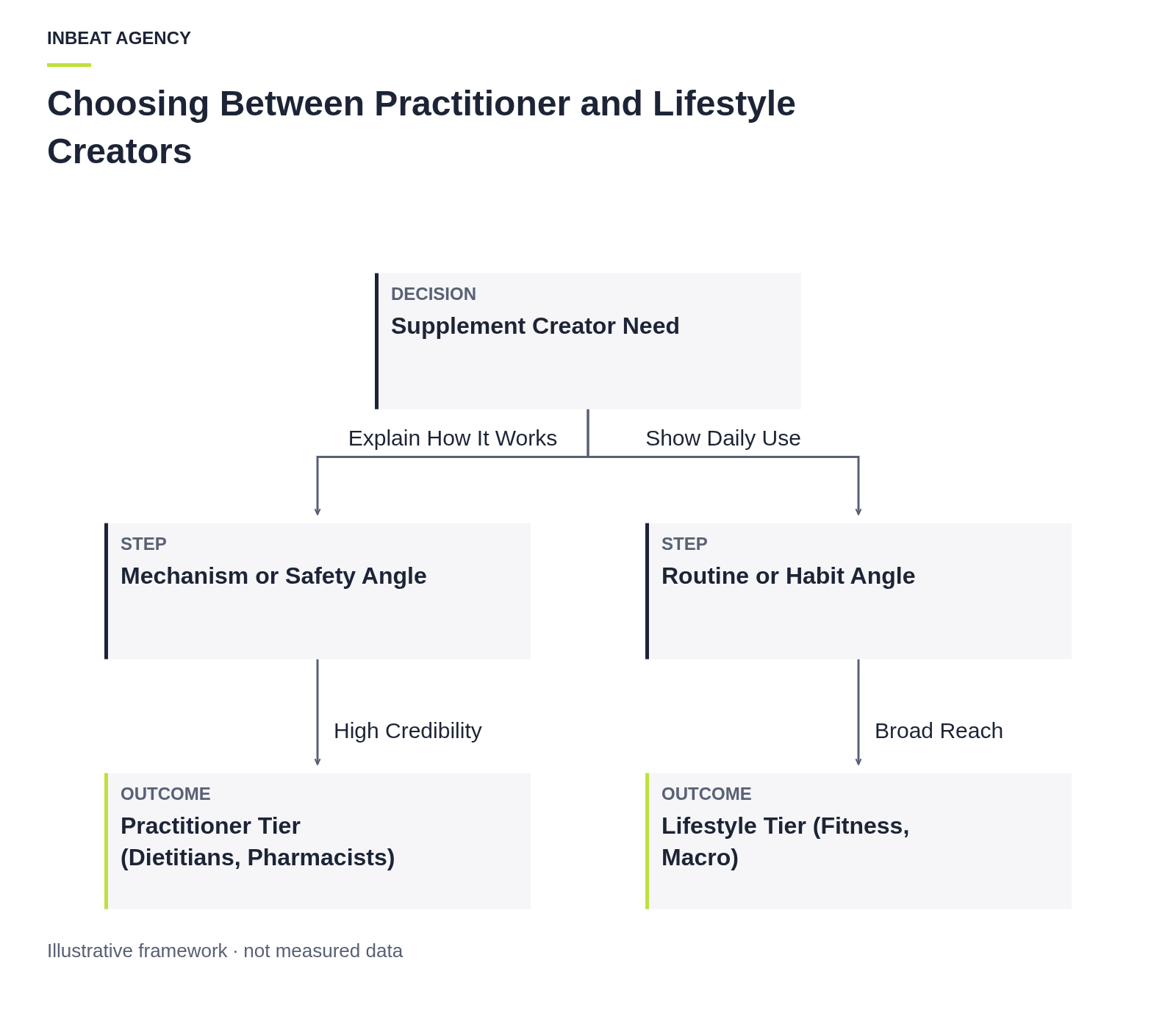
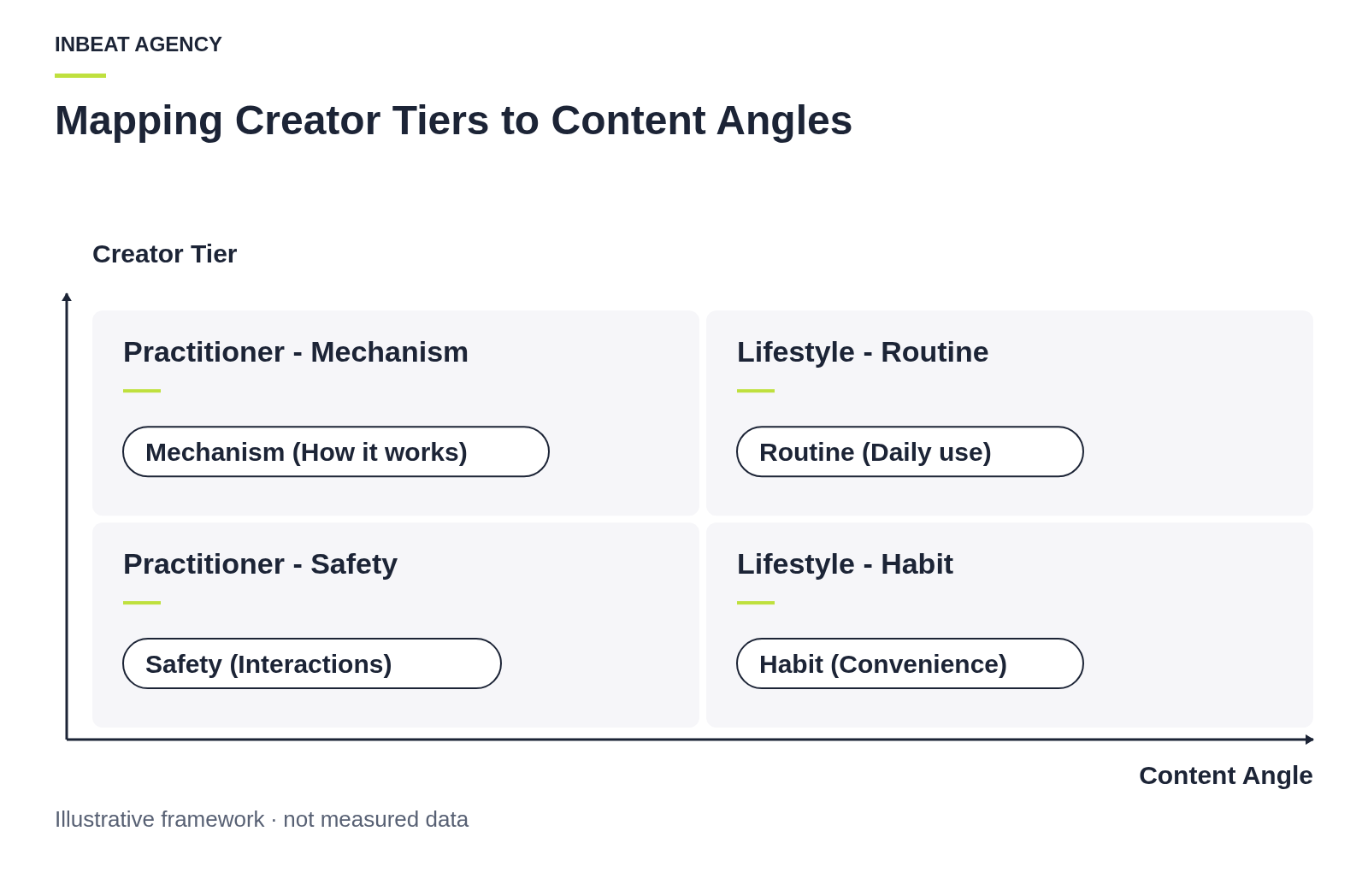
Use practitioners for mechanism and safety angles and lifestyle creators for routine and habit angles, inside one persona matrix so the angles can be compared on the same scoreboard. A hypothetical sourcing run makes the split concrete. For a daily multivitamin brief, a registered dietitian with 20,000 followers and a fitness creator with 400,000 followers pass very different gates. The dietitian clears the registry lookup, has no outcome claims in her last twenty posts and will decline a script that promises energy. The fitness creator has no credential to check, three posts that call a competitor product a game changer for recovery, and far larger reach.
A workable split is to use both, with the dietitian carrying the mechanism and who-it's-for angles and the fitness creator restricted to the routine angle with a script that contains no outcome words. inBeat's 3 R's framework of relevance, reach and resonance is the lens we use for the pairing: the practitioner wins on relevance and resonance, the lifestyle creator on reach.
Action for this quarter: build a shortlist of fifteen licensed practitioners in your category, verify each license, and reject any whose recent posts include a disease or cure statement.
Creator brief for supplement campaigns: claims, disclosures, and review fields
Build your supplement creator brief around claims control first and creative direction second. The eight fields below give the campaign team a working review framework; regulatory counsel should approve the claims, warnings, and restricted language that apply to the specific product before the brief reaches a creator.
Core fields for a supplement creator brief
Brief fieldWhat it containsWho owns itFailure mode if missingProduct facts sheetIngredients, serving, form, who the product is for and who should not take itProduct and regulatoryCreator fills gaps from the website or from memoryApproved benefit statementsThe exact structure/function phrasing counsel has cleared, verbatimRegulatory counselCreator paraphrases a benefit into an outcomeBanned words listOutcome verbs (cure, treat, fix, heal), disease names, timelines, medication comparisonsRegulatory counselReviewer has no objective standard to flag againstRequired disclaimers and warningsProduct- and claim-specific language approved by regulatory counsel, with placement requirements where applicableRegulatory counselRequired language is missing or lost during adaptationDisclosure placement specWhere and how the paid relationship is stated per format, visible and audibleInfluencer marketingDisclosure lost on crop or buried in hashtagsPersonal-experience framing rulesHow to describe own use without asserting a result for othersInfluencer marketing with counselTestimonial reads as a medical promiseReview and approval loopSteps, owners and turnaround timesInfluencer marketingContent goes live without a legal passUsage rights for paidDuration, platforms, edit permissions, whitelisting accessLegal and media buyingAd adaptation requires renegotiation or runs without rights
The disclosure row rests on the FTC's requirement, cited in the first section, that creators clearly disclose their relationship to the brand; the remaining fields are our template, built to make that requirement and the claim boundary operational.
Approved language, banned language and the grey zone
The boundary the brief has to teach is between describing a personal experience and asserting a medical outcome. "I take this with breakfast and it's become part of my routine" describes behavior. "It fixed my bloating" asserts an outcome. Between them sits a grey zone: "I feel like I have more energy since I started" is personal and hedged, yet still implies a result. Decide how your counsel treats that zone and write the decision into the brief. The structure/function versus disease-claim classification is not a marketing call; have counsel set it and paste the cleared statements into the approved list.
A hypothetical before-and-after of one brief line shows the shift. Before: "Share how the product helped you." After: "Describe when and how you take it. You may use any of the five approved statements below. Do not use the words on the banned list, do not state a timeline, and do not compare it to medication. Say 'paid partnership with [brand]' in the first three seconds and in the caption." The second version is less open, and it produces content that survives all three rooms.
Disclosure placement rules for Reels, TikTok, Stories and whitelisted ads
Set a format-specific disclosure standard that is stricter than the minimum guidance, because each placement handles captions, crops and overlays differently:
- Reels and TikTok: use spoken disclosure early in the video, on-screen text inside the safe zone, the platform's paid partnership label where available, and a caption disclosure.
- Stories: on-screen text on every frame that mentions the product, since viewers enter mid-sequence.
- Whitelisted ads: keep the disclosure inside the video frame rather than relying on the caption, since ad placements may strip or truncate caption text and the material connection still has to remain clear to the viewer.
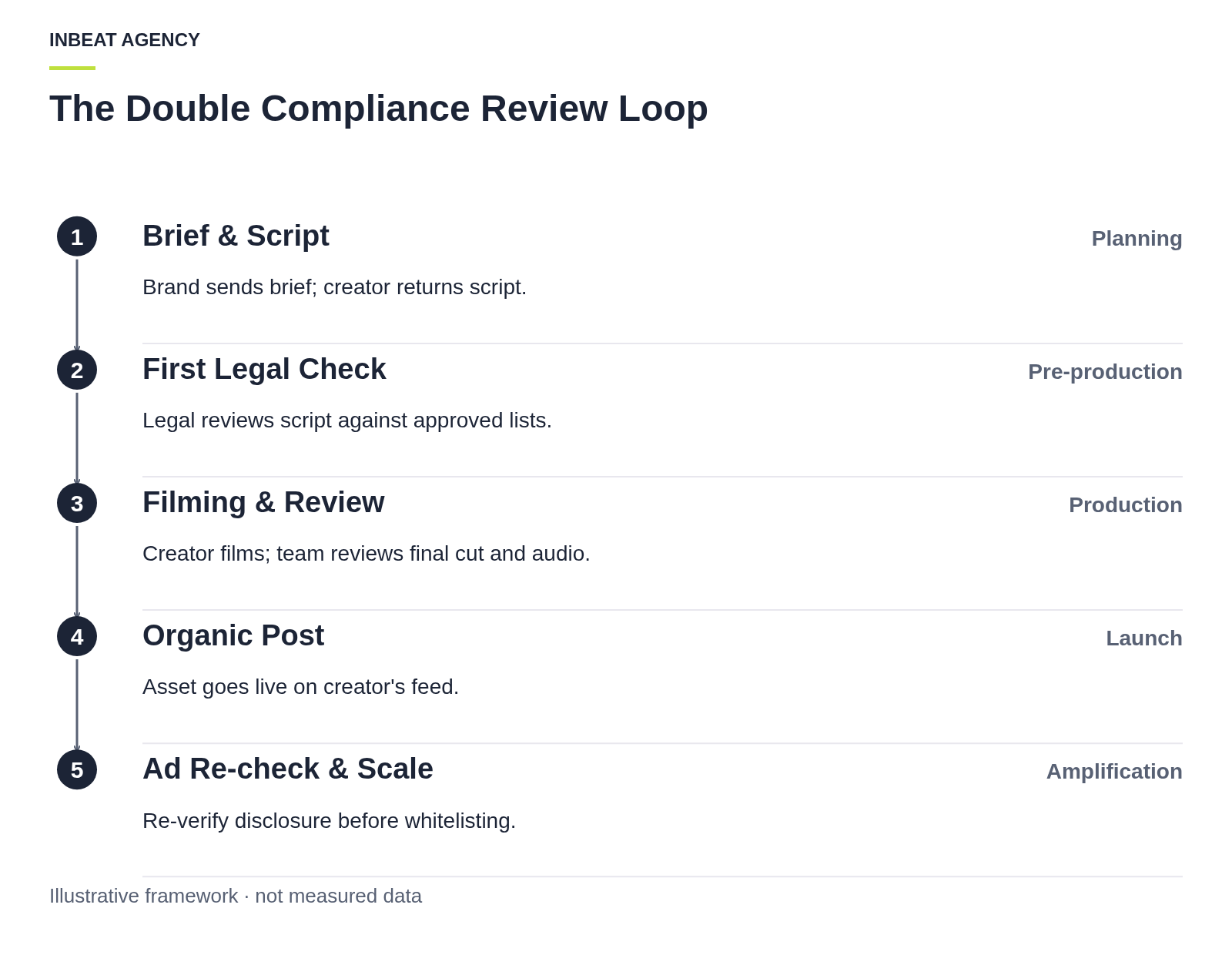
The review loop runs in this order:
- Brief sent with signed language lists.
- Creator returns a script or shot list.
- Legal check against approved and banned lists.
- Filming.
- Final review of the cut, including audio.
- Organic posting.
- Ad adaptation re-check before whitelisting, because the crop and the caption change.
This template reduces risk. It does not remove it. The brand carries responsibility for what it amplifies, and no brief substitutes for counsel reviewing your actual claims.
How to review high-risk supplement claims in creator drafts before they go live
Review every supplement creator draft against three statement types before it goes live: health outcomes, time-to-result promises, and comparisons to medication or competitors. Those three account for most of the exposure in our experience, and each has a different fix.
Which fields carry the most risk: outcomes, timelines, comparisons
Statement typeRisk levelReviewer testFix if it failsHealth outcome ("fixed", "cured", "got rid of")Highest in any categoryCan a stranger extract a promise that the product produces a result?Reshoot with an approved statement; caption fix is insufficient when the word is spokenTime-to-result ("within a week")High; stricter for weight management and immune positioningDoes the draft state or imply how fast a result arrives?Cut the timeline from the edit; reshoot if it anchors the narrativeComparison to medication or a competitorHighDoes the draft position the product as a substitute for treatment or as superior to a named product?Pull the asset; comparisons rarely survive a trimPersonal routine ("part of my mornings")Low for daily vitamins, moderate for high-scrutiny categoriesDoes the framing describe the creator's own behavior, or a result for the viewer?Caption clarification usually sufficesDisclosureAlways requiredCan a viewer with no context identify the paid relationship, visually and audibly?Re-edit to add in-frame disclosure
The disclosure test in the last row applies the FTC's disclosure requirement cited earlier; the risk levels for the other rows are our categorization and depend on your counsel's claim classification. Guidance such as Citrus Labs' overview of influencers in supplement marketing strategies describes the channel's role; the review step is where that role becomes defensible.
A pre-publish review checklist for creator scripts and cuts
Run two reviewers on every asset: one checks disclosure, one checks claims. Each applies this list to the script and again to the final cut, with audio on:
- Disclosure is visible and audible, inside the frame.
- No word from the banned list appears in speech, text or caption.
- Every benefit matches an approved statement.
- Framing stays on the creator's own behavior, with no result promised to the viewer.
- Any required disclaimer or warning is present and legible.
A draft passes when a reviewer with no campaign context can identify the paid relationship and cannot extract a medical promise. Weight-management and immune positioning get the stricter path: both reviewers sign, and counsel sees any grey-zone line. A daily vitamin can run with the standard two-person pass.
What to do when a creator improvises a claim on camera
Decide between caption fix, reshoot and pulling the asset based on where the problem sits. In a hypothetical case, a creator says the product "fixed" their sleep within a week. The reviewer flags the outcome verb and the timeline. A caption can't correct spoken words, so the cut is reshot with an approved statement and no timeline. Document the flag, the decision and the replacement in the asset file; that creates an audit trail of how the claim was flagged, reviewed and corrected.
Immunologist Dr. Andrea Love explains how exaggerated marketing language such as immune-boosting claims fails scientific scrutiny, highlighting the red flags review teams must catch in creator scripts.
Performance-based influencer deals for supplement brands: base fee plus commission
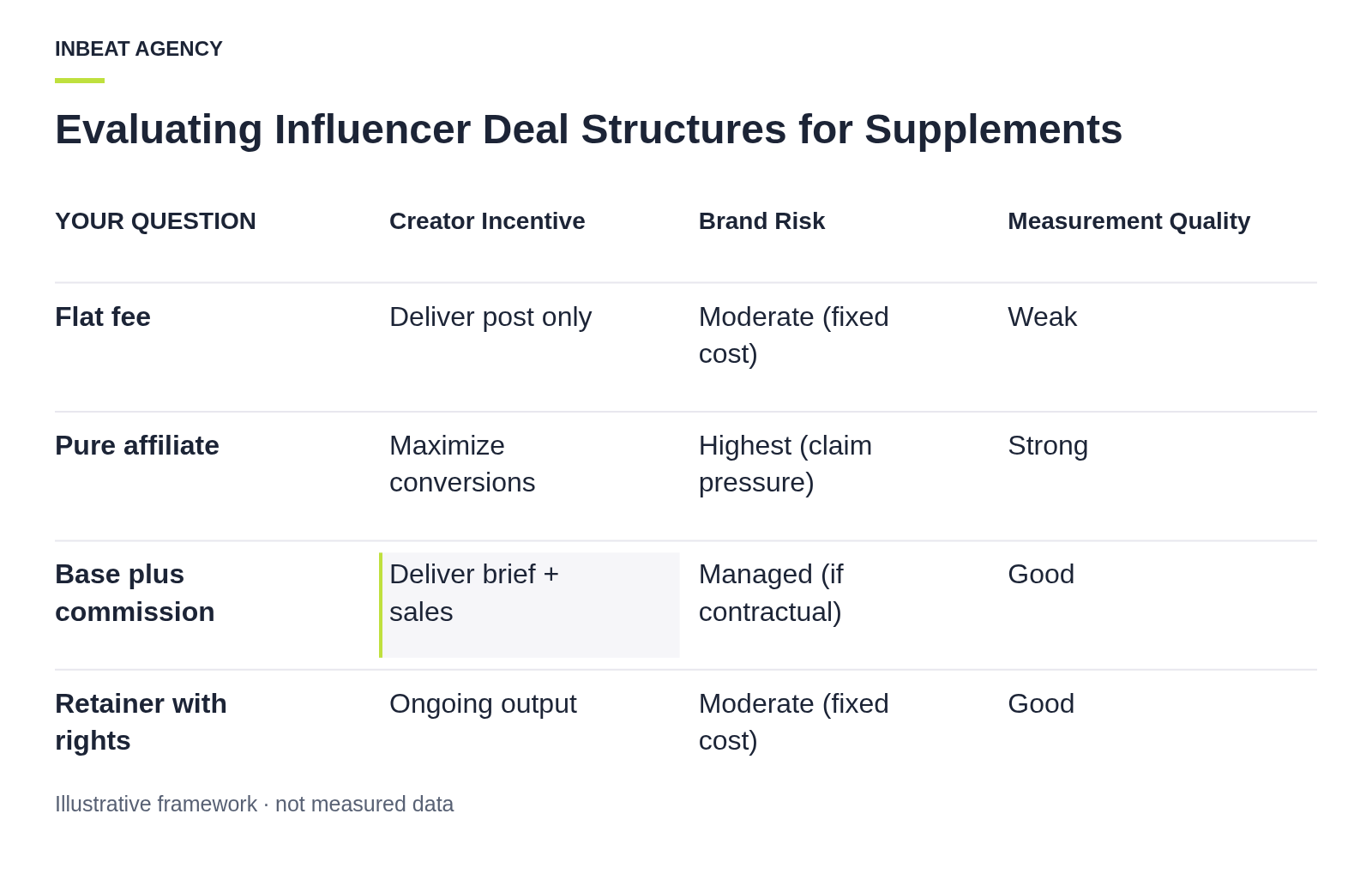
For supplement creator deals, pay a flat base fee plus a commission on tracked sales, and tie a claims-compliance clause to payment. Pure affiliate is mainly an option for early-stage brands with limited upfront creator budgets but reliable affiliate tracking already in place.
Why flat fee plus tracked-sales commission fits supplement risk
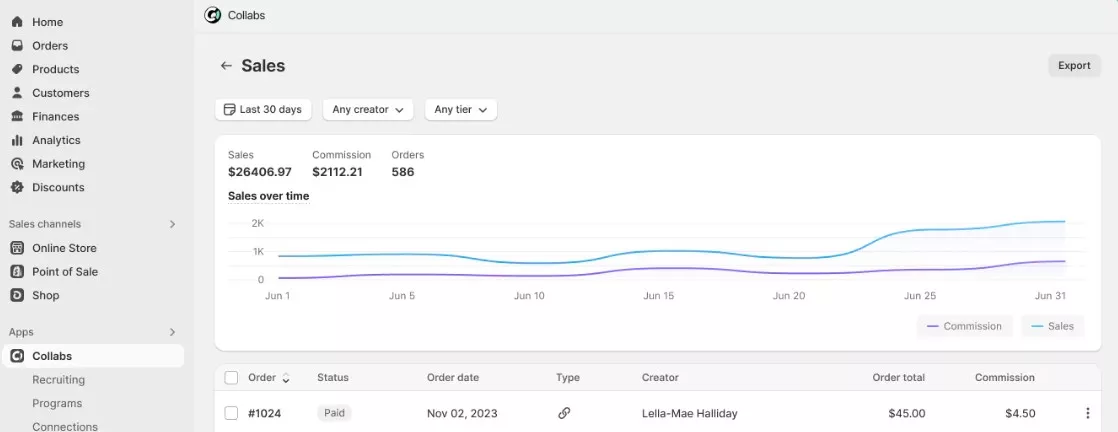
For most supplement programs, we prefer a base fee plus commission because the two parts reward different things. The base pays for the creator's work, review process and agreed usage rights, while the commission adds upside tied to tracked sales. That structure does not reduce claim risk on its own, so the brief, approval process and contract still need to control what the creator can say.
Deal structureCreator incentiveBrand riskTypical tracking setupBest fitFlat feeDeliver the post; no stake in outcomeModerate; you pay regardless of performanceOptional; tracking can be added separatelyPractitioner content where trust is the asset and volume is secondaryPure affiliateStrong incentive to drive conversionsHigher; conversion incentives can increase claim pressureRequired for commission attributionEarly-stage brands with limited upfront budget and reliable affiliate trackingBase plus commissionDeliver the brief and still care about salesManaged, if compliance is contractualRequired for commission attributionDefault for most supplement programsRetainer with usage rightsOngoing output and availability for paidModerate; higher fixed costOptional; usually added at campaign levelScaled programs with proven creators
The incentive, risk and measurement tradeoffs in this table are our working assessment, not industry benchmarks. The right structure depends on the creator, campaign economics and the level of claims oversight required.
Setting the base, the commission and the usage-rights clause
Set the base to reflect what the creator brings. In a hypothetical deal sheet, a practitioner creator gets a higher base and a lower commission than a lifestyle creator, because the practitioner's value is credibility that compounds in retargeting. The lifestyle creator accepts a lower base against a higher commission because their audience size gives the commission real upside. Add a 90-day paid usage clause granting whitelisting access and edit rights for cut-downs, so the media buyer can adapt the asset without a second negotiation. Specify that edits can't alter approved statements or remove disclosure.
What performance deals do to creator behavior and claim pressure
Commission creates pressure toward stronger claims. A creator paid on conversions has a reason to say the product works fast and works for everyone. The brief's banned list and the review loop therefore have to be contractual: payment of the commission is conditional on the asset passing review, and the brand retains the right to pull any asset containing an unapproved claim with no commission owed on sales after the pull date. Spell that out plainly at signing.
How to integrate creator UGC into paid social for supplements: whitelisting, dark posts and ad review
Move approved creator content into paid social through a loop of dark posts, creative-level reads and whitelisted scale, preserving the required disclosure and any applicable warnings through each adaptation.
Dark-post creator content to test angles before committing spend
Use dark posts to compare approved creative angles before deciding what deserves broader spend. Run several approved cuts per persona at comparable spend and evaluate creative-level CAC against a predefined campaign benchmark. The persona inside each cut is doing the targeting: a pharmacist talking through interactions pulls a different converter than a runner showing a pre-workout routine, and the dark post is where that difference shows up as a cost per acquisition you can compare instead of a debate about which messenger should work. Move forward with cuts that clear the benchmark and show enough signal to justify a larger test. Cuts that miss the benchmark should feed back into the brief as learnings about the angle, messenger, or execution before more budget is committed.
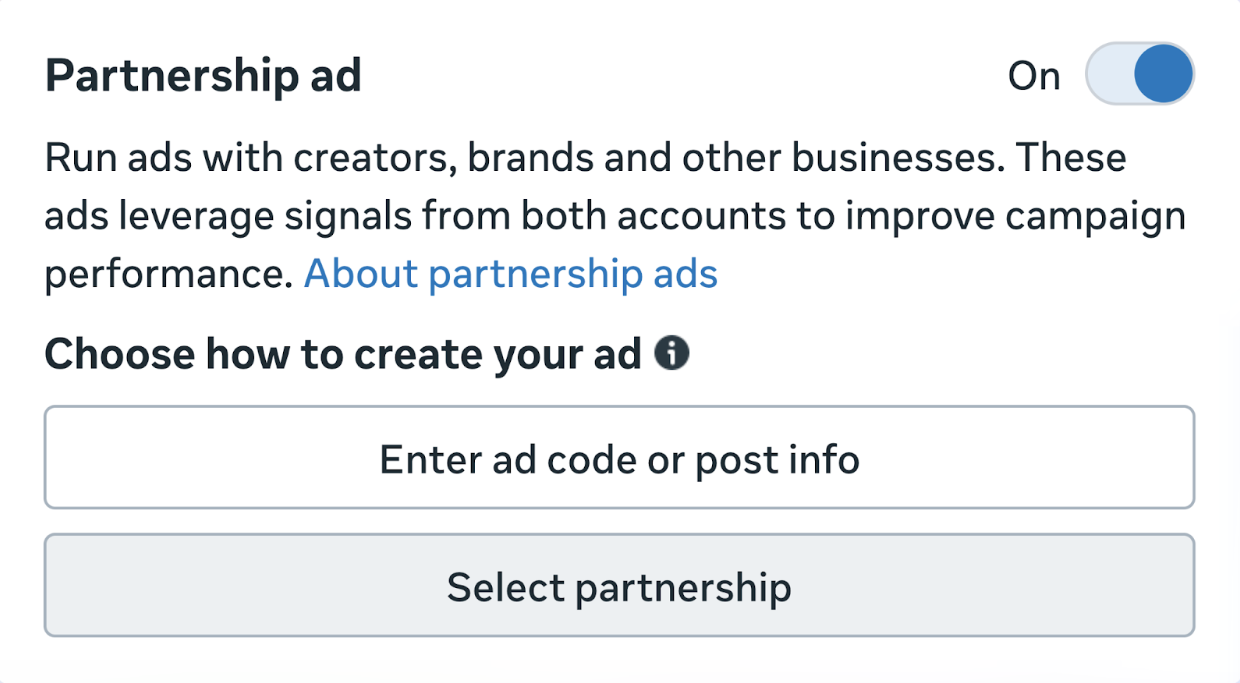
Whitelist the winners and keep disclosure and disclaimers in the ad
Whitelist winning cuts through the creator's handle, using the access granted in the usage clause. The FTC disclosure obligation cited in the first section does not lapse when a post becomes an ad; the material connection still has to be clear to the person watching. Practically, that means the spoken and in-frame disclosure from the brief's placement spec has to survive the 9:16 crop, and the disclaimer has to remain legible at feed size. Commission tracking from the agreement should carry into the whitelisted campaign so the creator is credited for sales their content drives under paid support, which keeps the relationship intact when you scale.
For a published example of performance creative scaled through paid media, see how inBeat worked with The Farmer's Dog; it is a pet food program, so read it for the mechanism. It is not a supplement benchmark.
Prepare for platform health-claim ad policies alongside FTC rules
Plan for a second review at the ad stage. Meta and TikTok apply their own health and supplement advertising policies on top of the FTC's disclosure rules, which means a post that is compliant organically can still be rejected or restricted as an ad. We are not quoting those policies here, because they change and your media buyer should read the current version directly. The planning step is to have the buyer check each winning cut against the platform's current rules before whitelisting, and to feed any rejection reason back to the brief owner so the next batch avoids it. Guides to influencer strategies for supplements and vitamins tend to stop at the organic post; the ad-stage re-check is where most of the rework, and most of the cost of a siloed process, shows up.
Action: set up the dark-post test described above, and give the media buyer a copy of the approved-language list so the ad re-check uses the same standard as the brief.
How to measure incrementality and ROI of supplement influencer marketing
Use holdout tests when you need to estimate the incremental effect of supplement influencer marketing. Commission tracking tells you which creator or touchpoint received attribution; a well-designed holdout test helps estimate how many of those sales were incremental. No source in this article quantifies incremental or long-term effects for supplement creator programs, so what follows is a method and a way to size your attribution gap. None of it is a benchmark.
Why tracked-sales commission data is attribution, not incrementality
A tracked sale through a creator's code or link records an attributed touchpoint, but some of those buyers may have purchased through search, direct traffic or retargeting anyway. Commission data works for paying creators against attributed sales; it does not establish how many of those sales were incremental.
Conceptual holdout designs for creator programs: geo, cohort and timing
Test design (conceptual)What it isolatesMinimum setupWeaknessGeo split on whitelisted spendThe paid increment on top of organic creator postsTwo matched regions, identical organic posts, paid spend in oneRegional seasonality and spilloverCreator-cohort staggeringThe organic effect of a creator waveTwo matched creator groups posting in different weeksCreator quality differences between cohortsPre-post window with matched controlLift over a baseline periodClean baseline, a comparable control product or marketConfounded by any other change in the window
These designs are drawn from general incrementality practice and are presented as conceptual; nothing in this article's sources validates them for supplement creator programs specifically. A hypothetical geo test illustrates the first row: two matched regions receive the same organic creator posts, one region also gets whitelisted spend, and the difference in sales between regions provides an estimate of the paid increment, assuming the regions remain otherwise comparable during the test.
Reading CAC and MER as the scoreboard across creator and paid
Use CAC at the creative level and MER at the account level as the shared scoreboard for creator and paid teams. That is our methodology recommendation; no source in this article establishes it. Earned media value should not drive the decision, because it prices exposure and your question is acquisition. Our comparison of paid ads and influencer marketing lays out why the two channels read differently on the same metrics.
Action: run one geo holdout on your next whitelisted creator campaign and compare the lift against commission-tracked sales to size the gap.
How inBeat builds supplement influencer marketing with practitioner creators and paid amplification
The system this article describes has five parts that only work as one: a claim-controlled brief with counsel-signed language lists, a practitioner tier inside the persona matrix alongside lifestyle creators, base-plus-commission deals with compliance tied to payment, dark-post testing read on creative-level CAC, and whitelisted scale with disclosure and disclaimers intact. Remove any part and the others degrade. A great brief without usage rights produces content you can't run. A great deal without a review loop produces claims you can't defend.
At inBeat, influencer sourcing and paid social sit in the same room. The person matching a dietitian to a mechanism angle works from the same approved-language list the media buyer checks before whitelisting, and the ad re-check feeds back into the next batch of briefs. One compliant asset moves through sourcing, briefing, two-person review, organic post, dark post and whitelisted scale without being rewritten at any stage, because every stage was designed with the others in view.
The decision for this quarter is small enough to execute: pick one product line, source and verify a short practitioner roster, rewrite the brief with the eight fields, sign deals with compliance clauses, and run the full loop through to a whitelisted ad. Book a strategy call with inBeat's paid social team to turn approved creator assets into whitelisted supplement campaigns.
FAQ
How do you verify a dietitian or pharmacist creator is actually licensed before signing them?
Look up the license in the relevant state board or national registry, confirm the name matches the creator's legal name, record the license number, status and expiry, and recheck at renewal. Where a credential is a certification rather than a license, verify it with the certifying body. Keep the record in the creator file alongside the signed brief.
Does a practitioner creator still need a sponsorship disclosure if they are giving a professional opinion?
Yes. The FTC guidance referenced in this article applies to anyone working with a brand to recommend products, and a professional opinion delivered under a paid relationship is still an endorsement. If anything the disclosure matters more, because viewers weight a clinician's statement as expert advice.
How should the commission clause change for a practitioner versus a lifestyle creator?
Shift the mix toward the base for practitioners and toward the commission for lifestyle creators. The practitioner's value is credibility that supports consideration and retargeting, which commission tracking undercounts. The lifestyle creator's value is reach that converts at launch, where commission is a fair reflection. Keep the compliance condition on payment identical for both.
What happens to the disclosure when a creator post is cropped into a 9:16 ad?
Caption disclosures are usually lost or truncated in ad placements, so the disclosure has to live inside the video frame and in the audio. Specify safe-zone placement in the brief and re-check the cropped cut before whitelisting. A missing in-frame disclosure is a failed review.
Can you run a geo-holdout test on an organic-only creator campaign with no paid spend?
Only imperfectly, since you can't control where an organic post is seen. A creator-cohort stagger is the closer fit: two matched groups of creators post in different weeks and you compare sales timing. This is a conceptual design, as noted earlier, and it is weaker than a geo split on paid spend.
Which clauses should let the brand pull an asset if a creator improvises a claim?
Include a claims-compliance clause stating that payment and commission depend on the asset passing review, a takedown clause allowing the brand to require removal of any post containing an unapproved claim within a set number of hours, and a usage clause giving the brand the right to stop running the asset as paid at any time with no further commission owed after the pull date.
Cover photo: Photo: SHVETS production / Pexels. Art direction: inBeat Agency.