.svg)
.svg)
.svg)
.svg)


.svg)



%20(1).png)

Healthcare marketing managers and health-tech teams face a difficult challenge. You need medical content that feels human enough to earn attention while keeping every claim, disclosure, and creator partnership compliant.
The stakes keep rising as creator-led content shapes health decisions. In 2025, EMARKETER found that 88.8% of Gen Z social media users who browse these platforms for health purposes follow or engage with health influencers. So, one poorly vetted creator can quickly weaken your brand trust and create compliance risk.
Is that something that you want to avoid? If yes, in this guide, we’ll show you how to source, vet, brief, and manage healthcare creators safely.
P.S. If you’re trying to scale this without getting buried in compliance headaches, inBeat Agency is usually the go-to partner for handling UGC creator management and keeping collaborations on the safe side.
TL;DR: Casting Healthcare UGC Creators
- Match the creator to the job: regular users for routines, patient advocates for lived experience, and clinicians for sensitive education.
- Check past claims, credentials, disclosures, audience fit, and brand-safety risks.
- Put approved claims, required disclosures, privacy rules, and usage rights in the brief.
- Give creators clear guardrails and room to speak naturally. Review every asset before publishing.
- Healthcare UGC works best when the creator, message, and compliance level fit from the start. In 2025, KFF found that 55% of U.S. adults use social media for health information at least occasionally. That reach makes each casting decision matter.
What Are the Unique Challenges of Casting UGC Creators in Healthcare?
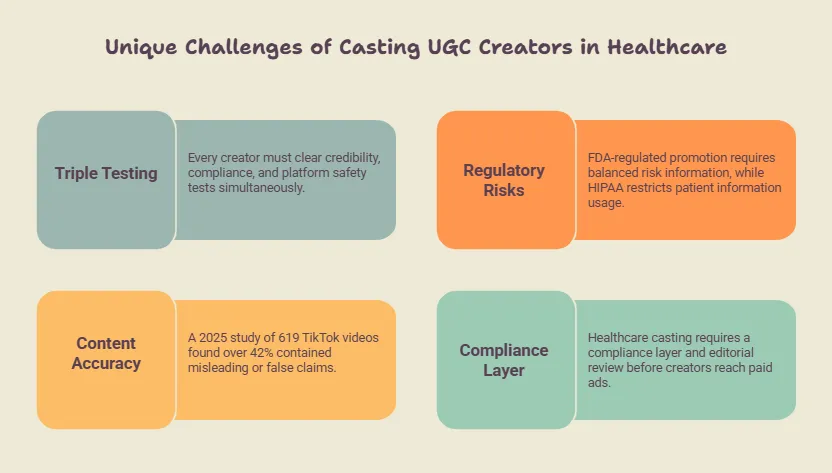
Casting UGC creators in healthcare is harder because every creator must clear credibility, compliance, and platform safety (three tests at once).
For example, for medical spa owners and health-tech marketers, a creator can sound authentic and still create risk by overpromising results, mishandling protected health information, or making claims that Meta flags under health advertising rules.
That tension makes user-generated content tricky. FDA-regulated promotion requires you to present balanced risk information, while HIPAA restricts certain uses of patient information in marketing.
So, standard influencer identification falls short because follower count and engagement say little about medical accuracy. A 2025 study of 619 TikTok videos about diabetic foot care found that more than 42% contained misleading or false claims. That is why healthcare casting needs a compliance layer and editorial review before creators reach paid ads.
What Types of Health UGC Creators Should You Cast?
The right health UGC creator depends on your audience, message, risk level, and required authority. These five personas overlap, so patients, medical professionals, employees, and regular users can also be paid creators.
Pro tip: Check out our guide on how to choose high-performing UGC video types for your campaigns.
Next, we’ll cover these five health creator personas for compliant, credible, conversion-focused campaigns.
Who Are Regular Users and When Should You Cast Them?
Regular users are everyday customers or community members who show how a product fits into their real life without claiming professional expertise or formal patient advocacy. They use routine videos, product demos, unboxings, online reviews, and day-in-the-life short-form videos.
They work well for wellness apps, fitness services, hydration products, supplements, and other lower-risk topics where relatability matters.
For example, inBeat used this approach for Nestlé Nuun. Our team activated 50+ creators around everyday hydration routines and generated a 30%+ engagement lift. The campaign shows why routine videos, demos, reviews, unboxings, and day-in-the-life content work well here.
Remember: Creators should stay grounded in genuine experiences and avoid unapproved health or outcome claims.
Who Are Patient Advocates and When Should You Cast Them?
Patient advocates are people who publicly share their lived experience with a diagnosis, treatment, recovery journey, chronic condition, or caregiving role. They fit disease awareness campaigns, patient support and treatment journey ads, and pharmaceutical storytelling where emotional resonance matters.
Their stories create peer-to-peer social proof and memorable brand love. Casting still needs consent, health-information privacy, claim review, adverse-event reporting, and respectful compensation.
inBeat did this kind of work for Mindbloom. We worked with 15+ real customers who experienced the treatment. The testimonial-led campaign helped reduce CAC by 25% and increase referral sign-ups by 40%.
Who Are Paid UGC Creators and When Should You Cast Them?
Paid UGC creators are hired to produce brief-led or scripted content assets for organic channels, paid media, whitelisting, or dark posting. Their audience size matters less because the main deliverable is usable creative.
So, cast them when you need volume, multiple hooks, controlled messaging, and fast testing. Your briefing system should cover FTC disclosures, usage rights, exclusivity, script approval, and health-claim review. At the same time, you need to prevent creators from implying personal use, treatment experience, or medical credentials they lack.
inBeat has used paid creator content across several healthcare and wellness campaigns for different goals. For Mindbloom, testimonial-led creator content supported paid media and whitelisting. Nurse.com used creator-led content to reach the healthcare community, generating 5M+ relevant impressions and 200K+ website clicks or users.
And for Nestlé Nuun, inBeat used creator-led product routines to support social acquisition, like so:
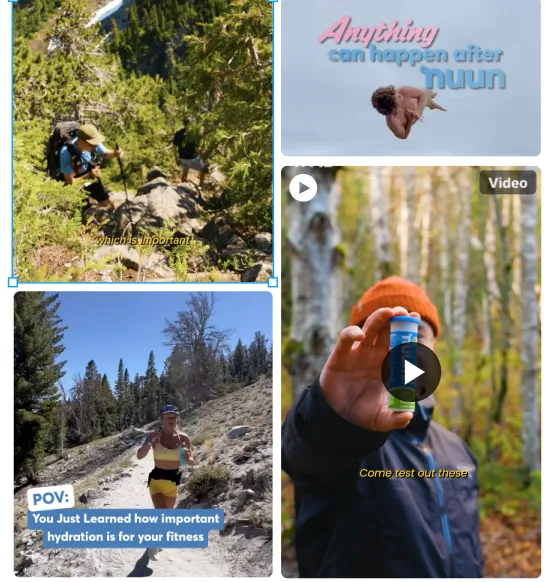
Together, these campaigns show how paid UGC can flex across testimonials, awareness, and product-focused creative.
Who Are Medical Professional UGC Experts and When Should You Use Them?
Medical UGC experts are licensed clinicians. Doctors, nurses, therapists, psychologists, pharmacists, and other qualified professionals suit sensitive topics, myth correction, condition education, and treatment explanations. Still, you need to verify licenses, credentials, scope, conflicts, claims, and sponsorship disclosure language.
Our campaign for Growtherapy shows how this expertise can support performance marketing. inBeat used therapist-led educational UGC across Meta and Google. The campaign produced more than 50 monthly concepts while reducing CPA by 15% and increasing CVR by 25%. The therapists made complex mental health topics easier to understand, while the creator-led format kept the content approachable.
Bonafide used a broader mix of 25 women 35+, healthcare, and wellness creators to produce over 90 assets across 12 formats. Featuring Dr. Jennifer Schell added a qualified clinical voice to the educational content, while the other creators made the campaign feel relevant to women experiencing these concerns.
This balance helps address a measurable trust gap. Pew found that 65% of people using provider information consider it highly accurate, compared with 7% for social media information. YouTube reinforces the value of verified expertise through source-context panels and Health Sources placement for qualifying licensed professionals.
Remember: Since pharmaceutical companies and some for-profit healthcare brands cannot apply, marketers should treat these features as a potential advantage of partnering with eligible clinician-owned channels.
What Are Employee Influencers and How Do They Build Trust?
Employee influencers are staff members (from entry-level to middle management and even C-suite) who voluntarily create approved behind-the-scenes content about workplace culture, professional routines, recruitment, or patient experience. Hospital marketing directors can decide to build an employee advocacy creator program to create community trust while supporting employer branding, patient confidence, brand safety, and conversion-focused UGC.
To use employee influencers for healthcare marketing:
- Give your staff training, approved talking points, consent procedures, publishing workflows, and compliance review.
- Make sure that participation stays voluntary; employees should be able to decline without consequences, and content should not disrupt their primary duties.
- Provide protected work time and fair compensation.
- Enforce patient privacy, HIPAA compliance, institutional policies, and limits on advice outside each employee’s professional scope.
How Do You Source the Right UGC Creators for Healthcare Marketing?
Source healthcare UGC creators by matching audience fit, credibility, content quality, and compliance history to the campaign before you look at follower count.
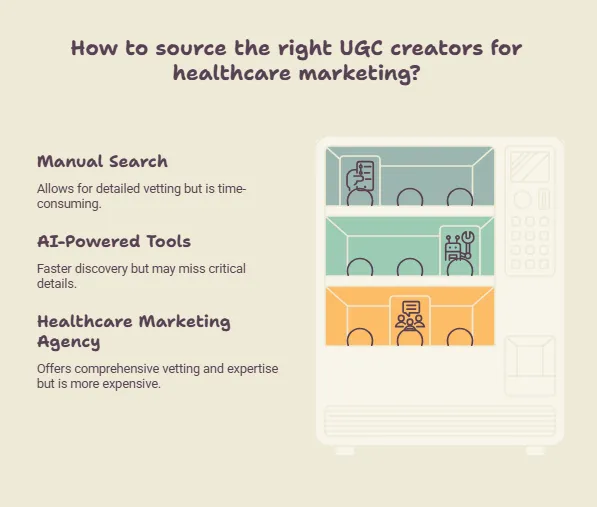
UGC agency teams can:
- Search TikTok, Instagram, YouTube, and LinkedIn manually.
- Use AI-powered discovery platforms and social listening tools to surface relevant content creators faster.
- Partner with a specialized healthcare marketing agency. This is usually the stronger option because human vetting can catch risky claims, poor brand fit, disclosure issues, and platform-specific restrictions that automated tools may miss.
Expert tips to choose healthcare UGC creators:
- For TikTok videos especially, prioritize storytelling, natural delivery, and demonstrated UGC content quality over vanity metrics.
- Strong creator marketing comes from people who can make health topics understandable and believable.
- Use performance data to refine the shortlist once testing begins.
How Do You Conduct UGC Vetting for Healthcare Compliance?
Vet healthcare UGC creators by checking brand safety, professional credentials, and delivery style before any content moves into production. The goal is to catch compliance risks early, before they reach healthcare advertising or paid distribution.
You can review the three-step framework below for rigorous creator vetting next.
How Do You Conduct a Brand Safety Audit for Healthcare Creators?
A healthcare brand safety audit should uncover anything in a creator’s history that could trigger compliance problems, platform bans, or reputational damage.
So, we recommend that you:
- Start by reviewing several months of TikTok, Instagram, YouTube, and other public posts. Search captions, comments, reposts, and older partnerships for unsupported health claims, miracle-cure language, contradictory medical opinions, undisclosed sponsorships, misinformation, harassment, or polarizing stances that conflict with the brand.
- Compare those findings with campaign requirements and platform policies. Check whether previous sponsored content used clear incentive disclosure and whether the creator repeatedly pushes claims beyond available evidence.
- Use AI screening platforms to speed up the first pass by flagging risky terms, sentiment, or historical content at scale.
- Use human compliance workflows to make the final call because context matters.
- Lastly, document each decision so the same standards guide future reputation management and creator approvals.
How Do You Verify Credentials for Medical Professionals?
You can verify medical creators through primary licensing and certification sources before approving them for a health-tech campaign.
- For health-tech teams hiring U.S. doctors, confirm the creator’s legal name, active license, license status, specialty, and disciplinary history through the relevant state medical board or FSMB data. Then verify claimed board certification through ABMS.
- For multi-state campaigns, repeat the check anywhere the doctor is licensed or presented as practicing.
- Internationally, use each country’s official regulator, such as the GMC in the UK, and confirm that the creator’s specialty matches the subject they will discuss.
What if you didn’t verify your medical creators or didn’t do it correctly?
The risk goes beyond paperwork. In 2025, the FTC acted against telehealth company NextMed over alleged deceptive weight-loss claims, fake reviews, and testimonials. Its final order required $150,000 for consumer refunds.
How Do You Assess a Creator’s Tone for Medical Content?
Assess a medical creator’s tone by checking whether they can make sensitive information approachable while treating serious health topics with appropriate care.
- Start with a “vibe check” using several recent videos and, ideally, a short test brief. Listen for empathy, clarity, pacing, humor, body language, and how they describe symptoms, outcomes, or personal stories. For wellness brands, the creator should feel warm and believable while respecting patient privacy, medical seriousness, and boundaries around advice.
- Watch out for oversharing from clinical settings, sensational hooks, fear-based language, dismissive jokes, guaranteed outcomes, or a style that makes vulnerable patients feel like content props.
- Compare their delivery with your UGC strategy, brand voice, and compliance expectations. This alignment affects performance too. A creator who feels natural on camera gives the final UGC ads a stronger chance of holding attention, earning trust, and converting.
How Do You Write a Compliant Creator Brief for Medical Content?
A compliant medical creator brief defines disclosures, approved claims, usage rights, and creative boundaries before production begins. For U.S. campaigns, requirements vary by product category, claim, audience, platform, and jurisdiction, so teams should avoid one-size-fits-all rules.
You can follow these four steps to protect the campaign while giving creators enough room to sound natural.
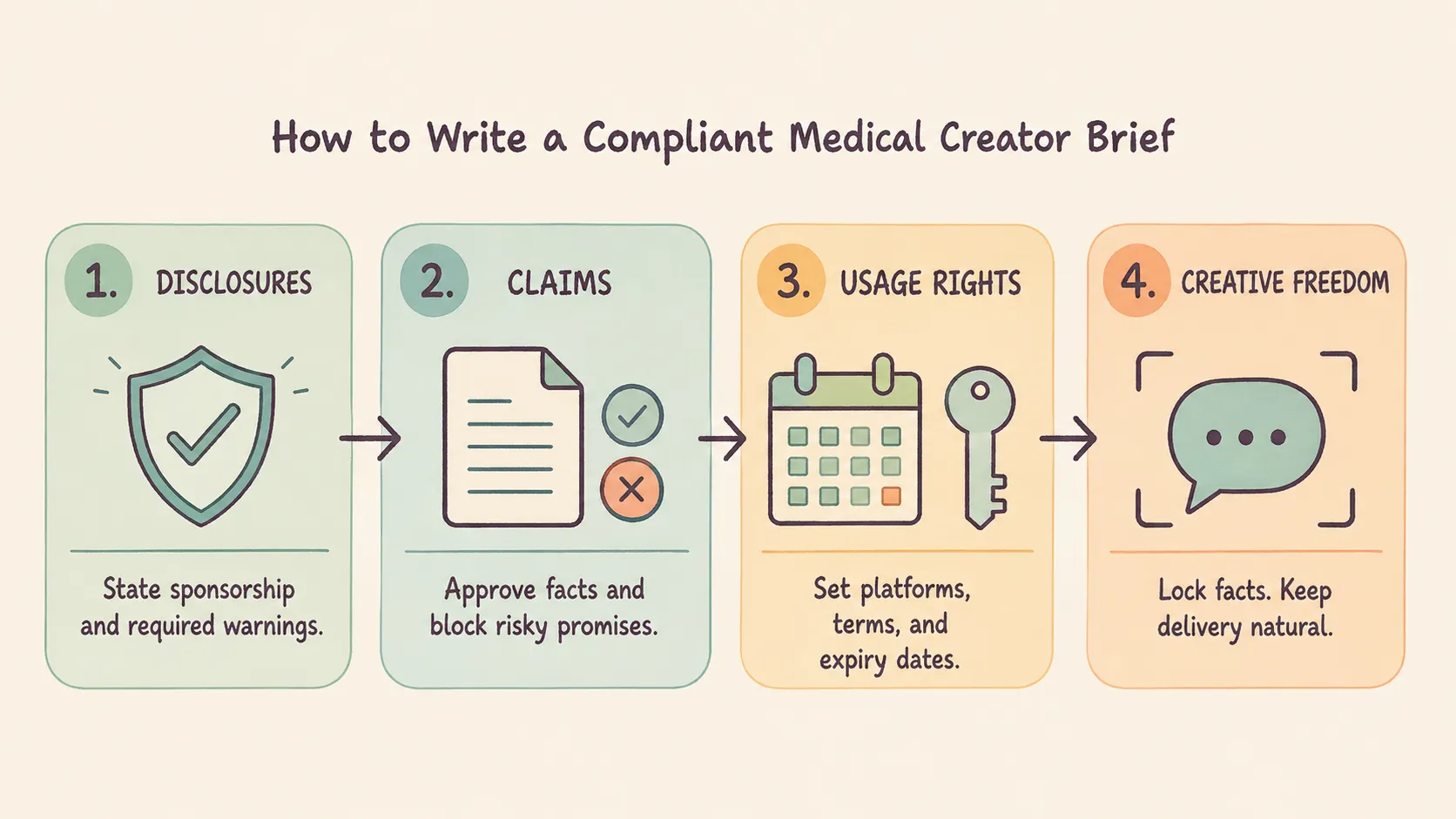
Let’s break them down below:
Step 1. Which Disclosures Should You Add to Healthcare UGC?
Healthcare marketing managers should assign disclosures based on the content, creator relationship, and product being promoted.
For a material connection, use clear language such as “Ad,” “Sponsored,” or “Paid partnership with [Brand].” When appropriate, add “For educational purposes only. This content does not replace medical advice from your healthcare provider.”
The brief should also state the creator’s relevant credentials, brand relationship, and approved risk, eligibility, contraindication, or typical-results language.
For dietary supplement labeling with an applicable structure/function claim, FDA requires this statement: “This statement has not been evaluated by the Food and Drug Administration. This product is not intended to diagnose, treat, cure, or prevent any disease.”
“Not medical advice” cannot correct a misleading claim. The FTC’s endorsement guides for disclosure say they should be clear, difficult to miss, and included in the video when the endorsement appears there. Platform disclosure tools alone may be insufficient.
Prescription-drug promotion also requires fair presentation of benefits and risks under FDA guidance.
Step 2. Which Claims and Phrases Should Creators Avoid?
Every brief needs an approved-claims list and a restricted-claims list, so creators know exactly where the factual boundaries sit.
For medical spas and health-tech startups, flag claims such as:
- “Cures,” “treats,” “reverses,” or “prevents” a condition.
- “Guaranteed results,” “permanent results,” or “works for everyone.”
- “Clinically proven” without evidence supporting that exact claim.
- “Completely safe,” “risk-free,” or “no side effects.”
- “FDA approved” when the product, use, or claim lacks that status.
- Exact weight-loss promises like “lose 20 pounds in 30 days” or misleading before-and-after claims.
Health claims generally require adequate scientific substantiation, including claims implied by the overall creative rather than stated word-for-word. Meta also evaluates the wider message and whether an ad implies knowledge of someone’s health or appearance.
For example, “Struggling with belly fat? Lose 20 pounds fast” combines a personal-attribute assumption, negative self-perception, and an unrealistic outcome. So, build your brand promotion guardrails around Meta’s Health and Wellness advertising policy and the FTC’s health-claims guidance.
Step 3. How Do You Define and Track Partnership Ad Usage Rights?
Agencies should record every permission before creator content is published, promoted, whitelisted, or dark-posted.
Keep one centralized tracker with these fields:
- Creator and asset names.
- Approved platforms and accounts.
- Organic, paid, partnership-ad, whitelisting, and dark-posting permissions.
- Start and expiration dates.
- Countries or territories.
- Editing, cropping, voiceover, and derivative-content permissions.
- Exclusivity terms and competing-brand restrictions.
- Renewal fees, approval owners, and expiry reminders.
- Meta permissions or TikTok authorization details.
Contractual content rights define what the brand may legally do with an asset. Platform-level ad rights determine whether the advertiser currently has the technical permission to promote content through the creator’s identity.
Meta supports content-level and account-level partnership ad permissions, and creators can stop advertisers from running partnership ads from their handles. You can track both through Meta’s partnership-ad guidance so content licensing never outlives the permission supporting it.
Pro tip: Review our guide to securing and managing UGC usage rights before repurposing creator content.
Step 4. How Do You Set Legal Guardrails Without Losing Authenticity?
Content strategists should control the factual boundaries while creators control their natural delivery.
- Divide the brief into two areas:
- Non-negotiable requirements should cover approved facts, restricted claims, disclosures, required risk language, pronunciation, CTA, and required visuals.
- Creative freedom should cover the hook, personal wording, filming location, examples, pacing, and storytelling style.
- Give creators talking points, source material, and compliant claim alternatives instead of forcing a rigid word-for-word script.
- Then review the concept, draft or rough cut, final edit, captions, landing page, and partnership-ad setup before launch.
Remember: Creators should never improvise medical claims, change required risk language, or describe experiences they did not have. This keeps compliance boundaries clear while preserving the human delivery that makes creator work worth adding to your content library.
Pro tip: Check out real UGC campaign examples from our agency work for practical inspiration.
How Can You Start Casting Healthcare UGC Creators Today?
Start by defining your campaign goals, compliance requirements, creator persona, and approval process before reaching out to anyone.
For healthcare marketing managers and agency professionals, accurate casting and thorough vetting help prevent risky claims, protect brand credibility, and improve ROI once content moves into paid distribution. From there, track results through clear performance reports and refine your creator mix based on what converts.
A specialized healthcare marketing agency can handle sourcing, credential checks, compliance reviews, and creator coordination, so get in touch with inBeat Agency for compliant healthcare UGC creator sourcing.
FAQs
Why is casting the right UGC creators important in healthcare marketing?
Casting the right UGC creators matters because healthcare campaigns carry higher trust, privacy, and compliance stakes. The right creator can communicate sensitive topics credibly, follow approved claims, and connect with the audience while reducing brand-safety risk and improving campaign performance.
How can I evaluate the credibility and expertise of UGC creators for healthcare topics?
Evaluate credibility by reviewing the creator’s past health content, tone, accuracy, audience fit, and sponsorship history. For medical professionals, verify active licenses, certifications, and professional scope. Also check whether their previous claims are evidence-based and consistent with your brand’s compliance standards.
What legal or compliance considerations should I be aware of when casting UGC creators in healthcare?
Healthcare UGC must follow applicable FTC, FDA, HIPAA, platform, and advertising rules. Review disclosures, claim substantiation, patient privacy, consent, credential accuracy, and usage rights before publishing. Requirements vary by product, audience, platform, jurisdiction, and whether the creator has a material brand relationship.
How do you ensure HIPAA compliance with UGC creators?
Protect HIPAA compliance by keeping protected health information out of creator content unless you have the required authorization and safeguards. Use documented consent procedures, approved filming rules, privacy reviews, and clear boundaries for clinical settings. Train creators before production and review every asset before publication.
What metrics should I use to measure the success of UGC creator campaigns in healthcare marketing?
Measure reach, engagement, watch time, click-through rate, conversion rate, CPA, ROAS, and qualified leads or patient actions tied to the campaign goal. Healthcare teams should also track content approval rates, compliance issues, creative performance, and which creator personas produce the strongest results.