
Healthcare marketing trends are easy to predict. Proving they deserve a place in your budget is another story.
Consider AI: according to KFF's 2026 research, 32% of US adults used AI chatbots for health information in the past year. That's a significant change in consumer behavior, but what does it actually mean for healthcare marketers?
The same question applies to clinician-led content, connected TV, and emerging measurement tools.
In this guide, we examine the healthcare marketing trends that matter in 2026 and the evidence behind them. We also explore where promising opportunities meet practical and regulatory limitations.
TL;DR
- AI Overviews already appear on 43.0% of health keywords in Ahrefs data, so entity accuracy is now a marketing task, and YouTube is the most cited source in one large health study.
- Clinician-led and patient-led video can reach patients across short and longer formats; health claims still need substantiation and review.
- CTV budgets are growing on survey projections, while search keeps closing conversions that other channels start.
- In one vendor survey, just 1% of leaders could link more than half their spend to patient conversions. For patient acquisition, track completed visits; B2B teams should focus on qualified opportunities.
- Tracking-pixel litigation, FTC privacy cases and FDA letters now attach to specific tactics.
- Brand-owned chatbots show low adoption, and AR or VR has no adoption data in the sources reviewed.
What Are the Biggest Healthcare Marketing Trends in 2026?
The biggest healthcare marketing trends in 2026 involve AI answer engines, clinician-led content, CTV experiments, outcome-level measurement, and stricter privacy and claims enforcement.
This guide focuses on paid media, creators, AI search visibility, and measurement, including the content and listing accuracy that influence discovery. It leaves site architecture, technical SEO audits, and web design outside its scope.
For a broader framework, see our healthcare marketing strategy guide.
| Trend | Evidence level | Verdict |
|---|---|---|
| AI search visibility | Strong on exposure, thin on outcomes | Act now |
| Clinician and creator video | Strong on reach, trust is conditional, campaign results mostly self-reported | Act now |
| Outcome-level measurement | Strong need, mixed methods | Act now |
| Consent and privacy hardening | Court and enforcement record | Act now |
| Review and reputation signals | Vendor surveys; low cost and local-search value | Act now for providers |
| CTV | Survey projections | Test |
| Brand-owned chatbots | Low adoption in survey data | Watch |
| AR and VR | No consumer adoption data in the sources reviewed | Skip |
Before we spend on a new format, we ask what a creator can responsibly say, where the message can run, and which outcome we can measure. Healthcare targeting restrictions make those creative decisions especially important.
We use paid media to test approved concepts, learn from audience response and improve the next version. A new channel earns attention when our team can review the message, measure a useful result and act on it.
Healthcare Consumer Trends: Where Do Patients Research Care in 2026?
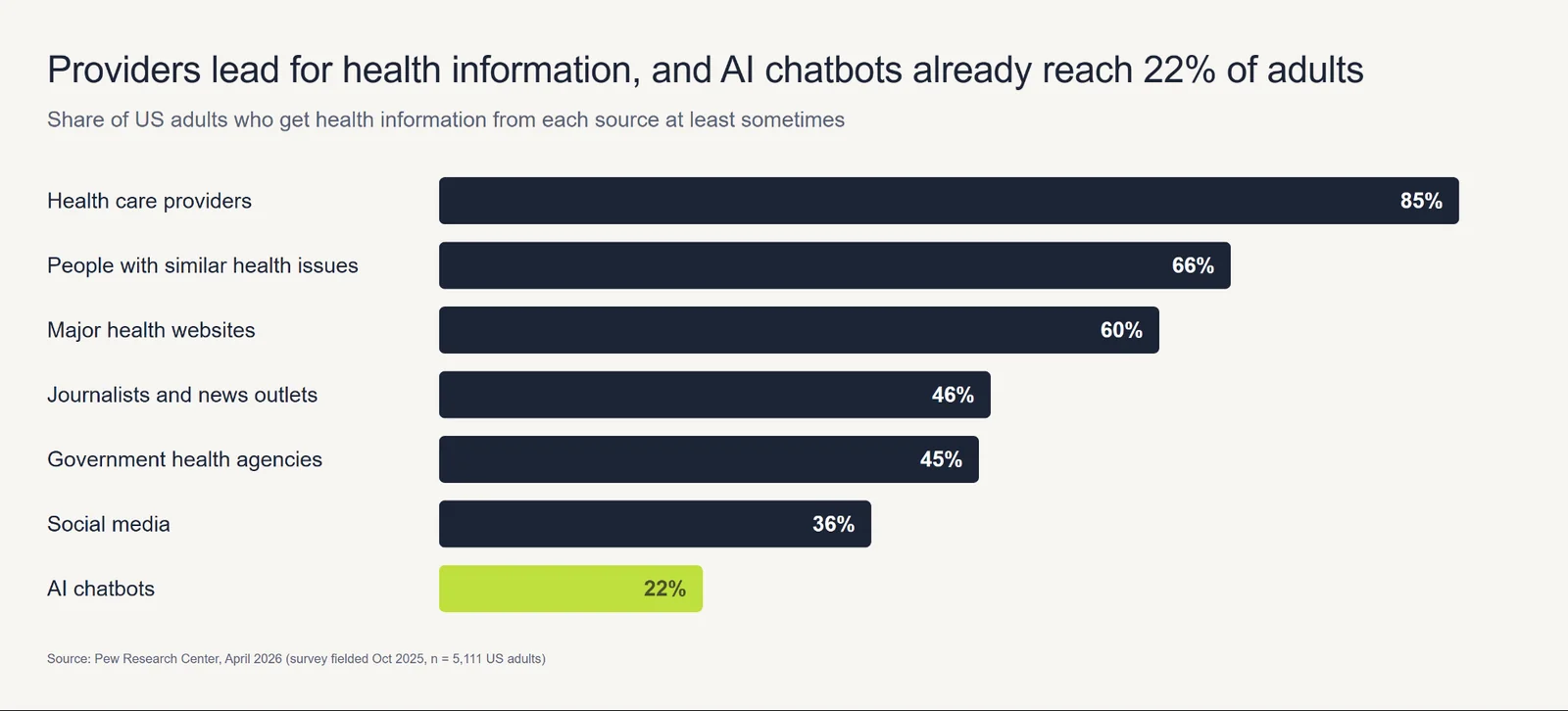
Healthcare providers remain the most widely used source of health information, while AI chatbots and social media increasingly feature in how people research care.
| Signal | Number and unit | Source | What it changes in the plan |
|---|---|---|---|
| Providers as a health information source | 85% of US adults use them at least sometimes | Pew, April 2026, n = 5,111 | Clinician credibility is still the trust anchor |
| Social media for health | 31% of US adults use it at least monthly, against 29% for AI chatbots | KFF, June 2026 | Comments and replies are research data |
| Health influencers and podcasts | 40% of US adults get health information from them | Pew, May 2026 | Messenger choice is the first creative decision |
| Virtual visits in the past year | 40% of Gen Z and 42% of Millennials, against 20% of Boomers | PwC, 2025, n = 4,030 | Convenience messaging needs age segmentation |
How Many Patients Use AI Chatbots for Health Questions?
About a third of US adults use AI chatbots for health information, and surveys land between 29% and 34% depending on wording.
KFF found that 41% of the adults who used an AI chatbot for health uploaded personal medical information, and 42% of physical-health users and 58% of mental-health users did not follow up with a clinician afterward (KFF poll, March 2026, n = 1,343). The poll does not show whether chatbot answers replace visits, but it underscores the need for accurate information where patients already look.
Rock Health's survey of 8,000 adults shows 32% had ever used an AI chatbot for health, up from 16% a year earlier. Only 5% had used a provider-offered chatbot and 4% a payer-offered one, so general-purpose tools carry most of the usage.
Pew's separate survey used different wording and put chatbot health use at 34%, so treat the surveys as separate measurements. Pew's April report, which asked about chatbots as an information source used at least sometimes, found a lower share, shown in the chart above.
Action: identify the sources your audience uses, then use social listening to collect the questions and concerns that recur across them.
How Many Adults Get Health Information From Creators and Social Media?
About 40% of US adults get health information from influencers and podcasts, and 31% use social media for health at least monthly.
Trust in creators is conditional: among adults who get health information from influencers, 10% trust all or most of it, 65% trust some, and 24% trust little or none.
Pew's content analysis of 6,828 influencers with 100,000 or more followers found 41% describe themselves as health care professionals in their profiles. KFF adds that 36% of social media health users say a major reason is to learn from people with similar experiences.
A clinician explaining a treatment and a patient describing a first visit do different jobs. Treat creators as a research channel before treating them as a media channel: their comments show what patients doubt.
How Much Do Virtual Care and Online Reviews Matter to Patients?
Deloitte reports that more than 90% of consumers who had a virtual visit would have another, and 24% would look for another doctor if a virtual appointment was not available. Virtual access is now a selection criterion.
Reviews carry weight too, although the data comes from vendors. Tebra's survey found 62% of patients had avoided booking after reading negative reviews.
How Is AI Search Changing Digital Health Marketing?
Ahrefs found AI Overviews on 43.0% of health keywords, against 20.5% of all keywords, in a study of 146 million SERPs.
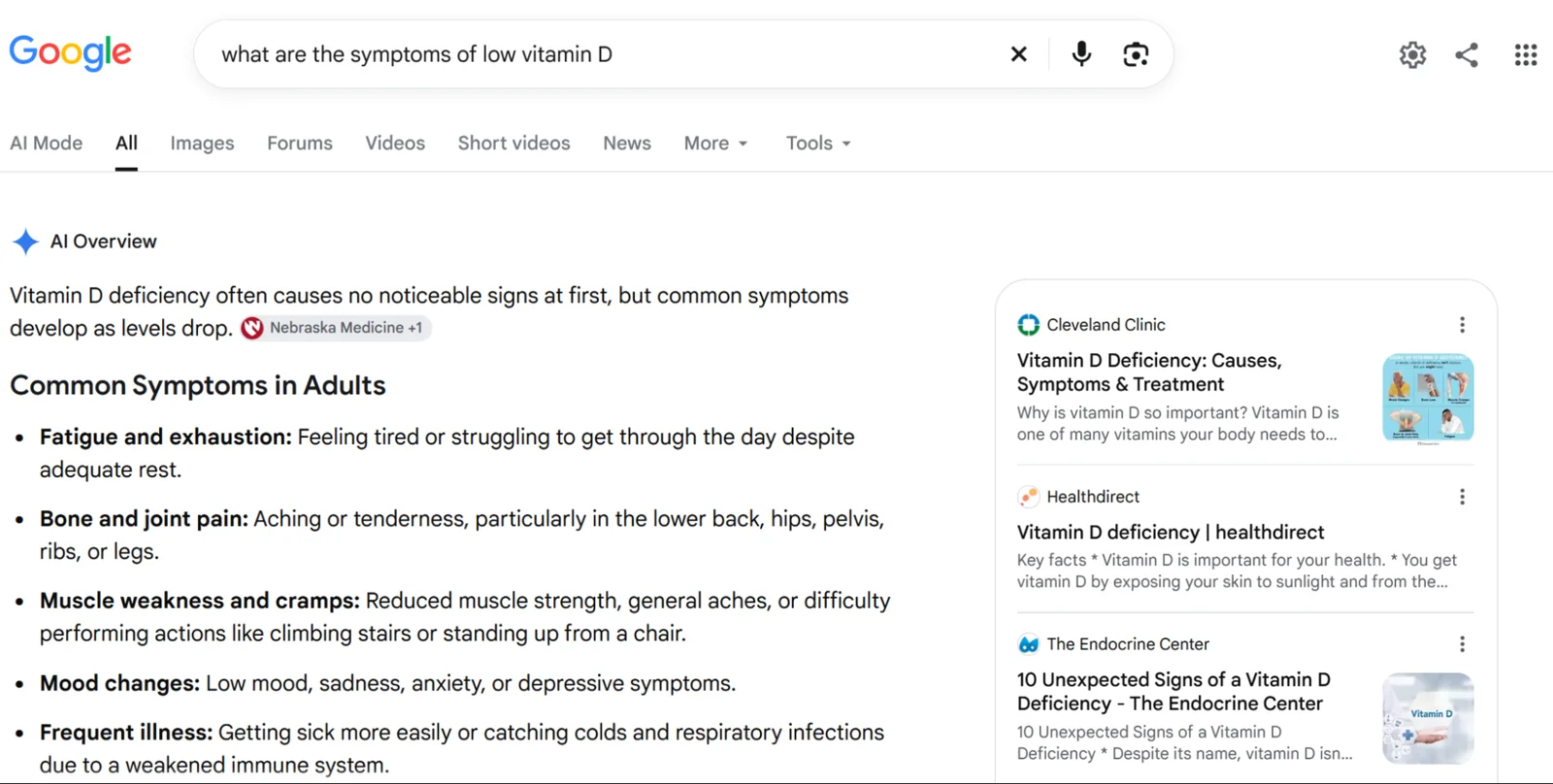
That exposure makes accuracy a marketing problem.
SE Ranking, reported by The Guardian, found AI Overviews on more than 82% of 50,807 health queries, with YouTube the most cited source at 4.43% of citations. That was a December 2025 snapshot of German-language queries, and Google disputed the implication.
A Northwestern University preprint that has not been peer reviewed tested 3,611 benchmark health questions.
Only 44.4% of top-five organic results were cited, and 22.2% of answers contained harmful content in the subset where the rubric expected a harmful claim. Benchmark questions are not live traffic, so read the figures as a risk signal.
The patient side points the same way.
In rater8's 2026 survey of nearly 1,000 US patients, 66% had seen wrong provider information from AI. The company sells reputation software to providers, so weigh it as a vendor survey.
One documented move shows where this goes.
On August 12, 2026, Zocdoc became the first health appointments connected app in the Gemini app, letting users book real-time slots across 200,000+ providers. No outcome numbers were published, so treat it as a documented move without proven results.
How Can a Health Brand Get Cited in AI Answers?
- Audit entity facts: providers, locations, services, hours and insurance on Google, directories and your own site, and fix mismatches first.
- Write answer-first pages for the ten questions patients ask most, opening each with the direct answer. Social search optimization covers the same habit for in-app queries.
- Publish useful clinician-led video on YouTube with verifiable sources. The SE Ranking citation finding comes from German-language searches, so test its relevance to your own market.
- Encourage authentic patient reviews and use privacy-safe replies that never confirm a patient relationship or reveal protected information.
- Track citations and mentions monthly with Ahrefs Brand Radar or a comparable tool.
For a lightweight monitoring routine, test the same ten patient questions in major AI tools monthly. Log factual errors and correct the underlying website or directory information where possible.
Digital Health Marketing Trends: Clinician-Led Video and Creator Content
Clinician-led video and patient perspectives are worth early testing in 2026, provided claims, disclosures and review are built into production.
Short clips are one option, although the examples below also span live Q&A, TV and longer educational video.
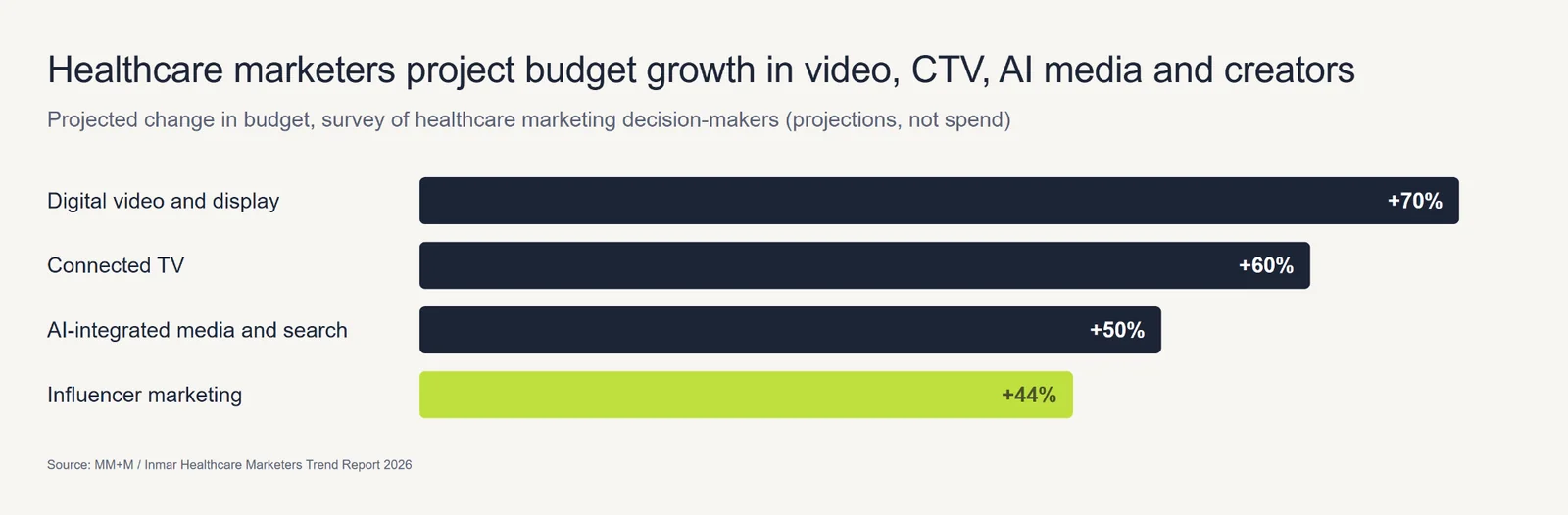
Marketers surveyed by MM+M and Inmar project influencer budgets up 44%, so the open question is which messenger carries which claim. These are survey projections of budget intent, so treat them as direction.
| Messenger | Best for | Key review checks | Brief note |
|---|---|---|---|
| Clinician creator | Symptoms, treatment options, what a procedure involves | Medical accuracy, evidence and disclosure | Speak in the clinician's own words from an approved claims sheet |
| Patient or caregiver creator | The first visit, the process, what daily life looks like | Typical-results claims, consent and disclosure | Show the experience and avoid outcome promises |
| Lifestyle creator | Routine, habit and convenience | Implied health benefits and disclosure | Tie the product to a real moment in the day |
This table is a practical guide to matching messengers with messages, rather than a legal risk ranking. Exposure depends on the claim, the supporting evidence, the product and the creator's connection to the brand. The FTC and FDA actions below inform those checks.
Which Creator Should Carry Which Health Claim?
Start with the approved message, then find the person best placed to explain it. Healthcare professional influencers explains how to source dermatologists, pharmacists, dietitians and physical therapists as creators.
Two 2026 examples show how credible messengers work beyond short-form video:
- Keck Medicine of USC, physician Reddit AMA. Vizient reports 300,000+ viewers and the top AMA topic on Reddit that day, with limited promotion through the physician's channels and Keck accounts. The view count is self-reported.
- Novartis, "Relax Your Tight End." Aired during Super Bowl LX on February 8, 2026, with NFL tight ends and Bruce Arians, a prostate cancer survivor, as peer messengers. According to the MM+M award entry, it ranked No. 7 on the USA Today Ad Meter, prostate cancer search activity ran 1.8 times above norms, and awareness among men 65 and older rose. These are award-entry claims, and the format was TV-led.
How Do You Brief Creators on Pre-Cleared Claims?
Open every brief with the approved claim and the disclosure line, then describe the scene.
Biogen and the National Ataxia Foundation ran "Nyestalgia," an unbranded four-part series with Bill Nye on Friedreich ataxia, through paid social on Meta and TikTok from September 2025 to January 2026.
The Science Guy: Back in the Lab for FA - Episode 1. Source: National Ataxia Foundation on YouTube
MM+M reports 44 million views, about 76% average completion on 4-5 minute episodes, and 169 requests for genetic-testing information in the following three months, up 1,100% on a small base.
These are agency-reported results, but they suggest longer educational stories can hold attention without establishing a short-form benchmark.
Build a five-field creator claims sheet before any brief goes out:
- Approved claims, each with its source
- Claims to avoid, including unsupported comparisons with approved drugs
- Required disclosure line and placement
- Named reviewer for medical accuracy
- Named reviewer for legal and platform policy
Healthcare Media Mix Trends: CTV, Social, and Search Budgets in 2026
MM+M and Inmar project digital at 82% of healthcare ad budgets by 2027, while search remains central to capturing existing demand.
360iResearch estimates the global healthcare marketing and communications market at $26.52B in 2026, up from $24.55B in 2025.
Search priorities depend on the audience. Local providers rely on reviews and nearby discovery, while larger acquisition teams also need to watch the cost of dependence on one channel.
In Freshpaint's survey of 200 healthcare marketing leaders, respondents reported that Google closes 58% of conversions that other channels start. Search may capture demand created earlier, which is why our healthcare paid social team tests creator-led concepts alongside search instead of giving the last click all the credit.
| Channel | Job in the plan | Evidence | Verdict |
|---|---|---|---|
| Search | Captures existing demand | Freshpaint: closes 58% of conversions others start | Keep, with a concentration cap |
| Paid social | Creates demand and carries creator creative | WordStream leads benchmarks below | Scale through tests |
| CTV | Reach | MM+M and Inmar budget projections | Pilot |
| Creator content | Trust and creative supply | Pew trust data above; MM+M +44% | Act now |
What Do 2026 Surveys Say About CTV Budgets?
Respondents to the MM+M and Inmar survey moved an average of 36% of former linear TV budget into CTV in 2025 and project CTV budgets up 60%.
Only 21% of Freshpaint's respondents use a DSP or CTV today, so adoption is early. Set a stop rule before the pilot starts.
Cost Anchors and What Is Missing
WordStream's 2026 benchmarks give two anchors for physicians and surgeons: Google search averages $40.04 per lead at a $4.76 click, and Facebook leads campaigns average $32.14 per lead at a $1.68 click. The Google data covers April 2025 to March 2026.
A lead in these benchmarks is a form or call, and a lead is not a patient. The data comes from WordStream's campaign sample, which skews to small accounts. These samples do not provide a comparable benchmark for every telehealth or direct-to-consumer health model.
Build your own: divide spend by consultations held.
For example, a $40 lead that becomes a held consultation 25% of the time costs $160 per held consultation. That figure is illustrative math, and your own lead-to-held rate replaces it. Track it weekly by channel so a cost spike shows up before the month closes.
Healthcare Marketing Measurement Trends: Patient Outcomes Replace Platform Conversions
Only 1% of healthcare marketing leaders can link more than half of spend to patient conversions, according to the Freshpaint survey above. Freshpaint sells tracking tools, so read it as a vendor survey.
A safer plan starts with an internal source of truth for qualified inquiries, bookings and held visits. Compare channels using aggregated or properly de-identified reporting, then test incrementality where volume allows.
Before disclosing any data externally, have privacy and legal reviewers assess whether PHI is involved and what permissions or authorizations apply.
Our healthcare marketing analytics guide explains how to define those events and assign ownership.
First, reconcile internal campaign records with booked and completed appointments.
Cost per held consultation is useful for patient acquisition, but patient-level visit data should remain in approved systems unless counsel establishes a lawful disclosure path.
Removing diagnosis fields or displaying a cookie banner does not, by itself, authorize sharing PHI with an ad platform.
Compare platform-reported leads with internal conversion rates and, where feasible, privacy-safe aggregate outcomes.
Many inquiries but few completed appointments may point to qualification or intake friction. A well-designed holdout can help distinguish incremental demand from conversions that would have happened anyway.
| Method | What it answers | What it needs | Healthcare caveat |
|---|---|---|---|
| Platform reporting | Which ads received credit for tracked actions | Approved tags and consent setup | Attribution is partial; avoid disclosing PHI to ad platforms |
| Lift or incrementality test | Whether spend added bookings or qualified leads | Enough volume, a valid holdout and privacy-safe outcomes | Small clinics may need longer windows |
| Marketing mix modeling | How channels contribute over time | Long, steady spend history | Slow to react to new creative |
Which 2026 Compliance Rules Change How Healthcare Marketing Trends Are Run?
Three pressures now attach to specific trends: tracking-pixel litigation, FTC privacy and endorsement enforcement, and FDA claims enforcement.
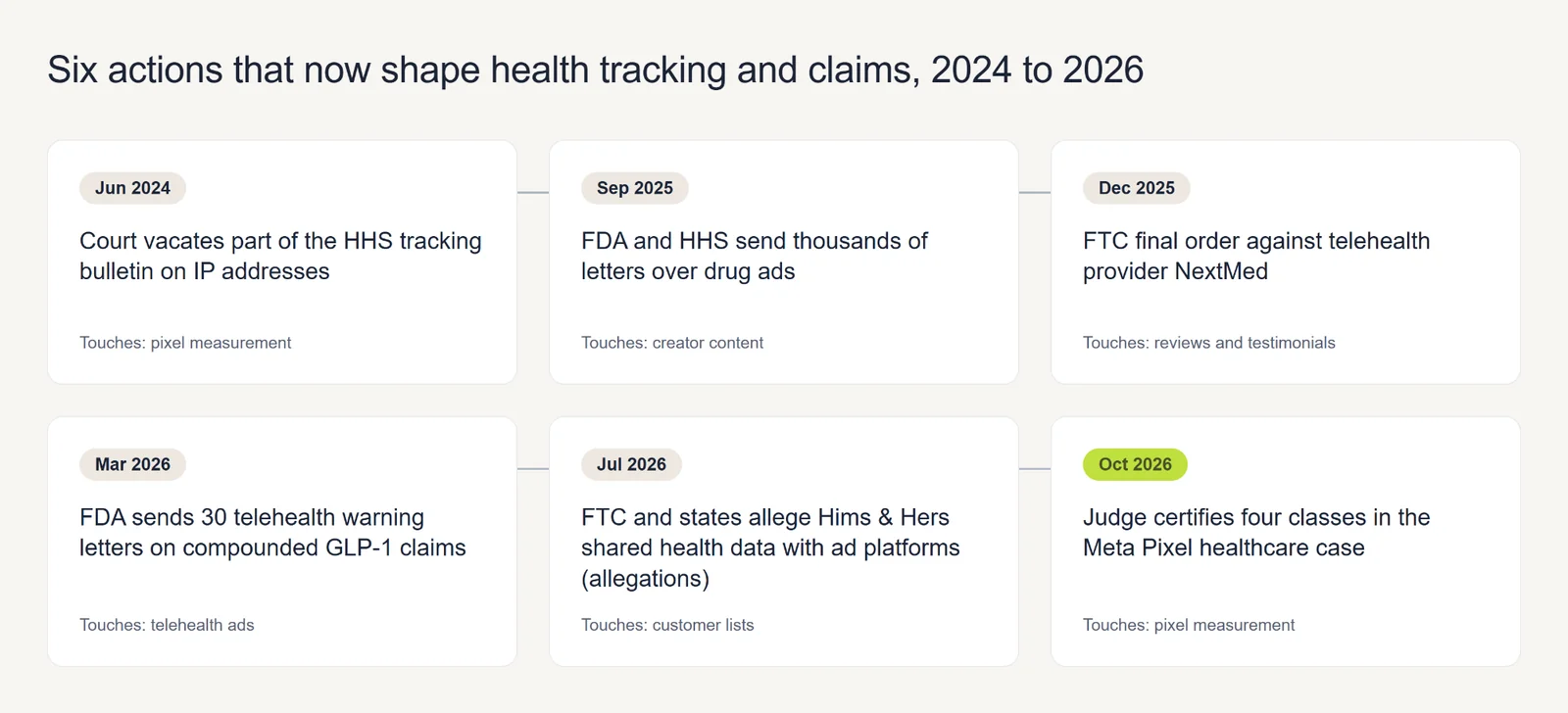
Every row below is a dated action, and the Hims & Hers entry covers allegations only.
| Date | Action | Trend it touches | What to do |
|---|---|---|---|
| Jun 20, 2024 | A federal court vacated the part of the HHS tracking bulletin covering IP addresses on unauthenticated health pages. HHS says it is evaluating next steps | Measurement and retargeting | Assess whether PHI is involved, confirm permitted disclosures, and obtain BAAs where vendors qualify as business associates |
| Sep 9, 2025 | FDA and HHS announce thousands of warning letters and about 100 cease-and-desist letters over drug ads, citing undisclosed paid influencer promotion | Creator content | Treat paid creator posts as advertising |
| Dec 2025 | FTC final order against telehealth provider NextMed: $150,000 for refunds, a ban on passing off reviews as those of real customers, substantiation for typical-results claims, disclosure of endorser connections | Reviews and testimonial creative | Substantiate every results claim |
| Mar 3, 2026 | FDA sends 30 warning letters to telehealth companies over compounded GLP-1 claims | Telehealth ads | Avoid implying sameness with approved drugs, and check the platform eligibility rules |
| Jul 29, 2026 | FTC, Utah and California allege Hims & Hers shared health information with Meta and Snap despite privacy promises. Five more states joined on Nov 10. The court has not ruled | Customer lists and lookalikes | Audit every list and event sent to ad platforms |
| Oct 30, 2026 | Judge certifies four classes in In re Meta Pixel Healthcare Litigation. Plaintiffs identify 660+ providers, Meta plans to appeal, and liability is undecided | Pixel-based measurement | Inventory every tag |
Run five checks before any launch:
- Tag inventory
- Consent and authorization checks
- Claims sheet
- Endorsement disclosure
- Platform category approval
Record who signed off on each item and keep the record where the whole team can find it.
UGC and compliance in healthcare marketing covers HIPAA, FTC and FDA exposure for creator content in more detail.
Which Trends to Delay: Brand Chatbots, AR and VR, and Unreviewed AI Output
Delay brand-owned chatbots, AR and VR, and unreviewed AI output until patient behavior and a review step support them.
Rock Health's survey, covered above, found low use of provider and payer chatbots. None of the consumer surveys cited here report AR or VR use for health decisions. AI-written health claims inherit the accuracy problem described in the AI search section, so a clinician or compliance reviewer signs off first.
Test any new trend with four questions:
- Does patient behavior data show demand?
- Can we measure a relevant outcome, such as a completed visit or qualified opportunity?
- Is the compliance question cleared?
- Do we have the creative or content capacity to feed it?
If a critical compliance or measurement gap remains, address it before testing.

Which Healthcare Marketing Trends Should Telehealth, Provider, and Health-Tech Teams Prioritize?
Telehealth and DTC teams can test claims-reviewed creator content and patient-acquisition measurement. Provider groups should prioritize reviews and accurate AI-facing entity data; B2B health-tech teams should start with privacy-safe tracking and pipeline quality. Telehealth marketing by care model goes deeper for telehealth teams.
| Organization | Prioritize first | Delay | Main risk |
|---|---|---|---|
| Telehealth or DTC | Clinician and patient creator video, held-visit measurement | Brand chatbots | Claims enforcement on compounded or prescription products |
| Provider group | Reviews, local search, AI entity accuracy | CTV before search and reviews are strong | Tracking-pixel litigation |
| Health-tech | Consent design, offline matching | Heavy creator spend before consent is clean | Privacy complaints over shared data |
The success metric should follow the buying journey: held consultations or completed intakes for patient acquisition, and qualified demos, opportunities or pipeline for B2B health-tech. Prioritize the segment where that outcome can be observed reliably.
90-Day Plan to Act on Healthcare Marketing Trends
Use the next 90 days to build a compliant measurement baseline and test one relevant creative idea. Add channels only when the audience, budget and sample size justify them.
- Days 1-30: audit tags and data flows with privacy reviewers, check what AI tools say about your services, and correct entity mismatches. Define success internally as held consultations, qualified demos or another outcome that fits your organization.
- Days 31-60: test one claims-approved creative concept with relevant creators, using the healthcare product launch plan as the calendar. If volume permits, compare two credible messengers delivering the same factual message.
- Days 61-90: review cost per completed patient outcome or qualified B2B opportunity. Run a holdout if sample size allows. Consider a small CTV pilot only where the audience fits, search and creative are established, and a stop rule is in place.
Apply the five-part compliance review before each test, then scale, revise or stop based on an outcome your team can measure responsibly.
Build a Smarter Healthcare Marketing Plan With inBeat Agency
Healthcare marketing trends matter when they help patients make informed decisions, meet claims requirements, and produce outcomes teams can measure responsibly.
At inBeat, we combine claims-reviewed creator briefs, paid social experiments, and privacy-conscious measurement for healthcare brands. Our team applies that approach to patient acquisition, while the same principles can guide campaigns for other care models.
Book a strategy call to identify the next opportunity worth testing.
FAQs
How should a telehealth brand brief creators on compounded GLP-1 claims after the 2026 FDA letters?
Brief creators from a claims sheet that bans any implication that a compounded drug equals an approved one. The FDA's March 2026 letters targeted that implication. Require endorsement disclosures and substantiation for any typical-results claim, as in the NextMed order. Add a review step where the clinician and a compliance reviewer both read the final cut against the claims sheet, because creators improvise on camera. The compliant GLP-1 marketing guide covers the brief structure.
Does an AI Overview change the value of a branded search campaign?
Keep branded search, because AI answers can carry wrong provider details and a branded ad is the version you control. Run a holdout in one region before cutting spend, and compare held visits, since branded clicks alone overstate impact.
When does a clinician creator's own post count as advertising?
A clinician's endorsement may be advertising when it is sponsored, directed or otherwise tied to a material brand connection, such as payment, free product or equity. Such connections generally require clear disclosure, and objective claims need substantiation. The FTC guidelines for influencers cover disclosure wording and placement.
How do you size a lift test when patient volume is low?
Set a minimum detectable effect and a test window before launch. When patient events are rare, use a longer window or a validated, more frequent proxy such as qualified inquiries, then monitor booked and held visits as secondary outcomes. A geographic holdout can help, but week-to-week stability alone does not prove lift.
Which healthcare consumer trend data should you trust when vendor surveys disagree with Pew and KFF?
Weigh sample, wording and seller. Pew and KFF are independent polls with published samples, while rater8 sells reputation software. Use vendor surveys for direction and cite them by name.
Do these trends apply to B2B healthcare marketing to hospitals and clinicians?
Only partly. For HCP marketing, MM+M and Inmar report display usage down 12%, social down 12% and content down 16%, while market research rose 24% and brand websites 20%. Consumer-facing creator trends matter less there, and measurement and consent matter just as much.