

Whether a GLP-1 ad can run depends on who is advertising, what is being sold and where it is shown, and the three platforms answer those questions differently.
Meta and Google gate prescription ads behind platform approval, and most advertisers need third-party certification first. TikTok's Ads pages say US prescription ads "may be allowed" with proof of regulatory approval.
This guide checks each platform's own policy pages, and sits on top of the broader healthcare marketing rules. "Not stated" indicates an unresolved policy scenario, not permission or an explicit ban; request platform confirmation before launch.
GLP-1 Ads on Meta, TikTok and Google: US Eligibility Matrix
Meta, TikTok and Google open prescription GLP-1 marketing to US advertisers only under approval or certification, and the tables below show which advertiser, product and market combinations each platform addresses.
Meta calls its approval "authorization", Google calls its approval "certification", and TikTok reviews accounts against regulator or licensing proof.
GLP-1 Ad Eligibility for Telehealth Brands, Pharmacies, Clinics and Supplement Sellers
Licensed telehealth providers, online pharmacies and drug manufacturers are the only advertiser types that Meta's Help Center lists as eligible to promote prescription drugs.
Google describes online pharmacies and telemedicine providers in similar terms.
TikTok names pharmacies and says nothing about telehealth. Neither names in-person clinics that offer GLP-1 injections.
Supplement and wellness brands must also review the claim and creative restrictions below, particularly when a product is positioned as an alternative to an approved prescription drug.
Sources: Meta Drugs and Pharmaceuticals, Meta Help Center, Google prescription drug services, TikTok healthcare and pharmaceuticals.
GLP-1 Ad Rules by Product Type and Country
Meta limits prescription ads to the US, Canada and New Zealand, while Google allows prescription drug services in 32 listed locations that include all three, so a US-first plan works on both platforms. Google publishes country-by-country tables.
The cited Ads policies do not establish a blanket GLP-1 exception. TikTok Shop has separate restrictions on prescription-drug sales and on products claiming to act like GLP-1 medicines. Its October 30, 2026 US guidance also covers Shop promotional videos and LIVEs, including creator content. This is distinct from paid TikTok Ads eligibility.
For TikTok, evaluate paid Ads, TikTok Shop, and sponsored creator posts separately. Each placement may have different eligibility and disclosure requirements.
LegitScript, Meta Authorization and Google Certification: What Each Platform Requires
Meta requires LegitScript certification before authorizing telehealth providers and online pharmacies, Google may require LegitScript, NABP or G2 accreditation before its own certification, and TikTok asks for regulator or licensing proof.
LegitScript certification costs a $975 application fee and a $2,150 annual fee per website, with an expedited review available for $2,500 more.
Two items are missing from the primary pages we read. Google states no review timeline and no fee for its own certification, and LegitScript gives a timeline only for its expedited option, where review starts within 2 business days.
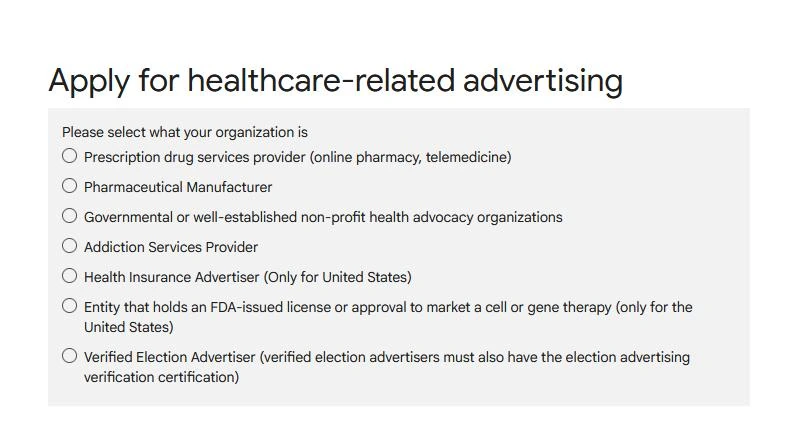
Plan for the LegitScript step to come first for telehealth providers and online pharmacies, because Meta requires it and Google may.
Policy Sources and Last-Checked Dates
This ledger records the policy pages and dates reviewed. A change-log date alone does not confirm campaign eligibility. Recheck each linked policy and account approval before launch.
Weight Loss Advertising Policy: Rules That Apply Without Naming the Drug
Every weight-loss ad on Meta must target people 18 or older, and TikTok restricts weight-loss claims to audiences 18 and up.
These weight loss advertising policy rules apply to clinics, coaching brands and supplement sellers even when the ad never mentions a prescription drug.
The practical read is that creative approved for a dietary product can fail review the moment it implies the same result as a prescription drug. Review every claim against the relevant platform policy before reusing the creative.
Five GLP-1 Advertising Policy Claims, Fact-Checked
Compliance guides circulating online make claims about Meta and TikTok rules that the policy pages do not support, and at least one headline claim is wrong for US advertisers. Each row below compares a circulating claim with the policy page itself.
Meta's rules for cosmetic-procedure depictions should not be generalized to prescription GLP-1 or other weight-loss ads. TikTok's healthcare page bars before-and-after comparisons for over-the-counter medicines, medical devices and food supplements.
Secondary guides take positions that run from "prohibited" to "allowed for cosmetic procedures", so confirm weight-loss before-and-after creative in an Ads Manager review before building around it.
FDA and FTC Rules for GLP-1 Ads on Top of Platform Policy
Platform approval is separate from FDA and FTC compliance. FDA prescription-drug advertising requirements include a fair balance of benefit and risk information, with appropriate presentation of material risks when making product claims.
Approved indications also matter: Wegovy and Zepbound have weight-management indications, while Ozempic and Mounjaro are approved for other indications, including type 2 diabetes.
A platform's approval does not authorize promotion for an unapproved indication. Compounded drugs are not FDA-approved and must not be marketed as equivalent to approved products without adequate support.
- Sep 9, 2025: the FDA launched a crackdown on deceptive drug advertising, sending about 100 cease-and-desist letters and naming undisclosed paid influencer promotion as a target.
- Mar 3, 2026: the FDA warned 30 telehealth companies about illegal marketing of compounded GLP-1s.
- Jun 15, 2026: FDA guidance for telehealth companies lists claims to avoid, including calling a compounded drug a "generic version" or clinically proven to give the same result as an approved one.
- Ongoing: the FTC requires appropriate substantiation for health claims, and creator posts fall under its endorsement rules, covered in our FTC guidelines for influencers.
The compounding background is covered in our GLP-1 marketing strategy guide, so it is not repeated here.
Landing Page and Creator Content Rules for GLP-1 Ads
Review the complete ad experience, including the destination. Meta reviews ad destinations, including landing pages, under its Advertising Standards; Google evaluates healthcare claims on landing pages; and TikTok's weight-management restrictions also extend to relevant destination claims.
Meta has separate prescription-ad disclosure requirements. Sponsored creator posts require an additional check against platform branded-content rules and FTC disclosure guidance.
Check personalized-advertising restrictions before building audiences from sensitive health signals.
For creators, apply FTC disclosure guidance and the platform's specific branded-content rules. Approval of a paid ad does not establish permission for every sponsored creator placement.
How to Check a GLP-1 Campaign Against the Matrix Before Launch
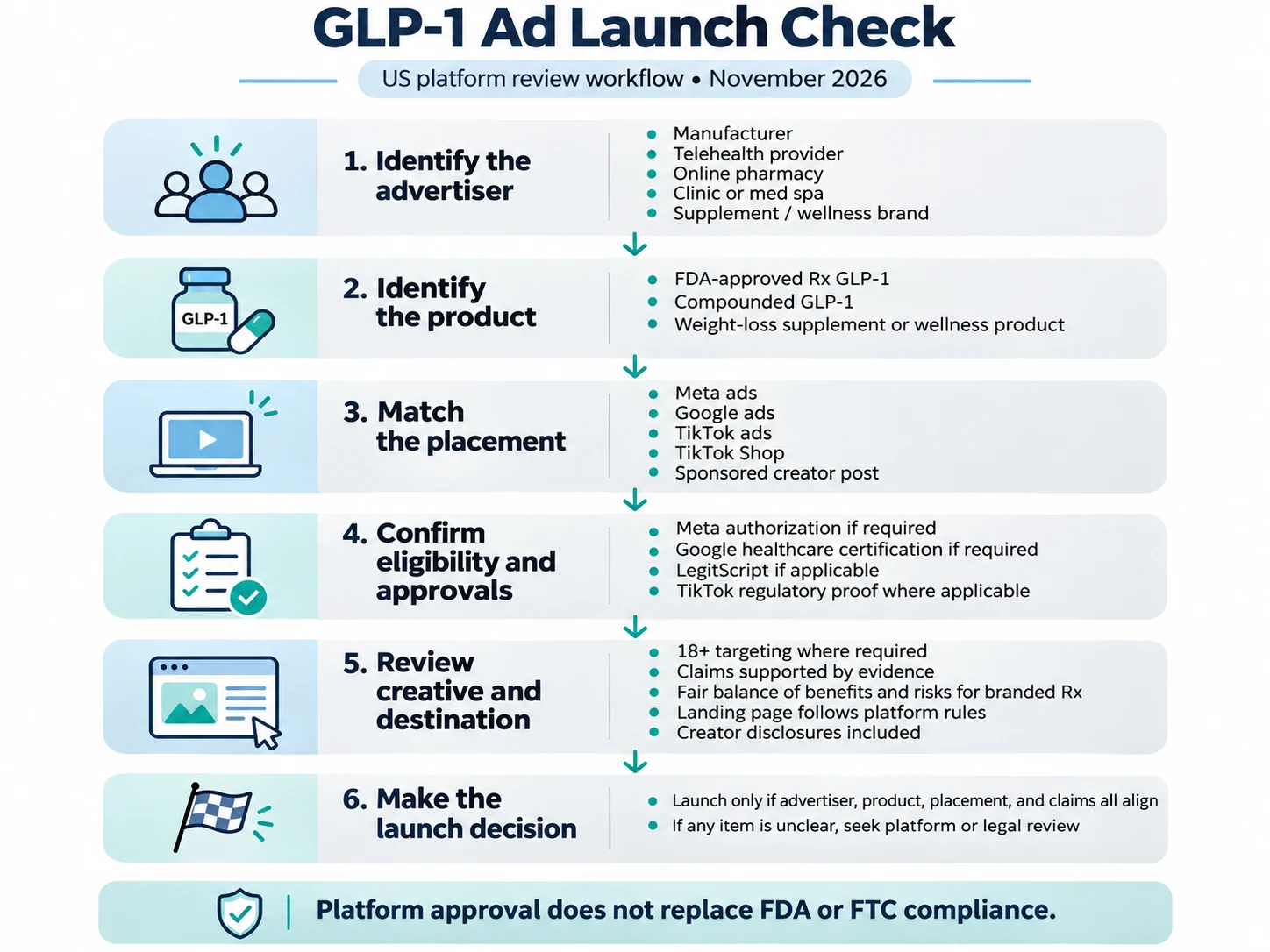
Run these seven checks in order, because the approval and creative checks depend on the first three answers.
- Name the advertiser type: manufacturer, licensed telehealth or pharmacy, clinic, supplement brand or coaching brand.
- Name the product type: branded Rx, compounded drug, supplement, surgery or education only.
- Confirm the market. Meta limits prescription ads to the US, Canada and New Zealand, and Google lists 32 locations.
- Apply for LegitScript certification first if you sell branded Rx online as a telehealth provider or pharmacy, and budget the fees listed in the approval section. Manufacturers can apply through Meta's internal review, which does not require LegitScript.
- Apply for Meta authorization, Google healthcare certification or TikTok review, depending on the platform.
- Review each ad and landing page against the creative table above and the FDA claims to avoid.
- Record the policy page and its date from the ledger in your launch file.
Can You Run GLP-1 Ads in 2026? The Short Answer
A US GLP-1 campaign may qualify, depending on the advertiser, product, market and platform review. Meta and Google offer authorization routes for certain manufacturers, telehealth services and pharmacies.
TikTok says qualifying US prescription ads may be allowed after review: regulator proof alone is not automatic approval. Confirm clinic and compounded-program eligibility individually, and comply separately with FDA and FTC requirements.
If you want a second set of eyes before submitting, our healthcare marketing agency runs this review on GLP-1 launches, and you can book a call to go through your setup.
FAQ
Does Meta authorization cover compounded GLP-1 ads?
Meta's policy pages never mention compounded drugs, so nothing at source says authorization extends to them. Treat any approval as covering the specific product named in your application, and check with your Meta representative before running compounded creative.
Can a med spa run GLP-1 ads on Meta or TikTok?
Meta's published prescription-ad eligibility list does not specifically include standalone med spas or in-person clinics; TikTok's cited Ads policy likewise does not resolve GLP-1 injections by clinics. This is an eligibility gap, rather than proof of a blanket ban. Seek written platform confirmation for the advertiser and treatment before launch.
Can TikTok creators post GLP-1 content for a telehealth brand?
Possibly, but permission for a TikTok Ad does not automatically authorize a sponsored creator post or TikTok Shop promotion. Check branded-content and healthcare rules for the actual placement, disclose payment clearly, and substantiate medical claims.
How often do these policies change?
Often enough to re-check before every launch: the policy sources above show Meta, TikTok and the FDA each moving within the past year, and Google dates none of its pages. Record the date you checked in your launch file.