

Patients trust physicians for medical advice. What changes when that advice appears in a sponsored Instagram Reel?
The distinction between education and promotion becomes crucial.
In a JAMA analysis of 740 high-engagement posts about three prescription-drug classes, 511 made efficacy claims. Only 165 of those posts (32.3%) mentioned risks or adverse effects.
Pharma brands must consider clinical accuracy, sponsorship disclosures and regulatory responsibilities before publishing.
This guide explains three practical content lanes, review ownership and escalation procedures for physician creator programs.
TL;DR
- Pharmaceutical influencer marketing covers three different jobs: HCP education, unbranded disease awareness and branded prescription promotion. Each needs a different lead reviewer and a different level of scrutiny.
- FDA promotional-media guidance addresses company involvement in third-party communications, while FTC endorsement rules address material connections and disclosures. Sponsorship, responsibility for content and product-promotion status require separate assessments.
- Approvals cover every artifact the viewer sees, including captions, overlays, links, the final cut and the script.
- Name one owner per document and one escalation owner per incident before the first creator is briefed.
- Physician creator fees may fit existing Open Payments categories, such as consulting or other services. Counsel and compliance should assess the recipient, payment, reporting entity and applicable exceptions.
- Measure each lane against its own goal. A single reach number hides the lane that carries the risk.
What Is Pharmaceutical Influencer Marketing and Who Counts as a Physician Influencer?
Pharmaceutical influencer marketing involves creator content about a disease area or prescription product, including sponsored education and product advertising.
Assess the content, any company role in developing or distributing it, the intended audience and material connections separately.
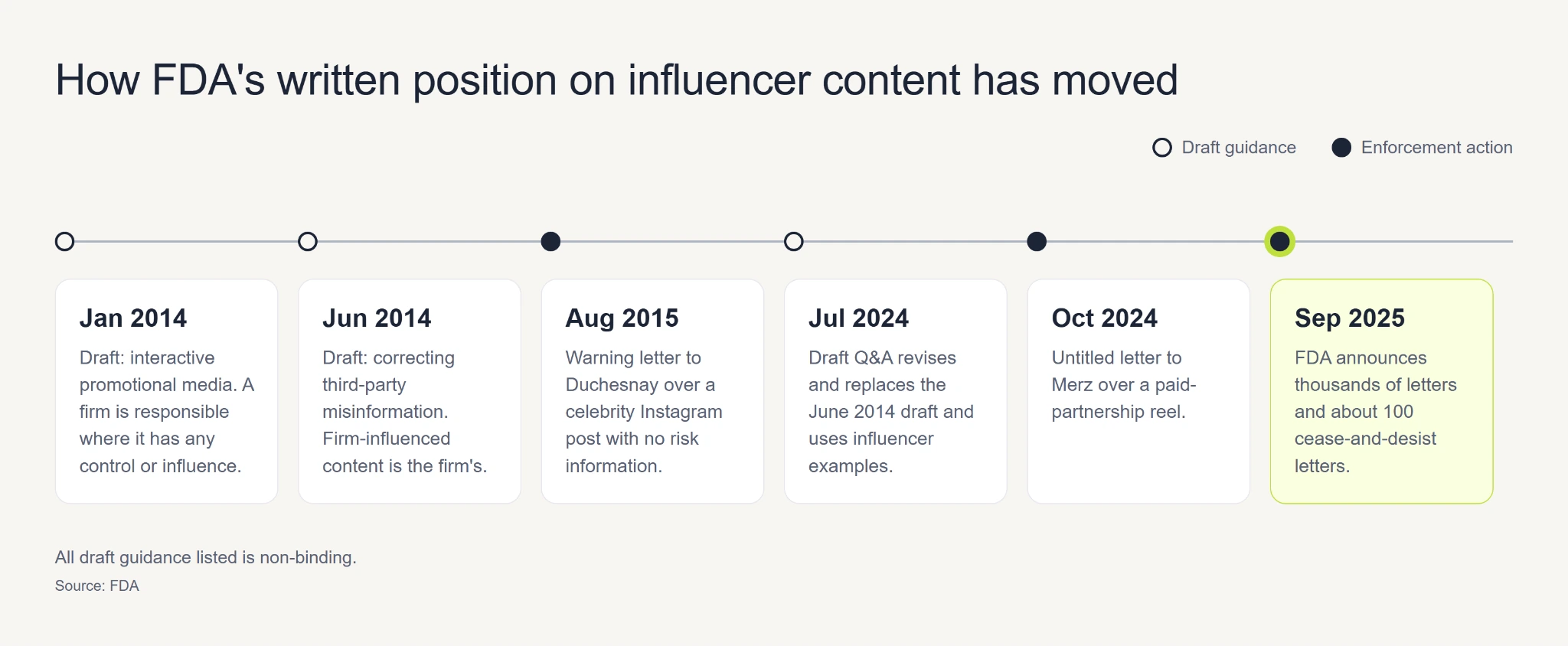
FDA's 2014 interactive promotional media draft discusses firm responsibility for third-party promotional content it influences.
A different FDA draft, issued in July 2024, addresses firms responding to misinformation spread by independent third parties; it should not be used as a general influencer-advertising rule.
Physician influencers, patient advocates, and paid speakers have distinct roles and responsibilities, although a single creator may fit more than one category.
| Creator type | Typical relationship to the company | What a brand can reasonably ask for |
|---|---|---|
| Physician influencer | Licensed MD or DO with a public audience. May be unpaid and organic, or contracted. | Education the physician writes under their own judgment, with sponsorship disclosed |
| Patient advocate | Person with lived experience, often supported by the company | Personal story content inside approved boundaries, with disclosure |
| Paid speaker or KOL | Compensated to present on the company's behalf | Content that FDA's 2014 interactive media draft treats as made on behalf of the firm |
The label "physician influencers" is sometimes used too broadly for non-physician creators, such as pharmacists, dietitians and physical therapists.
Those professions, their pricing and how to vet them sit in our healthcare professional influencers guide.
This article stays on US prescription drugs, where the review burden is heaviest, and does not cover OTC, supplements or other countries.
Can Pharma Companies Work With Influencers?
Yes, subject to the applicable advertising, labeling, endorsement and professional rules. FTC's 16 CFR 255.5 Example 4(ii) illustrates disclosure of a paid physician endorsement.
FDA's July 2024 misinformation-response draft has a narrower purpose and does not create a general approval process for influencers. Ask legal, regulatory and MLR reviewers to determine requirements for each proposed campaign.
Three Lanes of Pharma Creator Content: HCP Education, Unbranded Awareness and Branded Promotion
For planning, this guide uses three operational lanes: HCP education, unbranded disease awareness and branded prescription promotion.
These are workflow categories, not three formal FDA classifications.
A post's content, context, links, sponsor involvement and distribution determine which rules and internal reviews may apply. The creator's professional title alone does not classify the post.
| Lane | What the content does | Names a product? | Main audience | Who must review | Main risk signal |
|---|---|---|---|---|---|
| HCP education | Teaches clinical or disease topics from the physician's own judgment | No | Clinicians, informed public | Medical affairs, compliance | Sponsor involvement requires disclosure and a responsibility assessment; it does not automatically make the post a branded drug ad |
| Unbranded awareness | Helps people recognize symptoms and talk to a doctor | No | Patients and caregivers | Medical, regulatory, compliance | Links, tags or follow-ups that point to a brand |
| Branded promotion | Names a product and makes claims | Yes | Patients, HCPs | Medical, legal, regulatory (MLR) | Missing risk information, unsupported claims |
These are the lead reviewers for each lane. The ownership table below lists every role that signs a document, whatever the lane.
HCP Education Content
HCP education is content in which a physician explains a condition, a mechanism or a care pathway under their own medical judgment, with no product claims.
The AMA's opinion on social media expects physicians to publicly disclose financial interests related to their content, including paid partnerships and corporate sponsorships.
Funding, topic suggestions or script review can create a material connection or establish company involvement that needs assessment.
They do not, by themselves, turn every educational post into branded prescription advertising. Record who proposed the topic, paid the creator, reviewed drafts and controlled publication before production begins.
Unbranded Disease Awareness Content
Unbranded disease awareness content describes a condition and encourages people to seek care without naming a drug. FDA's CBER advertising Q&A describes disease awareness communications as ones that do not mention any specific drug or device, and describes help-seeking communications as directed at consumers.
A typical disease awareness campaign asks a physician or patient creator to explain early symptoms and suggest a conversation with a clinician.
Unbranded does not mean unsponsored. A peer-reviewed review of patient influencers describes FTC guidance as open to interpretation when no brand name appears, so the sponsor relationship still needs a clear, visible disclosure.
Branded Prescription Promotion
Branded prescription promotion that identifies a drug and makes product claims can trigger prescription-drug advertising requirements, including truthful presentation of benefits and risks.
FDA distinguishes advertisements from promotional labeling; the classification depends on the communication and applicable rules. For prescription-drug advertisements, 21 CFR 202.1 addresses requirements such as fair balance and risk information.
The clearest recent example is the Xeomin reel.
FDA's untitled letter to Merz, e-signed 31 October 2024, concerned a post made by Merz on its Xeomin Aesthetics account and by Nate Berkus on his own account in paid partnership.
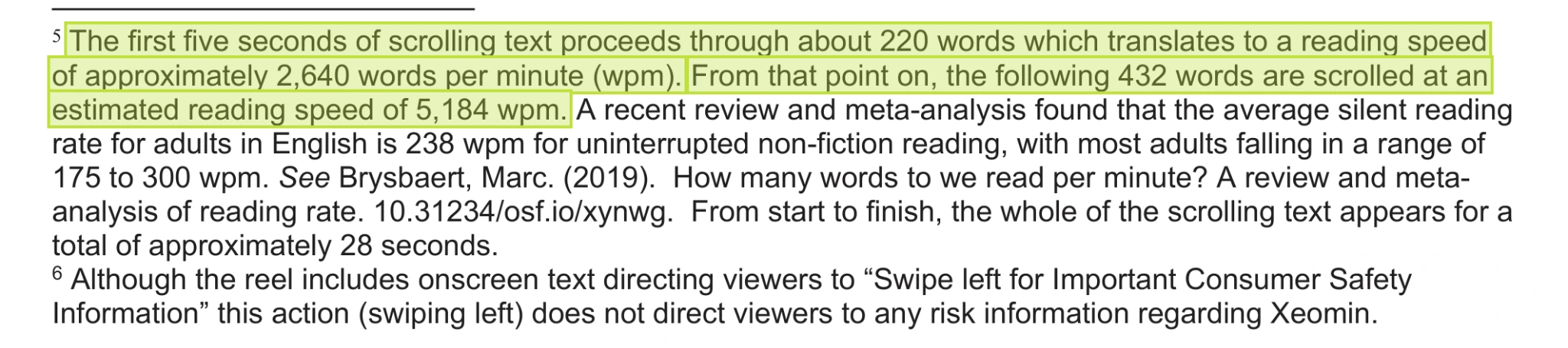
Risk information appeared only after about three seconds of a black screen, in small scrolling text. The first five seconds of that scrolling risk text carried about 220 words, roughly 2,640 words per minute, and the next 432 words ran at about 5,184 words per minute.
FDA compared that to an adult silent reading average of 238 words per minute, with most adults between 175 and 300. The letter went to the company, and it asked for a written response within 15 working days.
An older case shows that a link to safety information does not rescue a post.
In 2015, FDA issued a warning letter to Duchesnay over a Kim Kardashian Instagram post that presented efficacy claims without risk information, and said links to safety pages did not mitigate the omission. The linked copy is hosted by a third party; FDA's own copy was not located.
Where the Three Lanes Blur
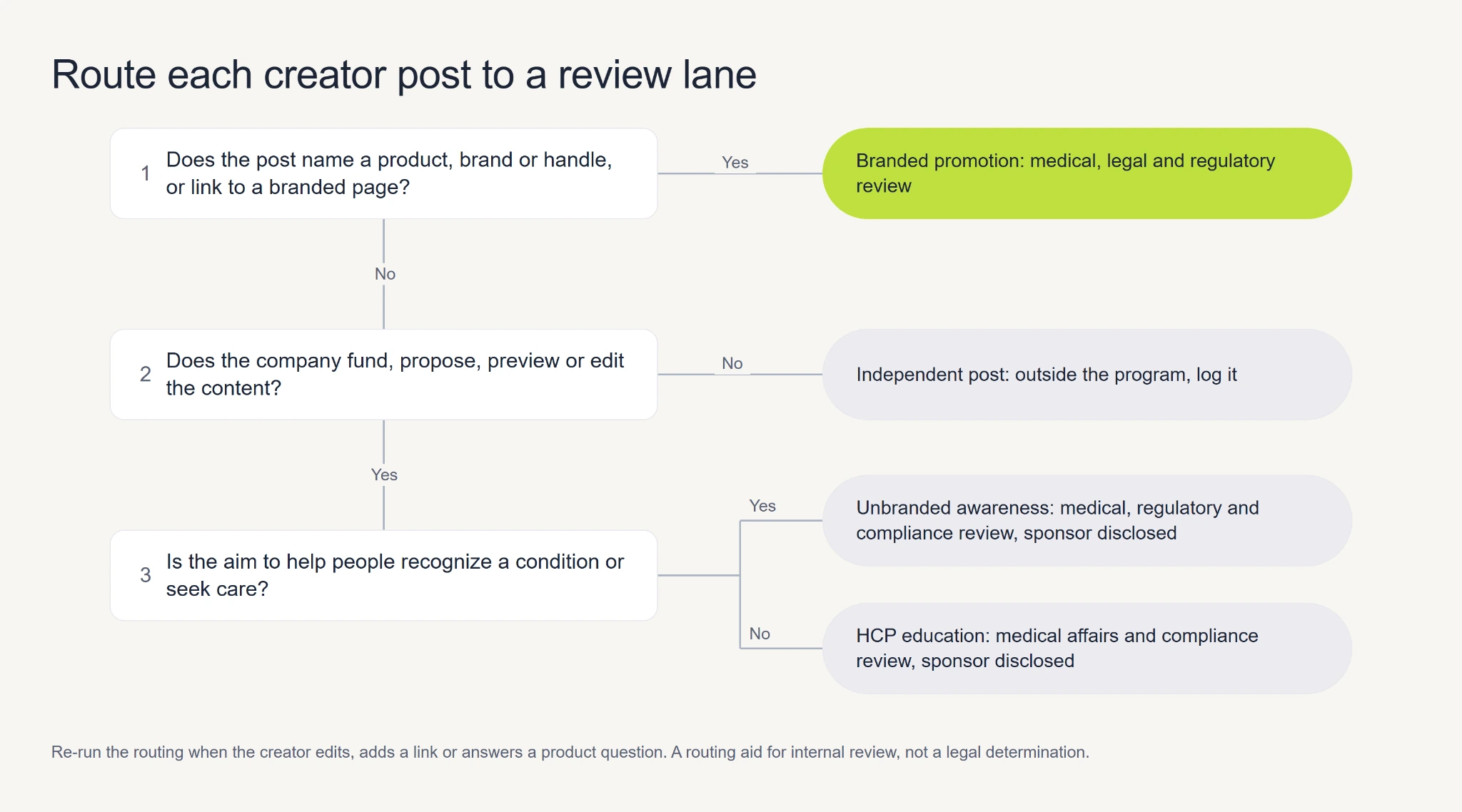
The lanes blur when a post starts in one and ends in another, and three patterns cause most of the confusion:
- An unbranded awareness post that links to a branded landing page in the caption or comments.
- An HCP education video where a viewer asks about a named drug and the creator answers in the comments.
- A creator who adds a brand tag or handle after the content was approved.
Document the proposed lane before briefing, then recheck it when captions, links, tags or replies change.
If content crosses categories, hold publication or further distribution and ask regulatory and legal reviewers to assess its actual promotional status rather than assuming a label resolves the issue.
What FDA and FTC Sources Say About Pharma Influencer Content
These sources cover different questions. FDA's 2014 interactive promotional media draft addresses firm involvement in promotional communications; FDA's July 2024 draft concerns responses to independent third-party misinformation.
FTC endorsement rules focus on advertising endorsements, advertiser responsibilities and disclosure of material connections. Paying a creator is relevant, but does not alone decide whether a post is branded prescription-drug promotion.
The table lists what each source says and whether it is binding.
| Source | What it says | Status |
|---|---|---|
| FDA June 2014 misinformation-response draft | Describes voluntary correction of independent third-party misinformation about prescription drugs and medical devices | Draft, non-binding; revised and replaced by the July 2024 misinformation-response draft |
| FDA July 2024 draft Q&A | Concerns companies correcting misinformation from independent third parties, including examples involving influencers | Draft, non-binding; specific to misinformation-response communications |
| 16 CFR 255.1 | Advertisers can be liable even when the endorser is not; they should give guidance, monitor and remedy | FTC Endorsement Guides (interpretive guidance) |
| 16 CFR 255.5 | Material connections must be disclosed clearly and conspicuously; Example 4(ii) covers a paid physician posting on social media | FTC Endorsement Guides (interpretive guidance) |
| FDA press release, 9 Sep 2025 | Names undisclosed paid influencer promotion; warning letters to pharma were one in 2023 and zero in 2024 | Agency announcement |
The White House fact sheet that accompanied the announcement put direct-to-consumer spending at over $10 billion in 2024 and described influencer campaigns as not sufficiently monitored for compliance with law.
The FTC's Endorsement Guides Q&A offers four practical checks for sponsored creator posts:
- Disclose material connections in each sponsored endorsement.
- Place disclosures where viewers will notice them; a profile badge alone is insufficient.
- Do not rely on a TikTok description alone to make sponsorship clear.
- For video, disclose both visually and audibly when the endorsement uses sight and sound.
Our FTC guidelines explainer covers the general rules.
These sources are not interchangeable: internal legal and regulatory reviewers should apply the binding rules and relevant guidance to each proposed communication.
Which Documents Need Review Before an HCP Creator Post Goes Live?
HCP creator approvals cover every document and artifact a viewer will see, from the lane classification to the final cut with its captions, overlays and links. The Merz letter shows why: the failure sat in how risk information was presented in the finished reel, so a reviewer who only approved a script would have missed it.
| Document | What the reviewer checks | Why this stage matters |
|---|---|---|
| Lane classification record | Which lane, who proposed it, any blur risk | Sets the review path for everything below |
| Creator vetting file | License status, employer or institution policy, past sponsorships | A creator's credentials are part of what the audience trusts |
| Signed agreement | Disclosure duty, change control, takedown, term | Defines what happens when content changes |
| Brief and approved claims sheet | Only approved statements, no off-label suggestions | Keeps the creator's words inside the boundaries |
| Script or talking points | Accuracy, balance, no unsupported claims | Cheapest stage to fix a problem |
| Rough cut | Visual presentation, pacing, any on-screen product references | Catches presentation issues the script hides |
| Final cut with caption, overlays, links, tags | Everything the viewer sees together, including risk information placement | The step the Merz letter turns on |
| Disclosure text and placement | Visible, audible where relevant, present on each post | The FTC wants disclosure in each ad |
| Adverse event language and comment settings | Reporting path and who monitors | Sets up the monitoring step |
Use the table as the production checklist.
Before release, confirm that the approved final cut exactly matches the posted package, including disclosures, captions, tags, links and comment settings.
Pro tip: lock the claims sheet and send the creator only that sheet, so the physician's own phrasing stays inside approved statements. Our influencer brief templates show how to structure the sheet.
Who Owns Document Review for Physician Influencer Content
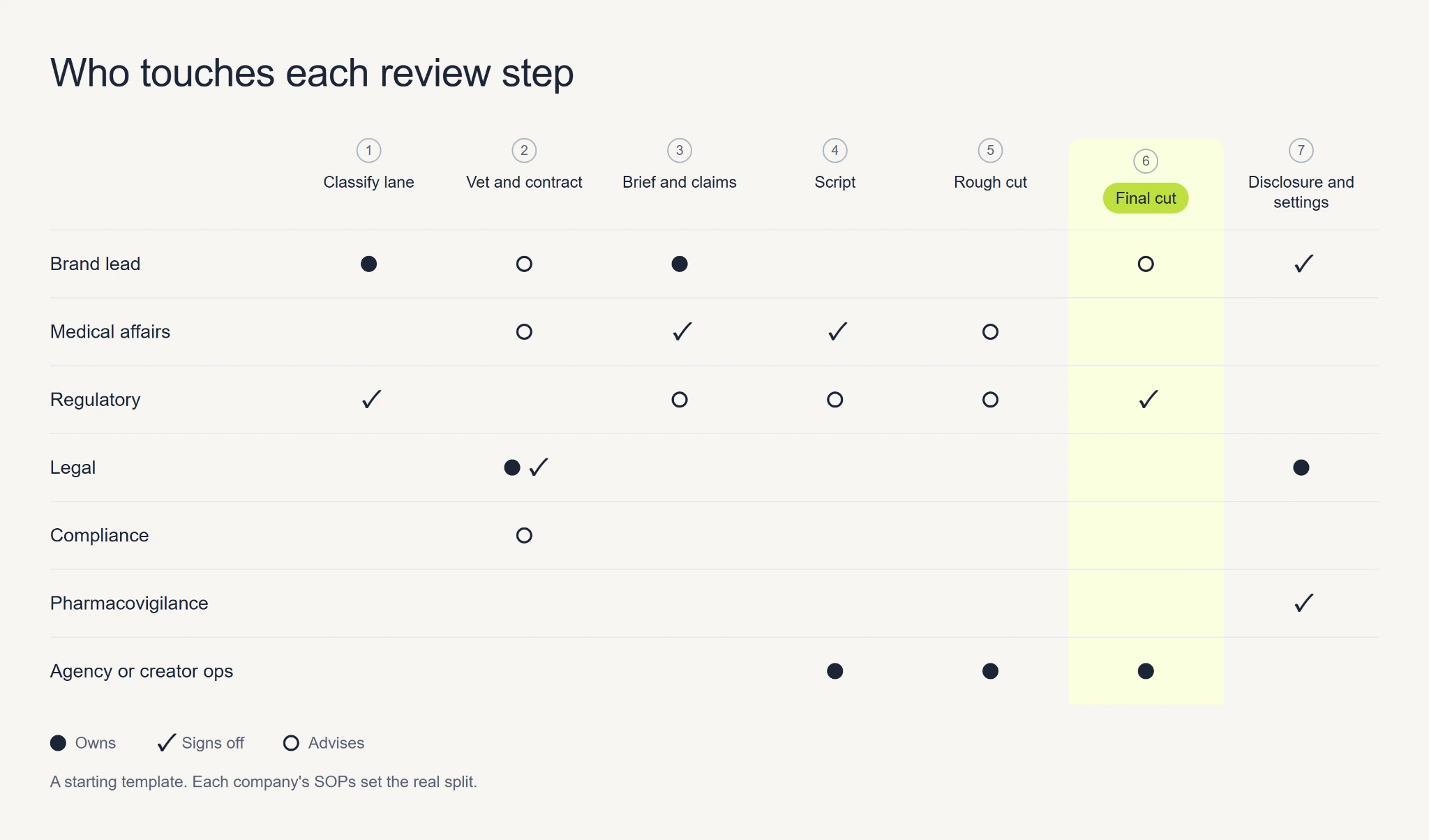
Assign a named owner for every artifact and incident. A campaign owner can coordinate release, but promotional material should go live only after all required medical, legal and regulatory sign-offs under the company's SOPs.
The table is a starting template. It is not a statement of what the law requires, and each company's SOPs decide the final split.
| Role | Owns | Advises | Signs off |
|---|---|---|---|
| Brand lead | Brief, campaign calendar, lane classification proposal | Creator selection | Schedules release after all required MLR approvals; does not replace medical, legal or regulatory sign-off |
| Medical affairs | Scientific accuracy of claims and talking points | Physician vetting | Claims sheet, script and scientific accuracy of the final execution, as required by SOP |
| Regulatory | Lane classification decision (promotional or non-promotional), risk presentation | Submission obligations | Promotional classification, final cut, claims presentation, captions and links |
| Legal | Agreement terms, disclosure duty, payments structure | Content ownership | Agreement |
| Compliance | Payments policy, speaker and consultant rules | Creator conflicts | Payment terms |
| Pharmacovigilance | Adverse event intake path | Comment monitoring rules | Adverse event language |
| Agency or creator ops | Execution, versioning, archive | Production timing | Nothing; submits for approval |
FTC endorsement guidance supports training, monitoring and remediation. Name the person who verifies that the complete publication package carries the required MLR approvals before the brand lead schedules it; put changes after approval back into review.
Set review turnaround at kickoff. Pharma review cycles run on their own clock, and a creator who posts on a weekly rhythm cannot wait on an undefined queue
In the inBeat healthcare workflow, briefing, revisions, approval cycles and compliance review run through one tracked flow, and the client's review team keeps sign-off.
Physician Influencer Payments and Contracts: What to Take to Counsel
Open Payments rules use existing categories for transfers of value, including consulting and compensation for services other than consulting.
A physician's social-media fee may be reportable even without an influencer-specific label. Assess whether the recipient and manufacturer are covered, the nature of payment, any exclusion and reporting obligations with compliance and counsel.
CMS does not give case-specific determinations.
Document how each arrangement was classified rather than assuming the absence of the word "influencer" creates an exemption.
| Topic | What the source says | Open question for counsel |
|---|---|---|
| Fair market value | PhRMA Code section 6: consultant pay should be reasonable, based on fair market value and not tied to business volume | How is a creator fee benchmarked? |
| Speaker-type arrangements | OIG speaker alert: warns about pay above fair market value and pay tied to business volume; company and HCP could be liable | When does a creator deal resemble a speaker program? |
| Open Payments | Covered-recipient and transfer-of-value rules may encompass physician creator fees under existing payment categories | Which payment category, recipient rules and exclusions apply to this creator fee? |
| Disclosure of payment | 16 CFR 255.5 Example 4(ii): a paid physician should disclose; AMA Opinion 2.3.2 expects disclosure of financial interests | What wording and placement does each channel need? |
| Employer or institution policy | Not covered by the sources reviewed | Does the physician's employer permit paid content? |
| Content ownership and takedown | Not covered by the sources reviewed | Who can edit, repost or remove, and for how long? |
The PhRMA Code describes bona fide consulting arrangements, including a legitimate need, written terms and appropriate selection criteria. OIG's speaker-program alert identifies risk factors for paid promotional speaking.
A social-media deliverable is not automatically a speaker program, but comparable compensation, selection and inducement risks still warrant review.
For the licensing side of content reuse, our UGC usage rights guide explains the terms to specify.
How to Monitor Pharma Influencer Content After It Goes Live
Monitoring means someone reads comments, tracks edits and watches for reshares on a defined schedule, with each finding routed to a named owner. Monitoring also feeds pharmacovigilance.
Comments and Adverse Event Intake
Comments are where a possible adverse event is most likely to appear. Under 21 CFR 314.80, applicants must promptly review adverse drug experience information obtained from any source, serious and unexpected events go into 15-day alert reports, and a non-applicant that elects to send reports through the applicant must do so within 5 calendar days.
The regulation does not mention social media. FDA's July 2024 draft Q&A links the two in a footnote, saying adverse drug experience information a firm obtains is subject to those reporting requirements.
Before launch, settle three comment-handling decisions:
- Decide whether comments stay open on each creator post.
- Assign the brand or agency account that monitors and records comments.
- Define how possible adverse events reach pharmacovigilance under the company's SOP.
These are program-level decisions. Reporting obligations remain with your pharmacovigilance and regulatory teams.
Monitoring Cadence and Triggers
Pharma social media listening for creator posts works best on a fixed cadence with defined triggers:
| What to watch | Who watches | Trigger | Next step |
|---|---|---|---|
| Comments on the post | Brand or agency moderator | Possible adverse event, off-label question | Route to pharmacovigilance or medical affairs |
| Edits to caption or video | Agency or creator ops | Any change after approval | Pause and send back to review |
| Reshares, stitches, duets | Agency or creator ops | Reuse by third parties with new claims | Log and review |
| Product mentions in an unbranded post | Brand lead | Creator names a drug | Reclassify the lane, escalate |
Our social listening guide covers tooling for tracking mentions and comment themes.
Archiving and Submission Records
Archive every approved version and every posted version with its date, caption, links and disclosure.
FDA's 2014 interactive promotional media draft discusses submission of promotional materials to FDA, and regulatory affairs should confirm what applies to each creator post and when.
What Escalation Paths Does Pharma Influencer Content Need?
Escalation paths should be defined before launch, with a named owner and a time limit for each trigger. The table lists common triggers and a suggested first move.
| Trigger | First action | Escalate to | Time limit |
|---|---|---|---|
| Post edited after approval | Pause the post, capture the current version | Regulatory, with the brand lead informed | Same business day |
| Comment reports a possible adverse event | Capture a screenshot, log it, route per SOP | Pharmacovigilance | Per your SOP and 21 CFR 314.80 timing |
| Comment asks about off-label use | Do not answer in the thread, log it | Medical affairs | Per your SOP |
| Unbranded creator names a product | Reclassify the lane, hold further posts | Regulatory | Same business day |
| Creator loses license or employer objects | Pause related content | Legal, with compliance informed | Same business day |
| Regulator letter arrives | Freeze edits, preserve archive | Legal, with regulatory informed | The letter's own deadline, such as the 15 working days in the Merz letter |
Treat the regulator-letter row as the one with an external clock. A written response is due even if the company disputes the finding.
When an incident involves public backlash beyond a regulator, our influencer marketing crisis management guide covers response planning.
How to Measure Pharma Influencer Programs by Lane
Each lane gets a different primary metric, because a single reach number hides the lane that carries the risk. The table pairs each lane with a metric to prioritize and one to read cautiously.
| Lane | Primary metric | Metric to read cautiously | Note |
|---|---|---|---|
| HCP education | Qualified HCP reach, saves and shares | Total views | A large public audience may contain few of the intended readers |
| Unbranded awareness | Help-seeking actions such as symptom checker visits and find-a-doctor clicks | Likes | Actions show whether people moved toward care |
| Branded promotion | Approved-claim adherence and compliant delivery first, then conversion metrics | Engagement on risk-heavy posts | Compliance holds before performance |
Attribution for creator programs is its own topic, and our influencer marketing attribution models guide covers the options.
For prescription work, the practical constraint is that every outcome metric has to be reported in a way your reviewers have already cleared, so agree the metric list and the report wording before launch.
Influencer marketing in healthcare has no reliable public ROI benchmark for physician creators. None is quoted here. Set the success definition per lane at kickoff, and tie measurement to the approved claims.
Build a Compliant Physician Creator Program With inBeat Agency
Our healthcare marketing agency sources patient advocates and HCP creators, then manages briefing, production, revisions and usage rights within your existing approval process.
Your MLR team keeps final approval, and our job is to move creator work through it with clear documents, owners and timing.
Book a strategy call and we will map your lanes, review path and escalation triggers against the program you have in mind.
FAQs
Does an unbranded physician post become promotional when the brand funds it?
Sponsorship can create disclosure obligations and require assessment of the company's role in the message, but it does not automatically turn a disease-awareness post into a branded drug advertisement. The content, product references, links, context and degree of company involvement determine which additional rules apply. Have regulatory and legal reviewers classify the complete post.
What changes when a physician creator is also a paid speaker?
A paid speaker role may add compensation, selection and anti-kickback concerns. The OIG speaker alert and PhRMA Code provide relevant risk factors, but an influencer deal is not automatically a speaker program. Review the creator's actual services, contract, fair-market-value support and any related speaking engagement.
Can a pharma brand turn a physician's organic post into a paid ad?
Potentially, but permission to repost does not automatically cover paid advertising. Confirm paid-media usage rights, then review the ad, caption and landing page together for product claims, risk information and disclosures. Route the new placement through the brand's applicable medical, legal and regulatory review before launch. Content cleared as independent education should not be assumed to be cleared for branded promotion.
Can a physician influencer share a real patient story in sponsored content?
Only after a privacy review. If a HIPAA-covered physician or practice discloses identifiable patient health information for marketing, the HIPAA Privacy Rule generally requires a valid written authorization, subject to limited exceptions. Removing a name alone may leave someone identifiable. A patient telling their own story is different from a clinician disclosing information obtained through care. Have privacy and legal reviewers check the proposed content before publication.