

Serena Williams discussing GLP-1 treatment. A football star recreated in claymation. A drug commercial drawing FDA scrutiny. Healthcare advertising in 2026 is taking very different creative routes, but all of them face the same challenge: getting attention without letting the message outrun the evidence.
And people are paying attention. EMARKETER found that 51% of US consumers notice healthcare and pharma ads on connected TV. So what makes a campaign worth studying beyond its reach?
We examine five recent brand campaigns and two compliance cases, looking at the creative decisions behind them, the evidence supporting their claims, and the ideas healthcare marketers can test next.
TL;DR
- Telehealth: Hims & Hers uses satire to question unequal access, while Ro pairs celebrities with patient testimonials. Each gives viewers a different reason to pay attention.
- Health systems: Kaiser Permanente uses stop-motion, Parkview builds on candid patient moments, and Memorial Hermann brings athletic imagery across several channels. Each relies on a distinct idea rather than a familiar promise of compassionate care.
- Pharma: the FDA's February 2026 letter to Novo Nordisk targeted the Wegovy pill launch ad, citing implied superiority and a major risk statement that was not presented in audio and text at the same time.
- Results: none of the five featured brand campaigns published audited advertising-performance results. Patient outcomes and traffic spikes should not stand in for campaign ROI.
- Your plan: clear claims before production, test focused creative variations, and use a decision metric suited to the campaign objective.
Health-condition targeting restrictions on major ad platforms put more weight on the message itself. Casting, the opening scene, and the way a question is framed help people decide whether an ad speaks to them.
The next question is which campaigns offer a useful creative lesson without overstating what their results prove.
What Counts as a Healthcare Advertising Example in 2026?
For this guide, a useful example has a clear audience, a recognizable idea, and enough public information to assess its claims. That lets us discuss the creative choices without mistaking patient outcomes for advertising results.
To keep those comparisons fair, we set a few boundaries:
- Dates: all examples ran in 2025 or 2026, reflecting recent creative formats and the rules surrounding them.
- Advertisers: telehealth, health systems, and one drug maker. No insurer example made the cut.
- Evidence: patient outcomes, audience engagement, regulatory findings, and advertising-performance figures are kept separate.
| Advertiser type | What the ad does | Examples here |
|---|---|---|
| Telehealth and direct-to-consumer | Moves a consumer from awareness to a visit or subscription | Hims & Hers, Ro |
| Health system | Builds preference in a local or regional market | Kaiser Permanente, Parkview, Memorial Hermann |
| Drug maker | Drives patient demand for a prescription product | Novo Nordisk (Wegovy) |
An ad rarely works in isolation. For channel and distribution decisions beyond the creative itself, our healthcare marketing guide covers the wider plan.
Healthcare Ad Examples From Telehealth Brands: Hims & Hers and Ro
Both telehealth brands begin with an issue people already have opinions about, but they tell very different stories. Hims & Hers challenges the affordability gap; Ro puts patient experiences alongside familiar faces.
Hims & Hers "Rich People Live Longer": An Access Argument as Creative
Hims & Hers premiered the 60-second spot online on January 29, 2026, ahead of its Super Bowl LX broadcast on February 8.
Hims Big Game Commercial: "Rich People Live Longer". Source: hims on YouTube
Rapper Common narrates, and the open borrows the piano riff from HBO's Succession. Fortune's report describes a caption reading "Spends Millions Cheats Death" over a Jeff Bezos lookalike in a spacesuit, then a Bryan Johnson lookalike lying under a red-light panel.
The spot contrasts proactive care for wealthy consumers with a reactive system for everyone else. That premise reflects KFF's January 2026 poll, in which 66% of US adults worried about affording healthcare, more than about food, utilities, or housing.
The humor comes from recognizable signs of wealth rather than a treatment demonstration. In that sense, the access gap is the message, not just the backdrop.
Still, a provocative point of view needs factual support. Our telehealth marketing guide explores the acquisition strategy beyond individual ads.
Ro and Serena Williams: Celebrity Proof Backed by Real Patients
Ro announced its first Super Bowl commercial on January 28, 2026, launching "Healthier on Ro" across TV, digital, and out-of-home. Ro's press release says Serena Williams lost 34 pounds in a year and cut her cholesterol 30%, from 185 to 129 mg/dL.
Those figures come from Ro itself. The release also identifies Williams' husband as an investor and board member.
Serena Williams Super Bowl LX Commercial ‘Healthier on Ro’. Source: Ro on YouTube
The campaign pairs Williams and Charles Barkley (45 pounds in seven months, per Ro) with ordinary patients: a Minneapolis runner who lost 75 pounds, a married couple in Atlanta who lost 41 pounds together, and a Colorado cyclist who lost 78 pounds.
The Super Bowl spot builds on Williams' August 2025 partnership, in which she first said publicly that she uses a GLP-1, according to Adweek.
Williams and Barkley give Ro immediate recognition; the patient stories supply more relatable detail. The trade-off is that individual outcomes can sound typical unless the claims and context are handled carefully.
What to Copy From Telehealth Ads
- Start with a clear point of view. Hims & Hers leads with affordability, while Ro begins with individual experiences. In either case, the premise should be clear before the offer appears.
- Use personal outcomes with context. Ro cites changes in weight and cholesterol, but the source and framing matter as much as the numbers. Avoid implying that any individual result is typical.
- Give each person on screen a purpose. A celebrity can introduce the topic; everyday patients help viewers understand what the experience may involve.
- Check material connections and disclosures. Ro acknowledges a family investment connection in its release. When a relationship requires disclosure, viewers should encounter it with the endorsement.
The details vary from one platform to another. Our Rules for GLP-1 ads guide covers those differences.
Healthcare Creative Examples From Health Systems: Kaiser Permanente, Parkview, and Memorial Hermann
For a health system, a brand spot has a different task from an ad for a particular service. It needs to explain what makes the overall care experience distinct.
Kaiser Permanente: A New Brand Platform Told in Claymation
"A Better Idea for Health Care" is Kaiser Permanente's first new brand platform in 25 years, created with Droga5 New York.
It launched in pilot markets in fall 2025, and the national expansion arrived in June 2026 with new spots starring LAFC's Son Heung-min as a stop-motion figure squeezing check-ups into a match, LBB reported.
Whole Team Effort | Kaiser Permanente | :30. Source: Kaiser Permanente on YouTube
The media mix includes film, social, digital, audio, and out-of-home. Meanwhile, the stop-motion format gives Kaiser's integrated-care message a recognizable, approachable look.
Kaiser has not published performance figures from the pilot. So the useful takeaway is how it tells the story, rather than any claim that animation outperformed another format.
Parkview Health: Real Patient Moments Set to Blink-182
Parkview's "A Human View" launched in May 2026 during National Nurses Week and National Hospital Week, created with Highdive.
Reel Chicago reports that many scenes come from real patient and caregiver interactions, and that the spots use Blink-182's "All the Small Things," the first time the song has been licensed for healthcare marketing.
Every Small Thing Means Everything. Source: ParkviewHealth on YouTube
Instead of relying on gentle piano and familiar slow-motion embraces, Parkview draws on everyday interactions between patients and caregivers. Faster editing and an upbeat track give the film a different pace from conventional hospital ads.
Memorial Hermann: One Anthem Across TV, CTV, and Social
Memorial Hermann's first brand-level anthem pairs two cinematic spots. "Finish Line" shows a runner crossing finish line after finish line, and "Reaching Higher" shows a gymnast whose bars keep rising. Per LBB, both broke on December 31 and run through 2026 on broadcast, online video, CTV, social, out-of-home, and print across Greater Houston.
Memorial Hermann Gymnast 30 1. Source: Memorial Hermann on YouTube
That shift was intentional. StrawberryFrog, which has worked with the system since April 2024, wanted a point of view closer to a performance brand than to conventional health system advertising.
The emphasis moves from facilities and procedures to persistence and personal progress. Our legacy brand marketing guide explores how established organizations can change the way people see them.
What to Copy From Health System Creative
- Make the care model visible. Kaiser's stop-motion story makes an abstract approach to care easier to understand.
- Look beyond familiar category cues. Parkview favors candid scenes and lively music, while Memorial Hermann draws on the energy of sports advertising.
- Build continuity across formats. Recognizable visual elements can connect TV, CTV, and social without forcing every edit to look identical.
- Concentrate the spend. For a regional system, reaching people who can actually book care matters more than stretching a limited budget across a national audience.
Side-by-Side: The Creative Device Behind Each Example
| Campaign | Year | Creative device | Casting | Channels named | Ad performance disclosed |
|---|---|---|---|---|---|
| Hims & Hers, "Rich People Live Longer" | 2026 | Satire aimed at a system | Lookalikes, narrator | TV (Super Bowl LX) | No audited ad metrics |
| Ro, "Healthier on Ro" | 2026 | Celebrity proof plus patient roster | Williams, Barkley, real patients | TV, digital, out-of-home, paid social | Patient outcomes only; no ad metrics |
| Kaiser Permanente, "A Better Idea for Health Care" | 2025-2026 | Stop-motion animation | Son Heung-min as a claymation figure | Film, social, digital, audio, out-of-home | No ad metrics disclosed |
| Parkview Health, "A Human View" | 2026 | Real moments at music-video pace | Patients and caregivers | Brand campaign, channels not itemized | No ad metrics disclosed |
| Memorial Hermann, "Finish Line" and "Reaching Higher" | 2025-2026 | Single cinematic metaphor | Athletes as stand-ins | Broadcast, online video, CTV, social, out-of-home, print | No ad metrics disclosed |
Pharma Examples and the Compliance Line
Attention alone is a poor measure of a prescription-drug ad. Regulators also consider what its words and visuals imply. The next two cases involve different kinds of scrutiny: an FDA letter about a TV spot, and lawmakers' concerns about another ad alongside separate FDA action on website claims.
Wegovy: The Super Bowl Spot and the Launch Ad the FDA Cited
Novo Nordisk ran its first-ever Super Bowl commercial for the Wegovy pill in February 2026, with Kenan Thompson, DJ Khaled, and Danielle Brooks. A different Wegovy ad drew the regulator. MM+M reported that the FDA's untitled letter, dated February 5, called the pill's launch TV ad "false or misleading," and that the letter did not address the Super Bowl spot.
The FDA's stated grounds were specific:
- Implied superiority: the ad suggested that the pill form offers better efficacy or safety than injectable GLP-1s, which had not been demonstrated.
- Broader benefits: the ad implied emotional relief and a solution to wider life challenges beyond weight loss.
- Risk presentation: the major statement of risks was not presented concurrently in audio and text.
Novo said the launch ad had run since the pill's debut and that it was responding to the letter. At the time of the report, the FDA had not commented on any Super Bowl ads.
The difference is visible in the execution. The Super Bowl commercial uses a 90-second comic premise, as Reuters' preview explains, while the launch ad combines lifestyle scenes with narration. The FDA's concerns arose from the messages conveyed by the latter.
That's why reviewing the script in isolation can miss important implications. Visuals, narration, and on-screen text may communicate more together than any single element says outright.
Hims & Hers 2025: Senators' Letter and Separate FDA Warning Letters
A year earlier, Hims & Hers used its 2025 Super Bowl spot, "Sick of the System," to criticize the weight-loss drug industry and direct viewers toward its alternatives.
Senators Dick Durbin and Roger Marshall wrote to the FDA, CNBC reported, arguing that the minute-long ad had no safety information and flashed a "not FDA-approved" notice for only about three seconds. Hims & Hers said it was complying with existing law.
Hims & Hers said its website traffic rose more than 650% in the hours after its 2025 Super Bowl ad aired, according to Fierce Healthcare.
The FDA's later action was separate. On September 9, 2025, it sent warning letters to Hims & Hers saying website claims about compounded semaglutide were false or misleading.
Those letters addressed the company's website, not the Super Bowl ad. In March 2026 the FDA announced warning letters to 30 telehealth companies over similar website claims.
What the September 2025 FDA Announcement Means for Creative
Under the existing "adequate provision" approach, broadcast prescription-drug ads can state major risks and give viewers a route to fuller labeling.
In September 2025, the FDA announced tougher enforcement of existing advertising rules and began rulemaking to reconsider this approach. That announcement did not, by itself, finalize a new rule.
The agency also described AI-assisted monitoring and placed greater emphasis on digital advertising and influencers. For teams producing several versions of a spot, the practical lesson is to review the complete set, from cutdowns and captions to landing pages, under the rules already in force. The announcement signaled closer scrutiny rather than a new obligation for those formats.
Rules That Shape Healthcare Creative Before It Ships
A TV commercial and its accompanying website can therefore require different checks.
The table below shows how FDA, FTC, privacy, and platform requirements enter the process. Our advertising compliance checklist covers the review workflow.
| Rule | Enforced by | What it changes in the creative | Where it shows up |
|---|---|---|---|
| FDA fair balance and major statement | FDA | Substantiate benefit claims and present major risks clearly, using the required audio and visual format | Wegovy untitled letter |
| FDA rules on compounded-drug claims | FDA | Avoid unsupported equivalence claims or implying compounded products are FDA-approved | Hims & Hers warning letters |
| FTC endorsement rules | FTC | Make material connections clear and prominent within the endorsement, including video content | Any ambassador or creator ad |
| HIPAA marketing rule | HHS Office for Civil Rights | Covered entities generally need authorization to use PHI for marketing, subject to exceptions | Marketing that uses identifiable patient information |
| Platform health-ad policies | Meta, Google, TikTok | Limits on condition-based targeting and personal-attribute copy | Telehealth and GLP-1 ads |
Patient and Creator Voices in Healthcare Creative
Ro and Parkview show how much specificity a patient or clinician can bring to a campaign. They also raise questions that need answers before filming: consent, support for testimonials, and disclosure when a relationship is paid.
Real Patients as the Proof Layer
Before publishing a patient story, the legal requirements depend on who is using it. HIPAA-covered organizations generally need written authorization when identifiable patient information is used for marketing. Other advertisers still need suitable consent, usage rights, and support for the outcomes described.
Our UGC compliance guide covers these production checks.
Clinician and Nurse Creators
Vizient's June 2026 report says 80% of internet users aged 18 to 49 look for health information on social media, and nearly two-thirds say they trust influencers for it.
The report highlights three ways healthcare organizations have brought those voices into their content:
- Jackson Health System: a 28-person creator network of physicians, nurses, employees, and community creators. A maternity patient's birth video drew more than 343,000 views and a 7.4% engagement rate, four times typical performance, per the Vizient report.
- SSM Health: nurse creators posted unscripted content, and one video comparing day and night shifts passed five million organic views.
- Keck Medicine of USC: a radiation oncologist's Reddit "Ask Me Anything" reached more than 300,000 viewers with limited promotion through the physician's and the system's own accounts.
At SSM Health, nurse-created content also became part of recruiting conversations, extending the idea beyond patient education.
Those numbers describe reach and engagement, not paid-media performance. They indicate audience interest but say little about acquisition efficiency.
For a closer look at the roles and requirements involved, see our guide to healthcare professional influencers.
How to Brief Healthcare Creator Content
A good creator brief needs to protect the facts without flattening the creator's voice. Five decisions make that balance easier to manage:
- Get the claims cleared first. Write the approved claims list before any creator reads the brief.
- Make the sponsorship disclosure prominent. The FTC advises placing it with the endorsement, where viewers can notice it. An early disclosure in both audio and on-screen text is a practical approach, rather than a fixed legal timing rule.
- Confirm patient consent and usage rights. When HIPAA requires written authorization, keep it with the asset; otherwise document the relevant permissions.
- Allow natural delivery within approved claims. Give creators room to speak plainly, then review the final wording and visuals for accuracy.
- Archive every version. Reviewers need the final cut and the posted caption together.
How to Turn These Examples Into a Creative Test Plan
A memorable campaign is a useful starting point, but what works on a Super Bowl broadcast may play differently in a social feed. Borrow the underlying idea, clear the claims, and test controlled variations before increasing spend.
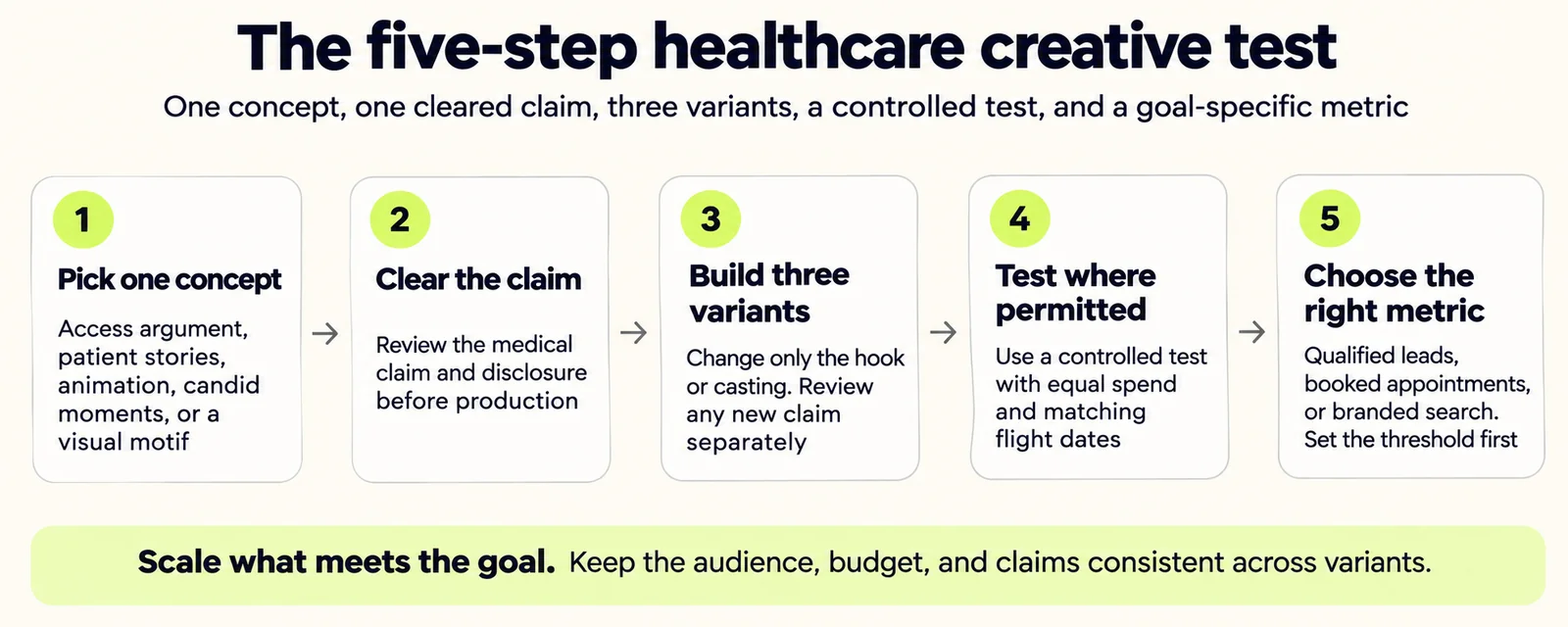
- Choose a single concept. Start with a patient-led opening, animation, candid footage, or another idea that fits your audience. Pick it for the objective, rather than simply copying a famous campaign.
- Clear the claim. The review owner signs off on the claim and the disclosure before production.
- Build three variants. Vary either the hook or the casting while holding other conditions steady. If a new testimonial introduces a new medical claim, clear it separately.
- Run it as a dark post. Where platform rules and advertiser eligibility permit, use a controlled unpublished-post test before expanding spend, as described in our dark posting guide.
- Choose a decision metric. Cost per qualified lead may suit acquisition, while branded search or appointment actions can be more useful for other objectives. Decide on a threshold before launch.
| Example device | What to test | Metric to read | Review owner |
|---|---|---|---|
| Systemic claim (Hims & Hers) | Three hooks on the same access claim | Cost per qualified lead | Legal and claims |
| Celebrity plus patients (Ro) | Three openings on the same claim: patient first, ambassador first, side by side | Qualified lead rate, call quality | Medical and legal |
| Brand platform film (Kaiser) | Three hooks on the same film concept | Branded search, assisted conversions | Brand and legal |
| Real moments (Parkview) | Three casting mixes of real patients and caregivers | Engagement and appointment actions | Patient privacy owner |
| Single metaphor (Memorial Hermann) | Three hooks on the same metaphor | Call volume in the target metro | Brand lead |
A click or platform-attributed conversion can still be several steps away from a booked appointment. Wherever possible, connect the test results to qualified inquiries and actual patient actions.
Our healthcare marketing analytics guide covers the measurement options.
To understand what caused a change in performance, hold four conditions steady and vary one element:
- Audience: the same capped audience for every variant.
- Budget: equal spend per variant.
- Window: the same flight dates.
- Claim: identical claims and disclosures in every cut, so a reviewer approves one claim set.
- Variable: one change per variant, either the hook or the casting.
Record the result and the decision in the same brief. Otherwise, it becomes easy to reinterpret a weak test after the numbers arrive.
Scale Compliant Healthcare Creative With inBeat Agency
What stands out across these ads is how differently brands earn attention: satire, patient stories, and playful animation all have a place. Yet whichever approach fits the audience, the claims still need support and the results need a meaningful way to be judged.
At inBeat, our performance creative team develops healthcare concepts and creator briefs around approved messaging, then works with media teams to test relevant variations.
For healthcare paid social, that might begin with a review of your existing ads and one carefully chosen experiment.
Want a second perspective on your next campaign? Book a strategy call with inBeat Agency, and we'll discuss which creative approach makes sense for your audience.
FAQ
Does a Super Bowl-style spot make sense for a regional health system?
Yes, if the idea is adapted to the size of the market rather than copied along with the media budget. Memorial Hermann ran related creative across several channels in Greater Houston, an approach that can also work for systems serving a defined region.
How do you keep creator-led healthcare ads compliant when the creator improvises?
Start with approved claims and a clear disclosure brief. Then review the finished video and caption together. Creators can still speak naturally, but additional medical claims or testimonials need evidence and a fresh review before publication.
What do you measure when a brand film cannot be tied to appointments?
That depends on what the film is supposed to change. For awareness, branded searches and direct traffic in the service area can be more useful than lead counts. For patient acquisition, track qualified inquiries and booked visits. Because the five featured brand campaigns published no audited ad-performance results, use your own baseline to set expectations.
Do the rules differ for a telehealth brand selling prescriptions and a hospital?
Yes. A telehealth ad promoting a particular prescription drug must meet the FDA requirements relevant to its claims and risk information. Hospitals face additional privacy considerations when using patient stories. Both can also trigger FTC endorsement rules when creators are paid.
Does a help-seeking ad avoid risk disclosure?
It can, provided the ad genuinely addresses a condition without naming or implying a particular drug. The distinction depends on the full execution, including visuals and connected messaging. If a concept starts to identify a product, ask regulatory counsel to assess its claims and risk disclosures before launch.
How long should a "not FDA-approved" notice stay on screen?
The sources cited here establish no universal three-second minimum. Lawmakers criticized how briefly the notice appeared in the 2025 Hims & Hers spot. Regulatory counsel should assess the wording, size, placement, and duration together to ensure any required disclosure is understandable.
Can you use another advertiser's traffic spike in your forecast?
Treat it as context, rather than a target. The reported Hims & Hers spike covers one broadcast and a short window, so it says little about what a different campaign will achieve. Build projections using your own conversion rates, qualified-lead costs, and appointment data.