

An ad can pass platform review and still put your brand at risk. A creator makes a claim nobody approved. The disclosure sits only in the caption. The music license covers organic content, but the campaign is paid.
Meanwhile, the rules keep changing. Google's 2025 Ads Safety Report recorded 35 policy updates in a single year. Add FTC requirements, usage rights, and landing-page changes, and an "Approved" status tells only part of the story.
This guide breaks advertising compliance into six checks, clear responsibilities, and practical review steps.
Catch issues before launch.
P.S. If you'd like a second pair of eyes on live accounts, our paid media account audit covers exactly this ground.
TL;DR: The Advertising Compliance Checklist in Six Answers
- What to check: claims, disclosures, creative rights, landing pages, targeting, and consent. Review all six areas, marking checks that don't apply to the campaign as N/A.
- Who signs off: it depends on risk tier. A new hook on cleared claims needs a media buyer and a checklist. A new high-risk health or financial claim needs compliance review. Previously approved variations may follow a lighter review path when existing approvals and applicable rules allow it.
- What changes for creator ads: the disclosure, the claims, and the license get checked again when a post becomes a paid ad.
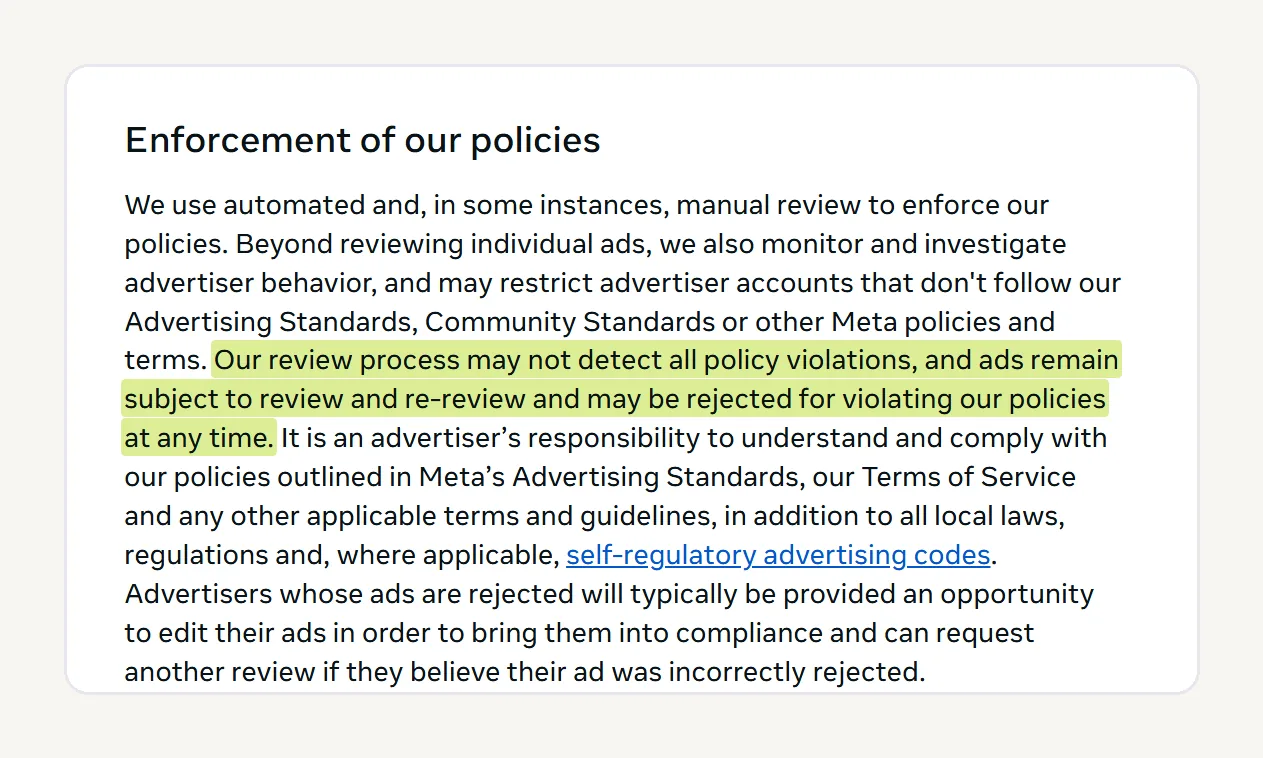
- What platforms catch: format and policy hits, usually within 24 hours. Approval is not a legal sign-off.
- When to re-review: any new claim, price, offer, landing page, market, audience, or policy change, and any edit to a live ad.
- What failure costs: up to $53,088 per violation under the Consumer Review Rule, the same per email under CAN-SPAM, and account-level action from the platforms.
What Is Advertising Compliance? Regulatory Compliance, Platform Policy, and Internal Rules
Advertising compliance means every ad meets three sets of rules: the law, the platform's policy, and your own brand standards. Regulatory compliance sets the floor, and the other two layers sit on top of it.
| Layer | Who enforces it | Example rule | What failure looks like |
|---|---|---|---|
| Law | FTC, FDA, FINRA, SEC | Objective claims need a reasonable basis before they run | Warning letters, civil penalties |
| Platform policy | Meta, Google, TikTok | Meta bars ads that ask, "Do you have diabetes?" | Disapproval, restriction, account action |
| Internal rules | Brand and legal | Approved claims list, banned phrases | Rework, a pulled campaign |
The same claim can pass one review and fail another. A substantiated claim may still breach platform rules because of how it addresses the viewer, while platform approval alone says little about the underlying evidence. Record legal and platform sign-offs separately.
Advertising Compliance Checklist: Six Areas to Check in Ads and Other Marketing Materials
Apply each check where it matters. Review claims, disclosures, and creative rights for every ad, and verify landing pages whenever an ad has a destination.
Check targeting at the campaign or ad-set level, and review consent and opt-out requirements when the campaign collects personal data or sends marketing messages. Mark irrelevant checks as N/A rather than treating them as failures.
| Check | What the reviewer looks for | Pass looks like | Fail looks like | Owner |
|---|---|---|---|---|
| Claims | Every objective claim and its evidence | Each claim maps to a dated source | Unsupported claim | Content marketer |
| Disclosures | Material connections, offer terms, synthetic media | Required disclosures are clear and visible | Disclosure missing or insufficient | Creator, media buyer |
| Rights | Music, logos, faces, stock | License covers paid use, territory, and campaign dates | Missing, expired, or organic-only license | Content marketer |
| Landing page | Match with ad, offer, price | Same product and price as the ad | Different price or a redirect chain | Media buyer |
| Targeting | Special categories, age, audience source | Restrictions and category settings verified | Housing ad run as a standard ad | Media buyer |
| Email & consent | Data collection, applicable consent, sender details, opt-out | Required notices present and opt-outs work | Missing unsubscribe or legally required consent | Lifecycle owner |
Claims Substantiation: Results, Superlatives, and Guarantees
Every objective claim needs evidence on file before the ad runs.
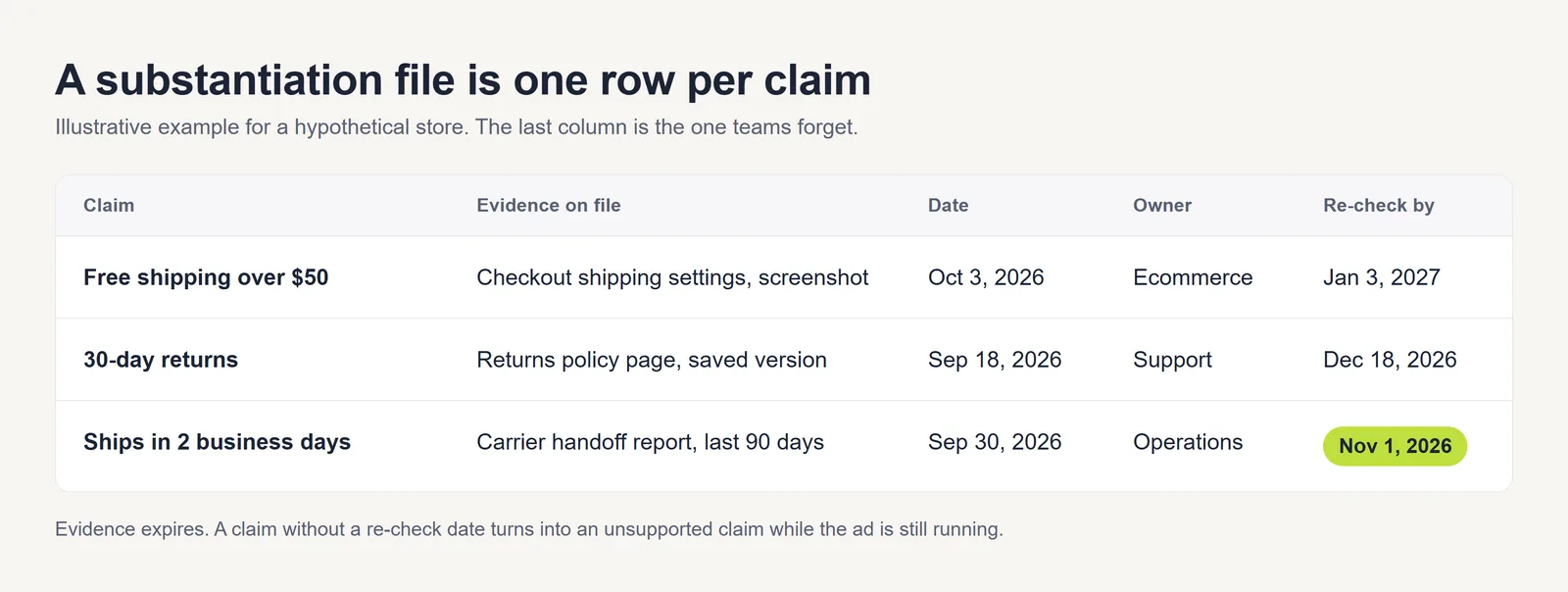
Keep a substantiation file with five columns: claim, evidence, date, owner, and a re-check date.
| Claim as written | What the reviewer flags | Direction for the rewrite |
|---|---|---|
| "Lose 30 pounds in 30 days" | Specific weight-loss result promised within a fixed timeframe, without adequate substantiation | Remove the unsupported weight-loss promise. Describe the program using factual, substantiated claims without implying guaranteed results. |
| "Do you have diabetes?" | "You" attached to a health attribute | Name the service, as in "Diabetes education program" |
| "Best-selling serum in the US" | Superlative with no source on file | Add a dated source or drop the line |
Watch implied claims too. On-screen text, captions, and creator voice-over all count as the ad's claims.
Regulators read ads this way. In March 2026 the FDA sent 30 warning letters to telehealth companies, flagging website claims that implied compounded GLP-1 products were the same as approved drugs.
Our guide to a compliant GLP-1 marketing strategy shows how a claims library handles that category.
Disclosure Check: Endorsements, Offer Terms, and AI-Generated Content
A disclosure check confirms three things: the material connection is stated, the offer terms are visible, and any synthetic person or voice is labeled. Check them in four places:
- In the frame: the FTC says a disclosure belongs with the endorsement itself, inside the video and not only in the description, in plain words such as "ad" or "sponsored."
- In the platform tool: use Meta's branded content tag or TikTok's Commercial Content Disclosure toggle. The FTC warns that platform tools alone may not be enough.
- In the offer: Google requires the full cost to be clear before and after purchase. For financial ads, Google says disclosures can't hide in roll-over text or on another tab.
- In synthetic media: rules on AI-generated performers vary by platform and market, so set a house rule that labels them and check the current platform policy.
Customer reviews and paid creator testimonials require different checks. Section 465.4 of the FTC Consumer Reviews and Testimonials Rule prohibits incentives tied to positive or negative consumer reviews, but doesn't apply to hired influencer testimonials. Creator endorsements must reflect genuine experiences, avoid unsupported claims, and disclose material brand relationships. Fake or false testimonials can still violate other parts of the rule.
Creative, Music, and Intellectual Property Rights
Every logo, song, face, and stock clip needs a license that covers paid use, the territory, and the flight dates. A creator's organic-post permission rarely stretches that far.
Check the license term against the campaign calendar before launch. Our guide to UGC usage rights covers term, territory, and exclusivity in detail.
An expired license on a live ad is the quietest compliance failure in the account, and a date column in the asset log catches it.
Landing Pages: Match the Ad, the Offer, and the Price
Reviewers follow the click, so the landing page is part of the ad. Meta's review covers the landing page and requires promoted products to match it. Check these before launch:
- Match: same product, same offer, same price as the ad.
- Destination: the page loads on mobile, and Google flags redirects to a different domain and tracking templates that lead to different content.
- Privacy: TikTok lists a missing privacy policy on a page that requests personal data as a rejection cause.
- Sensitive data: forms don't ask for health or financial details before they need to. Meta lead forms need prior written permission for sensitive information.
- Language: the page language matches the ad.
Mismatch example: an ad promises free shipping over $50 and the page applies it over $75. That fails Meta's match rule and gives Google a misrepresentation case.
Targeting, Special Ad Categories, and Data Use
Targeting is the layer reviewers see last and teams check least, because it lives on a different screen from the creative. Meta's special ad categories are social issues and politics, employment, housing, and financial products and services. In the US and some other regions, housing, employment, and financial ads lose age, gender, ZIP, lookalike, and saved-audience options.
Confirm four things:
- The category is declared when the ad fits one.
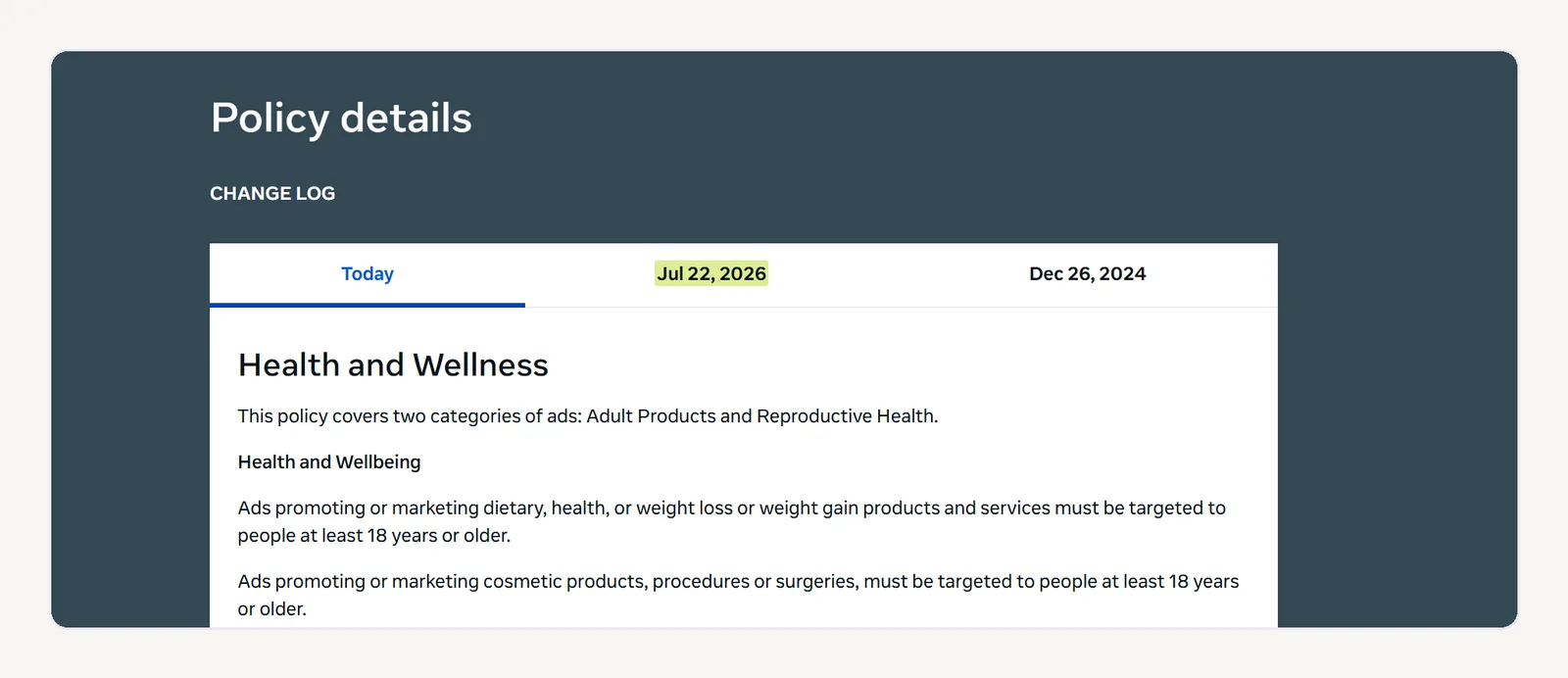
- Age minimums match the product. Meta requires 18+ for dietary, weight-loss, and cosmetic ads.
- Audiences come from data collected with consent.
- No interest or audience choice implies a personal attribute.
Email and Lead Capture: Consent and Opt-Out Requirements
Email campaigns and lead capture require their own checks. Under CAN-SPAM, commercial emails, including B2B messages, can carry penalties of up to $53,088 per violation.
The law generally doesn't require prior opt-in, but it does require accurate sender information and a working opt-out mechanism. Other rules may impose consent requirements depending on the market and channel.
For commercial email, check:
- Header and subject line are accurate, and the message identifies itself as an ad.
- The message includes a valid postal address, usually in the email footer.
- The opt-out is clear, honored within 10 business days, and works for at least 30 days after sending.
- You monitor what partners send on your behalf. The responsibility can't be contracted away.
SMS and calls fall under separate consent rules that this checklist doesn't cover.
How to Review Ads Before Launch: A Six-Step Process for Marketers and Compliance Teams
Run every ad through six steps in this order. If the self-check, the tier review, or the platform preflight fails, fix the ad and restart from that step.
- Write the compliance brief. List approved claims, required disclosures, banned phrases, and the landing page URL before anyone shoots or designs.
- Self-check against the table. The person who made the asset runs the six-area checklist and flags anything unclear.
- Assign a risk tier. Use the tier table below. When two tiers fit, take the higher one.
- Route for approval. Send the creative and supporting evidence to the reviewer identified in the risk-tier table below. Record the decision and obtain any mandatory regulatory sign-offs before launch.
- Run the platform preflight. Submit the ad, read the status, and screenshot it. Reviews usually finish within a day, so build that into the launch calendar and submit before the day the budget is due to start.
- Archive the approved version. Store the final asset, the claim-to-evidence map, the approver, and the date.
Review sized to risk is not an inBeat invention. Even FINRA, whose Rule 2210 generally requires pre-use principal approval for retail communications, proposed moving toward risk-based supervision in July 2026.
The proposal, outlined in Regulatory Notice 26-14, remains pending as of October 2026. Existing approval requirements and their exceptions still apply, but the direction is clear: review intensity should reflect the risk, while mandatory sign-offs remain in place.
Risk Tiers: Which Ads Need Which Sign-Off
| Tier | What triggers it | Who reviews | What gets recorded |
|---|---|---|---|
| 1: Low | Creative-only changes to an approved concept, with no new express or implied claims and no changes to the offer, targeting, or landing page | Media buyer, within the scope of prior approvals | Variant, approval reference, screenshot |
| 2: Medium | New offer, price, creator, market, or low-risk claim that requires no mandatory specialist approval | Marketing lead; specialist where needed | Evidence, offer checks, review decision |
| 3: High | New or changed high-risk health, financial, or income claims; outcome testimonials; campaigns involving minors; or communications requiring mandatory specialist approval | Compliance reviewer, legal counsel, or authorized approver | Claim evidence and dated approval |
Risk tiers reflect what changes between ad versions, not just the product category. A previously approved concept may qualify for a lighter review when its claims, meaning, and approval scope remain unchanged. Mandatory regulatory approvals still apply.
Three examples from a hypothetical supplement campaign show how the routing works.
- New hook on a cleared concept: The first three seconds change, but the approved claims, implied message, targeting, and landing page stay the same. Tier 1 applies only if the previous approval covers this type of variation. Otherwise, the ad returns for the required review.
- A "30% off" promotion: The product claims stay the same, but the offer, end date, and landing-page price change. Tier 2, with the marketing lead checking the offer terms and destination. Escalate if additional regulatory approval is required.
- A weight-loss testimonial: A creator introduces a new outcome claim that wasn't part of the approved claim set. Tier 3, requiring compliance review and adequate scientific substantiation before testing. Unsupported claims must be removed.
Pro tip: log the tier in the ad name. Anyone reading the ad account can see at a glance which review the ad passed.
How Compliance Reviews Move Between Teams
A reviewer can only approve what they receive. Each handoff should include the latest creative, the evidence behind its claims, and any unresolved issues. Use the following checkpoints to keep approvals tied to the version that actually goes live.
| Role | What gets handed off | Next reviewer |
|---|---|---|
| Creator | Final raw content, spoken claims, and disclosure placement | Content marketer |
| Content marketer | Approved copy, claim-to-evidence mapping, and paid usage rights | Media buyer |
| Media buyer | Final ad version, landing-page checks, targeting details, and unresolved flags | Marketing lead or assigned risk-tier reviewer |
| Lifecycle owner | Consent records where required, email copy, and opt-out test results | Marketing lead |
| Compliance reviewer | Dated approval, required edits, and the scope of authorization | Media buyer or agency |
| Agency | Final version matched to approvals, with outstanding issues documented | Client approver |
User-Generated Content and Creator Ads: What Changes When a Post Becomes a Paid Ad
When a creator post becomes a paid ad, the disclosure, the claims, and the license all get checked again for the ad version. Walk the content through five stages.
1. Brief. Give creators an approved claims list and a banned list. They shouldn't invent efficacy claims on camera.
For the briefing method, see our guide to briefing creators for native content.
2. Draft. Watch for ad-libs. A creator who says "this cured my acne" has made a claim the brand has to substantiate. Pro tip: ask for the raw file before the creator posts and compare it line by line with the approved claims list.
3. Approved post. The advertiser is liable for misleading or unsubstantiated endorsements even when the endorser isn't, and the FTC's FAQ recommends pre-approving paid posts.
4. Whitelisted ad. Confirm the creator's agreement permits paid amplification on the intended platform and covers the campaign dates. Enable Meta's branded content tool or TikTok's Commercial Content Disclosure setting, then compare the paid version with the approved post for changes to claims and disclosures. Archive the final asset and approval record.
5. Scaled ad. Re-check when claims, offers, or usage terms change, and confirm the creator's rights still cover the spend window.
If you want creator content that arrives with claims already cleared, our UGC agency builds that review into the brief.
How Meta, Google, and TikTok Review Ads (and Why Approval Is Not Compliance)
Meta, Google, and TikTok differ in how they evaluate landing pages, handle restricted categories, and review changes to live ads. The comparison below shows what each platform checks and which actions can interrupt delivery. Use it to build a platform-specific preflight before launch.
| Review focus | Meta | Google Ads | TikTok |
|---|---|---|---|
| Typical review time | Typically within 24 hours | Most reviews take one business day | Most ads within 24 hours |
| Re-review after approval | Ads stay subject to re-review and can be rejected at any time | Reserves the right to prioritize re-reviews | Edits to creative, links, targeting, or tracking trigger a new review |
| Landing page | Reviewed with the ad; products must match | Must work and match the display URL | Mismatch or missing privacy policy causes rejection |
| Financial ads | Special ad category; 18+; may need verification | Verification in some locations; disclosures immediately visible | Local licensing, disclaimers, 18+ |
| Enforcement path | Ad rejected or restricted | Destination issues get at least 7 days' warning; unacceptable business practices can mean suspension without warning | A failed re-review pauses the ad group |
Two details matter in practice. TikTok says landing-page changes alone don't trigger a new platform review, which makes your internal re-review the only check on them. And policy pages change, as the change log below shows for Meta and as TikTok's finance and weight-management pages (September 2026) show for TikTok.
Advertising Compliance in the Financial Services Industry and Other Regulated Categories
Regulated categories require additional scrutiny, but the review tier depends on the claims, changes, and applicable approval requirements. New high-risk claims and communications requiring mandatory specialist approval belong in Tier 3.
Financial services. FINRA member firms generally require prior principal approval for retail communications, with exceptions under Rule 2210. A retail communication reaches more than 25 retail investors within any 30-calendar-day period. Registered investment advisers also have obligations under the SEC Marketing Rule, where applicable.
On the platforms, Meta routes these ads through a special category with narrower targeting, and Google may require verification. Our financial marketing agency page shows how that work is staffed.
Health and supplements.
- Meta applies the 18+ minimum covered under targeting, bars cure claims for listed conditions such as diabetes and cancer, and restricts specific outcomes in a set timeframe. Its personal attributes policy adds a second trap: copy that asks "Do you have diabetes?" fails even when the product is legitimate.
- TikTok prohibits before-and-after comparisons for OTC medicines, devices, and supplements, and its weight-management rules bar unrealistic results and "easy or guaranteed" suggestions.
Other restricted categories. Each platform keeps a restricted list, and some markets go further. TikTok notes that certain markets prohibit weight-loss ads entirely. Read the list for your product before the first brief.
Bring the Tier 3 reviewer in at the brief stage, so the claims they clear are the claims the creative uses.
Keep Ads Compliant After Launch: Compliance Culture, Re-Review Triggers, and Training
A compliant launch stays compliant only if someone owns the re-review. A healthy compliance culture means anyone on the team can flag an ad and pause it without a debate about whose job it was.
Two habits keep the process alive after the first month. Put the policy pages your ads depend on on a quarterly reading list, and treat every platform change-log date as a prompt to re-check the live ads in that category.
Re-Review Triggers for Live Ads
- A new claim, price, or offer
- A new landing page or redirect
- A new country or audience
- Edits to creative, links, targeting, or tracking
- A platform policy update that affects the campaign's product, claims, targeting, or destination
- A creator edit that changes a claim or disclosure, deletion of a sponsored post used by the campaign, or expiration of paid usage rights
Internal Compliance Training for Marketing and Creative Teams
- Quarterly policy read: the media lead walks the team through the change-log dates on the platform pages they use.
- Claims file refresh: drop expired evidence and add new claims with sources.
- Disapproval review: go through last quarter's rejections and note the pattern.
- Creator one-pager: a short sheet on disclosure placement and banned claims, sent with every brief.
What Does an Ad Compliance Failure Cost?
Regulatory enforcement and platform action create different kinds of exposure. The examples below show the potential consequences of each.
| Compliance failure | Potential consequence | Source |
|---|---|---|
| Fake or false testimonials; sentiment-conditioned consumer reviews | Civil penalties of up to $53,088 per violation | FTC Consumer Review Rule |
| Non-compliant commercial email | Civil penalties of up to $53,088 per non-compliant email | FTC CAN-SPAM Act |
| Misleading claims about regulated drug products | FDA warning letters, corrective action, and possible further enforcement | FDA enforcement announcement |
| Unacceptable business practices on Google Ads | Immediate account suspension without prior warning | Google Ads policy |
| Edited TikTok ad fails re-review | Ad group paused, interrupting delivery | TikTok review policy |
The immediate cost often arrives before any regulatory penalty. A suspended account can interrupt an entire campaign, while a rejected creative sends the team back through revisions and approval. The earlier a compliance issue is caught, the less campaign work it puts at risk.
Build a Faster Ad Review Process with inBeat
A good review process makes launches faster, because cleared claims and tiered sign-off remove the back-and-forth that slows creative. We build the compliance brief, the claims library, and the tier routing into paid social and creator programs, so new variants inherit what's already been cleared.
If you'd like to map your current review path, book a strategy call. We'll walk through your ads, sort them into tiers, and mark where checks are missing.
FAQs
Does changing a landing page trigger another TikTok ad review?
Changing a landing page's content alone doesn't automatically trigger another TikTok ad review. The platform re-reviews certain edits to ads and ad groups, including changes to creative, destination URLs, and targeting. Internally, review any landing-page change affecting claims, pricing, offers, or required disclosures, even when the platform doesn't initiate another check.
Does an email footer need to repeat the ad's disclosures?
No. The footer carries the CAN-SPAM elements: the postal address and the opt-out. A disclosure that qualifies a claim belongs next to that claim, because the FTC's guidance puts disclosures with the endorsement itself.
How do you review AI-generated ad variants at volume without reviewing each one separately?
Approve the claim set and creative template with the required reviewers first. Then batch-check simple resizes and crops as Tier 1, provided they preserve the approved message and remain within the scope of prior approvals. Variants introducing new claims, implied outcomes, or regulated-category risks need a higher level of review.
If a platform approves an ad, who is still liable for the claim?
The advertiser. Meta says approved ads stay subject to re-review and can be rejected at any time, and under 16 CFR 255.1(d) advertisers can be liable for misleading or unsubstantiated endorsement statements. An approval status doesn't shift that responsibility.
How do you review ads for a financial services client when principal approval takes days?
Start by checking whether the communication requires pre-use approval under FINRA Rule 2210. Pre-approved claims and reusable templates can shorten preparation, but new communications must still receive principal approval where required. Batch submissions and involve compliance early to reduce delays. Regulatory Notice 26-14 proposes a more flexible approach, but remains a proposal as of October 2026. Investment advisers must also consider the SEC Marketing Rule.