

The detail that interested me most in ADM's pet nutrition research was what owners considered worth paying extra for. 77% of pet owners surveyed globally said they would pay more for products containing functional ingredients.
From a creative standpoint, that gives me something concrete to work with. If a product offers a benefit owners genuinely care about, I can build a campaign around showing how it works and why it's worth buying again.
In this guide, I'll explore four pet food branding strategies and explain how I'd test each with creator ads before investing in new packaging.
TL;DR
- Price ranks second as a reason to buy, behind nutrition and ahead of brand trust, in a 2,038-owner survey.
- Evidence, distinctive partnerships and genuine relationships make a position harder for cheaper competitors to imitate.
- Pick one position you can prove today and hold it for a full test cycle.
- Use the front of the pack to communicate the main benefit and make its evidence easy to find.
- Test each message as creator ads and read cost per new customer before changing a pack.
- Track how much revenue still needs a discount, because that number shows whether the brand is working.
I treat creative, media and measurement as one system. Bringing all three together in pet food branding gives the design team a chance to see how buyers respond to a promise before it becomes part of the visual identity.
Once that promise goes on a pack, changing it involves another round of design, printing and retail distribution. That's why I'd want early acquisition data and, later, evidence that buyers return over their normal replenishment cycle.
Do Pet Owners Choose Food on Price? What 2026 Data Shows
Price ranks second among the reasons owners give for choosing their current pet food. A Kansas State University survey of 2,038 US dog and cat owners puts nutrition and health first, with brand trust in third place.
What interests me here is that the value segment is growing even though nutrition still comes first.
Trade-down matters, of course, but a brand competing on price alone risks overlooking buyers who care more about what goes into the bowl.
| Signal | Number | Source | What it means for branding |
|---|---|---|---|
| Reason for choosing current food | 37.7% nutrition, 32.3% price, 28.9% brand trust | Kansas State survey of 2,038 US pet owners (dogs and cats), via Pet Food Processing | Nutrition leads, with affordability close behind |
| Dog owners feeding basic food | 21%, with premium still most fed at 31% | APPA 2026 Dog Report | The value tier is growing and premium still leads |
| Dog owners buying food at discount retailers | 22%, up 22% on the year | APPA 2026 Dog Report | Price shoppers are changing channels |
| Dry dog food sales over the past year | Down 3.8%, while fresh and frozen dog food rose 10.8% to about $1.8B | Circana, via Pet Food Processing | Fresh and frozen formats are growing while dry food sales decline |
| Store brand pet care units | Up 2.8% in the 52 weeks to November 1, 2026 | Circana for PLMA, via Progressive Grocer | Private label pet care unit sales are growing |
Read the table against your own brand with four checks:
- Which purchase motivations appear in your recent reviews and which are missing?
- What share of last quarter's revenue came from promotions?
- Which sales channels are growing, and how price-sensitive are their customers?
- Which rival do customers choose when they trade down?
Food also appears to be a spending priority: APPA reports that average treat spend fell 11% while food remained a protected essential.
These broader pet industry trends provide useful context, but your own customer research can reveal which benefits matter most when household budgets tighten.
Four Pet Food Brand Positions That Are Harder to Copy
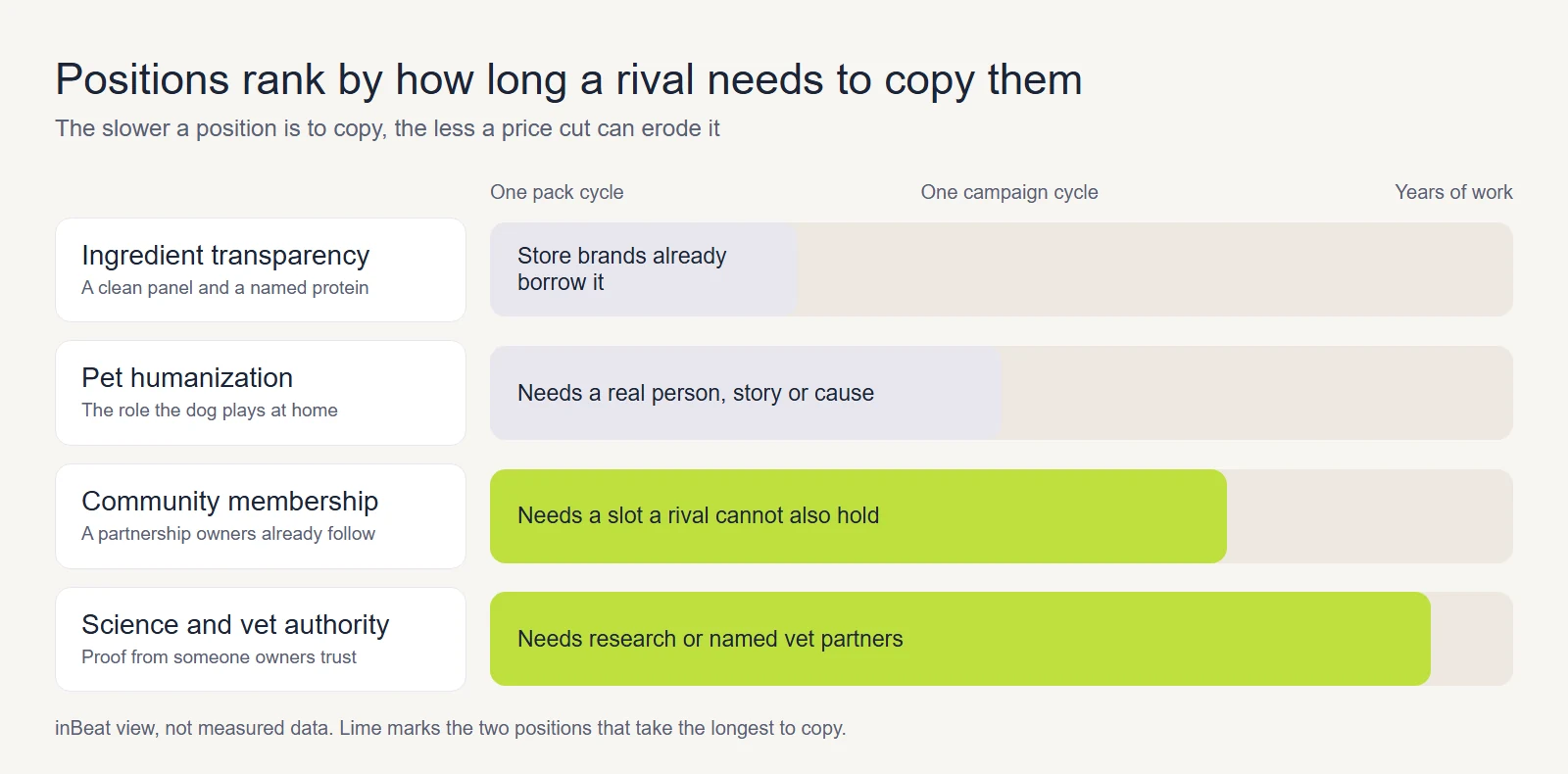
The most defensible positions are built on advantages a competitor would need time to reproduce. A visual style is relatively easy to imitate.
Replicating published evidence, traceable sourcing or established community relationships takes more work. Here are four approaches and the conditions under which I'd use them.
Science and Veterinary Authority
Science and veterinary authority are credible when the evidence comes from qualified professionals owners already trust. In a Tractor Supply survey, veterinarians were the top information source for 74% of dog owners. The published coverage does not state the sample size.
Purina Pro Plan's "Feed Your Pet Like a PRO" campaign puts tennis players Jasmine Paolini and Andy Murray on screen with their own pets, so the viewer links elite performance with expert nutrition.
System1's Test Your Ad scored it 4.5 stars, placing the campaign in the top 10% of pet food commercials assessed by the independent testing firm.
You can watch the spot on its channel:
Purina PRO PLAN - Feed your pet like a Pro. Source: System1 Group on YouTube
Hill's shows the commitment side. Its organic sales rose 2.1% in Q2 2026 even after about two points of drag from exiting private label, according to company remarks that Petfood Industry reported.
I read walking away from store-brand volume as a strategic choice, although the sales figures alone cannot establish why the company made it or whether the decision drove growth.
I'd start with scientific positioning when a brand has credible veterinary expertise or research it can substantiate.
Ingredient Transparency
Ingredient transparency depends on whether owners can understand what goes into the food and where it comes from. The same Tractor Supply survey found that most respondents did not consider dog food with more than six ingredients premium.
The threshold varied by generation: seven for Gen Z, six for millennials and five for Gen X and baby boomers. That's a useful insight for design, although ingredient count alone says little about nutritional quality.
Open Farm built on ingredient traceability and welfare. According to the company's announcement, it now sells in more than 9,500 retail locations across North America, following the addition of nearly 1,700 PetSmart stores in the US and Canada from June 2026.
A named protein is useful on the front panel, but a competitor can use the same wording. I'd build the creative around sourcing details the brand can document, with further information accessible from the pack or product page.
Pet Humanization
Pet humanization starts with the role animals play in the owner's life. In the Kansas State survey cited earlier, 81% of respondents viewed their pet as a child or family member. That suggests a promising message for brands built around the relationship between people and their pets.
Social discovery offers a way to reach that audience. APPA's 2026 report puts it at 47% of pet owners, up from 41% in 2024. If your customers already discover products on social, I'd test scenes from a pet's daily routine.
Rachael Ray Nutrish restored the full "Rachael Ray" name on its packaging from April 20, 2026, and launched its Home Chef-Inspired Bowls campaign around the spot "The Look".
Blue Buffalo, meanwhile, is reinforcing its founding story by matching donations up to $200,000 to the Morris Animal Foundation through December 31, 2026. Neither example comes with a published sales result for the campaign. What I like about both is how closely the message reflects the brand's identity.
Cultural and Community Membership
Community membership means sitting inside something owners already belong to. The Farmer's Dog was announced as the NFL's first official pet food partner on September 9, 2026 in a multiyear deal, and its launch ad "The Running Back's Dog" features Giants running back Cam Skattebo and his dogs.
The Farmer's Dog Ad: The Running Back's Dog. Source: The Farmer's Dog on YouTube
A season of games offers recurring buying moments to explore in creative, including game day and the walk afterward. An NFL-scale sponsorship requires a substantial commitment, of course. Smaller brands could pursue the same idea with local clubs or niche communities, provided the relationship makes sense to their buyers.
What Evidence Does Each Position Need Before It Goes on Pack?
Each position needs evidence appropriate to its promise. Some claims can be explained on a label; others require a product page or more detailed research.
The table shows what I would look for before approving creative. For advertising-specific requirements, see the guide to claims in video ads.
| Position | Proof owners will accept | Where to show it | Risk if it is thin |
|---|---|---|---|
| Science and veterinary authority | Named vet nutritionist, published feeding trial or clinical result | Back of pack, vet voice in creator ads | The claim reads as marketing and invites a challenge |
| Ingredient transparency | Named protein, documented sourcing and accessible ingredient details | Front of pack, product page first screen | Vague sourcing or unexplained ingredients undermine credibility |
| Pet humanization | A real person, story or cause the brand can document | Brand name, packaging, creator content | The warmth reads as borrowed |
| Community membership | A durable partnership or event owners can attend | Partner content, packaging, retail displays | The deal ends and the position goes with it |
How to Choose One Pet Food Brand Position: A Four-Step Audit
Choose a position your brand can support and that gives buyers a meaningful alternative to its closest rivals. I once watched a team approve a platform that promised science, clean ingredients and family warmth on one pack. The ads ended up sounding like a checklist, and none of the three ideas stood out.
- List the benefits you can substantiate, with a source for each claim.
- Review how your three closest rivals communicate their positioning in ads and on packaging.
- Interview owners to hear the words they use for the problem, following the owner interview format.
- Choose the most promising position for the test cycle and map it to the situations in which customers buy your product.
Pet Food Packaging Design That Signals the Position at Shelf and on the Product Page
The front panel should make the product's appeal clear within a few seconds, particularly when shoppers are comparing several prices.
Last weekend I stood in a pet food aisle and asked myself which bag explained why it cost more. Very few gave me a clear answer.
| Packaging element | Position it signals | Check before approving |
|---|---|---|
| Named protein and sourcing information | Ingredient transparency | Can an owner say the protein out loud after one glance? |
| Vet or lab mark | Science and veterinary authority | Can the proof behind the mark be checked? |
| Owner and pet photography | Pet humanization | Does the picture show a relationship or just a product? |
| Accessible ingredient details | Ingredient transparency | Can owners easily understand the ingredients and find their sources? |
| Brand name and character | Community membership or humanization | Is the name distinctive next to the three nearest competitors? |
Front-of-Pack Hierarchy
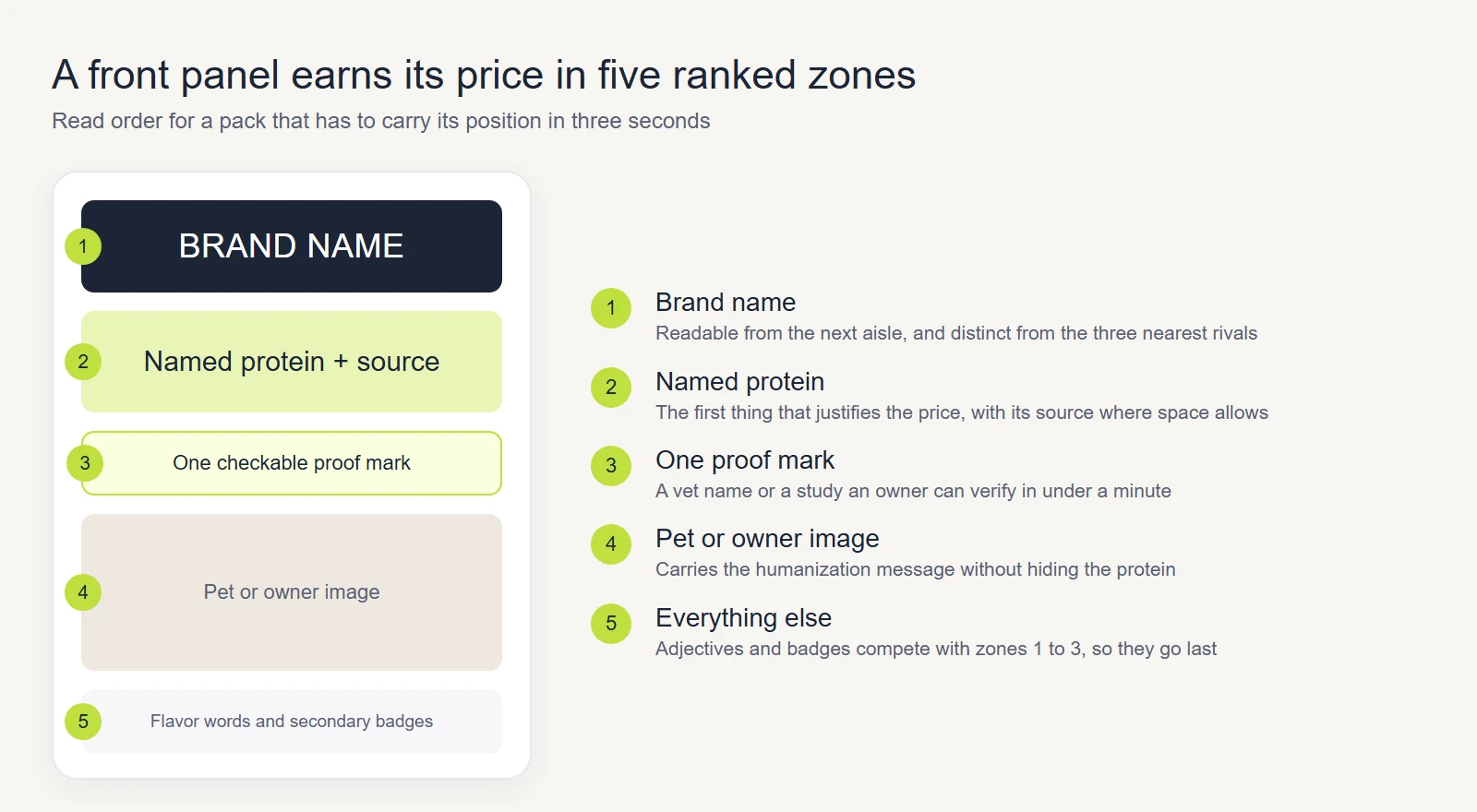
Place the brand name and main benefit near the top of the visual hierarchy. Depending on the position, a named protein or substantiated proof mark may help explain the claim.
First, though, leave room for mandatory information: US pet food packages must meet applicable FDA and state requirements, including front-panel information described by AAFCO.
Here's the order I'd use when reviewing the five main design zones:
- The brand name, large enough to read from the next aisle.
- The named protein, with sourcing information where space and labeling rules allow.
- One relevant, verifiable piece of evidence, such as a qualified expert's endorsement or a published study.
- Pet or owner imagery where it helps explain the brand story.
- Flavor descriptors and secondary badges, once essential information has its place.
Brand Name and Character
A name or character can communicate an identity before a shopper has read the product description.
Nutrish's decision to restore Rachael Ray's name is a useful example of the value a recognizable person can bring to packaging.
Before approving a name or character, consider these three questions:
- Could a shopper confuse the name with a close competitor's when hearing it aloud?
- Does it fit a credible brand story and leave room for future products?
- Will the name remain legible in a retailer's search results?
Product-Page Thumbnail
Evaluate the pack at thumbnail size in a retailer's results grid. If the main product benefit disappears, adjust the visual hierarchy and then check the product page friction that might keep a shopper from buying after clicking.
For the listing's first image, I'd reserve a clear view of the front panel. Subsequent images can explain the evidence behind the benefit or show the product in everyday use.

How Private Label Pet Food Changes the Branding Problem
Private label pet food creates an extra challenge because retailers can use packaging cues once associated with national brands. Chewy Made is a case in point: the company combined American Journey and three other labels under one name with refreshed packaging in May 2026, according to Petfood Industry.
Store brand dollar sales rose 3.3% in 2025 against 1.2% for national brands, across all categories, in PLMA data that an ADM report cites.
The all-category increase slowed in 2026, with Circana reporting store brand dollars up 0.3% as of November 1. Pet care performed better: over the 52 weeks ending on that date, store brand units rose 2.8% and dollar sales rose 2.6%.
ADM, an ingredient supplier, identifies several cues private labels now use, including named proteins, functional claims, clean-label positioning and design comparable to national brands.
Price remains part of the appeal.
According to PLMA's analysis of Circana data, the average store brand product sold for $4.14 in the first half of 2026, compared with $4.79 for a national brand. That 14% difference covers grocery categories as a whole. For pet food specifically, I'd look at the price gap in your own category to establish which benefits the creative needs to justify.
To defend your brand without constantly refreshing the packaging:
- Invest in distinctive evidence, such as feeding research or documented traceability, where it fits the product.
- Use a recognizable brand asset consistently across formats and channels.
- Consider a useful service or purchasing experience that customers value beyond the recipe itself.
- Limit repeated promotions on the hero product so customers have less reason to wait for its next discount.
How to Test Pet Food Brand Messages With Creator Ads Before a Rebrand
Use creator ads to compare positioning messages before approving a packaging change. When I look at a pet food account's creative, I often find variations of the same underlying claim. If that is all the account has tested, there is still no comparison of different positions.
When a message needs scientific support, let a pet creator tell the owner's story and a suitably qualified veterinary professional explain the evidence. These pet creator and vet pairings illustrate how the two roles can work together.
- Define one core claim per position and give creators a documented reason to believe it.
- Recruit creators whose audiences fit the intended buyers. Use more than one per position and, where feasible, have the same people test multiple messages to reduce creator-specific effects.
- Set comparable product, price, offer, audience, landing page, delivery terms and campaign settings. Give each message enough budget to generate meaningful conversion volume; a handful of sales is too little to call a winner.
- Assess acquisition cost first, using a predetermined comparison rule. Track repeat purchases and contribution margin once cohorts have had the same opportunity to reorder; views can help diagnose delivery, but they are secondary to the business outcome.
| Position | Creator type | Hook to test | Proof element in the ad |
|---|---|---|---|
| Science and veterinary authority | Qualified veterinary professional or pet nutrition expert | "What does this nutrition claim actually mean?" | The named nutritionist or study |
| Ingredient transparency | Home cook or label-reader creator | The ingredient panel read aloud | The sourced protein |
| Pet humanization | Pet owner with a strong bond | A day in the dog's routine | A real person or story from the brand |
| Community membership | Fan or athlete tied to the community | The shared occasion | The partnership itself |
Pet advertising examples can help you develop hooks, especially for demonstrations. A clear production brief should also specify the approved claims and the details that need to appear on screen, leaving creators room to deliver the message in their own style.
Read results at the position level, across multiple creators and comparable test conditions. I would advance the message with credible acquisition performance and a viable margin, then assess 60-day repeat rates if that window fits the product's normal reorder cycle.
If acquisition and retention favor different messages, compare cohort contribution before committing to either.
Watch out for a single standout creator, though. If one video drives most of the result, test the same claim with additional creators before treating it as a positioning win.
How to Measure Whether Branding Is Reducing Price Dependence
The most useful indicator of reduced price dependence is how much revenue the brand can earn without a promotion.
A few complementary metrics help separate changes in buying behavior from changes in ad performance or distribution.
| Metric | What it shows | How to read it |
|---|---|---|
| Share of revenue sold on promotion | Dependence on discounts | A decline alongside stable volume and margin suggests less reliance on promotions |
| Average discount depth | Average reduction from the regular price | Smaller discounts at comparable volume suggest reduced price sensitivity |
| Repeat purchase rate | Whether acquired customers return | Compare cohorts that saw different messages |
| Share of search against key rivals | Brand salience | A rising share without more discounting suggests growing recall |
| Review language naming the position | Whether owners repeat the claim | Track mentions of the benefit or evidence used in the positioning |
| Retail velocity in non-promo weeks | Sales per store in non-promo weeks | Compare sales per store in stock and at comparable distribution |
Track share of search monthly against relevant rivals as a directional measure of brand interest. If I could follow only two metrics, I'd pick revenue sold on promotion and repeat purchase rate at a comparable cohort age. Together they show whether buyers are coming back and how much business still relies on discounts.
For those comparisons to mean anything, establish a baseline before the first ad goes live. Record promotion share, discount depth and repeat purchase for the previous quarter, alongside changes in price, availability, distribution and media spend. Where possible, use a comparison group to help separate the influence of the positioning from those other factors.
Five Pet Food Branding Mistakes That Push Brands Back to Discounting
A brand can create extra work for itself when creative, retail and measurement teams make decisions independently. Here are five mistakes I would check for before increasing the redesign budget.
| Mistake | What it looks like | Fix |
|---|---|---|
| Approving claims without substantiation | A functional benefit in the brief with no supporting evidence | Build a claim-and-evidence register before briefing creators |
| Letting each channel tell a different story | Retail packaging and paid ads emphasize unrelated benefits | Agree on a shared message while adapting execution to each channel |
| Testing too many changes together | A new message, price and landing page launch at once | Stagger the changes or use a controlled comparison |
| Premium cues unsupported by the product | Packaging implies a benefit the formula or service cannot support | Align the design with the actual benefit, regardless of price tier |
| Copying the category color code | The same palette and visual cues as the category leader | Check brand recognition in a shelf or thumbnail comparison |
Before commissioning artwork, make sure the brand and paid media teams agree on what success looks like. A performance branding approach helps give the designer a commercial objective to work toward.
Build Pet Food Brand Equity With inBeat Agency
A distinctive pet food brand should be able to evolve without asking shoppers to relearn what it stands for. That's the creative challenge I find most interesting: building an identity that can support a new recipe, format or retail channel while retaining the reasons customers chose it in the first place.
My team combines brand strategy with creator-led ad testing. If you're deciding what your next product launch or packaging refresh should communicate, book a strategy call to discuss the opportunity.
Pet Food Branding FAQs
How do you keep a premium position when a store brand copies your packaging cues?
Look beyond the lookalike package and identify the customer concern that drove your original positioning. Keep the brand's recognizable assets consistent, and make the evidence behind the benefit easy to find in retail listings, ads and on your website.
Which position works for a new brand with no veterinary advisory board yet?
Ingredient transparency or humanization can be appropriate when a new brand has documented sourcing or a credible founding story. If clinical claims are part of the plan, involve appropriately qualified experts and substantiate those claims before using them.
How long should a message test run before judging a position against promotion-led sales?
Two weeks can be a starting point if spend and conversion volume are sufficient. Decide in advance how much evidence the comparison needs, then check repeat purchases over an appropriate replenishment window. With dark posting, you can control creative distribution more closely, provided the test also uses equivalent offers, audiences and campaign settings.
Can a value-priced brand use a transparency position without reading as premium?
Yes. A value-priced brand can explain its ingredients and sourcing in an accessible design without imitating the luxury end of the category. Even premium-looking packaging is compatible with affordable food if the claims are accurate and the product delivers what it promises.