

Pet owners will happily watch a dog do something ridiculous. Convincing them to spend money on the product in that video is another matter.
NielsenIQ's 2026 research found that 76% of pet parents believe caring for their animals costs more than it did a year ago. With shoppers paying closer attention to value, a charming commercial needs something beyond an adorable face.
The opening has to earn attention, the demonstration should make the product's benefits tangible, and the offer needs to justify taking the next step.
We examine recent pet advertising examples to see how brands approach these decisions and which ideas deserve a place in your next creative test.
TL;DR: What Pet Advertisements Are Testing in 2026
- Hooks. Five openings stand out in recent pet brand campaigns: a conversation with the dog, a pet's quirk, a wordless dog in motion, a bleeped joke and a taboo problem. The Farmer's Dog "The Jump" beat the Zappi norm for purchase uplift in its panel.
- Demonstrations. Show the product doing its job on a real pet before you say the claim. Litter-Robot backs the cycle it shows with a 90-day in-home trial.
- Offers. A percentage off the first order, a first box priced by dog weight, a 14-day guarantee and a free toy are four different tests.
- Evidence. Sources include third-party ad pre-tests, brand-page terms, trade-press reporting and company statements. None supplies verified, company-reported ad-level purchase results, so treat these examples as ideas to test rather than performance benchmarks.
- Claims. NAD treated implied claims in voice-over and imagery as claims.
Before the examples, separate three decisions that often get mixed together in a single pet ad:
- what the first seconds do
- what the product proves on camera
- what the buyer is offered
That distinction becomes especially useful on paid social. A pre-test can point you toward a promising idea, but purchase data from a sufficiently large sample is what should guide the next budget decision.
Which Pet Advertising Examples Come With Evidence, and What Kind?
Four types of evidence appear in this guide: independent pre-tests of finished ads, brand-page product and offer details, trade-press campaign descriptions, and company-stated claims.
The letters tell you where the evidence comes from, rather than how well the ad sold.
You'll find evidence grades in the hook comparison. The demonstrations and offers, meanwhile, are judged against the information brands publish and the limits of those claims. None comes with independently verified ad-level sales figures.
| Grade | What it is | Used here for | How far to trust it |
|---|---|---|---|
| A | Third-party pre-test of the finished ad | The Farmer's Dog (Zappi, System1), Rover (System1) | Signals how viewers respond in a test panel. It carries no spend, audience or cost per order |
| B | Terms read from the brand's own page on 10 November 2026 | Offers and product pages | Accurate on the day, and offers change without notice |
| C | Trade-press description of the creative | Freshpet, Pedigree, Hartz, Fi | Describes the idea, not the result |
| D | Company-stated claim | Pedigree's "8 in 10 dogs", Spot & Tango's revenue | Useful context, unaudited |
Of these sources, an independent pre-test gives the clearest indication of how viewers respond to a finished ad.
Zappi rated "The Farmer's Dog: The Jump" at a Sales Impact of 97 and a Brand Impact of 94, both in the top 5% of ads it has tested. That tells you the creative direction is worth testing in market. It does not tell you what the ad cost per order.
Pet Ad Hooks: Five Openings From Recent Pet Marketing Campaigns
An ad has only a moment to earn attention. In video, that usually means the first one to three seconds; in static creative, it's the opening line. Our guide to the 21 ad hook types covers more possibilities.
For pet advertising, five recent campaigns show how those openings work in practice and which details are worth changing when you run a creative test.
Owner Talks to the Dog: Freshpet Kitchen Conversations
Freshpet starts with something many owners recognize: asking a dog for relationship advice. Its May 2026 "Kitchen Conversations" campaign, created with Terri & Sandy, includes three spots.
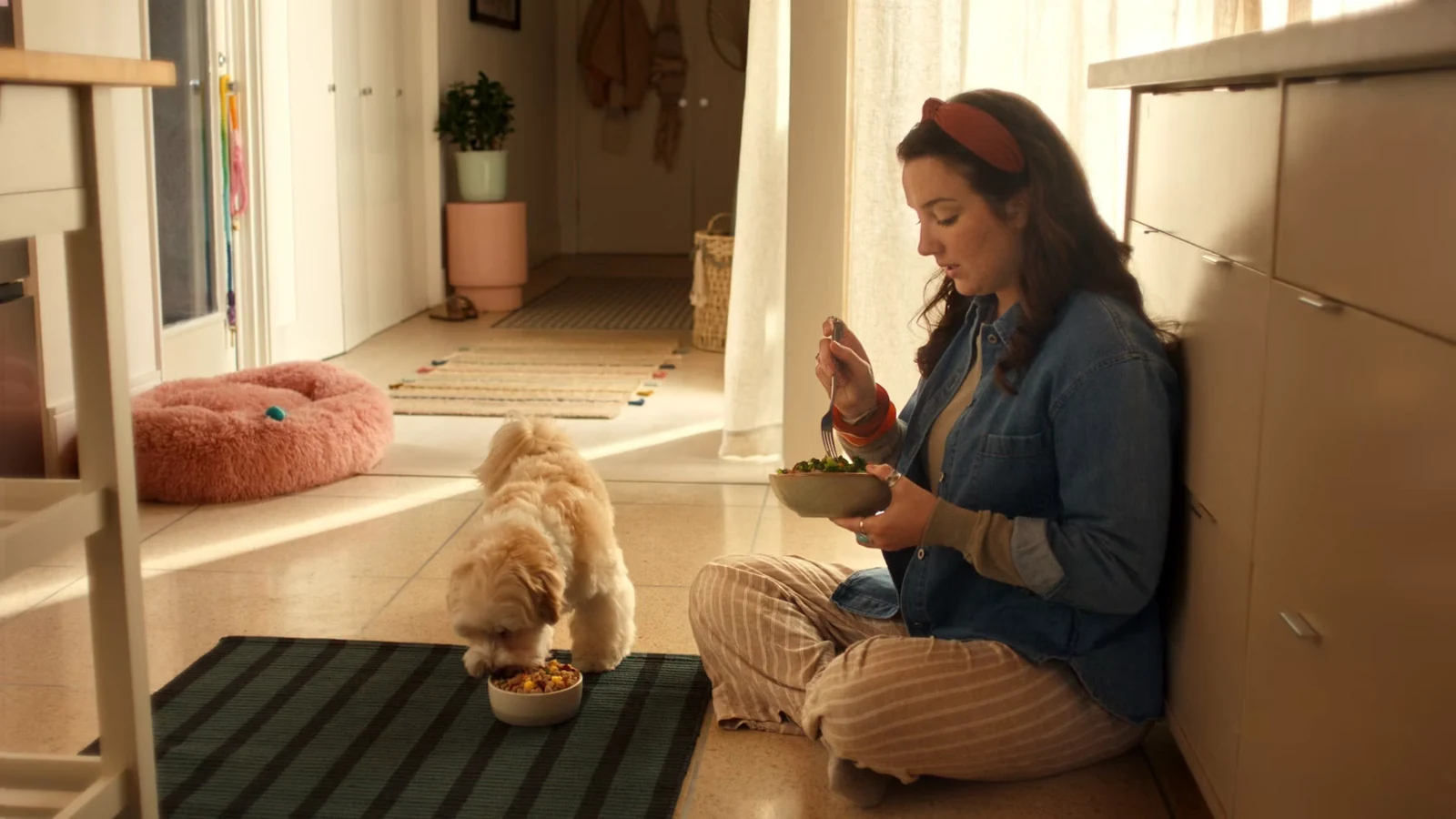
In "Too Soon," a man consults his dog about a post-date text. "Zodiac" follows a woman venting after a breakup, while "Sleep" has another owner joking about a restless night. Each story establishes a human situation before the food takes center stage.
The dog's reactions give those conversations their charm, while the owner's dialogue makes the premise easy to follow.
That suggests a simple social edit: lead with the owner's line in one version and the dog's reaction in another. Captions help the joke land when the sound is off.
Our pet food marketing guide looks at Freshpet's positioning in more detail. Here, the question is how quickly the first exchange draws viewers in.
Pet-Perspective Quirk: Rover We Get Your Pet
Rover takes a quieter route in its 2026 "We Get Your Pet" film. First, Cookie the cat chases soap bubbles; only afterward do we discover the sitter blowing them.
The spot uses no app screens. Instead, one oddly specific habit shows what it means for a sitter to understand an individual pet. That is a more memorable way to explain the service than listing its features.
System1 placed the ad in the top 1% of mobile app ads on both its short-term Spike and long-term Star ratings, called the campaign Rover's first 4-star ads in five years, and recorded Brand Fluency of 90% and 91%. That is a Grade A pre-test.
The reveal works because the sitter has paid attention to what Cookie enjoys. For a new version, vary the opening habit while keeping logo placement and the rest of the edit consistent.
Owners often know the small habits that would never appear in a standard creative brief. That's one reason pet influencer marketing can be a useful source of these ideas.
Wordless Emotional Opener: The Farmer's Dog
Some ads need very little dialogue. The Farmer's Dog builds anticipation with movement and music, then delivers its biggest emotional moment when the dog leaps into the water.
"The Jump" (September 2025) opens on a golden retriever running through woods to Tal Bachman's "She's So High," with the logo across the screen and a voice-over only in the final seconds.
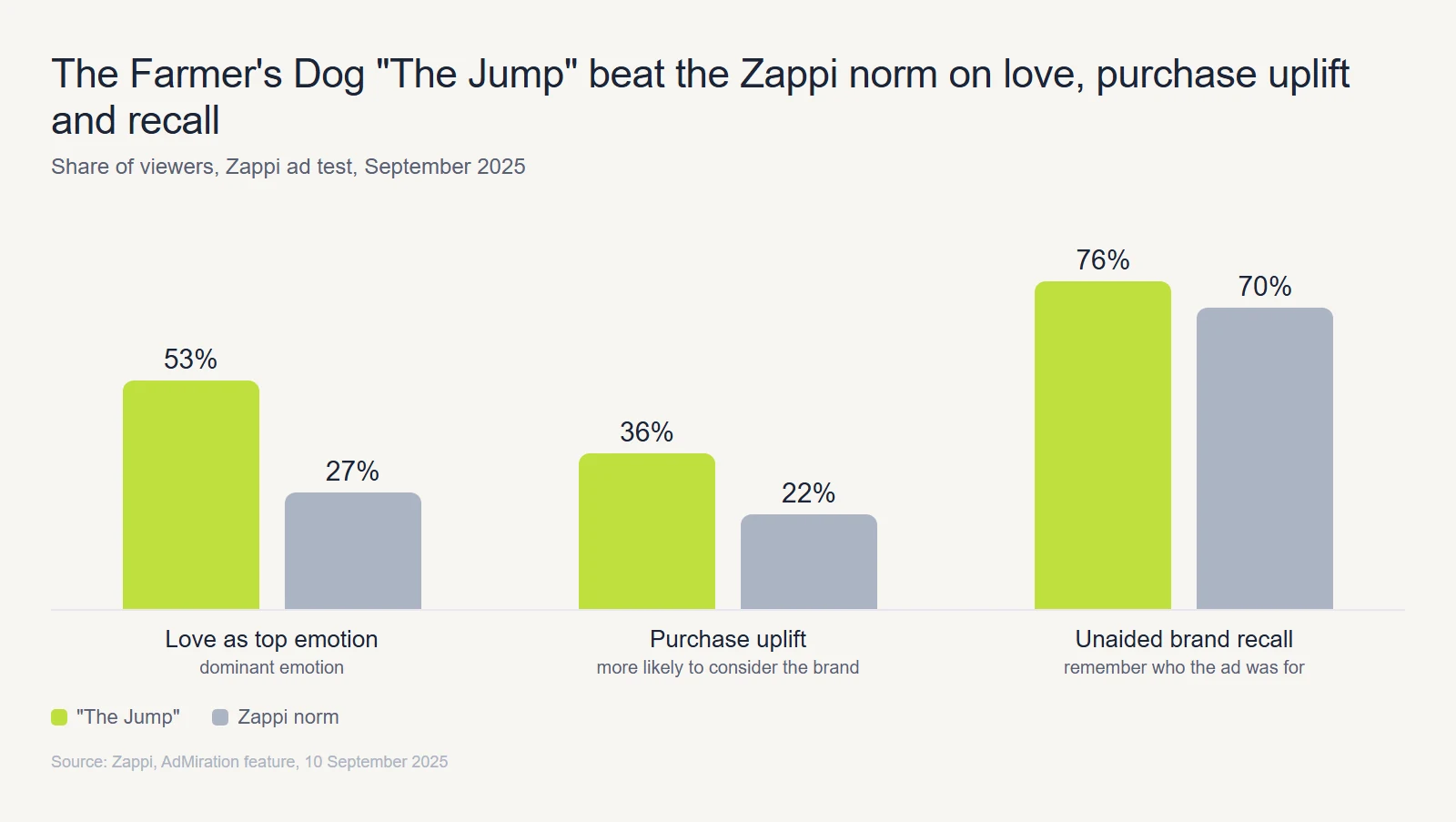
Zappi's panel gave it Love as the top emotion for 53% of viewers against a 27% norm, a Purchase Uplift of 36% against 22%, and Unaided Brand Recall, a brand awareness measure, of 76% against 70%.
The newer "For Everyone's Dog" (2026) strings vignettes of pets in family life together. System1 gave it 5.4 stars against a US pet food average of 3.1, placing it in the top 2% of more than 1,400 pet food ads it has tested.
These are polished TV spots, so their panel scores offer creative direction rather than a forecast for paid social. For Reels or TikTok, try a 6 to 15 second cut that preserves the key moment and introduces a short on-screen line early.
A Bleeped Joke as a Pattern Interrupt: Pedigree Dentastix
Pedigree chooses a very different opening: a censored joke about bad breath. Its April 2026 "Good Dogs Have Bad Mouth" campaign, made with Colenso BBDO, links a dog's supposedly bad mouth to dental care across OOH, social, digital and AV placements.
In the film, two apparently well-behaved dogs are let down by their mouths. The agency uses bleeps and the phrase "Bad Mouth" to make a familiar oral-care message feel unexpected.
Crucially, the joke leads back to the product's purpose. Pedigree says 8 in 10 dogs develop oral-health issues; without an independent study attached, that figure should be treated as a company claim.
A useful comparison would put the bleep first in one cut and introduce the dental problem before the punchline in another.
Taboo Problem Hook in the Pet's Voice: Hartz Comfitables
Talking about dog diapers can easily sound clinical. Hartz makes the subject more approachable with talking dogs in its January 2026 "What a Relief" campaign, developed with Cutwater.
In the "Good To Go" spot, the dogs say goodbye to "tinkle winkles and whoopsie doopsies" while introducing diapers and wraps. The playful script keeps the product's purpose clear without a medical-sounding pitch.
Comfitables Diapers "Good To Go" (0:15). Source: Hartz Pets on YouTube
For a brand selling a similarly sensitive product, the creative choice is clear: try playful and practical scripts against the same footage.
Hartz also introduced 12-count packs to make the first purchase easier. Keep the pack size unchanged between versions so the tone of the message remains the main variable.
How Dog and Cat Imagery Can Change the Message
There is an interesting distinction here: the research looks at exposure to dog and cat imagery, rather than assuming that all dog or cat owners think alike.
In "The Pet Exposure Effect" (Journal of Marketing, 2022), viewers exposed to dogs tended to respond better to promotion-focused messages, while cat exposure favored prevention-focused messages.
The researchers also explored consumer decisions and advertising responses for products outside the pet category, so the finding is a starting point for creative testing.
The effect was more apparent when the imagery evoked familiar traits associated with each animal.
To explore the idea without changing the audience or the product, choose something both dog and cat owners might buy, such as a stain-and-odor cleaner.
Then pair each headline with both a dog image and a cat image. Keep the offer, audience and placement the same across all four versions. For example:
- Gain-focused headline: "Make room for more playtime."
- Prevention-focused headline: "Clean up accidents before odors linger."
Treat these lines as test ideas, not expected winners. The original research did not measure sales of pet cleaners, so look for differences between the image-and-message combinations and let your own purchase data settle the question.
Pet Ad Hook Types Compared: First Seconds, Format and Test Variable
The right opening depends partly on what the product needs to communicate. Use the table to choose a starting approach, then vary one detail at a time rather than changing the whole ad.
| Hook type | Brand example | What the first seconds show | Best placement | What to vary | Evidence grade |
|---|---|---|---|---|---|
| Owner talks to the dog | Freshpet "Kitchen Conversations" (May 2026) | An owner confiding in the dog during meal prep | Reels, TikTok, TV | Owner line first or dog reaction first | C |
| Pet-perspective quirk | Rover "We Get Your Pet" (2026) | One pet's specific obsession, no app screens | YouTube, social, TV | Which quirk opens | A |
| Wordless emotional opener | The Farmer's Dog "The Jump" (Sept 2025) | A dog running to music, logo on screen | TV, YouTube, 6 to 15 second cuts | Music-first or caption-first | A |
| Pattern interrupt | Pedigree Dentastix (Apr 2026) | Two dogs and a bleep | OOH, social | Interrupt first or problem first | C, D |
| Taboo problem in the pet's voice | Hartz Comfitables (Jan 2026) | A talking dog names the accident | Digital and social | Playful or clinical copy | C |
For a first round, three distinct openings are enough to compare directions without spreading the budget too thin. If you need owner-shot footage, our UGC agency can cast pets and their owners and brief the creative.
Pet Product Demonstration Ads: What to Show Before You Make the Claim
Once the opening has earned attention, viewers need to see the product at work. A litter box can complete its cleaning cycle, a tracker can locate a dog, and a camera can toss a treat.
Each action gives the shopper something concrete to assess. Any spoken or on-screen claim still needs the right qualification and supporting evidence.
Litter-Robot: Show the Cycle and Qualify the Claim
For a self-cleaning litter box, watching the cycle is more useful than hearing a list of features. Litter-Robot's site shows the Litter-Robot 5 Pro cleaning process, WasteID detection of urine and feces, and its dual-camera view.
Meet Litter-Robot 5 | The Next-Generation Self-Cleaning Litter Tray. Source: Litter-Robot on YouTube
Its 90-day in-home trial and free US shipping offer another reason for shoppers to consider a higher-priced device.
The details around that footage matter too. Litter-Robot qualifies its odor claim: its FAQ says odors are significantly reduced, while the headline includes an asterisk. An ad should keep that qualification close to the promise it supports.
Fi Ultra and Tractive: Show the Map, Then the Proof
Trackers call for a different kind of proof. Fi introduced Fi Ultra in July 2026 with "Unleash the Wild," an AI-rendered film made by Dolsten & Co. MediaPost reports that the dogs were recreated with realistic markings and movements, including the founder's dog Thor. The campaign ran on TV, social and digital.
Fi 2026 UnleashTheWild 60. Source: Dolsten & Co on YouTube
As brand storytelling, the film can set a mood. A product demonstration has another job: show a real tracking session and clearly separate recorded app footage from illustrative scenes.
The collar is priced at $199 plus a $99 half-yearly membership, and satellite tracking covers the US first.
Tractive takes a more practical approach on its product page, highlighting live location and escape alerts alongside the DOG 6, listed from $79. It also displays a 4.7 rating based on more than 50,000 Trustpilot reviews.
Because both trackers require paid subscriptions, that cost belongs in either version of the ad. One useful split is a map-first opening against a dog-first opening.
Furbo: Show the Pet Using the Product
A treat camera has a built-in demonstration: the moment a pet reacts to the toss.
The Furbo Mini 360 page shows the treat toss and 360-degree view, with a $35 device price against a $99 reference price. Ask a creator to capture the toss and reaction in one uninterrupted take.
If the ad mentions Furbo Nanny features, explain the recurring plan cost separately from the device price. That way, the reaction footage draws people in without obscuring the ongoing expense.
Pet Product Demonstration Checklist: What the Camera Must Show
Across categories, the footage needs to cover the action, the visible result and any qualification that changes how a claim should be understood.
The tracker and fresh-food sequences in the table are filming suggestions, not documented executions of those brands' ads. Once a demonstration is consistent, compare a short cut of 6 to 15 seconds with a longer edit of 16 to 30 seconds.
| Product type | What the camera must show | Claim to qualify | Example |
|---|---|---|---|
| Self-cleaning litter box | The full cycle with a real cat | Odor and "never scoop" language | Litter-Robot |
| GPS tracker | The live map with the dog moving | Coverage area and subscription cost | Fi Ultra, Tractive |
| Treat camera | The pet reacting to the toss | Subscription features | Furbo |
| Fresh food | Scooping into the bowl and the dog eating | "Human grade" and health wording | Suggested fresh-food demo |
Whatever the product, three filming principles help keep the message clear:
- Open on the pet or the clearest product action.
- Show the job before the spec.
- Put the qualifier in the same shot as the claim.
Pet Brand Offers to Test: First-Order Discounts, Size-Based Boxes, Guarantees and Gifts
After viewers understand the product, the offer can address what might stop them from buying. A discount lowers the first payment; size-based pricing makes the cost specific; a trial eases uncertainty; and a gift adds value without changing the listed price.
The examples below use brand-page terms checked on 10 November 2026. Promotions vary by landing page and can change before checkout, so treat them as offer formats to examine rather than permanent prices.
Percentage-Off First Order: The Farmer's Dog and Chewy Autoship
A first-order discount is easy to understand, although its real value depends on the cap. The Farmer's Dog currently shows "Get started - 50% off," with free shipping on its plans. Since the page leaves the discount cap and scope unclear, confirm the checkout terms before using the offer as a reference.
Chewy adds an important condition: its help center lists 35% off the first Autoship order up to $20, followed by 5% off later orders. That turns the promotion into both an acquisition incentive and a reason to continue subscribing.
The Autoship terms page, updated 24 September 2026, also allows Chewy to change the discount. On a larger basket, the $20 cap means the actual saving falls short of the headline 35%.
First Box Priced by Dog Size: Ollie
Ollie takes a different approach by showing the cost of a first box according to the dog's size. The price becomes concrete before the buyer starts comparing percentage discounts.
On one version of Ollie's landing page, the first box is listed at $35 for X-Small dogs (1 to 14 lb), $45 for Small (15 to 28 lb), $55 for Medium (29 to 54 lb) and $75 for Large (55 lb and up). Shipping is free, and the brand advertises an Obsession Guarantee.
Ollie also runs promotional landing pages, so check the specific price at checkout. For testing, compare this size-based presentation with an introductory discount for the same meal plan.
Risk Reversal: Spot & Tango and Litter-Robot Trials
For buyers considering an unfamiliar food plan or an expensive device, a trial may matter more than a discount. Spot & Tango's page offers free shipping and a risk-free trial backed by a 14-day Happy Pup Guarantee, with meals starting at $0.53. Litter-Robot provides a 90-day in-home trial, although customers cover return shipping. Both address uncertainty, but each comes with its own conditions.
Free Gift Add-On: Bark Free Toy in Every Box
Gifts work differently because the listed price stays the same. Bark advertises an extra toy in every box during the first year, with BarkBox Classic starting at $24 a month.
To see whether the extra toy actually helps, compare it with a discount of similar cost to the brand. Then follow retention as well as initial sign-ups.
Pet Brand Offers Compared: Terms Read on 10 November 2026
| Brand | Offer as shown | Offer type | Condition to check | Source read |
|---|---|---|---|---|
| The Farmer's Dog | 50% off, free shipping | Percentage off | Cap and scope at checkout | thefarmersdog.com |
| Ollie | $35 to $75 first box by dog weight | Priced by size | Weight band | Ollie size-based landing page |
| Chewy Autoship | 35% off first order up to $20, then 5% | Percentage off, capped | Terms can change | Terms page, help-center snippet |
| Spot & Tango | Risk-free trial backed by a 14-day guarantee, from $0.53 a meal | Risk reversal | Refund conditions | spotandtango.com |
| Bark | Free extra toy in every box, first year | Free gift | Subscription term | bark.co |
| Litter-Robot | 90-day in-home trial, free US shipping | Risk reversal | Return shipping paid by customer | litter-robot.com |
| Furbo | $5 off first Furbo, 30% off first year of plan | Fixed-dollar device + percentage plan discount | Plan billed yearly; device priced separately | furbo.com |
What Pet Ads Can and Cannot Claim: Two 2026 NAD Rulings
Even a carefully worded ad can suggest something the brand never says outright. NAD examines those implied messages as well as explicit claims, and two 2026 dog-food disputes show why the images deserve as much scrutiny as the voice-over.
In March 2026, on a challenge by The Farmer's Dog, NAD found that a Freshpet social ad implied the food is "human grade." The owner says "We eat fresh, real food as much as possible at home, so of course, we want the same for Benji" and describes the food as "made with the same level of quality I want in my own food."
The decision called for Freshpet to discontinue the claims in the Benji video, and the brand agreed to comply. A third ad, which showed food being prepared in a home kitchen before serving, did not raise the same concern.
A month later, on 17 April 2026, NAD reviewed Sundays for Dogs in another challenge by The Farmer's Dog. It found support for "real food ingredients" and "all-natural ingredients," while questioning several other claims.
The concern was partly visual. Paired with whole-fruit and vegetable imagery, phrases such as "100% meat and superfoods" and "the same ingredients you'd put in your salad" could imply that the product contains whole produce, even though Sundays uses nutrient extracts.
The panel also recommended dropping "the world's healthiest, and most convenient dog food" for lack of substantiation, along with an unqualified "Made in USA" claim.
| Claim in the ad | Why it was challenged | Safer version to test |
|---|---|---|
| "Made with the same level of quality I want in my own food" | NAD read it as an implied human grade claim (Freshpet) | Name the ingredients and the cooking method |
| Whole fruit and vegetable imagery with "100% meat and superfoods" | Implied whole produce in a product made with nutrient extracts (Sundays) | Show the actual product and name the ingredient form |
| "World's healthiest and most convenient dog food" | Superiority claim without substantiation (Sundays) | One measurable attribute with a source |
AAFCO has had a human grade standard since January 2023, so check the applicable requirements before testing a human-grade message. Images can create the same implied promise as copy, which makes both worth reviewing before launch. This is not legal advice.
How to Run a Four-Week Pet Ad Test: Hooks and Offers
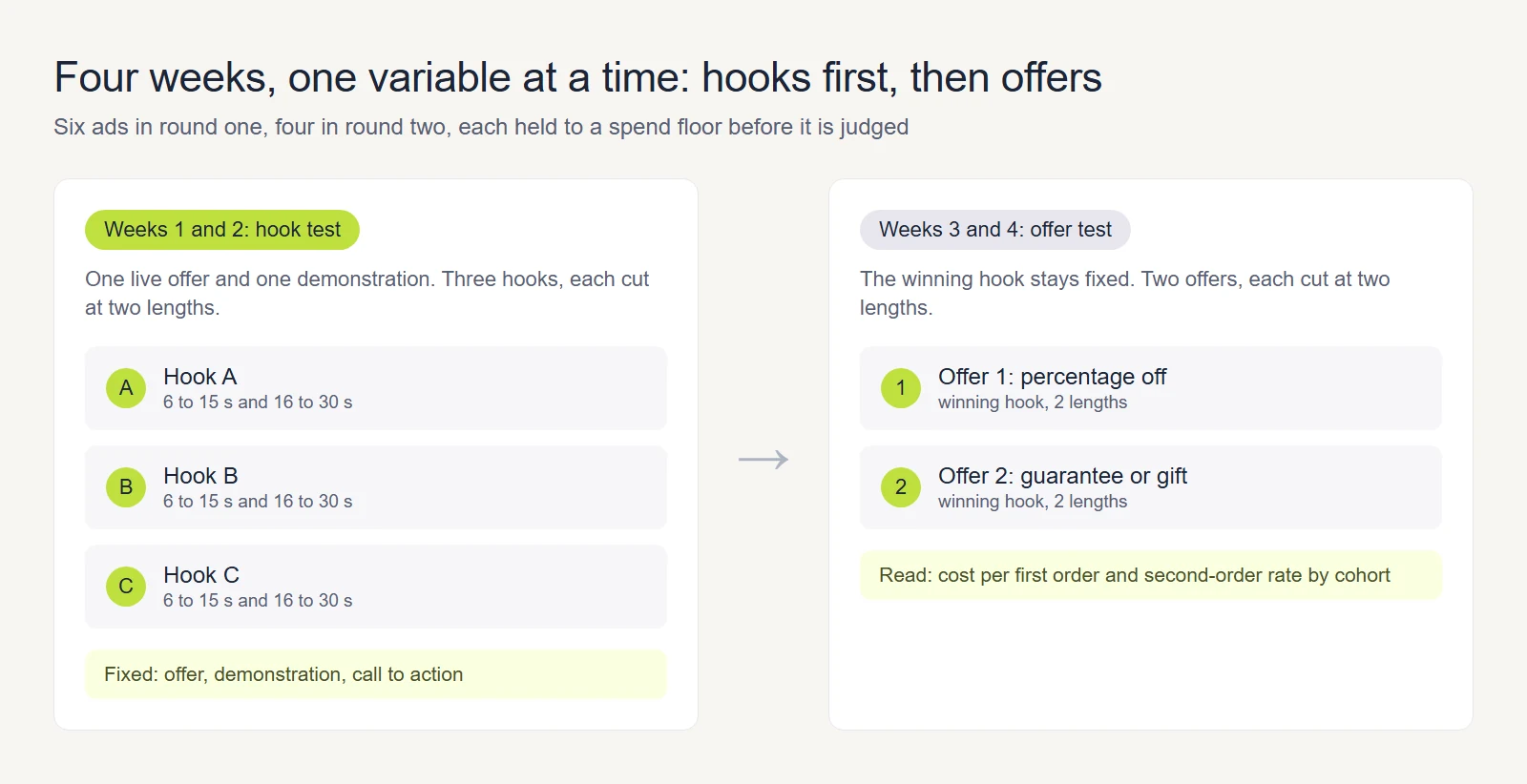
Think of the four weeks as two focused comparisons. First, run three openings at two video lengths while keeping the demonstration and offer unchanged. In the second half, take a promising hook forward and compare two offers under matched conditions. This process screens creative directions; evaluating a different demonstration requires another experiment. Our guide to creative testing explains why isolating variables matters.
- Keep the existing offer unchanged during weeks one and two. Otherwise, an incentive could explain a difference you mistakenly attribute to the opening.
- Shoot three openings around one demonstration. Match the product footage, proof, CTA and audience so you can understand what made one version more compelling.
- Turn each opening into two edits: a 6 to 15 second cut and a 16 to 30 second cut. That gives you six ads for the first round.
- Set a modest initial budget for each variation, then look at conversion volume before declaring a winner. The spend floor below is a planning assumption, not a significance threshold.
- The metric map helps explain where viewers disengage. Attention and retention point to creative issues, while cost per first order brings the discussion back to acquisition.
- Take the most promising opening into the offer comparison, keeping the video lengths matched. Review repeat-purchase results later, once those customer cohorts have had enough time to reorder.
The footage needs to be easy to reproduce, too. Owner-shot demonstrations can simplify production, and our pet UGC brief and acceptance checklist explain what to request from creators and how to assess the takes.
What Does a Pet Ad Test Cost? Illustrative Budget Math
Start with your target cost per first order rather than a universal testing budget.
Spending three to five times that target on each ad can provide an early directional signal, but it's illustrative planning math, not a validated threshold for statistical significance.
For example, with a $40 target, $120 to $200 in spend would produce only three to five expected purchases if the ad performed as hoped. That is far too little to support a confident comparison on its own.
| Step | Assumption | Result |
|---|---|---|
| Target cost per first order | $40 | $40 |
| Initial screening spend per ad (3x to 5x) | 3x to 5x of $40 | $120 to $200 |
| Ads in round one | 3 hooks by 2 lengths | 6 ads |
| Round one screening spend | 6 ads at $120 to $200 | $720 to $1,200 |
| Round two (2 offers, matched hook and lengths) | 4 ads at $120 to $200 | $480 to $800 |
| Illustrative screening total | Round one plus round two | $1,200 to $2,000 |
The arithmetic changes with your CPA: at a $100 target, the same screening approach allocates $300 to $500 per ad.
Those figures can help you plan the first pass. Keep the decision open until there is enough purchase data to support it.
Metric Map: Which Number Judges a Hook, a Demonstration and an Offer
Each metric helps diagnose a different part of the ad. Watch-time data can flag problems with the opening or proof, but it cannot establish whether a different demonstration would perform better unless that demonstration is tested separately.
| Variable | Metric | What it tells you | How to interpret |
|---|---|---|---|
| Hook | 3-second view rate (3-second plays divided by impressions) | Whether the opening retains attention in the same placement | Compare at similar delivery; confirm with purchase data before scaling |
| Demonstration | Hold rate (share of 3-second viewers still watching at the halfway point of the video) and click-through rate | Whether viewers stay through the product action and click | Use drop-off to revise the edit; test new demos separately |
| Offer | Cost per first order; later, second-order rate by cohort | Short-term acquisition cost and later customer quality | Revisit after enough repeat-purchase time and sample size |
Repeat purchases matter most for replenishment and subscription offers, although they often arrive after the four-week test has ended.
Start by comparing acquisition costs under similar conditions. Revisit the cohorts when enough customers have had a chance to place another order.
Running the variants as dark posts can also keep organic engagement separate from paid results. We explain the setup in how to test creator content.
How Spot & Tango Brought Social Ad Customers to TV
Spot & Tango provides an example of social ads informing a much larger creative decision. In April 2026, the brand announced a $3.5 million investment in TV and out-of-home, its first major push into those channels.
Instead of hiring studio actors, Spot & Tango featured existing customers selected using performance and engagement data from earlier social ads.
The connection is the point: earlier social work influenced the casting, while the reported $3.5 million budget tells us nothing about the campaign's return. This is evidence of a creative selection process, not proof of sales impact.
Test Pet Ads With inBeat Agency
A pet video can hold attention and still leave shoppers unsure about the product. Useful advertising makes the benefit visible, explains the offer and gives the team a clear idea to test next.
Through its ad testing services, inBeat helps brands compare creator-shot concepts, refine the footage and track performance against purchase outcomes. The aim is to learn which executions deserve the next round of spend.
Book a strategy call to plan your first creative round and identify the footage worth producing.
FAQs
What rights does a brand need to turn customer-shot pet footage into an ad?
Before using customer-shot footage in paid media, get written permission that covers editing, placements, usage duration and distribution channels. Check the agreement for recognizable people, music rights and any platform-specific ad authorization. Permission to share a clip organically is a different matter.
Should a subscription offer be judged by the same metric as a one-time device sale?
Start with first-order acquisition cost, then account for the economics of the product. Food and subscription boxes call for reorder, cancellation and margin data by cohort. For devices, returns and recurring plan revenue can be just as important. An offer should be compared with alternatives for the same product, rather than ranked against a completely different category.
What if a pet won't follow the script during a creator shoot?
Build the shoot around habits the animal already enjoys, with the owner giving familiar cues. Short sessions and extra cutaways leave room for spontaneous moments. If a planned trick never happens, adjust the creative instead of pushing the pet through it. Natural behavior usually makes better footage than a forced perfect take.
How can pet brands measure ad impact when customers buy from retailers?
When purchases happen at retailers, begin with the data those partners can share: promotions, retail-media reporting, product-page visits and sell-through. If feasible, compare similar stores or regions with different media exposure while accounting for pricing and promotion changes. It won't produce perfect ad-level attribution, but it can offer a more useful view of incremental demand.