

You can spend six figures producing a commercial, then undermine its impact with one casting decision.
The talent that feels authentic in one market may feel completely out of place in another. And the consequences extend beyond creative performance to licensing, contracts, and production costs.
There's a business case for getting representation right, too. Research spanning 392 brands across 58 countries linked inclusive advertising with 16% higher long-term sales.
So how do you find talent that connects locally while keeping a multi-country campaign manageable?
It starts with choosing the right commercial casting agency.
Our view: talent selection is part of how creative finds its audience. The person on screen, the objection they address and the details of their story all affect how the ad lands, alongside media targeting. Rather than assume one winning cast will travel, we'd test that choice in each market.
TL;DR: How to Choose a Casting Partner for Multi-Country Ads
- Match the partner to the production. Union actors and broadcast work often call for specialist casting; creator-led paid social may call for a UGC or creator agency. Hybrid campaigns can need both.
- Decide where local talent matters. A product-led demo may travel well, while a testimonial or character-led ad deserves a closer look at language, context and audience fit.
- Choose the operating model before the vendor. A global partner, a hub of local directors and independent country agencies offer different trade-offs in control, speed and local expertise.
- Score partners on evidence. Request a sample longlist in two markets and a clear contracting party for every booking.
- Scope usage rights early. Media, territory, term and exclusivity can materially change the quote, sometimes more than the initial session fee.
- Pilot one market first. It tests the partner, the paperwork and the brief before the full rollout.
What a Commercial Casting Agency Does for Multi-Country Ads
A commercial casting agency finds, auditions and books on-camera or voice talent.
On an international production, that can mean coordinating several local searches against one creative brief, while handling different booking and usage requirements.
Expect a casting breakdown, longlist, self-tapes or live auditions, callbacks, offers and supporting paperwork.
They may all help get someone on camera, but these four partner types do different jobs:
| Partner type | What it does | How it's paid | Best for |
|---|---|---|---|
| Casting agency or casting company | Searches across agencies and open talent, runs auditions, handles offers and bookings | Flat project fee or weekly rate | TV, online film and branded campaigns with actors or real people |
| Freelance casting director | Runs the casting process for one production, often in one market | Project fee | A single-market shoot with a clear brief |
| Talent agency | Represents its own roster and negotiates their fees | Commission from the talent | Booking a named performer you already know |
| Creator or UGC agency | Sources creators for brand-owned content and, where agreed, posts on creator handles; negotiates content and paid-usage rights | Per-asset or retainer fee | Native paid social creative |
The format and distribution plan should lead the decision. Union performers and broadcast work often need a casting specialist; creator-shot assets for the brand's paid channels may be better suited to a UGC agency.
When creators publish from their own accounts, posting permissions become part of the deal too. A hybrid campaign may need both kinds of partner.
Local contracting practices vary by country.
In the UK, Equity explains that there is no enforceable collective agreement in commercials that sets pay and conditions, so fees and usage need to be negotiated and recorded in writing.
US commercials, meanwhile, may fall under SAG-AFTRA.
That is why a useful partner should explain the rules behind each booking, rather than treat international casting as a single contractual process.
When the Cast Should Change by Market
Local casting matters most when the person carries the message through their accent, experience or cultural context.
A product demonstration may travel further with the same presenter. Either way, check how the creative lands with local viewers before rolling it out more widely.
| Ad type | Reuse one cast when | Re-cast when | Language handling |
|---|---|---|---|
| Product demo | The product does the persuading | The demo needs a local use case | Subtitles or dub |
| Testimonial or real-people ad | When the story fits across markets | When the story or language needs local context | Local speaker, local script |
| Spokesperson or founder | The brand figure is the point | The market doesn't know the figure | Dub only if lip-sync holds |
| Social-first creative | When the format works across markets | When local language or tone drives response | Native-language creators |
| Voice-led ad | The voice is a brand asset | Accent or dialect affects credibility | Native voice talent |
From there, the creative decision is how far to adapt the asset: adjust the existing version, transcreate it or re-shoot it.
Comparisons of global and local creative are useful, but they need context.
A "World Class" analysis from Publicis London, System1 and Effie looked at 1,262 Effie cases from Europe and the US and found that 124 multi-market campaigns delivered 29% more brand effects but 9% fewer commercial business outcomes than 1,138 single-market campaigns.
There is an important limit to that comparison: the cases are award entries, and the analysis is correlational. It measures campaign models rather than casting decisions. So a claimed percentage lift from culturally matched talent alone would need separate evidence.
Put local-flex rules into the master brief: keep the offer and product claims consistent while allowing each market to adapt language, casting and setting. Then compare creative performance by market before scaling a single version. For voice-led ads, specify accent and dialect too, as our notes on native voice talent explain.
Choose an Operating Model: One Global Partner, Local Casting Directors, or Local Agencies?
The simplest way to choose is to look at who owns the creative and where local casting is essential:
- One global partner may fit markets that share a creative approach and centrally managed production.
- A hub-and-spoke network suits distinct local casts with central creative oversight.
- Independent local agencies make sense when country teams own budgets and sourcing.
- A hybrid approach can work for a new launch, particularly if repeat sourcing will eventually move in-house.
One Global Casting Partner
A single lead can make briefs, reviews and approvals easier to manage. However, a global roster may rely heavily on subcontractors. Before committing, find out who sources the talent locally, which entity signs the booking and how market feedback reaches the central team.
Hub-and-Spoke Network of Local Casting Directors
With a hub-and-spoke setup, local directors run the talent search while a central team reviews work against the same brief.
You gain local knowledge, but approvals, invoices and currencies require coordination. Similar decisions arise in creator programmes when comparing a hub-and-spoke or agency-per-market model.
Local Agency per Country
Working with agencies country by country gives regional teams direct relationships and market knowledge. The trade-off is coordination: without a common brief, reporting process and escalation owner, decisions can drift.
Hybrid: Launch With a Partner, Then Hand Proven Talent to In-House
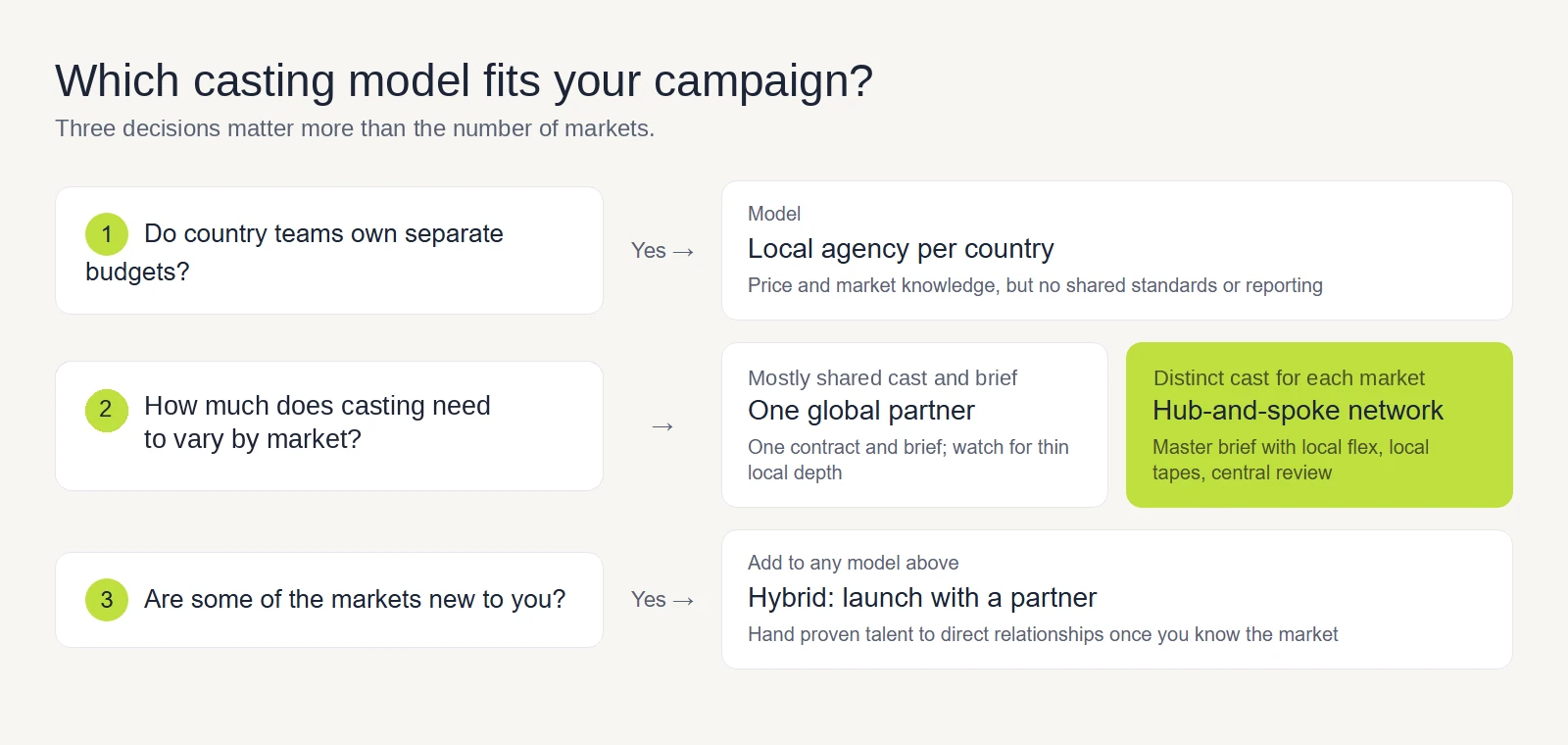
In practice, the decision comes down to ownership. Who approves the creative, who signs the talent contracts and where will local expertise make the biggest difference?
A specialist can help launch in unfamiliar markets while your team learns what works. If you later bring repeat bookings in-house, plan that transition early: talent contacts, existing licences and renewal responsibilities all need a clear owner.
| Model | Best when | Main strength | Main risk | Who signs the talent contract |
|---|---|---|---|---|
| One global partner | Shared look, central shoot | Speed and consistency | Thin local depth | The partner or its local entity |
| Hub-and-spoke network | Distinct casts per market | Local authenticity | Coordination and invoices | Each local director or the hub, by agreement |
| Local agency per country | Separate budgets | Price, market knowledge | No shared standards | The local agency |
| Hybrid | New markets today, scale later | Learning plus control | Handover gaps | Partner first, then you |
Evaluation Criteria for a Multi-Country Casting Partner
A polished reel tells you little about how a partner will manage your campaign. The seven checks below focus on evidence you can request before signing, along with useful answers and warning signs.
Local Talent Depth in Every Target Market
A sample longlist from two representative markets is more revealing than a broad roster claim. Agree a realistic turnaround and check availability.
- Strong: named talent with local signing agents and availability confirmed.
- Red flag: a generic database export or the same faces offered for every country.
Real-People and Street Casting Capability
Real-people casting often involves extra outreach, scheduling and consent work. Look at how the team finds non-professionals, checks their claims and collects appearance releases locally.
- Strong: a described sourcing method and sample release wording per market.
- Red flag: "we can find anyone" with no process for consent.
Creator and UGC-Style Talent Alongside Actors
A hero commercial and creator-shot variations may sit in the same campaign, but their rights work differently. Find out whether the partner handles UGC for brand channels, posts on creator accounts or both, and who manages paid amplification.
- Strong: separate rate cards for set-based talent and creator-posted content.
- Red flag: actor day-rates applied to creator content with no licence structure.
Remote Casting and Self-Tape Workflow Across Time Zones
For remote auditions, the workflow matters as much as the platform. Check who gives direction in the local language, how self-tapes are organised and when reviewers are expected to respond.
- Strong: a fixed review window and a native-language director on each tape.
- Red flag: tapes arriving without direction notes or in inconsistent formats.
Contracting Entity, Payment Currency, and Indemnity per Country
Before signing, establish who contracts each performer, the payment currency and who handles a rights dispute. For international creator work, milestone payments tied to licence delivery can make handovers easier to track.
In the UK, IPA–Equity guidance cites compound late-payment interest of 1.5% for each overdue month or part-month, although the applicable contract and law determine what is owed.
- Strong: a named contracting party for each booking and written payment terms.
- Red flag: "the talent's agency will handle it" with no contract trail.
Compliance Capability for Minors, Work Authorisation and Data
Permits and data handling are easier to resolve before a cast is selected. Check whether the agency arranges child licences and visas, where it stores auditions and how it manages releases. The detailed legal requirements come later; here you're testing whether the team has a process.
- Strong: the partner raises permits and data retention before you do.
- Red flag: no mention of either until the shoot is booked.
Proof From Comparable Multi-Market Jobs
Past jobs in the same countries provide a useful starting point. Speak with references directly, then use a paid pilot to see how the team works with your own brief.
- Strong: reference calls with a client who cast in two or more of your countries.
- Red flag: logos and showreels only.
Build a Casting Partner Shortlist in Five Steps
- Write one master brief. Include the markets, usage scope (media, territory, term, exclusivity), shoot dates, budget range and the local-flex rules. Add the role, playing-age band, required skills and language for each market.
- Send an identical RFP to three partners. Use an RFP with a scoring matrix as the base.
- Request sample longlists from two contrasting markets. Comparing a familiar country with a less familiar one can reveal gaps in the partner's local reach.
- Use one weighted scorecard for every proposal. The seven checks above, plus price, are reflected in the example below.
- Before expanding, test the partnership with a paid pilot in one manageable market. Set a learning budget, agree deliverables and document what needs to change for the wider rollout.
The scorecard translates those checks into a comparable set of weights. Treat them as an illustration and adjust the emphasis for your campaign.
| Criterion | Example weight | Score 1-5 | Evidence required |
|---|---|---|---|
| Local talent depth | 25% | Sample longlist per market | |
| Contracting entity and payments | 20% | Named entity, payment terms in writing | |
| Compliance capability | 15% | Permit and data-retention process | |
| References from comparable jobs | 10% | Two reference calls | |
| Remote casting workflow | 10% | Platform, review window | |
| Real-people capability | 10% | Release samples | |
| Creator and UGC-style capability | 5% | Separate rate cards | |
| Price | 5% | Itemised quote |
Three warning signs would make us reconsider a shortlist: missing sample deliverables, fees that cannot be itemised and usage terms that remain vague after questions.
Usage Rights and Buyouts Across Countries
Actor-led commercials often separate the shoot fee from the right to use the performance. The final quote then depends on media, territory, duration and exclusivity.
Creator-produced assets may follow a different model, which makes comparing identical rights scopes essential.
The Four Usage Variables to Define Before Any Quote
Without these four details, two quotes can look comparable while covering very different uses:
- Media: where the ad runs (TV, online video, paid social, out of home). "Social" does not automatically cover paid social.
- Territory: the countries licensed in the agreement. Use geo-targeting settings and delivery reports to help keep digital ads within that scope; ad-set targeting alone does not define the rights.
- Term: how long the ad can run.
- Exclusivity: whether the talent is barred from similar brands during that period.
The same applies to edits: a video licence may leave out cutdowns, stills or behind-the-scenes material. Confirm those uses explicitly and arrange any extension before the original term ends.
How the Rules Differ in the US and the UK
| Market | How usage works | Term and exclusivity mechanics | Who sets the rules |
|---|---|---|---|
| US | SAG-AFTRA commercials contract: a session fee plus use fees | Maximum contractual period of use of 24 months; use fees still apply | Union and the advertiser bargaining body |
| UK | Basic shoot fee plus use fees negotiated per job | Use fees are negotiated by duration and placement; featured artists can face category conflicts for up to three years | Negotiated terms based on a non-binding agreement |
| Other markets | Local practice | Ask the partner to state it in writing | Local market |
The 2025 SAG-AFTRA rate sheet prices foreign use as a multiple of the session fee:
- UK: 3 times
- Europe: 2 times
- Asia/Pacific: 2 times
- Japan: 1 time
- Worldwide: 9 times
In the US, the Joint Policy Committee, which bargains for advertisers and agencies, states that the maximum period of use was lengthened to 24 months in the 2025 Commercials Contract.
In the UK, Equity's FAQ says use fees should be paid not later than the second month after the commercial appears, and that unauthorised continued use is normally repriced at the original cost with a 10% uplift year on year.
Beyond fees, likeness and moral-rights requirements also vary by jurisdiction. That makes locally reviewed licences, with clearly stated territory, channel and duration, safer than assuming a US-style buyout will work everywhere.

Tiered Licences or One Worldwide Buyout
Start with the countries and duration your campaign is likely to need.
A worldwide licence can make sense for an asset with a long shelf life, provided the relevant local and union rules allow it and the expected reuse justifies the premium.
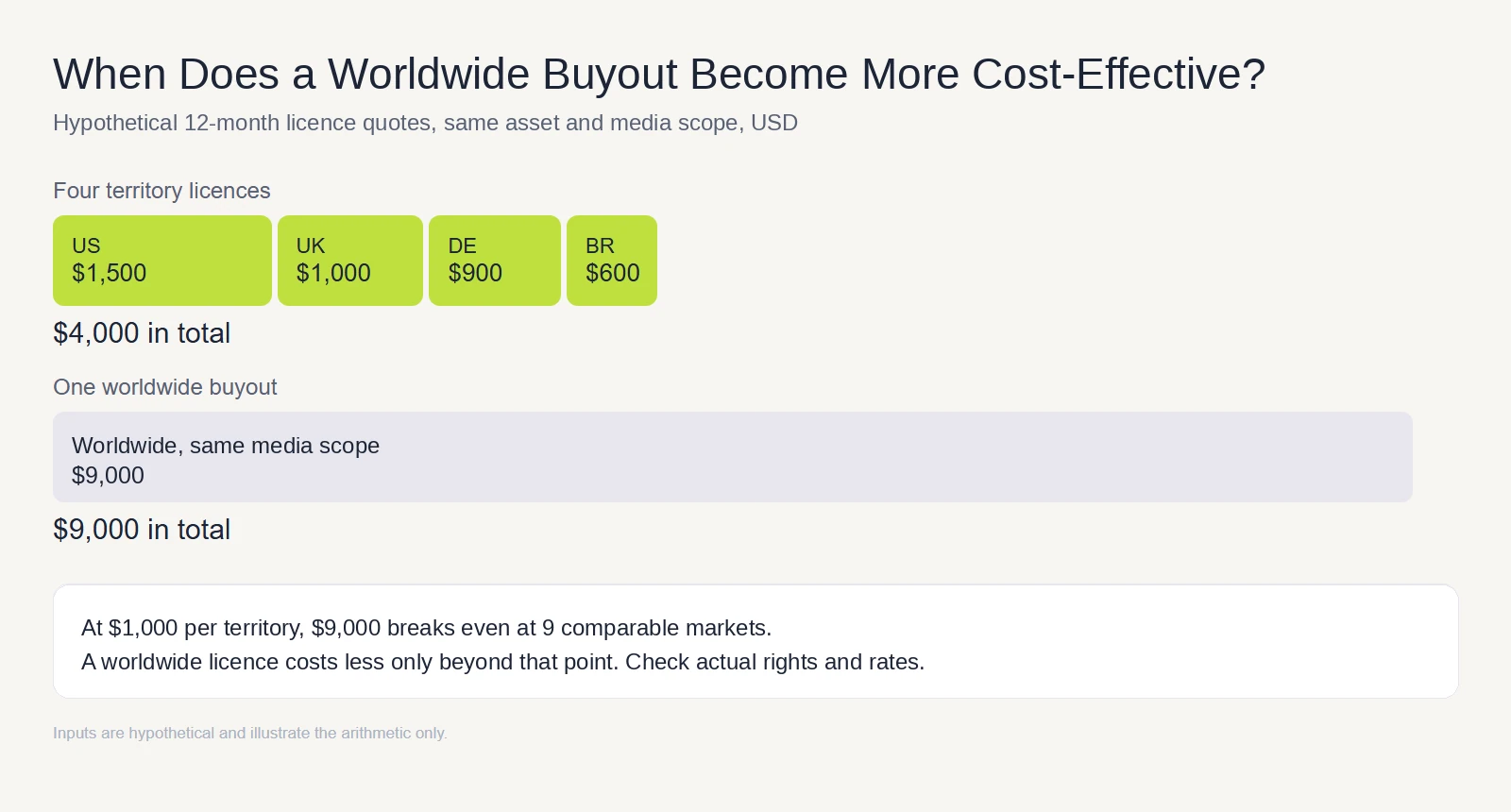
Here's a hypothetical comparison for one asset with the same media and 12-month term: US $1,500, UK $1,000, Germany $900 and Brazil $600 in separate territorial licences, or $4,000 in total.
At an average of $1,000 per territory, a $9,000 worldwide licence breaks even at roughly nine markets. That's arithmetic, not a market benchmark. Compare quotes only when the talent, asset, duration and rights are equivalent.
Budget for Multi-Country Casting Line by Line
The agency's headline fee tells only part of the budget story.
Across countries, talent compensation, usage, travel, production extras and tax treatment can vary independently. An itemised quote makes those costs easier to compare.
| Line item | Who sets the number | What varies by country |
|---|---|---|
| Casting fee | The casting partner | Flat project fee or weekly rate; local market norms |
| Talent session fees | Union rate sheet or negotiation | Union coverage and local minimums |
| Usage fees | Rights scope in the brief | Term, territory, media |
| Travel and work authorisation | Local immigration rules | Visa route and lead time |
| Local production extras | Local law and practice | Chaperones, interpreters, permits |
| Payment currency and tax | Contract and tax authority | Withholding and currency risk |
For a concrete reference point, the 2025 SAG-AFTRA Commercials Contract Year 2 rate sheet, effective 1 April 2026 to 31 March 2027, lists:
- an on-camera session fee of $855.20
- a Pension and Health contribution rate of 23.5%, or 19.95% for eligible JPC authorizers
The contract raises minimum rates 5% in Year 1, 4% in Year 2 and 3% in Year 3.
In the UK, Equity states that holiday pay is 12.07% of working-time fees, and HMRC's guidance on payments to foreign performers lists TV commercials and models in TV or online adverts among the appearances that can trigger withholding tax.
A single 'typical' cross-border fee would hide more than it explains. Casting type, destination and licence scope all affect price, so compare itemised proposals for the same deliverables instead.
Casting Timeline and Lead Times by Market
Start with the shoot date, then work backwards from the slowest local requirement. A practical sequence looks like this:
- Brief and usage scope locked.
- Longlist from each market.
- Self-tapes with local-language direction.
- Callbacks and client selects.
- Offers, holds and contracts.
- Permits and travel for talent who cross borders.
- Shoot.
Once the creative and talent are selected, permits and travel may determine the schedule.
The examples below cover the UK and California only; check the rules in every additional destination before locking shoot dates:
| Constraint | What the rule sets | Source |
|---|---|---|
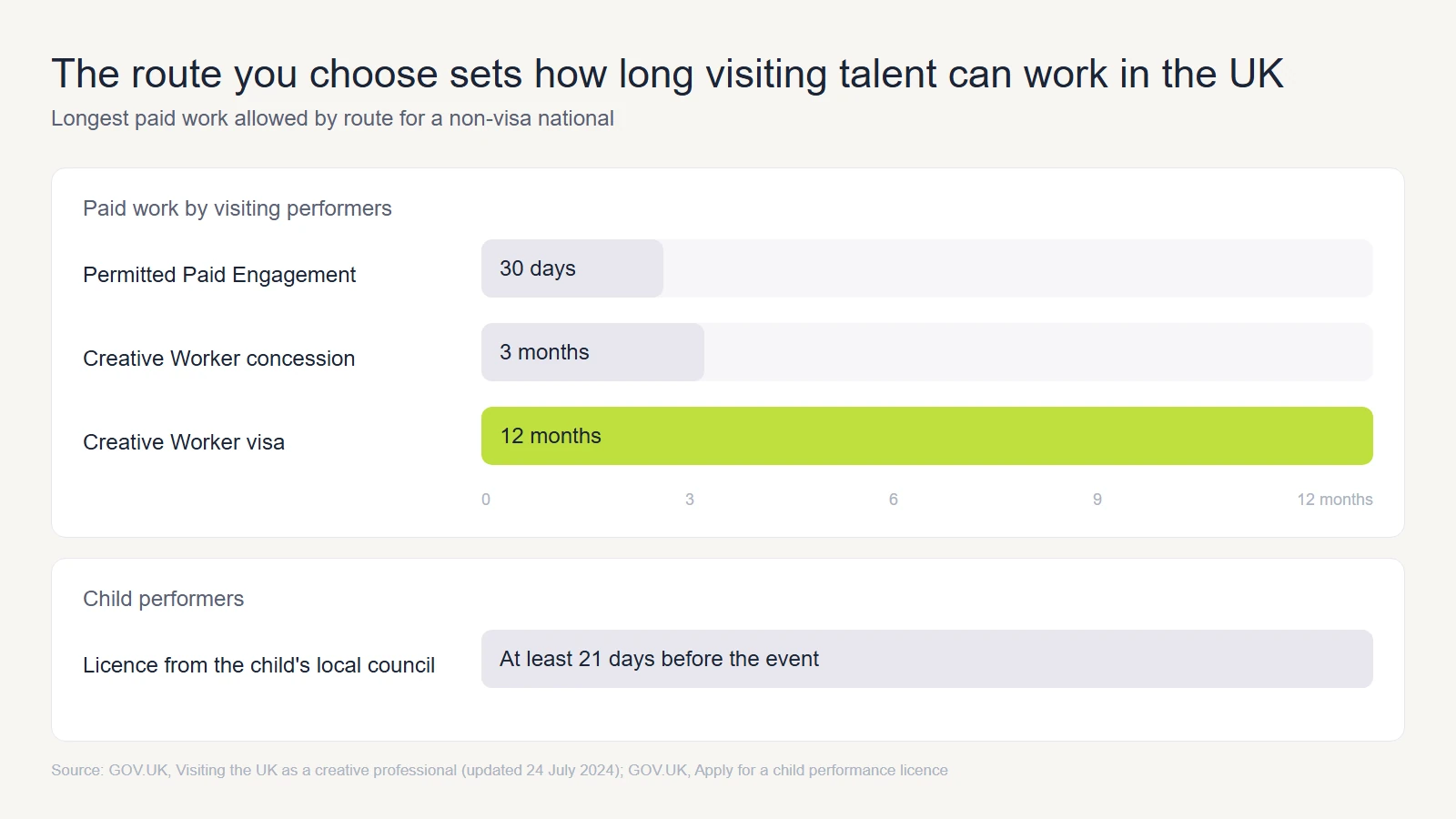
| UK child performance licence | Apply at least 21 days before the event | GOV.UK |
| UK paid work by a visiting performer | Permitted Paid Engagement: up to 30 days for eligible adult non-visa nationals invited and paid by a UK source. Creative Worker routes: up to 3 months (concession) or 12 months (visa), with a licensed sponsor and Certificate of Sponsorship. | GOV.UK |
| California minors | Entertainment work permit; first-time registrants can request a 10-day permit | California DLSE |
After casting and approvals, the production still needs coordinated direction. Here's what to plan for when directing an overseas shoot remotely.
Regulation, Consent, and AI Rules by Country
Beyond the casting brief, four areas deserve a country-by-country check: likeness and personal data, minors and work authorisation, endorsement disclosure, and synthetic talent. Each can affect whether an asset is cleared to run.
Likeness, Consent and Data Protection for Tapes
Casting tapes and signed releases contain identifiable personal data.
Under GDPR Article 7(3), a person can withdraw consent at any time, and it must be as easy to withdraw as to give.
That rule applies when consent is the lawful basis for processing. An appearance release or performance licence may involve separate contractual rights, so check both the privacy basis for storing tapes and permission to use someone's likeness in ads.
Set retention periods and deletion responsibilities with the casting partner before collecting the first tape.
Minors and Foreign Talent
The UK and California examples above are starting points, rather than a global timetable. Assign responsibility for permits and supervision in each location. In the UK, the event organiser must apply to the child's local council, and an approved adult must supervise the child.
Endorsement and Disclosure Rules for Creator-Style Talent
When talent speaks for the brand on a creator's handle, disclosure rules apply.
The FTC says a connection that a significant minority of consumers wouldn't expect should be disclosed clearly and conspicuously, and that its enforcement focus is usually advertisers and their agencies.
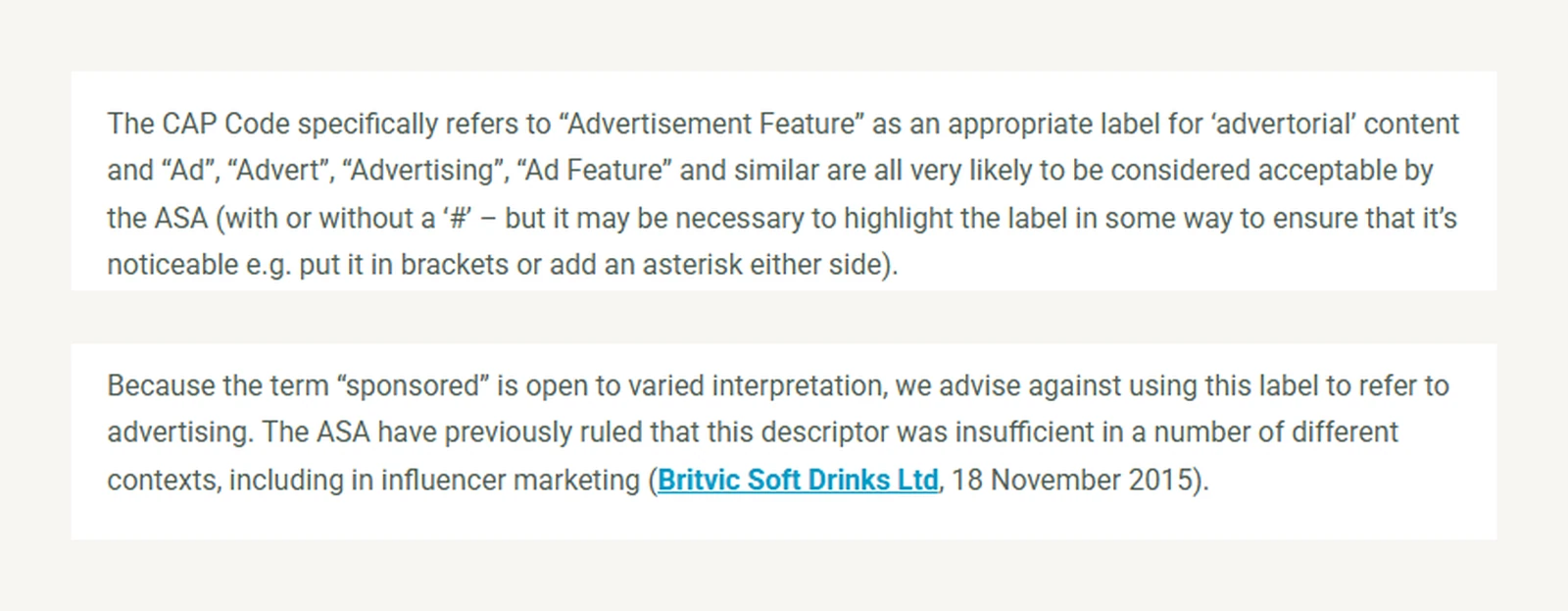
The UK's ASA expects a prominent "ad" label upfront and advises against the label "sponsored". ASA research published in February 2026 found that 79% of UK online users surveyed wanted influencer ad labels visible without extra clicks.
Before launch, check local disclosure rules alongside the creative. Healthcare and other regulated categories may introduce further consent requirements for patients and clinicians.
Digital Replicas and Synthetic Performers
The 2025 SAG-AFTRA Commercials Contract treats digital replicas of real performers differently from wholly synthetic characters. For a digital replica, the producer generally must:
- use commercially reasonable efforts to give 48 hours' notice for creation or use, with a 24-hour minimum in specified short-notice situations;
- obtain clear consent through a digital-replica rider or separate signed writing that describes the intended use;
- pay the performer 150% of a scale session fee for each commercial featuring a generated performance, plus applicable holding and use fees.
A synthetic performer is a human-like digital character that is neither a replica of an identifiable person nor voiced by a human performer. SAG-AFTRA restricts its use primarily for economic advantage.
When a covered commercial also features a human on-camera principal, specified session-fee-equivalent payments and benefit-plan contributions apply; other cases can require bargaining. Confirm the relevant contract terms before quoting synthetic talent.
In the EU, Article 50 of the AI Act has applied since 2 August 2026. Providers generally must mark AI-generated outputs in machine-readable form, while deployers have disclosure duties for deepfakes. Certain artistic or creative works have tailored disclosure requirements, and the rules differ from consent to use an identifiable person's likeness. Confirm which requirements apply to the finished ad before using synthetic talent in EU markets.
Contract Terms That Protect a Multi-Market Cast
For an international rollout, a master services agreement can establish the relationship with the lead partner, while each talent booking still needs clear written terms. The contracting entity may vary by country. Make sure these eight points have an owner:
- Contracting entity per country: who signs, and who is liable. Log each talent's usage rights window per market in the same file.
- Payment terms: specify deadlines and applicable late-fee provisions for each market; the UK Equity guidance above is one reference point.
- Replacement and cancellation: who steps in if talent drops out.
- Holds and recalls: how long a hold lasts and who can release it.
- Indemnity: who pays if a usage dispute arises.
- Release and tape ownership: retention period and deletion duty.
- Extension pricing: the price of renewal, agreed up front.
- AI and replica clause: what the partner may and may not do with captured likeness.
Scale Creator-Led Ads Across Countries With inBeat
For paid social, inBeat's Agency helps brands source local creators, build creative variations and connect production with media buying.
In a NielsenIQ campaign, our team worked with 250+ creators across 19 countries, combining native-language UGC with voiceover adaptations. We can help plan creator briefs, asset testing and paid-usage permissions; union or broadcast productions may still require a specialist casting partner.
Bring your target markets, formats and paid-media goals to a strategy call. We'll talk through creator sourcing, production workflows and the permissions each asset will need.
FAQs
Does a worldwide buyout cover paid social in countries where the ad was never planned to run?
The exact wording controls. Express worldwide paid-social rights may allow use in additional countries during the agreed term, but 'all media' can still leave gaps around channels, edits and union requirements. Check the licence before expanding distribution.
How do you get a quote when a US union spot also runs abroad?
Include every country, medium and term in the brief, then request a line-by-line quote for union foreign-use fees. A US session fee alone does not necessarily cover international use.
What changes when the talent is a creator posting from their own handle?
A creator post involves more than the finished asset. Separate fees for production, posting, amplification through the creator's account, term and exclusivity. Brand-owned UGC can run as an ad without a creator post, whereas Partnership Ads or Spark Ads generally need account permissions.
Should casting tapes in each market be reviewed centrally or locally?
Local directors can guide language and performance, while a central team compares auditions against the same brief. That gives you consistent review standards without losing cultural context.
Can you use a synthetic performer in one market and human talent in others?
Potentially. The key is to review the creative and the law separately in each country: US union contracts distinguish digital replicas from synthetic performers, and EU rules can require transparency disclosures. Audience response deserves testing alongside cost.