

What makes an ad sound like it belongs in a market rather than simply being translated for it? Sometimes, the difference comes down to a single voice.
TikTok and NRG's US research found that Spanish-dominant users were 57% more likely to say they'd watch more brand ads after seeing Spanish-voiceover creative compared with English-only versions.
But choosing the right language still leaves difficult decisions.
- Which accent fits the audience?
- How much should the script change?
- And how do you preserve the original message within a fixed runtime?
Let's explore what matters.
P.S. If you'd rather have scripts written natively in each market before they reach a studio, our creative ad copywriting team handles hooks, body copy, and CTAs by language.
TL;DR: Six Decisions to Lock Before Any Ad Voice-Over Session
- Language and accent: pick the language variety and accent from the audience's market, then write a voice profile.
- Casting: shortlist three voices per language from native voice talent in each market, then book them once the adapted script is locked.
- Adaptation and timing: time-code the English script, adapt it to each slot, and read it against a timer.
- Auditions and pronunciation: audition on the hard lines, then have a native reviewer approve how every brand term is said.
- Direction: brief in the talent's language and ask for three reads per line.
- Handoff: deliver a clean voice-only track per language with loudness, naming, subtitles, and usage details attached.
What Is Multilingual Advertising Voice-Over?
Multilingual advertising voice-over is a spoken audio track, recorded by native voice talent in each target market, that adds to or replaces an ad's original narration. It differs from dubbing, which replaces on-screen dialogue and has to match lip movements.
This guide covers ads only. eLearning course narration and corporate narration run longer, use neutral delivery, and follow different approval rules, so they are out of scope.
| Format | What changes | Timing constraint | Best fit in ads |
|---|---|---|---|
| Voice-over | A new spoken track over the existing visuals | Fits the cut, no lip match | Demos, explainers, audio ads |
| Dubbing | On-screen dialogue replaced in each language | Matches lip movement and pace | Scripted spots with speakers on camera |
| Subtitle translation | On-screen text translated | Reading speed and line length | Sound-off feeds, secondary markets |
| AI voice | Synthetic track generated from text | Same as voice-over, plus disclosure duties | Scratch tracks, fast variants |
Example: Dubbing scripts face two constraints, according to The Guardian's report on the "Squid Game" translations: the line must take the same time to say as the original, and it should copy the actor's mouth movements. A dub is a rewrite with a stopwatch attached, and the same logic applies to ad voice-over.
Language, Accent, and Dialect: What to Decide for Each Market
Language variety sets the vocabulary of the script, accent sets how the voice lands, and the audience's market decides both. Teams that choose by language alone usually end up with a voice that is understood but doesn't sound local.
Language Variety: How Vocabulary and Idiom Change by Market
The same language uses different words, forms of address, and idioms in different markets. Our Mexico market guide flags regional Spanish variation down to words as small as popote and pajilla for a drinking straw.
Three things change from market to market:
- Vocabulary: product terms, slang, and everyday nouns.
- Formal address: tú, usted, or vos in Spanish; tu or vous in French.
- Idiom: a joke or proverb that lands in one market can mean nothing in the next.
Which Accent Should an Ad Voice Use?
Accent decides whether the audience hears a neighbour or an import. There are three profiles to choose from:
- Local accent: the default for any market where you are spending meaningful budget.
- Regional-neutral accent: one voice that sounds acceptable across several nearby markets, useful for small budgets across a shared language.
- Intentionally foreign accent: the accent itself is part of the story, such as a French voice for a perfume.
A local voice is also why creator-led localization often beats a dubbed global asset, a point our localized ads playbook covers in detail.
Even brands with the strictest identities localize delivery. Mastercard, for one, says its sonic brand adapts tunes, instruments, and vocals to local context. Voice work follows the same logic: keep the brand asset recognizable and localize the delivery.
Dialect Choices for Spanish, Portuguese, French, and Chinese
Four languages cause most of the dialect decisions in ad budgets. The last column flags the cultural nuances that trip up most scripts.
| Language | Variety options | Pick when | Watch-out |
|---|---|---|---|
| Spanish | Mexican, Castilian, Rioplatense, regional-neutral Latin American | Mexican for Mexico, Castilian for Spain, Rioplatense for Argentina and Uruguay; use neutral only when one voice must cover several countries | Slang that sounds local in one market and odd in the next |
| Portuguese | Brazilian, European | Brazilian for Brazil, European for Portugal | Vocabulary and spelling differ, so one script rarely serves both |
| French | France, Canadian (Quebec), Belgian, Swiss | Canadian French for Quebec campaigns | A France accent can read as imported in Quebec |
| Chinese | Mandarin, Cantonese | Mandarin for mainland reach, Cantonese for Hong Kong and Guangdong | Written script differs too: Simplified and Traditional |
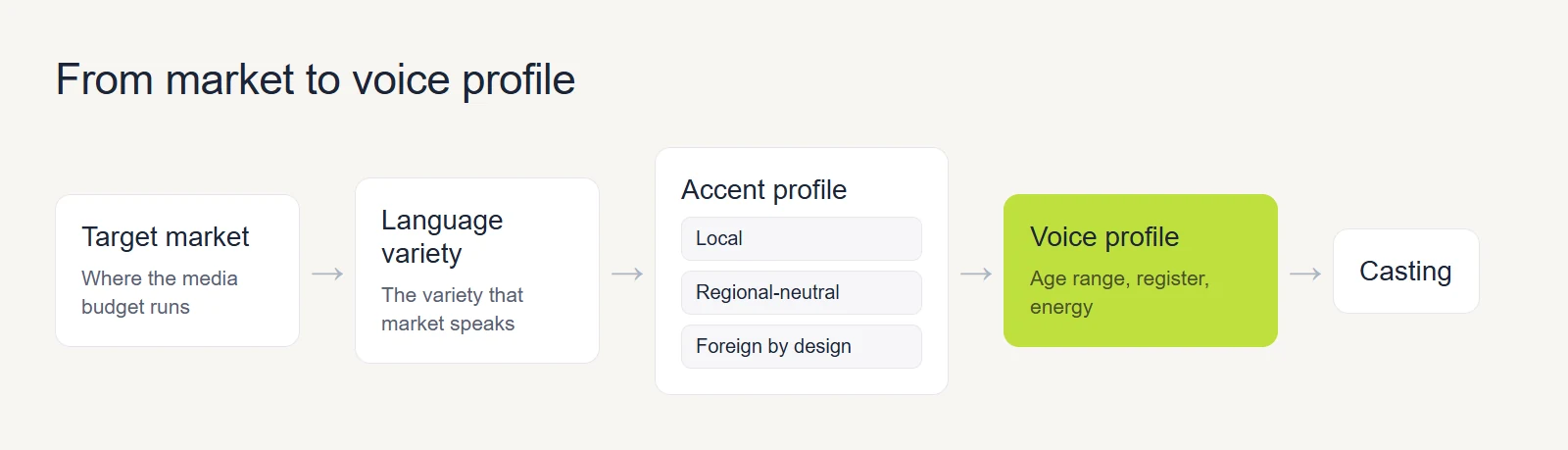
Use this four-step rule to land on a decision:
- Fix the target market from where the media budget runs.
- Pick the language variety that market uses in everyday speech.
- Choose the accent profile: local, regional-neutral, or foreign by design.
- Write the voice profile: age range, register, and energy. Casting works from this document.
International Voice Casting: How to Find and Shortlist Native Voice Talent
Cast native voice talent in each target market against the written voice profile, and shortlist three voices per language. One voice per market is a guess, and ten is a project of its own.
Where to Find Native Voice Talent: Five Sources Compared
Five sources cover most needs, and each trades speed against control.
| Source | Best for | Control | Main risk |
|---|---|---|---|
| Voice-over marketplace | Quick tests, small budgets | Medium: you screen candidates yourself | Uneven quality, usage terms vary by listing |
| Exclusive agency | Hero spots | High | Premium fees |
| Non-exclusive agency | Batches across several languages | Medium to high | Talent may sit on rival rosters |
| In-market freelancer | Depth in a single market | High for that market | You manage QA and file prep |
| Creator network | Voices that also appear on camera | High | Not every creator records clean audio |
Voice Casting Criteria: What to Check Beyond Fluency
Fluency is the entry ticket. These criteria separate candidates:
- A reel in your ad category.
- A match to the voice profile.
- A home studio with clean room tone.
- The usage terms they offer.
- Turnaround.
Casting also decides how long a voice will carry the brand. Mercedes-Benz kept Jon Hamm as its brand voice for 15 years before handing the role to Lucy Liu in July 2025. A voice is a long-term asset, so write usage terms with that horizon in mind.
Pro tip: ask each candidate to record the same ten-second slate on their own mic before you book a studio. Room tone and mic handling tell you more than a polished demo reel.
Script Adaptation and Timing: How to Fit Translated Copy Into 15-, 30-, and 60-Second Spots
Translated copy usually runs longer than English, so time-code the English script, adapt it to each slot, and read it aloud against a timer before anyone auditions. Script adaptation is a rewrite for rhythm and idiom, and word-for-word script translation misses both.
- Time-code the English script by line. Time-coding scripts means marking when each line starts and ends against the cut, so the adapter writes to a slot.
- Brief a native adapter on tone and register. Include the voice profile, the audience, and the lines that carry the offer.
- Adapt for rhythm and idiom. Let the adapter restructure sentences freely.
- Read the adapted script aloud against a timer. If it overruns, cut copy first.
- Lock the adapted script. Auditions, pronunciation review, and recording all work from this version.
Text growth follows a pattern: the shorter the source line, the more room the translation needs. The table below comes from the W3C's text-size guidance, which reproduces IBM figures for user-interface strings. Treat it as a direction for taglines and CTAs, then confirm with a real read.
| English source length | Typical expansion | What it means for ad copy |
|---|---|---|
| Up to 10 characters | 200 to 300% | CTAs and taglines need fresh writing |
| 11 to 20 characters | 180 to 200% | Short hooks usually need a rewrite |
| 21 to 30 characters | 160 to 180% | One-line claims need headroom |
| 31 to 50 characters | 140 to 160% | Standard sentences grow by about half |
| 51 to 70 characters | 151 to 170% | Two-line claims still need headroom |
| Over 70 characters | 130% | Long sentences grow the least |
When a read overruns, you have three fixes:
- Cut copy: drop the weakest claim and keep the offer.
- Tighten the read: a slightly faster delivery that stays clear.
- Extend the spot: only if the placement allows it.
Slots differ by placement. A television commercial has fixed 15, 30, and 60-second slots, while audio ads on streaming and podcasts often allow a looser tail. Leave a half second of room at the head and tail either way.
Example: the Korean honorific "oppa" appeared as "old man" in the English dub script and as "babe" in the subtitles, while The Guardian notes it really means "older brother," a term of respect. Two translations of the same word, each tuned to its format, show why adaptation needs a back-translation check before lock.
Audition Scripts: Which Lines Reveal the Right Voice
An audition script is three to five lines from the adapted script, chosen because they contain the hardest sounds, a number, and the emotional peak. Reading the full ad tells you little about whether a voice can handle the one line that matters.
Choose lines that test five things:
- The hook: shows whether the voice can open with energy.
- The product name: exposes pronunciation of the brand term.
- A price or number: reveals clarity on digits and units.
- The tagline: tests landing and rhythm.
- The legal line: shows the voice can read fast without losing clarity.
Here is a sample set for a fictional skincare brand:
Meet Brightside. Two minutes to a calmer morning.
Get 30% off your first box at brightside.com/offer.
Brightside. Start slow.
Offer ends 31 October. Terms apply.
Send the same lines and a one-line direction note to the three shortlisted voices, then score every read blind. These starting weights work for most ad markets; adjust them if a market has special risks:
- Pronunciation accuracy: 25%
- Fit to the voice profile: 25%
- Emotional read at the peak line: 20%
- Clarity on the number and price: 15%
- Clean audio: 15%
Book one paid test read for the top two scorers so the final pick rests on a real session.
For hook structure and how scripts earn attention in the first seconds, see our guide to UGC scripts.
How to Run a Pronunciation Review for Brand Names Before the Session
A pronunciation review is a native reviewer approving how brand names, product names, numbers, and acronyms are said in each market before anyone records. Linguistic quality assurance at this stage costs minutes, while a fix after recording costs a re-booked studio.
The pronunciation sheet is the working document. Here is a sample for the same fictional brand:
| Term | Written form | Phonetic guide | Reference audio | Market decision |
|---|---|---|---|---|
| Brightside | Brightside | /ˈbraɪtˌsaɪd/ | Reviewer's 5-second clip | Keep English pronunciation in all markets |
| 30% | 30% | Spoken as a full phrase in each language | Reviewer's clip | Say "30 percent" in the market's own phrasing |
| brightside.com/offer | URL | Spell out domain, say "slash offer" | Reviewer's clip | Keep the English URL, spoken slowly |
Brand names raise a policy question every time: say the name the original way, or adapt it to the local ear. Pepsi's insight that Spanish speakers pronounce its name more easily without the second P became "Pesi" in Spain, as Ad Age reported in 2010.
In September 2026 Duolingo launched a fashion line printing phonetic spellings such as "air-mess" for Hermès, a joke built on the fact that consumers do mispronounce brand names.

The reviewer should be a different person from the adapter, speak the exact language variety, and listen to the first three takes before the session continues. Log every decision for the next campaign so the sheet grows.
Direction Notes: How to Brief Native Voice Talent in Their Own Language
Write direction notes in the talent's language, attach a reference read, and ask for three reads per line. A direction note in English for a Portuguese read passes through two translations before it reaches the microphone.
Start with a written brief: tone words, the audience, one reference ad, and what the line must never sound like. Then run the session live with a bilingual director or producer on the call, so pick-up lines get fixed in the session with no email chain a day later.
Ask for three reads on every key line:
- Safe read: the cleanest delivery of the script as written.
- Brand read: the delivery that matches the voice profile.
- Push read: one step bolder, to show where the ceiling is.
Emotional resonance comes from the push read more often than from the safe one, and the safe read is your fallback if the push runs too far.
A good brief fits on one page, and every note is something the talent can do with their voice.
Deliverables: What to Hand Off With Every Voice-Over File
Hand off dry, voice-only audio tracks, one per language, in the agreed format, plus clean alternates, the pronunciation sheet, and the usage record. Anything less sends your editor back to the talent for a fix.
| Deliverable | Spec | Why it matters |
|---|---|---|
| Master voice track | WAV, 48 kHz, 24-bit, mono, cleanup only (our default; confirm with your editor) | Editors can match any platform from a clean master |
| Alternate takes | Safe, brand, and push reads, labelled by line | Re-cut without re-recording |
| Stems without music | Voice-only file plus a music-free mix | Swap music per market |
| Loudness | Europe broadcast: -23.0 LUFS; US television: -24 LKFS; social platforms: check each spec | Prevents rejection at broadcast QC |
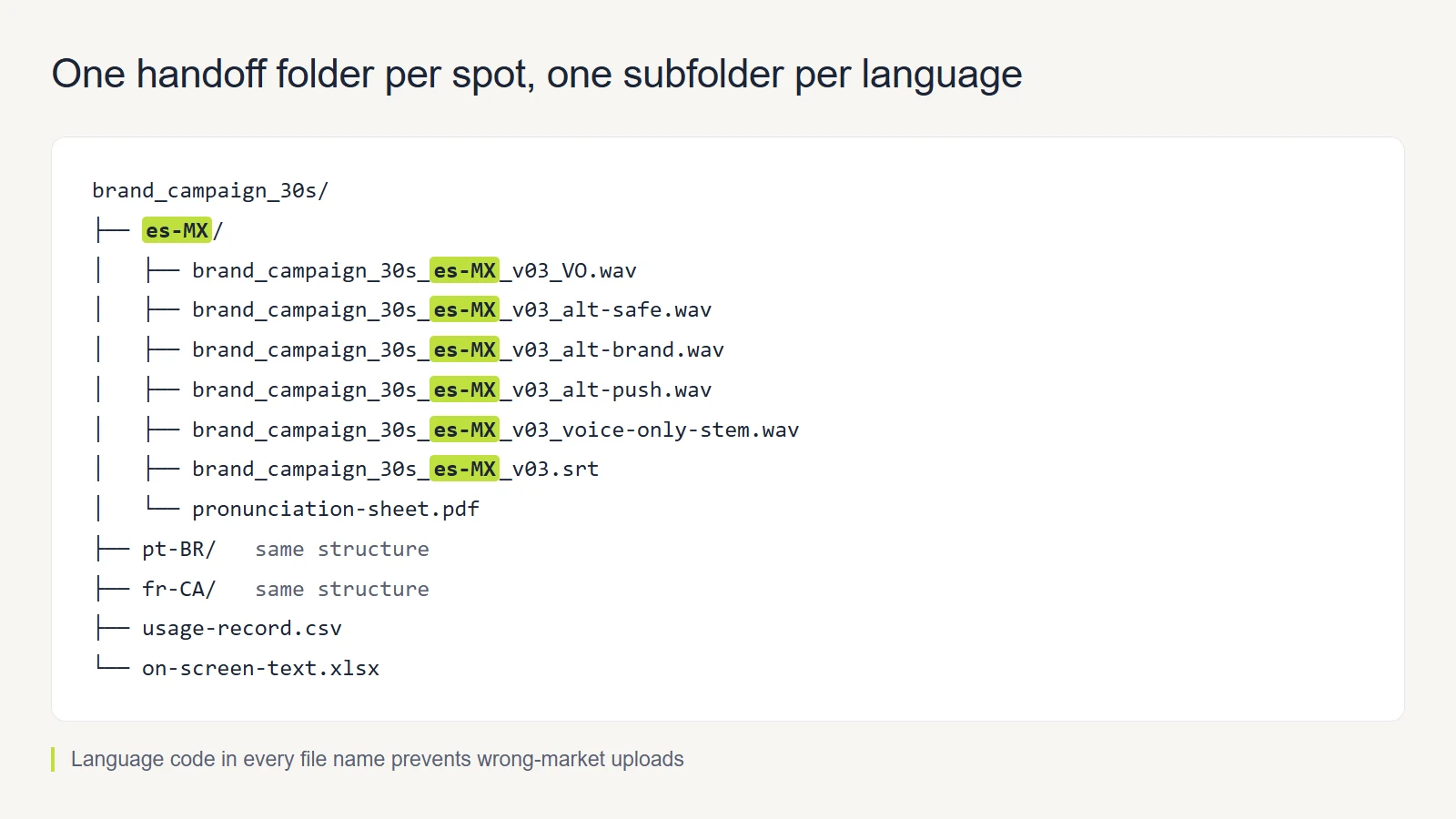
| File naming | brand_campaign_30s_es-MX_v03_VO.wav | Language codes prevent wrong-market uploads |
| Subtitle SRT file | One .srt per language, time codes matched to the final cut | Subtitle time codes drift whenever the cut changes |
| On-screen text sheet | Every on-screen string with its translation | Keeps on-screen text localization in step with audio |
| Usage record | Talent, term, territory, and media on one line | Renewals stop being a surprise |
The loudness numbers come from two standards. EBU R 128 sets a target of -23.0 LUFS with a tolerance of 0.5 LU and a maximum true peak of -1 dBTP, and it treats advertisements as programmes.
In the US, ATSC A/85 recommends -24 LKFS for content without metadata, and the FCC's CALM Act rules require commercials to match the average volume of the programme around them. Check the current revision of each standard before delivery, because ATSC updates its document.
Use this handoff checklist so broadcast-quality voice recordings reach the editor ready to use:
- Run audio cleanup: remove breaths, clicks, and room noise without changing the performance.
- Edit to the adapted script: pick the best takes and cut to the locked version.
- Check loudness: measure the final mix against the target for each placement.
- Name every file: brand, campaign, length, language code, version.
- Package the folder: audio post-production files, alternates, SRTs, sheets, and the usage record.
AI-Enhanced Voices and Voice Cloning: When They Fit in Multilingual Ads
Use AI voices for scratch tracks and low-risk variants, keep native voice talent for hero spots, and get written consent before any voice cloning. AI-enhanced voices are a speed tool.
Use AI voices for:
- Scratch tracks that let editors time the cut before the session.
- Fast variants for internal tests across many markets.
- Low-stakes ads where the voice is not the brand (our AI UGC ads guide covers the tooling).
Use human voice talent for:
- Hero spots, television commercials, and launch campaigns.
- Any market where the brand has no review capacity to catch errors.
- Any ad where the voice carries emotion or a signature brand sound.
The audience reaction in late 2025 shows why. McDonald's Netherlands released an AI-generated Christmas ad on 6 December and pulled it on 9 December after viewers called it creepy, according to the BBC. The brand called the moment a learning on the effective use of AI.
Rules are tightening as well. The European Commission states that Article 50 of the AI Act applies from 2 August 2026, requiring disclosure of audio deepfakes, such as a cloned voice that resembles a real person and would falsely appear authentic. Check disclosure duties with counsel for every market you buy in.
For cloning, get written consent from the talent that covers which markets, which media, and for how long. Our post on why global usage rights fail goes deeper on licensing by territory.
How Much Does Multilingual Voice-Over Cost?
A 30-second voice-over can cost a few hundred dollars or several thousand. The difference often comes down to where the ad runs, how long the brand can use the recording, and how many markets need their own voices.
According to Voice Crafters' industry rate guide, professional non-union voice talent in the US falls within these pricing ranges:
| Advertising placement | 3-month usage | 12-month usage |
|---|---|---|
| Paid digital, local market | $400-$500 | $1,200-$1,500 |
| Paid digital, regional market | $525-$750 | $1,500-$1,800 |
| Paid digital, national market | $1,000-$1,250 | $2,700-$3,200 |
| National TV commercial | $1,250-$1,400 | $3,200-$3,500 |
These are US voice-talent benchmarks per advertising spot, not complete multilingual production prices. Rates vary by country, talent, media rights, and campaign scope.
For perspective, three localized versions running as local digital ads for three months would cost approximately $1,200-$1,500 in voice-talent fees alone using these benchmarks.
The full multilingual voiceover production budget also needs to account for:
- Script adaptation: translation, rewriting for timing, and cultural adjustments. Smartling places professional human translation at approximately $0.15-$0.30 per source word, although short advertising scripts may require project-based transcreation fees.
- Recording and direction: talent sessions, bilingual direction, and studio costs. Confirm which services the talent fee already covers.
- Quality control and delivery: native pronunciation review, audio cleanup, alternate takes, and final file preparation.
- Revisions and usage: additional recording sessions, new cutdowns, extended licensing, and extra markets.
To compare quotes fairly, request an itemized price per language with recording, usage rights, and production services clearly separated. Lock the adapted scripts before booking sessions, and agree on revision limits before recording begins.
How to Test Localized Voice-Over Versions Before Rollout
Test one voice variable at a time in dark posts, then scale only the winner. Changing accent, gender, and tone in one go tells you whether the ad won or lost and hides the reason.
- Pick one variable: accent, gender, or tone.
- Run two variants: same visuals, same copy, only the voice differs.
- Set kill and scale thresholds: write them down before launch.
- Hold the brand voice constant: the voice profile stays fixed, only the variable moves.
Set the thresholds from your own CPA and hook-rate targets, and let each variant gather enough impressions to settle the result before you call it. A separate market-entry test, a dubbed or translated asset versus local creators, is covered in our new market launch plan.
Run this QA list before any voice-over goes live:
- Pass: the native reviewer signed off on pronunciation.
- Pass: the read fits the slot with head and tail room.
- Pass: loudness matches the placement target.
- Pass: subtitles and on-screen text match the final cut.
- Pass: the usage record covers every market in the plan.
Scale Voice-Over Across Markets With inBeat Agency
Voice-over works best when it sits inside the same system as creative, media, and measurement. We help brands write the voice profile, source native voice talent, adapt scripts, and test voice variants in paid media across markets.
Book a strategy call and we'll walk through your market list, the voice profile for each, and a test plan for the first two variants.
FAQs
Does a bilingual speaker count as native voice talent for an ad?
Only if they are native in the exact variety of the target market. A speaker who grew up in Mexico but lives in Madrid may carry both accents, and the audience hears the mix. Ask for samples recorded for ads in that market.
How do you keep one brand voice consistent when each market is cast separately?
Hold the voice profile constant while the person changes by market. A shared document with age range, register, and energy, plus reference reads from a hero market, lets different voices sound like the same brand. Revisit the profile when the brand's tone changes.
What changes when the same script runs as audio ads or as a television commercial?
Audio ads rely on the voice alone, so pacing, pauses, and pronunciation carry the whole message. The script needs a clearer hook because there is no visual to recover attention.
Do you keep subtitle SRT translations when the voice-over is localized?
Yes, for sound-off feeds. Build the subtitle SRT translations from the adapted script, so the on-screen words match what the voice says.
What happens to usage rights when an organic ad moves to paid media?
Rights are usually tied to media and term, so a move to paid media often needs a new or extended buyout. Check the original agreement before the switch, and record the new term on the usage record.
How many audition rounds are reasonable for a low-spend test market?
One round with three voices and one paid test read each for the top two scorers is enough for a test market. A second round makes sense only if no candidate clears the scorecard. Our creative testing guide explains how to read the results of that test.