.svg)
.svg)
.svg)
.svg)


.svg)







User-generated content is now one of the most effective formats in social media advertising. From TikTok ads to Instagram Reels, brands rely on UGC to create platform-native content that feels real and drives engagement.
Now, artificial intelligence is changing how that content gets produced.
AI-generated content, particularly AI UGC ads powered by digital avatars, voice synthesis, and automated video generation, has moved from testing to real execution. You can now produce dozens of content variations in hours, test hooks quickly, and scale ad campaigns faster.
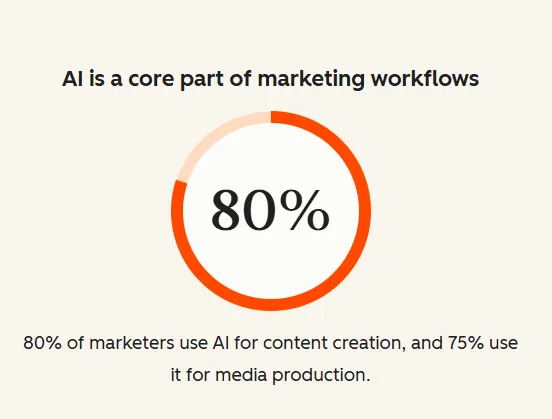
This shift is happening fast. According to the HubSpot 2026 State of Marketing Report, over 80% of marketers are already using AI for content creation and advertising.
At the same time, real UGC still drives stronger trust, better customer experiences, and higher conversion rates across many industries.
So you’re left choosing AI UGC or real UGC. The real question is, which one actually performs better in 2026?
In this guide, you’ll get a clear, performance-focused breakdown across conversion rate, CPA, and ROAS, so you can decide what works best for your social media strategies.
We’ll cover:
- What AI UGC ads and real UGC actually are
- Where each format wins or struggles
- A head-to-head comparison across key performance data
- How platforms like Meta and TikTok respond to AI-generated UGC ads vs real UGC
- How to choose the right approach based on your budget, funnel stage, and industry
- A practical framework to combine AI-powered advertising with real creators for better campaign performance
P.S. Struggling to scale UGC ads without burning budget on content that doesn’t convert? At inBeat Agency, we help you combine AI UGC testing with high-performing creator content, so your ad campaigns scale with real performance data, not assumptions. Book a free strategy call now!
AI UGC vs Real UGC: Key Differences
The simplest way to read this comparison is through performance creative function. AI UGC is usually stronger as a testing and iteration layer, while real UGC is usually stronger as a trust and conversion layer. That distinction can sometimes matter more than the production method itself.
What Are AI UGC Ads?
AI-user-generated content, or AI UGC, refers to content created entirely or partially using generative AI tools. These AI UGC ads are built using preset scripts, AI avatars, voice synthesis, and platform-specific optimizations.
You can customize them to feature AI-generated personalities that mimic human-like expressions, gestures, and speech, which makes them feel similar to real UGC ads in social media feeds.
Types of AI UGC Ads
Here are the most common formats you’ll see when working with AI UGC ads:
AI Avatars or Influencers (Talking Head Videos)
These use AI avatars or digital humans that deliver your script directly to the camera, similar to how human creators film UGC. You can control tone, script style, and delivery while keeping it platform-native for TikTok Ads or Instagram Reels.
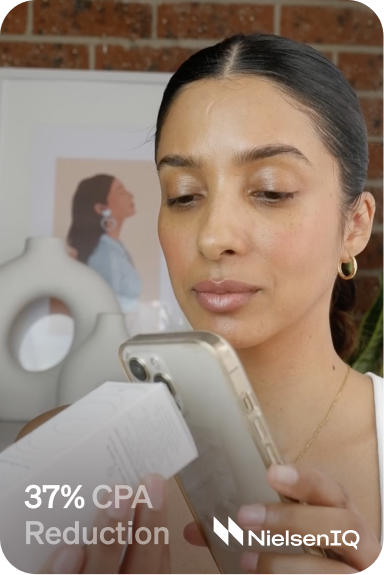
Below is an example of an AI UGC ad we created for our client, NIQ.
AI Voiceovers with Stock Visuals
Instead of showing a face, these ads combine AI-generated voiceovers with product shots, stock footage, or screen recordings. This format works well for product demos, explainer-style content, and simple video campaigns.
Script-Generated Testimonial Ads
These present customer experiences using AI actors or voice synthesis, based on real feedback, verified use cases, or approved messaging/
Here’s an AI UGC ad we created for our client Clearscore, where the testimonial is real, but the animation is AI-generated.
Why Brands Are Adopting AI UGC
AI UGC is gaining traction because it solves some of the biggest challenges in content creation and social media advertising. If you’re running ad campaigns, you need speed, volume, and consistent output. That’s exactly where AI-powered tools make a difference.
- Speed of production: You can create AI UGC ads in hours instead of waiting days or weeks for human creators, filming, and video editing. This helps you launch campaigns faster and respond quickly to trends.
- Cost efficiency: AI-generated UGC ads reduce reliance on creator fees, production costs, and reshoots. You can produce more content at a lower cost, which improves your overall CPA during testing. In fact, in some campaigns, performance data shows AI UGC ads delivered up to 28% lower Cost Per Result and 31% lower CPA.
- Infinite variations for testing: You can generate multiple hooks, script styles, and content variations using AI platforms. This makes A/B testing much easier and helps you find winning creatives based on real performance data. Magic Hour AI, for example, lets you use face swap to replace the on-screen presenter across multiple video variants in seconds, so you can test different creator styles or demographic fits without briefing a new creator each time.
- Localization at scale: AI lets you adapt the same ad into different languages, accents, and markets using voice synthesis and digital avatars. You can expand your social media strategies across regions without rebuilding content from scratch.
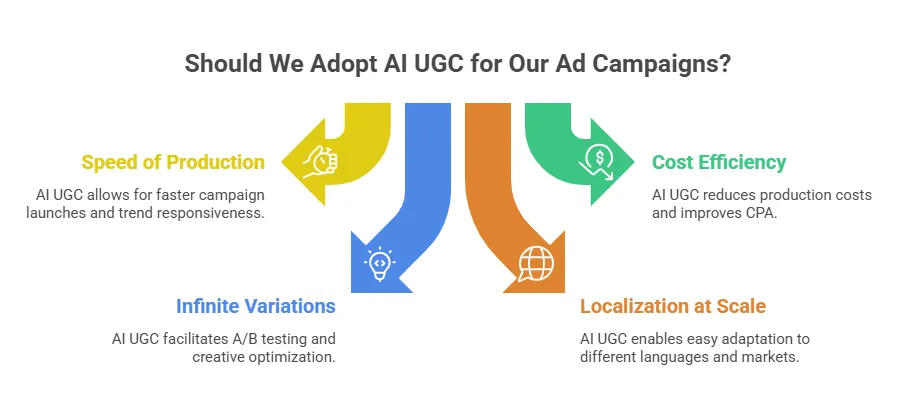
This is why more teams are using AI UGC as part of their performance creative workflow. Instead of treating every ad as a finished asset, they use AI to test multiple hooks, scripts, offers, and formats quickly, then evaluate which variables actually improve CTR, CVR, and CPA before investing further.
Where AI UGC Falls Short
The fact is, AI UGC solves a lot of production challenges, but it still has clear limitations, particularly when it comes to trust and perception.
So, if you rely too heavily on AI-generated content, you may start seeing performance gaps in certain areas.
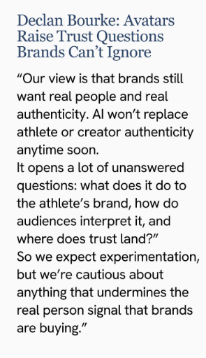
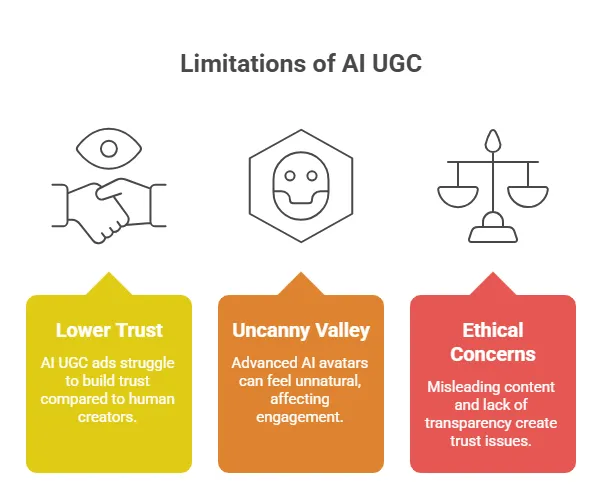
- Lower trust: AI UGC ads can struggle to build the same level of trust as real human creators. When users sense that content is AI-generated, it can reduce credibility, typically for products that rely on strong customer experiences or social proof.
As highlighted in the AI Influencer Marketing Report 2026 by Influencer Strategists:
- Risk of “uncanny valley”: Even with advanced AI avatars and digital humans, some content can feel slightly off. Subtle issues in facial expressions, voice tone, or timing can make the ad feel unnatural, which affects engagement and conversion rates.
- Ethical concerns: You need to be careful with how you present AI-generated UGC ads. Misleading content, fake testimonials, or a lack of transparency can create trust issues and even lead to compliance risks.
What Is Real UGC?
Real user-generated content (UGC) is content created by actual customers or human UGC creators who share their real experiences with a product or service. Because it comes from real people, it carries stronger social proof and helps build trust with your audience.
Types of Real UGC Ads
Real UGC ads come in different formats, but they all focus on showing real customer experiences in a way that feels natural in social media feeds.
Here are the most common types you’ll see:
Customer Testimonials
In this type, real users share their experiences with your product. Whether it’s a quick review or a detailed story, this format builds strong trust and works well for improving conversion rates.
Here’s an example of a customer testimonial UGC from one of our clients, Mindbloom.

UGC Influencer-Created Ads
These are created by UGC creators who understand platform-native content and how to engage audiences. They show the product in action through honest reactions, first impressions, and walkthroughs, which works well for eCommerce brands.
You can share brand guidelines with your creators to guide their messaging, while keeping the content relatable and authentic.
This is how it looks in practice with a UGC ad we created for our client, Bumble.
Why Real UGC Became So Powerful
Real UGC continues to perform because it aligns with how people actually consume content on social media.
When you use real creators and genuine customer experiences, your ads feel less like traditional ads and more like content people want to watch.
- Authenticity and relatability: At the end of the day, people trust people. Real creators bring that “this could be me” vibe that’s hard to fake. And data supports this: 86% of consumers say authenticity is a key factor when deciding what brands they like and support. It’s even stronger with Gen Z, who prefer raw, unfiltered content over overly produced ads.
- Social proof and trust signals: When potential customers see others using and recommending your product, it builds confidence. Customer testimonials, product reviews, and peer recommendations all act as strong trust signals that influence buying decisions. In fact, 79% of people say user-generated content highly impacts their purchasing decisions.
- Strong brand credibility: Content created by human creators adds a layer of credibility that AI-generated content still struggles to match. It shows that real people trust your product, which strengthens your brand image.
- Better storytelling: Human creators bring emotion, context, and personal perspective into your video campaigns. This makes your messaging more engaging and memorable, and helps you communicate value beyond just features.

From a performance creative standpoint, this is why real UGC remains so valuable. It makes content feel more human, so it strengthens the parts of performance that depend on credibility, emotional context, and real social proof. You need this especially when users are closer to conversion.
Where Real UGC Falls Short
Just like AI UGC, real UGC ads have their own set of challenges when you try to scale. These usually show up as you increase content volume and try to move faster with your ad campaigns.
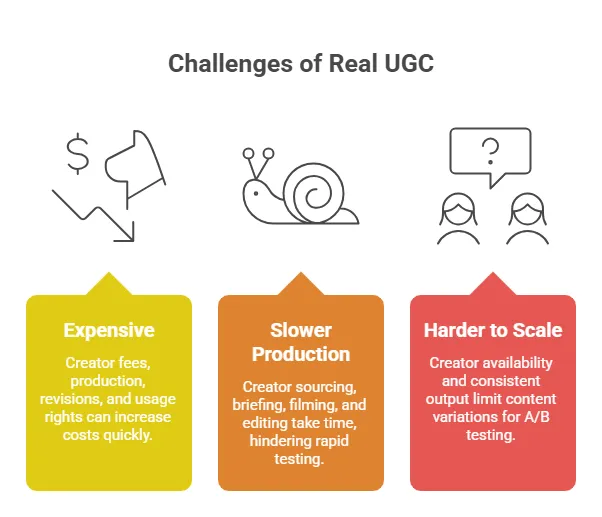
- Expensive: Working with human creators means paying for creator fees, production, revisions, and sometimes usage rights. As you increase content volume, costs can rise quickly compared to AI-generated content.
- Slower production: You need time for creator sourcing, briefing, filming, and video editing. This makes it harder to move fast when you want to test new ideas or respond to trends in social media.
- Harder to scale: Scaling real UGC depends on creator availability and consistent output. You may struggle to produce enough content variations for A/B testing, which can slow down your ability to optimize campaign performance.
AI UGC Ads vs Real UGC: Head-to-Head Comparison
Now let’s get into what actually matters, performance. If you’re running ad campaigns, you’re not choosing based on theory. You’re looking at metrics like CTR, conversion rate, CPA, and ROAS.
1. AI UGC Ads vs Real UGC: Performance Metrics Overview
CTR (Click-Through Rate): Who Wins Attention?
When it comes to grabbing attention in crowded social feeds, real UGC still has a slight edge, but AI is catching up fast, typically in testing environments.
Real UGC Ads:
- Strong thumb-stopping power
- Feels native to TikTok Ads and Instagram Reels
- Blends naturally into organic content
And the numbers back it up. UGC-style ads can generate up to 4X higher click-through rates compared to traditional brand ads. That’s mainly because they don’t feel like ads; they feel like content you’d already be watching.
AI UGC Ads:
- Improving quickly with better hooks and script styles
- Easier to test multiple variations
- Can fatigue faster if overused across campaigns
Bottom line: If your goal is to instantly stop the scroll, we recommend using real UGC. And if your goal is to rapidly test and iterate until you find a winner, AI UGC becomes incredibly powerful.
CVR (Conversion Rate): Who Actually Converts?
This is where things get interesting. Clicks are great, but conversions are what actually make you money. And when it comes to converting, trust becomes the deciding factor.
Real UGC Ads:
- Higher trust leads to stronger conversions
- Works well in industries where credibility matters
- Common in categories like beauty, health, and finance
And the impact is pretty massive. User-generated content can increase conversion rates by up to 161%. That’s because real people sharing real experiences act as powerful social proof; it reduces hesitation and makes buying feel safer.
AI UGC Ads:
- Performs well when the script is strong
- Works better with cold audiences
- Suitable for low-risk or impulse purchase products
There’s also a broader trend showing up in mobile marketing. Campaigns using AI-style UGC content have shown a 63% higher likelihood of users installing an app after viewing the ad. This shows how effective this format can be for quick, action-based conversion.
Bottom line: Conversion rate is heavily driven by trust, and right now, real UGC still has the edge in most cases. AI UGC is great for testing and scaling, but when it comes to actually closing the sale, human-driven content usually performs better.
CPA (Cost Per Acquisition): Where AI Dominates
This is where AI UGC really starts to shine. Even if it doesn’t always win on trust or conversions, it can seriously improve how efficiently you get there.
Real UGC Ads:
- Creator fees increase overall costs
- Slower production limits testing speed
- More expensive to scale content volume
Working with creators isn’t cheap, typically when you factor in revisions, multiple takes, and ongoing content needs. This makes large-scale testing harder and more expensive.
AI UGC Ads:
- Lower production and content creation costs
- Faster iteration cycles
- Helps you test more creatives at a lower cost
And this is where the numbers back it up. As mentioned earlier, some campaigns using AI-generated UGC have reported up to 31% lower cost per acquisition (CPA) compared to traditional creative approaches.
Bottom line: AI UGC may not always convert better, but it helps you find winning creatives faster and at a lower cost.
ROAS (Return on Ad Spend): The Real Battle
ROAS is where things get more nuanced. It’s not just about which format performs better, but how you use it within your ad campaigns.
Real UGC ads:
- Delivers more stable performance over time
- Helps build stronger brand credibility and trust
- Supports long-term campaign consistency
AI UGC ads:
- Scales quickly once you find a winning creative
- Works well when you want to push volume and expand fast
- Performance can drop if the same creatives are overused
When you zoom out, the difference becomes clearer.
Bottom line: AI UGC works well as a short-term performance engine to test and scale quickly. Real UGC, on the other hand, plays a stronger role in building long-term brand value and sustained performance.
What This Means for Your Performance Creative Strategy
The performance takeaway is that each format solves a different creative problem.
As we said above, AI UGC helps you test faster, produce more variants, and reduce the cost of finding winning ideas. Real UGC helps you improve trust, support conversion, and sustain stronger performance once a concept is validated.
Pro tip: That’s why the strongest performance creative systems use AI to accelerate learning and real creators to strengthen the ads that prove they can scale.
2. AI UGC Ads vs Real UGC: Authenticity & Trust
This is where the difference becomes very clear. When someone sees your ad, they’re quickly deciding if it feels real or not.
Real UGC Ads:
- Builds a stronger emotional connection because it comes from real people
- Feels more credible and relatable in social feeds
- Establish trust through genuine customer experiences
AI UGC Ads:
- Realism is improving with better AI avatars and voice synthesis
- Can still feel slightly artificial or overly scripted
- Users may detect it as AI-generated, which can impact trust
In our experience, most teams mess up here. They focus too much on scaling content and overlook how important trust is in driving conversions.
We’ve seen that when your product relies on credibility or real customer experiences, real UGC consistently performs better. AI UGC can still play a role, but trust is harder to replicate when the content doesn’t feel fully human.
3. AI UGC Ads vs Real UGC: Platform Performance Differences
Performance also depends on where your ads are running. Each platform responds differently to AI UGC and real UGC, so you need to adjust your approach instead of using the same content everywhere.
TikTok and Instagram Reels
- Strong bias toward authenticity and platform-native content
- Real UGC blends more naturally into social feeds
- AI UGC can work, but it needs strong hooks and natural delivery to avoid feeling out of place.
YouTube Ads
- Script quality matters more than who delivers it
- AI UGC can perform well if the messaging is clear and engaging
- Real UGC still helps when storytelling and credibility are important
Meta Ads (Facebook and Instagram)
- Both AI UGC and real UGC can perform well, depending on execution
- Hybrid strategies are becoming more common across ad campaigns
- AI helps with testing and scaling, while real UGC supports consistent performance
From what we’ve seen, this is where many teams miss opportunities. They reuse the same creatives across platforms without adapting to how users consume content on each channel.
If you align your content with platform behavior, you’ll get much better results from both AI UGC and real UGC.
AI UGC Ads vs Real UGC: Which Should You Choose?
The better question is not “AI UGC or real UGC?” It is “what role should each play in your performance creative system?”
Quick Decision Guide: AI UGC vs Real UGC
Based on the Budget
Your budget directly affects how much content you can produce and how quickly you can test new ideas. This is where the difference between AI and real UGC becomes more obvious.
- Low budget → AI UGC: If you’re working with limited resources, AI UGC helps you produce more content at a lower cost. You can test multiple hooks, angles, and creatives without spending heavily on creators.
- High budget → real + hybrid: With a larger budget, you can invest in real creators while still using AI for testing and iteration. This gives you both scalability and stronger trust signals.
Based on the Funnel Stage
Different stages of your funnel require different types of content. Remember: what works for attention doesn’t always work for conversion.
- Top of funnel → AI testing: At the awareness stage, you need volume and experimentation. AI UGC helps you test different messages quickly and identify what grabs attention.
- Bottom of funnel → real UGC: When users are closer to converting, trust becomes more important. Real UGC works better here because it establishes credibility and reduces hesitation.
Based on the Industry
Your industry also plays a big role in how your audience responds to content. Some categories rely heavily on trust, while others are more flexible.
- E-commerce → hybrid approach: You can use AI UGC for testing and scaling, then bring in real creators to strengthen performance once you find winning concepts.
- SaaS → AI + educational UGC: AI UGC works well for explainer-style content and product demos, while real UGC can support credibility through customer experiences.
- Regulated industries → real UGC: In industries like finance or health, trust and compliance matter more. Real UGC is usually the safer and more effective option.
How to Combine AI and Real UGC for Maximum Performance
The best results don’t come from choosing between AI UGC and real UGC. They come from combining both in a structured way. When you use each format for what it does best, your content strategies become much more efficient and performance-driven.
AI for Ideation and Testing
This is where AI gives you a real advantage. You can quickly generate multiple hooks, scripts, and content variations without slowing down your workflow.
- Generate different angles, messaging styles, and hooks using AI-powered tools
- Test variations across your ad campaigns to see what resonates
- Use performance data to identify which concepts actually work
Real Creators for Winning Concepts
Once you know what’s working, you can bring in human creators to elevate those ideas.
- Turn validated scripts into high-performing real UGC ads
- Use human creators to add emotion, credibility, and relatability
- Align content with your brand voice while keeping it natural and engaging
This is where most teams mess up. They either rely too much on AI-generated content or jump straight into creator production without proper testing.
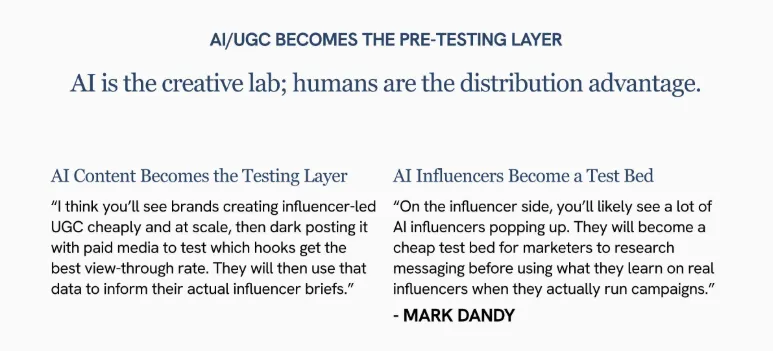
Insider tip: In our experience, the teams that perform best treat AI as a testing layer and real UGC as a scaling layer. This shift alone can make a big difference in how efficiently your campaigns grow.
As Mark Dandy explains in the AI Influencer Marketing Report 2026 by Influencer Strategists, this is exactly how many teams are structuring their content systems today.
Build a Performance Creative Workflow
The goal is not to produce more ads. It is to build a system that helps you learn faster and scale what works.
A stronger approach is to treat AI UGC and real UGC as two different stages in the same performance creative workflow.
Step 1: Generate multiple ad angles with AI
Start by using AI to create different hooks, scripts, offers, and messaging styles around the same product. The goal here is to quickly create a wide range of testable concepts.
Step 2: Launch small-scale tests to identify winners
Run these AI-generated creatives in controlled tests across your paid channels. Watch for early signals like hook rate, CTR, landing page engagement, and initial CPA trends. At this stage, you are trying to identify which ideas deserve further investment.
Step 3: Isolate what actually made the ad work
Once a few concepts start outperforming, break down why. Was it the hook? The framing of the problem? The offer? The creator-style tone? This step matters because you do not want to assume the whole ad worked when only one variable carried the result.
Step 4: Rebuild the winning concepts with real creators
Take the strongest validated ideas and turn them into real UGC with human creators. This is where you add stronger trust signals, emotional nuance, product experience, and platform-native delivery that feels more believable and conversion-friendly.
Step 5: Refresh and expand without losing the core message
Once the real UGC versions perform, create variations around the same winning angle. Test new intros, creator types, visual structures, and CTAs while keeping the core value proposition intact. This helps you scale without resetting the learning.
Step 6: Use performance data to decide what stays AI and what moves to real UGC
Not every concept needs to be upgraded into creator-led content. Some AI UGC ads may remain useful for fast testing, simple demos, or top-of-funnel campaigns. Others earn the investment in real creators because they prove they can drive stronger conversion efficiency over time.
Remember: When teams skip this structure, they usually waste money in one of two ways: either they overproduce real UGC before validating the concept, or they keep scaling AI-generated content after trust starts to drop. Both create performance ceilings that could have been avoided.
Scale High-Performing UGC Ads with inBeat Agency
AI UGC and real UGC are both powerful, but they serve different roles in your content strategy. AI helps you move faster, test more ideas, and scale efficiently, while real UGC builds trust, credibility, and stronger conversions.
When you combine both in a structured way, you create a system that balances speed with performance and short-term wins with long-term growth.
Key Takeaways
- AI UGC ads help you produce content faster and test multiple creative variations without slowing down your workflow
- Real UGC ads build stronger trust through authentic customer experiences and relatable storytelling
- AI works well for testing hooks, messaging, and early-stage campaign ideas
- Real UGC performs better when your goal is to drive conversions and reduce hesitation
- Cost efficiency is a major advantage of AI UGC, especially during the testing phase
- Real UGC requires more investment but delivers stronger credibility and brand impact
- The best-performing strategies combine AI for testing and real creators for scaling
- Aligning your content with platform behavior improves overall campaign performance
If you want to scale your UGC ads without wasting budget on underperforming creatives, working with the right team makes a big difference.
At inBeat Agency, we help you combine AI UGC testing with high-performing creator content, so your campaigns are built on real performance data and not assumptions.
Book a free strategy call now to identify what’s working, refine your content strategy, and scale UGC ads that actually convert.
FAQs
Is AI UGC legal?
Yes, AI UGC is legal as long as it follows advertising guidelines. You need to avoid misleading claims, use real or verified messaging and testimonials, and stay transparent where required, particularly in regulated industries.
Do AI ads convert better than real people?
It depends on the use case. AI ads work well for testing and scaling, but real UGC usually converts better when trust and credibility play a bigger role in the decision.
Can users tell if UGC is AI-generated?
In many cases, yes. While AI-generated content is improving, users can still notice subtle differences in tone, expressions, or delivery, which can affect how they perceive the ad.
How much does AI UGC cost vs real UGC?
AI UGC is generally much more cost-effective since it reduces creator fees and production overhead. In many cases, AI-generated UGC can be up to 73% cheaper than traditional UGC, while real UGC creators typically charge anywhere from $150 to $500 per video, depending on deliverables and usage rights.
Real UGC requires more investment, but it often delivers stronger trust and long-term performance.
What makes inBeat Agency different from other UGC agencies?
We focus on performance-first UGC. Instead of just producing content, we test, validate, and scale creatives using real performance data, combining AI UGC and creator-led content.
Does inBeat Agency use both AI UGC and real creators?
Yes, we combine AI-generated UGC for rapid testing with real creators to scale high-performing concepts. This hybrid approach helps you move faster while maintaining strong conversion performance.
Appendix
- https://www.hubspot.com/state-of-marketing
- https://www.businessinsider.com/cpg-marketers-using-ai-ad-testing-to-video-production-2026-3
- https://creatify.ai/blog/case-study-aigc-ads-vs-ugc-vs-designer-made
- https://issuu.com/influencer-strategists/docs/ai_influencer_marketing_report_2026_b79e6d3115303c?fr=sZTU0MjkwMTY1Mzc
- https://nytlicensing.com/latest/marketing/what-authentic-content-marketing/
- https://hearts-science.com/how-authenticity-drives-the-trend-of-user-generated-content/
- https://influee.co/blog/ugc-ads
- https://www.yotpo.com/blog/increase-conversion-rate-eco
- https://superscale.ai/learn/ai-vs-traditional-ugc-complete-comparison/
- https://www.videotok.app/blog/ai-avatars/ugc-ads-rates-traditional-ugc-vs-ai-ugc