

Usage rights are the permissions a brand needs before it can use creator content in its own marketing, including paid ads.
Most creator contracts a performance team signs default to the same clause: worldwide, perpetual, all media.
It reads like safety.
In practice, it prices every clip as if it will run in every market for years, when the ad account will retire most of them in weeks and never show them outside two or three countries.
The question this article answers is how much of that permission you should buy up front, and the answer for paid social is far less than the default.
Note: Here, “global UGC usage rights” means a blanket licensing package: worldwide territory, perpetual duration, and all-media use. We're not only discussing geographic coverage.
P.S. If you'd rather have creators sourced, briefed, and licensed in tiers from the start, that is what inBeat's UGC and content creation team does.
We treat creator content as a creative engine and the ad account as the laboratory, and that changes how we buy rights. Most clips exist to be tested. The account tells you within weeks which two or three deserve more markets and more time, and it tells you with spend and CAC.
Paying worldwide perpetual fees on every clip prices the entire batch as if each one were the winner.
We prefer to license light, launch, read the signal, and buy more scope only for creative that has earned it. Reach is what media buying is for. The license should follow the media plan. It was never meant to be one.
TL;DR: why global UGC usage rights fail in performance media
Global perpetual UGC usage rights fail in performance media because they buy territory and time the ads never use. The short version:
- A usage right is a license to specific uses. Copyright law gives the creator the exclusive right to reproduce, distribute, and display their work, so every brand use needs a grant, and a worldwide perpetual grant is the widest and most expensive form that grant can take.
- Paid social is geo-targeted at the ad set, and most UGC ads are retired for fatigue long before a multi-year term becomes relevant. The premium mostly pays for scope that is never exercised.
- Tiered licenses scoped by territory, channel, duration and a spend trigger match cost to the handful of ads that actually win.
- Delivering an ad to a market or channel outside the grant is unauthorized use under copyright law. Calling it a paperwork gap you tidy up later changes nothing.
- Professional creators routinely accept scoped rights with written renewal options. Vague terms cause the friction; narrow ones rarely do.
Take two minutes now: open your last five creator agreements, decide whether "worldwide, in perpetuity" was chosen or inherited, and flag every contract where it was the default for review. Picture a testimonial that only ever ran to US and Canadian audiences for six weeks, licensed for the planet forever. That gap is what the rest of this article prices and fixes.
What global and perpetual UGC usage rights actually cover
A global perpetual grant covers every market and every future date, and in paid social you will use a sliver of both. Before arguing about price, it helps to be precise about what a usage right is and which dimensions a buyout actually maxes out.
Usage rights are permissions, and the default owner is the creator
Usage rights are permissions the brand obtains from the creator; absent a grant, the brand has nothing. US copyright law reserves reproduction, distribution and public display to the owner, and the person who shot the clip is that owner unless a written agreement says otherwise.
Fadel's guide for marketers frames the same point from the rights-management side: the brand's job is to secure and track the specific permissions it needs. Assuming them is where the gaps start. Our own UGC usage rights guide walks through the contract language; this piece is about how much of it to buy.
In practice, a license has six dimensions you can set independently:
- Channel: organic social, paid social, website, email, retail, broadcast.
- Territory: the markets where the content may be shown.
- Duration: how long the grant lasts, with or without renewal.
- Exclusivity: whether the creator may work with competitors, and for how long.
- Modification: whether you can re-cut, caption, add music or swap hooks.
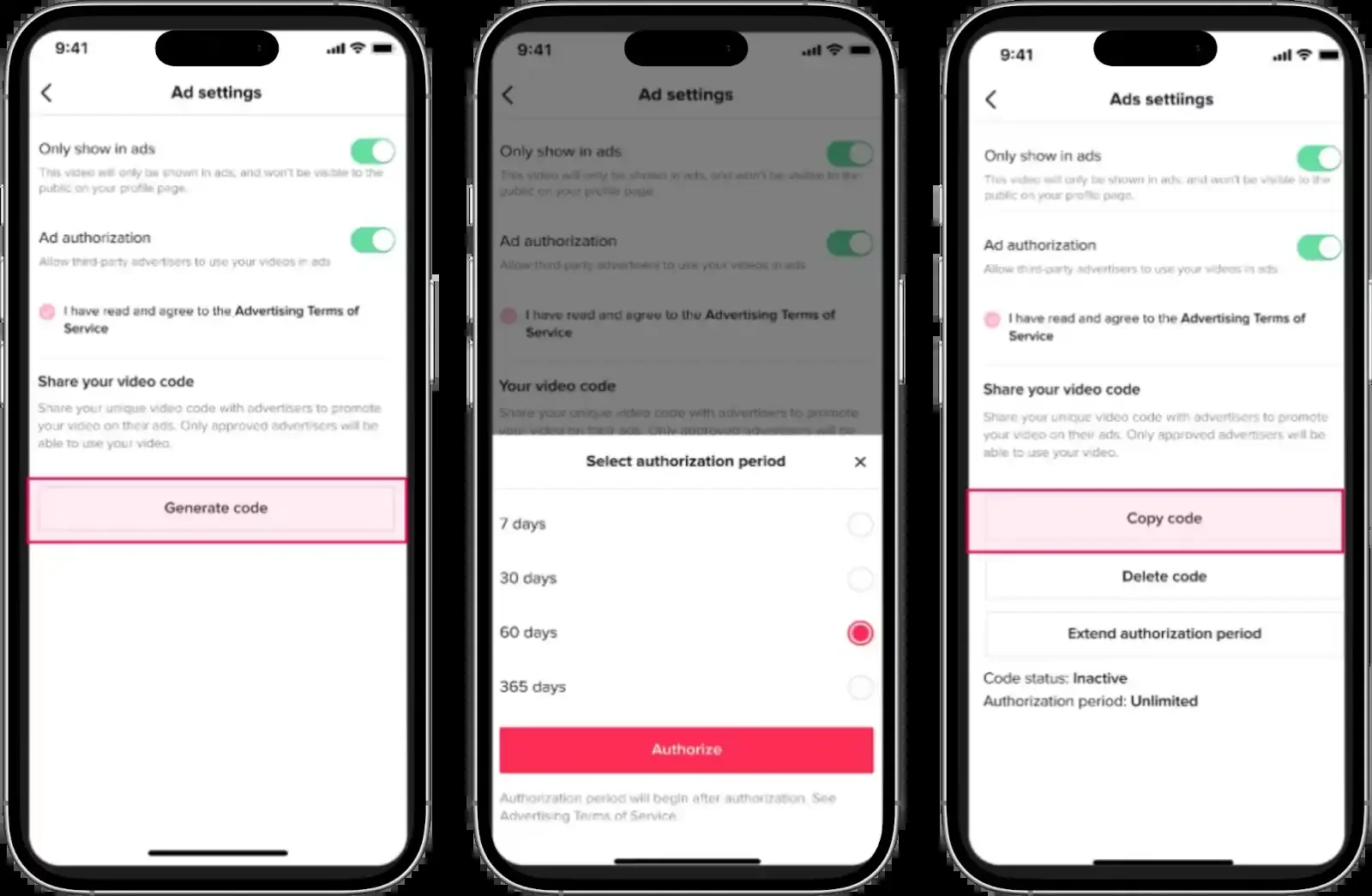
- Whitelisting: whether you can run ads from the creator's handle via Spark Ads or partnership ads.
"Global perpetual" maximizes two of the six and says nothing useful about the other four. Teams that buy it often still lack the modification or whitelisting rights they end up needing most.
Organic reposting and paid advertising are separate grants
Reposting a creator's clip on your own feed and putting media spend behind it are different uses, and most contracts price them differently.
Influee's guide to usage rights separates organic from paid for exactly this reason: paid use multiplies the audience and the commercial benefit, so it is treated as a distinct permission. Whitelisting adds a third layer, since the ad is delivered from the creator's identity; Conbersa's explainer on whitelisting and Spark Ads treats that access as its own grant with its own term.
Conceptually, the same 30-second testimonial might be licensed for organic Instagram reposting only, or for Meta ads delivered to German audiences for 60 days. Same file, two licenses, two prices.
What 'worldwide' means when ads are delivered by targeting
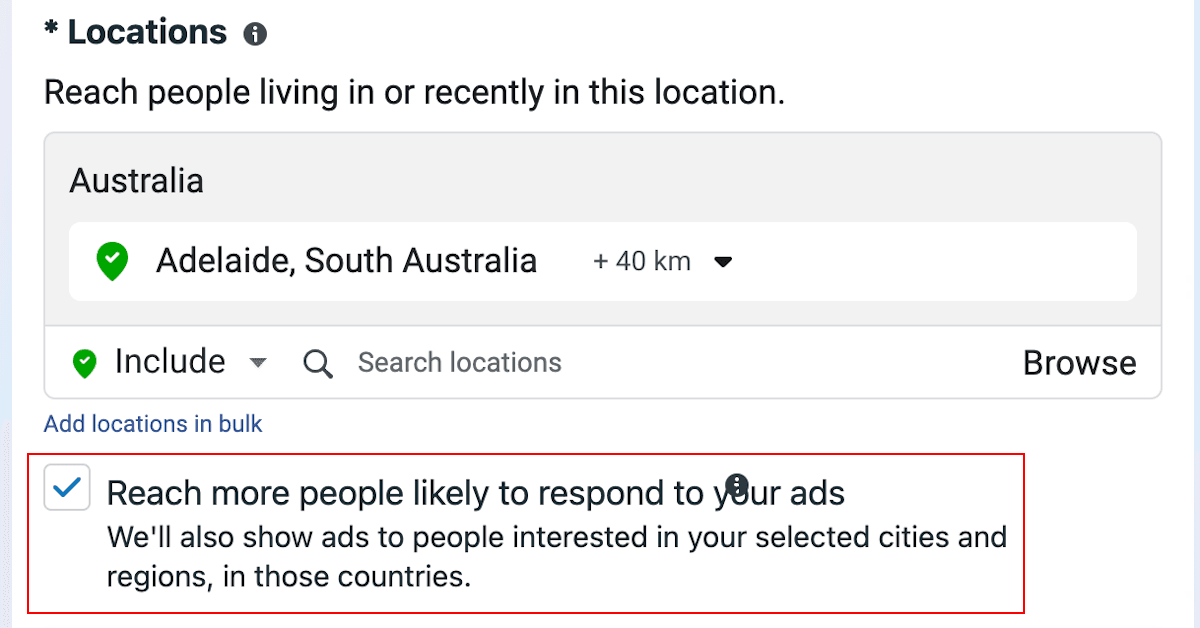
Territory in paid social is defined by where you aim the ad set. The platform's footprint is beside the point. Meta, TikTok and YouTube are available almost everywhere, but your campaign reaches the locations you select, in the currency and ad account market you chose.
That makes territory a controllable, auditable setting.
A license written as "United States and Canada" maps directly onto a location field in the ad set. Beware that national rules on moral rights and likeness differ, so the territory you pick also decides which local regimes apply; the specifics are beyond this article.
Why does "global" get requested anyway?
Habit, mostly. It removes the burden of tracking which clip may run where, and legal teams prefer a clause that never needs checking. That is an administrative convenience dressed up as a media plan.
Do this before moving on: for each of your last five creator contracts, write down all six scope dimensions (channel, territory, duration, exclusivity, modification, whitelisting) and mark each one as deliberately negotiated or defaulted. Most teams find two were chosen and four defaulted.
How fast UGC creative fatigues in paid social
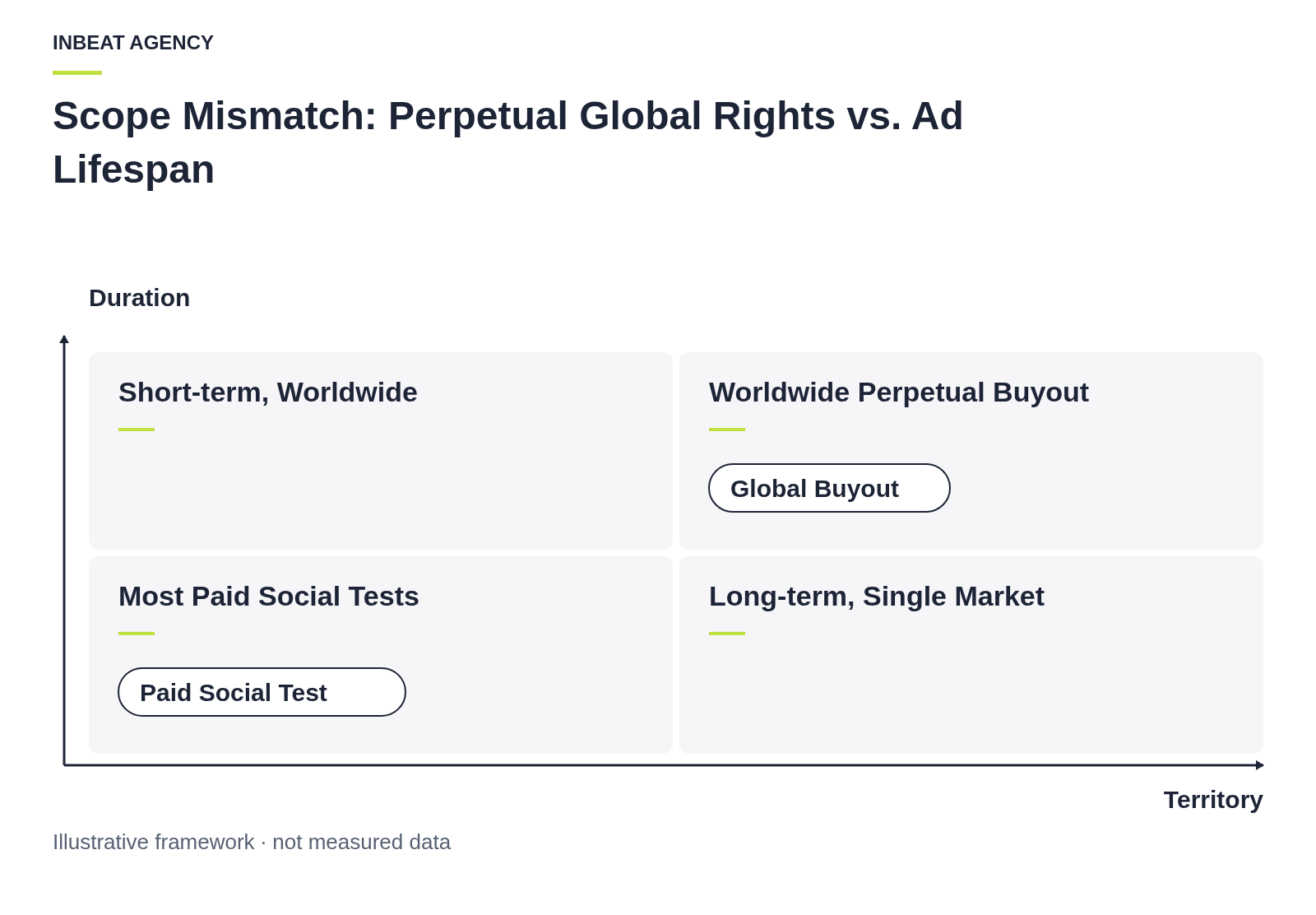
UGC ads in paid social fatigue in weeks, and the license term you paid for is measured in years. That mismatch is the core of the overspend, and it comes from three habits of performance teams that are correct for media and expensive for licensing.
Why a winning UGC ad is retired long before a license ends
A winning ad is retired when its frequency climbs and CPA rises on the same audience, and that happens on a timescale of weeks on most accounts.
No approved benchmark in our research puts a number on the half-life, and we won't invent one, but the mechanism is uncontroversial: a creator clip works because it feels new in the feed, and the feed stops treating it as new quickly.
The buyer's response is to refresh the creative; nobody lets the same cut run unchanged for a multi-year term. Perpetual duration is priced for a longevity the asset does not have. The rights still have to exist for the ad to run at all, which is why Hustler Marketing's guide insists on securing them before launch; the only open question is how long you buy.
Testing volume multiplies the licenses you are paying for
Performance teams test many clips and scale few, and a buyout-by-default policy pays full price for the losers. Hypothetical: you brief ten creators, test all ten, and two scale for eight weeks.
Under a worldwide perpetual policy, you bought ten global perpetual licenses for eight winning ad-weeks. Eight of those licenses never serve a single paid impression after the test window.
The clip count is what makes the premium painful; one global buyout on a hero asset is a defensible choice, ten of them per monthly batch is a line item nobody would approve if it were labeled honestly.
Re-edited UGC still needs valid usage rights
What a brand reuses after a win is almost always a derivative: a new hook on the same body, captions for a different market, a shorter cut for Stories, or a fresh creator reading of the same angle.
That work needs modification rights far more than it needs long duration. It also pulls in adjacent permissions, since a re-cut that adds a trending track raises its own licensing question, which our music licensing guide for UGC covers.
Run this check this week: pull the active-run duration of your last ten retired UGC ads from the ad account, put each one next to the license term you paid for, and total the gap. That ratio is the duration you are over-buying, in weeks and in fees.
One limit on this argument: it is about paid social. An evergreen testimonial on a product page or a clip cut into a retail display may run for years, and longer terms are reasonable there. Argue duration by placement.
UGC usage rights pricing: tiered licenses vs full buyouts
Tiered licensing wins for paid social test batches, and full buyouts win for evergreen hero assets. The decision depends on how many clips you test, how many markets you run, and whether your team can track an expiry date.
How a full buyout is priced and what you are really paying for
A full buyout is one fee for all channels, all territories, and an unlimited term, often bundled with exclusivity. You are paying for simplicity: nothing to renew, nothing to register, and legal signs once.
Some agency guides argue this is the right default; Foxwell Digital's piece on owning content in perpetuity makes the case from the brand side. The hidden cost is that every clip in the batch is priced as a winner.
Creator-facing rate guides treat usage rights as a separate line on top of the creation fee, and The UGC Club's breakdown of rates is one of several that describe perpetuity and exclusivity as premium add-ons; it is an older creator-side guide, useful for structure, but does not work for today's prices.
Multiply a premium add-on by ten tested clips and the losers dominate the invoice.
How tiered licensing by channel, territory, and duration is priced
A tiered license starts with a base fee covering organic use plus one defined paid tier: a named channel, named launch markets, and a fixed term with modification rights included.
The length of that term is a negotiation point; a window such as 30 to 90 days is a working example that matches a typical paid social test cycle; it's not an industry standard. Expansion tiers are pre-priced in the same agreement: extra markets, extra channels, whitelisting access, longer duration.
You pay an expansion fee only when an ad earns it. Creator guides already price this way; UGC Roster's advice to charge per platform and InfluencerFee's overview of UGC pricing models both treat platform and duration as separate levers, which means a tiered ask matches how professional creators already quote.
The capital efficiency is simple to see in the hypothetical above: ten base fees plus two expansion fees, against ten buyouts. The license remains mandatory for every clip that runs as an ad, so nothing here reduces compliance; it moves the expensive part of the purchase to the moment the ad account proves the clip deserves it.
| License structure | Channels covered | Territory | Duration | When you pay | Best for | Hidden cost |
|---|---|---|---|---|---|---|
| Full buyout | All channels, usually including whitelisting | Worldwide | Perpetual | Entire fee at delivery, before any performance data | Evergreen hero assets, website and retail use, teams unable to track renewals | Every clip priced as a winner; losers carry the same premium |
| Tiered license | Organic plus one named paid channel in the base tier; others as options | Launch markets in base tier; added markets as options | Fixed base term sized to the test cycle (an illustrative example: 30 to 90 days); extensions as options | Base fee at delivery; expansion fees only when a trigger is hit | Paid social test batches, multi-market rollouts, creator programs at volume | Register and renewal discipline; a missed expiry can pause a profitable ad |
| Hybrid | Buyout on the one or two clips that prove evergreen; tiers on the rest | Mixed | Mixed | Base fees up front, buyout exercised after the test | Brands that both test at volume and need a few permanent assets | Requires a pre-agreed buyout price in the original contract |
Structures and the organic-versus-paid split follow the usage-rights breakdowns in Socially Powerful's explainer; no dollar figures are quoted because none in our research were verified at the origin.
How to negotiate limited UGC usage rights with creators
Scoped terms with a written renewal path are the professional norm, and they are what experienced creators expect. The recurring complaint in creator communities is the opposite: brands demanding unlimited, perpetual rights at a flat fee with no path to extra compensation when an ad scales.
A tiered contract tells the creator exactly what happens if their clip wins, which is a better relationship than a buyout that treats a top performer the same as a clip that never left testing.
Pro tip: rebuild your creator rate card now as a base fee plus explicit, pre-priced expansion tiers (added markets, added channels, whitelisting, extended duration), and attach that card to the creative brief before you source a single creator. Creators quote against it, and you never renegotiate mid-flight.
Hypothetically, a brand swaps a per-clip worldwide buyout for a base organic fee, a 60-day US paid tier, and a pre-priced EU expansion; the EU option is exercised on two clips and ignored on eight.
How to structure tiered UGC licensing by region and spend
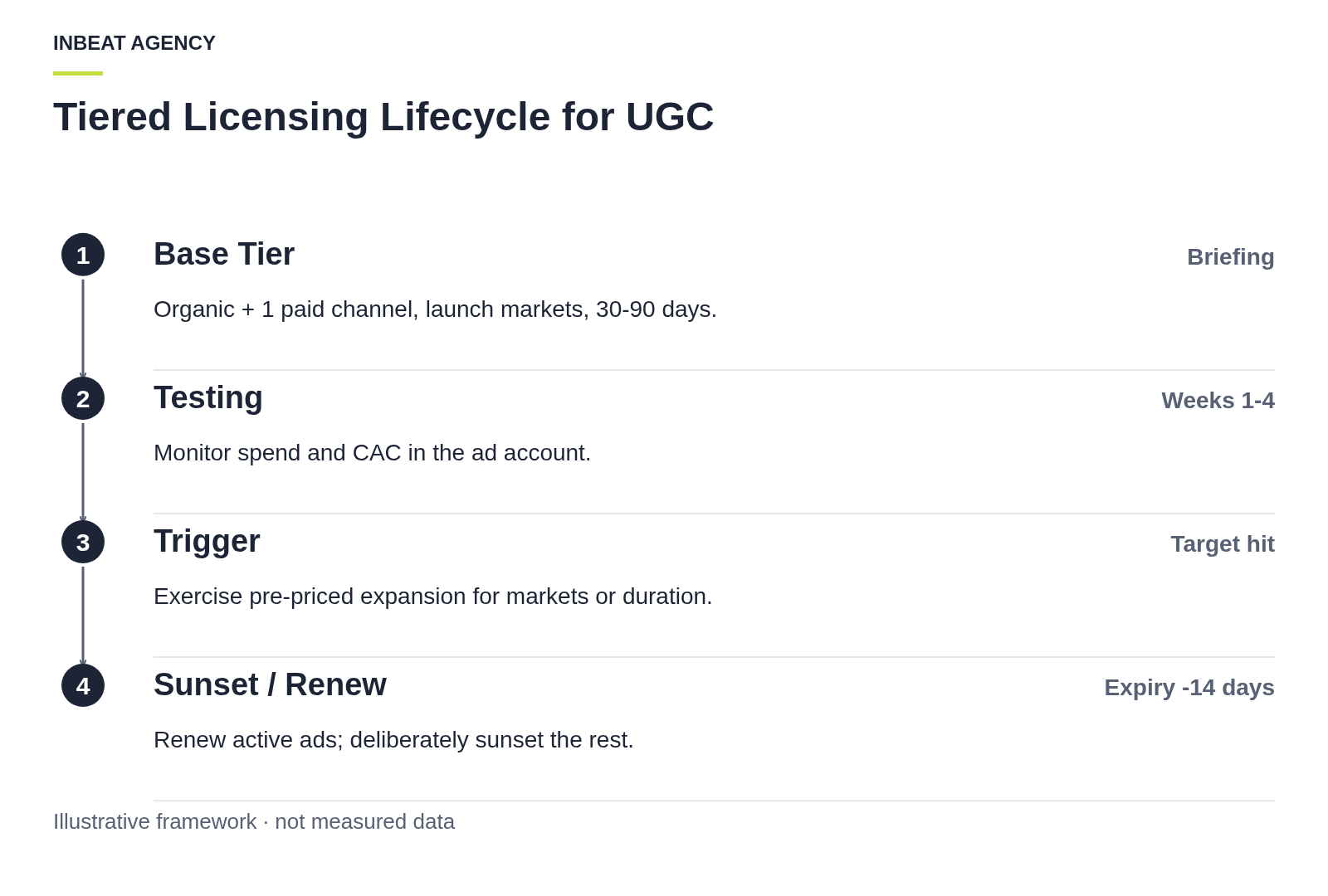
Structure tiered licensing in five steps, all written into the brief and the contract before the first clip is shot. The procedure below is the framework we recommend; however, it is a working method, so we are not presenting it as a documented client result.
- Define the base tier in the brief: organic use plus one paid channel, the launch markets, a fixed term sized to your test cycle (such as 30 to 90 days, used here as a sample timeframe), and modification rights included so re-cuts never need a new ask.
- Pre-price the expansion tiers in the same agreement: additional markets, additional channels, whitelisting access and extended duration. These are options the brand may exercise at a fixed price, with no renegotiation.
- Tie each option to a spend or performance trigger so the media buyer initiates expansion when an ad earns it, without routing through legal each time.
- Hold a license register with five columns (creator, clip, channel, territory, expiry) that the ad account team reads weekly. The license is a precondition of running the ad, so the register is a media document as much as a legal one.
- Renew ahead of expiry for any ad still in rotation, using an operational buffer you set in advance (two weeks is an illustrative choice), and sunset rights deliberately for everything else.
Set the base tier before content is shot
Write the base tier into the creative brief instead of a contract sent after delivery. Creators price the work knowing the paid scope, and your sourcing team stops negotiating rights clip by clip.
Digital Applied's 2026 licensing framework describes a similar sequencing, with scope agreed up front and extensions handled as defined events.
Keep the base tier narrow and honest: if the launch plan is US only on Meta, say so. Teams that pad the base tier "just in case" recreate the buyout problem one clause at a time. Modification rights belong in the base tier because every winner gets re-cut.
Trigger expansions from the ad account instead of the calendar
Exercise an expansion option when the ad set proves the clip, which usually means a spend threshold or a CAC target held over a defined window. The media buyer owns the trigger because the media buyer sees it first.
Take this example: a US-launch DTC brand's top creator ad hits its spend trigger in week three; the buyer exercises the pre-priced Canada and UK expansion the same day, pays the creator the option fee, and duplicates the ad set into the new markets. There's no legal review, no renegotiation, and, importantly, no gap in delivery.
If your team runs media through inBeat's performance marketing service, this trigger sits in the same weekly review as budget reallocation, which is where it belongs.
For budgeting, Twine's method for calculating UGC cost is a useful reminder to count option fees as part of the content cost from the start.
Track UGC license expiry and renew before ads must pause
Build the five-column register this week, even as a spreadsheet: creator, clip, channel, territory, expiry.
Then add an expiry alert as a permanent line item in your weekly media review, in the same meeting where you read frequency and CPA, since all three answer the question "does this ad keep running?"
Read the register weekly and renew ahead of expiry for anything still spending.
The failure mode of tiered licensing is a profitable ad switched off because nobody saw the date. Pick a buffer and hold to it; a two-week window is one workable rule of thumb, long enough for the creator to confirm and your finance team to pay, though the right number depends on your payment cycle and creator responsiveness.
For ads you are retiring anyway, let the term end on purpose and note it in the register. A deliberately sunset license is a clean record; a lapsed one that is still live is an infringement waiting to be noticed.
Legal risks of running UGC outside licensed territory or channel
Running a creator ad outside its licensed territory or channel is copyright infringement, and the most common cause is a targeting setting nobody treated as a decision.
This section is general information and does not constitute legal advice; national rules on moral rights, likeness and damages vary, and you should check the markets you actually run in with counsel.
Unauthorized use is copyright infringement, whatever the contract calls it
The creator holds the exclusive rights to reproduce, distribute, and publicly display their work under 17 U.S.C. §106, and a license is the only thing that lets your brand exercise any of them. Use beyond the grant falls outside that authorization entirely.
That reframes a scope breach: delivering a US-licensed ad to French audiences is a use the creator never authorized, and no late fee or amended clause changes that. The contract defines the boundary; the statute defines what happens when you cross it.
Scoped licenses do not create this exposure. They make the boundary visible, which is a reason to prefer them, since a worldwide clause hides the fact that your team never had a reason to run most markets in the first place.
Cross-border and platform compliance layers blanket contracts miss
Audit every active ad set now: for any creator ad carrying a territory-limited license, check whether Advantage+ audience, expanded-location, or worldwide delivery settings are switched on, and turn them off or expand the license before the next spend.
The usual breach is accidental: audience expansion, Advantage+-style automation, or a worldwide location setting switched on during a scaling push. Hypothetical: a license covers US paid social; in week six the ad set is changed to worldwide delivery to find cheaper impressions, and the clip serves in a dozen markets the creator never agreed to.
Nobody intended it, and intent does not change the analysis. Make the register's territory column the reference the buyer checks before touching those settings.
A worldwide grant does not solve this, because copyright is only one layer. Endorsement disclosure rules, likeness and personality rights, and privacy regimes differ by market, and a clause that says "worldwide" from the copyright owner says nothing about whether the disclosure in the caption satisfies a given country's advertising regulator or whether a bystander in the clip has rights there.
Blanket contracts give false comfort on exactly the questions that only arise when you choose to run a market. A tiered license forces that choice to be explicit, which is when those local questions get asked.
How to document UGC permissions and ad delivery
Disputes with creators tend to be settled on documentation, and the side with a dated record usually wins quickly. The register from the previous section is that record: it shows what was licensed, when, for which markets, and when each expansion was approved.
Pair it with written confirmation of every exercised option, even a short email, and a screenshot of ad set targeting at launch and at each change. If a creator claims an ad ran beyond scope, you can show the delivery countries from the platform report against the territory column within minutes.
If they are right, the same record shows exactly how far the overrun went, which shrinks the negotiation. Treat the register as evidence you are building for a dispute you hope never happens; that framing keeps it accurate.
How inBeat approaches UGC usage rights for performance testing
The decision rule is short: buy scope in tiers tied to what the ad account proves, and reserve full buyouts for the few assets that will genuinely live for years on your site, in retail or in a hero campaign.
Everything in a paid social test batch starts with a base tier and earns its expansions.
That is how we run it.
- We source creators at volume, matched by persona (follower count is not the main priority).
- We brief them against a rate card that already contains the base tier and the option prices.
- We launch every clip with scoped paid rights.
The account is the laboratory: dark-post the batch, read the signal, and exercise territory, duration, and whitelisting options only on the ads that earn them.
Make, launch, learn, repeat applies to the license as much as to the hook. We are not citing campaign results here, because the mechanism and the arithmetic carry the point on their own.
The tradeoffs are worth stating plainly:
Single-market brands with a small content volume gain less from tiers than multi-market testers. Evergreen asset types justify longer terms. And a team that will not maintain a register should either hire the discipline or accept the buyout premium as the cost of not tracking anything, which is a legitimate choice as long as it is made on purpose.
Before you leave this page, pull up your next three creator briefs and decide, brief by brief, which will launch with a base tier and pre-priced expansions and which genuinely needs a buyout.
If you want help scoping licensing around the ads you will actually scale, book a strategy call through inBeat's performance creative service.
FAQ
What happens to a whitelisted or Spark ad when the creator's license expires while it is still profitable?
Pause it unless a renewal is confirmed, because whitelisting access and the content license are both grants that end on the date written. The advance renewal buffer in the register (two weeks is the illustrative window used in this article) exists to prevent this moment. If it arrives anyway, pay the pre-priced extension immediately; a contract with no pre-priced extension is the real failure, since it leaves you negotiating while the ad burns margin.
How do you define territory in a license when a platform delivers ads worldwide by default?
Define territory as the locations you may select in the ad set, listed by country, and make the brand responsible for keeping targeting inside that list. Platforms deliver where you aim them, so the setting is the boundary. Spell out that automated audience expansion into unlisted countries is outside scope so there is no argument later about what "delivery" meant.
Should modification and re-edit rights be part of the base tier or priced as an expansion?
Base tier, always. Winners are re-cut within days of being identified, and a modification fee at that point is a tax on your best creative. Set the limit on modification by purpose: edits that keep the creator's message intact are in scope, edits that change what the creator appears to endorse are not.
Do tiered licenses need exclusivity, and how should exclusivity be scoped by category and duration?
Most test clips do not need exclusivity, and paying for it on ten clips to protect two is the same mistake as a blanket buyout. When a winner emerges, exercise a pre-priced exclusivity option scoped to your product category and to the period the ad is actually running, with a defined end date. Category should be narrow enough that the creator can keep working.
How should a brand handle creator content that performs organically but was never licensed for paid use?
Do not boost it until a paid grant is signed; organic permission does not cover ads. Treat the organic performance as the test result and go back to the creator with a paid tier priced for the channel and markets you intend to run. Most creators welcome the ask, because it signals their work is about to earn more.
When is a full worldwide perpetual buyout actually the cheaper option?
When the asset will run across many markets and placements for years and the alternative is a long sequence of option fees plus the staff time to track them. Website testimonials, retail screens and a hero spot you will re-use each season fit that profile. If the option fees you would plausibly exercise exceed the buyout price, buy out; for a monthly test batch they almost never do.
Cover photo: Photo: SHVETS production / Pexels. Art direction: inBeat Agency.