.svg)
.svg)
.svg)
.svg)


.svg)


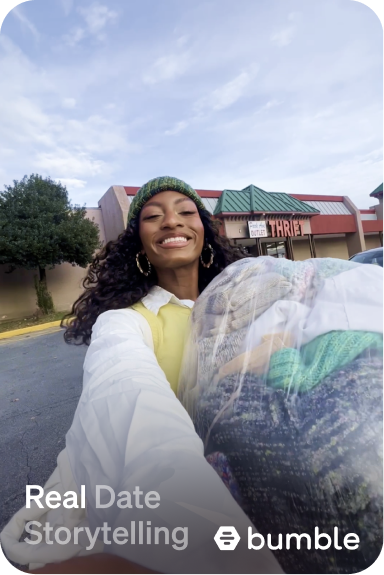
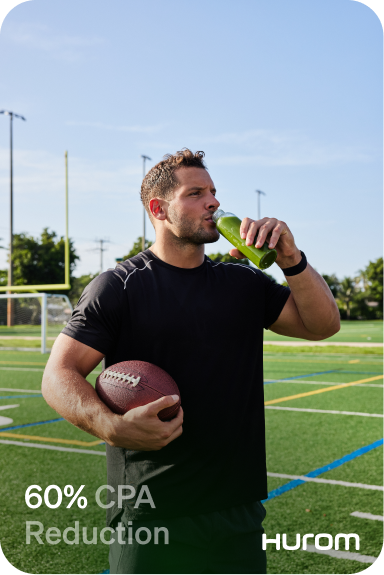
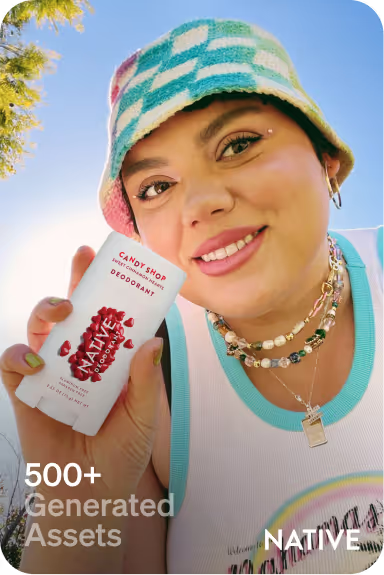


Performance creative has become the engine of modern paid acquisition. Instead of producing a few polished ads per quarter, brands now test dozens of variations every month across platforms like Meta, TikTok, and YouTube.
This approach has created an entirely new ecosystem of ad formats, creators, and production models. From UGC videos and product-focused B-roll ads to mashups and static creatives, each format comes with different production requirements and pricing structures.
For marketing teams, the challenge is now understanding:
- What formats exist
- How much they typically cost
- How they’re used in performance campaigns
If you want to understand all that, you’re on the right page.
This guide breaks down the most common performance creative formats used in paid social today, explains typical pricing ranges, and clarifies industry terms like UGC ads, darkposting, whitelisting, and creator licensing.
Let’s dive in.
TL;DR: Performance Creative Pricing
If you’re evaluating performance creative production, the table below summarizes the typical cost ranges for the most common ad formats used in paid social campaigns.
| Creative Format | Average Price | Notes |
|---|---|---|
| UGC Ads | $1,750 | Creator-shot videos with basic editing and hook variations |
| Complex UGC Performance Ads | $3,500 | Creator content with professional editing |
| B-Roll Ads | $1,000 | Product-focused footage with text overlays or voiceovers |
| Blink Ads | $750 | Edited compilation of existing clips or testimonials |
| Mashup Ads | $500 | Short, attention-grabbing creatives |
| Static Ads | $750 | Image-based ads with headline and copy |
Actual costs vary depending on creator experience, production complexity, licensing rights, and the number of creative variations produced.
What Is Performance Creative?
Performance creative refers to advertising content specifically designed to drive measurable results in paid media campaigns, such as clicks, sign-ups, or purchases.
Unlike traditional brand campaigns, performance creative is built around testing and iteration.
In other words, you won’t be launching a single ad concept.
You must produce multiple variations of the same idea to identify which messaging, visuals, and hooks generate the best results.
Side note: there’s a good reason for that data-driven testing approach. In fact, A/B testing can increase leads by 40%, in certain scenarios, according to Hubspot.
Here’s a neat comparison between performance creatives and regular creatives:
This approach is especially common on platforms such as:
- Meta Ads (Facebook and Instagram)
- TikTok Ads
- YouTube Shorts ads
- Snapchat Ads
A typical performance creative workflow includes:
- Producing multiple ad concepts
- Testing several hook variations
- Iterating based on campaign performance
- Continuously introducing new creatives
Because of this testing-driven model, most campaigns combine several creative types, each with different production costs and roles within the advertising strategy.
The sections below explain the most common performance creative formats used in paid social today.
The Most Common Performance Creative Ad Formats
Each format has a different purpose. Some ads rely on creators speaking directly to the camera, while others use product footage, testimonials, or fast-paced edits built from existing assets.
Understanding these formats helps you choose the right creative strategy and estimate typical production costs.
So, let’s analyze them together:
UGC Ads (User-Generated Style Ads)
UGC ads are short-form video ads designed to feel authentic and relatable. That’s why they frequently feature a creator speaking directly to the camera.
Plus, they look nothing like traditional commercials.
In fact, these ads resemble organic social media content. Creators typically demonstrate the product, share their experience using it, or explain how it solves a specific problem.
This format works well in performance marketing because it builds trust quickly and blends naturally into social media feeds.
UGC ads commonly include:
- A creator presenting or reviewing a product
- A problem–solution narrative
- A product demonstration or tutorial
- Multiple hook variations to test different opening messages
Because they rely on creators and original production, UGC ads are usually the most common format used in paid social campaigns today.
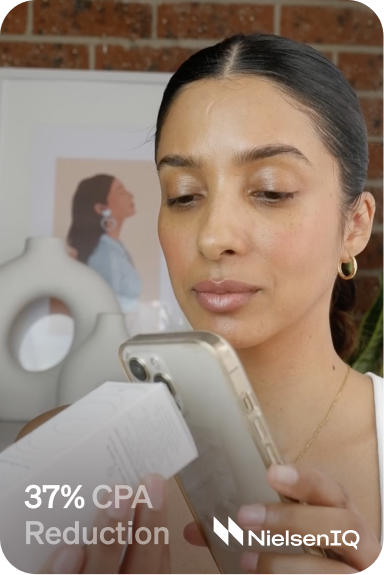
Here’s an example of an UGC ad from one of our campaigns for Nielsen IQ.
We onboarded over 100 unique international creators per month and generated content in 17 different countries. Basically, we created hundreds of international variations from one single video content.
B-Roll Ads
B-roll ads focus primarily on product visuals rather than a creator speaking on camera.
These ads typically combine product footage, lifestyle clips, and screen recordings with text overlays, voiceovers, or captions explaining the product’s benefits.
Here’s a good B-roll ad that one of our in-house creators made for Rail Europe:
They are frequently used for:
- Product showcases
- Feature demonstrations
- Before-and-after scenarios
- Simple product storytelling
Because they rely on product footage and editing instead of the actual creator performance, B-roll ads tend to be faster and cheaper to produce compared to full UGC ads.
That lines up with broader creator-content trends: in a 2024 CreatorIQ survey, 40% of organizations said traditional ads became more expensive, while creator-content production costs stayed flat.
Mashup Ads
Mashup ads are created by combining multiple existing assets into a single ad.
Instead of filming new content, editors assemble clips from different sources such as:
- Existing UGC videos
- Product footage
- Testimonials
- Customer reviews
- Previous ad creatives
We created this mashup B-roll add for the Leo app:
Mashups are particularly useful for rapid testing because they allow brands to produce new creative variations without organizing new shoots.
Many performance teams use mashup ads to quickly test new hooks, messaging angles, or value propositions.
Blink Ads
Blink ads are extremely short ads designed to capture attention within the first few seconds of a social media feed. That early hook matters: Meta reports that: 65% of people who watch the first 3 seconds of a video will keep watching for at least 10 seconds.
Here’s a good example from one of our campaigns for Dockers:
Creator-led storytelling like this produced impressive results for Dockers: 15.8 million total views, 10% engagement rate, and a measly $3.86 average CPM.
But back to blink ads.
As you’ve seen from our example above, they usually rely on:
- Bold visuals
- Fast editing
- Strong text overlays
- Quick product highlights
Blink ads are typically shorter and more direct than other ad formats. Their primary goal is to stop users from scrolling and deliver a quick, clear message.
Because of their simplicity, blink ads are often used to test new messaging angles before investing in more complex creative production.
Static Ads
Static ads are image-based ads.
While video dominates many paid social platforms, static ads still play an important role in performance campaigns, especially in retargeting or conversion-focused placements.
Static ads usually include:
- A product image or visual concept
- Headline and supporting text
- Brand elements or product benefits
They are quick to produce and allow marketers to test messaging variations without the cost of video production.
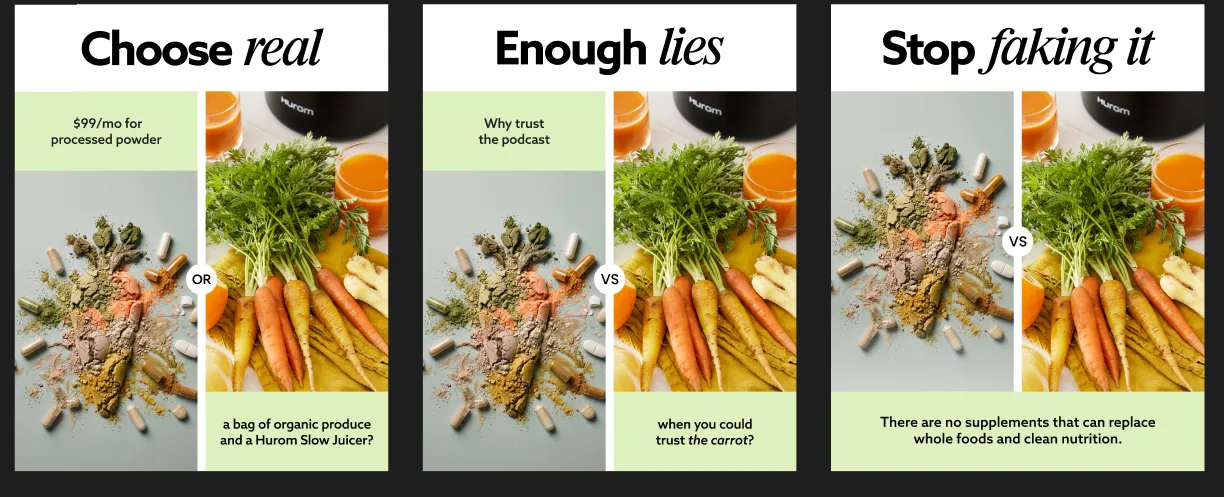
Here are some examples of static ad variations that we created for our client Hurom:
Now that you understand the most common performance creative formats, let’s look at their prices.
Typical Performance Creative Pricing by Ad Format
The cost of performance creative varies widely depending on the format, creator involvement, and production complexity. However, industry benchmarks provide useful ranges for the most common ad formats used in paid social campaigns.
For example, studies of UGC creator pricing show that most short-form UGC videos typically cost between $150 and $500 per video, depending on the creator’s experience and the complexity of the content.
According to current sources, beginner creators may charge as little as $50–$150 per video, while experienced creators or specialists can charge $300–$1,000+ or more, especially when paid advertising usage rights are included.
Pro tip: Because many performance ads require editing, hook testing, or creative strategy beyond the base creator fee, agency-produced performance creatives typically cost more than raw creator content.
From our experience working with different clients and discussing with different partner agencies, these costs are common:
| Content Type | Deliverables | Minimum | Regular | Maximum |
|---|---|---|---|---|
| Standard UGC | 1 net new video, 4 hook variations | $1,500 | $1,750 | $2,500 |
| Complex UGC | 1 net new video, no variations guaranteed | $2,500 | $3,500 | $5,000 |
| B-roll Ad | 1 video, 4 hook variations | $750 | $1,000 | $1,500 |
| Blink Ad | 1 short video, no variations | $500 | $750 | $1,000 |
| Mashup Ad | 1 video, 4 hook variations | $400 | $500 | $750 |
| Static Ad | 1 static ad design, 4 copy variations | $500 | $750 | $1,000 |
Once your deliverables and budget are clear, compare agency services and fit to find a partner whose production and testing process matches the brief.
These ranges reflect typical production costs for individual assets. In practice, performance marketing teams usually produce creatives in batches so they can test multiple variations at once.
For example, many paid media teams launch 10–30 new creatives per month, testing different hooks, angles, and messaging approaches to improve performance.
What Actually Drives Performance Creative Pricing
While format plays a role, the cost of performance creative is usually determined by several underlying production factors.
Understanding these variables helps you estimate realistic budgets and evaluate creative proposals from agencies or production partners.
Below are the main elements that influence performance creative pricing.
Creator Talent and Persona
UGC ads depend on creators who represent the brand’s target audience. The more specific the persona, the harder it can be to source creators.
For example, campaigns may require:
- Creators within a certain age group
- Professionals such as doctors or financial advisors
- Niche audiences such as athletes or gaming influencers
Creators with specialized backgrounds or credibility in a specific industry usually command higher rates.
Production Complexity
Some performance ads are simple recordings filmed on a smartphone, while others require structured scripts, product demonstrations, or multiple filming setups.
Costs typically increase when production involves:
- Scripted narratives
- Multiple scenes or locations
- Advanced editing or motion graphics
- Voiceovers or professional filming
Hook Variations and Creative Testing
Modern paid social campaigns rely heavily on creative testing.
Instead of producing one ad, advertising agencies create multiple versions of the same concept with different hooks or opening messages.
For example, a single video concept may include several variations testing:
- Different problem statements
- Different product benefits
- Different storytelling approaches
Producing additional variations increases editing time and production complexity.
Localization and Languages
Running ads in multiple markets usually requires creative localization.
This may involve:
- Different languages
- Region-specific messaging
- New creators for each market
Remember: Localized campaigns require producing new creative variations and not simply translating an existing ad.
According to Microsoft, you can power your localized campaigns with transcreation.
Transcreation involves more extensive changes to preserve intent while making the message culturally appropriate for the target market. However, transcreation is more expensive, so pick it only for certain scenarios:
“Because transcreation takes more time and is more costly than other forms of localization, it is mostly used for strategically critical content such as slogans, headlines, marketing, campaigns, brochures, commercials, and certain parts of games. It could also be applicable for any content that is exceptionally artistic or emotional.” (Microsoft, Transcreation)
Industry Complexity and Compliance
Certain industries require additional review and compliance considerations.
Examples include:
- Healthcare and medical products
- Financial services
- Legal services
Ads in these sectors may require specific disclaimers, additional approvals, or specialized messaging, which can increase production time and cost.
Creative Licensing: What Brands Are Actually Paying For
When brands purchase performance creative, they are not just paying for the production of the ad itself. They are also paying for usage rights, commonly referred to as creative licenses.
A license defines where, how, and for how long a brand is allowed to use a piece of content. These usage rights are particularly important in creator-led ads and UGC campaigns, where the creator retains ownership of the content unless specific rights are granted.
Different licensing agreements allow brands to use the content in different ways.
Understanding these licensing terms is important when budgeting for performance creative, since usage rights can represent a significant portion of the total creative investment.
| Type of License | Cost |
|---|---|
| Paid Media License | 20–50% of base fee |
| Organic Social License | Included in base fee for first 3 months; 10% per month afterward |
| Perpetual License | 100–150% of base fee |
Paid Media License
A paid media license grants a brand the right to use the creative as advertising on paid platforms.
This includes running ads on platforms such as:
- Meta Ads (Facebook and Instagram)
- TikTok Ads
- YouTube Ads
- Google Ads
- Snapchat Ads
Under this license, the creative is uploaded directly into advertising platforms and used in paid campaigns. The content typically does not appear on the creator’s social media profile.
Paid media licenses are usually included in the base price of performance creative production, but in some cases they may require additional fees depending on the scope of the campaign.
Recent benchmarks put paid ads usage at roughly:
- +20-30% of base fee for 3 months
- +25-40% for 6 months
- +30-50% for 12 months
Organic Social License
An organic license allows the brand to publish the creative on its own social media channels.
This includes posting the content on:
- Brand Instagram profiles
- TikTok accounts
- YouTube channels
- Other owned social media platforms
Because organic posts can reach audiences beyond paid advertising campaigns, creators charge additional fees to grant these rights.
Shopify notes that organic social on the creator’s own channels is included in the base rate, while brand social reposting may require an added fee.
If charged separately, it’s commonly lower than paid media, often negotiated case by case rather than with a universal benchmark.
Some creators tend to charge 10% per month after 3 free months:
Perpetual vs Time-Limited Licenses
Licensing agreements also specify how long a brand can use the content.
Most creator agreements use time-limited licenses, commonly lasting between 6 and 12 months. After that period, brands may need to renew the license to continue using the content in ads or organic posts.
Some campaigns purchase perpetual licenses, which allow the brand to use the creative indefinitely.
This is where pricing jumps. A perpetual or in-perpetuity license is typically benchmarked at +100–150% of the base creative fee.
UGC vs Darkposting vs Whitelisting vs Partnership Ads: Costs for Each Format
Many performance marketing terms are used interchangeably even though they refer to different advertising approaches.
Terms such as UGC ads, darkposting, whitelisting, partnership ads, and Spark Ads are usually confused because they all involve influencer-generated content and paid social advertising.
The key differences usually come down to three factors:
- Whether the creator has a public social profile
- Whether the content is posted on the creator’s feed
- Which account appears as the advertiser in the paid ad
The table below summarizes the main distinctions and costs.
| Ad Approach | Price | Video posted on creator feed? | Who runs the ad? | Typical Use Case |
|---|---|---|---|---|
| UGC Ads | $100 to $500+ per video | No | Brand account | Performance creative for paid media |
| Darkposting (UGC style) | 15% of the base rate per month | No | Creator handle | Paid ads that appear from the creator profile |
| Whitelisting | 20–30% of the base rate per month | Yes | Brand runs ads from creator post | Influencer-style paid amplification |
| Partnership Ads / Spark Ads | Starting at $100 for nano influencers to $20,000 for macro influencers | Yes | Both creator and brand appear | Collaborative branded ads |
Understanding these formats helps brands choose the right creative strategy depending on their campaign goals.
UGC Ads
As we explained above, UGC ads involve creators producing content that looks authentic and native to social media, but the ad itself is run directly from the brand’s advertising account.
The creator does not need to publish the content on their personal profile. Instead, the brand receives the video and uploads it into advertising platforms such as Meta Ads or TikTok Ads.
This approach is common in performance marketing because it allows brands to:
- test multiple hook variations
- edit and optimize creatives internally
- scale ads quickly without relying on creator posting schedules
Our client Hurom prefers this approach:

In terms of cost, a single UGC video typically falls around $100 to $500+, with recent benchmarks putting the 2025 average at roughly $150 to $212 per video and the median around $175.
Darkposting
Darkposting refers to ads that appear to come from a creator’s social media profile, even though the content is not actually published on their public feed.
In this setup:
- The creator provides access or authorization for their account
- The ad runs from the creator’s handle
- The post does not appear organically on their profile
This approach can make ads feel more authentic because they appear to come directly from a real person rather than a brand.
Pricing is usually layered on top of the content-production fee: a common benchmark for darkposting or creator authorization is about 15% of the base rate per month. So if a creator charges $200 for the video, darkposting rights might add about $30 per month.
Whitelisting
Whitelisting is a broader term used when a creator publishes content on their profile and then allows a brand to promote that post as a paid advertisement.
In this model:
- The creator posts the content on their feed
- The creator provides advertising authorization (often via a code or platform permission)
- The brand runs paid ads using that post
Because the content exists as a public post, it can generate both organic engagement and paid reach.
Whitelisting is commonly priced as an added rights fee rather than a flat universal rate, with one current benchmark putting it at roughly 30%, though many creators we know only charge 20-25% of their base rates for whitelisting.
Partnership Ads and Spark Ads
Some platforms offer built-in collaboration formats where both the creator and brand appear on the ad.
Examples include:
- Partnership Ads on Meta
- Spark Ads on TikTok
In these formats:
- The creator posts the content
- The brand promotes the post as an ad
- Both the creator and brand handles are visible in the ad
Shopify’s current TikTok benchmarks suggest roughly:
- $100 to $500 for nano influencers
- $500 to $2,000 for micro influencers
- $2,000 to $20,000 for macro influencers per video/post
That’s before extra fees like usage rights, exclusivity, or extended licensing are added.
How Many Creatives Should Brands Test Per Month?
One of the most common questions brands ask when launching performance creative campaigns is how many ads they should produce and test.
In our experience at inBeat, the answer depends largely on budget, industry, and campaign maturity. However, one pattern consistently holds true: brands that test more creative variations tend to find winning ads faster.
Paid social platforms reward constant creative iteration. Instead of relying on a single ad concept, high-performing campaigns typically test multiple messaging angles, hooks, and brand storytelling approaches.
For Smaller Budgets: Focus on Iteration
For brands with smaller advertising budgets, we usually recommend starting with a limited number of creatives and focusing on iteration.
In many early-stage campaigns, we’ve seen success with testing 5-10 creatives per month, each built around a different hook or messaging angle.
For example, the same product might be presented through several approaches:
- A problem-solution narrative
- A product demo
- A testimonial-style UGC ad
- A quick benefit-focused B-roll ad
Testing these variations allows teams to identify what resonates with their audience before scaling production.
For Scaling Campaigns: Increase Creative Volume
When brands begin scaling their paid media budgets, creative volume becomes much more important.
For many of our clients running performance campaigns across Meta and TikTok, we often produce 10–30 new creatives per month. This allows teams to continuously introduce new concepts while refreshing existing ads that begin to fatigue.
At this stage, the goal is not just testing new ads, but also producing multiple hook variations of winning creatives to extend their lifespan.
For example, a single high-performing concept may generate several variations testing:
- Different opening hooks
- Different problem statements
- Different product benefits
This approach allows campaigns to scale without relying on a single creative.
For Competitive Niches: Creative Volume Becomes Critical
In highly competitive industries, creative testing often needs to move even faster.
Some of our clients in ecommerce niches such as health, beauty, and consumer products produce significantly higher volumes of performance creative because ad fatigue appears quickly in these markets.
In these cases, creative pipelines are designed to constantly introduce new ads while retiring underperforming ones.
This approach helps maintain strong performance even as audiences become familiar with existing creatives.
How inBeat Agency Approaches Performance Creative
At inBeat, we approach performance creative with one core principle in mind: winning ads come from structured testing, not isolated ideas.
Instead of producing a few polished ads and hoping they perform, we help brands build creative pipelines that continuously generate new concepts, hooks, and variations. This allows campaigns to quickly identify what resonates with their audience and scale the creatives that deliver results.
Our process typically focuses on three core elements.
Creator Sourcing and Authentic Content
Many high-performing ads rely on creators who can present products in a natural and relatable way.
At inBeat, we work with a network of vetted creators across different industries and demographics. This allows brands to quickly produce UGC-style ads that match their target audience and feel native to platforms like TikTok, Instagram, and YouTube Shorts.
Depending on the campaign, creators may produce:
- Product demonstrations
- Testimonials and reviews
- Problem-solution narratives
- Lifestyle integrations
These formats help ads feel more organic and engaging within social media feeds.
Structured Hook Testing
In our experience, the first few seconds of an ad often determine whether someone continues watching or scrolls away.
Because of this, we typically build multiple hook variations for each creative concept. Each version tests a different opening message, question, or value proposition while keeping the rest of the ad structure consistent.
This structured testing approach allows campaigns to quickly identify which messaging angles generate the strongest engagement and conversions.
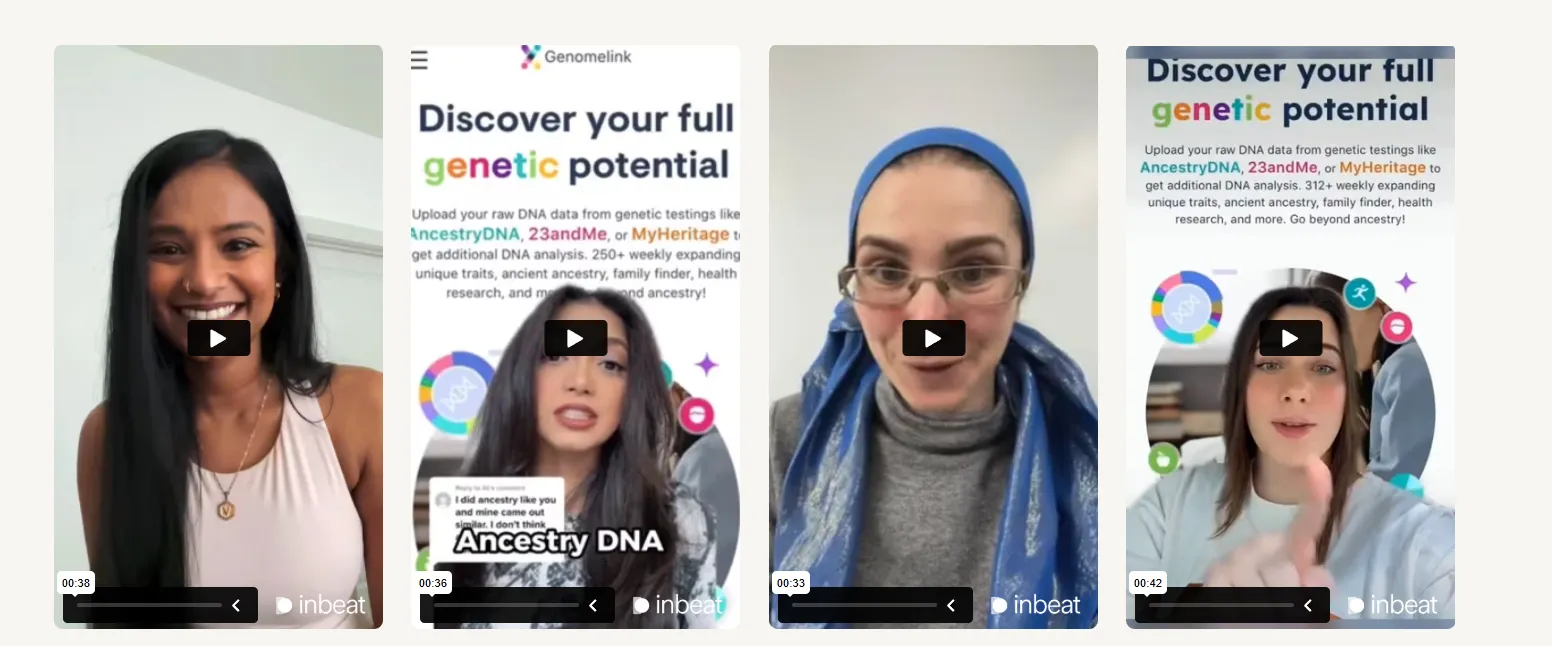
For clients like Genomelink, this kind of rapid testing led to 73% decrease in CAC, 124% increase in registration completion, and 27% drop in cost per registration.
Continuous Creative Iteration
Performance creative is rarely static. Even strong ads eventually lose effectiveness as audiences see them repeatedly.
To keep campaigns performing, we continuously introduce new creative concepts and variations. This includes experimenting with different ad formats such as:
- UGC creator ads
- Product-focused B-roll ads
- Mashup edits built from existing assets
- Short attention-grabbing creatives
By constantly testing new ideas while optimizing proven concepts, we help our clients maintain strong campaign performance as their advertising budgets scale.
Performance Creative Is an Ongoing System
The most successful brands we’ve worked with treat creative production as a continuous system.
As such, they build repeatable workflows for generating, testing, and improving new creatives every month.
Understanding the different creative formats, pricing structures, and licensing considerations involved in performance advertising is the first step toward building that system.
Remember: For brands looking to scale paid social campaigns, investing in a structured performance creative strategy makes the difference between ads that simply run and ads that consistently drive measurable growth.
And if growth is what you need, get in touch with us today and let’s power your performance marketing campaign together!
FAQ
Do brands need new creatives every month?
In most digital advertising campaigns, yes. Platforms tend to favor fresh creative output, and performance can drop if the same ads are shown repeatedly. Many creative teams introduce new assets monthly to test ideas, maintain engagement, and improve key performance metrics like conversions and click-through rate.
Do I have to create my own UGC ads?
Not necessarily. Many UGC agencies focus on producing content for data-driven ads. Their goal is to create authentic assets that support customer acquisition or lead generation, working directly with creators and brands.
Why do brands produce multiple versions of the same ad?
Performance campaigns rely heavily on testing different creative variables. A single concept might include variations in hooks, messaging, visuals, or calls to action. This approach helps identify which version drives better business outcomes, such as higher engagement, better thumbstop rates, or stronger return on ad spend.
Can brands reuse performance creative assets across platforms?
Yes, but results improve when creatives are adapted to each platform’s intent and format. For example, what works on TikTok may need adjustments for Meta or YouTube Shorts. Using modular content makes it easier to tailor assets while maintaining consistency across channels.
How long do performance ads typically run?
Top-performing ads can run for weeks or even months, especially if they continue delivering strong results like stable conversion rates or better brand recognition. However, most brands refresh creatives regularly to maintain visual impact and avoid fatigue.
Performance Creative Glossary
The terminology used in paid social advertising can be confusing because many terms overlap. This quick glossary summarizes the most common performance creative concepts.
| Term | Definition |
|---|---|
| Performance Creative | Advertising content designed specifically to drive measurable results in paid media campaigns, such as clicks, leads, or purchases. |
| UGC Ads | Ads that mimic user-generated content, typically featuring a creator speaking directly to the camera or demonstrating a product. |
| Hook | The opening seconds of an ad designed to capture attention and stop users from scrolling. |
| Hook Variation | Multiple versions of an ad that test different opening messages while keeping the rest of the creative similar. |
| B-Roll Ad | A product-focused ad that relies on footage, screen recordings, or visuals instead of a creator speaking directly on camera. |
| Mashup Ad | An ad created by combining existing clips, testimonials, or UGC footage into a new creative variation. |
| Blink Ad | A very short ad designed to capture attention quickly through fast editing or bold visuals. |
| Static Ad | An image-based advertisement that includes visual design, headline text, and supporting copy. |
| Whitelisting | A creator grants a brand permission to run paid ads using content posted on the creator’s social profile. |
| Darkposting | Paid ads that appear from a creator’s social media handle but are not visible as organic posts on their profile. |
| Creative License | Usage rights that determine where and how a brand can use creative content in advertising or organic social media. |
Appendix: Research Sources
- Shopify, TikTok Influencer Marketing: How To Run a Campaign (2026)
- Katja Orel, UGC Rates 2026: The Ultimate Guide With Real Numbers
- Lukas Minnebeck, How Much Does UGC Cost in 2026? Real UGC Pricing, Rates, and Hidden Fees [+ AI UGC]
- Denisa Lamaj, UGC Usage Rights: The Ultimate Guide for Brands
- Design Revision, UGC Creator Pricing in 2026: What It Really Costs
- Facebook team, Updated features for video ads
- CreatorIQ, CreatorIQ: Brands and Agencies Say Creator Marketing Drives Better ROI For Less
- Hubspot, An Introduction to Using A/B Testing for Marketing Optimization