.svg)
.svg)
.svg)
.svg)


.svg)




%20(1).png)

According to Bazaarvoice’s 2025 Shopper Preference Report, 52% of shoppers cited real customer reviews as the biggest factor in their final purchase decisions, while 35% said they trust content featuring real-life photos and videos.
For brands, that's a real opportunity: UGC can build credibility and trust, and drive measurable results. Of course, it has to be produced and measured the right way.
While UGC includes a range of formats, video stands out for delivering a message in an engaging, emotional way. If you want to integrate UGC videos into your marketing strategy but aren't sure where to start, this guide walks through the whole system.
In this guide, you'll find:
- What separates organic UGC from commissioned UGC-style content and influencer content, and why the distinction matters.
- A repeatable process for building performance-ready UGC videos.
- How to measure UGC performance beyond likes and views.
- Usage rights, disclosure, and brand-safety basics.
- Real case studies with verified, current results.
P.S. Need a consistent pipeline of performance-ready creator content? inBeat's UGC agency sources creators, develops hooks and scripts, manages production and usage rights, and uses campaign data to inform each new creative batch.
Key Takeaways
- Organic UGC, commissioned UGC-style content, and influencer content are three distinct things with different contracts, disclosure requirements, and measurement approaches.
- Distribution has to be planned; virality isn't a strategy.
- Measure UGC against the same funnel-stage metrics you'd use for any other creative.
- Usage rights and disclosure need to be settled before production.
Organic UGC vs. Paid UGC vs. Influencer Content
The term "user-generated content” actually covers two different formats: organic content created voluntarily by customers, and commissioned UGC-style content produced by creators for a brand under a paid brief. Influencer content is different again: the brand pays for the asset and for access to the creator's audience.
Organic UGC may feature genuine customers. Commissioned UGC-style videos feature contracted creators following an approved brief. Brands should not present a paid creator as an independent customer unless that description is accurate, both because it misleads viewers and because it can run afoul of disclosure rules covered later in this guide.
Before sourcing any content, decide which of three things you actually need: customer advocacy, ad creative, distribution through a creator's audience, or some combination. That decision shapes everything downstream, from what you brief creators on to how you measure success.
Here's an example of a brand that treated this as a performance problem from the start:
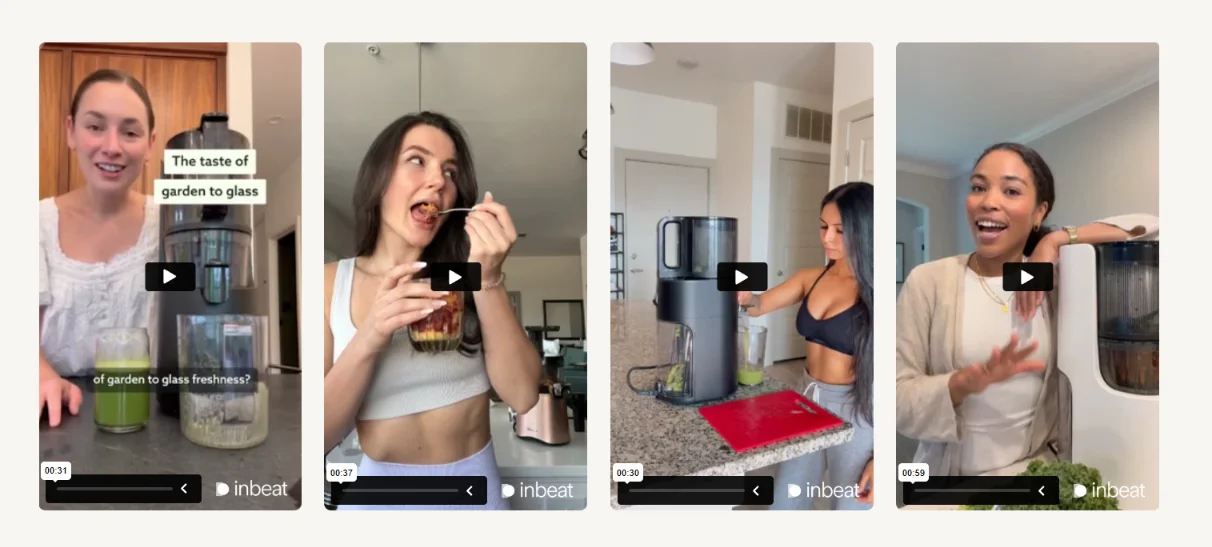
Hurom tackled rising CPAs by moving away from an "always on sale" approach to a health-focused messaging strategy. Working with inBeat, the brand shifted creative around key health concerns and iterated on hooks, CTAs, and social proof across ongoing UGC production.
The result: a 70% reduction in overall CPA, a 300% increase in ROAS, and 33% month-over-month profit margin growth.
How Can UGC Videos Drive Actionable Results for Your Brand?
UGC videos can influence the metrics that matter, but the format is not automatically persuasive or cost-effective. Results depend on the creator, message, product, distribution strategy, and how systematically the brand tests each asset.
Here is what UGC video can realistically contribute:
- Stronger perceived authenticity: Customer and creator videos can feel more credible when they show the product in a recognizable setting, use natural language, and reflect a real experience. That authenticity must be earned. An overly scripted paid creator can appear less believable than well-produced brand content, especially when the creator makes generic claims or does not seem familiar with the product.
- Support for purchase decisions and conversion: UGC videos can demonstrate the product, answer objections, explain use cases, and provide evidence that is difficult to communicate through static brand copy. A peer-reviewed 2025 study of 643 Gen Z consumers found that UGC on TikTok and Instagram had a statistically significant positive relationship with purchase intention ((\beta = 0.180,\ p < 0.001)). The research focused on sustainable fashion consumers in Egypt, so it should not be treated as a universal conversion benchmark, but it supports UGC’s role in purchase consideration.
- Better paid-social performance in the right context: Creator-led videos can combine platform-native execution with paid distribution. TikTok’s internal analysis of creator campaigns running between February 2024 and January 2025 found that creator ads generated a 70% higher click-through rate and 159% higher engagement rate than non-creator ads at the same CPM. These are platform-reported results and creator-led advertising is broader than organic UGC. Still, the findings show why creator, hook, format, and publishing context are worth testing as performance variables.
- Additional value from creator-handle distribution: The account publishing the content can affect performance as much as the video itself. In another TikTok analysis, ads published through creator accounts produced a 59% higher engagement rate and a 16% higher six-second view-through rate than comparable content not published through a creator account. This supports using Spark Ads or similar creator-handle formats when the creator’s identity and existing audience trust are relevant to the campaign.
- Deeper participation in the brand: When customers or creators contribute content, respond to briefs, or participate in recurring campaigns, they move from passive viewers to active participants. That can support advocacy and give the brand a pool of people who already understand its products. The relationship still needs to be maintained through clear communication, recognition, fair compensation where applicable, and opportunities for repeat collaboration.
- Extended reach through planned distribution: UGC can reach new audiences when customers or creators publish it through their accounts or when the brand amplifies approved posts through paid media. Virality is unpredictable and should not be the strategy. Plan distribution through brand channels, creator handles, Spark Ads, partnership ads, product pages, and retargeting campaigns. TikTok’s commercial UGC guidance confirms that Spark Ads allow brands to turn organic creator posts into paid campaigns while retaining the original post and its engagement history.
- A more efficient creative-production system: Organic customer content can reduce the volume of brand-led production required. Commissioned UGC can also produce more testable variations than a traditional shoot when creators supply modular footage, alternative hooks, product demonstrations, proof points, and several CTAs. It is not free, however. Brands must still budget for creator fees, product shipping, usage rights, revisions, editing, creator-handle permissions, and paid distribution.
- Faster creative learning: Likes, comments, shares, watch time, and saves can help identify which messages attract attention. For paid UGC, connect those signals to CTR, landing-page views, conversion rate, CPA, ROAS, and customer or lead quality. A highly engaging video may attract the wrong audience, while a less entertaining product demonstration may produce stronger conversion efficiency.
- A more useful product page: UGC videos can improve the shopping experience by adding demonstrations, customer language, FAQs, comparisons, and real-world context. For search visibility, embed indexable video, include captions or transcripts, add descriptive supporting copy, and use appropriate video structured data. These practices make the page more informative and accessible, although UGC alone does not guarantee higher search rankings.
How to Build a Performance-Ready UGC Video
A strong UGC ad is built around one audience, one problem, and one primary action. Start with a hook that introduces the problem or desired outcome, demonstrate the product early, support the message with credible proof, address a likely objection, and finish with a specific CTA.
Pro tip: Produce several hooks and endings for each core concept so the media team can test variables without commissioning an entirely new video.
The process we recommend to clients:
- Define the campaign objective and the conversion event.
- Select the audience and the product angle.
- Match the creator to the category and use case.
- Write multiple hooks, proof points, and CTAs.
- Request modular raw footage.
- Produce several platform-ready edits.
- Launch controlled creative tests.
- Feed the results into the next production batch.
Here are some tactics you can use:
1. Showcase User Stories and Testimonials
Video testimonials are a compelling way to build trust because they show a real person's experience. To use them effectively:
- Create a dedicated space: Establish a section on your website or social channels where you regularly feature user videos and testimonials.
- Make it easy to contribute: Reach out to customers directly via email or social media to request video testimonials, with clear instructions and a simple submission path.
- Show a range of stories: Feature a diverse set of use cases and demographics so more of your audience sees themselves in the content.
- Host live Q&A sessions: Let customers ask questions and share experiences in real time. This builds engagement in a way a static testimonial can't.
- Make it easy for customers to submit video testimonials: Include clear instructions, a user-friendly submission form, and prompt follow-up acknowledging their contribution.
.webp)
2. Use Hashtags to Organize UGC
A hashtag helps organize and monitor submissions, but it isn't a distribution strategy on its own. Pair it with a clear creative prompt, launch content, creator seeding, incentives, moderation rules, and permission language explaining how the brand may reuse submissions.
- Design an accessible challenge: Keep the creative ask simple enough that a broad range of your audience can participate.
- Offer real incentives: Feature contributors on your platforms, offer discounts, or run a prize for the most creative submissions.
- Highlight what you receive: Sharing selected submissions on your own channels acknowledges contributors and shows future participants what good submissions look like.
- Track what's actually happening: Use social analytics to monitor reach and engagement on the hashtag itself, and adjust the prompt if participation stalls.
- Use a unique, memorable hashtag: It should be tied to your brand and the specific campaign goal.
3. Lower the Barrier to Creating Content
Give your audience easy-to-use templates, tools, and guidelines. This matters most for people who are interested but don't feel confident in their creative or technical skills.
- Offer templates: Branded templates that users can customize keep submissions on-brand without constraining creativity.
- Publish clear guidance: Simple tutorials on creating engaging content with your product lower the barrier for first-time contributors.
- Point to accessible tools: Adobe Express, Canva, CapCut, InVideo, Async, and the native editing tools built into TikTok and Instagram all lower the skill floor for creating usable video.
- Design for mobile first: Most UGC today is shot and edited on a phone, so templates and guidance should assume that from the start.
Pro tip: Update your toolkit and guidelines periodically as platform-native editing features and trends shift; a guide built around last year's tools loses relevance quickly.
4. Build a Community of Contributors
A community built around your brand improves both the quantity and quality of UGC over time, because contributors who feel invested keep participating.
- Create dedicated spaces: Groups or forums where your most engaged users can share tips, get early access, and interact directly with your brand build that investment.
- Feature community content regularly: This rewards contributors and shows prospective ones what participation looks like.
- Run contests and events: Regular prompts keep content flowing instead of relying on organic momentum alone.
- Actually engage: Commenting on and sharing user content signals that contributions are seen and valued, which encourages more of them.
5. Work With Micro-Influencers on Commissioned Content
When a creator publishes to their own audience, that's influencer-generated content. When a brand commissions and licenses the asset for its own channels, that's UGC-style creator content. One piece of content can serve both purposes, but the contract, distribution rights, and measurement approach differ, and should be spelled out before production starts.
Micro-influencers with a niche following are a strong source of this content, since their audiences tend to trust their recommendations more than a macro-influencer's broader, less specific following.
For Greenpark Sports, inBeat worked with micro-influencers across relevant niches to build brand awareness and produce consistently high-performing content, brainstorming creative concepts, hooks, CTAs, and scripts to develop UGC that could compete with bigger-budget competitors on cost efficiency.
.webp)
Steps to get this right:
- Identify genuinely relevant creators: Match on audience fit and engagement quality; do not focus on follower count only.
- Offer value beyond a flat fee: Early product access, behind-the-scenes involvement, or personalized incentives tend to produce better creative than a transactional brief.
- Leave room for authenticity: Creative freedom within the brief produces content that reads as genuine instead of scripted.
- Collaborate on the concept: Involving creators in early brainstorming tends to produce more distinctive, better-performing content than handing them a finished script.
Pro tip: Plan to reuse commissioned creator content across paid social, email, and website testimonials from the start, since that changes what usage rights you need to secure upfront.
Where to Use UGC Across the Funnel
UGC shouldn’t be limited to organic social posts. With the appropriate usage rights, the same creator-led concept can support paid social, product pages, email campaigns, marketplace listings, sales materials, and post-purchase education. However, each asset should be adapted to the audience’s stage of awareness; don’t reuse UGC videos unchanged across every channel.
Awareness
At the top of the funnel, UGC videos should make the product or problem immediately recognizable. Creator stories, routines, unboxings, and problem-led hooks can introduce the brand without forcing a detailed sales pitch into the first few seconds.
These videos are especially useful in prospecting campaigns because they can communicate in the visual language people already associate with TikTok, Instagram Reels, and YouTube Shorts. The goal is to earn enough attention for viewers to understand the problem and become curious about the solution.
Consideration
Once viewers recognize the problem, UGC videos should help them evaluate whether the product is right for them. Demonstrations, tutorials, comparisons, FAQs, and product walkthroughs can explain how the product works and address practical questions that polished brand content may overlook.
These assets can support retargeting campaigns, product pages, landing pages, email sequences, and marketplace listings. The strongest consideration-stage videos answer one clear question at a time, such as who the product is for, how it is used, what makes it different, or what customers should expect.
Conversion
Conversion-focused UGC videos should reduce the final points of friction between consideration and action. Testimonials, objection-handling videos, product-in-use demonstrations, and direct-response creator ads can reinforce the value proposition while giving viewers a clear next step.
The message in the video should also match the destination. If the creator emphasizes a particular feature, offer, or use case, the landing page should continue that message. A disconnect between the ad and the page can weaken conversion performance even when the video generates a high click-through rate.
Retention and Advocacy
UGC clips can continue working after the sale. Creator-led setup instructions, onboarding videos, troubleshooting tips, and advanced use cases can help customers use the product successfully and reduce avoidable support requests.
Brands can also invite customers to submit tutorials, reviews, transformations, or creative product applications. These programs can generate new content and strengthen customer participation, but submissions should only be republished after the brand has obtained clear permission and confirmed the necessary usage rights.
Adapt UGC to Each Placement
A strong concept can be repurposed, but the execution should reflect where it appears. A prospecting ad may need a fast hook and a short vertical edit, while a product-page video may benefit from a slower demonstration, captions, and additional context. Email may use a thumbnail linking to the full video, while TikTok Shop content should connect the demonstration directly to the featured product.
You should also distinguish between permission to repost a video and permission to use it in advertising. Spark Ads, partnership ads, creator-handle advertising, product pages, and third-party marketplaces may require separate contractual rights. TikTok, for example, defines Spark Ads as a way to use organic TikTok posts in paid advertising, subject to its authorization and advertising processes.
Finally, assign each placement a primary objective. Awareness content should not be judged solely by last-click ROAS. However, strong watch time should not be treated as success if the campaign produces no qualified traffic or downstream business value.
4 Practices to Make Your UGC Strategy Work
Starting a UGC program isn't enough on its own. These four practices are what actually drive results for your UGC videos:
- Build variations. For every concept, test multiple hooks, openings, proof points, CTAs, creator profiles, and edit lengths. Reuse approved raw footage to produce additional variants without reshooting the entire concept.
- Amplify UGC across channels. Repurposing approved content for email, digital advertising, offline materials, and other placements maximizes what you get from a single production run.
- Repurpose UGC videos across high-intent touchpoints. Use approved UGC on product pages, landing pages, email, retargeting ads, app-store pages, and sales materials, re-editing the asset for each placement instead of publishing the same cut everywhere.
- Work with a managed UGC partner for ongoing output. Brands that need a steady pipeline of videos, benefit from a managed partner handling creator sourcing, briefs, production, usage rights, creative variations, and the performance feedback loop that keeps the next batch better than the last.
How to Measure UGC Video Performance
UGC performance should be measured from the first second of the video through the final business outcome. Watch time alone cannot tell you whether a video is generating profitable customers, while CPA alone does not explain why one creative performs better than another. The strongest reporting framework connects both.
Start by defining the job of each video. A prospecting ad designed to introduce the brand should not be judged by the same standards as a retargeting testimonial intended to close a sale. Likewise, a lead-generation campaign needs to focus on customer acquisition metrics; distinguish between form submissions and qualified leads that progress through the sales process.
Attention Metrics
Attention metrics show whether the opening earns enough interest for viewers to continue watching. Hook rate and three-second views help evaluate the opening, while hold rate, average watch time, and completion rate indicate whether the rest of the video maintains that interest.
Document how each metric is calculated because definitions can differ by platform or reporting tool. More importantly, evaluate attention in context. A surprising or entertaining hook may produce excellent watch time without attracting people who are likely to purchase.
Traffic and Conversion Metrics
CTR and CPC reveal whether the video persuades viewers to take the next step. Compare these metrics with landing-page views to identify the difference between an initial click and a completed page visit. A large gap can signal accidental clicks, slow load times, or a mismatch between the ad and the landing page.
Conversion rate, CPA, and ROAS show whether that traffic creates the intended outcome.
For lead-generation campaigns, track qualified leads; it’s better than reporting every form completion as equally valuable. When possible, connect the original creative to downstream outcomes such as booked calls, approved applications, sales, or retained customers.
Business Impact
Campaign metrics should eventually connect to broader business performance. CAC shows the full cost of acquiring a customer, while repeat-purchase rate and customer value indicate whether UGC attracts buyers who remain valuable after the first transaction.
Incrementality is harder to measure but especially important at scale. Platform attribution can show that an ad received credit for a conversion, but it does not necessarily prove that the conversion would not have happened otherwise. Holdout tests, geographic tests, lift studies, and comparisons with established campaign baselines can provide a clearer view of UGC’s actual contribution.
Creative-Level Learning
Do not report UGC as one undifferentiated content category.
- Tag each asset by creator, audience, concept, hook, product angle, proof point, format, CTA, and editing style. This reveals whether performance came from the creator, the message, the execution, or a particular combination of variables. For example, one creator may consistently produce strong hook rates but weak conversions, while another generates fewer clicks but a lower CPA. The first may be useful for awareness or as a source of opening sequences. The second may be a better fit for conversion-focused campaigns.
- Compare assets under similar campaign objectives, audiences, placements, budgets, optimization settings, and attribution windows. A video with a high watch rate is not automatically a successful performance asset if it fails to generate qualified clicks or conversions. Attention and business outcomes are separate measurements that should be checked against each other.
Usage Rights, Disclosure, and Brand Safety
Creating a UGC video does not automatically give a brand unrestricted permission to use it. Usage terms should be agreed upon before production begins, especially when the content will appear in paid advertising.
We discuss all these details in our extended guide on UGC usage rights, but if you want a summary, make sure your agreement specifies:
- Which channels may use the content, including organic social, paid social, websites, email, product pages, retail media, and offline advertising.
- The length of the usage period and the territories in which the content may appear.
- Whether the brand can run the content through the creator’s account using whitelisting, partnership ads, or Spark Ads.
- Whether the brand receives edited assets, raw footage, or both.
- Which edits are permitted, including new hooks, shortened cuts, voiceovers, subtitles, translations, and combinations with other footage.
- Whether category exclusivity applies and how long it lasts.
- What happens when the usage period expires, including renewal fees and takedown timelines.
- Whether the creator’s name, image, voice, and likeness may be used outside the original video.
Music, stock footage, images, locations, product packaging, and third-party appearances also require attention. A creator may have permission to use a song in an organic social post without having the commercial rights required for paid advertising. Anyone identifiable in the footage should have granted the appropriate permission, particularly when the content includes children, customers, patients, or employees.
Paid, gifted, affiliate, or otherwise material relationships must be disclosed clearly. The disclosure should be easy to notice and understand, so don’t hide it in a long caption or ambiguous hashtag. Testimonials must reflect a real experience and cannot include results or product claims the brand cannot substantiate.
This is especially important in wellness, finance, and healthcare compliance. A creator should not improvise claims about medical outcomes, earnings, product safety, or guaranteed performance simply because the content is intended to feel conversational.
Human UGC vs. AI-Generated Creator Content
AI can make UGC video production faster without replacing the human experience that gives the format its value. Brands can use it to research creative angles, draft scripts, generate hook variations, create captions, remove backgrounds, prepare alternative edits, and localize approved content.
We already discussed how AI UGC ads compare to real UGC.
With that in mind, the level of risk depends on how AI is used in your UGC clips:
- AI-assisted human content: A real creator records the video, while AI supports scripting, editing, captioning, or versioning.
- AI-altered creator content: A real performance is modified through voice cloning, dubbing, facial editing, or synthetic backgrounds. These uses require the creator’s explicit permission.
- Fully synthetic creator content: The person, voice, or testimonial is generated entirely through AI. This should not be presented as the independent experience of a genuine customer.
The key distinction is whether the asset represents an actual experience. A synthetic presenter can explain product features, but it should not claim to have used the product, experienced a health outcome, or achieved a financial result unless the underlying testimonial is real, authorized, and accurately represented.
AI should not be used to fabricate customer stories, imitate a real creator without permission, or manufacture social proof. The FTC’s rule on consumer reviews and testimonials specifically covers reviews and testimonials that falsely represent a person who does not exist or an experience that did not occur.
The agency also notes that AI avatars are not prohibited outright, but their use can still be deceptive when viewers are likely to interpret them as real testimonialists.
We advise you to:
- Document which parts of the asset were generated or materially altered.
- Retain the creator’s consent.
- Review the final version for deceptive implications.
If a reasonable viewer could misunderstand who created the content or whether the experience was real, disclose the use of AI or select a format that does not rely on personal testimony.
Common UGC Mistakes
- Treating every paid creator as a genuine customer: A creator may demonstrate a product without having the long-term experience required to offer an authentic testimonial. The script should reflect what the creator can truthfully say.
- Optimizing for likes instead of business outcomes: Engagement can help diagnose creative appeal, but it should not replace CPA, ROAS, qualified leads, or customer-quality metrics.
- Using one script across different creators: Overly rigid scripts flatten the creator’s natural voice and often make the content feel staged. Keep required claims and key messages consistent while allowing creators to express them naturally.
- Producing one final edit: One shoot should generate multiple hooks, product demonstrations, proof points, CTAs, and edit lengths. Modular production provides more testing opportunities without requiring a new shoot for every variation.
- Ignoring paid-media and creator-handle rights: Permission to publish a video organically does not automatically cover paid ads, whitelisting, partnership ads, or long-term commercial use.
- Making unsupported claims: Health, financial, environmental, and performance claims require evidence. A casual delivery style does not reduce the brand’s responsibility for what the video communicates.
- Waiting for creative fatigue: Prepare replacement concepts while the existing ads are still performing. Waiting for CTR to collapse or CPA to rise leaves the campaign without tested alternatives.
- Reusing the same edit on every platform: TikTok, Reels, Shorts, paid feeds, landing pages, and product pages have different viewer expectations. Adapt the opening, pacing, captions, length, and CTA to the placement.
- Publishing customer content without written permission: Tagging the brand or using a branded hashtag does not necessarily grant commercial usage rights. Obtain permission that covers the intended channels and duration.
- Changing too many variables at once: If every test uses a new creator, angle, hook, offer, and audience, the result provides little usable creative learning. Structure tests so the team can identify which change affected performance.
Recent Examples of UGC Videos in Practice
We've seen how user-generated content videos can breathe life into your brand's marketing strategy. But how do major brands leverage this power to achieve real results?
Let's dive into some inspiring examples that showcase the effectiveness of UGC video campaigns.
1. Coca-Cola: Share a Coke 2025
Coca-Cola relaunched Share a Coke in 2025 with a stronger connection between physical products and customer-created digital content. Named bottles and cans returned as the campaign’s entry point, but on-pack QR codes also directed customers to a digital hub where they could customize packaging and use the “Share a Coke Memory Maker.”
The tool allowed customers to combine their own content and memes into personalized videos designed to be shared with friends. Coca-Cola supported the activation with influencer content, social distribution, outdoor creative, and retail partnerships, with the global campaign scheduled to reach more than 120 countries.
The campaign is useful because it does not merely ask customers to post about the product. It gives them a personal prompt, a creation tool, and a clear reason to share. The physical product initiates participation, while the digital experience turns that participation into video content customers can distribute themselves.
2. Prose
Prose needed an ongoing supply of creative for paid and organic marketing; a small batch of one-off UGC videos couldn’t have helped them. inBeat built an always-on micro-influencer system that combined creator recruitment, licensed UGC production, and continuous creative delivery.
.webp)
The program involved more than 100 creators and delivered over 450 creative assets. More than 50 creators were identified as high-performing, giving the brand a proven group it could return to for future production. The broader creator strategy also supported monthly follower growth of more than 5,000.
This example shows why creator selection should improve over time. The initial objective is not simply to produce a large number of assets. It is to learn which creators, messages, and formats consistently work, then use that information to build a more reliable content pipeline.
3. Grow Therapy
Grow Therapy used therapist-led UGC and educational content to address a difficult performance challenge: turning a sensitive, considered service into social creative that could generate qualified conversions across Meta and Google.
The program produced more than 50 assets per month, creating enough volume to test different therapist profiles, educational themes, hooks, and explanations of the service. According to inBeat’s published results, the strategy reduced overall CPA by 15% while increasing conversion rate by 25%.
.webp)
The case demonstrates that effective UGC does not always need to imitate a casual product review.
In a category such as mental healthcare, credibility, clarity, and responsible messaging matter more than making the asset appear spontaneous. Subject-matter expertise can still be presented in a platform-native format, then tested and refined like other performance creative.
Turn Creator Content Into a Repeatable Performance System
UGC video is a genuinely effective marketing format, but only when it's treated as a system: sourcing, briefing, production, rights, distribution, and measurement working together.
inBeat sources category-relevant creators, develops and tests new concepts, manages production and licensing, and uses paid-media results to guide the next creative batch. Explore inBeat's UGC services or book a strategy call to talk through your current creative pipeline.
FAQ
What is the difference between UGC and influencer content?
UGC describes the content itself, while influencer marketing includes distribution to a creator’s audience. A brand may hire a UGC creator only to produce licensed assets. An influencer is generally hired for content creation, audience access, or both.
Does a UGC creator need a large following?
No. Following size is largely irrelevant when a creator is hired to produce content for the brand’s channels or paid ads. In that situation, evaluate category fit, camera presence, production ability, reliability, and performance history. Audience size matters when creator distribution is part of the campaign.
How many UGC videos should a brand test?
There is no universal number. A practical starting batch might include six to twelve core videos across at least three concepts and two or more creators. Build additional variations by changing hooks, openings, calls to action, and editing styles; don’t treat every variation as a completely separate production.
What usage rights should a UGC contract include?
The contract should define approved channels, organic and paid use, duration, territory, editing permissions, raw-footage access, and rights to the creator’s name, voice, and likeness. It should also address creator-handle advertising, Spark Ads, exclusivity, renewal fees, music, third-party materials, and takedown procedures.
Can customer videos be used in paid ads?
Yes, but public availability does not equal advertising permission. Obtain written consent covering paid commercial use, channels, duration, permitted edits, and the customer’s likeness. Confirm rights to music and third-party footage, and preserve any disclosures required when compensation or another material relationship exists.
How should paid UGC be disclosed?
Paid, gifted, affiliate, employment, or other material brand relationships should be disclosed clearly and where viewers will notice them. For video endorsements, the FTC recommends placing the disclosure in the video and not relying only on the caption. Terms such as “ad” and “sponsored” are clearer than vague labels such as “collab” according to the FTC disclosure guidance.
Which UGC metrics matter most?
The right metrics depend on the campaign objective. Track hook rate, hold rate, and watch time for attention; CTR and landing-page views for traffic; and conversion rate, CPA, ROAS, or lead quality for acquisition. Break results down by creator, hook, concept, format, and CTA to identify repeatable patterns.
How often should brands refresh UGC ads?
There is no fixed refresh schedule. Watch for declining hook rates or CTR, rising frequency and CPA, weaker conversion rates, or changes in the offer and customer objections. Maintain an ongoing production pipeline so new concepts are ready before fatigue materially affects campaign performance.