

Most brands entering a new country carry their home-market creator playbook with them: the same roster type, the same brief, the same benchmarks. When the first wave of posts goes quiet, the usual conclusion is that the market isn't ready.
But the usual culprit is content that wasn't built for the market. CSA Research's 2020 survey of 8,709 shoppers in 29 countries found that 76% prefer to buy with product information in their own language, and 73% want reviews in it.
Creator content is the review layer for a brand nobody knows yet, so it has to sound local from the first post.
This playbook breaks an influencer marketing new market launch into three 30-day phases, each ending in a go/no-go gate.
P.S. If you'd rather hand the next market to a team already working with brands in the UK, France, Indonesia, Brazil, Mexico and Canada, our influencer marketing agency can take it from research to paid scale.
TL;DR
- Treat the first 90 days as a market-entry pilot with a budget attached. A finished campaign comes after Day 90.
- Days 1 to 30: research local content norms, build a shortlist of local influencers and map disclosure law.
- Days 31 to 60: run a small pilot that tests several concepts through several local influencers each.
- Days 61 to 90: put paid media behind the content that earned it, then decide to scale, iterate or stop.
- Measure against the new market's own baseline. Home-market benchmarks will mislead you in both directions.
Our view before the mechanics: the first quarter in a new country is a listening exercise with a media budget behind it. The local feed shows what people already believe about your category, local influencers show how they say it and paid distribution shows which version of that message actually moves product.
Brands that land with a finished campaign are guessing. Brands that land with a pilot, a shortlist of local voices and money reserved to back the winners are measuring, and they get to Day 90 with an answer.
What Is an Influencer Marketing New Market Launch?
An influencer marketing new market launch uses local creators to build awareness, trust and early sales in a country where your brand is unknown. It differs from a domestic creator program in three ways: you have no brand baseline, no local rate benchmarks and no proven messaging.
Two things get confused here, so it helps to draw the line early:
- A market-entry pilot is a learning exercise in one country. Its job is to find the message, format and creator profile that work there.
- A global campaign rollout takes a concept already proven in several markets and adapts it for more. It assumes the learning is done.
Pro tip: This article covers the first. For the second, see our guide to scaling influencer campaigns across markets.
The broader commercial decisions (pricing, distribution, sales motion) belong to your go-to-market strategy; what follows is the creator and paid-social layer that sits inside it. B2B launches follow a different buying cycle and are out of scope here.
When Should Influencer Marketing Lead an International Expansion Strategy?
Influencer marketing should lead when you need proof of demand before committing to the market, and follow when leadership has already committed. IAB's research found brands use creators across the funnel, including for awareness (43%), reaching new audiences (41%) and online sales or conversions (32%).
Pick one model before Day 1 and write it down. It decides what counts as success at each gate, and switching models mid-pilot is how teams end up judging a demand test by sales targets.
Pro tip: A bottom-up launch often starts with product seeding. Sending products to a few dozen local creators and reading their unprompted reactions is cheap market research, and our guide to influencer seeding covers how to run it.
What Must Be in Place Before an Influencer Campaign Launches in a New Market?
Your local funnel must work before a single creator posts, because the biggest burst of creator traffic often comes soon after publication. Check each of these before Day 1:
- Entry mode is settled. Direct-to-consumer export, a marketplace listing or a local distributor each change what the creator's call to action points to. Decide which one this launch uses.
- A landing page in the local language, with local currency pricing and local payment methods.
- Reviews in the local language. The same CSA Research study found 40% of shoppers will never buy from a website in another language. Seed a handful of local reviews before launch.
- Shipping and returns that are clear and priced for the new market.
- An ad account billing in local currency, so paid amplification in Days 61 to 90 isn't blocked by setup.
- A product range cleared for sale. The product range may need to change by market because of local regulation, shipping restrictions, pricing or demand.
- Customer service in the local language, even if it's a small shared inbox at first.
Compliance deserves its own check and gets one in the Days 1 to 30 section below.
What Does a 90-Day Influencer Market-Entry Plan Look Like?
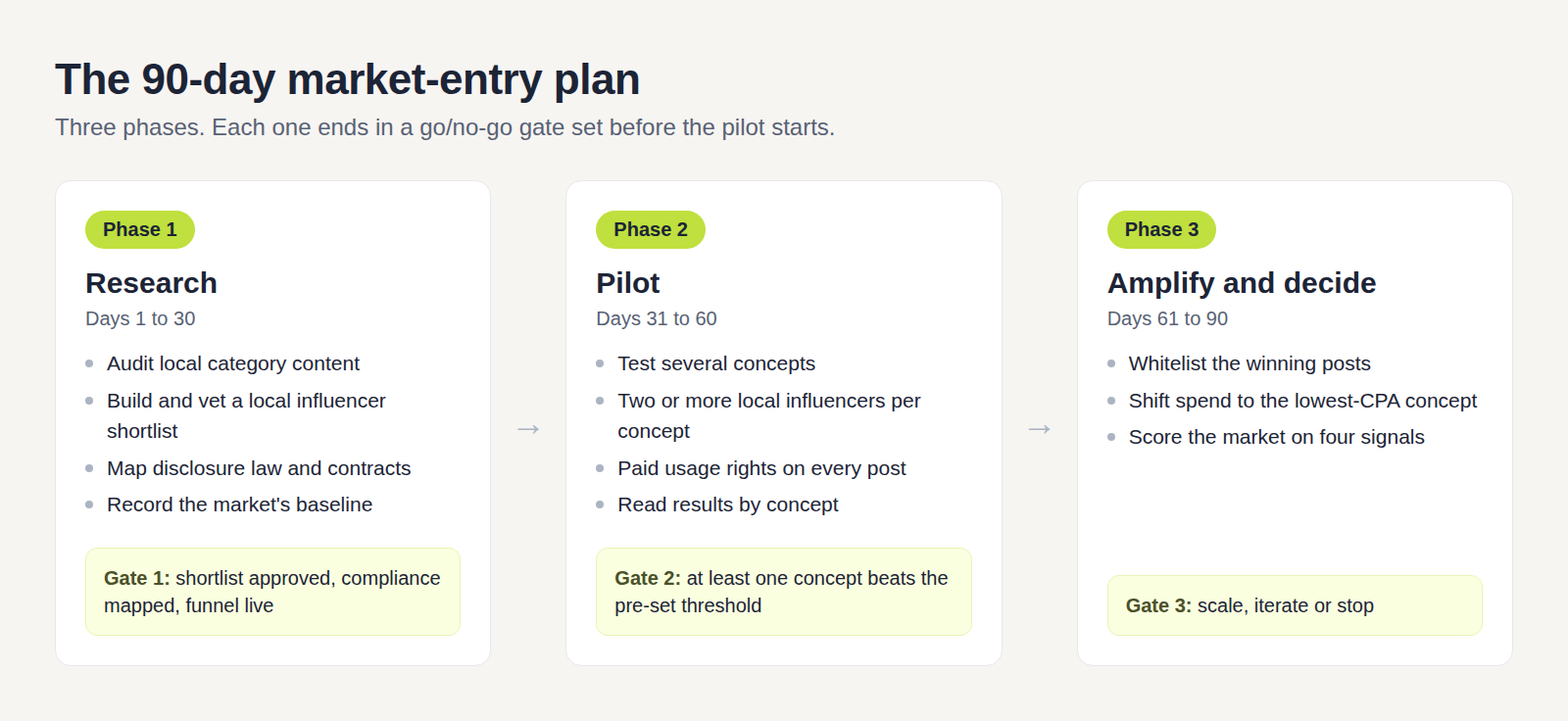
The 90-day plan runs in three 30-day phases: research, pilot and amplify. Each phase ends with a go/no-go gate that decides whether spend increases, holds or stops.
The sections below cover what happens inside each phase. The plan works because the gates are set before the pilot starts, so nobody is tempted to move them once results come in.
Days 1 to 30: How to Research the Market and Build a Local Influencer Shortlist
The first 30 days produce three things: a picture of how your category is talked about locally, a vetted shortlist of local influencers and a map of the rules you'll work under. No paid campaign content needs to go live yet.
How to Read Platform Usage and Content Norms by Country
Start with the local feed. Search your category in the local language on each major platform and log the 20 most-viewed recent posts: format, length, whether the creator shows their face, how the product appears and what the comments ask.
Content norms differ more than most teams expect. BURGA's head of brand partnerships told Modash that short-form video drives most engagement for the brand in Europe and the US, while clean static Instagram posts still perform strongly in Japan. A home-market brief would have missed that entirely.
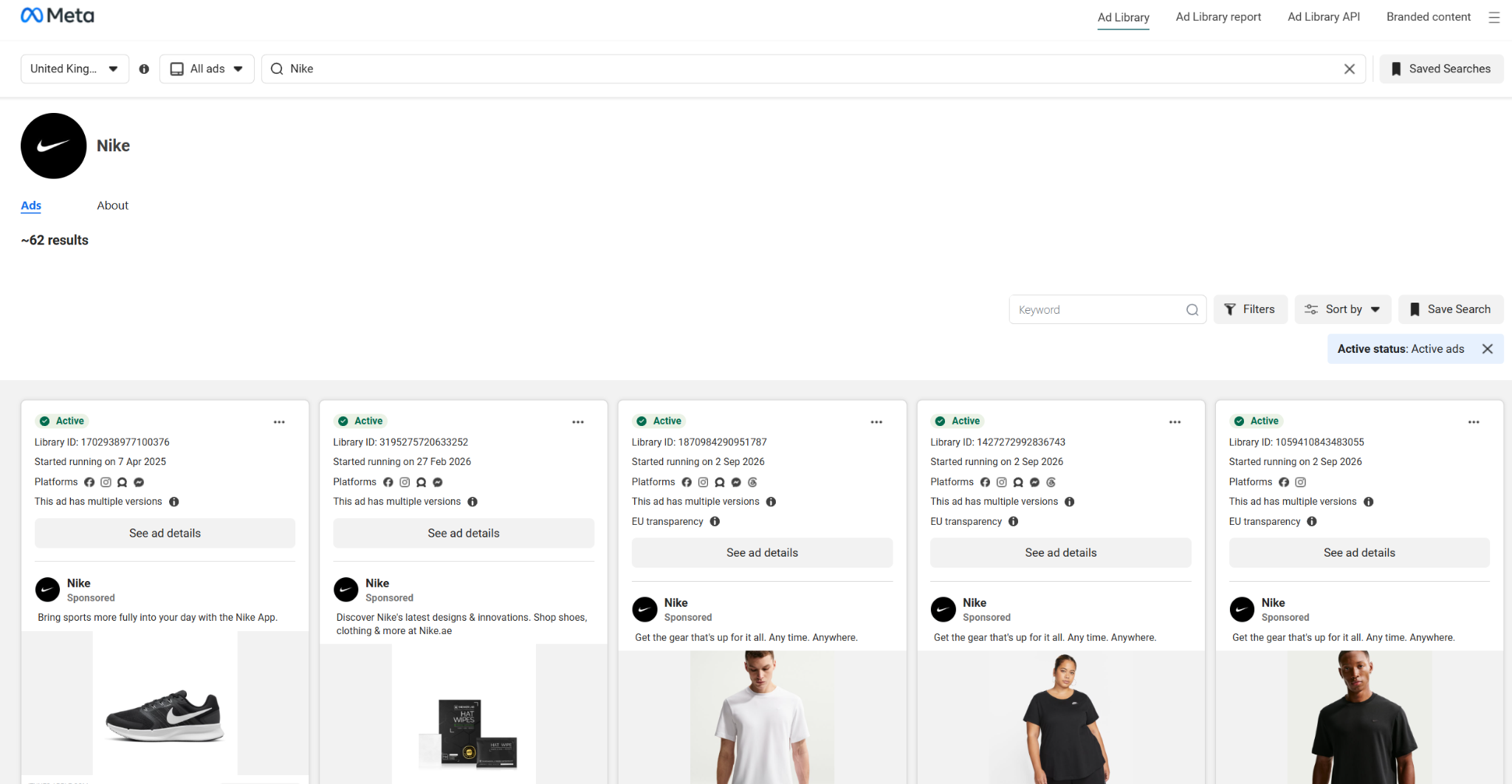
Then run a competitive analysis. Filter the Meta Ad Library by the new country and look at which competitors are running creator ads, which creators they use and which ads have run longest. An ad that's been live for months is usually an ad that's working.
How to Find Local Influencers in a New Country
Use three routes together and cross-check the results:
- Discovery platforms, filtered by audience country and language. Modash reports 40% of marketers use software for this, and it's the fastest way to build a long list.
- Local talent agencies and managers. They know who's trusted, who's overexposed and who's about to be caught in a controversy, which no database shows.
- Competitor and category ads. The creators competitors have already trusted with paid distribution in the Ad Library are proven converters in that market.
Finding the right people is the hardest part of the job: Modash's respondents named it their single biggest challenge in a new market, ahead of briefing and tracking. Start with micro-influencers, whose audiences tend to be concentrated in one country. Our guide on how to find micro-influencers covers the search mechanics.
How to Vet International Influencers for Audience Location and Brand Fit
Vet every local influencer on audience location first, because a creator with a large diaspora or English-speaking audience can look local and deliver almost no in-market reach. Check these before shortlisting:
- Pull the audience-country breakdown from their analytics or a discovery tool and set a minimum share in the target country before you look at anything else.
- Read the comments. Local-language comments from real accounts are a better signal than any follower count.
- Review their disclosure history. Creators who already label ads correctly will cost you less legal review time.
- Decide which brand-fit criteria are fixed and which can flex locally. Brand values stay fixed; tone, humor and on-camera style can adapt.
What Are the Influencer Marketing Laws and Disclosure Rules by Country?
Disclosure rules differ by country, and brands carry responsibility alongside the creator in most of them.
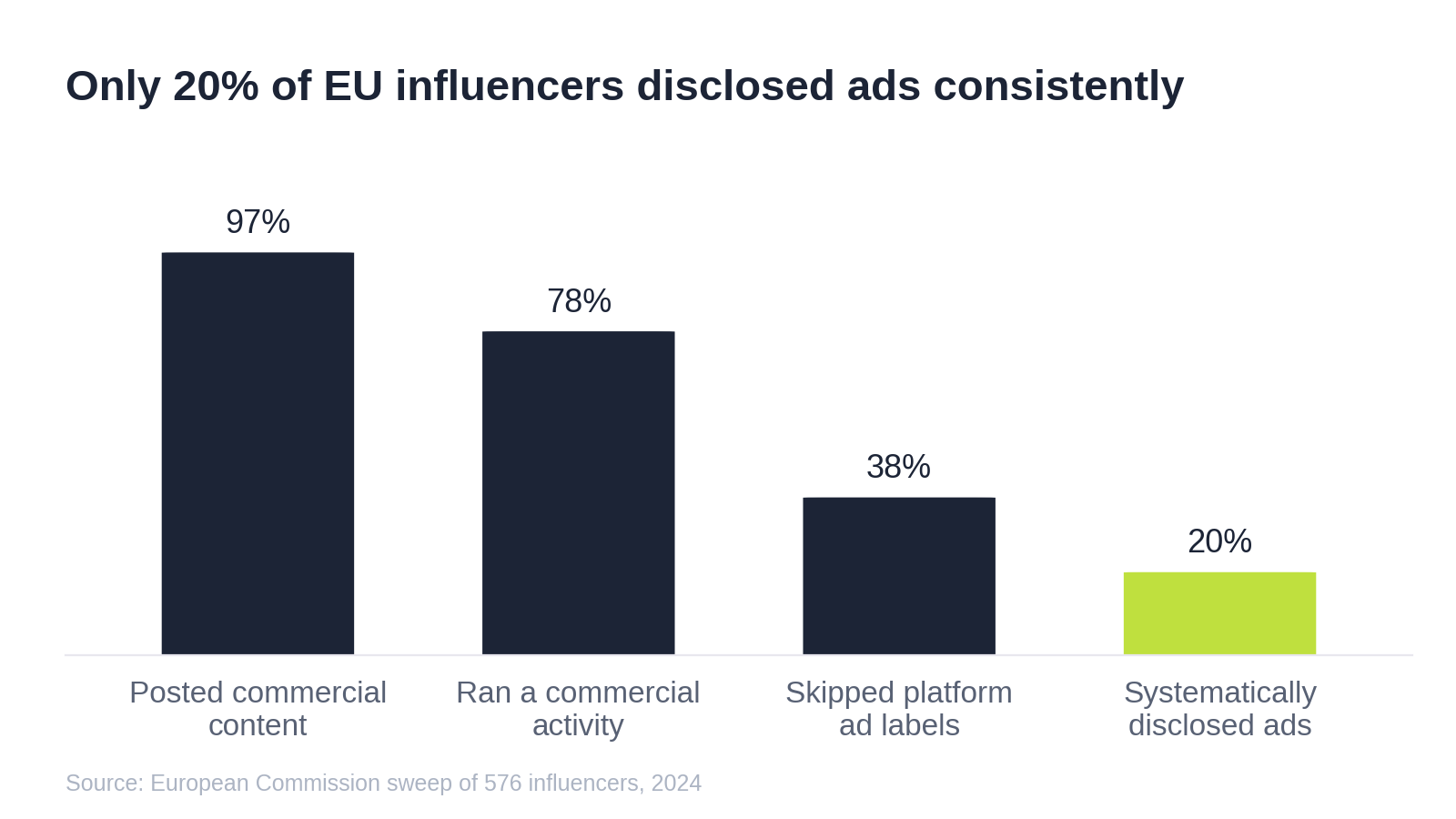
Enforcement is also catching up with a widespread compliance gap: a 2023 European Commission sweep of 576 influencers found 97% posted commercial content, but only 20% systematically disclosed it as advertising.
Put the disclosure wording for each market into the creator contract and check every post before you pay for it.
Gate 1 (Day 30): the shortlist is approved, the compliance map is signed off and every item in the pre-launch checklist is live. If the funnel isn't ready, move the pilot to a later start and keep its full size.
Days 31 to 60: How to Run a Market-Entry Pilot with Local Influencers
The pilot's job is to find which concepts work in this market, so structure it around concepts and read results by concept. A pilot that books ten creators with one shared brief tells you which creator did best, which isn't the question you need answered.
How Many Local Influencers a Market-Entry Pilot Needs
A market-entry pilot needs enough local influencers to test each concept through more than one voice. A market-entry pilot needs enough local influencers to test each concept through more than one voice. Test at least two creators per concept so one creator's personality doesn't decide the result.
Use this structure to size the pilot, then fill in the numbers from your budget and local rates:
Read results by concept at Day 60: engagement quality (saves, shares, local-language comments asking about the product), click-through to the local landing page and code or link sales.
How to Localize Influencer Briefs Beyond Translation
Localize the brief by changing what the product promises, how the story is told and when it's told. Translating the home-market brief word for word changes none of those.
For example, a skincare brand entering Japan might find that local buyers respond more strongly to ingredient quality and product texture than to the lifestyle angle used at home.
Adapt three things in every brief:
- The value proposition. Lead with the benefit this market cares about most, which your Days 1 to 30 content audit should already have surfaced.
- The format. Match the local norm you logged, whether that's long YouTube reviews, fast taste tests or static product shots.
- The calendar. Local holidays, seasons and shopping events. Southern-hemisphere summer falls in December, so an Australian festival push belongs then, whatever month it ran at home.
Then hand the creator room to adapt the script. Local influencers know how their audience talks better than a brand team abroad ever will.
How to Mix Micro and Macro Influencers in a New Market
Start the pilot with micro-influencers and add a larger name only after a concept has won. Micro-influencers give you more concepts tested per dollar, audiences concentrated in one country and content that reads as a genuine recommendation. A macro creator booked in Days 31 to 60 spends a large share of the budget on one untested message.
Once a concept has proven itself, one or two bigger creators can carry it to a wider audience.
How to Contract and Pay Influencers Across Borders
Contract for paid usage rights from the first post, because Days 61 to 90 depend on being able to run creator content as ads. Negotiating rights after a post has gone viral costs more and delays the paid test.
Three cross-border details trip up launches:
- Written contract rules. France now requires a written contract above its €1,000 threshold, and other markets have their own formal requirements. Use a local-law template.
- Payment in local currency through a platform that handles international transfers. Late or messy payments damage your reputation with local talent managers fast.
- Tax and invoicing. Confirm whether you need to withhold tax or collect a local invoice before the first payment goes out.
Gate 2 (Day 60): at least one concept beats the engagement-quality or cost threshold you set before the pilot. If none does, go back to the content audit and brief a second round before spending on media.
Days 61 to 90: How to Amplify Winning Creator Content with Paid Media and Decide Whether to Scale
The final 30 days put paid media behind the concepts that won the pilot. Organic results show that a message resonates; paid results show whether it can acquire customers at a cost the market can sustain.
How to Run Creator Whitelisting in a New Country
Run creator whitelisting by getting the creator's permission to advertise through their handle, then launching the ad from your own account in the new market. On Meta, the creator shares a partnership ad code and the ad runs with both accounts in the header.
Meta's own documentation says partnership ads use signals from both accounts for ranking.
Follow this order:
- Collect partnership codes or permissions for every winning post, and log which code belongs to which asset.
- Launch the winners as dark posts to a broad audience in the new country, so you can test variations without cluttering the creator's feed. Our guide to dark posting walks through the setup.
- Split spend evenly across the winning concepts for the first week so each gets a fair read.
- Move budget toward the concept with the lowest cost per acquisition and cut the rest.
Go/No-Go Scorecard for Scaling Influencer Marketing After 90 Days
Score the market at Day 90 on four signals and let the pattern decide the next step:
A market that hasn't produced a single winning concept by Day 60 should pause spend before a full launch, even if leadership wants a bigger push. More money behind unproven creative buys reach without learning, and that's the most expensive way to find out the brief was wrong.
What Scaling Looks Like After Day 90
Scaling after Day 90 means turning the pilot's winners into a system. Move the best-performing local influencers onto longer retainers, keep a steady flow of new creator content feeding paid media to stay ahead of ad fatigue and brief new creators on the proven concepts.
Once that system runs smoothly in one market, the same three-phase plan becomes your template for the next country.
How to Measure Influencer Marketing in a Market With No Brand Baseline
Measure a new-market launch against the market's own starting point, recorded in Days 1 to 30 before anything is published. Home-market benchmarks don't transfer: engagement norms, click-through rates and acquisition costs all differ by country, so the right comparison is this market in week one against this market in week twelve.
Record these baselines before the first post goes live, then track them through Day 90:
Direct attribution will undercount creator impact, because many people see a post and buy later through search. That's why branded search and geo holdouts sit alongside codes.
How Much to Budget for Influencer Marketing in a New Country
Budget for a new-market launch by phase, with a paid media reserve set aside before the pilot starts. The total depends on local creator rates, which vary widely by country and are usually unknown until Days 1 to 30, so build the budget as a structure first and fill in the numbers once your shortlist returns quotes. For per-creator rates, see what content creators cost.
A useful check: if the paid reserve is smaller than the creator budget, the plan can find winners but can't prove they scale.
Hold contingency against currency fluctuation risk as well, since creator fees and ad spend are usually paid in local currency while your budget is set in your home currency.
Pro tip: If product seeding makes up a large part of your plan, our product sampling team handles cross-border shipping and creator selection together.
Agency, Local Freelancer, or In-House: Who Should Run a New-Market Influencer Launch?
A local freelancer suits a bottom-up test, an agency suits a committed top-down launch, and an in-house team suits a market you already know you'll keep. One practitioner put it plainly to Modash: if the launch is a test and not a companywide objective, hire a local freelancer, because agencies are expensive.
If Germany is the market, our shortlist of influencer marketing agencies in Germany compares German-office agencies with multi-country partners.
Whichever you choose, agree on time zones and approval windows before Day 31. A brief that waits two days for sign-off in another time zone can cost a creator's posting slot.
Common Mistakes When Launching Influencer Marketing Internationally
The four mistakes to watch for are testing too many variables at once, choosing creators before understanding local positioning, chasing low creator rates and over-editing local scripts. Each one is avoidable with a decision made before Day 31.
By the time a new-market campaign reaches the pilot stage, the biggest risks usually come from how the test is designed. A weak pilot can produce plenty of content while teaching you very little about the market.
Testing Too Many Variables at Once
If every creator gets a different concept, format, offer and call to action, strong results become difficult to explain. Keep enough variables consistent that you can tell whether the concept, creator or execution drove the outcome. The goal of the first pilot is learning, rather than maximum creative variety.
Choosing Creators Before Understanding Local Positioning
A creator can match your demographic target and still be wrong for the way the category works locally. Research the conversations, objections and buying cues in the market first, then recruit creators who naturally fit that context. Otherwise, the shortlist ends up shaping the strategy instead of supporting it.
Confusing Low Creator Rates With Low Acquisition Costs
Cheap creator fees can make a market look attractive before performance data exists. A higher-priced creator whose content earns stronger paid performance may ultimately produce customers more efficiently. Compare markets on what it costs to create and distribute content that converts, rather than creator fees alone.
Over-Editing Local Creator Scripts
Headquarters often tries to protect brand consistency by pulling local content back toward the home-market voice. That can erase the language, references and delivery style you hired local creators for in the first place. Keep claims, brand rules and mandatory messaging fixed, while giving creators room to adapt everything around them.
Launch Your Next Market with inBeat
A new country rewards the brands that listen first and spend second. The 90-day plan above works because each phase answers one question before the next phase spends money: how the market talks, which messages land and whether those messages can acquire customers at scale.
We run that sequence end to end. Our team researches the local feed, recruits and vets local influencers, briefs concepts for the market and puts paid media behind the posts that earn it, with measurement set against the market's own baseline from day one.
If you're planning a launch in the next two quarters, book a strategy call. We'll review your target market, your pre-launch checklist and a draft 90-day budget with you.
FAQs
Should you use home-market creators with global audiences or only local influencers?
Use local influencers for the pilot and treat global creators as a later add-on. Global creators rarely deliver concentrated reach in one country, and their audience data usually confirms it. They can help once a local concept has proven itself and you want broader reach.
Can you dub or AI-translate proven creator content in place of reshooting it?
Dubbed or translated content works best as a paid media test, and poorly as the core of a launch. It keeps the home-market creator's framing, references and on-camera style, which is exactly what local audiences notice. Test one dubbed version against local creator content in Days 61 to 90 and let cost per acquisition decide.
How do you run creator whitelisting when the brand has no local legal entity?
You usually don't need a local entity to run partnership ads, but you do need an ad account that can bill and target the new country. Check the platform's advertiser requirements for that market in Days 1 to 30, and confirm local tax obligations on ad spend with your accountant.
Does the 90-day plan change for marketplace-first launches?
The phases stay the same, but the call to action and measurement change. Creators send traffic to a marketplace listing, so your baseline and tracking shift to marketplace data such as listing views and sales in that country, and your pre-launch checklist must include local-language listings with reviews.
How do you price local influencers without local rate benchmarks?
Ask your shortlist for quotes during Days 1 to 30 and compare them against each other. Five or more quotes from creators of similar size give you a working local range, and a local talent agency can tell you which quotes are outliers.