

More brands are running influencer campaigns across ten, fifteen, or thirty markets at once, and most find that a strategy built for one market doesn't simply multiply. Creator sourcing, disclosure rules, and what resonates in a feed all shift by country.
This guide covers what changes when influencer marketing goes global, and a process for campaigns that hold up across markets.
P.S. If you'd rather bring in a partner who's solved this, our influencer marketing agency runs multi-market campaigns for brands like HelloFresh and NielsenIQ.

One thing before our deep dive. We run creative, media, and measurement as one system, a view that matters most when a campaign crosses into a new market. Cross-market rollouts become harder to manage when local creative production, approvals, and reporting develop at different speeds. Plan those capabilities alongside media spend. The real bottleneck is supply: native creative, sourced and tested locally, feeding one measurement system fast enough to keep up.
What Is Global Influencer Marketing?
Global influencer marketing is the practice of running influencer campaigns across multiple countries under one strategy, using local creators, languages, and platform habits to execute it.
A global program usually includes:
- A shared campaign objective and brand positioning
- Market-specific audience and creator criteria
- Central brand, legal, and reporting standards
- Localized briefs and content
- Contracts and usage rights covering the intended markets and channels
- A measurement system that separates global performance from local results
The defining feature is coordination.
A global program has a shared goal, a shared measurement framework, and a shared creative direction. The creators, content, and media plans underneath that shared structure still get built market by market, because that's where the actual performance gets made or lost.
In our work with HelloFresh, that meant one dark-posting and creative-testing system covering 17 countries and 100+ local creators, run as a single program instead of 17 separate country teams each inventing their own process.
When Does a Brand Need a Global Influencer Marketing Strategy?
A brand needs a dedicated global strategy once influencer work shifts from a single campaign to an operating problem. The clearest signals:
- Multiple country teams are already running influencer campaigns independently, with no shared creator vetting, reporting format, or brief, and leadership can't compare performance across markets.
- The brand is entering two or more new markets in the same planning cycle and needs a repeatable launch process. A fresh plan for each country wouldn’t be realistic.
- A single-market program is working, and the obvious next step is expansion, but the team has no framework for choosing the next market or adapting the creative that worked.
- Category competitors are already running localized creator content in target markets, and a one-size-fits-all approach is losing share of voice there.
Five country teams running five vendor lists and five reporting formats is a common starting point. Brands that wait until that fragmentation is visible usually spend their first quarter of any global program just untangling what already exists before they can improve it.
Global vs. Local Influencer Marketing: What's the Difference?
Local influencer marketing optimizes one market's creators, language, and platform mix for one audience. Global influencer marketing optimizes a shared strategy, budget, and measurement system across many markets at once, while each market still executes locally underneath it.
Scale isn't the deciding factor; the number of countries matters more than campaign size. As such, a large campaign confined to one country is local, while a small pilot spanning five countries requires cross-market coordination.
| Local influencer marketing | Global influencer marketing | |
|---|---|---|
| Creator sourcing | Sourced and vetted for one market | Market-specific audience profiles, evaluated against shared vetting criteria |
| Brief | Built for a single audience and platform mix | A fixed spine (claim, compliance, KPI) with local flex points |
| Compliance | One country's disclosure and contract rules | Shared compliance standards, with market-specific legal review and disclosure requirements |
| Measurement | Platform-reported metrics are usually enough | Market-level reporting, with measurement methods matched to the campaign objective |
| Budget owner | Usually one regional or brand marketer | Usually a global lead allocating across regional pools |
Neither approach wins by default.
- A brand with one flagship market and a few opportunistic ones should stay local and add markets one at a time.
- A brand already competing with real budget in ten-plus markets needs the global structure, or it keeps re-solving the same sourcing and compliance problems in every new country.
WARNING: This distinction also affects compliance. The U.S. Federal Trade Commission states that disclosure requirements may apply to creators posting from abroad when their content can reasonably be expected to affect U.S. consumers. At the same time, campaigns targeting European markets must account for EU consumer protection standards and relevant national requirements. A single global disclosure line may therefore be insufficient across every market.
Why Global Influencer Campaigns Often Underperform
Global influencer campaigns tend to underperform for one root reason: the brand scales the media plan before it scales the creative supply and the measurement system underneath it.
A campaign built and tested in one home market gets translated, localized in name only, and pushed into new markets with the same creators, hooks, and cadence that worked at home. Performance drops, and the team concludes the market itself is weak. The real explanation is usually simpler: a translated ad is running in a market it was never actually tested in.
The next section breaks down the specific operational challenges behind that pattern. The section after it walks through a process for avoiding it.
ClearScore ran into a milder version of this same pattern when scaling into the UK, Canada, and Australia.
That’s why we built their approach around locally-led creator content instead of a single exported campaign, like so:
Once that shift happened, the program brought overall cost per sign-up down 27% month over month, with the winning creator content capturing 70% of ad spend versus every other creative in rotation and posting a 33% thumbstop rate.
The Main Challenges of Running Influencer Campaigns Across Markets
Most of these challenges show up as symptoms long before anyone names the root cause: a market underperforming for no clear reason, a legal team flagging a live campaign, or a finance team unable to compare CAC across regions. Five problems account for most of it.
Cultural Relevance and Local Buying Behavior
A message that reads as confident in one market can read as arrogant in another, and a format that feels native on one platform can feel like an obvious ad the moment it crosses a border. Buying behavior compounds this: a five-second hook that wins in a fast-scroll market can undersell a product where longer-form, review-style content is what actually drives the purchase decision.
The most common mistake here is treating creative localization as a translation step. It's a re-creation step, and skipping that distinction is the single biggest source of underperformance on this list.
Is translation always wrong, though?
No. Decide whether each asset needs subtitles, dubbing, a revised script, or a new shoot. Base that choice on whether the original demonstration, offer, and cultural references remain relevant in the target market.
Finding Creators With Real Local Influence
Follower count travels across borders; actual influence over a local audience's purchase decisions doesn't. A creator with a large global following built on one platform's algorithm in one market can carry negligible pull with a different audience elsewhere.
Vetting for that requires local platform fluency, and an audience-demographics filter alone won't catch it. Our guide to finding micro-influencers covers the vetting criteria that matter most; at global scale, those criteria need a local reviewer applying them in each market.
Language, Messaging, and Brand Consistency
Consumers don't just prefer content in their own language; they buy differently because of it. CSA Research surveyed 8,709 consumers across 29 countries and found that 76% prefer to buy products with information in their native language, and 40% say they'll never buy from a site in a language they don't speak.
That preference extends to how a claim gets worded locally. A literal translation of a global tagline is rarely the version that actually persuades in a given market, which is why the brief needs a fixed claim with room for local wording, built for that market from the start.
Disclosure Rules, Contracts, and Usage Rights
Every market a brand enters has its own rules for how a creator must disclose a paid relationship, and the FTC's requirements in the US are only one version of this. Getting it wrong carries real exposure: FTC civil penalties for undisclosed endorsements can run over $50,000 per violation, and the agency's 2024 Consumer Reviews and Testimonials Rule extended enforcement to fake reviews and undisclosed AI-generated endorsements.
Our FTC guidelines for influencers covers the US requirements in detail.
A global program needs that same review repeated market by market, plus a usage-rights agreement that names which specific markets and channels each piece of content is cleared for, since a license covering one country's paid social account won't automatically extend to another's.
Managing Timelines, Approvals, and Payments at Scale
A single-market campaign might run on one approval chain and one payment method. A twenty-market program spans twenty time zones, several currencies, local tax and invoicing requirements, and creators who expect payment on their own market's norms.
Coordination overhead grows faster than the campaigns themselves without a centralized system for contracts, approvals, and payments, and the brand ends up spending more time managing logistics than reviewing creative.
How to Build a Global Influencer Marketing Strategy
Build your global influencer marketing strategy around six decisions: the campaign’s role, market-level targets, launch priorities, creator selection, briefing, and production. Agree on these before outreach so creators receive a brief that reflects what each market needs.
The examples below follow a hypothetical skincare brand expanding into two markets. They illustrate planning decisions, not reported campaign results.
1. Define the Campaign’s Role in Your Broader Marketing Strategy
Decide what influencer marketing needs to accomplish in each market and how other channels will support it.
- Awareness and category entry: creators introduce the product, demonstrate its use, and give unfamiliar audiences a reason to investigate.
- Performance and acquisition: creator content supplies concepts and assets for paid social testing.
- Trust-building: detailed demonstrations and honest reviews help buyers evaluate the product and understand whether it suits their needs.
For our skincare brand, existing demand in Market A could justify testing creator ads for customer acquisition. In Market B, where customers are unfamiliar with the product, the first campaign might focus on demonstrations that answer common purchase questions.
Write the role as a short brief: who needs to do what, after seeing which content, and where they should go next. For Market B, that could mean helping first-time buyers understand when to use the product, then directing them to a localized product page with instructions and delivery information.
2. Set Global Goals and Market-Level KPIs
Set a shared business objective, then assign targets that reflect each market’s campaign role and starting point. Use consistent metric definitions so the global report remains comparable.
Before launch, document:
- The conversion or audience action being measured.
- The baseline and target for each market.
- The reporting source and attribution window.
- The costs included in acquisition calculations.
- The reporting period and currency-conversion method.
Suppose the skincare brand wants to acquire new customers efficiently. Market A already has reliable acquisition data, so its target can reference the existing customer acquisition cost. Market B needs an initial test to establish a baseline before the team commits to a scale target.
If Market B begins with educational content, track its awareness or consideration objective separately. Do not present video views as evidence that the acquisition goal has been achieved.
3. Prioritize Markets Based on Opportunity and Launch Readiness
Evaluate demand alongside the practical requirements for serving customers and producing local content. Product availability, delivery, localized landing pages, creator supply, and approval requirements all affect whether a market is ready for investment.
A simple launch comparison might look like this:
| Planning question | Market A | Market B |
|---|---|---|
| Is there evidence of demand? | Existing customer orders and relevant search activity | Early interest, with limited purchase data |
| Can customers buy easily? | Localized checkout and established delivery | Checkout ready; delivery arrangements still being finalized |
| Is suitable creator content available? | Several relevant creators shortlisted | Local sourcing still underway |
| Are product claims and briefs approved? | Local review completed | Review pending |
| Next action | Run a controlled acquisition pilot | Complete launch requirements and validate demand |
In this example, Market A receives the first acquisition test. Market B gets a preparation plan with named owners and deadlines.
Keep the decision record alongside your prioritization matrix. Reassess a market when its constraints change, such as a new distribution agreement or a completed local review.

4. Choose the Right Creator Mix for Each Market
Select creators for their audience relevance, content capabilities, and role in the campaign. Follower tier helps describe the shortlist, but it does not establish local influence or creative quality.
For each candidate, review:
- Audience location: whether the audience is concentrated in the intended market.
- Language and interaction: whether comments suggest meaningful engagement from the target audience.
- Category relevance: whether the creator regularly covers the product category and answers useful questions.
- Production capability: whether they can deliver the demonstrations, reviews, or short-form variations the campaign needs.
- Commercial fit: fees, availability, deliverables, and rights for the intended channels and territories.
For the skincare pilot, the shortlist could include a routine-focused micro-influencer who explains product use clearly and a creator experienced in producing concise product demonstrations. A larger creator might earn a place when their relevant local reach supports the awareness objective.
Commission a small initial batch and evaluate the work before expanding the roster. Keep creator selection criteria consistent while allowing the mix to vary by market.
5. Build a Global Brief That Allows for Local Relevance
Give creators a shared product message and specify which execution decisions belong to local teams. Separate the elements that require brand approval from those creators can adapt.
For the hypothetical skincare campaign, a completed brief might include:
| Brief element | Shared requirement | Local adaptation |
|---|---|---|
| Product message | Demonstrate where the product fits in a routine; use approved claims | Explain the routine in the creator’s natural language |
| Demonstration | Show application and packaging clearly | Choose a setting and filming style familiar to the audience |
| Hook | Introduce a relevant product-use question | Select the question using local customer feedback |
| Offer and CTA | Use the approved offer and destination for that market | State local pricing, availability, and delivery details |
| Measurement | Apply shared event definitions and tracking conventions | Use the market’s assigned objective and target |
| Compliance | Follow brand standards and complete local review | Apply the required disclosure wording and placement |
If Market A’s customer feedback centers on application order, the creator could open by demonstrating where the product belongs in a routine. If Market B’s feedback centers on texture, the creator could start with a close-up demonstration.
Those differences should come from research or testing. Avoid assigning creative angles based on broad assumptions about a country’s culture.

6. Plan Content Production, Review, and Localization
Define the approval process before creators start production. Each deliverable needs an owner, a reviewer, a deadline, and a clear record of its usage rights.
- Review concepts locally. Check the hook, wording, offer, and planned demonstration for relevance and compliance.
- Approve claims before filming. Resolve product-claim questions while changes are still inexpensive.
- Choose the localization method. Decide whether the asset needs subtitles, dubbing, a revised script, or a new shoot.
- Review the finished asset. Confirm that the delivered content matches the approved concept and includes the required disclosures.
- Log the approved version. Record its market, language, creator, channels, rights expiry, and approval status.
- Assign an escalation owner. Give local reviewers a named contact for conflicts involving claims, brand guidelines, or cultural context.
For example, close-up application footage might remain useful across both skincare markets, while the opening line, voiceover, and offer screen change. If the demonstration itself depends on a routine unfamiliar to the new audience, commission a revised version.
Record that decision before approving reuse, and confirm that the creator’s agreement covers the intended adaptation and distribution.
How to Measure Global Influencer Marketing Performance
Measurement has to answer two different questions at once: is each market hitting its own goal, and is the global program working as a whole. Conflating the two produces reports that satisfy neither audience.
Measuring Global Influencer Awareness Campaigns
For awareness-stage goals, track reach, video completion rate, and branded search lift by market, and always alongside the aggregate. A global reach number can mask a market where the campaign barely moved brand awareness, simply because a much larger market's numbers are carrying the average.
Measuring Consideration and Engagement for Global Influencers
Engagement rate benchmarks vary by platform and by market. Compare each market's creators against a local benchmark, since a 3% engagement rate can be strong in one market's platform mix and weak in another's.
Measuring Conversions, CAC, and Revenue in Influencer Campaigns
Track CAC and revenue per market in local currency first, then normalize to a shared reporting currency for the global roll-up. Our customer acquisition cost breakdown and influencer marketing ROI guide cover the underlying calculations.
At global scale, the main addition is a consistent exchange-rate methodology, a fixed rate per reporting period is usually cleaner than a floating daily one, so month-over-month comparisons aren't distorted by currency swings that have nothing to do with campaign performance.
How to Compare Performance Fairly Across Markets
Comparing raw CPA or ROAS across markets punishes regions with structurally higher media costs or lower baseline conversion rates. Compare each market against its own baseline, its CPA before the campaign, its own prior quarter, and against the market-level KPI set in step 2 of the strategy above.
Attribution Challenges in Global Influencer Campaigns
Attribution gets harder at global scale, with more platforms, more currencies, and more markets where third-party cookie loss and walled-garden reporting already made single-touch attribution unreliable. Nielsen's 2025 Annual Marketing Report found that 85% of marketers are confident they measure ROI holistically, but only 32% actually do cross-channel measurement well enough to back that up.
Our marketing measurement services build the attribution and reporting layer that closes that gap, combining platform data with incrementality reads so a market's real contribution doesn't get lost in reporting noise.
How Influencer Marketing Works With Other Growth Channels
Influencer content earns its budget fastest when it feeds other channels, and living only as an organic post is the slowest way to get value from it.
Use Creator Content in Paid Social Campaigns
Dark posting, running a creator's content as a paid ad without publishing it organically first, is the fastest way to test hooks, angles, and creators against real spend before committing a media budget to any one asset. Our breakdown of dark posting covers the testing structure in more detail. Across markets, the same test-then-scale logic applies per market, since a hook that wins one country's dark-post test can still lose in another's.
Whitelisting and Creator Licensing Across Markets
Whitelisting, running paid ads directly through a creator's handle, extends reach beyond a creator's own following while keeping their name and trust attached to the ad.
Meta reports that adding partnership ads to standard campaigns produces on average 19% lower CPAs and 13% higher click-through rates than brand-account ads alone.
At global scale, whitelisting agreements need to specify which markets and ad accounts the license covers. A creator agreement cleared for whitelisting in one country doesn't extend automatically to another, so the contracts section below treats this as a named clause.
Leverage Influencer Content for Performance Creative Testing
Treat creator content as a supply of testable creative variables. The same underlying product claim, tested across several creators' natural styles and several markets' cultural framings, produces a structured signal a single hero ad never could, and it's the fastest way to learn which specific angle a new market responds to before scaling spend behind it.
Support SEO With Influencer Campaigns
Creator content that lives beyond the paid flight (like YouTube reviews, blog mentions, embedded social posts), builds backlinks and branded search volume that support organic visibility in a new market, especially where the brand has no existing organic footprint yet.
That benefit compounds over time in ways paid media alone doesn't, which makes it a reason to keep the content living well past the flight, but a poor justification for launching the campaign on its own.
Repurpose Creator Content for Product Pages, Email, and Organic Social
Every piece of licensed creator content should have a second and third life:
- Product pages: real usage footage next to the specs improves conversion, particularly where trust in the brand is still being built.
- Email and lifecycle flows: creator content performs as social proof in welcome and post-purchase sequences.
- Organic social: content that wasn't the top paid performer tends to still work organically, where the bar for authenticity is lower than for a scaled paid ad.
Paid Amplification: How to Extend the Life of Global Creator Content
The content that wins a market's initial test rarely stays fresh for the campaign's full run. Plan a refresh cadence per market from the start, and brief the next round around the winning creative's underlying angle.
That way, the market keeps building on what worked instead of retiring it wholesale, since waiting for performance to visibly decay before sourcing new creative means the market has already started losing efficiency.
What Global Brands Should Include in Influencer Contracts
A global influencer contract needs several clauses that a single-market agreement often skips entirely:
- Territory and market scope: exactly which countries the content and any paid usage rights apply to, named explicitly instead of assumed as worldwide.
- Usage rights duration and channels: how long the brand can run the content, and in which paid and organic channels, per market if rights differ by region. Our UGC usage rights guide covers the base structure this should follow.
- Whitelisting and ad account access: whether the creator grants paid-ad access through their handle, and in which specific markets that access applies.
- Disclosure requirements by market: the specific disclosure language required in each jurisdiction the content runs in, distinct from a single generic disclosure line.
- Payment terms and currency: payment currency, timing, and method, matched to creator expectations in their own market.
- Exclusivity scope: whether an exclusivity clause applies globally or only in the markets where the creator is actually active.
Brands that reuse a single-market contract template globally usually discover the gap when a creator's content needs to run in a second market it was never cleared for. Re-negotiating after the fact almost always costs more than specifying it upfront.
How to Choose a Global Influencer Marketing Agency
A few checks separate an agency that can genuinely run a global program from one that will manage it market by market with no shared system underneath:
- Ask how they source and vet creators locally. A global network with no local vetting process runs straight into the mismatched-influence problem covered above.
- Ask to see a real cross-market reporting example. A single-market case study doesn't answer this. If they can't produce a report that rolls several markets into one comparable view, they haven't actually run one.
- Ask how they handle disclosure and contract compliance per market, with specifics. A general compliance statement isn’t good enough here.
- Ask whether creative testing and paid amplification sit with the same team, or get handed off between separate creative and media vendors. That handoff is usually where global campaigns lose the most time.
- Ask for a named example of a campaign scaled across at least three markets, with the market-level results included alongside the global aggregate.
Common Mistakes Brands Make When Scaling Influencer Marketing Internationally
- Translating a home-market campaign instead of rebuilding it locally. Subtitles and dubbed voiceover rarely count as localization.
- Using one global creator brief with no local flex points, which produces content that reads as foreign everywhere it runs.
- Comparing markets on raw CPA or ROAS, when each market's own baseline and local KPI is the fairer measuring stick.
- Treating disclosure compliance as a single US-centric checklist, when every market carries its own rules.
- Centralizing every approval through one global team, turning a five-market program into a bottleneck.
- Committing to a large market before a smaller, lower-complexity one has proven the model.
Build Global Influencer Campaigns That Perform Locally with inBeat
Scaling influencer marketing across markets works when creative, media, and measurement stay connected as campaigns move from one country to the next, instead of getting handed off between a creative vendor here and a media buyer there.
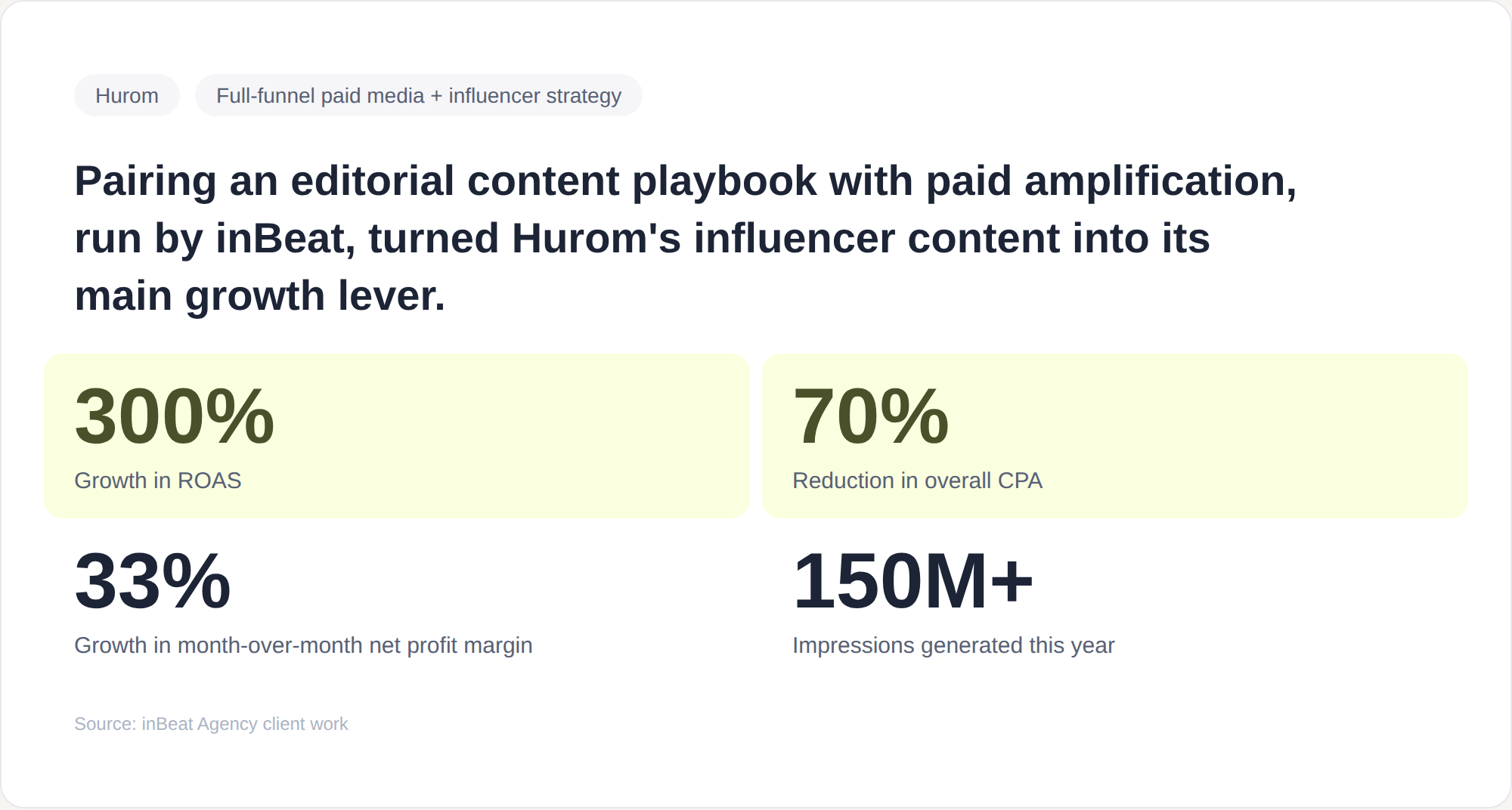
That's the system we run for clients like Hurom, where pairing an editorial content playbook with paid amplification drove 300% ROAS growth and a 70% reduction in overall CPA, and NielsenIQ, where a global panelist-acquisition program now runs across 17+ countries and 20+ languages.
If your team is planning a multi-market rollout and wants a partner who handles creator sourcing, paid amplification, and cross-market measurement as one system, book a free strategy call. We'll walk through your target markets and where the fastest wins actually are.
Frequently Asked Questions
What is a global influencer marketing strategy?
A global influencer marketing strategy coordinates creator campaigns across multiple markets while allowing room for local audiences, languages, and buying habits. It defines the role of social media, creator selection, content production, influencer cooperation, paid distribution, and measurement within the broader marketing plan.
How can influencer marketing support brand building across markets?
Influencer marketing can increase brand visibility, shape brand preference, and introduce a product through trusted local voices. Over time, repeated exposure can also support word of mouth marketing and make the brand more familiar to audiences who may not respond to traditional advertising.
How should brands choose creators for international campaigns?
Start with influencer research rather than follower count alone. Evaluate audience location, engagement quality, content style, purchasing decisions, and previous partnerships. A global program may combine established creators with nano influencers when smaller accounts offer stronger local trust or more relevant communities.
What is a full-funnel creator strategy?
A full-funnel creator strategy uses different types of content at different stages of the customer journey. Some creators build awareness and audience participation, while others explain the product, answer objections, or produce content to conversion that can support paid social media marketing and sales.
How can brands adapt creator content for different countries?
Create a shared strategic framework, then adapt the execution to each market. Language, references, product benefits, offers, product placements, and calls to action may need to change. The central brand message should remain consistent, but local creators should retain enough freedom to make the content feel natural.
How should brands measure global creator campaigns?
Measure each market against its objective. Awareness campaigns may focus on reach, video completion rate, view-through rate, brand searches, and earned media value. Performance campaigns may focus on clicks, conversion rate, customer acquisition cost, revenue, and the contribution of creator content to social commerce.
Can one creator asset be used in several international markets?
Yes, if the content remains culturally relevant and the usage rights cover the intended countries, platforms, duration, and paid media placements. Brands may adapt subtitles, voiceovers, offers, or landing pages. Refilming is usually better when the product, setting, or original message does not transfer naturally.
How can brands connect influencer marketing with social commerce?
Creator content can move audiences from discovery to purchase by combining product demonstrations, clear explanations, social proof, and direct shopping paths. Product links, creator codes, shoppable videos, and retargeting can help connect content performance with purchasing decisions and measurable revenue.