

A creator's post performs better than expected. The brand wants to turn it into a paid ad. There's just one problem: the contract only covers organic publishing.
Suddenly, getting more value from a successful collaboration requires another round of negotiations.
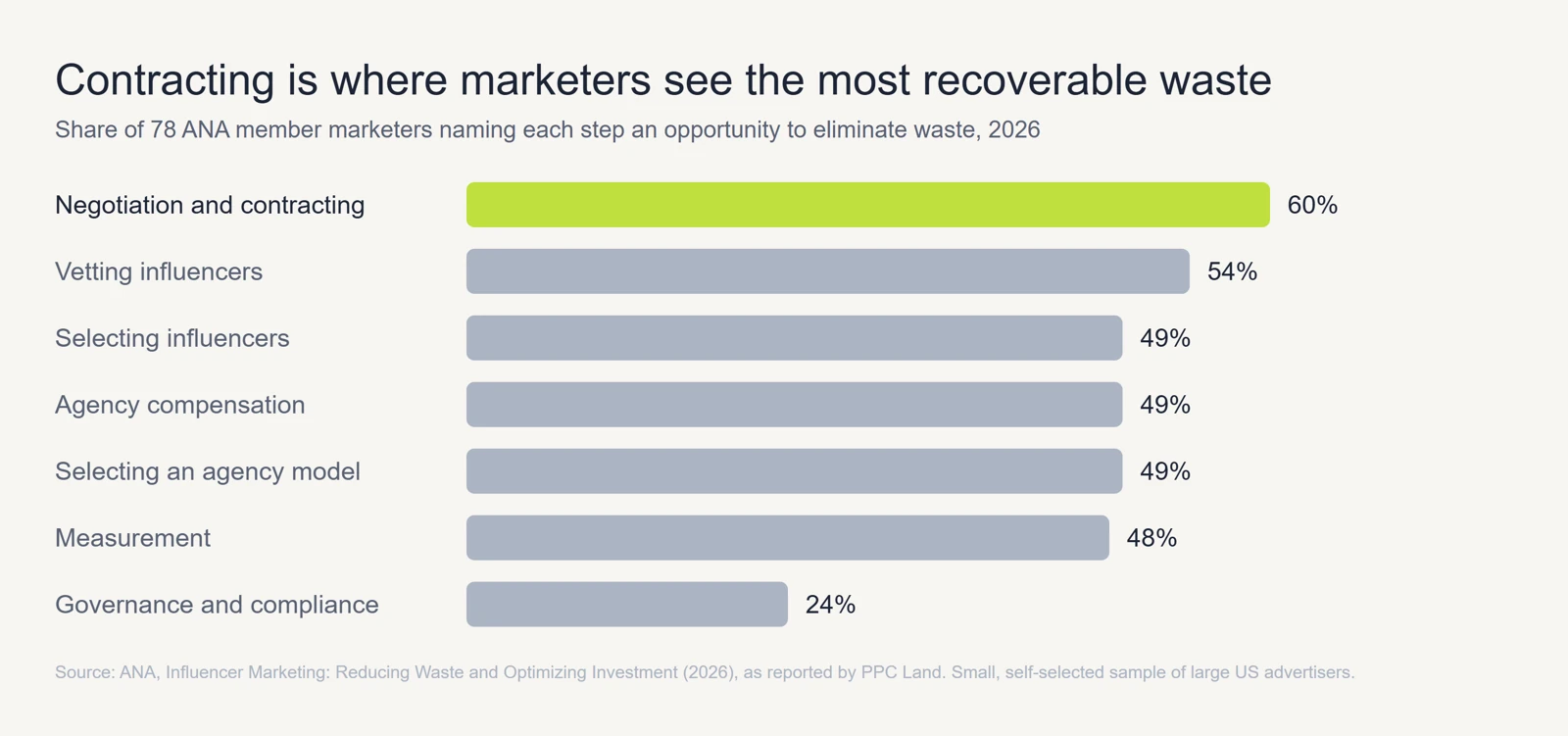
It's an expensive time to discover a missing clause. According to the Association of National Advertisers' 2026 study, 60% of client-side marketers identified negotiation and contracting as the top opportunity to reduce influencer marketing waste.
A well-written influencer contract addresses these issues before launch. Here's what to include, which terms deserve extra attention, and what to watch for before signing.
TL;DR
- An influencer contract is the written agreement that fixes deliverables, payment, content rights, disclosure duties, and exit terms between a brand and a creator.
- Use a signed written agreement for paid creator deals, especially those involving advertising rights or exclusivity. Gifting and self-serve programs may use shorter terms, but disclosure and any promised deliverables still need clarity.
- Nine core areas deserve attention: usage rights, payment, deliverables, exclusivity, disclosure, contractor classification, reporting, termination, and AI.
- Paid-content permissions, defined deliverables, and workable remedies deserve particular care.
- Use the influencer contract example below to see the terms in context, then scan the draft for vague deliverables, unnecessary usage rights, broad exclusivity, and missing remedies.
What Is an Influencer Contract?
An influencer contract, also called an influencer agreement, sets out the agreed obligations of a brand and a creator, including deliverables, payment, content rights, and exit terms.
Law firms treat it as a standard business contract: Morgan Lewis describes influencer agreements as functioning like standard professional services agreements.
The parties are the brand, the creator or the creator's business entity (our guide explains how creators and influencers differ), and sometimes an agency acting for the brand. The contract does four jobs:
- Scope: which posts, on which platforms, by which dates.
- Money: fee, payment trigger, and deadline.
- Rights: what the brand may do with the content, and for how long.
- Risk: disclosure duties, exclusivity, breach, and termination.
Creators and brands also use three other documents that people mix up with it:
| Document | Who writes it | What it binds | When to use |
|---|---|---|---|
| Influencer contract | Brand or agency, reviewed by both sides | Deliverables, fees, rights, disclosure, exit | Any flat-fee deal, paid usage rights, or exclusivity |
| Creative brief | Brand or agency | Guides the creative; can bind if incorporated into the signed agreement | Paid campaigns; incorporated into the agreement when applicable |
| Media kit | Creator | Nothing; it states audience and rates | Sourcing and negotiation |
| Terms page | Brand | Standard conditions for a self-serve program | Gifting, affiliate, and ambassador sign-ups |
The brief says what the content should feel like, and our influencer brief templates cover that side in detail. The contract says what each party must do and what happens when they don't.
Do You Need a Formal Influencer Contract for Every Collaboration?
A signed written agreement is the safer standard for flat-fee work and particularly important when a deal includes paid advertising, exclusivity, or a transfer of rights.
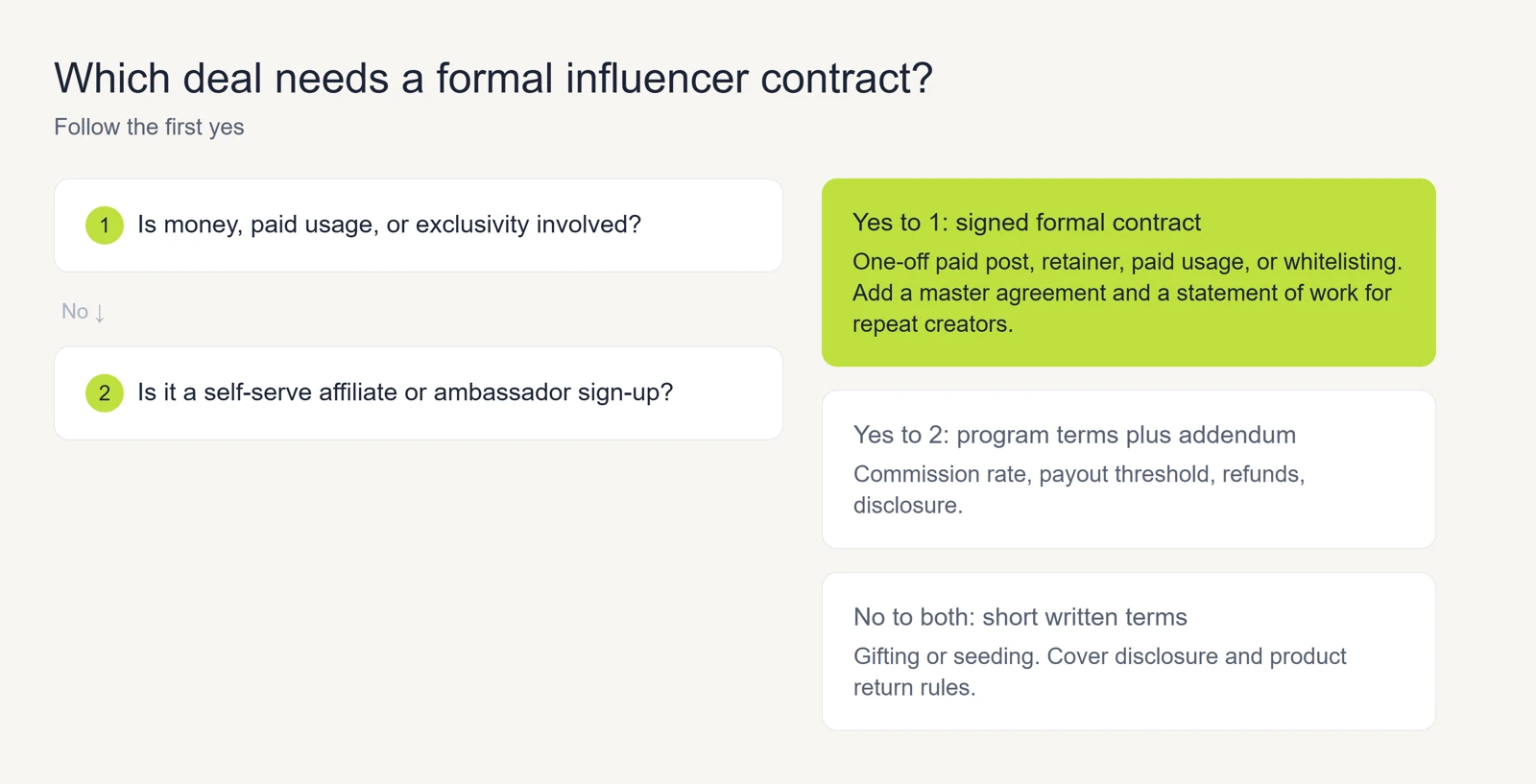
The legal form required depends on the jurisdiction and the rights granted: some copyright assignments and exclusive licenses require a signed writing.
Gifting and self-serve programs can use shorter written terms that still address disclosure, promised posts, and permitted use.
| Deal type | Contract level | What to put in writing | Risk if skipped |
|---|---|---|---|
| Gifting or seeding | Short written terms | Disclosure requirement, no guaranteed posting, product return rules | No agreed process for correcting undisclosed posts |
| Affiliate or ambassador program | Program terms plus an addendum | Commission rate, payout threshold, refund handling, disclosure | Disputes over commissions and unclear ownership of content |
| One-off paid post | Formal contract | Deliverables, fee, deadline, approvals, usage window | Missed posts and arguments about what was bought |
| Retainer | Master agreement plus a statement of work per period | Monthly deliverables, term, renewal, exclusivity | Scope creep and unclear exit |
| Paid usage or whitelisting | Formal contract with a separate rights grant | Channels, duration, territory, ad account access | Content you can't legally run as an ad |
Seeding programs are the usual place a lighter approach works, and our guide to influencer seeding shows how to keep the terms short without dropping disclosure.
Rights gaps tend to appear when a brand wants to reuse content beyond the original post. Paid amplification, website placements, and retail media should each be addressed before launch.
Asking after a post performs shifts leverage to the creator and raises the price, and some brands lose the ability to use their best content at all (ANA via PPC Land).
What Should an Influencer Contract Include?
These nine areas cover the terms most often negotiated in creator campaigns.
They are a checklist rather than a complete legal template; the agreement also needs the parties, dates, applicable law, and other deal-specific provisions.
| Clause | What it settles |
|---|---|
| Usage rights, whitelisting, and paid amplification | Where and how long the brand can run the content |
| Payment terms | Fee, trigger, deadline, kill fee, late fee |
| Deliverables and approvals | Formats, counts, specs, revision rounds, proof |
| Exclusivity by product category | Which competitors the creator can't work with, and when |
| FTC disclosure | Required labels, review, takedown |
| Independent contractor status | Factors affecting worker classification and contractor independence |
| Reporting | Which numbers the creator delivers, from where, by when |
| Termination, breach, and remedies | What happens when someone misses or breaks a term |
| AI and digital replica | What the brand may and may not generate from the creator's likeness |
Usage Rights, Whitelisting, and Paid Amplification
Organic posting and paid advertising are separate grants, and the contract must name both. A creator who agrees to post on their own feed has not agreed to let you run that post as an ad, edit it, or keep it live for a year.
Write these items into the clause:
- Organic repost rights: whether the brand may repost on its own channels, and where.
- Paid ad rights and whitelisting: permission to run the content as ads, including through the creator's handle, with who controls the ad account and how the creator can revoke access.
- License or assignment: a license permits specified uses while the creator retains ownership; an assignment transfers copyright ownership and generally calls for an express signed writing. A license can itself be perpetual without transferring ownership. Define channels, territory, duration, edits, and price before choosing either approach.
- Edit and derivative rights: whether the brand may cut, caption, or recombine the footage.
- Takedown on expiry: what happens to posts and ads when the license ends. Morgan Lewis's creator-side note flags post deletion after expiry as a point creators raise.
| Grant | What the brand may do | Term to specify | How it's priced |
|---|---|---|---|
| Organic repost | Share the post on brand channels | Platforms and duration | Included in the base fee or priced separately |
| Paid ad rights | Run the content as ads from the brand account | Channels, territory, start and end dates | Separate fee, scaled to duration and spend |
| Whitelisting | Run ads through the creator's handle | Ad account access, duration, revocation | Separate fee, quoted apart from brand-account ads |
| Edits and derivatives | Cut, caption, recombine | Which edits, how many versions | Priced as an add-on or bundled into the license |
The chart below compares stages of influencer marketing where surveyed marketers saw opportunities to reduce waste. It reinforces the case for agreeing on paid amplification rights early.
Payment Terms, Milestones, and Kill Fees
Write the fee, the payment trigger, and the payment deadline as three separate lines.
A sentence like "payment on completion" leaves two of the three undefined. Tie each payment to an event both sides can see and check on the day it happens.
Cover these points:
- Flat fee per deliverable, stated in one currency, with rate benchmarks by platform and tier in our content creator cost guide.
- Deposit and balance: a share at signing and the rest on approved delivery. LawDepot notes some influencers charge an upfront retainer, usually 10 to 50 percent of the contract amount.
- Payment deadline: a net period such as 15 or 30 days from approved delivery or invoice.
- Late-payment fee: LawDepot cites rates up to 18 percent a year but warns every state sets its own limits, so check local law before copying a number.
- Kill fee: a stated amount if the brand cancels after production starts. We recommend a kill fee in the contract because it turns a cancellation argument into arithmetic; the percentage is for you and the creator to agree.
- Fees and taxes: who absorbs platform and transfer fees, and which tax forms the creator provides before the first payment.
Deliverables and Approvals for Instagram Stories, Reels, and TikTok
Name the format, count, length, tags, and posting window for every deliverable. "A few posts" can't be enforced, and "one Instagram Story" doesn't say how many frames.
For Instagram Stories, specify:
- the number of frames and whether a link sticker is required;
- the posting window, since Stories expire after 24 hours;
- how long the creator keeps them in a highlight, if at all;
- proof of delivery, such as a screen recording and insights screenshot captured before expiry.
For Reels and TikTok, specify length, cover frame, audio rules, and caption requirements. For every format, set the number of revision rounds, the review turnaround in days, and how long the post must stay live before the creator may delete it.
| Format | What to write down | Proof of delivery |
|---|---|---|
| Feed post | Image or carousel count, caption points, tags, posting date | Live link |
| Instagram Stories | Frame count, link sticker, 24-hour window, highlight duration | Screen recording and insights before expiry |
| Reels or TikTok | Length, cover frame, audio, caption, posting window | Live link |
| YouTube integration | Placement in the video, length, description link | Live link |
Because Stories disappear quickly, agree on advance review, a posting window, and evidence of disclosure.
The FTC notes the practical difficulty of monitoring Stories in real time; advance review helps, but the brand still needs reasonable monitoring and correction procedures.
Exclusivity by Product Category
Define exclusivity by product category, add a named competitor list where you can, and set a start date and an end date. A clause that says "no competing brands" fails on all three counts.
Write the clause with these parts:
- Category: narrow and specific, such as protein powder.
- Window: how long before and after the post the restriction applies.
- Named competitors: a list the creator can check.
- Carve-outs: what the creator may still promote.
- Fair pay: LawDepot points out exclusivity limits a creator's income, so the creator should be compensated for it, and warns the clause may be unenforceable if it defines competitors as any business competing with the client.
Broad exclusivity may cost more than the protection it delivers. Restrict it to named competitors or a clearly defined product category, with reasonable dates and explicit carve-outs.
When ads run in several markets, tiered licenses and scoped exclusivity keep the price in check, as we explain in why global usage rights fail in performance media.
FTC Disclosure Clause
Require clear disclosure of material connections in every relevant post, plus a process for reviewing, correcting, or removing noncompliant content. The brand carries real exposure here: the FTC says its enforcement focus usually will be on advertisers or their ad agencies, though it may act against an endorser who ignores warnings.
A workable clause requires:
- a clear and conspicuous disclosure in every sponsored post, even under a long-term deal (the FTC's guidance says an ongoing relationship still needs disclosing);
- wording such as "Ad," "#ad," or "Sponsored by [brand]";
- "Gifted by [brand]" for free product, because "Gifted" alone is likely ambiguous;
- a reminder that tagging a brand doesn't count as a disclosure;
- brand review before posting and a takedown right for non-compliant posts.
Write the exact label into the contract, since official guidance can change.
Independent Contractor Status
A court or agency looks at the reality of the relationship, whatever label the contract uses. Fisher Phillips warns that a closely managed campaign can look like an employment relationship.
Describe outputs, deadlines, and permissible review rounds without unnecessarily directing the creator's daily work. Worker classification depends on the full relationship and applicable law, so wording alone cannot establish independent-contractor status.
Brand control that raises the risk includes:
| Brand control | Why it looks like employment | Safer contract wording |
|---|---|---|
| Exact filming schedule and location | Brand directs when and where the work happens | "Creator chooses time and place; delivers by [date]" |
| Brand-supplied tools or software | Brand provides the means of work | "Creator uses their own equipment and tools" |
| Long exclusivity that makes the creator dependent | Creator can't work for others | Narrow category exclusivity with a stated end date |
| Penalties for weak performance | Looks like workplace discipline | Fixed project fee tied to delivery and approval |
The consequences can be steep. Fisher Phillips lists unpaid overtime, back pay, expense reimbursement, legal fees, and liquidated damages that double the amount owed.
Polsinelli adds that California's ABC test presumes a worker is an employee unless the hiring entity proves three prongs, and it notes that some influencers run established businesses with multiple clients, which supports contractor status.
Project-based fees and independent working methods may fit genuine contractor arrangements, but they cannot override statutory classification tests. Treat employee advocates separately under applicable employment rules.
This section isn't legal advice, and counsel should review the final text.
Reporting Terms: Google Analytics, UTM Links, and Native Insights
Write which numbers get reported, from which source, by which day, and by whom. "Share performance" gives nobody anything to check.
Cover these items:
- Native insights: capture visible Story proof and initial insights before the Story expires; request later insights separately if the platform makes them available.
- UTM links: tagged links so clicks and sales appear in Google Analytics on the brand's side.
- Discount codes: a unique code per creator for sales that don't click through.
- Access: view-only access to the creator's analytics, or screenshots if the creator won't grant it.
- Data ownership: who owns the numbers and how the brand may use them.
| Metric | Source | Deadline | Who delivers |
|---|---|---|---|
| Views, reach, saves | Native insights | Before Story expiry for initial proof; later insights if available; 7 days for feed and video | Creator |
| Link clicks and sessions | Google Analytics via UTM links | Live, brand-side | Brand |
| Sales | Discount code or tracked link | 30 days after posting | Brand |
| Audience demographics | Native insights | 7 days after posting | Creator |
The ANA study rated measurement the hardest step for 67% of respondents and listed URL tagging for clicks and sales among its remedies. The contract should assign responsibility for tagged links and access to resulting reports.
Termination, Breach, and Remedies
Write a remedy ladder so a missed post triggers a defined sequence. Without one, every breach becomes a new argument.
A workable ladder runs in this order:
- Notice and cure period: the brand notifies the creator in writing, and the creator has a set number of days to fix it.
- Fee reduction: an agreed reduction if the deliverable arrives late or off-spec.
- Reshoot or repost: the creator redoes the deliverable at no extra cost within the contract's limits.
- Termination: the brand ends the contract if the breach isn't cured.
- Clawback: the creator returns fees paid for work not delivered.
Add these supporting clauses:
- Morals clause: Morgan Lewis recommends a morals clause allowing immediate termination for cause.
- Non-disparagement: neither side publicly criticizes the other.
- Confidentiality: which terms, such as rates and campaign details, neither side may share.
- Takedown right: the brand can have content removed on request.
- Indemnity: Morgan Lewis's creator-side note says the company should expect to indemnify and the influencer to counter-indemnify for advertising, contest, and lottery compliance.
- Governing law and disputes: the state or country, and whether disputes go to mediation first.
AI and Digital Replica Clauses
Add a clause that bars AI training and synthetic likeness unless the creator grants those rights separately. Coblentz advises addressing AI use and digital replica rights expressly in influencer agreements, and JD Supra's legal analysis says replica rights belong apart from general name, image, and likeness grants.
Write the clause to cover:
- whether the brand may use the creator's voice or face to train models or generate new content;
- whether AI may edit an approved post, and whether edits need re-approval;
- confirmation that first-person claims in a post reflect the creator's real experience;
- disclosure when AI materially changes a product demonstration or portrays a real person's statements.
Price digital-replica permissions separately from the original post, with limits on identity, uses, approvals, and duration.
New York's advertising-disclosure provision for certain synthetic performers took effect June 9, 2026; it is distinct from broader rights governing replicas of actual people. Check the rules that apply to each campaign and jurisdiction.
Influencer Contract Example and Free Template
An influencer contract example is easier to use when the terms belong to the same deal.
Imagine a brand commissioning one sponsored Instagram Reel and securing permission to use it as a paid ad for three months.
The excerpt below shows how a posting commitment and a separate advertising license could be written together.
Illustrative contract excerpt: One Sponsored Instagram Reel
Deliverables: [Creator legal name] will submit one 30-45-second Reel by [date] and publish it on [date] after approval. The post will include [brand tag], [link], and a clear sponsorship disclosure.
Payment: [Brand legal name] will pay [amount and currency] within [number] days of [agreed milestone]. Cancellation after production starts will be handled under [agreed kill-fee terms].
Approval: The brand may request up to [number] rounds of revisions within [number] business days. Approval does not replace either party’s disclosure responsibilities.
Paid usage: The creator retains copyright and grants the brand a nonexclusive license to run the approved video as paid Meta ads in [territory] for 90 days. Permitted edits include [specified cuts and captions]. Further use requires written renewal.
Missed delivery: After written notice, the creator has [number] days to correct an undelivered item. If the breach remains unresolved, [agreed fee reduction or refund terms] apply.
A complete agreement should also address exclusivity, reporting, confidentiality, AI and likeness rights, governing law, and disputes. This excerpt illustrates possible wording rather than a ready-to-sign legal document.
Download the Free Influencer Contract Template (PDF). The fillable PDF includes campaign terms, content rights, payment and reporting schedules, and signature fields. Have qualified counsel review the final agreement before signing.
Red Flags to Check Before You Sign
Eight signals tell you a draft will cost money later. Scan any contract against this table before it goes out.
| Red flag | Why it costs money | Fix |
|---|---|---|
| "A few posts" or "regular content" | Deliverables can't be enforced | Name count, format, length, and dates |
| Unnecessary perpetual or worldwide usage rights | You pay for rights you won't use | License by channel, territory, and duration |
| Silence on paid usage | Winning posts can't legally run as ads | Add a separate paid-usage grant |
| Category-wide or full exclusivity | Premium for little protection | Narrow to named competitors or a clearly defined product category |
| No approval step | Off-brief or undisclosed posts go live | Require approval before posting |
| No remedy for a missed post | Every breach becomes a negotiation | Add the remedy ladder |
| Brand dictates schedule and tools | Contractor status at risk | Specify the deliverable only |
| No AI or replica language | Likeness use is undefined | Add a separate replica clause |
A signed contract is only as good as the creator behind it. Our influencer vetting checklist covers the audience, safety, and conflict checks that belong before the contract stage.
How to Get an Influencer Contract Signed
Draft from the brief, negotiate three terms, and sign before the deal is announced. Six steps keep it moving:
- Start from the brief and the vetting result. Copy deliverables, formats, and dates from the approved brief so the two documents match.
- Use a master agreement and a statement of work for repeat creators. The master agreement holds the standing terms; each campaign gets a short statement of work with its own deliverables and fees.
- Send the contract before announcing the deal. The brand's leverage drops once the creator has teased the partnership.
- Negotiate the three terms that move price: paid usage, exclusivity, and payment schedule.
- Have counsel review the final text, especially contractor status and any AI language.
- Sign electronically and calendar every expiry date. Usage licenses end; a calendar entry keeps ads from running unlicensed.
Who drafts depends on your in-house or outsourced setup. An in-house team controls the template but carries the follow-up, an agency of record handles drafting, negotiation, and tracking, and outside counsel reviews the final text.
Build Safer Creator Deals With inBeat Agency
A useful creator agreement makes the next decision easier: whether to approve a post, extend paid distribution, request a correction, or end a campaign. Those choices are far simpler when the deliverables, rights, and responsibilities are settled in advance.
inBeat helps brands coordinate creator selection, production, usage permissions, and campaign execution.
If you're planning a program that will feed paid creative, book a strategy call to discuss the workflow and rights requirements. Have qualified counsel review the final legal agreement.
FAQs
Can a brand use a creator's trending audio in paid ads?
A creator's permission to use audio in an organic post does not automatically clear that recording or composition for advertising. Check the platform's commercial music rules and obtain any necessary music licenses or use cleared audio before amplifying the content.
Who owns raw footage and unused takes after a campaign?
The agreement should say whether raw files are part of the deliverables and whether the brand receives a license to edit or reuse them. Paying for finished posts alone does not necessarily grant rights to every unused clip.
What if a platform removes a sponsored post?
Distinguish a creator-caused policy violation from a platform error. Set a notice deadline, require reasonable cooperation, and agree whether a compliant repost, substitute deliverable, or partial refund is appropriate.
Can a brand edit a creator's testimonial into a new claim?
Editing permission is separate from permission to make inaccurate claims. The agreement can allow cuts and captions, but edited testimonials must remain truthful, accurately reflect the creator's experience, and meet applicable advertising rules.
What happens if a creator signs through an agency or management company?
Identify which entity is the contracting party, who is authorized to sign, who receives payment, and who can grant the necessary content and likeness rights. Confirm that the manager's authority extends to the permissions requested.
Should a contract cover advertising uses beyond social platforms?
Yes, if the campaign may extend to a website, email, marketplace, retail media, or out-of-home placements. Specify each channel and license term rather than assuming the original social-post agreement covers other media.