.svg)
.svg)
.svg)
.svg)


.svg)






A creator with 300,000 followers can still be a bad buy. Checking for bots and inactive accounts is the obvious first step. The harder part is knowing whether the rest of the partnership is worth the risk. According to a survey by EMARKETER and Viral Nation, 96.6% of brands wanted documentation of influencer vetting, yet only 25.6% always received it.
A clean audience audit can still leave expensive surprises: content you can't run as an ad because usage rights were overlooked, a sponsored post flagged for missing disclosure, or a deliverable arriving after the campaign window. This influencer vetting checklist takes you through five gated checks, covering identity, audience quality, brand safety history, and pre-contract risks. Each ends with a documented proceed, conditional, or drop decision.
Start where your shortlist ends.
P.S. If you'd rather hand the sourcing and vetting of creators at volume to a team that does it every week, see how inBeat runs influencer marketing as part of a paid social system.
inBeat Agency POV: We vet creators the way a media buyer vets a placement, because that's what a creator is to us: a source of native creative we intend to put spend behind. When you sign a creator you're buying their likability and the trust their audience extends to them, and a bought audience or a sloppy disclosure habit poisons both at once. So our checks run well past the follower audit to the questions that decide whether the content can work as an ad at all. Do we hold the rights to dark-post it? Will it ship on the date the test calendar needs? Will the data that comes back be clean enough to learn from? Vetting is the first round of the test, run before any money moves.
How to Vet Influencers Step by Step: The Full Checklist
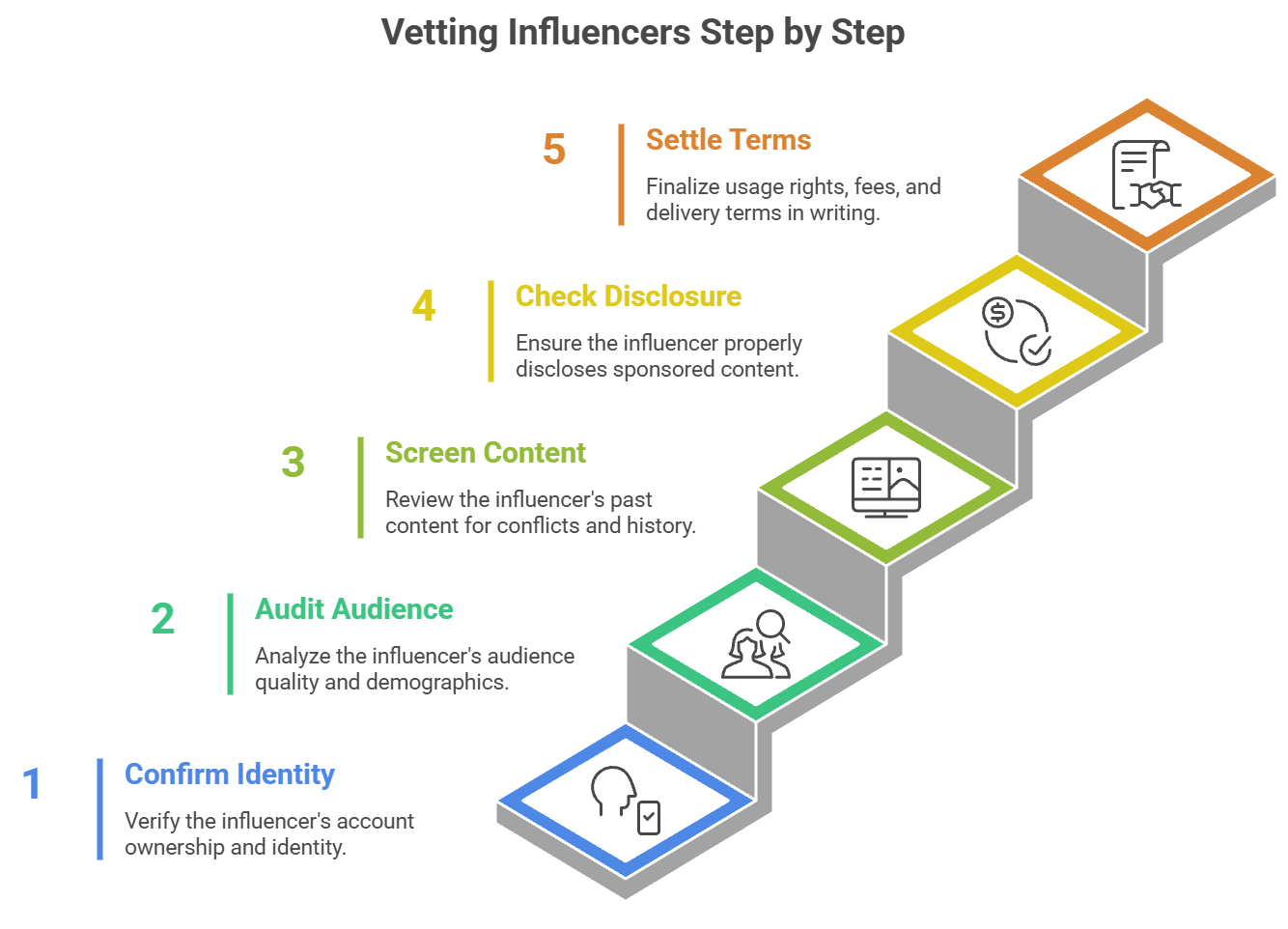
A sequential five-step gate is the cheapest way to catch a bad audience before any contract cost lands, because each step runs only on the creators who survived the one before it. Vet a shortlisted creator in those five ordered steps and stop the moment one of them fails.
The order is deliberate: the early steps are cheap and eliminate the most candidates, while the final step costs legal and negotiation time and is only worth running on survivors. This checklist starts from a shortlisted name, with sourcing already done, and ends at signed terms.
What Outcomes Can Each Vetting Gate Have?
Every gate has the same three outcomes: proceed, proceed with conditions, or drop (at step 5: sign, sign with amendments, or walk away). Record which one you chose and why, because a conditional pass without a written condition becomes an unconditional pass by the time the contract is drafted.
Example: How the Gate Drops a Bad Audience Early
The sequence saves time in a way that's easy to see on a shortlist. Take the hypothetical creator from the intro who reports a six-figure follower count. Identity checks out in ten minutes. Then the audience gate catches a growth curve with two unexplained step changes and a follower base heavy with empty profiles.
That creator is dropped at step two. Nobody spends an hour on their content archive, nobody drafts terms, and the analyst moves to the next row. Copy these five steps into a shared sheet with one row per creator and a pass, conditional or fail column per gate, and the sheet becomes the record that the later sections depend on.
Influencer Audience Audit: How to Spot Fake Followers, Bots and Engagement Pods
A manual audience audit surfaces the inorganic patterns a rate card conceals: bots, bought engagement and comment pods all leave fingerprints in the last dozen posts that a headline follower count never shows. Run three manual checks on the creator's last 12 posts and record each result against thresholds you set for your niche before you ask about rates.
The checks below are the influencer audience audit in its manual form; the comparison section covers when software has to take over. Each check looks at a different layer, because fake followers, bought engagement and comment pods leave different fingerprints and a creator can pass one layer while failing another. Treat the audience as the thing you're actually buying: a follower count is a claim about the audience, and these checks test that claim.
How to Check Follower Growth and Audience Composition
Organic growth is lumpy but explainable, while artificial growth is a clean step with nothing behind it. A real account shows a plateau, a jump when a post travels or a press mention lands, then another plateau. A step change with no matching post is the first red flag. Ask the creator for native analytics screenshots covering the last 12 months and lay the jumps against their content calendar. If a 40,000-follower jump in a week has no viral post behind it, ask directly; a purchased burst is usually denied, and the denial without an explanation is your answer.
Then sample the followers themselves. Open 50 at random from the follower list and tally how many have no posts, no profile photo, or follow thousands of accounts while being followed by a handful. Note geography and language against the audience the creator claims. A US-focused food creator whose sampled followers skew toward accounts posting in a different language from a different region is selling you reach you can't use. The creator's reported audience and the audience that will actually see your content are two different sizes.
How to Check Engagement Quality Beyond the Engagement Rate
The ratio of saves and shares to likes is a far better indicator of genuine engagement than the headline engagement rate, because saves and shares are expensive to fake and signal that content was useful enough to keep or pass on, while likes are cheap. Set the single engagement-rate figure aside and look at the mix.
Compute the saves-plus-shares to likes ratio and the comments to likes ratio across the 12 posts. Then check whether engagement tracks content quality. On a healthy account, a weak post underperforms and a strong one overperforms. On an account buying engagement, every post lands within a narrow band regardless of what's in it, because the purchased volume doesn't care about the content.
How to Spot Engagement Pods and Paid Engagement From Comment Patterns
An engagement pod shows up as the same handful of accounts commenting first on every post, often within minutes of publication, with generic praise or emoji-only replies that would fit any image. To find one, read the first 20 comments on each of the 12 posts and note the account names. Paid engagement looks similar, but the accounts commenting are throwaways.
Real superfans exist, so one or two recurring names is normal; a dozen names covering most of the first comments on most posts is a pod. Timing is the clinching signal: comments clustered inside the first few minutes, then nothing, point to a coordinated drop. An audience encountering the post as it reaches their feeds comments over hours, unevenly. The comment check is worth repeating on the final draft before the post goes live, because pods can be recruited for a single campaign.
How to Set Audience Audit Thresholds for Your Niche
Set thresholds as written policy for your niche. As a hypothetical illustration only: a beauty brand on Instagram might decide that more than 20 percent empty profiles in the follower sample, or any unexplained follower jump above 15 percent in a month, triggers a drop, while a B2B software brand vetting LinkedIn creators sets different numbers because the platform's engagement behavior differs. Decide the cut-offs in advance, write them next to the gate, and tune them quarterly from the creators who slipped through.
Manual Influencer Vetting vs Automated Vetting Tools: Which to Use and When
Manual vetting is enough below roughly a few dozen creators a month, and it's better than software at reading pods, sarcasm and context. Tools win once volume or multi-platform monitoring makes manual review physically impossible.
What Do Automated Vetting Tools Do Well, and Where Do They Fall Short?
What tools do well is coverage: scanning an entire follower base, pulling history from platforms you'd never check manually, and alerting you mid-campaign when something changes. What they miss is judgment. A score can't tell you that a creator's edgy post from three years ago was a parody, that their sense of humor fits your brand or that they've delivered late on their last two partnerships.
Treat the score as one input. When it's borderline, run the manual composition sample and the comment read before deciding, and never let a green score skip the background check or the contract review.
When Does Volume Justify a Vetting Tool?
The cost logic resolves by volume. A brand vetting 15 creators a quarter spends a few analyst hours per creator and gets better decisions than any subscription would give it. An agency vetting 400 creators a month can't sample followers by hand and needs a tool to triage, with manual effort reserved for the creators that clear the score. Write down your threshold volume, and write down which checks stay manual regardless of volume: pods, brand fit and delivery reliability belong on that list.
Influencer Background Check: Brand Safety Screening for Past Content and Conflicts
Most of the brand-safety risk in a creator deal is findable in advance by a structured search log that covers every handle and platform, because the problems that surface mid-campaign were usually visible beforehand to anyone searching methodically. Spend 20 minutes per surviving creator on that search, covering every handle, prior sponsored posts and competitor tags, and log each finding as clear, conditional or disqualifying. This is the influencer background check, and it's cheaper than it sounds once you follow a fixed method.
How to Review a Creator's Content History and How Far Back to Look
Controversy queries and platform archives reveal the history a scrubbed feed hides. Search the creator's name and handle together with a short list of controversy terms: lawsuit, apology, backlash, banned, scam, plus any term specific to your category.
Then search each handle inside each platform, since a creator who's careful on Instagram may be looser on X or an older YouTube channel. Check archived copies of their pages and any coverage of deleted posts, because a scrubbed feed is itself a data point. Run this search yourself, since the creator's own account of their history is the least reliable source.
Set the lookback window by exposure. A creator with a modest following and a two-year account history gets a two-year review. A large creator, or any creator in a regulated category, gets as far back as the archive goes, because the downside scales with their reach and with your category's scrutiny. For content that was acceptable in its original context years ago but reads badly now, decide the rule in advance: we treat it as conditional, raise it directly with the creator, and judge the creator's response.
How to Check a Creator for Competitor and Category Conflicts
A creator's recent competitor mentions and public category stances are the clearest early signal of contractual and values conflicts. List every brand tagged or mentioned in the creator's sponsored posts over the past 12 months and mark your direct competitors. A recent competitor partnership isn't automatically disqualifying, but it's a conditional flag: confirm whether exclusivity is still in force, since a creator who breaches someone else's exclusivity to work with you will do the same to you. Separately, search for category stances.
A creator who has publicly criticized your product category, or who built their following on a position your product contradicts, fails on values regardless of how good their numbers look.
Keep values alignment and tone of voice apart in the log.
Pro tip: A tonal mismatch, where the creator is louder or more casual than your brand, can be briefed around; our guide to briefing for native creator content covers how to do that without scripting the life out of the result.
A values conflict can't be briefed around, and trying to is how brands end up in screenshots.
How to Read a Creator's Disclosure History as a Brand-Safety Signal
A creator who repeatedly skips ad disclosure is both a compliance liability and a reputational one, and their last five to ten sponsored posts will show whether that habit exists. Pull those posts and check whether each carried a clear, visible disclosure. The FTC's position is that readers should be told about an incentive whenever they'd evaluate the content differently knowing about it, which covers free product as well as payment, according to the FTC's endorsement guides FAQ.
Three recent sponsored posts with no disclosure is a pattern, and the audience that notices undisclosed ads tends to say so in the comments. Log it as a conditional pass pending a disclosure clause, and if the creator argues that disclosure hurts their engagement, drop. The contract section covers the forward-looking terms; here the disclosure record is a screen on character.
Hand the log to whoever runs campaign monitoring, since the background check covers the past and someone needs to watch the present once the content is live.
Pre-Contract Influencer Risk Checks: FTC Disclosure, Usage Rights and Delivery Terms
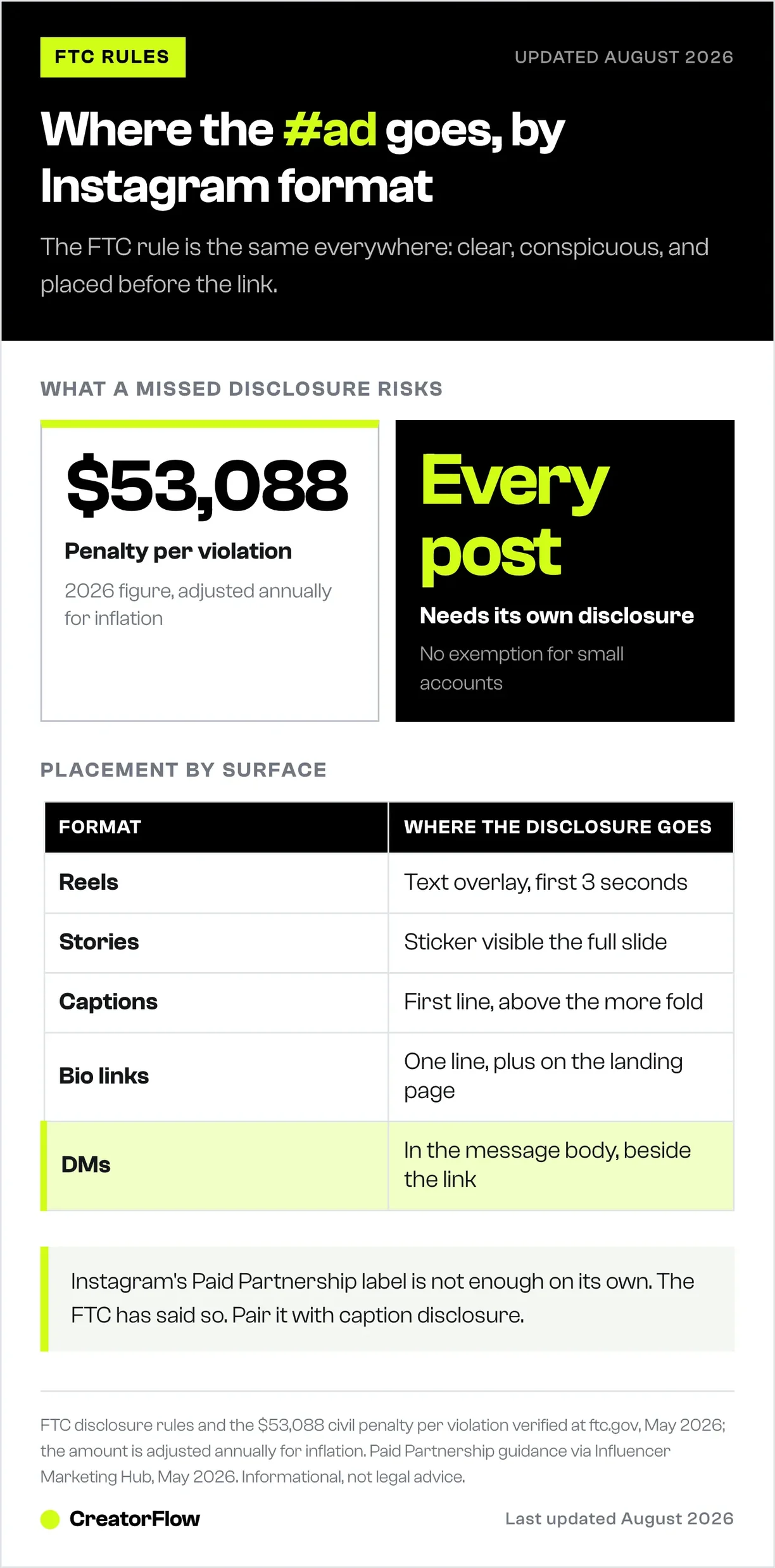
The steepest avoidable losses in creator campaigns come from contract gaps: usage rights you don't hold, posts that go live undisclosed, and deliverables that miss the date. Add four things to your standard creator agreement before the next signature to close them:
These are the pre-contract influencer risk checks, and ranking vetting guides barely mention them even though this is where the largest avoidable losses sit. This is practical guidance; have counsel review the clauses before anyone signs.
What FTC Disclosure Terms to Confirm Before Signing
A clear disclosure clause protects you twice: it limits the brand's exposure under the FTC endorsement principle and keeps the content compliant when you later run it as a paid ad. Write the disclosure requirement into both the brief and the contract, and specify the form: plain language such as "ad" or "paid partnership," placed where the audience will see it without expanding a caption or scrubbing to the end of a video.
Free product given in the expectation of a post counts as an incentive too, so a seeding campaign with no cash changing hands still needs disclosure language in the agreement. Make the creator responsible for including it and give yourself the right to request edits or removal if a post goes live without it. Confirm the creator agrees before you negotiate anything else; a creator who won't sign a disclosure clause has told you how the campaign will go. Our FTC guidelines for influencers cover the wider rules.
How to Price Usage and Whitelisting Rights Into the Agreement
Price the rights before you agree the fee, because the fee you're quoted is almost always for an organic post on the creator's own account. Usage and whitelisting rights, the extra you pay to run a creator's content as paid ads or to keep using it beyond the initial window, are the cost teams most often forget. Product and shipping count as real cost too, including the retail value of anything gifted, which belongs in the cost model in the next section.
Consider a hypothetical creator quoting a low organic post fee. The post performs, and the media team wants to run it as a dark post from the creator's handle for 90 days. If the contract is silent on whitelisting, you're now renegotiating from weakness with a creator who knows the content works, and the eventual rights fee can exceed the original post fee. Specify in the agreement:
If content is meant to run as paid media, settle this before the first post, every time.
What Delivery, Payment and Exit Terms to Put in the Agreement
Check the creator's delivery record before you set dates. Ask for two brand references and actually call them, or review the creator's visible campaign history for gaps between announced partnerships and the posts that followed. Then write the terms:
Add payment terms that release the balance only after the post is live with disclosure intact and the usage files have been delivered.
Finally, verify the payee. The payee must match the account holder you verified in step 1. Paying a third party who turns out not to control the handle leaves you with no content and no recourse, and it's a check that takes five minutes.
How to Calculate the Cost of Poor Influencer Vetting: Hidden Fees, Wasted Spend and Contribution Margin
Poor influencer vetting creates costs that rarely appear as a single line item: fees paid for inauthentic audiences, wasted media spend, and lost contribution margin. According to the 2026 Influencer Marketing Benchmark Report, fake or bot followers account for 56.5% of reported fraud and quality issues, while inauthentic comments and purchased engagement represent another 20.8%. These figures describe the types of problems marketers encounter rather than the percentage of budget lost.
The financial exposure is substantial. US creator ad spend reached $37 billion in 2025 and is projected to hit $44 billion in 2026, according to the IAB's April 2026 report. Yet there is no established industry benchmark isolating the financial return on influencer vetting. A more defensible approach is to calculate avoidable costs using actual campaign spending, performance data, and contribution margins.
What Goes Into the Full Cost of One Placement?
Start with the full cost of one placement:
A "free" seeding placement still carries product, logistics and staff time, so it has a measurable cost per creator even when the fee is zero.
How a Failed Check Turns Into Wasted Spend and Margin Loss
A failed audience check converts to wasted spend through the denominator. Inflated follower counts make the CPM look acceptable, but the content reaches a fraction of the claimed audience and the CAC on anything you run behind it is unusable, so you've paid for reach that produced neither customers nor a clean read. A failed contract check converts to margin loss more directly: paying a second time for rights you should have bought up front, re-shooting after a missed deadline wrecks the test calendar, or pulling a live post over missing disclosure and eating the fee.
How to Build a Cost Model per Creator
Build a one-line cost model per creator and compare it against the cost of failure. As a purely hypothetical example: if vetting a creator costs two analyst hours and a placement's full cost stack is $4,000 including rights and product, then one bad placement in twenty pays for vetting all twenty several times over. Fill in your own numbers, then compare the full cost stack against your target CAC before approving any fee. The ratio decides whether a creator is worth signing, and the follower count alone never does.
Does the Influencer Vetting Checklist Change for Micro vs Macro Influencers?
The five gates don't change between micro and macro influencers; what changes is how deep each check goes, which tooling you need, and the size of the downside if the check fails. Pick the column that matches your next campaign and set the depth of each check before you start the shortlist.
How Does Vetting Change for Micro-Influencers?
Micro creators are where manual audit stays feasible and where engagement pods are the most common audience problem, because pods are how small accounts inflate their numbers. Contract risk at this tier centers on delivery, since many micro creators are part-time, and on securing paid-usage rights cheaply while the creator's rate is still modest.
How Does Vetting Change for Macro-Influencers?
Macro creators flip the picture: audience composition can't be sampled meaningfully by hand, so tooling becomes necessary, the lookback has to be longer because the archive is deeper and the exposure larger, and usage fees often exceed the post fee itself. Our comparison of content creators and influencers covers how the two roles differ in what you're actually buying, which affects which column applies.
How Do Regulated Categories Change the Checklist?
Regulated or high-risk categories such as health, finance and alcohol tighten the disclosure and content-history gates for every tier, since the regulator and the press apply the same scrutiny to a 20,000-follower creator as to a two-million-follower one when the claim is wrong.
How to Vet a Large Shortlist Without a Full Audit on Every Name
Vetting at volume favors many small checks over one deep check. A hypothetical pod check on a 20,000-follower creator takes an analyst ten minutes by eye; on a two-million-follower creator the tool score covers audience composition and the comment read stays manual on a sample of posts. The cheaper check runs on every creator, the deeper one only where the stakes justify it, and that's how a large shortlist gets vetted without the budget for a full audit on each name.
How to Document and Enforce Influencer Vetting at Scale
Gating payment release behind a completed, evidence-linked scorecard is what makes vetting standards hold at scale, because it's the one lever that works regardless of who runs the review. Build the documentation layer in five ordered steps, and make a completed record the precondition for releasing payment.
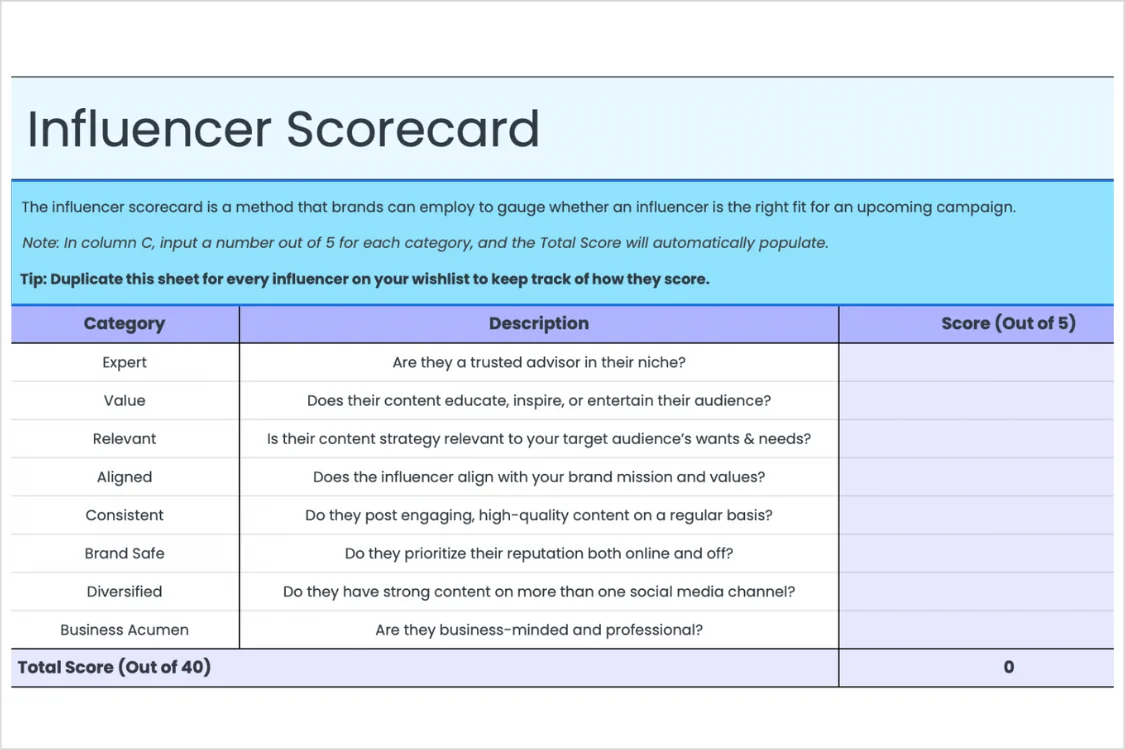
How to Enforce the Scorecard Before Payment
Enforcement is simple to state and hard to hold: no payment release without a complete record. Add a quarterly review of creators who failed after signing, whether through a late deliverable, a disclosure miss or a post that underperformed its audience numbers, and use those cases to adjust thresholds. That loop is what turns a borrowed template into your own criteria.
Why Does the Method Survive Platform Changes?
The method lasts because it doesn't depend on any one metric. Platforms change what they report and how engagement is counted, but a record built on engagement quality across several signals, content history, and written terms survives those changes, because none of the gates rests on a number a platform can redefine overnight.
What Does This System Cost in False Positives?
The system has costs of its own. Thresholds produce false positives, and a strict audience cut-off will drop some genuine small creators whose audiences simply look unusual. Over-vetting a creator whose full cost stack is small wastes analyst hours that the cost model in the earlier section would never justify. Scale the depth of the record to the money at risk, and record the reason when you deliberately run a lighter check.
How inBeat Approaches Influencer Vetting Inside a Creator Program
Every creator who clears the five gates becomes a supply of native creative we can test, and the performance data that comes back, read at the creative level with CAC and MER as the scoreboard, shapes the next shortlist: which personas, which angles, which kinds of creators earned their place.
That's the make, launch, learn, repeat loop applied to creator selection as well as to ads. It's also why we settle usage and whitelisting rights before the first post goes live whenever the content is meant to run as paid media.
Our Booksy case study walks through what that creator-to-paid hand-off looks like in practice.
Decide whether vetting sits with the creator team alone or is shared with media buying. We'd argue for shared, because the buyer knows which rights the test calendar will need.
If you're sourcing and vetting creators at volume for paid social and want to compare notes on thresholds, tooling or contract terms, book a strategy call with the team, or read more about how we work.
Influencer Vetting FAQs
What engagement rate should disqualify a creator during influencer vetting, and why does the answer depend on niche and platform?
No single rate works across accounts, because engagement behavior differs between platforms, content formats and audience sizes. Set a disqualifying floor per niche and platform as written policy, and weigh the engagement mix (saves, shares, comments against likes) above the headline rate, since the mix is harder to buy.
Does the FTC disclosure requirement apply when the creator only received free product?
Yes. The FTC's principle is that any incentive that would change how readers evaluate the content needs disclosure, and free product given in the expectation of a post qualifies. Write the requirement into seeding agreements as well as paid ones.
Can you skip the audience audit for very small creators where the fee is low?
Lighten it, but don't skip it. Run the quick comment read and a small follower sample, and record that you chose the lighter version. The full cost stack of a small placement still includes product and your team's time, and content from a bought audience is useless as a test signal.