
Your next ad test could fall behind schedule before a creator films a single frame. The reason might be a payment stuck between countries.
In Visa’s 2025 survey of 1,067 creators across five countries, 26% said payment delays had affected their content production.
For brands running international creator programs, a rejected wire, missing tax form, or slow approval can turn a confirmed shoot into a missed content deadline. Then the delay reaches the media team, where the next creative test depends on those files arriving on time.
This guide covers the payment methods, onboarding steps, and milestone schedules that help creators get paid and campaigns stay on track.
P.S. If you need creators sourced, briefed and paid at volume across markets, inBeat's UGC team runs that as one production line.
What International Influencer Payments Involve
International influencer payments run from the signed contract to money settled in the creator's local currency, and the chain holds more than the fee.
Tax forms, the usage-rights line, currency conversion, intermediary bank deductions and any platform cut all sit inside it, and any one of them can stop the clock.
Who Pays Creators in a Cross-Border Program
The party sending the money shapes the workflow and the records your team needs:
- Brand pays directly: The brand manages creator agreements, document collection, transfer approvals and payment records.
- Agency pays on the brand’s behalf: The agency handles the agreed payment administration and may advance creator fees, subject to the contract.
- Platform-assisted payouts: The provider may collect information and process transfers. Contracting and compliance responsibilities depend on the service it actually provides.
Delegating payment operations can reduce admin work, but the brand still needs a clear handoff between finance and the creator supplying the raw files. The agreement should name the parties responsible for verification, disputes and records.
Whether you treat that person as an influencer renting you reach or a creator supplying production assets shapes which model fits, because asset supply needs faster and more frequent settlement.
Where Cross-Border Payouts Stall
Four common handoffs can hold up an international creator payout:
- Missing documents: The required tax or payment record has yet to be collected or verified.
- Incorrect bank details: Missing IBAN, SWIFT or local routing information leads to a rejected transfer.
- Unclear FX terms: The contract leaves open who covers conversion spreads or receiving fees.
- Invoice mismatches: The invoice differs from the approved scope, purchase order or payment amount.
Most can be identified during onboarding, before a creator commits to a production date.
Hypothetical example: a US DTC brand wires a Lisbon micro creator without an IBAN. The bank returns the funds after four business days, the creator pushes the shoot a week, and the asset drops out of that fortnight's TikTok test batch.
Why Payout Speed Is a Creative-Production Variable
A payment hold can shift a shoot or edit deadline after creative has already been assigned to an ad test. Track two operational metrics alongside content delivery: time from tranche approval to creator receipt, and the share of payouts requiring manual follow-up.
Map each handoff from signed agreement to settled funds, then review transfers that miss the agreed payment window.
Choose Payment Infrastructure by Roster Size
Choose a payment method, onboarding process and settlement schedule that fit the size and complexity of your creator roster. The table offers a practical starting point; the method-by-method comparison below helps refine the choice.
| Roster size | Recommended rails | Onboarding workflow | Payment schedule | Main risk it controls |
|---|---|---|---|---|
| Under 20 creators a month | Digital wallets, with wires for the occasional high-value deal | Manual checklist: contract, tax form, wallet or bank details, invoice template | Asset-triggered tranches paid as they fall due | Fees eating small payments |
| Mid-size, several markets | Payout platform with multi-currency balances | Platform intake collects forms and payment details before the first payout | Weekly batch day | Wire rejections and finance hours |
| Enterprise, multiple agencies and currencies | Payout platform; escrow or milestone release for higher-risk deals | Named compliance owner in every SOW, one intake standard across agencies | Fixed weekly payout day shared with the media team | Ghosting, audit gaps and late assets at scale |
Under 20 Creators a Month
Wallets plus a written milestone contract and a manual tax-form checklist keep fees low and admin tolerable.
At lower volumes, compare the wallet or bank charges with the staff time needed for manual payments. A contract template and one-page onboarding checklist may be enough, but total cost depends on the countries and payment methods involved.
Mid-Size Rosters in Several Markets
Once you manage roughly 20 or more creators a month across several currencies, a payout platform with multi-currency balances and bundled form collection can save finance hours and reduce rejections. Treat that figure as a rule of thumb, not a benchmark.
Platforms now sell reporting and operational scale as the product, so expect the payback in exports as well as in rejections avoided.
Enterprise Volume With Multiple Agencies and Currencies
At enterprise volume, standardize onboarding, reporting and payout approvals across agencies, and name a compliance owner in every SOW. Consider escrow or a formal milestone-release service for higher-risk contracts, rather than assuming every enterprise payment needs it.
The payout day matters most here because dozens of assets queue for test slots, and a missed batch can cost a week of learning across the roster.
Whatever the tier, log the landed cost per asset. Influencer ROI tends to be overstated in two ways, loose attribution inflating the return and missing costs shrinking the spend, and payment fees are the cost most teams forget first.
International Influencer Payment Methods and Platforms Compared
Four rails cover almost every cross-border creator payment, and the right one depends on payment size, volume and how much admin you can absorb.
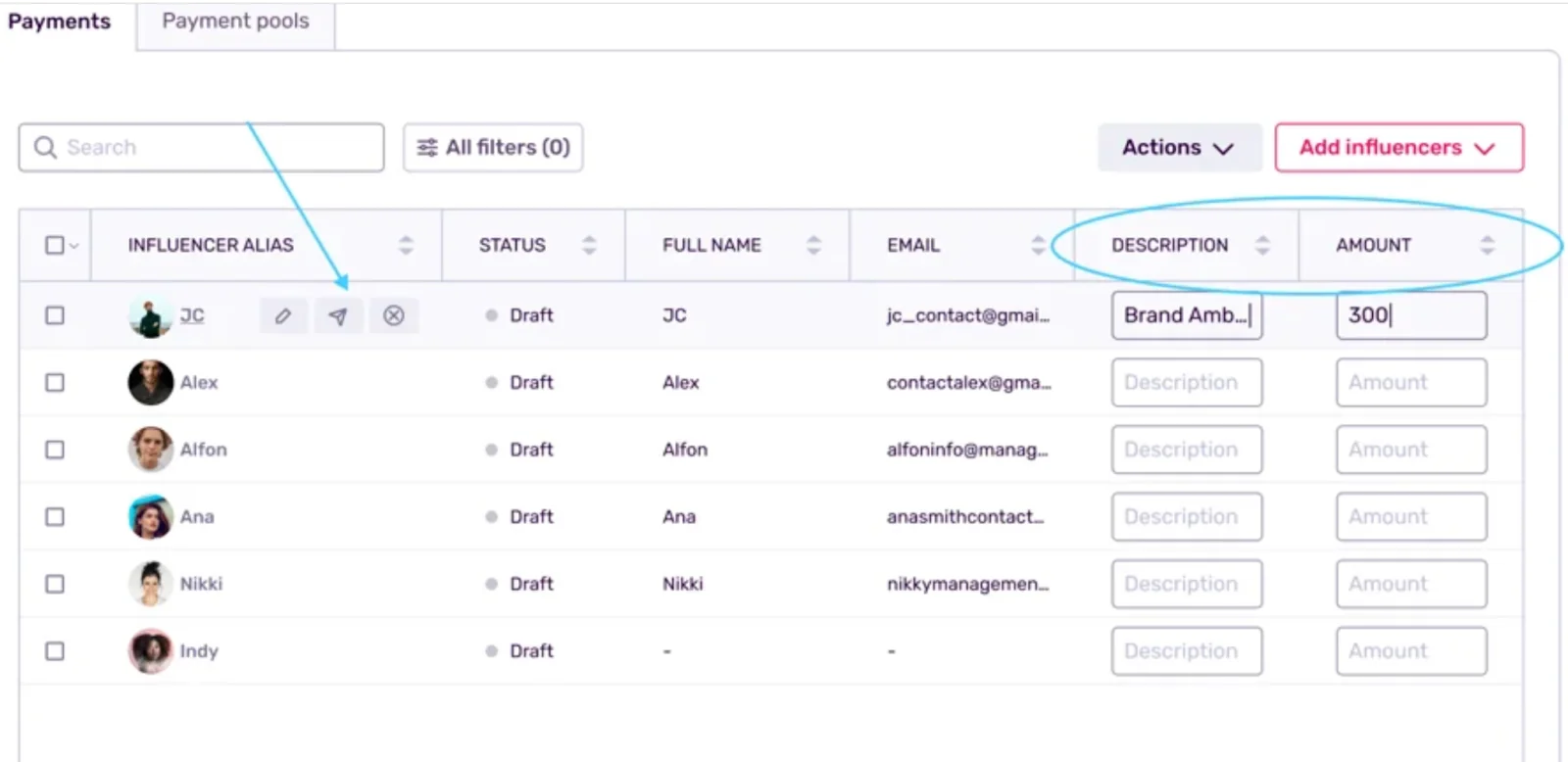
Roster size is a useful starting point, rather than a break-even rule. Compare total transfer and FX costs, finance hours, rejected payouts, document handling and reporting needs before moving from wallets or wires to a platform.
| Method | Typical fee structure | Settlement time | Who bears FX cost | Tax-form handling | Best for roster size |
|---|---|---|---|---|---|
| Direct international bank wire | Fixed sending fee plus possible intermediary bank deductions | Several business days, longer on rejection | Creator, unless the contract assigns it | Manual, collected by the payer | Low volume, high value |
| PayPal and digital wallets | Receiving fee and FX spread on conversion | Near-instant to a few days to withdraw | Creator by default | Manual, collected by the payer | Nano and micro rosters |
| Automated payout platforms | Subscription or per-payout fee, platform FX rate | Batched, usually within the week of approval | Negotiable; platform rate applies | Bundled into onboarding | Mid-size to enterprise |
| Escrow and milestone-release services | Escrow fee on top of transfer cost | Released on milestone approval | Depends on provider and contract | Varies; often bundled | Enterprise or high-risk engagements |
Fee and timing descriptions are directional and vary by provider, corridor and currency; verify current terms with your bank or platform before budgeting.
Direct International Bank Wire
Wires suit high-value, low-volume payments where a fixed fee is a rounding error on the invoice.
Their weakness is fragility: a missing IBAN, SWIFT code or local routing detail triggers a rejection that can take days to surface, and intermediary banks may deduct their own charge so the creator receives less than the invoice.
Use wires when a single creator contract is large enough that the fee matters little and the creator has a business bank account. For everyone else, the rejection risk alone argues for another rail.
PayPal and Digital Wallets
Nano and micro creators usually ask for a wallet because it's what they already use and it settles fast.
The catch is that receiving fees and conversion spreads land on the creator unless your contract says otherwise, which turns a clean fee into a smaller net amount and a sour follow-up email.
State in the contract who covers wallet fees and FX, and if you want goodwill, cover them. A wallet payment that arrives in full on the promised day is the cheapest retention tool a small roster has.
Automated Payout Platforms
Depending on the provider and market, a payout platform may support batch transfers, document collection, multiple currencies and transaction exports. Check the actual features and supported corridors before switching.
Evaluate the reporting layer as hard as the rails: you want a per-creator, per-asset export that finance and growth can both read.
Pilot before you migrate. Run one market on the platform for a month, confirm the exports and FX rates match what you were promised, then move the rest of the roster.
Escrow and Milestone-Release Services
Escrow and milestone release answer the question practitioners keep raising in threads about managing influencer payments safely: what stops a creator disappearing after the upfront payment. The funds are committed, which reassures the creator, but released only on approved milestones, which protects the budget.
The cost is an extra fee and an extra onboarding step, so reserve escrow for larger contracts, first engagements with unknown creators, or markets where legal recourse is impractical. For a repeat micro creator who has delivered three times, escrow is friction without benefit.
Score your current rails against the six table columns, then pilot one platform on one market. The scorecard will usually show the move before the finance team feels it.
Creator Compensation Models Matched to Campaign Goals
Match the compensation model to what the campaign is buying. Creative supply and awareness favor a flat fee, measurable DTC sales favor a hybrid, and pure affiliate belongs in established programs where tracking is already live.
| Model | Best-fit campaign goal | Who carries the risk | Cross-border complication | Attribution requirement |
|---|---|---|---|---|
| Flat fee | Creative supply, awareness, guaranteed deliverables | Brand | Currency of the fee and who absorbs FX | None beyond delivery confirmation |
| Affiliate or commission | Sales-led programs with mature tracking | Creator | Recurring payouts in a foreign currency, local tax treatment of commission income | Clean, creator-level sales tracking |
| Hybrid fee plus revenue share | Measurable DTC sales where you also need the asset | Shared | Two payout streams with different triggers and currencies | Creator-level tracking plus a fee ledger |
Flat Fee for Guaranteed Deliverables
A flat fee buys predictability, and it fits any program where the asset itself is the output and the creator's audience is secondary.
If you plan to run the content as dark posts and let the ad account find the audience, you're paying for production, and production is priced per deliverable.
The flat fee also keeps cross-border admin simplest: one amount, one currency clause, one payout trigger per deliverable. Most of the mess in international programs comes from adding a second payment stream before the first one runs smoothly.
Affiliate and Commission Pay for Sales-Led Programs
Commission-only pay shifts the risk to the creator, which is why experienced creators in markets with strong demand often decline it.
It works when attribution is clean enough that the creator trusts the dashboard, and it fails when codes leak, links get stripped on platform, or the brand's own retargeting takes credit.
The attribution problem cuts both ways. Loose attribution flatters the brand's ROI by crediting creators with sales they didn't drive, and it short-changes creators when the opposite happens, so a commission program needs a tracking method both sides accept before the first post.
Hybrid Retainer With Revenue Share
The common hybrid pairs a flat fee with a sales commission.
Impact.com's rate guide reports brands typically offering a flat fee plus a 10 to 20 percent commission on sales across social platforms, a range drawn from its creator team's experience rather than a published sample, so treat it as a starting point for negotiation.
The hybrid earns its complexity when you need the asset and you can measure the sales. If either half is missing, you're paying for two streams of admin to get one stream of value, and a flat fee with a performance bonus clause is cleaner.
Fairness matters here too. The ANA published an Influencer Pay Equity Guide because inconsistent fee logic across creators is a known industry problem, and a documented model per campaign type is how you avoid it across borders.
Usage Rights and Whitelisting Across Borders
Usage rights and whitelisting are licensing and ad-access terms that can accompany a flat fee, commission or hybrid deal. When paid amplification is included, specify any additional rights fee and have its local tax treatment reviewed separately from the content fee.
Write the rights fee as its own clause with its own currency, term, territory and payout trigger, so renewing a license later doesn't reopen the whole contract.
Whitelisting adds a second layer: you're running ads from the creator's handle, which means platform permissions, a defined spend cap and a clear end date.
The brief should already know the asset is destined for ads, because content briefed for native delivery performs differently from content retrofitted into a campaign after the fact.
Set one default model per campaign type and write it into your template. Then the only negotiation left is the number.
Tax Compliance for Cross-Border Creator Payouts
Identify the tax and payment documents required for each arrangement during onboarding, so missing paperwork is less likely to delay the first payout.
What follows is operational guidance for marketing and finance teams, not legal or tax advice; rules differ by country and change, and your accountant or counsel should sign off on the specifics.
| Payment type | Counts as compensation? | Form or record to collect | Timing in workflow |
|---|---|---|---|
| Cash fee for content | Yes | Applicable tax/status record; verified payout details; invoice or valid local equivalent | At signature, before deposit |
| Usage rights or whitelisting fee | Yes | Applicable tax/status record; separate rights-fee line | At signature; renewals on each term |
| Affiliate or commission payout | Yes | Applicable tax/status record; commission statement for each period | Before first commission run |
| Free product or gifted service | Depends on transaction and jurisdiction | Shipment/value record; ad disclosure check if relevant | At shipment |
Categories are general; thresholds, reporting duties and treatment of gifted product vary by jurisdiction and should be confirmed locally.
Collect Tax Forms Before the First Payment
For relevant US payments, an individual foreign payee may be asked for Form W-8BEN, an eligible foreign entity for Form W-8BEN-E, and a US person for Form W-9.
The correct document depends on the payer, payee, income type and applicable withholding rules. These forms address US tax documentation; other payment arrangements can require different records.
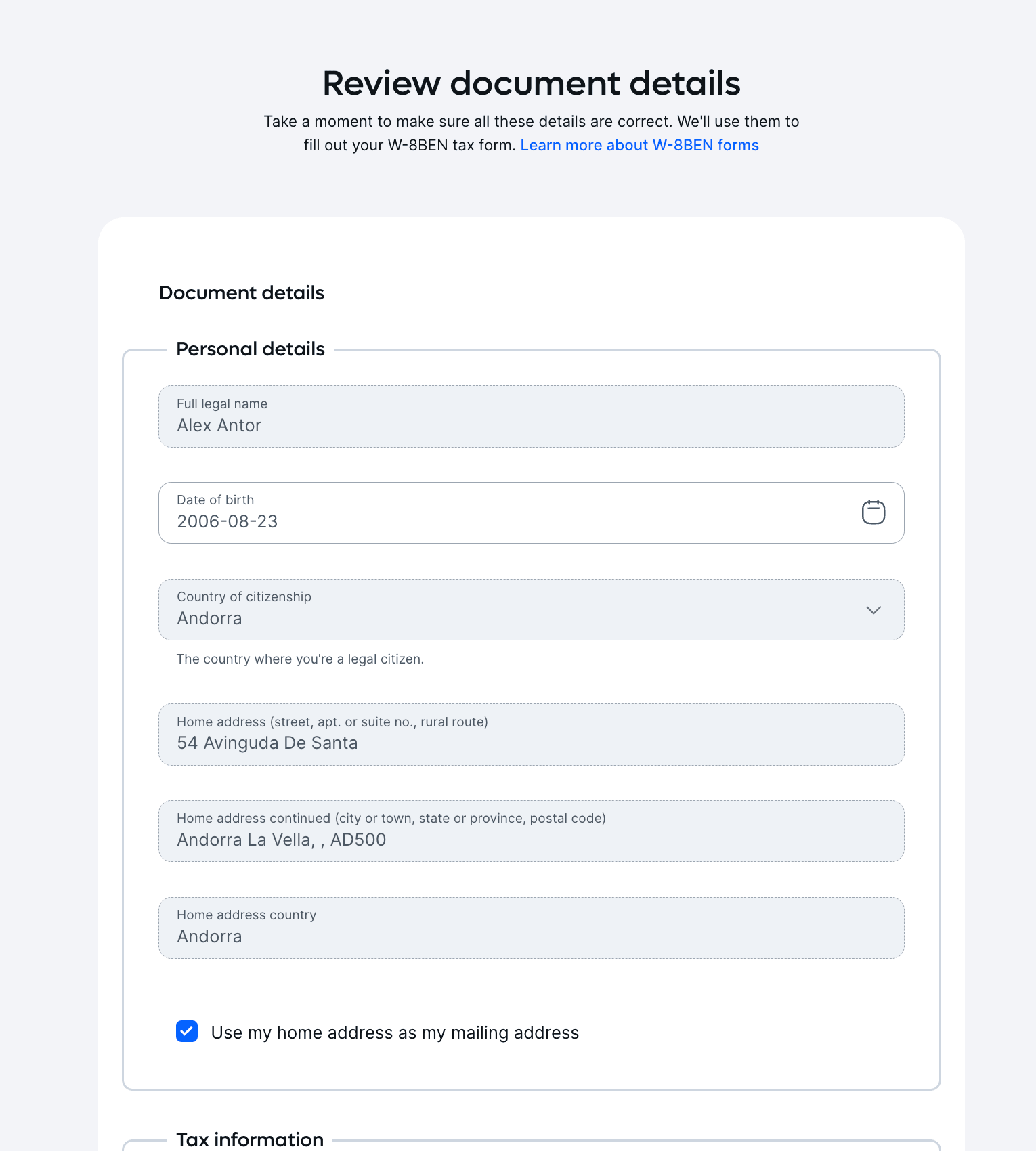
Before approving the first payout, check that the following are complete:
- Signed agreement: Confirm the fee, payout currency, milestone triggers, usage rights and who absorbs transfer charges.
- Verified recipient: Match the creator’s legal name with the bank or wallet details and confirm the payment route is supported.
- Applicable tax record: Collect the form or status documentation that finance requires for this payer and payee.
- Payment documentation: Secure the invoice, approved payment statement or legally valid local alternative needed for the transaction.
- Document owner: Assign responsibility for storage, access controls and any required renewal or reporting.
Tax forms can contain sensitive personal and tax-identification data. Restrict access, define retention rules with the finance or compliance owner, and avoid sharing copies in open folders.
Tax and Disclosure Considerations for Gifts and Commissions
Affiliate commissions are a form of creator remuneration. Free products and gifted services can also have tax or reporting implications, depending on the transaction and jurisdiction. Advertising disclosure is a separate question: assess whether a creator endorsement involves a material brand relationship and follow the rules that apply to the audience and market. Record relevant cash and non-cash value so finance can review the arrangement.
Keep a per-creator record of gifted items, stated values, any posting obligations and required disclosures. That record is easier to maintain when captured at shipment than reconstructed later.
Local Invoicing and VAT Rules
Creators in VAT jurisdictions may need to issue invoices with VAT applied or with a reverse-charge note when billing a foreign business. Give each market an invoice template that already contains the right fields, including your company's tax identifier, and most of the back-and-forth disappears.
Many nano and micro creators have never issued a formal invoice. A fillable template and a two-line explanation of what goes where saves more time than any software feature.
Who Owns Compliance: Brand, Agency or Platform
Name one owner for compliance records and write it into the SOW.
If an agency pays creators on your behalf, the SOW should say which party collects forms, stores them, and produces them in an audit; if a payout platform is merchant of record, confirm in writing what it files and what it leaves to you.
Platforms may bundle tax-form collection, while the underlying legal responsibilities depend on the contractual arrangement. Confirm the provider's role, record retention and any reporting obligations in writing.
How to Structure Milestone Payouts So Production Never Stalls
Define the events that make each tranche payable, then agree when approved payments are processed and expected to reach the creator. A 50/50 or 40/40/20 split can work when the amounts and triggers match the production scope.
1. Release a Deposit at Contract Signature
Approve the first tranche when the signed contract, applicable tax documentation and verified payout details are complete. Set a processing deadline that gives the creator access to any agreed deposit before production costs arise.
The deposit signals commitment and funds the creator's out-of-pocket costs, and because it only releases after paperwork is complete, it also enforces the onboarding checklist without a separate reminder.
Size it to the risk. A new creator in a market where recourse is weak gets 40 percent; a repeat creator with three clean deliveries can get 50 percent without debate.
2. Pay the Second Tranche on Draft Approval
Draft approval makes the second tranche payable. The contract should state whether an approved tranche joins the next scheduled payout batch or qualifies for an expedited transfer, along with the expected arrival window.
In a two-tranche structure this step merges with the final payment. Use three tranches when the deliverable set is large or the edit cycle is long enough that a mid-point payment keeps the creator engaged.
3. Pay the Balance on Final Asset and License Delivery
Tie the final tranche to the agreed deliverables, such as approved raw files, final edits and the signed usage license. Require a live post only when publication is part of the creator's contracted scope. For UGC supplied solely for brand ads, file delivery and rights approval may be the final milestone.
Hypothetical illustration: a UGC program running fortnightly TikTok test batches pays 50 percent on signature and 50 percent on raw-file plus license delivery, so each asset enters the next dark-post round the day the license lands. The split is illustrative; the asset trigger is what matters.
4. Run a Fixed Payout Calendar for the Whole Roster
Use one or two predictable processing days each week for routine approved tranches, with a clearly defined exception for deposits that must arrive before a booked shoot. Tell creators the expected settlement window, since payment approval and receipt can fall on different dates.
Publish the calendar to creators at onboarding. A creator who knows that approved tranches pay every Thursday stops emailing on Tuesday, and your account managers get their week back.
Pro tip: put the payout day in the same weekly planning document as the brief deadlines and the ad launch dates. When all three sit on one page, a slipped payment is visible before it becomes a missed test.
Log every tranche, fee and rights payment against the asset it funded. That ledger is what the next section turns into a landed cost, and without it the ROI figure understates spend from the first campaign onward.
How Payment Fees and Delays Affect Influencer ROI
International payment fees and payout delays hit ROI in two places: they add cost that rarely reaches the spend column, and they push assets out of test slots.
Fees are the clearest example of the missing-cost error described earlier.
| Cost component | Where it hides | How to capture it | Who owns the line |
|---|---|---|---|
| FX spread | Difference between the quoted rate and the rate applied | Track source and settlement currencies, the rate actually applied, a reference rate where available, and explicit fees separately. | Finance |
| Transfer and wire fees | Bank statement, separate from the creator payment | Record per payment, including intermediary deductions | Finance |
| Platform cut or subscription | Monthly invoice, not tied to any creator | Allocate across assets paid that month | Finance with growth |
| Usage rights and renewals | Separate contract clause, often paid later | Accrue against the asset at signature, settle on trigger | Growth or creator lead |
| Admin time | Nowhere; it's salary | Estimate hours per payment run and allocate | Operations |
| Recurring commissions | Future periods after the campaign closed | Accrue a forecast at launch, true up monthly | Finance with growth |
FX Spreads and Transfer Fees on the Ledger
An FX spread is the gap between the mid-market rate and what your bank or platform actually applies, and a transfer fee is the fixed charge on top.
Both are small per payment and material across a roster, and neither appears in a spreadsheet that records only the creator's quoted fee.
For each transfer, record the quoted creator amount and currency, the applied conversion rate, sender fees, any intermediary deductions and the amount received when available. The difference between invoice and settled amounts can reflect several factors, so separate FX spread from stated transfer fees before reporting costs.
Lost Test Iterations From Late Creative
A late asset forfeits a test slot. The loss is a delayed iteration, because the hypothesis that asset was meant to test waits a full cycle, and every brief that would have followed from the result waits with it.
Measure the delay in test cycles. If you run fortnightly test batches and an asset misses one, the learning arrives two weeks late, which compounds across a program that depends on make, launch, learn, repeat.
Landed Cost per Creator Asset
Landed cost per asset is the creator fee plus usage rights plus every payment fee plus an allocation of admin time, all in your reporting currency.
Use landed asset cost when evaluating production efficiency, and include the appropriate share of creator production costs in total acquisition spend when calculating campaign CAC. Cost per asset and CAC are different metrics.
Illustrative landed cost for one creator asset, excluding media spend:
- Creator fee: $500
- Paid-usage rights: $100
- FX and transfer charges: $20
- Allocated payment administration: $30
- Total landed cost: $650
These are sample amounts, rather than observed campaign results. Keep a per-asset ledger for the actual fees, rights, currency conversion and any later commissions.
Hybrid structures with a commission in the range cited above complicate this because payouts recur after the campaign closes, so book a forecast at launch and true it up monthly.
Build the sheet before the next campaign, and share it between finance and growth. The shared view is what turns a payment process into a cost you can manage.
Make Creators Want to Work With You Again
Brands remember the content a campaign produced. Creators remember the experience of working with the brand, including how many follow-ups it took to receive their money.
A campaign can deliver excellent results and still leave a creator reluctant to accept the next brief. Unexpected currency deductions, unclear payment terms, and repeated paperwork all contribute to that experience.
That's worth considering before expanding into another market. The real test of your payment process is whether creators would happily work with you again under the same terms. Reliable payments make those repeat collaborations easier to secure.
If you're planning a creator program across multiple countries, book a call with inBeat to discuss your setup and what your next campaign needs.
Frequently Asked Questions
Can nano and micro creators go through the same workflow as mid-tier talent, or do they need a lighter process?
Use the same core checks with simpler tools: an agreed fee and FX clause, applicable tax documentation, verified payment details and clear deliverable triggers. A wallet, two tranches and a fillable invoice template may be suitable when supported in the creator's market.
What should the contract say about who absorbs FX spreads and receiving fees?
Name the party explicitly and name the currency of the fee.
The cleanest clause states that the creator receives the agreed amount net of all transfer and conversion charges, or that the fee is gross and charges are the creator's; both clauses work, and a contract that leaves it unstated is what produces the dispute.
What should you do if a creator's international payout is returned?
Confirm the rejection reason with the bank or provider, verify the recipient's details and agree on a supported transfer route. Tell the creator when the corrected payout is expected, and flag any production deadline that depends on it. Record both the failed transaction and the replacement payment so costs are reconciled.
How do you pay a creator who has no business entity and cannot issue a formal invoice?
Collect applicable tax documentation and verified payment details, then confirm which payment records are permitted in the creator's jurisdiction. Where self-billing is allowed, obtain any required agreement before issuing an invoice on the creator's behalf. A payout platform that supports individual contractors may also provide suitable documentation.
Do usage rights for ads get settled upfront or on a renewal cycle?
Settle the initial term upfront with the final tranche, since the license is what unlocks paid amplification, and write renewals as a separate trigger with a fixed price for each extension. That way extending a winning asset is a single payment, not a renegotiation.
How should you reconcile creator payments made in several currencies?
Use a consistent reporting currency for campaign comparisons. For each payout, keep the contracted amount and currency, the actual conversion rate, explicit fees and net recipient amount where available. Link those entries to the creator and asset, then reconcile them against the bank or platform statement.