
Influencer marketing has a curious problem: brands are putting more money into it while struggling to explain what they're getting back.
Linqia's 2026 research puts numbers to that contradiction. While 62% of marketers are increasing their budgets, 79% struggle to measure influencer ROI.
The trouble often starts much earlier. A poor creator fit, a restrictive brief or a one-off partnership can hold a campaign back before the first results arrive.
Here are seven influencer marketing mistakes worth examining before you commit another dollar, plus practical fixes backed by real brand examples.
TL;DR: The Seven Mistakes and the Fix for Each
Most mistakes start well before a post goes live. Use this table to spot the cost of each one and the first action to take.
| Mistake | What It Costs | The Fix |
|---|---|---|
| 1. Vetting on follower count | Paying for reach that does not buy, and audience backlash | Test audience fit and sentiment before paying |
| 2. No KPIs before launch | Nothing to judge or renew against | One goal and one primary KPI, set before outreach |
| 3. Scripted briefs | Content that reads as an ad | Lock claims and legal terms, leave the voice to the creator |
| 4. Vague usage rights | Winning posts you cannot run as ads, or rights you overpay for | Write duration, channels and territory per placement |
| 5. Disclosure left to the creator | Regulatory and reputational exposure for the brand | Require, check and log every disclosure |
| 6. One-off posts | No baseline and no winning hook to reuse | Test, read the paid signal, renew what earns it |
| 7. Vanity metrics as ROI | Renewing the wrong creators | Report the campaign's primary KPI by creator |
Already dealing with weak results? The diagnostic table near the end will help you work out where to look first.

Mistake 1: Influencer Vetting Based on Follower Count Alone
A large following looks reassuring on a shortlist. It tells you how many people might see a post, but far less about whether they trust the recommendation.
The audience may be in the wrong market, tune out sponsored content or push back on the category altogether.
Why Follower Count Fails as a Vetting Test
The gap rarely shows up in a creator's media kit. Here's what the familiar numbers leave out:
| Metric Brands Check | What It Hides |
|---|---|
| Follower count | Reach potential, with nothing on buyers or location |
| Engagement rate | Can be inflated, and says nothing about purchase intent |
| Past brand logos | Who paid the creator, and nothing on who bought |
| View counts | One viral post lifts the average |
OpenAI's 2026 "Summer Club" illustrates why audience sentiment deserves its own vetting check. In August the company took a group of creators to a luxury retreat in upstate New York for what TechCrunch described as its first-ever influencer brand trip, with sessions on how to use ChatGPT Work.
- Comments under the creators' posts focused on AI data centers and on the cost of the stay, which The Verge put at upwards of $2,000 a night.
- One post had fewer than 300 likes; another drew under 15,000 views.
- Meanwhile, two reaction clips drew more than 500,000 views combined.
- One creator later wrote that she had not considered the trip might be controversial. OpenAI said the event was education-led.
The backlash tells us little about OpenAI's internal vetting process. It does, however, show why brands should check audience sentiment before signing, rather than assuming reach equals fit.
Favorite Daughter offers a useful contrast.
Its co-founder said a Dallas creator with 60,000 followers sells more of the brand's product than an A-list celebrity. That is a brand-reported claim, as are the other brand figures in this guide, but it matches what a fit-first process looks for.
A Five-Step Vetting Gate Before Any Payment
Here's a practical way to vet a creator before signing.
Start with four screening checks, then use what you learn to choose the right tier. An issue in one area should prompt a closer look, rather than an automatic rejection.
- Pull the creator's last 30 days of organic posts and drop viral outliers before judging reach, the window agency HYDP uses before it contracts creators, according to Digiday.
- Read comments for sentiment toward your category and questions that signal buying interest.
- Check past sponsored posts for category conflicts and disclosure habits.
- Request audience demographics, especially location and age, and check how closely they match your buyer.
- Match the creator tier to the brief. Niche voices can help prove relevance before you expand to accounts with wider reach.
For bot detection, engagement pods and score thresholds, the audience audit and brand-safety screening process covers the full influencer vetting checklist.
Mistake 2: No Influencer Marketing KPIs Set Before Launch
Before you brief anyone, decide what the campaign needs to achieve and how you'll recognize success. That primary KPI will guide the shortlist, formats and tracking. Skip this step and every team can walk away with a different definition of a win.
That expectation is showing up in creator negotiations.
Digiday reports that advertisers now ask for cost per lead, conversions, link clicks and engaged views. Earned media value also makes some scorecards, but it's an estimate of exposure rather than proof of business impact. Keep it as context, not the deciding number.
| Campaign Goal | Primary KPI | Guardrail Metric | Where to Read It |
|---|---|---|---|
| Awareness | Engaged views | Cost per 1,000 engaged views | Platform analytics and creator screenshots |
| Consideration | Landing-page visits from creator links | Bounce rate | GA4 and UTM report |
| Acquisition | Cost per acquisition by creator | New-customer rate | Store backend and tracked codes |
| Ad creative sourcing | Cost per acquisition of the creator ad against the brand ad | Three-second hook rate | Ads Manager |
| App installs or leads | Cost per install or per qualified lead | Day-7 retention or lead quality | Attribution platform or CRM |
Choose the row that reflects the campaign's job. Secondary metrics can help explain performance, but they shouldn't compete with the main target.
Of course, numbers shouldn't make the entire decision.
Rothy's tracks clicks and sales while placing greater weight on creator-brand alignment, according to the same report. The balance is to define success up front without losing sight of fit.
Put the campaign goal and success threshold in the brief. In the contract, spell out deliverables and reporting, adding performance targets only when they're part of an agreed payment model. If the primary KPI is return on spend, the ROI formula and calculator show how to compute it from campaign costs and revenue.
Mistake 3: Influencer Briefs That Script Every Line
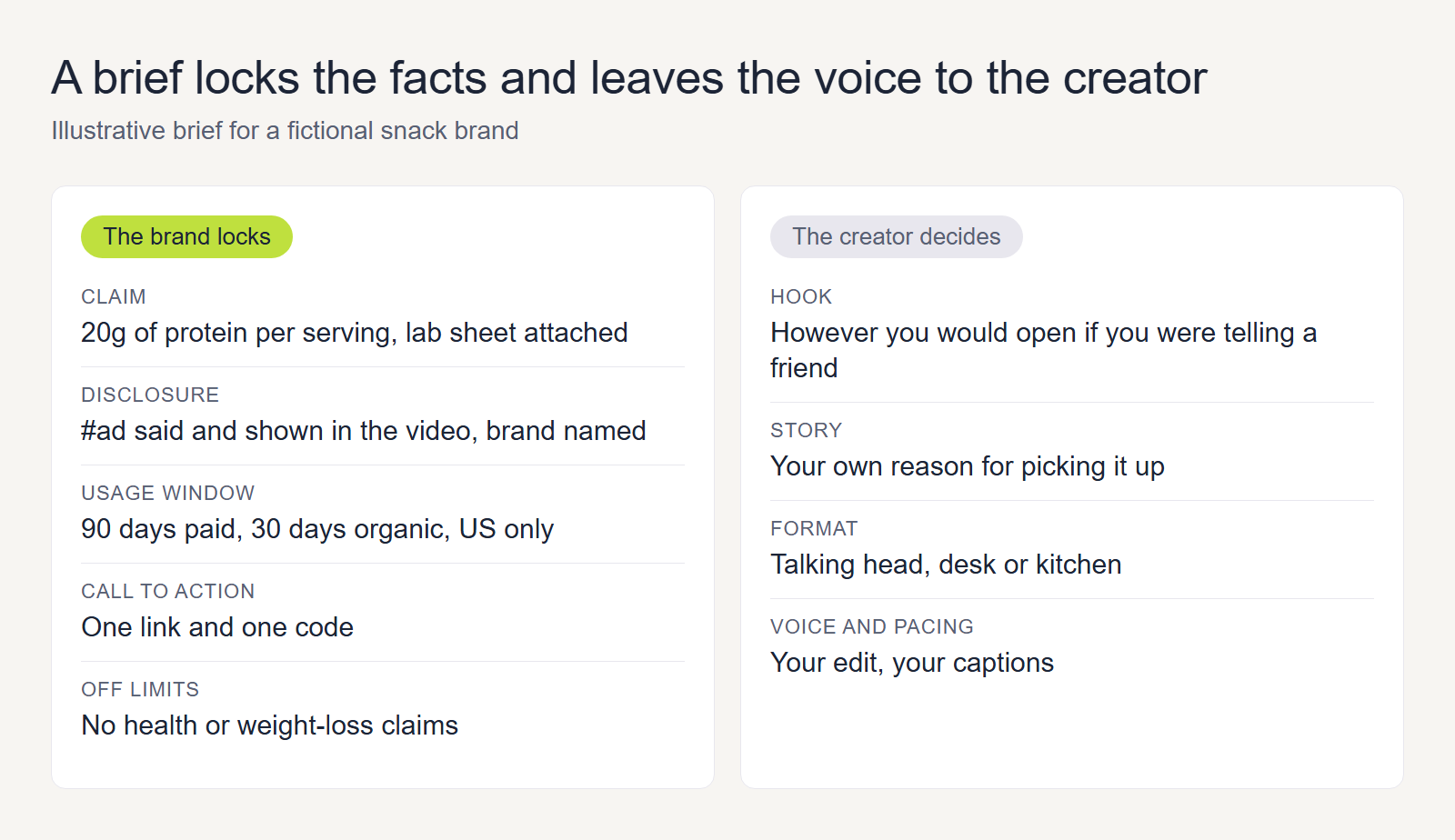
A useful influencer brief sets the boundaries without handing over a script. Lock product claims, required disclosures and other essentials, then leave the hook, format and pacing to the creator. Their audience can usually tell when a recommendation sounds nothing like their usual content.
Lock these in the brief:
- Product claims and the proof behind each one
- Required disclosure language
- The usage window
- One primary call to action
- The primary KPI and the threshold that counts as good
- Off-limits topics
Leave these to the creator:
- The hook and the first three seconds
- The story and the format
- The voice and the pacing
Bob's Discount Furniture shows how creative control can evolve.
Season one of its shoppable series "Till Decor Do Us Part" was produced by the brand and generated more than 152 million video views and nearly $9 million in attributable sales, according to the company's September 2026 announcement.
For season two, Bob's brought in established creator couples and let them take more control of scripts, filming and production. At the same stage of the rollout, its CMO reported roughly 50% higher organic reach and engagement, although the season was still running.
There is a caveat: the cast, distribution and production approach changed together, so that lift cannot be attributed to creative freedom alone. Still, the case shows how a brand can protect the essentials while giving creators room to make the work their own.
Pro tip: review a creator draft against the claims list, and leave tone and pacing alone. The post on what a brief should specify and what it should leave open breaks down the review process.
Mistake 4: Influencer Contracts and Usage Rights Left Vague
Every influencer contract should state how long, where and in which paid or organic channels the brand can run the content, because "organic" and "paid" on their own leave the critical details out.
Digiday reported in September that usage rights are the biggest hurdle in creator pricing, and that shorthand at the offer stage is a main cause.
Here's where the details start affecting the price:
- One influencer manager quoted by Digiday said usage and exclusivity are almost always priced separately.
- Agencies also report more requests for perpetual rights, often to avoid renegotiating later, even when brands are unlikely to use the content for years.
- That can be expensive for paid creative that may need replacing month after month.
- One seasonal brand took a different route. Its agency negotiated six months of non-consecutive usage across the calendar, and the creators agreed.
Whitelisting lets brands run authorized paid ads using a creator's content or identity. Meta calls these partnership ads, while TikTok uses Spark Ads. Contracts and platform permissions both need to cover the full ad run.
| Clause | What to Specify | What Breaks When It Is Vague |
|---|---|---|
| Duration | Months of paid and organic use, with a start date | Content pulled mid-flight, or run past the license |
| Channels and whitelisting | Organic, paid, partnership ads, Spark Ads, site, email | A winning post that cannot be boosted |
| Territory | The markets where the content may run | Global use on a local license |
| Exclusivity window | Competitor categories and number of days | Paying for exclusivity that was never needed |
| Edits and derivatives | Cutdowns, captions, music | Re-approval cycles that delay launch |
| Payment date | A fixed pay date and the payee | Late payment and a disengaged creator |
| Revision rounds | A cap, such as two rounds | Open-ended edits and creator burnout |
| Kill fee and exit | Fee if the brand cancels, plus a reputation exit | Disputes when a campaign ends early |
The full clause list sits in clauses, deal types and red flags, and tiering licenses by region and spend is a cheaper way to avoid paying for rights you will never use.
Mistake 5: FTC Influencer Disclosure Treated as the Creator's Job
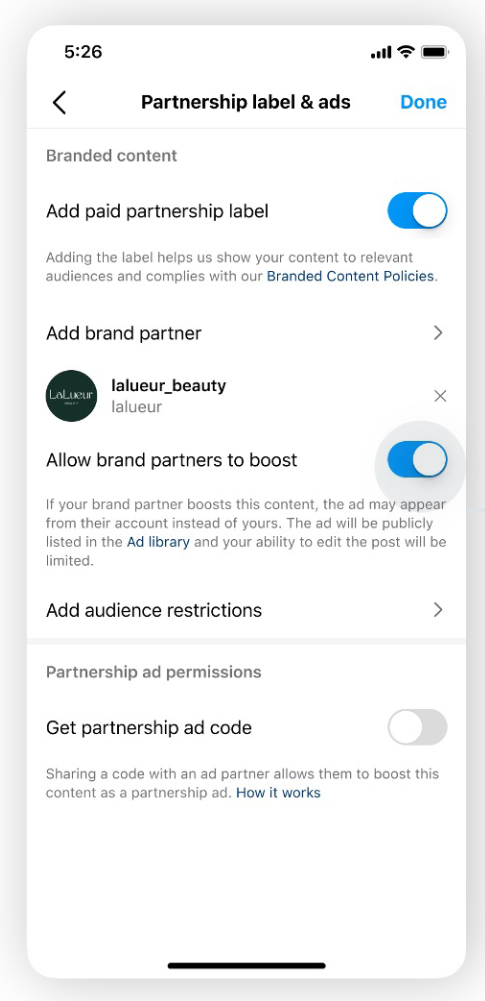
A brand shares responsibility for a creator's missing disclosure, so it needs its own process for checking them. The FTC's updated Endorsement Guides set out staff views on how brands should monitor the influencers they pay and on platform disclosure tools.
Kalshi offers a useful example from 2026:
- In June the National Advertising Division, the ad industry's self-regulatory body, said it would refer Kalshi to regulators, including state attorneys general.
- The inquiry centered on whether Kalshi's ties to influencers or affiliates were clearly disclosed and whether the company had adequate steps in place to monitor compliance.
- Kalshi declined to participate. The release made no finding of a violation, but it shows how a brand's own oversight can come under scrutiny alongside its creators' posts.
Material connection includes free product and affiliate commissions. The FTC rules on endorsements and material connection apply to a gifted-product post the same way they apply to a paid one.
The FTC's warning letters show the disclosure habits it expects brands to monitor.
Its Endorsement Guides are advisory, but deceptive endorsements can still lead to enforcement under the FTC Act. Where civil penalties are legally available, the maximum is $53,088 per violation in 2026. That is a statutory ceiling, not an automatic fine for a missing disclosure.
For brands, that means a review process with five simple checks:
- Add a contract clause requiring disclosure in the video itself.
- Name the sponsor clearly.
- Use platform disclosure tags as extra support, never as the only notice viewers see.
- Review the disclosure in the draft before publication, then save a dated screenshot once the post is live.
- Assign one owner to recheck each live post within 24 hours and correct any disclosure gaps immediately.
For health and financial promotions, add a legal or compliance review of the claims before the post goes live. The disclosures matter, but so does the message itself.
Mistake 6: One-Off Influencer Posts With No Program Behind Them
One post might get attention, but it gives you little to compare. A recurring creator program lets you test different people and hooks, read the paid results, and bring back what works. That's a better basis for deciding who deserves another round than one impressive view count.
CreatorIQ's 2026 research adds useful context: 38% of brands named boosting creator posts as their highest-ROI creator activity. But that doesn't mean putting paid spend behind every post. Give yourself a range of creative concepts, then scale the ones that earn it.
Here's how a 90-day test could work:
- Days 1 to 30: recruit 8 to 10 creators across two message angles, secure paid usage rights for the test phase, then run small-budget dark-post tests to compare hooks.
- Days 31 to 60: after a full purchase cycle, compare cost per result and creative quality by creator. Pause weak concepts rather than renewing every partner by default.
- Days 61 to 90: renew the best-fit creators, extend paid usage rights where needed, and scale the concepts that met the campaign KPI.
Favorite Daughter offers a useful planning example.
The brand began working with creators in August ahead of its September 25 National Daughters Day sale. Twenty-five creators went live that morning, and the brand reported $2 million in total sales, double the previous year, according to Coresight Research's Shoptalk recap. The figure describes the whole promotion, not sales attributed solely to creators.
SharkNinja offers a larger-scale example.
In October 2026, it launched First Fans for employees and SharkNinja Storytellers for consumers who share their product experiences. The company reported more than 19 billion impressions across over 200,000 brand and creator posts that year. These are company-reported reach figures, not sales attributed to influencer partnerships.
If you'd rather have a team run the test-and-scale loop, our performance creative agency handles the testing and creator-level reporting.
Mistake 7: Influencer Marketing ROI Reported From Vanity Metrics
For acquisition campaigns, compare cost per acquired customer by creator. For awareness, consideration or lead generation, use the primary KPI you chose in Mistake 2. Views, likes and earned media value can add context, but they cannot replace the outcome you're trying to achieve.
View counts are also less stable than they look: on August 24, 2026 YouTube began counting a view from the first frame, with no minimum watch time, which is why one agency now asks creators for engaged views up front.
Build the tracking into the campaign from the start:
- Set up a unique tracked link with UTM parameters for each creator.
- Assign individual promo codes as another signal.
- Add a post-purchase "how did you hear about us" survey.
- Track each creator's results against the campaign's primary KPI in a shared sheet.
- For campaigns with enough geographic coverage and spend, consider a geo holdout test to estimate incrementality before scaling.
- Review the same campaign through two attribution models.
None of these methods tells the whole story. Last-click attribution can miss purchases that begin with a creator's post and end through search. Promo codes also leak to coupon sites. Read the signals together rather than treating one report as the final answer.
Take a simple hypothetical campaign: six creators receive $2,000 each, for a total budget of $12,000. Two of them bring in all 40 purchases.
- Blended cost per acquisition: $12,000 / 40 = $300
- Cost per acquisition for the two winning creators alone: $4,000 / 40 = $100
- The other four creators absorbed $8,000 and drove nothing
At campaign level, the CPA is $300. Look more closely and the two creators who drove purchases have a combined CPA of $100. That changes who you'd investigate for a renewal.
Underperforming Influencer Campaign? Which Mistake to Check First
If something feels off while a campaign is live, start with the symptom. This table shows where to look before you change the budget or swap creators.
| What You See | Most Likely Mistake | First Check |
|---|---|---|
| Views are high and sales are flat | Mistake 2 or 7 | Confirm a primary KPI was set and every creator has a tracked link and code |
| Comments are hostile or off-topic | Mistake 1 | Read the comments on the creator's last five sponsored posts |
| The content feels scripted and underperforms its campaign goal | Mistake 3 | Compare the creative with the creator's organic posts and the relevant campaign KPI |
| A strong post cannot run as an ad or was paused | Mistake 4 | Check the license for paid use, channel and dates |
| A watchdog or platform flags missing disclosure | Mistake 5 | Audit every live post against your disclosure log |
| One big post, then flat results | Mistake 6 | Check whether a second and third concept were ever tested |
When backlash goes public, as it did for OpenAI, respond with facts and the brand's reasoning, and keep creators out of the line of fire. Reaction videos can outrun the original posts, as The Verge's numbers showed.
The guide on responding when creator content draws backlash covers the response steps.
Run Influencer Campaigns Without Costly Mistakes With inBeat Agency
Most of these mistakes can be caught before launch. Vet the audience, agree on creative boundaries and rights, then judge results against the campaign goal.
At inBeat Agency, we bring those checks together across creator sourcing, paid testing and reporting, so every new round of content builds on what you've learned.
Book a strategy call and bring one live campaign. We will review it against the seven checks and tell you which one to fix first.
FAQs
How long should a brand wait before calling a creator campaign a failure?
Judge a creator campaign after a full purchase cycle, while watching early click and conversion signals where relevant. In a Statista survey of 1,050 U.S. consumers for NeoReach, 22% said they bought within a day of discovering a creator recommendation. That's self-reported behavior, not observed sales data. Fast-moving categories may show an early signal, while longer-consideration purchases need more time.
Which of these mistakes change for B2B influencer marketing?
For B2B, the more useful question is whether the right decision-makers are paying attention. Vet audiences for job role, seniority and buying influence, then track qualified leads, demos or pipeline rather than consumer sales. Disclosure and usage terms still apply.
Is a brand liable when a creator skips a disclosure the contract required?
Potentially. Responsibility depends on the facts, including the brand's oversight and the creator's conduct. A contract clause sets expectations, but brands should also train creators, monitor posts and keep records. Relying on the clause alone offers little protection.
When does performance-based creator pay beat a flat fee?
Commission or conversion-based pay can work for proven products with reliable tracking. Flat fees make more sense when you're testing new concepts and the outcome is uncertain. Kohl's, for example, offers creators commission on sales alongside free product, according to Digiday. A base fee plus a performance bonus gives both sides some predictability.
How can a brand tell how much of a creator budget reaches the creator?
Ask for a line-by-line budget that separates talent fees, agency fees, production, usage rights and paid amplification. Consultancy TrinityP3 argues a bundled deal can leave as little as 35% of the budget for talent, against as much as 60% when billed line by line. Digiday also reports ANA figures showing agencies take 30% of influencer spend on average and only 39% of agreements are transparent to the marketer.