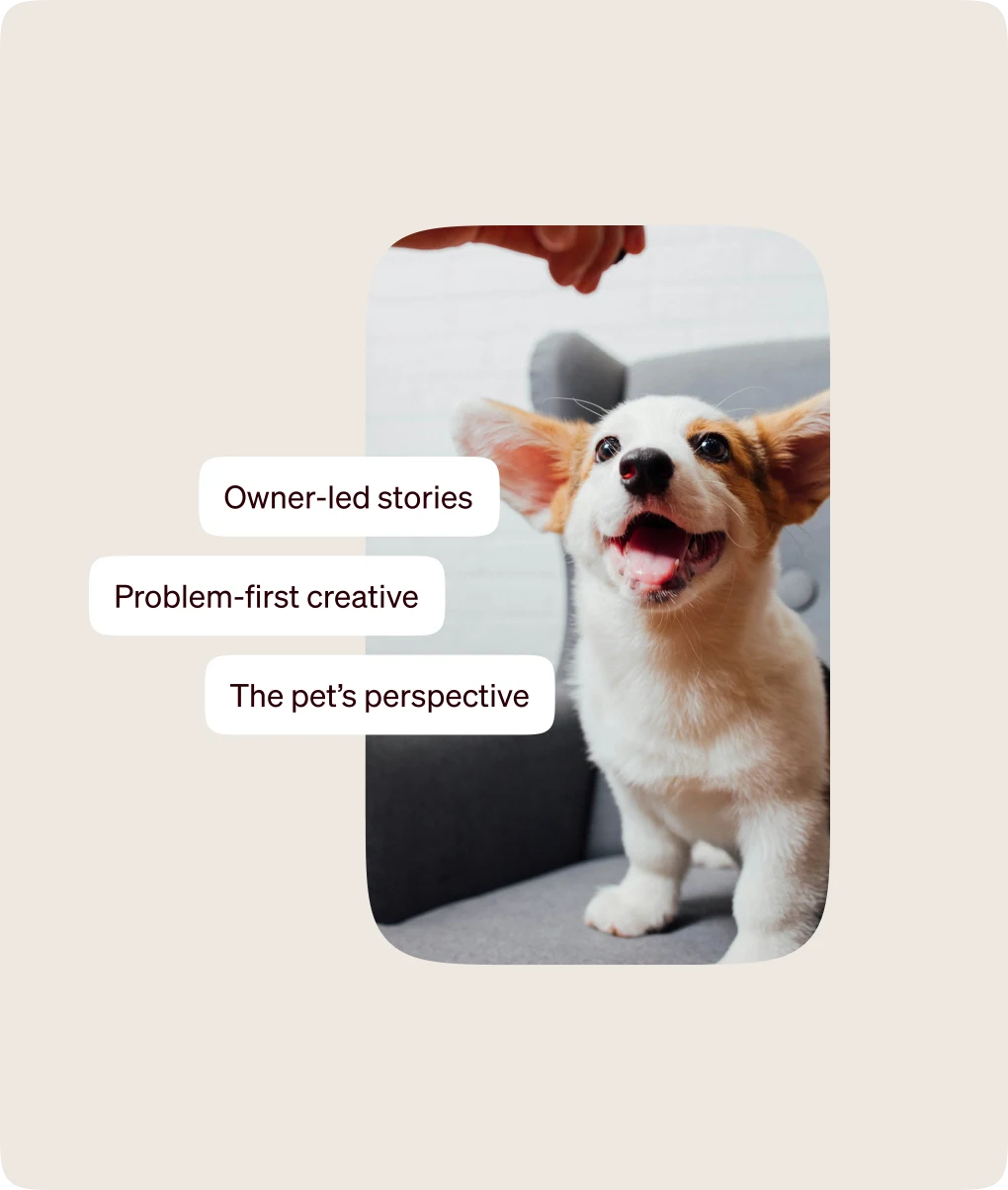
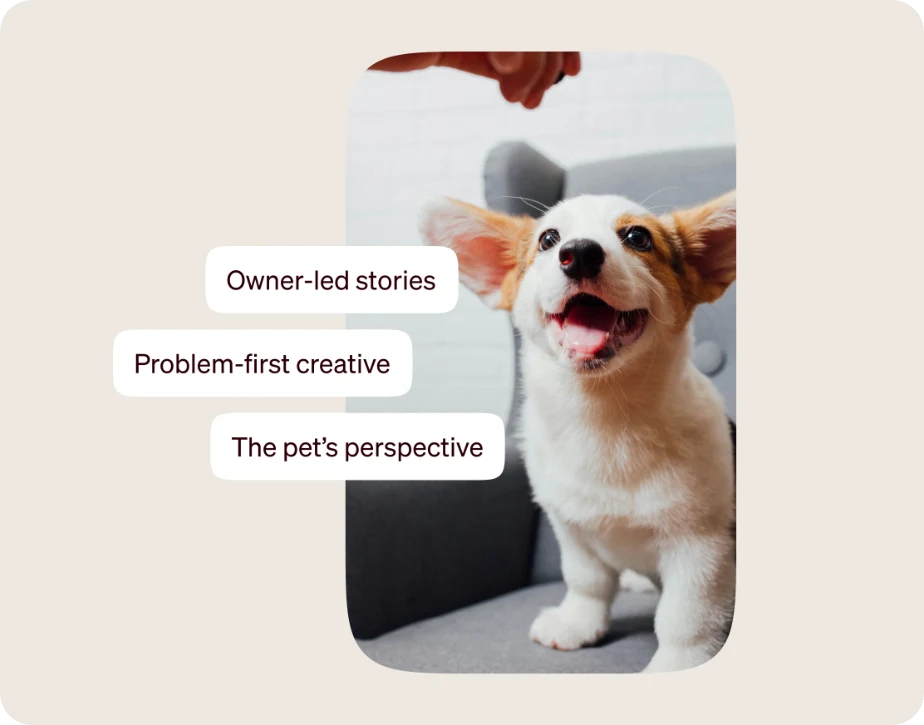
2,572 pet ads and posts: what pet UGC almost never does
We analyzed 24 pet brands across paid ads and organic social. The pet opens the video. The person does the talking.
The idea to take with you
Creator-style video is already common in paid pet ads. The pet’s own voice and perspective are the open lane worth testing.
Independent research by inBeat
November 2026
893 Meta ads and 1,679 organic posts. Research captured November 16–17, 2026. Shares describe creative, not spend or results.
The pet opens the video. The person does the talking.
3.3%
Only 84 of 2,572 ads and posts give the pet a voice
A pet point-of-view shot appears in just seven posts, and none of them are ads. These are creative shares, not evidence of campaign returns.
The pet opens the video. The person does the talking. In our sample, a real animal is on screen within the first second of about two in three videos on every channel. Yet a voice speaking as the pet shows up in 3.3% of everything we coded (84 of 2,572), and a shot framed as the pet’s point of view in 7 posts, none of them ads.
Paid UGC is a sales format. 82% of the brands’ Meta video ads look like creator content, more than on their own organic Facebook (58%), Instagram (70%) or TikTok (65%). In those ads, the creator names a concrete problem 74% of the time and shows the product in use 82% of the time. On the brands’ own feeds, both drop by half or more.
One reading: pet brands have settled on a single template for paid creator content (owner, problem, product, offer). The pet’s own perspective is the part almost nobody uses, which makes it the open lane worth testing.
Pet brands spend heavily on creator-style video, and most of it follows the same script. We wanted to know what pet UGC looks like across paid and organic channels, and what it leaves out.
So we coded every ad and post against the same set of labels: who appears first, how fast the pet shows up, whether the pet “talks”, whether the camera takes the pet’s point of view, whether the product is used on camera, the setting, the production finish, whether the video works without sound, and the opening hook.
Disclaimer: This is one snapshot of active ads and recent posts. Shares describe ads and posts, without assessing brand spend or results.
1 The sample
24 pet brands. Four channels. One consistent set of labels.
24 US pet brands that make their own products, 2,572 ads and posts. We picked direct-to-consumer and challenger brands across four segments, then collected four channels for each one:
Meta ads: 893 ads active in the US Meta Ad Library on November 16, 2026, up to 40 per brand, chosen the same way for every brand. These are paid ads: all 893 run in Instagram placements and 892 also run on Facebook.
Facebook posts: 532 posts from the brands’ own Facebook pages published between August 18 and November 16, 2026, up to 30 per brand. PetLab Co. had no posts in that window, so Facebook covers 23 brands.
Instagram posts: 689 posts from the brands’ own profiles published between August 18 and November 16, 2026, up to 30 per brand. 144 of them are collaboration posts published from a creator’s account with the brand as co-author.
TikTok posts: 458 posts from the same window, up to 30 per brand. Five brands had no active TikTok account, so TikTok covers 19 brands.
Retailers that sell many brands (Chewy, Petco, PetSmart) and pet insurance are out of scope.
Segment
Brand
Meta ads
Facebook posts
Instagram posts
TikTok posts
Food
Jinx
40
8
20
4
Food
JustFoodForDogs
40
28
30
23
Food
Maev
40
13
29
13
Food
Ollie
40
24
30
30
Food
Open Farm
40
30
30
27
Food
Spot & Tango
40
1
30
30
Food
The Farmer’s Dog
40
30
30
27
Grooming, litter and hygiene
Fresh Patch
40
27
29
30
Grooming, litter and hygiene
Litter-Robot by Whisker
12
27
29
30
Grooming, litter and hygiene
PrettyLitter
40
27
30
30
Grooming, litter and hygiene
Wondercide
40
21
28
23
Toys, gear and tech
BarkBox
25
21
29
14
Toys, gear and tech
Bullymake
40
25
30
0
Toys, gear and tech
Dog Friendly Co.
40
30
30
30
Toys, gear and tech
Halo Collar
40
30
30
20
Toys, gear and tech
Ruffwear
40
27
30
0
Toys, gear and tech
Tuft & Paw
40
30
30
30
Treats and supplements
Bocce’s Bakery
16
14
30
0
Treats and supplements
Dog is Human
40
27
25
9
Treats and supplements
Finn
40
5
30
30
Treats and supplements
Native Pet
40
30
30
30
Treats and supplements
Pet Honesty
40
27
30
0
Treats and supplements
PetLab Co.
40
0
20
28
Treats and supplements
Zesty Paws
40
30
30
0
Total
24 brands
893
532
689
458
How to read the numbers
Channel names. “Meta ads” means paid ads, shown on both Facebook and Instagram. “Facebook”, “Instagram” and “TikTok” mean the brands’ own organic posts on each platform. Meta ads can’t be split by platform (see Sources and scope), so the paid column covers both apps.
Counting unit. Each ad or post counts once. If it has several images or videos, a label counts as present when any of them shows it.
Video comparisons. TikTok is almost all video (445 of 458 posts), while 37% of Meta ads, 39% of Facebook posts and 41% of Instagram posts are images only. Every cross-channel comparison below uses videos only (564 Meta ads, 325 Facebook posts, 405 Instagram posts, 445 TikTok posts), so the format mix doesn’t drive the gap.
Small samples. Jinx (4) and Dog is Human (9) have under 10 TikTok posts, and Spot & Tango (1), Finn (5) and Jinx (8) post rarely on Facebook. They stay in the totals and are flagged wherever brands are compared.
Checks. Each headline gap held when we gave every brand equal weight, left out any single brand, removed the brand with the most positives and dropped the posts flagged in a second review.
Your move
Before you benchmark your own creative against these numbers, split your library the same way (video vs image, paid vs organic). Pooled numbers hide most of the differences that matter here.
2 Paid vs organic
Paid video looks more like UGC than the brands’ own feeds
82% of paid Meta video ads (shown on Facebook and Instagram) look like creator content (462 of 564), against 58% of the brands’ organic Facebook videos (190 of 325), 70% of their organic Instagram videos (284 of 405) and 65% of their organic TikTok videos (288 of 445). Same 24 brands, same week.
Creator-style look · share of videos
The same brands, compared across paid and organic channels.
Meta ads
82%
Facebook organic
58%
Instagram organic
70%
TikTok organic
65%
Video-only comparison: 564 Meta ads, 325 Facebook posts, 405 Instagram posts and 445 TikTok posts. Shares of videos, not spend or results.
We count a video as creator-style when its main presentation is personal and social-native: a person filming their own pet at home, talking to a phone camera, or a creator segment that carries the video. It describes how the ad looks, and not who made it.
You might expect brands to keep the polished work for ads and the casual footage for their own feeds. Our sample points the other way.
21 of the 24 brands use a creator look in most of their video ads
11 of 22 on Facebook
18 do so on Instagram
11 of 19 on TikTok (only 19 of the 24 brands we analyzed have an active TikTok account)
Removing any single brand keeps Meta between 80.5% and 83.8%, and giving every brand equal weight still puts Meta ahead (76% against 54% on Facebook, 70% on Instagram and 63% on TikTok). Taken together, the brands’ Meta organic feeds (Facebook and Instagram) come to 65%, against 82% for their Meta ads.
The format changes with the channel
Testimonials, demos, unboxings and before-and-after videos make up 52% of Meta video ads, 23% of Facebook videos, 26% of Instagram videos and 22% of TikTok videos.
Lifestyle clips and skits fill the feeds instead: 37% on Facebook, 34% on Instagram and 44% on TikTok, against 10% in ads.
The three organic feeds look alike on format. Facebook is the least creator-led channel of the four.
Your move
If your paid creative already looks like UGC, that look won’t set you apart by itself. What changes the result is what the creator does in the video, which is where section 03 comes in.
3 Problems and product use
In ads, UGC names a problem and shows the product working
74% of Meta video ads name a concrete pet or owner problem (419 of 564). On the brands’ own feeds, it’s 26% on Facebook, 29% on Instagram and 27% on TikTok. It’s the widest and most stable gap in the study.
A concrete problem is a specific difficulty the video names: fleas after walks, bad breath, a picky eater, hairballs, litter box smell, a senior dog slowing down. A general promise (“healthy, happy dogs”) doesn’t count.
16 of the 24 brands name a problem in most of their video ads.
Removing any single brand keeps the paid share between 72.7% and 76.4%, and the gap holds with equal brand weight (70% against 25% on Facebook, 29% on Instagram and 26% on TikTok).
Names a concrete problem · share of videos
The same brands, compared across paid and organic channels.
Meta ads
74%
Facebook organic
26%
Instagram organic
29%
TikTok organic
27%
Video-only comparison: 564 Meta ads, 325 Facebook posts, 405 Instagram posts and 445 TikTok posts. Shares of videos, not spend or results.
The creator carries the pitch
Inside Meta, the creator-style ads are the ones doing the selling. They name a problem in 78% of cases, against 59% of brand-produced video ads. They show the product in use in 86% of cases, against 64% of brand ads.
Share of videos
Meta ads
Facebook organic
Instagram organic
TikTok organic
Product used on camera
82%
51%
61%
47%
Discount appears
45%
2%
6%
2%
Playful tone
33%
68%
64%
71%
Why the problem-first script fits this category
Pet owners switch foods more often than you might expect. In fact, Packaged Facts found that 43% of US dog and cat owners changed pet food in the 12 months to September 2025, and 70% said they’d pay more for foods with health benefits (Petfood Industry, July 2026).
A named problem gives a switcher a reason to try something new, which is one reading of why brands lean on it when they pay for reach.
Your move
Keep problem-first creator ads for paid, and write the problem in the owner’s own words (“why does every walk turn into a flea check?”). On organic, you don’t need to copy the ad script; your feed is where the brand’s personality can carry the post.
4 The opening frame
The pet opens almost everywhere; paid ads put the product first more often
A real animal is on screen within the first second of 60% of Meta video ads, 64% of Facebook videos, 67% of Instagram videos and 65% of TikTok videos. It’s the one habit all four channels share.
Opening pattern · videos
Meta ads
Facebook organic
Instagram organic
TikTok organic
Pet within first second
60%
64%
67%
65%
Product first on screen
22%
15%
10%
10%
The pet shows up at some point in 85% to 89% of videos on every channel, and in most of those it’s there from the first frame.
The pattern holds brand by brand: removing any single brand keeps every channel between 58% and 68%, Facebook included.
What changes in paid is how often the product takes the opening frame. In Meta video ads, the product is the very first thing you see in 22% of cases, about twice the rate on Instagram posts (10%) and TikTok posts (10%), and well above Facebook organic posts (15%).
Removing any single brand keeps the paid share between 19.5% and 22.7%.
A product-first open is the brand-produced version of the hook: a bag, a tin or a collar on screen from frame one. 61% of these ads carry a discount (74 of 122), against 46% of all paid videos.
People open most of the rest. An owner or presenter is first on screen in about a third of videos on every channel (31% to 34%). A visibly identified vet opens 2% to 4% of videos, though trainers or groomers almost never do.
Your move
The pet-first open is now table stakes, so it won’t make you stand out. Test what happens in seconds two to five instead: the pet’s reaction to the product, or the problem shown from the pet’s side.
5 The pet’s perspective
The pet is on screen. Its perspective is almost absent.
The pet is in almost every video, but it rarely speaks and almost never holds the camera. A voice or caption speaking as the pet appears in 84 of 2,572 ads and posts (3.3%). A shot framed as the pet’s point of view appears in 7 (0.3%), and none of those is an ad.
Pet presence vs pet perspective · all ads and posts
Presence is common. A voice or point of view is rare.
Real pet on screen
80%
Pet voice
3.3%
Pet point of view
0.3%
All 2,572 ads and posts. Pet voice: 84 items. Pet point-of-view: seven posts, none paid.
The pet’s voice
We counted a talking pet when a voiceover or on-screen caption speaks in the first person as the animal (“We don’t drool over just anything”). In videos, that’s 6% of Meta ads, 3% of Facebook organic posts, 5% of Instagram organic posts and 5% of TikTok organic posts.
The channels don’t differ in any meaningful way; the format is rare everywhere.
It isn’t unknown, though. 18 of the 24 brands used it at least once, and PrettyLitter (13) and Ollie (12) account for almost a third of all cases.
When a pet voice does show up in an ad, it tends to carry the same problem-first script as the rest: a PrettyLitter cat “confronting” its owner about her love life sets up a line about its urinary health (see the examples below).
The pet’s point of view
Only seven posts frame a shot as the pet’s view, from four brands: PrettyLitter (a cat at the window captioned “my view:”), Dog Friendly Co. (an owner leaning down into the lens, “Ready? Let’s go”), Open Farm and BarkBox.
All seven are organic. In 893 active Meta ads, we found none.
What research says about letting the pet speak
A 2025 study in the Journal of Advertising Research tested posts written in the first person as a pet against identical posts written as a person.
In a small Meta split test for a peanut butter brand, the pet version drew 18 post engagements against 6, at about a third of the cost per result.
In follow-up experiments, people were willing to pay more for products endorsed in the pet’s voice, and the effect ran through how sincere the pet seemed (Lavertu et al., 2025).
The authors’ advice was concrete: give the pet human-like features and keep the message about the present moment.
That study looked at pet influencer posts, not brand ads, and the field test was small. Still, it points at the same gap our data shows: the format with evidence behind it is the one pet brands almost never use.
Your move
Take one problem-first script that already runs in your ads and recut it so the pet tells it, in the present tense (“Every walk ends with a flea check. I’m over it.”). Run it against the original with the same offer, and judge it on cost per first order.
6 Research context
What research says about pets, sincerity and switching
Four sources help explain the patterns above. None of them measures these brands’ ads; they describe the buyers and how people respond to animals in marketing.
US pet spending reached $158 billion in 2025. 95 million households own a pet; dogs live in 53% of households and cats in 39%. 22% of owners spent less on their pets in 2025.
A large, value-conscious market where owners are weighing every purchase, which suits a problem-and-offer script in paid.
Posts written in the pet’s voice drew more engagement than the same posts in a person’s voice, and raised willingness to pay. Sincerity explained the effect.
The strongest evidence for the format our sample almost never uses (3.3% of ads and posts).
Across 126,220 evaluations of 302 print ads, animals helped attitude change and purchase intention, and worked best without a human model next to them for those later stages.
Most pet UGC pairs the animal with an owner. Pet-led cuts are worth testing for audiences already close to buying.
Two caveats. The Trivedi and Teichert study used print ads, and the Lavertu field test was small. Treat both as reasons to test.
7 More patterns
More patterns to use in your next creator brief
The findings below didn’t make the headline, but they’re useful when you brief a creator. Shares are of videos unless the row says otherwise.
Pattern
Meta ads
Facebook organic
Instagram organic
TikTok organic
Median video length
32 s
17 s
21 s
16 s
Testimonial format
28%
4%
4%
7%
Opens on a trend or meme
7%
21%
17%
24%
Opens on the pet doing something
14%
24%
28%
23%
Filmed at home
51%
43%
45%
45%
Features a cat
20%
27%
20%
26%
Makes sense with the sound off
84%
91%
91%
88%
Two platform-only patterns: 21% of the brands’ Instagram posts (144 of 689) are collaboration posts published from a creator’s account, and the brands also paid to promote 46% of their TikTok posts (209 of 458).
A pattern we checked and dropped
TikTok marks which organic posts a brand also paid to promote. Promoted posts looked more like creator content than the rest (78% against 65% in brands that do both). The difference showed up in only 6 of the 13 brands, so it’s one way some brands work, though it is not a rule we can report.
8 Creative examples
Seven executions show how these patterns look in practice
Seven examples from the sample, each one typical of a pattern above. Product and health claims are the brands’ own. Meta links open the ad in the Ad Library; active ads can stop running at any time.
A
Meta ad
Zesty Paws: the flea check
An owner brings her dog in from a walk and asks why every walk turns into a flea check, then walks through the brand’s flea and tick kit with a discount. The paid template in one video: creator look, named problem, product in use, offer.
Two dogs cuddling open the video under the caption “pet products that actually work”, followed by a supplement bundle and 25% off the first order. Pet first on screen, problem named, offer in the copy.
A cat “confronts” its owner about her dating life in a back-and-forth, and the owner turns it into a line about his urinary health. One of the few paid videos where the pet gets a voice, and it still lands on a named problem.
A creator holds her orange cat and talks through hairballs and a dull coat. A collaboration post published from the creator’s own profile, which is how 21% of the brands’ Instagram posts reach the feed.
On-screen text sets haunted houses against a real fear: your dog finding a chicken bone on the sidewalk. A trend-style open, the format behind 24% of the brands’ TikTok videos.
A cat’s silhouette at a sunny window, captioned “my view:”. One of only seven posts in the whole sample framed as the pet’s point of view, and the same video ran on the brand’s TikTok.
These are tests we’d run, based on the gaps above. None of them is a proven result yet. Each one names the number that would settle it; a better click-through rate or more likes by themselves don’t.
1
Let the pet tell the problem
Recut your best problem-first creator ad so the pet speaks, in the present tense, with the same offer and length.
How to judge it: Cost per first order and new-customer share against the original. For subscriptions, add 60-day retention.
2
Open from the pet’s eye level
Replace the first two seconds with a shot framed as the pet’s view (the bowl, the leash, the door), then run the same ad.
How to judge it: Cost per first order. Watch 3-second view rate as a diagnostic.
3
A pet-led cut for warm audiences
For retargeting, cut a version with the animal and product only, no owner on screen.
How to judge it: Conversion rate and cost per order among people who already visited your site.
4
Bring the feed’s personality into paid
Take an organic post that already did well, keep its playful open, and add the owner’s problem as a line on screen before the product appears.
How to judge it: Cost per first order against your standard creator ad.
Beyond pet brands
This chapter is our interpretation of the data. Any category where the end user can’t speak for themselves (baby care, elder care, plants) faces the same choice: tell the story through the buyer or through the person or creature being cared for. In this sample, almost everyone picked the buyer.
Frequently asked questions
What is pet UGC?
Pet UGC is user-generated or creator-style content featuring pets and their owners: a person filming their own dog or cat at home, reviewing a product, or showing it in daily use. Brands use it in paid ads and on their own social feeds. In our sample, 82% of pet brands’ Meta video ads have this look.
Do pet brands use UGC more in ads or on their own social accounts?
In ads, in our sample. 82% of Meta video ads look like creator content, against 58% of the same brands’ Facebook videos, 70% of their Instagram videos and 65% of their TikTok videos. The ads also name a concrete problem far more often (74% against 26%, 29% and 27%).
What makes a pet UGC ad different from an organic pet post?
The job it does. Paid creator videos usually name a problem, show the product in use and carry an offer. Organic posts lean playful, rarely include a discount and show the product in use less often.
What does pet UGC almost never do?
Give the pet a voice or a point of view. A voice speaking as the pet appears in 3.3% of the 2,572 ads and posts we coded, and a shot framed as the pet’s point of view in 0.3%, with none in active Meta ads.
Sources and scope
What we collected
893 Meta ads active in the US Meta Ad Library on November 16, 2026, from 24 brands (up to 40 per brand), with their images and videos.
532 Facebook posts, 689 Instagram posts and 458 TikTok posts published by the same brands between August 18 and November 16, 2026 (up to 30 per brand and platform, pinned posts excluded).
Each ad and post was labeled against one fixed set of definitions, with a second review of about 10% of items for every brand and channel. The same definitions apply to all four channels.
Why these four channels
An ideal split would put paid and organic side by side on each platform. Public data doesn’t allow that today, for two reasons:
Facebook ads and Instagram ads can’t be separated. Meta runs one ad across several placements, and 892 of the 893 ads in our sample ran on Facebook and Instagram at the same time, with the same creative. The Ad Library doesn’t show how much of an ad was delivered on each app, so we treat Meta ads as one paid channel.
US TikTok ads aren’t public. TikTok’s public ad library only covers ads shown in Europe, the UK and Switzerland. What TikTok does show is which organic posts a brand also paid to promote, so we report that share (46% of the brands’ TikTok posts) instead.
For organic, we used each brand’s own Facebook page, Instagram profile and TikTok account, so the paid column can be read against the organic feeds on both Meta apps.
What the numbers describe, and what they don’t
Shares are of ads and posts, not of spend, impressions or sales. An active ad isn’t necessarily a successful one.
“Creator-style” describes how a video looks, not who made it or whether the person is a real customer.
Product and health claims are quoted as the brands’ own.
The sample is purposive: 24 direct-to-consumer and challenger brands that make their own products. It doesn’t represent every pet brand or retailer.