
When I interviewed Andrew Kamphey for The Pulse, our conversation turned to what always-on influencer marketing actually means. I brought up how we worked with our top-performing ambassadors at inBeat: we sent them products regularly and had a dedicated account manager.
But you can maintain those relationships year-round and still concentrate your campaigns around specific buying moments.
Timing matters here. One Instagram sponsorship study found that purchase intention was higher 20 days after exposure to sponsored content.
So, how do you decide when to activate your creators? I'd start with your customers' buying cycle.
TL;DR
- Always-on programs suit continuous demand and brands that need a steady supply of creator content.
- Campaign bursts suit time-sensitive demand, product launches and tightly defined experiments.
- Consideration time, repeat purchase frequency and seasonality are separate variables. Quick decisions can occur year-round or around a specific event.
- A hybrid program can retain creators while varying the timing of public posts and paid media.
- Compare both models using mature conversion cohorts, incremental outcomes and fully loaded costs.
Always-On Influencer Marketing vs Campaign Bursts: Key Differences
Always-on influencer marketing is an ongoing program of creator activity. A campaign burst concentrates that work within a specific window, often around a launch, promotion or other commercial event.
Keeping ads fresh at scale was a recurring challenge for my paid media clients. My team responded by bringing influencers into the creative process. For that reason, I'd agree on asset delivery dates separately from organic posting and ad schedules.
Always-On Programs and Campaign Bursts Compared
| Dimension | Always-on influencer marketing | Campaign bursts |
|---|---|---|
| Objective | Sustained presence or content supply | Concentrated exposure or defined test |
| Timing | Recurring, variable activity | Bounded activation window |
| Creator relationship | Often recurring | New or established collaborators |
| Cash commitment | Recurring commitments possible | Concentrated expenditure |
| Output | Predictable flow of deliverables | Batch of time-specific assets |
| Learning | Iterative improvements | Learning within and after each activation |
| Risk | Unused capacity or fatigue | Missed timing or limited learning |
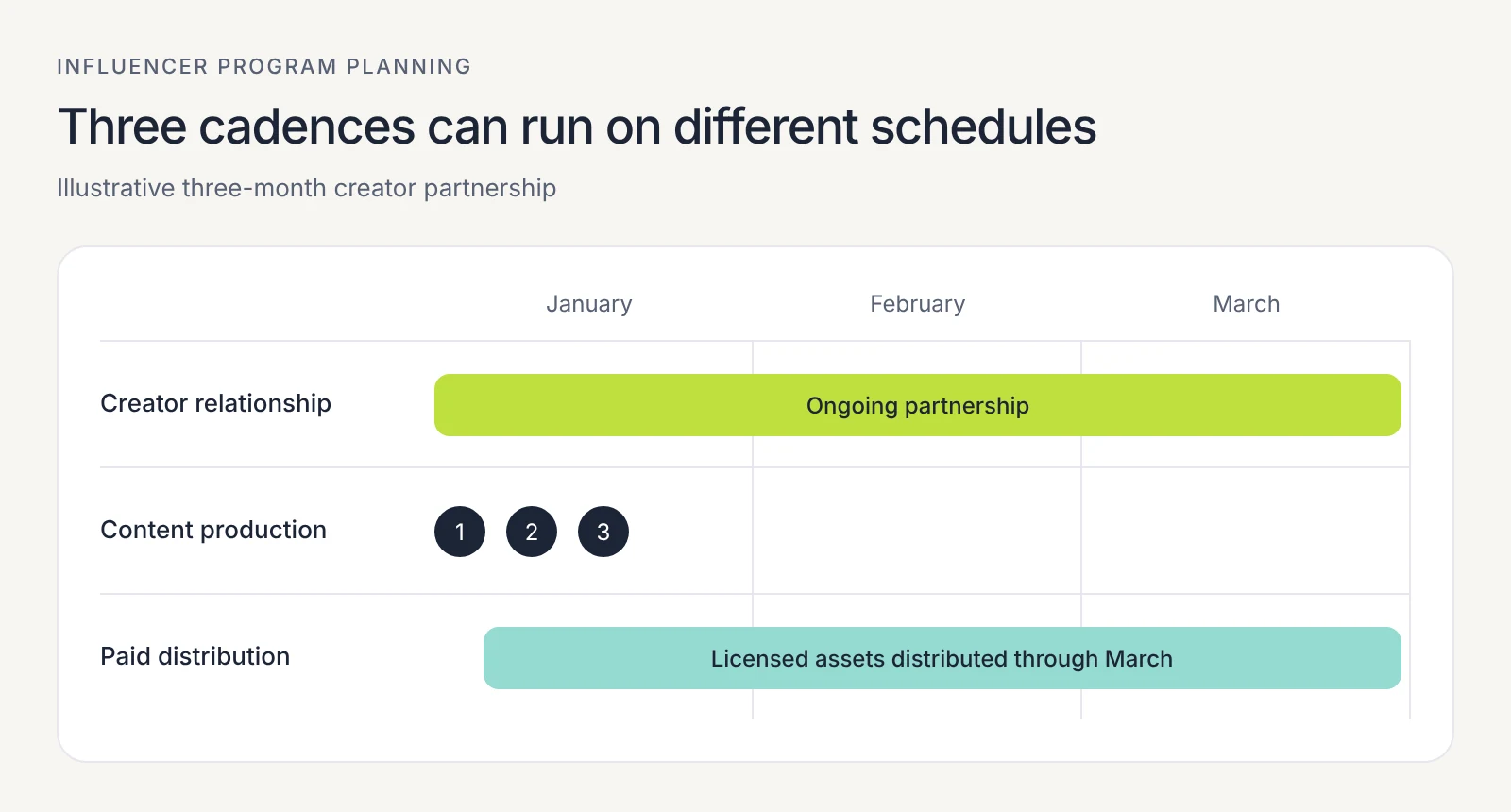
For example, a creator might deliver three videos in January, while the brand licenses and distributes them through March. The following diagram shows how the three commitments can overlap.
Later's 2025 influencer marketing research reported that 70% of its leading brands turned creator relationships into ongoing partnerships. The figure describes adoption among the brands studied; campaign effectiveness is a separate question.
I'd ask the agency to break down its recurring fee. Does it reserve creator capacity, guarantee a volume of usable content or cover regular public posts?
How to Map Influencer Marketing to Your Customer Buying Cycle
Four variables determine when to activate creators: consideration time, repeat purchase intervals, seasonal demand and conversion lag. Together, they help you work backward from the purchase date to the moment customers need to hear from you.
Google's messy-middle research simulated 310,000 purchase scenarios across categories and showed how consumers can move repeatedly between exploring alternatives and evaluating them. A campaign calendar based solely on checkout dates misses much of this activity.
My starting point here is historical data covering the full seasonal cycle, broken down by product and customer type. A premium product and an inexpensive accessory sold by the same brand may warrant entirely different schedules.
Buying Cycle Diagnostic
| Variable | Data source | Calculation or signal | Decision |
|---|---|---|---|
| Consideration time | CRM, analytics | Median/P75 observed first-touch interval | Education lead time |
| Repeat purchase | Order history | Repeat interval and cohort repeat rate | Retention content timing |
| Seasonality | Orders, category search, inventory | Weekly demand and promotion patterns | Baseline versus peak capacity |
| Conversion lag | Ad reports, CRM | Delay from known touchpoint to purchase | Reporting maturity |
Estimate Time to First Purchase
For each customer you can match, export the first identifiable website session or CRM inquiry alongside their first-order date.
Use a mature cohort and calculate two figures:
- Median: the typical recorded delay before purchase.
- 75th percentile: the delay within which 75% of observed purchasers converted.
Both figures exclude people who never purchased, so examine the conversion rate for the complete cohort as well.
Anonymous impressions and unrecorded research can make the observed journey shorter than the real one. Retail brands can supplement website data with shopper surveys, retailer sell-through reports and loyalty data.
Use the earliest identifiable customer touchpoint for planning, and measure conversion lag from a recorded ad interaction to purchase for reporting.
Identify Repeat Purchase Intervals
Next, calculate how many days returning customers take to place a second order. Pair that interval with the share of the original cohort who went on to buy again.
Consider a skincare brand where returning customers typically repurchase after six weeks while first-time customers take longer to decide. I'd prepare separate prospecting and retention briefs for those audiences.
Subscription renewals deserve separate treatment because automatic billing can occur without a fresh purchase decision.
Map Seasonal Demand and Commercial Deadlines
Plot weekly new-customer orders against category search interest, promotions and stock availability. A discount introduced every November can create a spike that resembles natural seasonality. Research the underlying category entry points as well, so the calendar reflects what prompts buyers to shop.
With that information, mark three dates on the calendar:
- Start of product research.
- Peak purchasing period.
- End of the offer.
Which Influencer Marketing Model Fits Different Buying Cycles?
For year-round demand, an always-on program is a sensible starting point. Bursts work well around narrow purchasing windows, and a hybrid model makes sense when research begins well ahead of a seasonal peak.
I look at how long decisions take and when demand peaks, then use margins and team capacity to determine how much to invest.
Validate the recommendations below against your own customer data.
Influencer Marketing Model by Buying Cycle
| Consideration time | Demand pattern | Starting model | Content focus | When to change |
|---|---|---|---|---|
| Short | Continuous | Always-on | Routines, demos | Marginal returns weaken |
| Short | Concentrated | Burst | Offer, availability | Demand becomes continuous |
| Long | Continuous | Always-on education | Proof, comparisons | Education fails to assist demand |
| Long | Concentrated | Hybrid | Early proof, timely conversion | Booking or purchase window shifts |
| Any | Unvalidated | Bounded pilot | Test a specific hypothesis | Evidence supports expansion |
Short Buying Cycles: Always-On for Continuous Demand
Everyday food, affordable cosmetics and low-friction app subscriptions are examples of products that may have a steady flow of new buyers, even when individual purchase decisions happen quickly.
In these categories, useful creator briefs give people fresh reasons to use the product. A food brand might commission recipes for different occasions, while a beauty brand could demonstrate several routines.
inBeat's Bluehouse Salmon program produced over 500 unique educational and recipe assets and grew the brand's social following by 1,900% in 12 months.
Bluehouse Salmon. Source: inBeat on Vimeo
Those are useful indicators for a content and awareness objective; acquisition ROI would require separate evidence.
Campaign Bursts for Time-Sensitive Purchase Decisions
Limited-edition products, event tickets and retailer promotions often have a short period in which attention can turn into revenue. Concentrating creator activity makes sense when availability or an offer creates a real deadline.
Imagine a collection going on sale Friday, with stock expected to move quickly. I'd use the lead time to confirm creator bookings and approve the content, then publish purchase-focused material as soon as the collection is available.
Set the end date around stock levels or the offer deadline. If the products sell out early, pause the ads and redirect the remaining budget only when there's a relevant alternative to promote.
I would also negotiate usage rights for assets that can serve future collections. A launch deadline may be much shorter than the content's useful life.
Long Consideration Cycles: Ongoing Product Education
Premium appliances, complex health products and some software purchases require buyers to evaluate alternatives, establish trust and work through objections. In such cases, creators can provide different kinds of proof throughout the research process.
A product comparison may help someone build a shortlist, while a detailed demonstration can address an objection after the buyer examines specifications. For health-related products, choose creators with appropriate expertise and brief them on approved claims.
Aspire's Meyer customer story describes three- to six-month ambassador agreements following individual collaborations. It's a useful example of how creators can earn a longer commitment.
Software came up during a discussion about micro-influencer marketing.
I pointed to YouTube for a simple reason: people often arrive there looking for an answer to a specific question. Searchable demonstrations and comparisons are the formats I'd commission first, since they can remain useful well beyond launch day.
Seasonal Demand With Extended Purchase Research
Some products combine a lengthy consideration period with relatively concentrated demand. Travel bookings and higher-priced gifts can follow this pattern, depending on the audience and offer.
A hybrid approach gives the brand room to publish educational content ahead of the decision window and increase paid distribution closer to purchase.
A travel company, for example, could commission destination comparisons and itinerary walkthroughs before its busiest booking period, then introduce availability-led messaging nearer the relevant dates.
Use historical booking behavior to determine when that education needs to start. For travel, the booking window matters more than the date of departure.
If the channel is unproven, inventory is uncertain or margins are thin, I would start with a bounded pilot. Define the hypothesis and the evidence required to justify expansion before signing a longer agreement.
How to Budget for Always-On and Campaign-Based Influencer Marketing
Always-on programs carry recurring expenses, bursts have campaign-specific costs, and hybrids need a separate reserve for peaks. Once you've chosen a model, compare its costs with the alternatives over the same period, using consistent objectives and licensing assumptions.
CreatorIQ's compensation research puts average 2025 campaign earnings at $11,400, with a median of $3,000. These figures cover campaign earnings, so I'd use them as a reference point when requesting quotes for specific deliverables.
Influencer Program Cost Model
| Cost component | Always-on | Burst | Estimate |
|---|---|---|---|
| Creator fees | Recurring agreements | Activation fees | Deliverables and rates |
| Production | Regular batches | Launch batch | Editing and revisions |
| Licensing | Renewals | Campaign usage | Term, territory, channels |
| Labor | Ongoing management | Peak coordination | Staff or agency hours |
| Logistics | Regular shipments | Launch shipments | Units and shipping |
| Media | Optional baseline | Incremental spend | Test and scale plan |
| Measurement | Recurring reporting | Test and cooldown | Tools and analysis |
| Reserve | Separate contingency | Event-specific allowance | Known risks |
Calculate the Minimum Viable Always-On Budget
Before starting inBeat, clients came to me for recommendations on nano- and micro-influencers. I ran into a practical constraint: finding the right creators meant assessing numerous profiles, and the tools available at the time were expensive and difficult to use. I'd therefore include sourcing and vetting in the initial budget for a new roster.
First, work out how many concepts the team can test and distribute each month. Then estimate the monthly cost across four groups:
- Creator fees and incremental production costs.
- Content licensing and renewals.
- Management, logistics and measurement.
- Baseline paid media, if planned.
Remove duplicate charges when a package already includes editing or rights. Review the deliverables, renewal terms and exit provisions in the influencer contract.
Use current influencer rate benchmarks to assess quotes alongside creator expertise, deliverable complexity and audience fit. Reserve enough internal capacity to approve and deploy the material.
Estimate Campaign Burst Costs
For a standalone burst, estimate the entire cost of the activation: creator fees, sample shipments, review requirements, licensing and distribution. In a hybrid program, budget only the incremental costs beyond the ongoing commitment. Production expenses may come due before launch.
I'd release the event budget once the date, stock and commercial objective are confirmed. A dedicated line item also makes additional fees easier to spot in an annual agreement.
Check paid usage rights before budgeting amplification. Geographic restrictions, expiry dates and platform permissions can affect whether a previously commissioned video can support the next campaign.
Calculate the Break-Even Customer Count
To see whether a proposed activation can pay for itself, work out how many additional customers it needs to acquire:
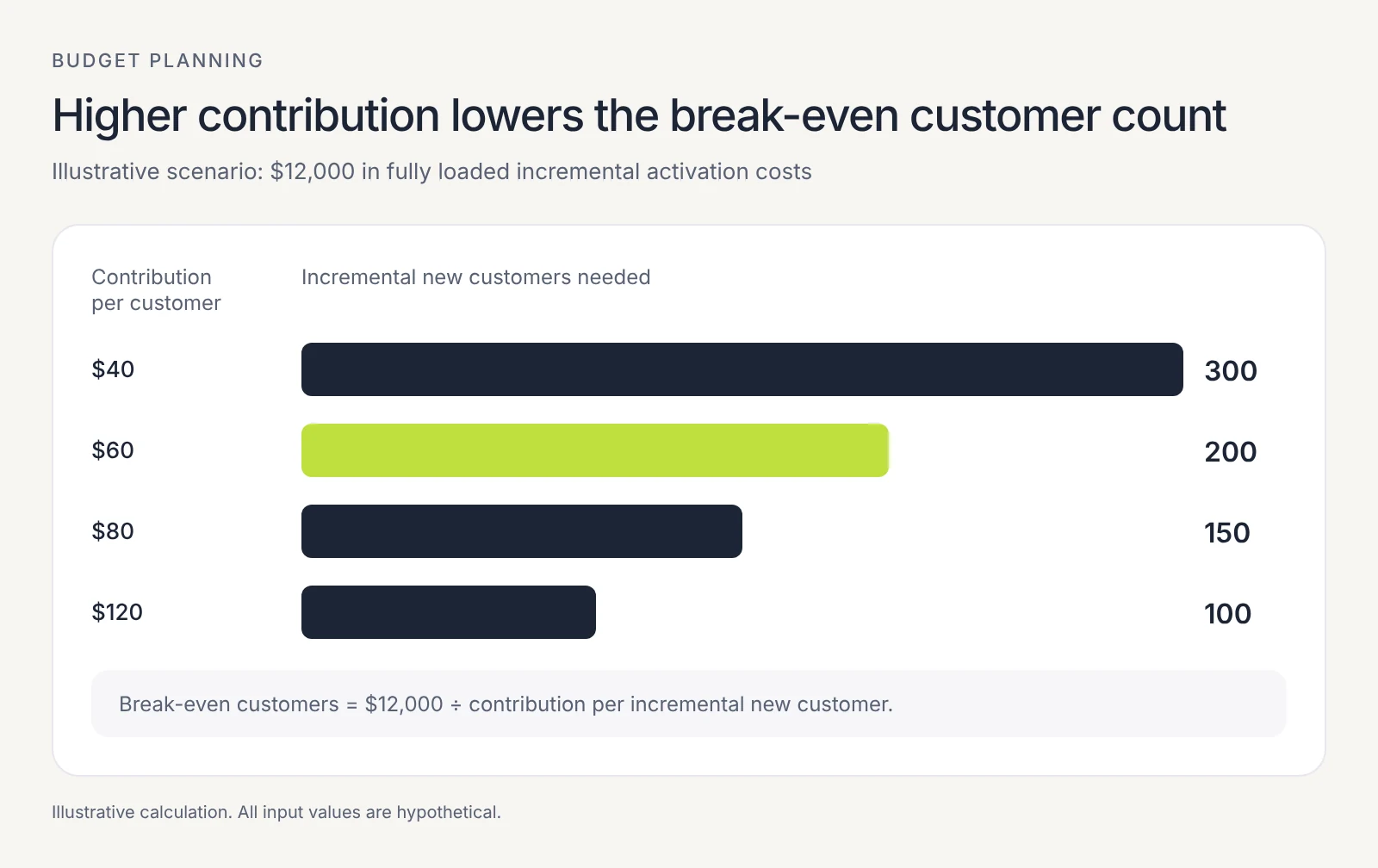
Break-even incremental new customers = total incremental program costs ÷ contribution per incremental new customer.
Suppose an additional activation costs $12,000 and the business expects $60 in contribution per incremental new customer over a specified period. In this example, you'd need 200 additional customers to break even.
Work out contribution after relevant variable costs and expected refunds, excluding marketing expenses already counted in the numerator. Apply the same time horizon to each option.
How to Build a Hybrid Influencer Marketing Strategy
A hybrid strategy needs a clear brief for the core roster between activations, plus extra production and promotional capacity around important buying windows. I'd plan both commitments before booking the next launch.
Retain a Core Creator Roster
Start with paid individual projects or, when appropriate, opt-in influencer seeding. Gifting alone carries no guarantee of a post, so use contractual agreements wherever a specific deliverable is essential.
My approach is to assess candidates through an influencer vetting checklist and judge the initial collaboration against its actual objective:
- Audience fit and relevance to the product.
- Ability to explain or demonstrate the product credibly.
- Quality and usability of the delivered material.
One client had low product and shipping costs, which gave my team room to seed products on a large scale and retain the best-performing collaborators for future collection launches. With a more expensive product, I'd start with a smaller paid trial before offering longer agreements.
Match Content Production to Demand Windows
Create a production calendar that includes evergreen demonstrations, testimonials and answers to common product questions. These assets can remain useful beyond a single campaign if the claims and permissions are still valid.
For a launch, reserve enough production capacity for offer-specific content and revisions. Keep evergreen assets organized independently so that updating one promotion does not require commissioning an entirely new library.
Maintain a shared asset library containing:
- Creator details and approved claims.
- Asset versions and permitted channels.
- Licensing expiration dates.
Schedule Paid Distribution Around Buying Intent
Use a limited testing budget to identify effective messages before scaling. The team can use dark posting to test creator content where appropriate, keeping paid tests separate from contracted organic posting schedules.
At inBeat, Hurom's full-funnel creator strategy combined health-focused messages with systematic paid testing.
Hurom — Case Study 02. Source: inBeat on Vimeo
The broader program reported a 65% reduction in overall CPA and a 300% increase in ROAS. It illustrates how creator content can support a performance-creative program; the results reflect several changes introduced together.
Review Creator Partnerships and Campaign Timing
Each month, check which assets get approved, deployed and deliver results, alongside audience reach, margin and production capacity. Use those findings at renewal to plan the next period.
Illustrative Quarterly Hybrid Calendar
| Activity | Month 1: prepare | Month 2: activate | Month 3: review |
|---|---|---|---|
| Core roster | Renew proven partners | Deliver agreed work | Assess next renewal |
| Production | Evergreen and launch briefs | Launch content and revisions | New evergreen concepts |
| Organic posts | Education | Concentrated launch posts | Return to planned cadence |
| Paid media | Test approved assets | Scale eligible winners | Reduce event spend; measure tail |
This example assumes a promotion in the second month. If customers need longer to make a decision, move educational activity earlier and extend the measurement period.
The quarter-end review is a good opportunity to adjust upcoming deliverables. I'd leave the longer-term investment decision until conversion cohorts mature.
How to Compare Always-On and Campaign-Based Influencer Marketing ROI
A fair ROI comparison uses a consistent definition of incremental outcomes and accounts for differences in commercial conditions. I'd separate the marketing effect from the lift associated with a seasonal promotion, which can make the same budget look more productive.
Google Ads allows selected click-through conversion windows of up to 90 days, depending on the conversion source and campaign setup. Choose an observation horizon that reflects your own conversion delays.
Compare Mature Conversion Cohorts
Align the measurement plan across both models:
- Conversion definition and which costs are included.
- Observation period, measured from the same point in each cohort.
- Commercial conditions, including audiences, stock, pricing, promotions and other media.
Leave time after a burst for customers who are still deciding. For continuous activity, use rolling exposure or activation cohorts and exclude periods that have yet to mature.
Separate acquisition from repeat-purchase outcomes, especially when existing customers respond disproportionately to discounts.
Measure Incremental Impact
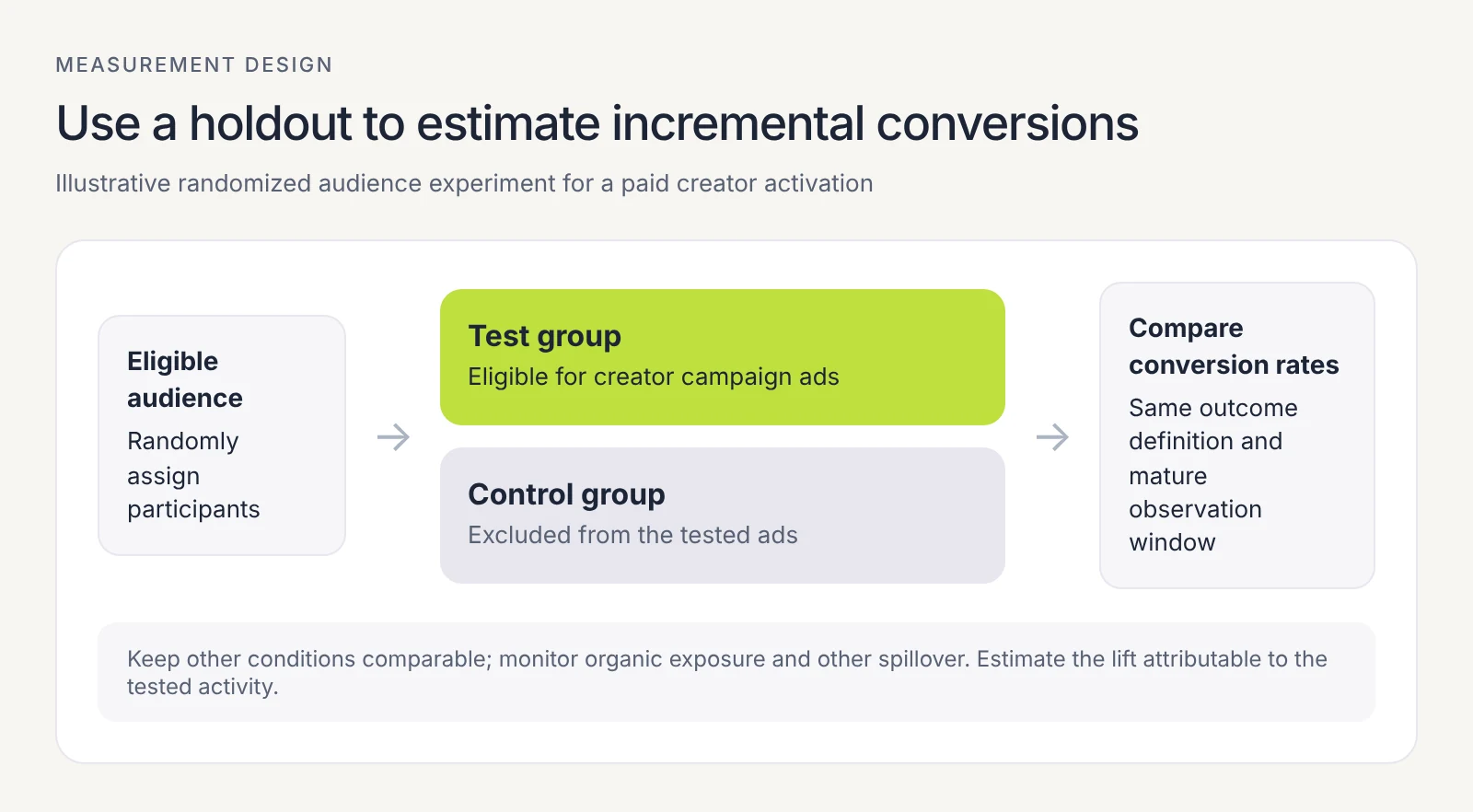
Where scale permits, use a randomized audience holdout or a carefully designed geographic experiment to estimate how many additional conversions the campaign generated.
Google's Conversion Lift documentation provides one example of controlled experimentation available to eligible advertisers. Organic creator activity can be harder to isolate because people may encounter public posts across regions or devices.
Discount codes, UTMs and post-purchase surveys can still help explain which messages or collaborators deserve closer attention. However, the same sale can appear in several reporting systems. Use influencer marketing attribution models for diagnosis while keeping causal estimates distinct.
Build a Shared Performance Scorecard
The same video can serve different objectives. If a creator program supplies content for paid ads and organic social, I'd judge the work by its intended outcome: conversions, reach or engagement. The scorecard below brings those measures together.
Influencer Program Measurement by Outcome
| Objective | Leading indicator | Business outcome | Review horizon | Decision |
|---|---|---|---|---|
| Content supply | Approval/use rate | Creative acquisition cost | After comparable tests | Renew productive creators |
| Awareness | Qualified reach | Incremental brand lift | Study end | Adjust audience coverage |
| Acquisition | Qualified visits | Incremental new customers | Mature cohort | Scale or reduce spend |
| Profitability | Contribution estimate | Incremental contribution after costs | Defined contribution horizon | Reallocate budget |
Assign a target, a review date and a decision owner to every business outcome.
Track incremental CAC, including all program expenses, against contribution per acquired customer. For production, measure the cost per approved asset you deploy, then assess its performance under similar test conditions.
Calculate influencer marketing ROI as follows:
ROI (%) = (incremental contribution before program costs − fully loaded program costs) ÷ fully loaded program costs × 100.
Keep awareness and reach metrics separate from the financial calculation. If you can measure only attributed conversions, call the result attributed ROI and explain how you assigned credit.
When to Change Your Influencer Campaign Cadence
Revisit your campaign cadence when demand changes or additional spending stops paying off. I'd diagnose the specific constraint before cutting a creator relationship, reducing production or pulling media spend.
Cadence Adjustment Signals
| Signal | Investigate | Action |
|---|---|---|
| Rising marginal CAC | Audience overlap, creative fatigue, demand | Refresh or reduce paid distribution |
| Unused licensed assets | Approval bottlenecks, media capacity | Reduce production commitments |
| Late deliveries | Brief quality and workload | Adjust scope or schedule |
| Upcoming launch | Stock, offer, timing | Release burst reserve if justified |
| Weak product/channel fit | Pilot evidence and commercial assumptions | Limit further commitments |
Workload is another consideration. Epidemic Sound's 2025 survey found that 35% of surveyed professional creators experienced burnout as a daily struggle. The survey covers the broader profession, including people outside ongoing brand partnerships.
Late deliveries and repetitive creative may signal that the workload is too heavy. Revisit the brief, deadlines and output requirements. Practical creator burnout prevention measures can help valuable partners maintain a sustainable schedule.
Whatever model you choose, honor existing contractual commitments and follow local disclosure rules, such as the FTC guidance for influencers in the US.
Build an Influencer Marketing Program Around Your Buying Cycle with inBeat
Flexibility should be part of the agreement you sign with your agency. Could you shift the next month's deliverables toward a different product, for instance, without paying to renegotiate the entire program?
At inBeat, I'd build the scope around your commercial calendar, from creator sourcing and production to paid amplification.
If you're planning your next launch or considering a longer commitment, talk to inBeat's influencer marketing team about a program that fits your category.
Frequently Asked Questions
Can an always-on influencer program run without a monthly retainer?
Recurring paid projects, affiliate partnerships and opt-in seeding can all support ongoing activity without a fixed monthly retainer. If predictable monthly output is essential, formalize the deliverables and creator availability in a contract.
Can a brand run different influencer marketing models for different products?
A brand can maintain a steady program for everyday products and run bursts for limited collections. Track each product group's costs and outcomes separately so the performance of one offer does not obscure the economics of another.
How should exclusivity work in an always-on influencer partnership?
Limit exclusivity to relevant competitors, products and time periods. Broader restrictions may raise fees and reduce a creator's ability to earn elsewhere, so price them separately and review them at renewal.
Can a campaign burst build lasting brand awareness?
A short burst can influence later buying decisions if the creative is memorable. Measure brand recall or consideration afterward, and use a suitable comparison group when estimating incremental lift.