.svg)
.svg)
.svg)
.svg)


.svg)





%20(1).png)

A creator can love your brand and still dread the next brief. That's the tension behind always-on programs: brands get a steady stream of content, while creators lose the breathing room that naturally comes between campaigns. And when every finished project leads straight into another, even a successful partnership can become difficult to sustain.
The warning signs are already there. In Epidemic Sound's survey of 3,000 professional creators, 35% cited burnout among their daily struggles, nearly matching time pressure at 36%. A separate study of 542 North American creators found that 69% reported financial instability.
Brands can't eliminate every source of creator stress, but they can rethink the deadlines, contracts, payment terms, and feedback cycles that contribute to it.
Here's where to start.
TL;DR
- Pay on a fixed date written into the contract, and split large fees into milestones.
- Set deliverables per month from the creator's capacity, then cap revision rounds at two.
- Write a short brief with three to five non-negotiables and leave the rest to the creator.
- Batch briefs, shoots and approvals into one monthly window, and tie creator pay to delivery, with any performance bonus on top of a guaranteed floor.
- Rotate formats, schedule a recovery break each quarter, and watch for the five early warning signals.
What Is Creator Burnout in an Always-On Creator Program?
Creator burnout is sustained exhaustion from content work, and an always-on program raises the risk because it removes the natural end date that a one-off campaign provides. In the Creators 4 Mental Health study, 62% of creators reported burnout as a direct result of their work, and creators with five or more years of publishing reported higher rates of burnout, anxiety, depression and imposter syndrome than newer ones.
For brands, the challenge is recognizing when an ongoing partnership starts putting too much strain on a creator. We'll cover the early warning signals and how to respond in Way 9.
Burnout is also a different problem from ad creative fatigue. Creative fatigue on an ad means the audience has seen the asset too often. Burnout means the person making the asset has run out of capacity. A brand can rotate the first one in an afternoon, while the second takes weeks to repair.
Which Creator Burnout Triggers Can a Brand Control?
Not every source of creator burnout is within a brand's control. The table separates pressures brands can address directly from external factors whose impact they can only reduce.
| Trigger | Who controls it | Brand lever | Section |
|---|---|---|---|
| Late or unpredictable pay | Brand | Fixed payment date, milestones | Way 1 |
| Content volume | Brand | Deliverables per month | Way 2 |
| Revision rounds | Brand | Contract cap | Way 3 |
| Creative constraints | Brand | Short brief | Way 4 |
| Scattered production | Brand | Monthly batch window | Way 5 |
| Performance pressure | Brand and platform | Pay structure | Way 6 |
| Format repetition | Brand | Rotation calendar | Way 7 |
| No recovery time | Brand | Breaks and office hours | Way 8 |
| Algorithm volatility | Platform | Guaranteed base fee softens the impact | Way 6 |
That distinction matters. CreatorIQ's 2026 compensation report identifies algorithm volatility and inconsistent brand deals among creators' major challenges. Brands can't stabilize platform reach, but guaranteed fees can make creators' income less dependent on it.
1. Pay Creators on a Fixed Date to Reduce Financial Insecurity
Pay a fixed number of days after delivery, write that number into the contract, and treat it as a deadline for your own finance team. Financial insecurity is the strongest pressure in the research, and the study links underpayment, delayed payments and scope creep to poorer emotional well-being.
The scale of the gap explains why timing matters. CreatorIQ reports an average payment of $11.4K per campaign but a median of $3K, and the top 10% of creators earned more than three-fifths of all payments in 2025.
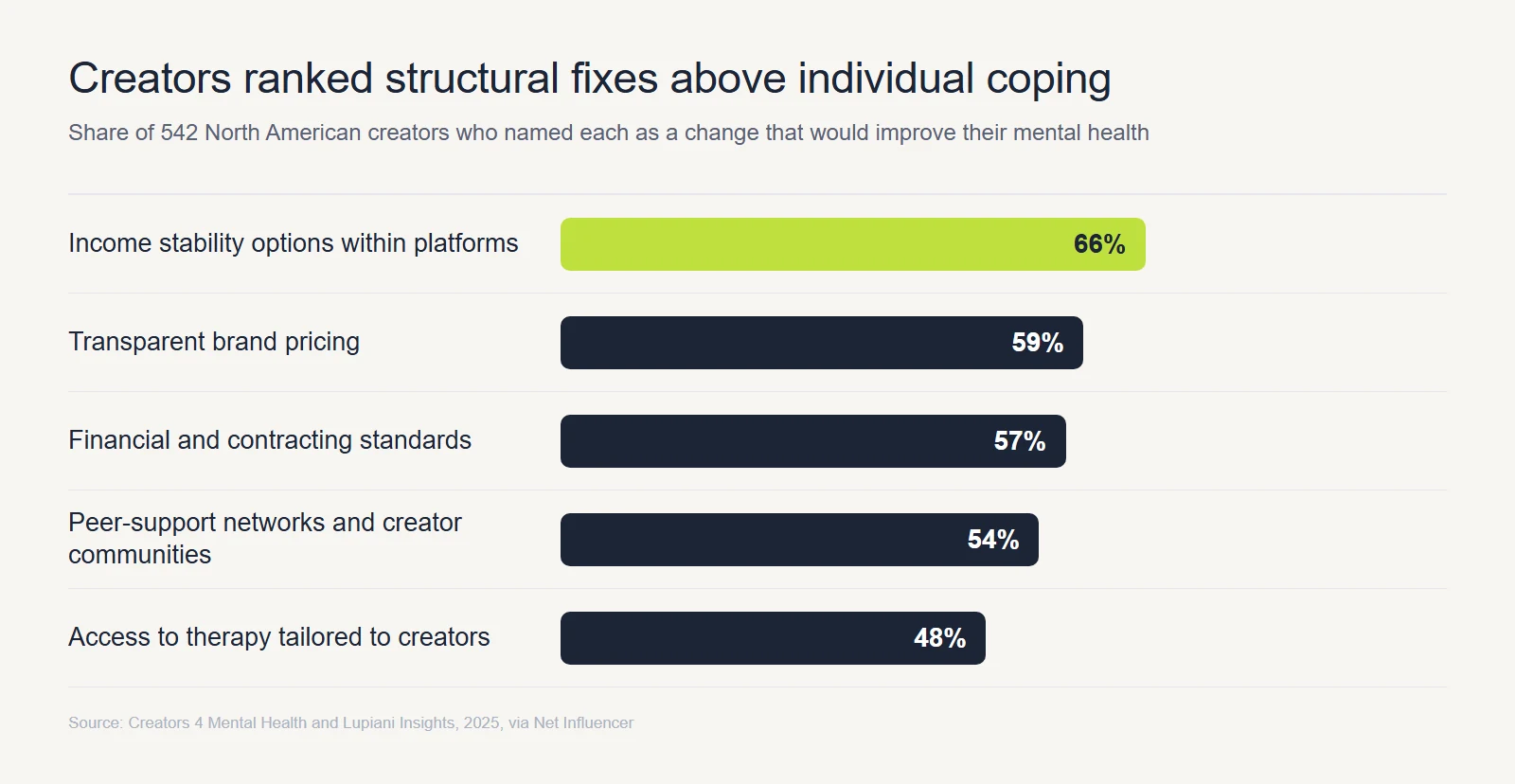
For a median creator, a payment that lands 60 days late is income already earned and unusable for two months. Creators asked what would help most, and structure came first.
Our guide to what content creators cost shows how fees move by tier, platform and content type, which helps you set the fee before you set the schedule.
Put the Payment Date in the Contract
These three lines cover it:
- The payment term: a fixed number of days after delivery. Our starting point is 14 to 30 days.
- The trigger: delivery of the final asset, with approval handled inside the revision window from Way 3.
- The late-payment owner: a named person on the brand side who answers payment questions.
Your finance team's terms may set the ceiling. If an agency of record runs your creator contracts, its scope of work should cover deliverables, term, payment schedule and revision rounds.
Split Large Fees Into Milestones
A milestone split protects cash flow on bigger deals. Starting points we use for planning:
| Fee size | Split | Why |
|---|---|---|
| Small, single deliverable | Full payment on delivery | Keeps admin low |
| Mid-size, several deliverables | 50% on signing, 50% on delivery | Funds production up front |
| Monthly retainer | Paid monthly, on the same date each month | Gives the creator a predictable income line |
Define and Price Paid Usage Rights Up Front
Unclear usage terms can turn a single deliverable into an open-ended commitment, especially when brands request additional edits or extend campaigns beyond the original agreement. Define the channels, licensing period, and permitted uses before production begins. Paid usage can be included in the production fee or priced separately, provided both sides understand exactly what the agreement covers.
Pro tip: Itemize production and paid usage rights in the quote, even when negotiating a bundled fee. This makes future extensions easier to price. Our usage rights guide covers how long rights typically run and how to charge for them.
2. Set a Realistic Monthly Content Volume for Each Creator
Set deliverables per creator per month from that creator's own capacity, and write the number into the contract.
Content volume is the most direct dial a brand holds, and the temptation to turn it up comes from the media side: American Eagle's marketing vice president told Glossy's NRF briefing that content is currency and no team can produce enough of it in-house. The pressure to feed that demand lands on creators.
The table gives inBeat starting points by creator type. Run the capacity check before adding more.
| Creator type | Starting point per month | Capacity check before adding more |
|---|---|---|
| Nano creator with a day job | 1 to 2 pieces | Ask about work weeks and travel in the next 30 days |
| Part-time micro creator | 2 to 4 pieces | Ask what else is booked this month |
| Full-time micro creator on retainer | 4 to 8 pieces | Compare delivery dates from the last two months |
The testing calendar belongs to the brand, and the posting calendar belongs to the creator. When the paid team wants more concepts, translate that demand into creator asks in three steps:
- Count the net-new concepts the paid account needs this month.
- Divide the count across the whole roster, so no single creator carries it.
- Cap each creator at the number in the contract, and add roster members when the count is short.
3. Cap Revision Rounds at Two and Write the Cap Into the Contract
Two revision rounds, with a third round priced as new work. Open-ended feedback is a steady source of work-related stress because the creator can't see where the work ends.
Our brief guide recommends one or two rounds, written into the contract, so a third round needs a new agreement. Unlimited revisions usually signal a weak brief, so fix the brief before adding review cycles.
Define what counts as a round: one consolidated feedback pass from the brand. Compliance corrections shouldn't spend a creative round.
| Feedback type | Counts as a round? | Who decides |
|---|---|---|
| Legal or disclosure fix | No | Brand compliance owner |
| Product claim correction | No | Brand product owner |
| Hook, tone or pacing change | Yes | Brand marketing lead |
| Full reshoot | New scope, priced separately | Brand and creator together |
Add one more rule: send all feedback in a single consolidated pass within a set window. Our starting point is 48 hours after delivery, owned by one named person. Two reviewers sending separate notes to the same creator is how a two-round cap turns into five.
4. Give Creators Creative Autonomy Inside a Short Brief
Set one clear outcome and three to five non-negotiables, then let the creator decide how to deliver the message. The goal is to protect essential brand requirements without turning the brief into a script.
Large brands have reached the same conclusion.
Walmart's head of content, influencer and commerce said at NRF 2026 that early Walmart briefs were too restrictive and weren't in the best interest of creators, audiences or performance.
Glossy reports that Walmart now gives creators content ideas and social-listening trend data and lets them speak in their own voice, and that the company manages "tens of thousands" of affiliate creator relationships through its Walmart Creator platform and networks such as LTK. Fabletics follows the same principle and avoids forcing specific language on creators.
A workable split looks like this:
- Fixed: product claims, legal disclosure, brand-safety lines, delivery date.
- Open: hook, scene, script wording, music choice, posting time.
- Shared: the delivery standard the content will be judged against, so the creator knows what done looks like.
5. Batch Briefs, Shoots, and Approvals Into One Monthly Production Window
Group briefs, production, and approvals into a predictable monthly schedule. This reduces the context switching caused by scattered requests and gives creators a clearer view of when work begins, when feedback arrives, and when the month’s commitments are complete.
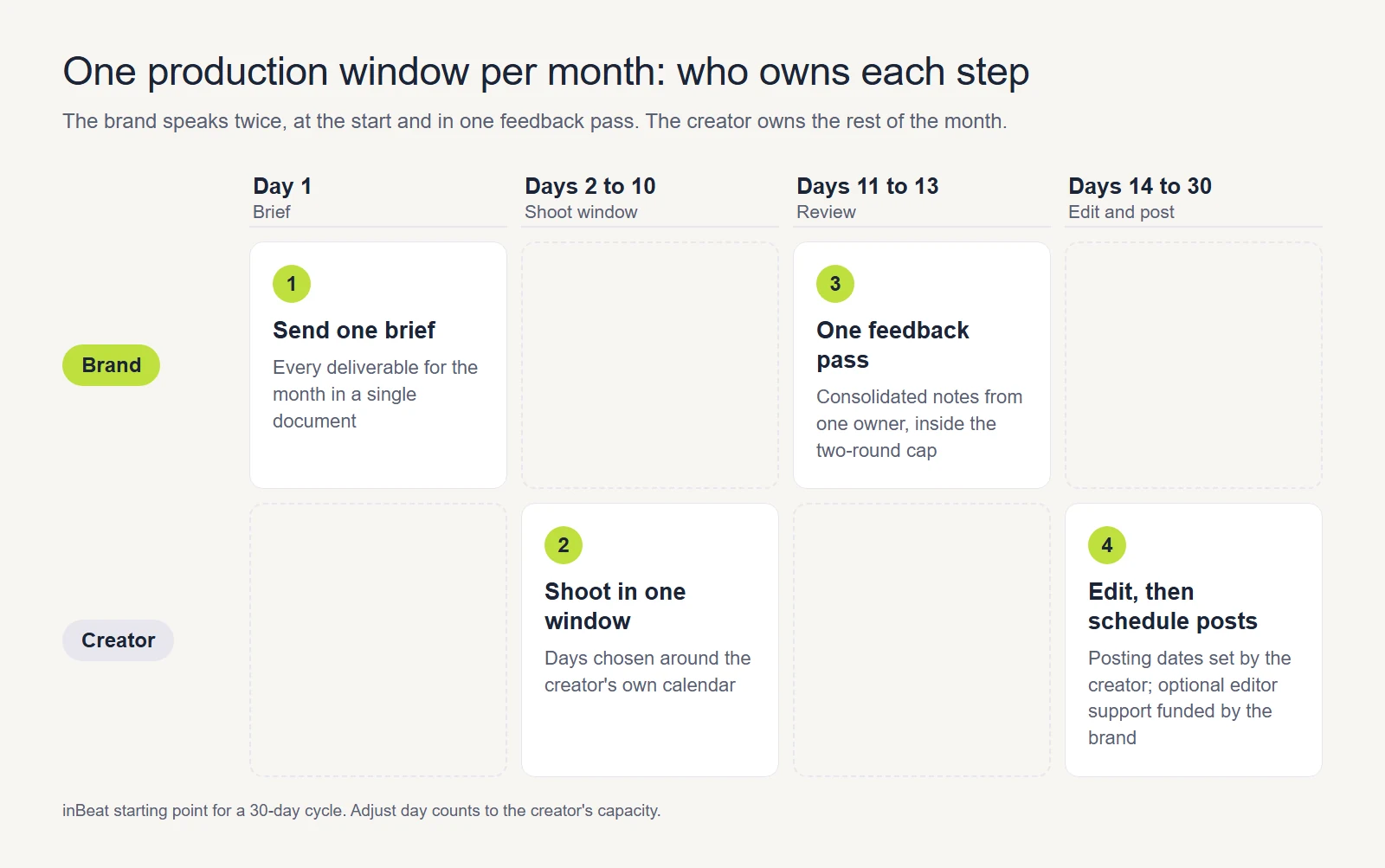
Concept caps and roster rotation keep any single creator from carrying the whole load. The monthly cycle runs like this:
- Day 1: send one brief covering every deliverable for the month.
- Days 2 to 10: the creator shoots inside a window of their own choosing.
- Days 11 to 13: the brand reviews the submitted content and returns feedback within the 48-hour window established in Way 3.
- Days 14 to 30: the creator edits, then schedules posts around their own calendar.
Support makes the window easier to hold. CreatorIQ found that about three in five creators already work with operational support such as teams or outsourced services, which means a brand that funds a video editor or a virtual assistant for a key creator is covering a cost the creator would otherwise absorb. The cost is modest, and it returns hours to the creator's week.
For teams coordinating several creators, our Content Factory handles briefing, casting, and monthly delivery. This gives creators a more predictable production schedule instead of scattered requests throughout the month.
6. Remove Performance Pressure From Creator Pay
Pay a guaranteed base fee for delivery, and evaluate performance on the paid side rather than tying the creator's income to organic results. The pressure is reflected in the research: 69% of creators reported obsessing over content performance, and 58% said their self-worth declines when content underperforms. Frequent analytics checking was also associated with poorer emotional well-being.
Fees tied to views feed that loop. Test performance where the data is cleaner and the creator isn't carrying the result.
Our dark posting guide explains how paid tests read creator content without putting the creator's own account on the line.
| Pay structure | Pressure on the creator | Fit |
|---|---|---|
| Fee tied to views | High | Rarely, and only with a floor |
| Base fee plus performance bonus | Medium | Programs with a guaranteed floor |
| Flat fee plus separate usage fee | Low | Always-on programs feeding paid social |
| Product-only gifting | Low pay, high uncertainty | Seeding, with no deadline |
Large retailers keep the measurement burden on the brand. American Eagle scores creator work on reach, resonance and reaction, and says affiliates drive the reaction while celebrities drive reach.
Pattern Beauty and H&M look beyond hard KPIs to sentiment and the quality of the conversation a creator starts, according to Glossy's NRF briefing.
7. Rotate Content Formats and Creative Angles on a Calendar
Alternate high-effort and low-effort formats, and change the angle every month. A rotation calendar spreads the effort so no month asks for the same heavy lift twice. It also protects against format fatigue on the creator's side: producing the same talking-head hook every week drains the person making it.
A produced video asks for far more setup than a casual talking-head, so mixing the two gives a creator some lighter weeks inside every quarter.
Content formats do different jobs, so the mix can follow the program's goals. The table shows a sample quarter for a creator on a monthly retainer.
| Month | Format | Effort level | Angle |
|---|---|---|---|
| 1 | Produced product video | High | Problem the product solves |
| 2 | Casual talking-head | Low | Honest first impressions |
| 3 | Photo set plus short caption | Medium | Daily routine with the product |
Audience expectations shape the calendar too. Followers expect a creator's feed to stay recognizably theirs, so the angle can change while the creator's voice stays constant.
American Eagle's marketing leader told NRF 2026 attendees that each platform needs its own reason for being, and that content must differ by platform or audiences stop consuming it. Rotation applies the same logic to a creator's calendar.
8. Schedule Recovery Time and Office Hours Into the Program
Give every creator a no-ask break each quarter, shorter on small rosters, and fixed contact hours the rest of the year. A recovery break means no deliverables, no feedback requests and no schedule changes, with the fee unchanged on retainers. Work-life boundaries are a creator's first line of defense, and a brand sets or breaks them through its own habits.
The table lists break types and lengths.
| Break type | Length | What the brand pauses |
|---|---|---|
| Quarterly rest | 1 to 2 weeks | Briefs, feedback and approvals |
| After a major launch | 3 to 5 days | New asks and reshoot requests |
| Holiday week | Creator's choice | Everything except urgent compliance |
Office hours matter just as much. Pick two or three fixed windows each week when the brand answers questions and returns approvals, and stop sending requests outside them. A creator who knows when answers arrive can plan the rest of the week with nothing to check.
Creators rarely have anyone who cushions this for them. In the same study, only 6% reported a manager or agent who is emotionally supportive.
A clear break policy from the brand fills part of that gap. To cover a creator's break without a hole in the content calendar, rotate roster members in for that break, as described in Way 2.
9. Track Early Warning Signals Before a Creator Steps Back
Changes in communication, creative output, and delivery patterns can indicate that a creator is struggling with their workload, although none proves burnout on its own.
The five signals below give brands a starting point for monthly check-ins and help identify where expectations or working conditions may need adjusting.
| Signal | What it may indicate | What to check | Action |
|---|---|---|---|
| Replies slow down | Capacity is shrinking | Reply time over the last three months | Ask about workload and offer a longer deadline |
| Ideas get safer | Creator idea fatigue | Compare the last three briefs' hooks | Open the brief further, or rotate the format |
| Deliverables slip or fewer posts requested | Volume is above capacity | Deliverables against the contract number | Lower the number for one cycle |
| Scope renegotiation | Pay or workload feels off | Payment dates and revision counts | Fix the term the creator raises |
| Revisions multiply | Brief or feedback problem | Rounds per asset | Review the brief and feedback history to identify what caused the additional rounds. |
Assign one owner on the brand side to run this check each month, with five minutes per creator. When two signals appear together, lighten scope, extend deadlines or move up the next recovery break.
Brands can also point creators toward support without making it a condition of the deal. Tubefilter reports that 89% of creators lack access to specialized mental health resources, and the study's own recommendations, as covered by Harvard Chan School, include income-stability options and creator-focused resources and peer communities.
Peer support is the most requested support resource: 54% of creators named peer-support networks and creator communities as a structural fix, yet fewer than one in three belong to any community that offers emotional or career support. A brand can share a list of creator-focused resources once a quarter, make it optional, and leave it there.
How Long Should Creators Get to Turn Around Content?
Set turnaround times according to the work involved. As a planning starting point, allow 7-10 business days for a straightforward UGC video and 10-15 for content requiring more elaborate shoots or editing. Start counting once the creator has received the approved brief and any required products, with additional time allocated for brand feedback and revisions.
Remember: Shorter deadlines should be agreed upon as paid rush requests rather than becoming the default.
Four rules keep turnaround from adding to the load:
- Set a standard turnaround for each content format in the contract and repeat it in the brief.
- Price rush requests as an exception, and agree the fee before the work starts.
- Treat scope changes, such as an extra platform, an extra piece or a longer usage window, as new terms with their own fee.
- Share peak-season deadlines early, so creators can plan around holidays and sales events.
Which Creator Deal Structure Helps Reduce Burnout Risk?
Monthly retainers offer more predictable income than one-off campaigns, but their effect on creator burnout depends on how the workload is managed. Clear deliverable limits and scheduled recovery time matter just as much as guaranteed pay. The table compares five deal structures by income stability, workload demands, and potential burnout risk.
| Structure | Income predictability | Workload risk | Potential burnout risk | Best fit |
|---|---|---|---|---|
| One-off deal | Low | Low per deal, high across many | Medium to high | Launches and single moments |
| Monthly retainer | High | Medium | Low to medium | Always-on programs |
| Ambassador program | Medium | Medium | Medium | Brands with a loyal creator pool |
| Affiliate, commission only | Low | Varies | High | Large pools with light asks |
| Gifting and seeding | None | Low | Low, if deadline-free | Testing fit before a deal |
Risk ratings are editorial assessments based on income predictability and workload demands.
Two well-known programs show the layering.
Gymshark runs a three-stage pipeline of seeding, ambassador and athlete, so the contractual long-term tier only opens for creators who have already proven fit.
Sephora runs two tracks: the exclusive Sephora Squad, where application and vetting can take up to a year, and My Sephora Storefront, a commission-only affiliate track with a 15% commission and a 15-day attribution window. The commission track gives creators no guaranteed income, which is the exposure the table scores as high.
Match the structure to the creator's situation. Nano creators with day jobs tend to do best with gifting plus a small paid retainer, mid-tier and larger creators with a guaranteed base.
The influencer gifting loop explains how to run the seeding stage without getting ghosted. Budgets are brand-specific, and B2B programs usually run smaller pools with higher fees per creator.
What Does Creator Burnout Cost a Brand?
When a creator leaves an always-on program unexpectedly, the brand may need to find a replacement, repeat onboarding, and absorb gaps in planned content. Recruiting and onboarding costs can be calculated from staff hours, while delayed production and interrupted testing require a different assessment.
The table breaks down these costs using illustrative inputs rather than industry benchmarks.
| Cost or disruption | How to estimate it | Illustrative input |
|---|---|---|
| Recruiting a replacement | Hours to source and vet times hourly cost | 10 hours × $60 = $600 |
| Onboarding and briefing | Hours of brief writing and calls | 4 hours × $60 = $240 |
| Ramp-up | Weeks until output matches the lost creator | 3 weeks of reduced output |
| Lost testing signal | Concepts that can't be read this month | 2 to 4 concepts |
Under these assumptions, sourcing and onboarding alone cost $840, before accounting for delayed content or disrupted testing. The three-week ramp-up and two to four postponed concepts represent operational impacts rather than additional dollar amounts, and may overlap. Brands can compare these replacement costs with the expense of planned breaks, roster coverage, and workload adjustments to decide where prevention makes financial sense.
Build a Burnout-Resistant Creator Program With inBeat
An always-on creator program should deliver fresh content without pushing the same creators beyond their capacity. Our influencer marketing agency helps brands build sustainable production schedules, manage creator relationships, and keep content flowing as campaign demands change.
Book a strategy call to review your current workflow and identify where unnecessary pressure could put your creator partnerships at risk.
FAQs
Should the revision cap change when the creator's video will run as a whitelisted paid ad?
Keep the two-round cap, and add one pre-approval step before the creator shoots. Paid use raises the stakes on claims and compliance, so settle those in the brief and treat later compliance fixes as outside the cap. The creative rounds stay at two.
Does a guaranteed base fee reduce a creator's output once the next deal is no longer at stake?
It can, if the base fee comes with no deliverable count and no review. Pair the base fee with a named monthly deliverable number and a quarterly check-in on quality. The guaranteed income takes away financial insecurity, and the check-in keeps the work honest.
How do you handle burnout signals from the creator whose content is the best performer in paid?
Lighten the load before the creator asks, because the best performer is also the most expensive to lose. Apply the Way 9 actions at once. Treat their winning angles as a brief for others to adapt, which spreads the load.
How long can a recovery break last before a weekly UGC retainer loses its testing rhythm?
The quarterly break from Way 8 works when the roster has at least three creators to cover the gap. A smaller roster needs shorter breaks, staggered across creators. Plan the pause into the testing calendar in advance so the paid team reads the gap as scheduled.
How should cadence differ for a nano creator who has a full-time job?
Confirm the number each cycle, because day-job hours and travel weeks make capacity swing from month to month. Raise it only after two months of on-time delivery.