

Influencer budgets are getting bigger and the operating model behind them is getting harder to ignore. According to Influencer Marketing Hub’s 2026 benchmark, 87.49% of marketers expect their budgets to rise, and 72.22% expect an increase of 50% or more. Inside a multi-brand company, that extra spend can easily split into separate creator programs run by separate teams.
An influencer marketing agency of record (AOR) creates one portfolio-wide framework for that work. This article explains what sits inside the mandate, how to keep decision-making clear, and how to scale from a pilot brand to every brand under the parent.
Let’s get into the structure.
P.S. If you want that mandate run for you, our influencer marketing agency team builds these programs.
TL;DR
- An influencer AOR is the one agency that holds the standing mandate for a company's creator program, across brands, regions and teams.
- It executes six work streams: creator sourcing, briefs, creator contracts, content development, platform execution and reporting. The parent keeps strategy and budget authority; brand teams approve product claims.
- Five written rules make multi-brand work: approval rights, creator conflict rules, roster ownership, disclosure compliance and a two-layer contract.
- Roll out in seven steps: one anchor brand for about 90 days, then siblings in order of overlap.
- No independent benchmark of AOR fees exists, so compare how each fee line is quoted before comparing totals.
One thing before the mechanics. We run creator, media and measurement as one system, because each one decides what the others are worth.
Creators supply native, testable content with borrowed trust. Paid distribution is where that content proves itself in numbers. Measurement then tells you which message and messenger earn the next dollar.
A portfolio of sibling brands multiplies the stakes of that loop: every brand that learns something alone is a lesson the other brands pay for again. A good AOR exists to stop that repeat payment.
What Is an Influencer Marketing Agency of Record?
An influencer marketing agency of record is the single agency a company appoints to run its creator program on a standing basis. That replaces hiring a new partner for each campaign. It owns sourcing, briefing, contracting, production and reporting for the brands in its mandate, and it plugs that work into the wider digital marketing strategy that PR, media and creative agencies already run.
The term "agent of record" also appears in staffing and insurance. That is a different arrangement. Here, AOR means a marketing agency with an ongoing creator mandate.
Four operating models cover most programs:
Model | Who holds creator contracts | Who owns strategy | Fee shape |
|---|---|---|---|
Project-based agency | The agency, per campaign | Brand team, with agency input | Fee per campaign |
Roster of direct creator deals | The brand | Brand team | Creator fees only, plus internal time |
Hybrid | Split by creator or campaign | Shared | Retainer or fee for the outsourced parts |
Influencer AOR | The agency or the parent, under one master agreement | Parent sets direction, agency runs it | Retainer, percentage of managed spend, or both |
Why Parent Companies Appoint an Influencer AOR
Parent companies appoint an AOR to stop their own teams from competing with each other for the same creators. In Digiday's 2023 reporting, agency executives described procurement and finance teams pushing to consolidate, partly to avoid different agencies paying the same influencers and bidding against one another.
The mandate itself has grown. By Digiday's July 2025 account, briefs ask the agency to own creator marketing across teams, regions and product lines.
One agency executive there estimated AOR work was 25% or less of creator RFPs in the past and is now the majority. That is one executive's estimate, so read it as direction. A consumer-health company with many brands, Haleon, appointed a creator AOR on a three-year term in 2024, according to the same report.
Adoption still varies by company size. Among 200+ enterprise marketers, 49% partner with specialist influencer agencies in Linqia's 2026 survey.
In the broader, mixed-size sample of 600+ marketers behind the Influencer Marketing Hub benchmark, 66.3% run influencer programs entirely in-house and 21.4% use an agency fully or partly. The samples differ in size and makeup, so read the two figures as separate views.
Who Should Skip an Influencer AOR?
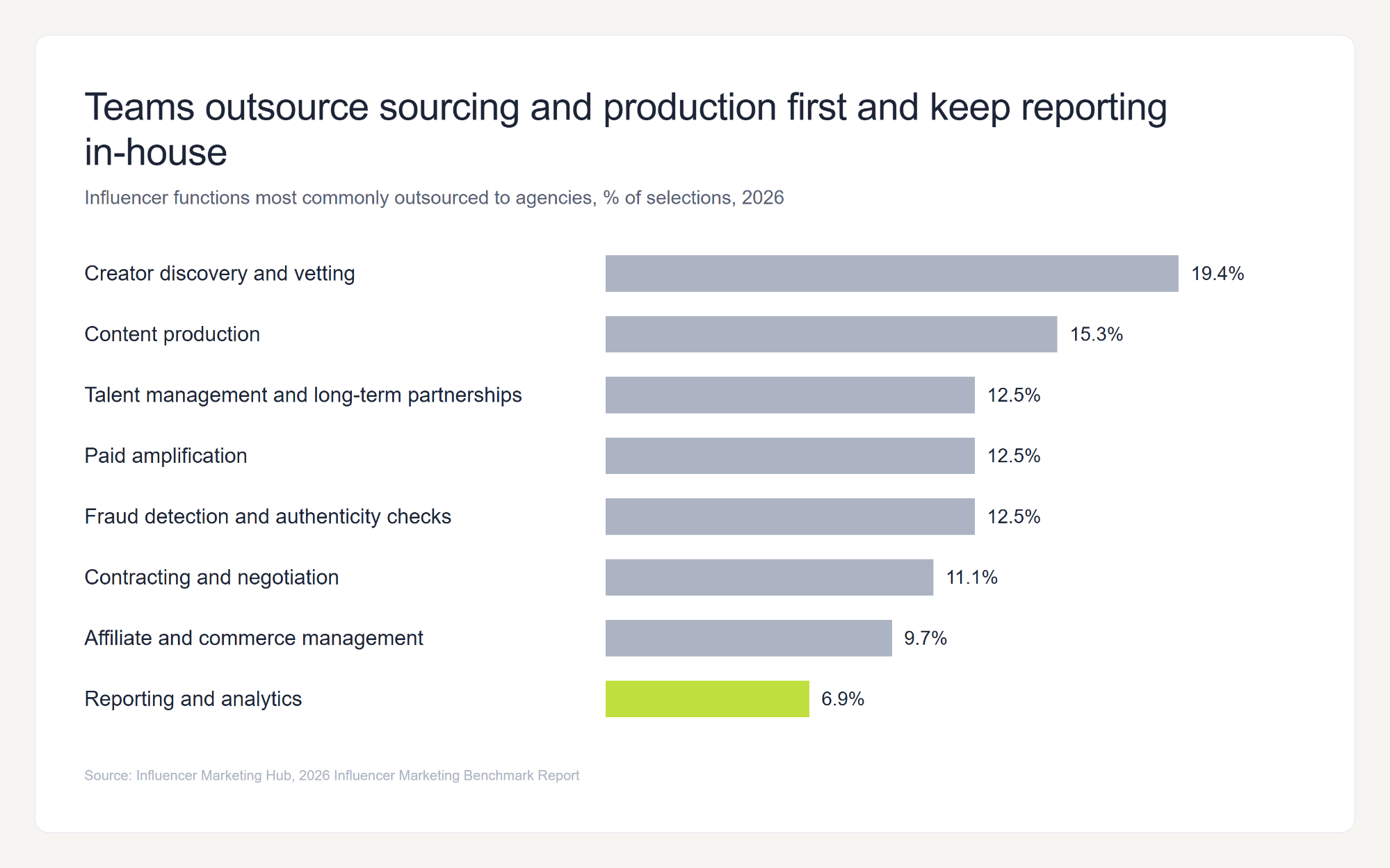
An AOR is a weak fit for a company with one product line and a capable in-house team. The Influencer Marketing Hub data shows what agencies are usually hired for: the most outsourced functions are creator discovery and vetting at 19.4% and content production at 15.3%, while reporting and analytics is the least outsourced at 6.9%.
Most teams hire agencies for capacity in specific lanes and keep ownership of the program.
The AOR case starts when several brands share creators, platforms and budgets, because coordination becomes the constraint.
What Does an Influencer AOR Do Day to Day?
An influencer AOR runs six work streams across every brand it serves: creator sourcing, briefing, creator contracts and payments, content development, platform execution and reporting. Strategy direction, product claims and budget authority stay with the parent and the brands. The governance section below covers who approves what.
Work stream | AOR executes | Brand team provides |
|---|---|---|
Creator sourcing and vetting | Shortlists, vetting, outreach | Audience and category priorities |
Briefs and messaging | Brand-level briefs from one master architecture | Product facts, approved claims |
Creator contracts and payments | Deliverables, terms, payments | Signature authority where required |
Content development | Production, revisions, UGC volume | Product access, feedback within agreed time |
Platform execution | Posting plans, paid amplification set-up | Ad account access, permissions |
Reporting | Dashboards per brand and for the portfolio | KPI targets and data access (definitions come from the parent) |
How Does an Influencer AOR Find and Vet Creators?
Creator identification starts from the audience and treats follower count as a secondary signal: the AOR matches creators to each brand's buyer persona and sets up audience targeting to match. It builds micro and macro influencer partnerships in the proportions each brand needs, and it checks influencer track records before any contract: past sponsored posts, comment quality, audience location and growth pattern.
Vetting matters because fake audiences are the most common quality problem. In the Influencer Marketing Hub survey, fake or bot followers made up 56.5% of reported fraud and quality issues, and only 10.9% of respondents reported none. Run the checks on a sample of recent posts before a creator joins the roster.
How Does an AOR Write Creator Briefs?
The AOR writes every brief from one master messaging architecture, then adapts it per brand. Each brief carries three fixed fields:
- The claim the creator can make.
- The proof behind it.
- What to avoid.
Fixed fields keep content messaging consistent across sibling brands while leaving the creator's own voice intact. A creator who sees the same three fields in every brief learns the portfolio's expectations once, which shortens revisions on the second and third brand.
Who Handles Creator Contracts and Payments?
The AOR drafts and tracks creator-level contracts for every brand: deliverables, term, payment schedule and revision rounds. Contract management also covers payment timing, which is where creator relationships often sour. Usage rights and exclusivity are governance decisions and sit in the next section.
How Does an AOR Run Content Development and UGC Creation?
The AOR runs content development as a content creation system:
- Batch briefs.
- Shot lists.
- Fixed revision rounds.
- A library where approved assets are tagged by brand and format.
UGC creation fits the same system, because one efficient way to get volume is to brief many small creators at once and reuse the best output in paid and on-site placements.
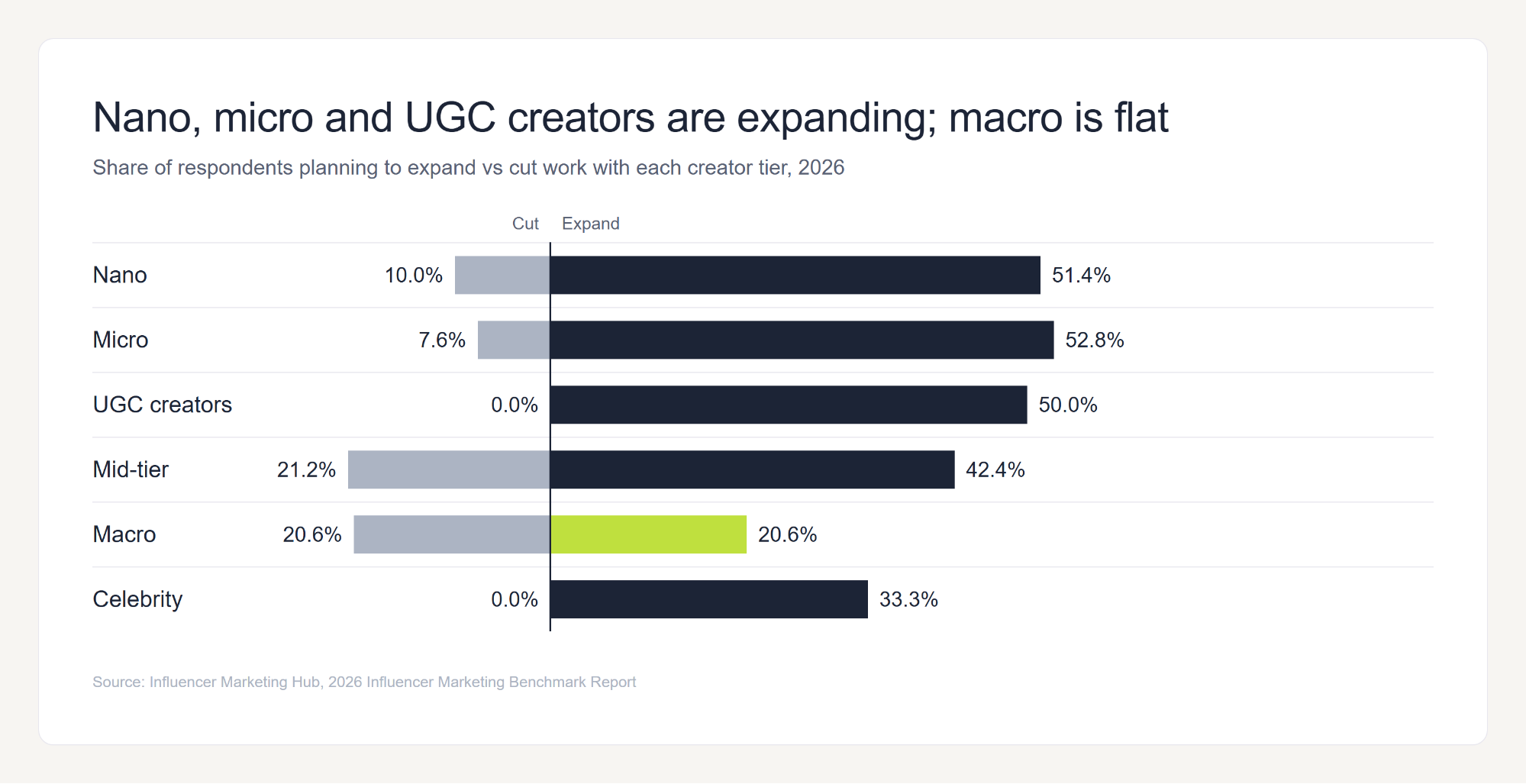
The market is heading that way. In the Influencer Marketing Hub data, 51.4% of respondents plan to expand work with nano creators, 52.8% with micro creators and 50.0% with UGC creators, while macro creators sit flat at about 20% expanding and 20% cutting.
How Does an AOR Adapt Creator Content to Each Platform?
The AOR adapts one brief to each platform's mechanics, because a file cross-posted unchanged rarely fits more than one of them. That looks different on each platform:
- TikTok: Spark Ads, TikTok Shop and TikTok Live Shopping.
- Instagram: Reels and partnership ads.
- YouTube: longer-lived assets.
Platform choice follows the data: TikTok appears in 31% of investment plans, and TikTok Shop accounts for 66.17% of platform selections among social-commerce adopters.
Treat live shopping as a targeted bet. 62% of respondents put it in their top three formats, yet the benchmark calls it polarizing by category.
What Reporting Should an Influencer AOR Deliver?
The AOR hands over one dashboard per brand and one portfolio view that rolls them up. The parent sets the KPIs behind them (see the KPI section below).
Governance Model for an Influencer Marketing AOR
Governance for an influencer AOR is five written rules agreed before the first brand launches: who approves what, how creator conflicts are settled, who owns the roster, how disclosure compliance is enforced, and how the contract is structured. Usage windows and brand-safety escalation sit alongside them as operating protocols. Without the five rules, each sibling brand improvises, and the AOR ends up arbitrating between the parent's own teams.
Decision | Parent company | Brand team | AOR |
|---|---|---|---|
Annual portfolio budget | Approves | Proposes | Advises |
Budget shift between brands | Approves | Requests | Recommends |
New creator category for a brand | Informed | Approves | Proposes |
Product claims in briefs | Informed | Approves | Drafts |
Extending paid usage of a creator's content | Approves above a set spend | Approves below it | Proposes |
Pausing a campaign after a creator issue | Can order | Can order | Can pause immediately, then escalates |
Who Approves What in an Influencer AOR Program?
Name one person on the client side who owns the AOR relationship, and set a maximum turnaround for each approval tier. In our experience, slow approvals stall multi-brand programs faster than weak creative does.
In Digiday's 2023 reporting, an influencer agency executive said the agency now sits in monthly cross-agency meetings, which is the right instinct: the AOR needs a standing seat where the PR, media and creative agencies are present.
How Do You Handle Creator Exclusivity Across Sibling Brands?
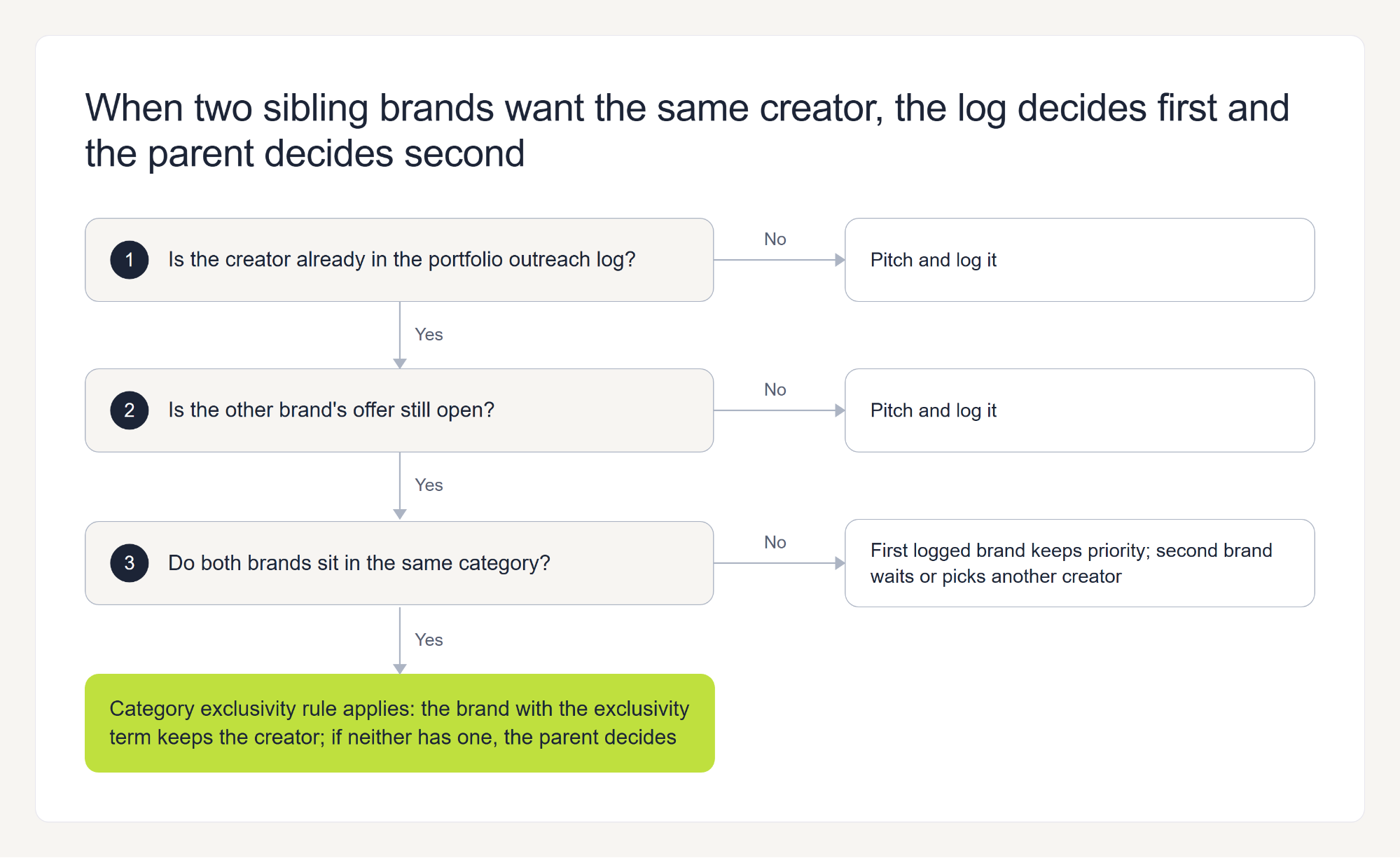
Sibling brands share a creator pool, so they need three written rules:
- Category exclusivity per brand.
- One outreach log for the whole portfolio.
- A tie-break when two brands want the same creator.
The outreach log is the cheapest control. If every pitch is logged before it is sent, no creator receives two offers from the same parent in the same week.
Creators care about this too. A Village Marketing executive told Digiday in 2023 that influencers want category exclusivity and tend to get it from brands that buy consistently. We found no quantified data on how often sibling brands collide on creators, so build the rule from your own roster overlap.
Who Should Own the Creator Roster?
The parent should own the roster, with the AOR maintaining it and tagging each creator by brand fit. Decide in the contract who holds creator relationships if the AOR changes. Creator contracts also move slowly: a vendor guide from Make Influence notes that existing creator agreements generally need the creator's consent to transfer, so consolidation happens at renewal over several months.
How Does an AOR Handle FTC Disclosure Compliance?
A brand can be liable for its creators' disclosures, so compliance cannot sit with the creator alone.
Under 16 CFR 255.1(d), an advertiser can be liable for a deceptive endorsement even when the endorser is not, and advertisers should provide guidance, monitor compliance and act on violations. Following those steps does not create a safe harbor. It does lower the odds of enforcement.
The Federal Trade Commission's 2023 update to the Endorsement Guides also addressed the liability of advertisers, endorsers and intermediaries, which includes agencies.
The enforcement picture has a second layer. The FTC's 2024 Consumer Reviews and Testimonials Rule bans buying fake social media indicators such as bot followers, and the FTC lists civil penalties of up to $53,088 per violation as of December 2025. That rule does not govern creator #ad tags; the Endorsement Guides do.
Markets differ. In the UK, the ASA and CMA guide for influencers expects a clear, prominent "Ad" label upfront, holds both the influencer and the brand responsible, and expects disclosure to continue for 12 months after a relationship ends. Sibling brands that sell in several markets need one disclosure checklist per market, because each regulatory body sets its own rules.
Compliance in practice is a process the AOR runs: a pre-approval check on every disclosure, spot checks after posting, and a removal request path. The gap is real. In a 2026 survey of 365 creators, 18% said a brand had explicitly asked them not to disclose a paid partnership.
How Should Usage Rights and Authorization Windows Work?
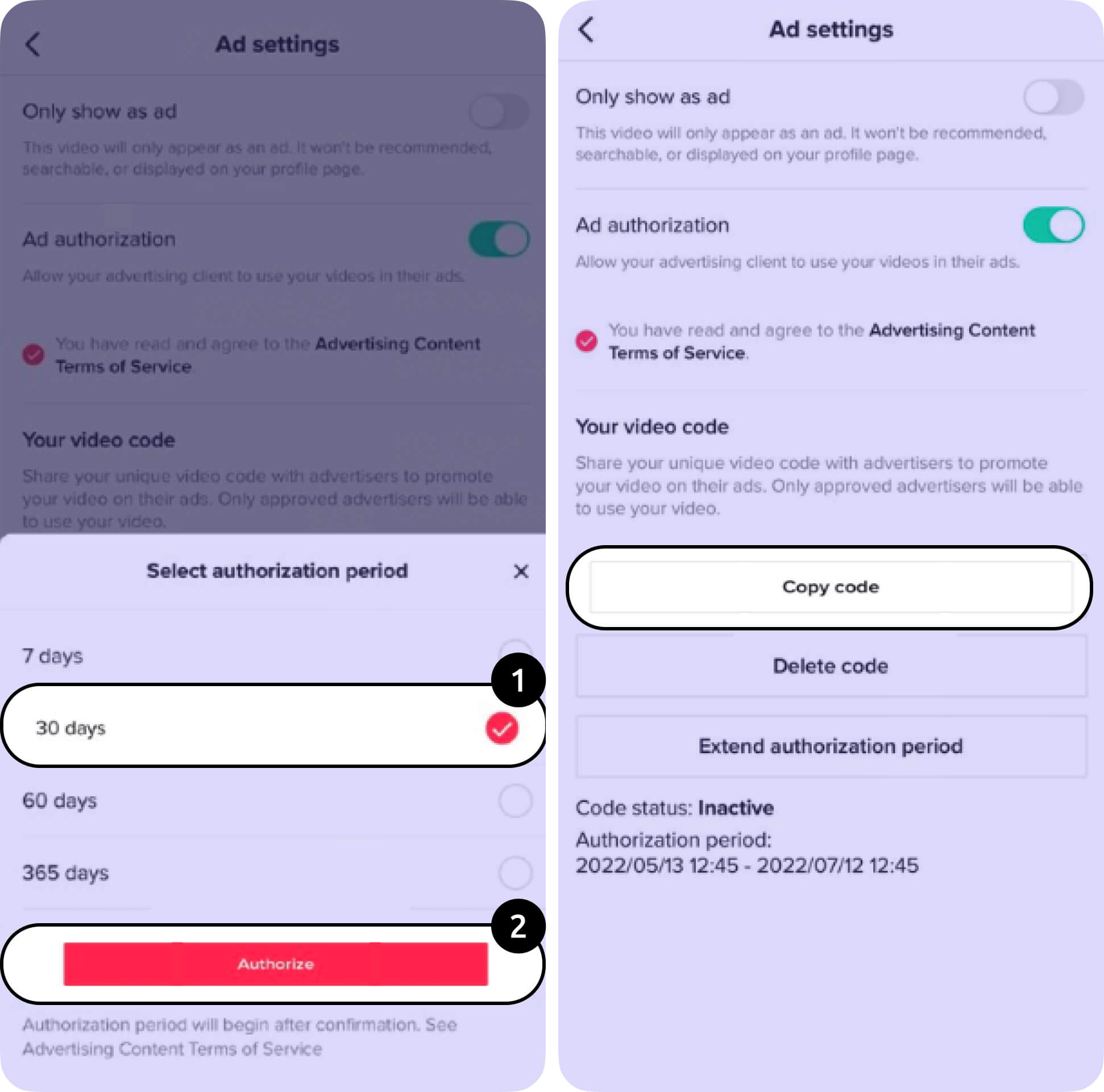
Set one standard usage window per brand in its statement of work, and treat extensions as approval-tier decisions.
Pro tip: Our UGC usage rights guide covers licensing structure, and the platforms build the mechanics in.
On TikTok, the creator authorizes a post with a code and the advertiser chooses how long the authorization lasts. On Meta, an advertiser needs permission from the partner whose handle appears, and that permission can be revoked at any time. Meta offers content-level permission for a single post and account-level permission for ongoing use.
For sibling brands this has one consequence: a window agreed for Brand A does not cover Brand B. Reusing a creator's content across brands needs its own agreed term and fee.
What Should a Brand Safety and Escalation Protocol Include?
Store the vetting result for every creator, name one escalation path, and let the parent, brand teams and AOR pause content, as the decision table shows. The AOR should be able to pause a creator's content within hours and notify every brand that creator has worked with.
Rehearse the path once a year with a mock incident, so the first real escalation is not also the first time anyone has used the protocol.
What Should the Master Services Agreement and Brand-Level Addenda Cover?
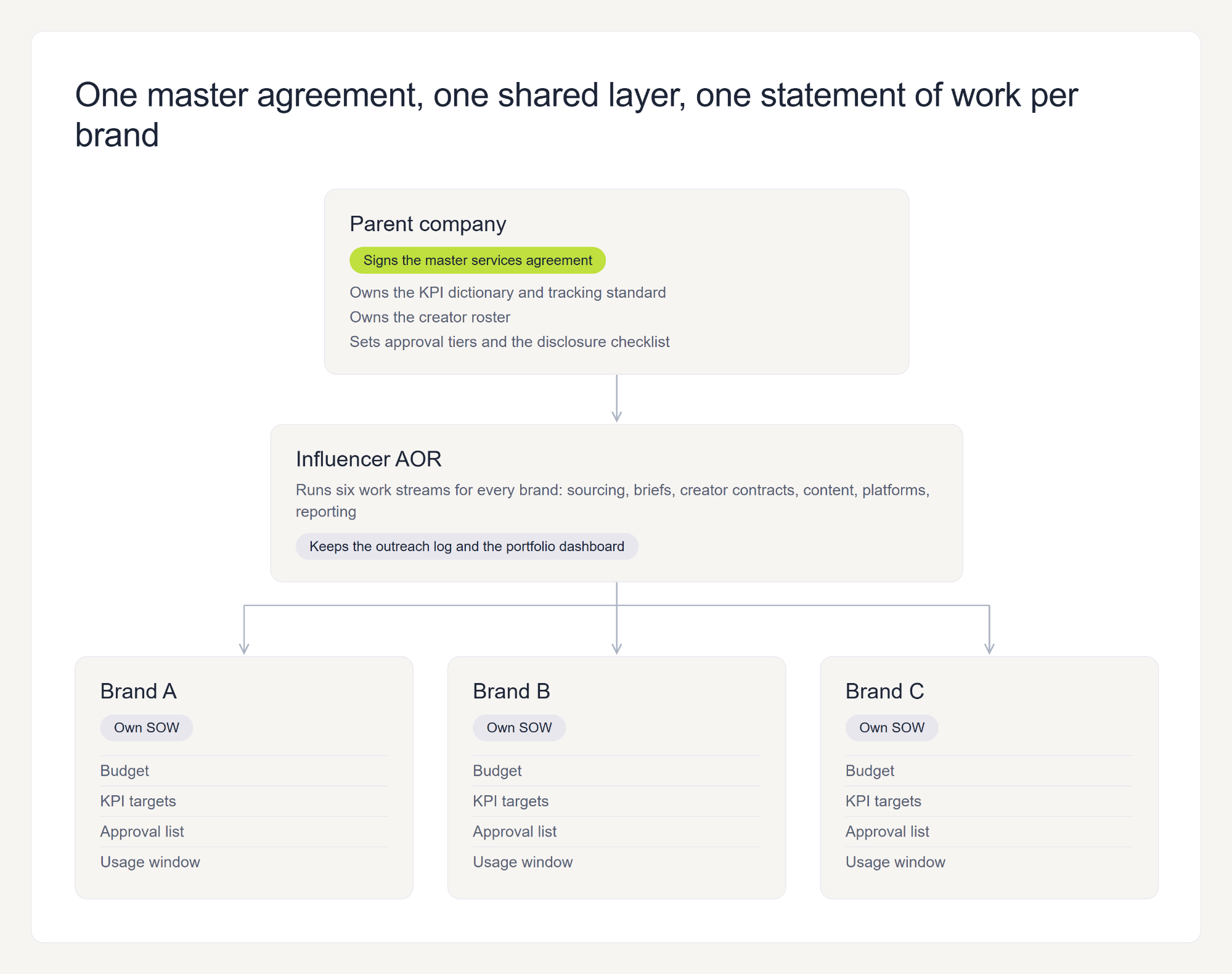
Use two contract layers. The parent signs one master services agreement (MSA) with the AOR covering term, fee structure, data ownership and exit. Each brand then gets its own statement of work (SOW) with its budget, KPI list, approval list and usage window. A new sibling brand joins by signing a SOW and leaves the master agreement untouched.
Exit terms deserve the same attention as entry terms. Specify what returns to the parent at the end: the roster, creator contracts, content libraries and tracking data. This is the parent-to-agency contract; creator-level contracts are covered in the scope section.
How Does an Influencer AOR Expand From One Brand to Every Sibling Brand?
Start with one anchor brand for about 90 days, write the playbook from what the pilot proves, then onboard sibling brands in order of overlap with the anchor. A smaller brand that shares creators, platforms and buyers with the anchor will be live in the first wave below, while a larger brand with a different buyer needs its own playbook adjustments.
- Pick the anchor brand. Choose the brand with the clearest buyer, the most platform activity already and a team willing to follow the process. Avoid the most politically sensitive brand as the first one.
- Run the pilot with full tracking. Set the KPI dictionary, tracking standard and approval tiers on this brand first. Treat the pilot as a test of the governance as much as of the creators.
- Write the playbook. Capture the brief architecture, vetting checklist, disclosure checklist, usage windows and reporting template. Each later brand copies the playbook and edits only what its buyer requires.
- Audit each sibling brand. List its creators, creator contracts, current agencies and tracking set-up. The audit shows where creators already overlap with other brands and which contracts expire when.
- Sequence siblings by overlap. Start with the brand that shares the most creators and platforms with the anchor. Leave the brand with the most different buyer for last.
- Onboard each sibling with its own SOW. Sign the statement of work, set the brand's targets inside the shared KPI dictionary and add its creators to the portfolio roster.
- Transition creator contracts at renewal. Keep brand-signed agreements in place where they still work, and replace agency-signed agreements with new contracts under the portfolio's chosen structure as they come up for renewal.
Phase | Timing | Output | Gate to move on |
|---|---|---|---|
Pilot | About 90 days | Anchor brand live, playbook drafted | KPIs reported consistently; approvals within agreed turnaround |
Wave 1 | Next 60 to 90 days | Highest-overlap siblings onboarded | Outreach log in use; no duplicate outreach |
Wave 2 | Following quarter | Remaining siblings onboarded | Portfolio dashboard reconciles to brand dashboards |
Steady state | Ongoing | Creator contracting aligned to portfolio standards | Quarterly cross-brand review running |
The multi-year framing is deliberate. Haleon's three-year AOR term, covered earlier, is long enough to complete a rollout of this kind and still collect the benefit. If a brand in your portfolio is mid-contract with another agency, schedule its onboarding for the renewal date and avoid forcing an early exit.
If you want a team to run this sequence, our micro-influencer agency practice builds the creator side of it.
KPIs, Tracking and Attribution Across Sibling Brands
The parent owns one KPI dictionary and one tracking naming standard; each brand sets its own targets inside them; the agency produces the reporting. This split matches how teams already behave: they outsource reporting and analytics least, as noted earlier, because they want to keep the definitions.
KPI setting needs shared definitions so brand numbers add up. Brand awareness is the most selected KPI at 55.1%, and it is particularly useful at portfolio level because the same definition can be applied across sibling brands. Track website traffic with the same UTM naming convention on every brand, so a visit from a creator is classified identically everywhere.
Metric | Defined by | Target set by | Reviewed |
|---|---|---|---|
Brand visibility (reach, awareness lift) | Parent | Brand | Quarterly, cross-brand |
Engagement and content quality | Parent | Brand | Monthly |
Conversions | Parent | Brand | Monthly |
Revenue and customer acquisition cost | Parent | Brand | Monthly, with finance |
Our team sets these up for new brands. Three tracking standards go in once:
- Tracking pixels plus server events. Run the platform pixel together with its server-side events and pass the same event ID through both. TikTok deduplicates matching events within 48 hours, and Meta recommends the same redundant setup.
- One naming convention. Use the same UTM structure, promo-code format and landing-page routing for every brand.
- Creator-level signals. Promo codes lead measurement adoption at 45.9% in the benchmark, with affiliate links at 26.0%. Affiliate marketing programs and codes give a creator-level conversion signal even when click paths break.
Measurement is where programs struggle. 79% of enterprise marketers struggle to measure influencer ROI, and 48% name attribution as the biggest gap in Linqia's survey.
Multi-touch attribution modeling helps as a quarterly cross-check across brands, and weekly decisions run on the shared KPIs above.
The quarterly cross-brand review is the one meeting that makes the portfolio smarter than the sum of its brands. Compare the same KPIs across brands, flag creators who perform in more than one, and move budget toward what the numbers support.
Influencer AOR Pricing: Fee Models and What Moves the Price
AOR work is priced as a retainer, a percentage of managed creator spend, or a hybrid of the two, and the agency fee is separate from creator fees. No independent benchmark of AOR fee levels exists.
Pro tip: Compare quotes line by line and judge the return with the framework in our guide to influencer marketing ROI.
Fee model | How it is charged | Strength | Risk |
|---|---|---|---|
Monthly retainer | Fixed monthly fee for a defined scope | Predictable; covers strategy and management time | Pays the same when workload drops |
Percentage of managed creator spend | Share of creator fees the agency manages | Scales with activity | Rewards higher creator spend whether or not results improve |
Hybrid | Lower retainer plus a percentage | Balances both | Needs clear definitions of what the percentage covers |
Per-brand SOW fee under one MSA | Fee per sibling brand | Fits multi-brand rollouts | Can inflate if every brand is priced as a standalone account |
Three anchors help, each with limits. First, Digiday reports brands spending $1.5 million to $2 million on creator AOR deals, according to executives it interviewed, without saying whether that covers creator fees. It is anecdotal, with no sample size.
Second, creator fees are the larger moving part: rising creator costs are the top challenge at 35.4% in the Influencer Marketing Hub survey, where nano and UGC creators mostly cost under $500 and mid-tier creators most often cost $2,000 to $10,000 per engagement. That is a self-selected sample, so use it for direction only. Our UGC rates guide breaks down what individual creator formats cost.
Third, scope drives the fee more than any rate card: number of brands, number of platforms, creator volume per month, and how much paid amplification the AOR operates. In a multi-brand deal, ask for one master rate card and a separate budget line in each SOW.
How to Choose an Influencer AOR
Score every candidate on six criteria and ask each one for their creator conflict policy in writing before shortlisting. A candidate that cannot describe how it handles two sibling brands wanting one creator has not run a multi-brand mandate.
Criterion | What to ask | Red flag |
|---|---|---|
Multi-brand governance | Show a decision-rights table from a current multi-brand client (names removed) | No written approval structure |
Roster depth | How many active creators per tier, and how recently each was used | A large database with few active relationships |
Reporting access | Do we get direct access to the data behind the dashboards | Reports only as slides |
Contract and exit terms | What returns to us at the end | Roster or content held by the agency |
Conflict policy | How are duplicate pitches prevented | "We trust our team" |
Disclosure process | Who checks disclosures and when | Creators handle it alone |
Pro tip: Run a paid pilot under the MSA with a single-brand SOW before expanding the mandate across sibling brands.
Build a Multi-Brand Influencer Program With inBeat Agency
A portfolio of sibling brands gets the most from creators when the learning is shared and the rules are written down once.
If you are weighing an AOR for several brands, book a strategy call. We will go through your brand list, pick the anchor brand, map where your creator and agency overlaps sit, and draft the governance rules.
FAQs
Can one sibling brand keep its current agency while the others move to the AOR?
Yes, and it is often the right call when that brand's contract has months left. Give the AOR read access to that brand's data and apply the shared KPI dictionary and outreach log until its contract renews. The portfolio dashboard stays whole, and you avoid early-exit fees.
How do you judge whether the AOR is working after 12 months?
Judge the AOR on the portfolio as a whole. Check four things: approval turnaround against the agreed tiers, the share of creators used by more than one brand, the gap between brand dashboards and the portfolio roll-up, and the cost of producing one approved asset compared with the first quarter.
What does an exit look like?
The master services agreement section lists what returns to the parent. Add a transition period of a few months, and write all of it into the agreement at signing. Agencies that resist data and roster handover clauses are telling you something.
Does an influencer AOR replace our social or PR agency?
Not necessarily. According to Digiday's 2025 reporting, a creator AOR sometimes replaces the social agency and sometimes works in tandem with creative and media shops. Decide by workload: if the social agency's main output is creator and influencer content, the AOR can take it over; if it also runs community management or brand content, split the scope in writing.
Does an AOR make sense when sibling brands sell to different buyers on different platforms?
It can, but share less. Keep one master agreement, one disclosure process and one KPI dictionary, then let each brand run its own briefs, creator pool and platform plan. The shared layer is governance and measurement; the buyer-facing creative stays brand-specific.