

Creator budgets now cross borders faster than the processes behind them. A brand that runs creators well in one country usually finds the second and third markets harder than expected, because the creative travels and the operations don't.
The expansion is already happening at scale. IAB projects U.S. creator ad spend at $44 billion in 2026, growing nearly four times faster than the media industry overall. Creator activity is spreading across markets too, with 17 countries taking part in IAB Global Creator Week programming in 2026.
This guide covers the operating layer of a global creator program: how to source, brief, review, license and report on creators in several countries, with a template for each stage.
P.S. If you'd rather hand the operating layer to a team that already runs it, our influencer marketing agency manages creator programs across multiple countries.
TL;DR
- Operating model: Run hub-and-spoke, with shared rules at the center and creators, language and culture owned in each market.
- Sourcing: Vet creators by where their audience lives, then hire each new creator on one paid trial deliverable.
- Briefing: Lock a short global spine and put everything local into a one-page market annex.
- Language QA: A native speaker of the exact language variety reviews the script before filming and the cut before it runs.
- Rights and reporting: License by territory, channel and duration upfront, and compare markets in local currency against their own baselines.
Before getting tactical, start with the operating principle behind the program: creators, creative and media need to work as one system. We run them that way, with the people briefing creators sitting next to the people buying the media and reading the data. Going global puts more pressure on that system because every new market adds another layer of language, culture, rights and measurement.
The persona inside a piece of creator content does the targeting, and in a new market that persona has to be local: a local face, a local accent, a local reason to care. So the job is to standardize the machinery (rules, rights, metrics) and let each market's creative stay native. Clone the system, then let every market run its own learning loop.
What Is a Global Creator Program (and When Do You Need One)?
A global creator program is a standing system for sourcing, briefing, reviewing, licensing and measuring creator content in several countries under one set of rules. It outlives any single campaign. The roster, the rights library and the reporting carry over from one launch to the next.
A multi-market influencer campaign is a burst: one product moment, a list of creators per country, a wrap report. A global creator program, in contrast, is what you build once those bursts start repeating.
You need a program when three signals show up together:
- You run, or plan to run, creators in three or more markets within a year.
- You put creator content into paid media, which makes rights and disclosure a live risk.
- Someone, in-house or a partner, can own each market day to day.
It's too early when the second market hasn't found product-market fit, when there's no budget for native-language review, or when you can't measure sales locally. For the strategy question of whether and where to expand, you can start with our guide to global influencer marketing. This article picks up once that decision is made.
How Can You Manage Influencers in Multiple Countries?
Manage influencers in multiple countries with a hub-and-spoke model: a central hub owns standards, contracts and measurement, while a lead in each market owns creators, language and culture. Other models can work in narrower cases.
1. Centralized Hub Model
One central team sources, briefs and approves for every market. It's fast and consistent when markets are culturally close and share a language, say the US and Canada, or the UK and Ireland. It breaks the moment you need native-language outreach, a local creator network or a cultural read the hub can't make.
2. Hub-and-Spoke Model
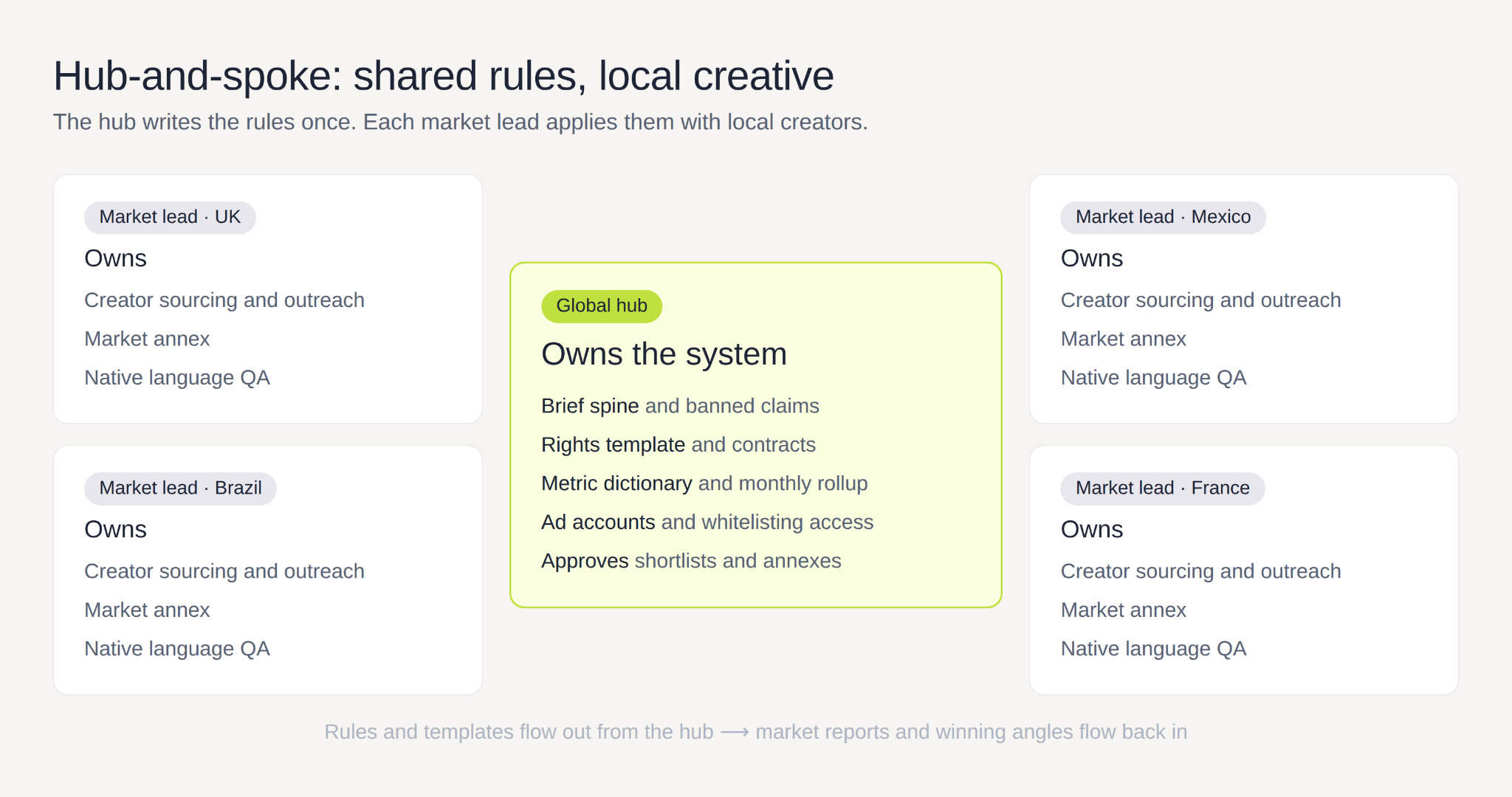
The hub writes the rules and holds the tools. Each spoke, usually a market lead or local partner, applies them.
This model works well once a program spans several markets because decisions sit closer to the people with the relevant knowledge. The hub understands the brand, contracts and performance data. The market lead understands the creators, language and cultural context.
3. Agency-per-Market Model
A separate local agency runs each country. You get maximum local depth and minimum consistency: five agencies usually means five reporting formats and five sets of rights terms.
Agencies that run creator programs for their own clients face a version of this too. A white-label creator partner lets them add markets under their own brand without building a creator team in each one.
Once the operating model is set, the next question is who owns each decision. In our experience, unclear approval ownership causes some of the biggest delays in multi-country creator programs.
The table below assigns each core decision to the hub, market lead or creator so approvals do not drift between teams.
If you're weighing whether the hub itself should be internal or outsourced, our breakdown of in-house vs outsourced influencer marketing covers the cost and control trade-offs.
Creator Sourcing in New Markets: How Can You Find and Vet Local Creators?
Find local creators by where their audience lives first and follower count last, check that the audience is real, then hire on a small paid trial before building a roster. Identifying the right creators is already the hardest part at home: a third of brands told IAB it's their biggest hurdle with creators.
1. Set an Audience-Location Floor
Ask every shortlisted creator for audience-country screenshots from their native analytics, and set a minimum share of followers in the target market before you look at anything else.
Watch for audiences that cross borders. A Belgian francophone creator may reach as many people in France as in Belgium. A creator in Spain can pull a large Latin American audience. Neither is a bad pick, but you need to know which market you're paying to reach.
2. Search in the Local Language and on Local Platforms
Search the way a local would. Use local-language hashtags, category terms, local slang and the creator marketplaces available on each platform in that country. Then add human discovery routes, including local talent managers and referrals from creators you already trust.
Platform mix changes by market too. Commerce features, creator tools and monetization options do not launch everywhere at once. TikTok Shop, for example, only expanded into Austria, Belgium, the Netherlands and Poland in June 2026.
3. Vet Every Creator With One Scorecard
Use one scorecard in every market so a "pass" in Brazil means the same thing as a "pass" in the UK.
Important note: Audience authenticity needs a closer look because strong surface-level metrics can still hide low-quality followers. In Influencer Marketing Hub's 2026 survey, fake or bot followers made up 56.5% of the fraud and quality issues marketers reported.
4. Hire New Creators on a Paid Trial Deliverable
Contact shortlisted creators in their own language, and plan for follow-ups, since first messages mostly go unanswered. Our influencer outreach email templates adapt well once a native speaker localizes them.
Then commission one paid deliverable before offering a roster contract. One video shows you how a creator follows a brief, how fast they turn around revisions and how they sound on camera. That's cheaper than finding out three posts into a retainer.
What Should a Multi-Market Influencer Campaign Brief Include?
A multi-market influencer campaign brief has two parts: a global spine that locks the few things that must never change, and a one-page market annex, or local addendum, for everything that should adapt by market.
The spine keeps the program consistent, while the annex makes it relevant to each market.
The table below shows which brief elements belong in the global spine, which should be adapted locally, and who approves each decision.
Use the “Set in market annex” column as the structure for a one-page addendum for each market. This gives local teams room to adapt the creative without reopening the parts of the brief that should remain consistent everywhere.
Insider tip: Let creators pitch the hook in their own language, then translate the pitch for the hub. Translating a hub-written script for the creator is how you get content that sounds dubbed even when it isn't.
If you want a starting point for the core brief itself, our influencer brief templates cover the standard elements before you layer on the market-specific annex.
How to Run Language QA and Transcreation on Creator Content?
Run language QA as two native-speaker reviews: one on the script before filming, one on the final cut before it runs organic or paid. The reviewer must speak the exact language variety, and transcreation, rewriting the idea so it lands locally, happens at the first gate.
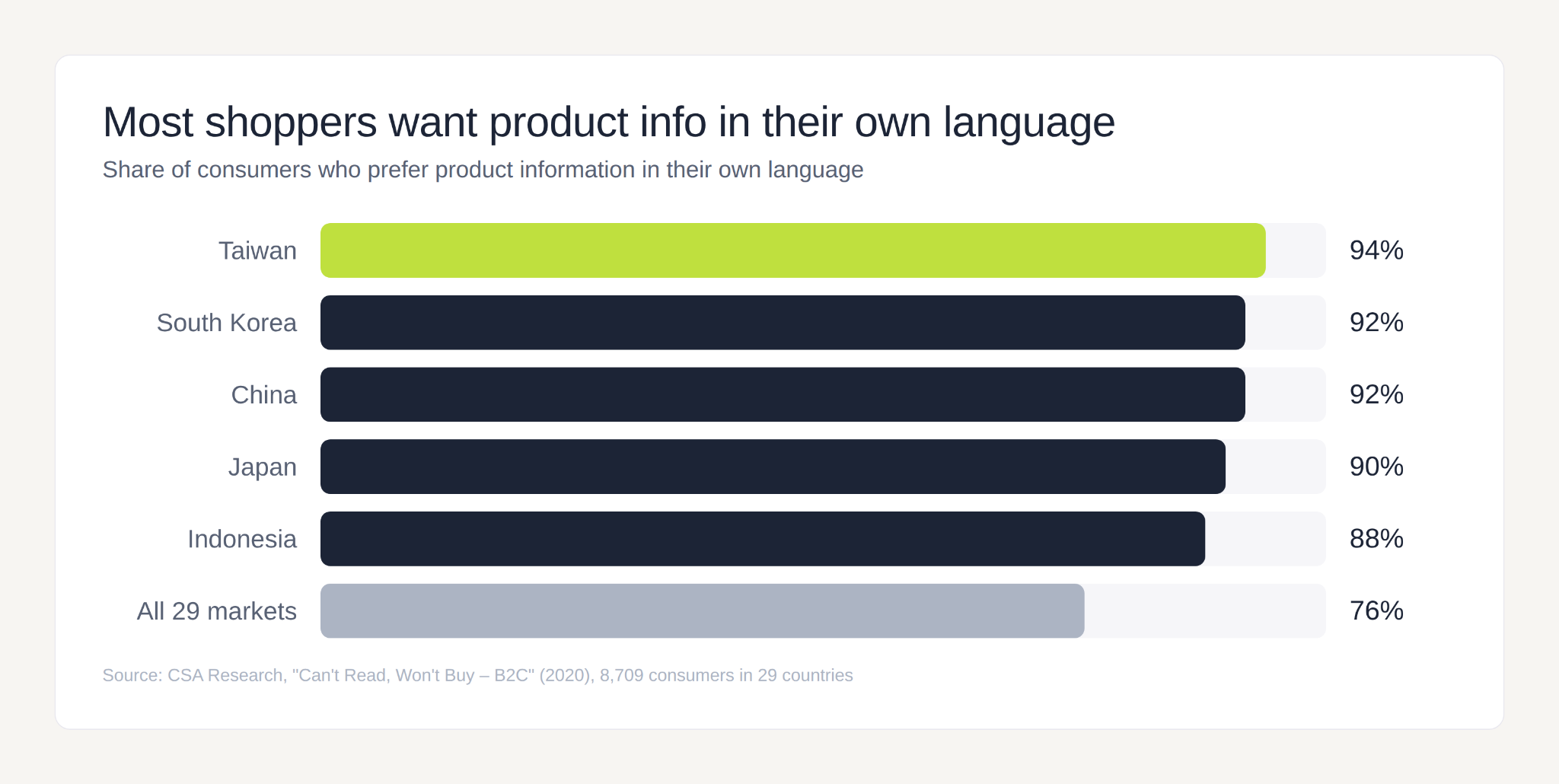
Language is where buyers decide. In fact, in a CSA Research's survey of 8,709 consumers across 29 countries, 76% preferred product information in their own language and 40% said they never buy from sites in other languages. Preference ran highest in Asian markets, which matters if your next wave points east.
Machine translation speeds up the first draft but doesn't remove the reviewer. Among translation professionals using machine translation or LLMs, 90 to 98% still post-edit the output, according to Slator's 2025 survey.
Before the QA gates begin, choose the localization method that fits the asset. The table below compares the main options by use case, speed and risk.
Once the localization method is set, run every asset through the same QA process:
- Review the script or talking points before filming. A native reviewer checks claims, idiom, tone and language variety.
- Back-translate sensitive claims where needed. Health, finance, pricing and other regulated claims can be translated back into the hub’s working language so the central team can confirm the meaning has not drifted.
- Review the final cut. Check spoken audio, on-screen text, captions, hashtags and the disclosure wording from the market annex.
- Confirm the market-specific version. Make sure the final asset matches the approved language variety, offer, product details and local requirements.
- Log the sign-off. Record the reviewer, date and file version in the production log so paid media teams know which asset is approved.
The process becomes more important as the number of markets and asset variations grows.
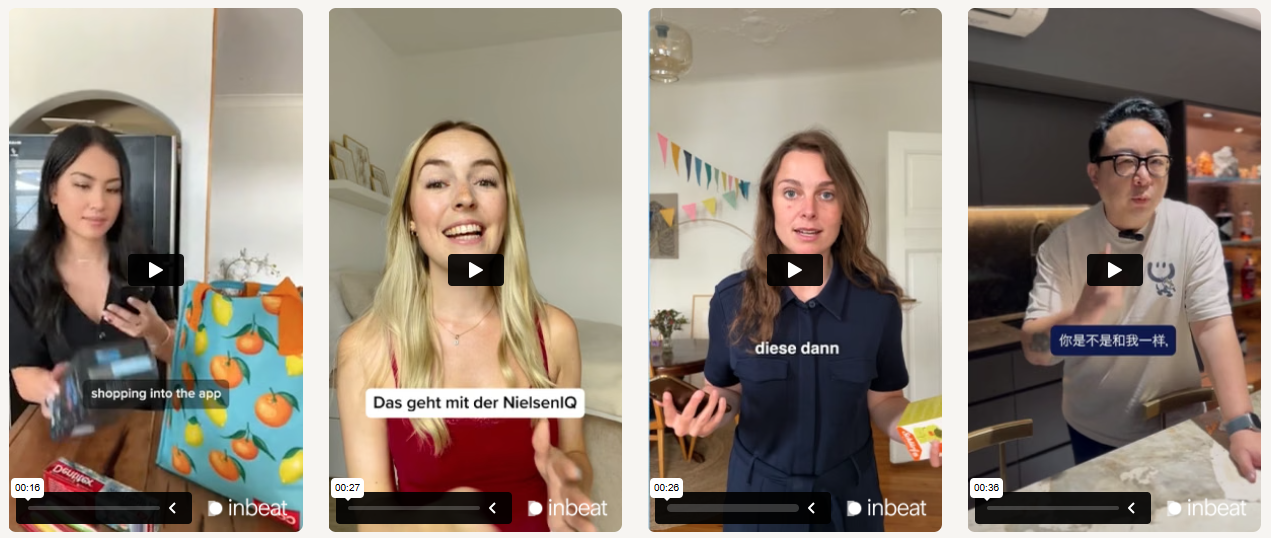
For NielsenIQ, inBeat supported panelist acquisition in 19 countries across Europe, North America, Latin America and Southeast Asia. Our team onboarded 250+ international creators, influencers and actors, then used voiceover actors and video mashups to turn single videos into variations across 20+ languages and accents. The QA gates are what kept that volume shippable.
Language variety matters within a single language too. Spanish used in Spain, Mexico and U.S. Hispanic campaigns can differ in vocabulary, tone and cultural references. Each market therefore needs a reviewer who understands the exact audience the content is meant to reach.
If producing creator content in many languages is the bottleneck, our content factory handles creator production across markets with native-language review built into the workflow.
What Are the Influencer Disclosure Rules by Country?
Influencer disclosure rules differ by country, so default to the strictest rule among your markets and put each market's exact label in its brief annex. Enforcement data shows most creators still fall short, so the brand's own review has to catch what creators miss.
One rule catches teams out when they scale paid media: a whitelisted ad follows the disclosure rules of the market it runs in, whatever the creator's home market requires. A creator-licensed video from the US running in France needs the French label.
Our guide to FTC guidelines for influencers covers the US rules in depth. For every market, have local counsel approve the disclosure row of each annex; this table is a starting point and isn't legal advice.
How Should You License Usage Rights and Whitelisting Across Markets?
License usage rights by territory, channel and duration in the original creator contract. Every market you add later becomes a renegotiation, usually after the content has already proven itself and the creator knows it.
The stakes are high across markets because creator content rarely stays on the creator's channel. Linqia's 2026 report found 100% of enterprise marketers repurpose influencer content beyond the creator's own feed, and 81% said it outperforms brand-created assets.
The table below shows the rights that should be defined before production starts and the gaps that commonly appear once content expands across markets.
1. Define Territory and Renewal Terms Upfront
Name every country the content may run in, and price two extras upfront: adding a territory and renewing the term. A renewal rate agreed in advance is cheaper than one negotiated after a video becomes your best performer.
2. Set Whitelisting Access for Each Market
Whitelisting and creator-authorized ads create a separate operational question: which account has permission to run the content, and for how long?
Our guide to TikTok Spark Ads explains the authorization flow. For a multi-market program, map each market to the correct ad account and make sure the authorization window covers its planned launch dates.
If paid media runs centrally, the hub should coordinate the required creator permissions across markets. If local teams run media, access ownership should be documented in the market workflow.
3. License Music and Derivative Edits Before Localization
Music rights are the quiet blocker on reused content. TikTok requires businesses to use its Commercial Music Library of about one million pre-cleared tracks for organic business posts, ads and branded content, so a trending sound in a creator's original may not survive into paid.
The contract should also define permission for derivative edits such as subtitles, dubbing, re-cuts and voice modification. If AI-generated or altered voice is part of the production plan, get explicit written consent and specify the territories and uses it covers.
Our guide to music licensing for UGC covers the music side in more detail.
How Can You Contract and Pay Creators Across Borders?
Set the contracting entity, payment currency, payout method and tax documentation before outreach starts. Cross-border creator payments become much harder to untangle once content has already been delivered.
The table below shows the main operational decisions to settle before creators are contracted in a new market.
For U.S. payers, foreign creators may need to provide Form W-8BEN to establish their foreign status and, where applicable, claim treaty benefits.
A 30% withholding rate can apply to certain U.S.-source income paid to nonresident aliens, but personal-service income is generally sourced based on where the work is actually performed. A creator producing the work outside the U.S. may therefore be treated differently from one performing services inside the U.S.
France adds another layer. From January 1, 2026, a written contract is mandatory when the value of a commercial influencer collaboration exceeds €1,000. The contract must include specified information and clauses. Creators established outside the EU, EEA or Switzerland who target French audiences may also need a legal representative in the EU.
Keep the contracting entity consistent within each market where possible. Decide whether the brand, a local subsidiary or an agency of record signs and pays creators, then document that setup in the market workflow.
Note: This section covers common operating considerations, not tax or legal advice. Have local advisers confirm withholding, contract and representation requirements before launch.
How to Compare Creator Performance Across Markets?
Compare creator performance across markets with one metric dictionary, in local currency at a fixed exchange rate, indexed against each market's own baseline. Raw cross-market rankings mostly measure local media prices.
Measurement is where most programs struggle. The Linqia's 2026 report that we mentioned above reports 79% of marketers struggle to measure influencer ROI and 48% name attribution as the biggest gap.
IAB’s 2026 creator measurement work points to fragmented metrics, siloed platforms and weak cross-media comparability as structural barriers to measuring creator advertising at scale.
1. Build One Metric Dictionary
Influencer marketing reporting across countries only works if "engagement rate" means the same thing in every market report. Define each metric once, in writing: what counts as a qualified view, whether engagement rate is calculated on reach or followers, how CPA and CAC are attributed. Every market fills in the same fields.
Our guide to marketing agency reporting shows what a useful monthly report and review call should contain.
2. Report in Local Currency at a Fixed FX Rate
Report spend and results in local currency, then convert at one exchange rate fixed for the quarter. A floating rate makes a market look better or worse because its currency moved. Show both numbers side by side so market leads can read their own results without converting in their heads.
3. Index Each Market Against Its Own Baseline
Media and creator prices vary too much between regions to compare raw costs: the same CPA can be excellent in one market and weak in another. Index each market's CPA against its own trailing baseline, and judge it on improvement.
A baseline shows direction; in your two or three largest markets, add incrementality testing to check that creator-driven sales are additional.
The table below shows how a monthly cross-market report can combine local spend, standardized currency conversion, baseline performance, creative learnings and rights management in one view.
Illustrative template with hypothetical figures.
4. Feed Creative-Level Results Into the Next Market Annex
The report earns its keep when it changes the next brief. Track which hooks, formats and creators perform best in each market, then carry those learnings into the next market annex. This keeps each market’s creative direction tied to actual performance instead of starting from scratch every cycle.
What Tools Help You Manage Influencers in Multiple Countries?
Most global creator programs run on four tool types: a discovery tool, a payout provider, a shared rights and production log, and one reporting dashboard. The tools matter less than everyone in every market using the same ones.
- Creator discovery: Each platform's own marketplace (TikTok One, Instagram's creator marketplace) to filter creators by country, plus a third-party discovery tool if you need cross-platform search.
- Payouts: One provider that pays in local currency in all your markets, such as Wise, Payoneer or PayPal, so the hub sees every payment in one place.
- Rights and production log: A shared sheet or Airtable base listing every asset with market, creator, approved version, rights territory and expiry date.
- Reporting: One dashboard (Looker Studio or your BI tool) fed by the same metric dictionary in every market.
How Should You Plan the Timeline and Budget for a Multi-Market Creator Launch?
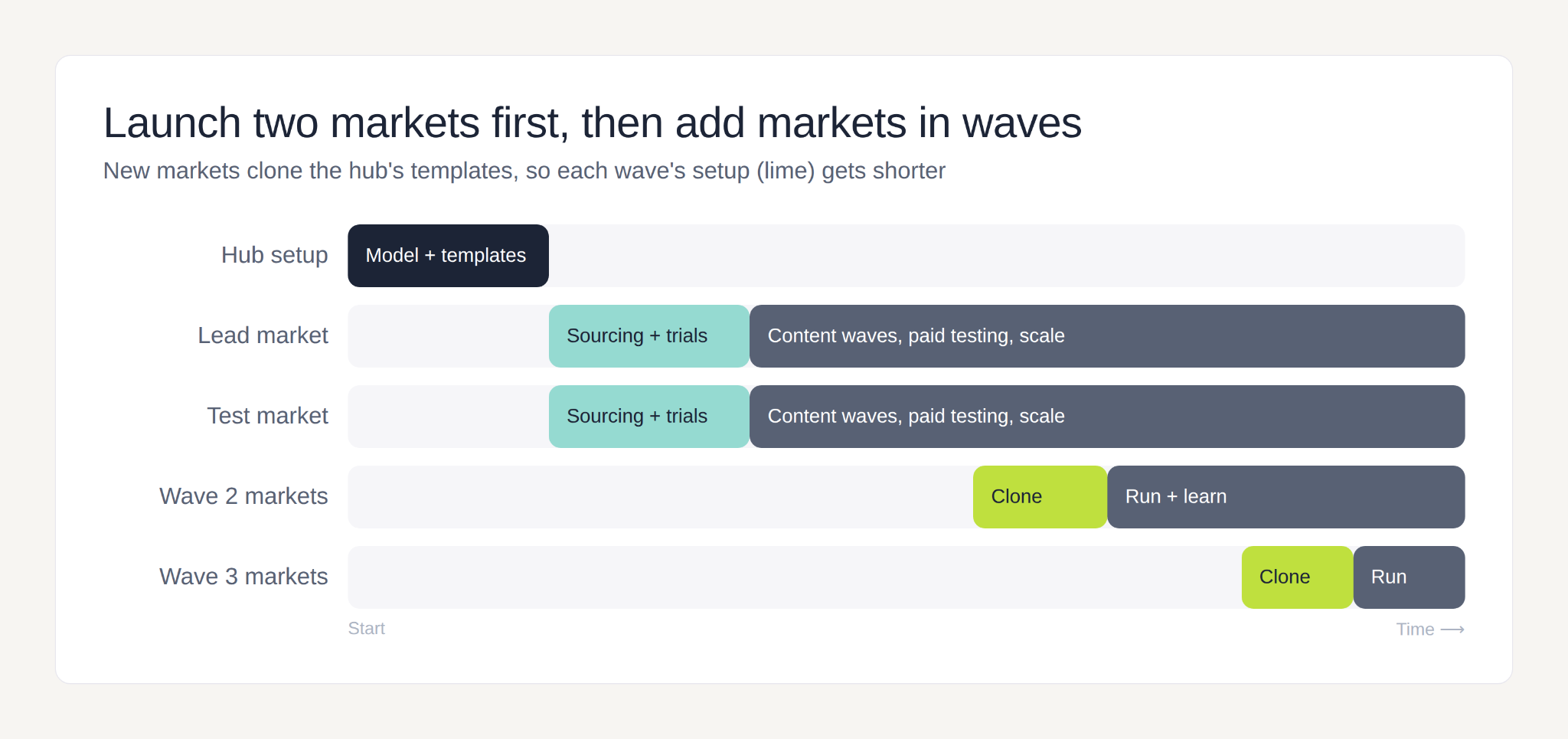
Launch one lead market and one test market first, then add new markets in waves once the operating model, templates and review process are working.
We have noticed that the earliest phases usually carry the heaviest setup work because the team is building the system and the first creator roster at the same time. Later markets can reuse much of that infrastructure.
The timeline below shows an illustrative phased rollout. Confirm the exact ranges against your team’s delivery experience before publishing them as standard timelines.
Budget each cost separately because the line items scale differently as new markets are added.
- Creator fees: Set rates by market, creator tier and deliverable. Our guide to how much content creators cost covers current pricing benchmarks.
- Production and localization: Budget for reshoots, voiceovers, subtitles, re-edits and market-specific versions.
- Native review: Include review costs for each language variety, either per asset or through an ongoing local reviewer.
- Rights and renewals: Separate paid usage, whitelisting access, territory expansion and renewal fees from the creator’s production fee.
- Paid amplification: Set a media budget for scaling creator assets that perform well.
- Tooling and operations: Include payouts, contracting, creator management and reporting systems.
Build a Global Creator Program with inBeat Agency
A global creator program works when the operating system stays consistent and the creative stays local. That’s how we run it: one team coordinates sourcing, briefing, native-language review, usage rights and reporting across markets.
inBeat Agency works across markets including France, the UK, Brazil, Mexico, Indonesia and Canada, with multi-language creator production for broader international programs. Agencies that need the same infrastructure under their own brand can also work with us through our white-label model.
If you're planning your second or tenth market, we can map your operating model, flag the rights and disclosure gaps in your current contracts, and show you what a first wave would look like in your lead markets.
Book a strategy call with us and bring your market list.
FAQs
Can one creator video run in two markets that share a language, like Spain and Mexico?
Sometimes, for visual content with little dialogue. For talking-head content, audiences notice accent, slang and price format quickly, and a mismatch reads as foreign. Test the original in the second market with a small paid budget, and if it underperforms the local baseline, re-record the script with a local creator.
Who keeps the creator relationship when a local agency sources creators but the global brand pays?
Settle it in the agency contract before sourcing starts. A common setup has the brand own the content rights and the creator contact list, while the agency manages the relationship during the term. Without that clause, the roster leaves with the agency.
Should a global creator program use the same creators across markets or a separate roster per market?
Use a separate roster per market as the base, with a small number of cross-market creators where the audience is truly multinational, such as travel or gaming. Local creators carry local trust. Cross-market creators work best for launches that need one face everywhere.
What approval turnaround should the hub commit to when markets sit in different time zones?
Commit to a fixed window, such as one business day in the market's own time zone, and put it in the decision-rights table. If the hub can't meet it, hand script approval to market leads and keep only claims spot-checks at the hub.
What do you do when a market's creator pool is too small to fill a roster?
Widen the pool before lowering the bar. Recruit creators from neighboring markets who share the language and whose audience clears your in-market floor, and add on-camera talent or UGC creators for ad-only content. A smaller roster you retain beats a padded one you replace every quarter.
Can inBeat produce creator content in multiple languages?
Yes. inBeat can manage multi-language creator production using local creators, voiceovers, subtitles, re-records and other localization methods depending on the asset. Native-language review can be built into the production workflow before content moves into organic or paid media.